
DEC 00 05 Direct Digital Control Lab Station
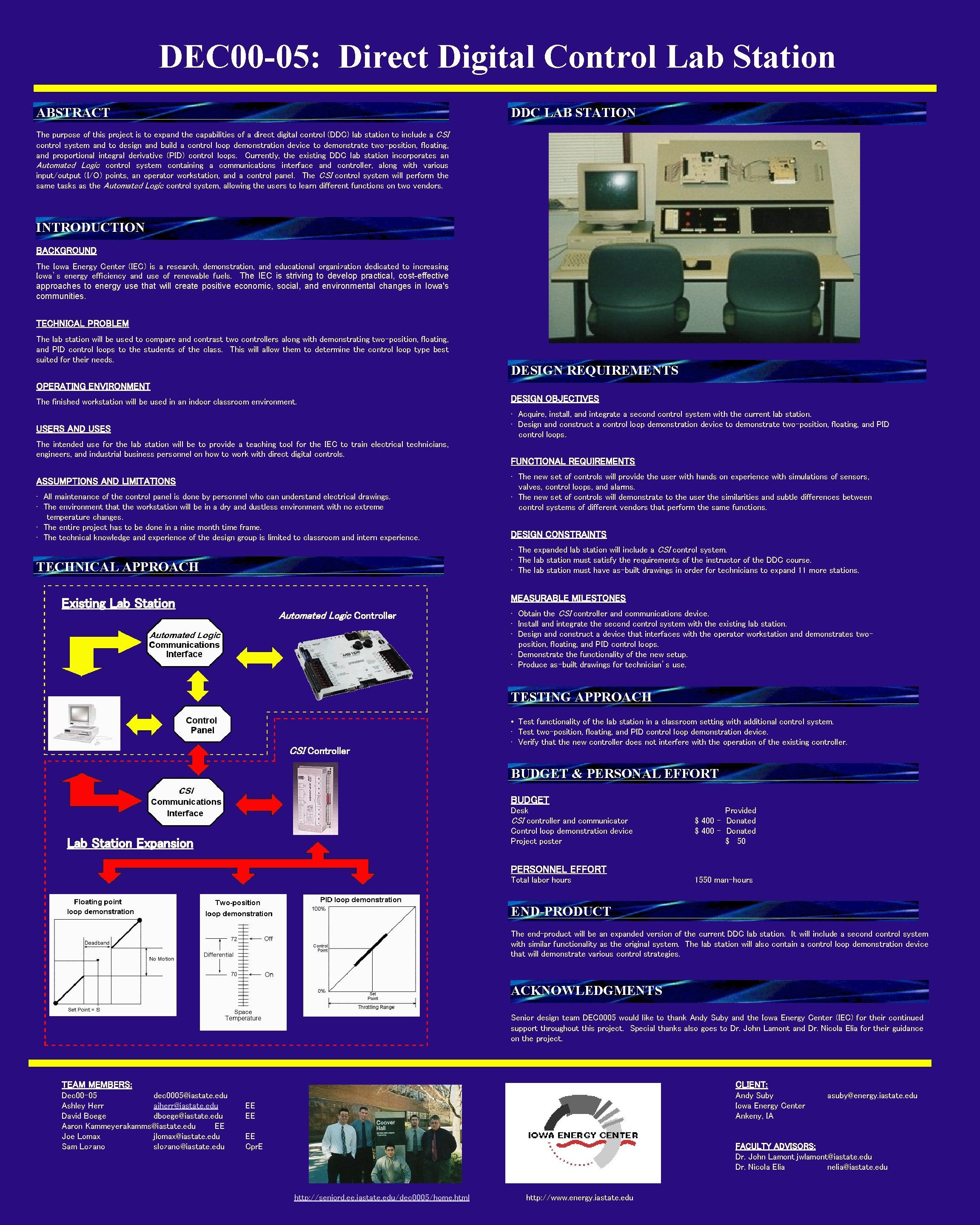
DEC 00 -05: Direct Digital Control Lab Station ABSTRACT DDC LAB STATION The purpose of this project is to expand the capabilities of a direct digital control (DDC) lab station to include a CSI control system and to design and build a control loop demonstration device to demonstrate two-position, floating, and proportional integral derivative (PID) control loops. Currently, the existing DDC lab station incorporates an Automated Logic control system containing a communications interface and controller, along with various input/output (I/O) points, an operator workstation, and a control panel. The CSI control system will perform the same tasks as the Automated Logic control system, allowing the users to learn different functions on two vendors. INTRODUCTION BACKGROUND The Iowa Energy Center (IEC) is a research, demonstration, and educational organization dedicated to increasing Iowa’s energy efficiency and use of renewable fuels. The IEC is striving to develop practical, cost-effective approaches to energy use that will create positive economic, social, and environmental changes in Iowa's communities. TECHNICAL PROBLEM The lab station will be used to compare and contrast two controllers along with demonstrating two-position, floating, and PID control loops to the students of the class. This will allow them to determine the control loop type best suited for their needs. DESIGN REQUIREMENTS OPERATING ENVIRONMENT The finished workstation will be used in an indoor classroom environment. DESIGN OBJECTIVES • Acquire, install, and integrate a second control system with the current lab station. • Design and construct a control loop demonstration device to demonstrate two-position, floating, and PID control loops. USERS AND USES The intended use for the lab station will be to provide a teaching tool for the IEC to train electrical technicians, engineers, and industrial business personnel on how to work with direct digital controls. ASSUMPTIONS AND LIMITATIONS • All maintenance of the control panel is done by personnel who can understand electrical drawings. • The environment that the workstation will be in a dry and dustless environment with no extreme temperature changes. • The entire project has to be done in a nine month time frame. • The technical knowledge and experience of the design group is limited to classroom and intern experience. FUNCTIONAL REQUIREMENTS • The new set of controls will provide the user with hands on experience with simulations of sensors, valves, control loops, and alarms. • The new set of controls will demonstrate to the user the similarities and subtle differences between control systems of different vendors that perform the same functions. DESIGN CONSTRAINTS • The expanded lab station will include a CSI control system. • The lab station must satisfy the requirements of the instructor of the DDC course. • The lab station must have as-built drawings in order for technicians to expand 11 more stations. TECHNICAL APPROACH MEASURABLE MILESTONES Existing Lab Station Automated Logic Controller • Obtain the CSI controller and communications device. • Install and integrate the second control system with the existing lab station. • Design and construct a device that interfaces with the operator workstation and demonstrates twoposition, floating, and PID control loops. • Demonstrate the functionality of the new setup. • Produce as-built drawings for technician’s use. TESTING APPROACH CSI Controller • Test functionality of the lab station in a classroom setting with additional control system. • Test two-position, floating, and PID control loop demonstration device. • Verify that the new controller does not interfere with the operation of the existing controller. BUDGET & PERSONAL EFFORT BUDGET Desk CSI controller and communicator Control loop demonstration device Project poster Lab Station Expansion Provided $ 400 - Donated $ 50 PERSONNEL EFFORT Total labor hours 1550 man-hours END-PRODUCT The end-product will be an expanded version of the current DDC lab station. It will include a second control system with similar functionality as the original system. The lab station will also contain a control loop demonstration device that will demonstrate various control strategies. ACKNOWLEDGMENTS Senior design team DEC 0005 would like to thank Andy Suby and the Iowa Energy Center (IEC) for their continued support throughout this project. Special thanks also goes to Dr. John Lamont and Dr. Nicola Elia for their guidance on the project. TEAM MEMBERS: CLIENT: Dec 00 -05 dec 0005@iastate. edu Ashley Herr ajherr@iastate. edu David Boege dboege@iastate. edu Aaron Kammeyerakamms@iastate. edu EE Joe Lomax jlomax@iastate. edu Sam Lozano slozano@iastate. edu Andy Suby Iowa Energy Center Ankeny, IA EE EE EE Cpr. E asuby@energy. iastate. edu FACULTY ADVISORS: Dr. John Lamont jwlamont@iastate. edu Dr. Nicola Elia nelia@iastate. edu http: //seniord. ee. iastate. edu/dec 0005/home. html http: //www. energy. iastate. edu
- Slides: 1