
Debt Structural Adjustment Programs SAPs and Primary Health
Debt, Structural Adjustment Programs (SAPs) and Primary Health Care GH 101 January 2015 Stephen Gloyd, MD, MPH
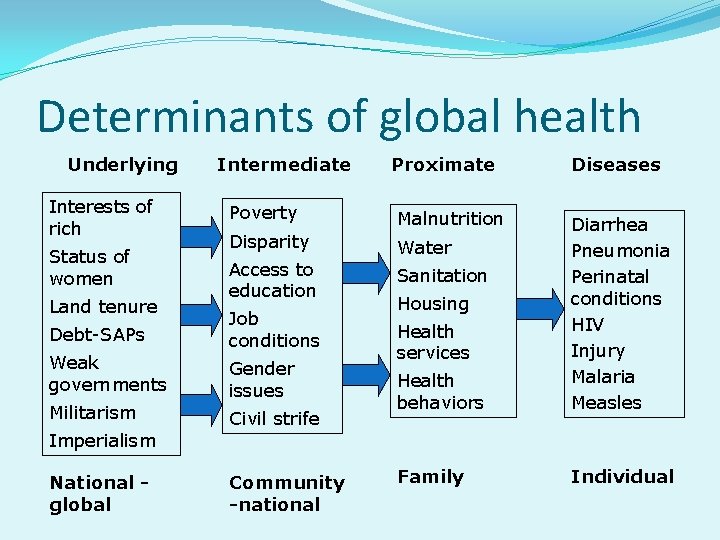
Determinants of global health Underlying Interests of rich Status of women Land tenure Intermediate Proximate Poverty Malnutrition Disparity Water Access to education Sanitation Debt-SAPs Job conditions Weak governments Gender issues Militarism Civil strife Diseases Health behaviors Diarrhea Pneumonia Perinatal conditions HIV Injury Malaria Measles Family Individual Housing Health services Imperialism National global Community -national
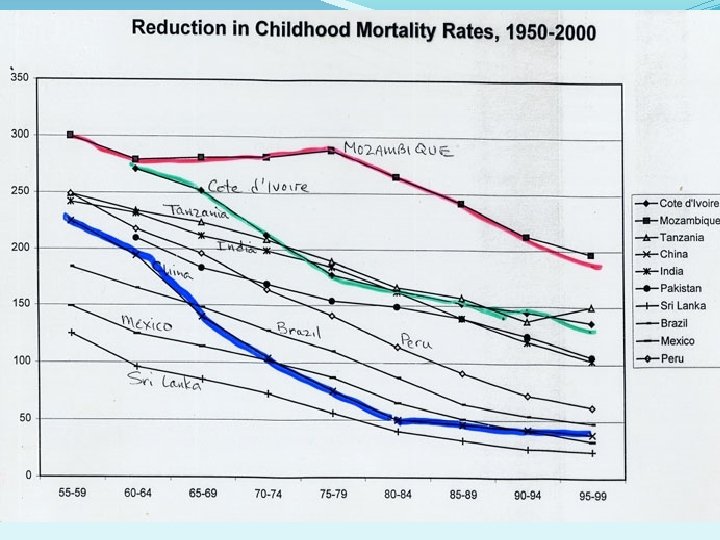
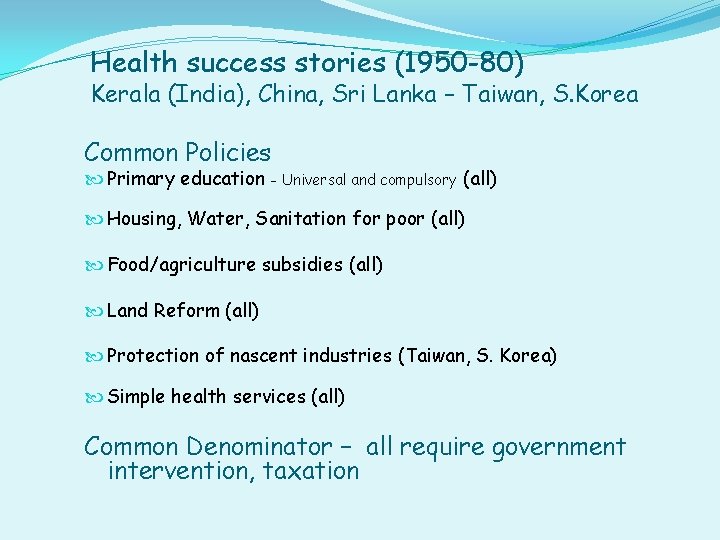
Health success stories (1950 -80) Kerala (India), China, Sri Lanka – Taiwan, S. Korea Common Policies Primary education - Universal and compulsory (all) Housing, Water, Sanitation for poor (all) Food/agriculture subsidies (all) Land Reform (all) Protection of nascent industries (Taiwan, S. Korea) Simple health services (all) Common Denominator – all require government intervention, taxation
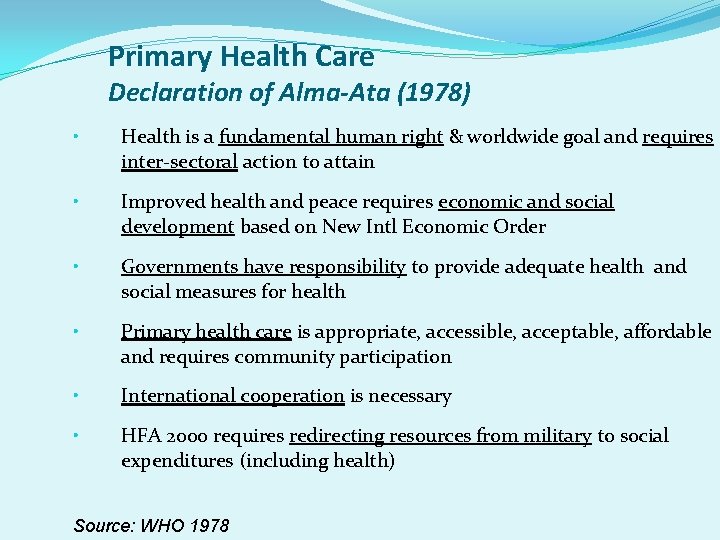
Primary Health Care Declaration of Alma-Ata (1978) • Health is a fundamental human right & worldwide goal and requires inter-sectoral action to attain • Improved health and peace requires economic and social development based on New Intl Economic Order • Governments have responsibility to provide adequate health and social measures for health • Primary health care is appropriate, accessible, acceptable, affordable and requires community participation • International cooperation is necessary • HFA 2000 requires redirecting resources from military to social expenditures (including health) Source: WHO 1978
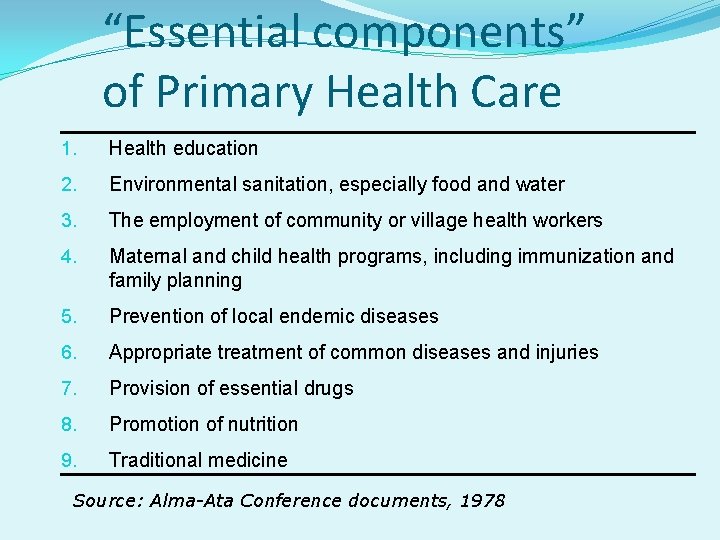
“Essential components” of Primary Health Care 1. Health education 2. Environmental sanitation, especially food and water 3. The employment of community or village health workers 4. Maternal and child health programs, including immunization and family planning 5. Prevention of local endemic diseases 6. Appropriate treatment of common diseases and injuries 7. Provision of essential drugs 8. Promotion of nutrition 9. Traditional medicine Source: Alma-Ata Conference documents, 1978
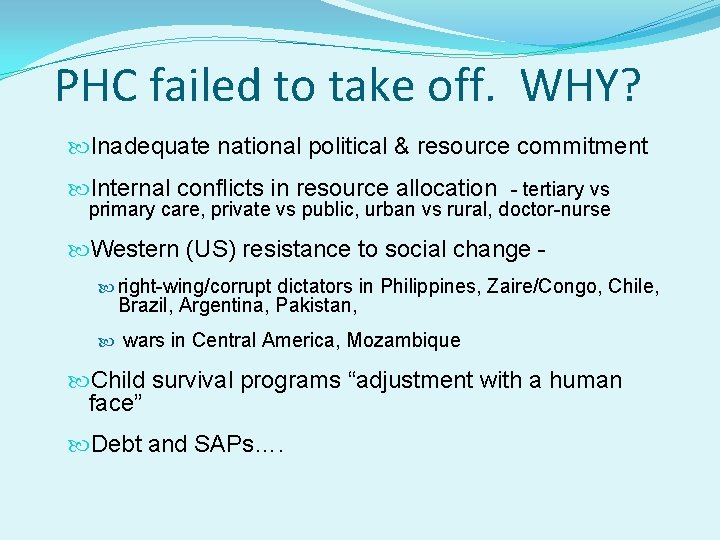
PHC failed to take off. WHY? Inadequate national political & resource commitment Internal conflicts in resource allocation - tertiary vs primary care, private vs public, urban vs rural, doctor-nurse Western (US) resistance to social change right-wing/corrupt dictators in Philippines, Zaire/Congo, Chile, Brazil, Argentina, Pakistan, wars in Central America, Mozambique Child survival programs “adjustment with a human face” Debt and SAPs….
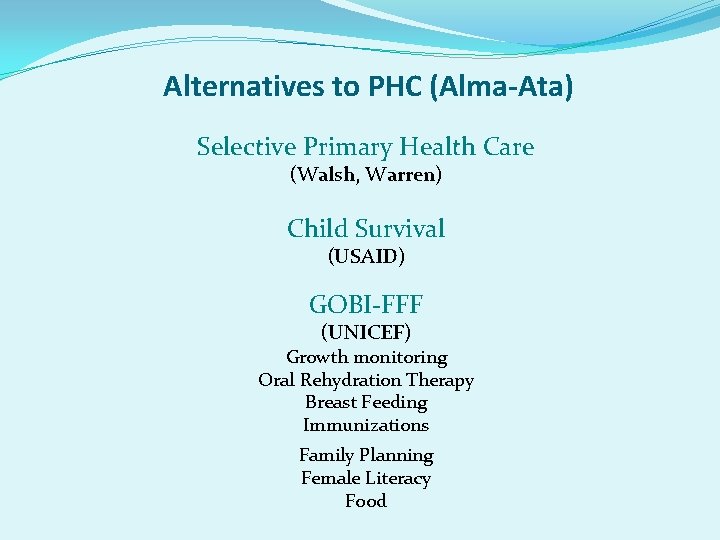
Alternatives to PHC (Alma-Ata) Selective Primary Health Care (Walsh, Warren) Child Survival (USAID) GOBI-FFF (UNICEF) Growth monitoring Oral Rehydration Therapy Breast Feeding Immunizations Family Planning Female Literacy Food
Selective Primary Health Care Rationale PHC is great, but can’t afford it PHC requires political will that isn’t there PHC need immense organizational support Ideology of Cost-effectiveness Establish priorities (Can’t do everything at once) Quick fix (short term goals) Trust in power of technology to address social & economical problems BUT – Context was “antigovernment” neoliberalism
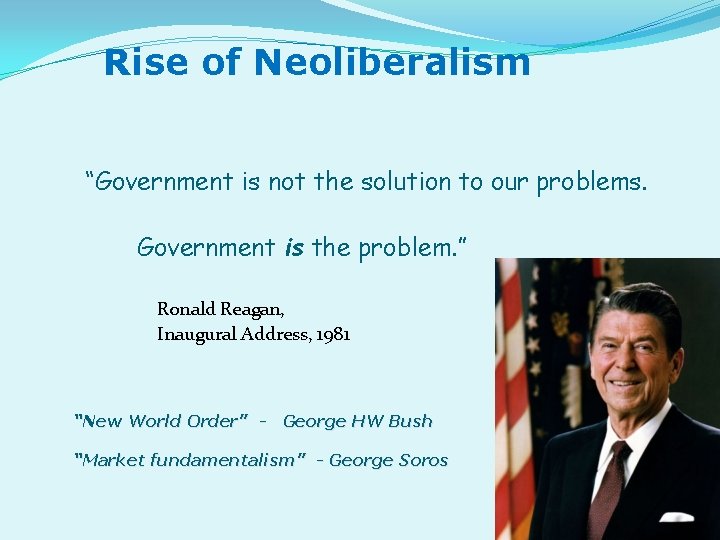
Rise of Neoliberalism “Government is not the solution to our problems. Government is the problem. ” Ronald Reagan, Inaugural Address, 1981 “New World Order” - George HW Bush “Market fundamentalism” - George Soros
Neoliberalism Expansion of markets (‘free trade’) Deregulation - reduction of government intervention on market forces Privatization Individual responsibility instead of public good Market forces can bring about social good (e. g. , efficiency, comparative advantage)
Historical imposition of neoliberalism Imperialism Military intervention (war) Free trade agreements International aid Debt & structural adjustment
Origins of Debt Increased oil prices (OPEC-1970 s) Floating US currency Increased interest rates (7 -22%) Worldwide recession in 1980 s Decreasing commodity prices (subsidies) Decreased US foreign assistance Waste, corruption, mismanagement Aggressive loans – intentional (? )
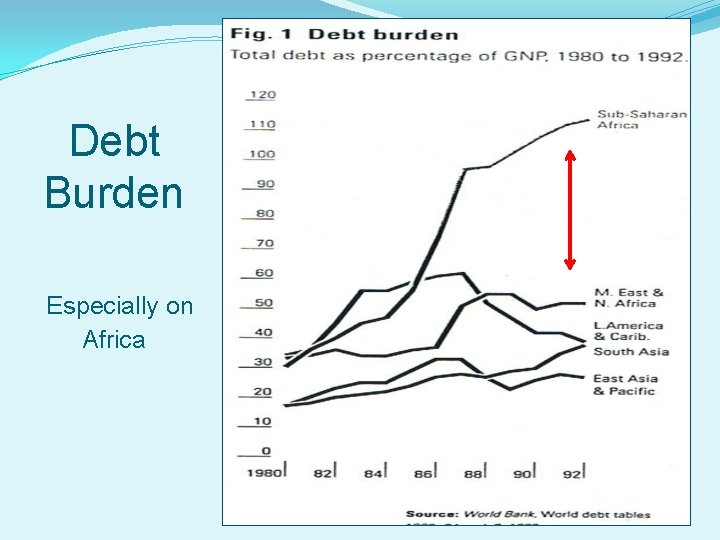
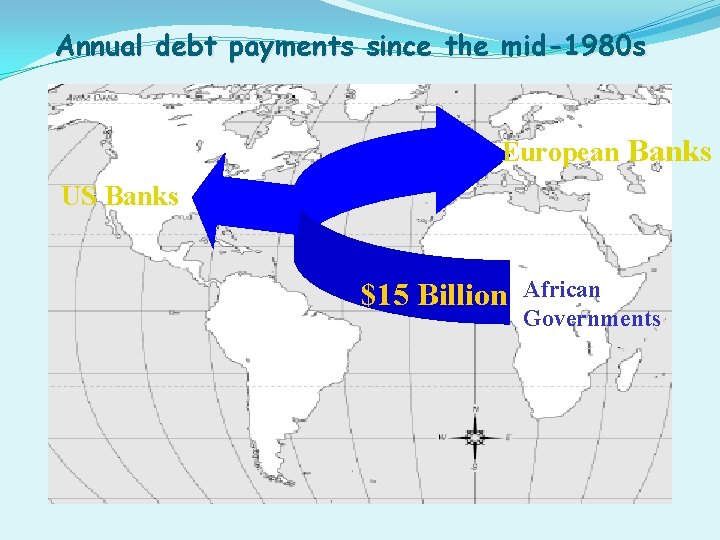
Debt Burden Especially on Africa
Structural Adjustment Programs “Washington Consensus” (IMF, World Bank) Austerity measures to reschedule debt (IMF conditional) 1. Reduce government expenditures 2. Improve terms foreign investment 3. Privatize the economy – ‘Free market’ Continue paying debt (often greater than health budgets)
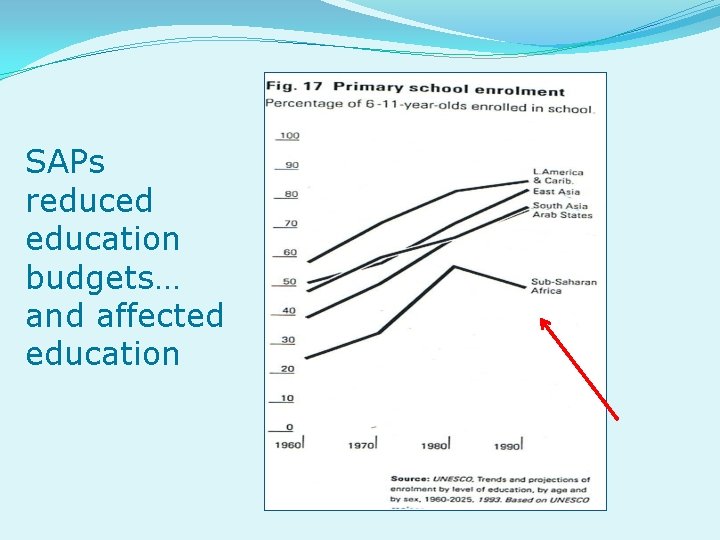
Structural Adjustment Programs Typical components of SAPs Decrease government spending Lay off workers (mostly health and education) Cut government programs (education, health, agriculture) End subsidies for poor (food, transport, housing, water) Improve terms foreign investment & increase exports Reduce taxation, currency controls on investors Devalue currency Reduce or freeze wages – reduce worker power Privatize economy “Free Market Rules” Market regulation of prices (huge increases) “willingness to pay” ethic for social services Growth of private health care Reschedule debt over longer period (indefinite)
Annual debt payments since the mid-1980 s European Banks US Banks $15 Billion African Governments
SAPs reduced education budgets… and affected education
Structural Adjustment Programs (SAPs) & education Tanzania - based on enrollment by age 7 -12, DHS data Tanzania SAPs
Primary Education Completion Rate
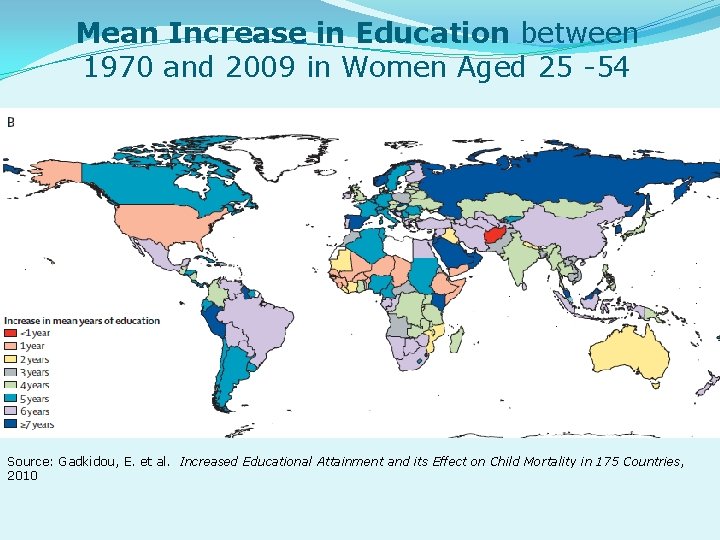
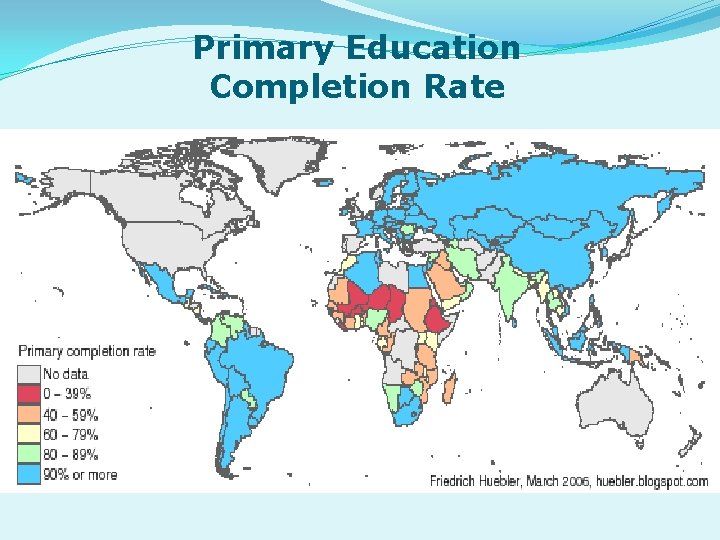
Mean Increase in Education between 1970 and 2009 in Women Aged 25 -54 Source: Gadkidou, E. et al. Increased Educational Attainment and its Effect on Child Mortality in 175 Countries, 2010
SAPs and Reduction in Health Budgets Health budgets half of 1980’s levels Benin = 9% to 4% Mali = 8% to 4% Mozambique = 11% to 2. 5% Increasing donor dependence Support of NGOs for health care
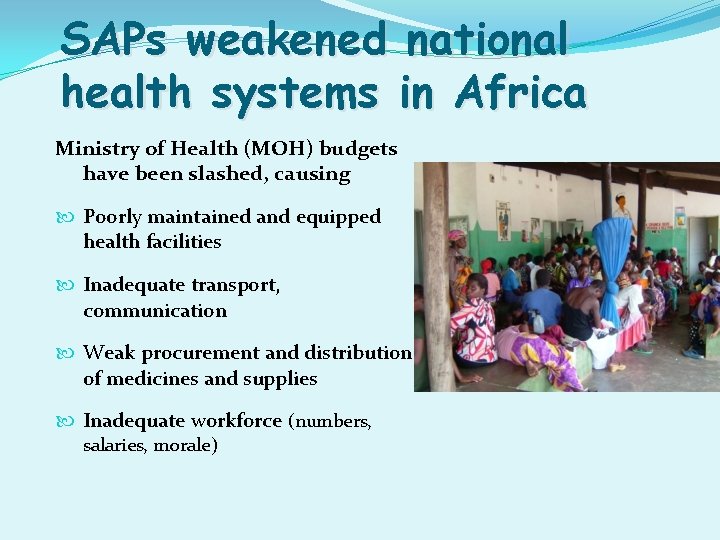
SAPs weakened national health systems in Africa Ministry of Health (MOH) budgets have been slashed, causing Poorly maintained and equipped health facilities Inadequate transport, communication Weak procurement and distribution of medicines and supplies Inadequate workforce (numbers, salaries, morale)
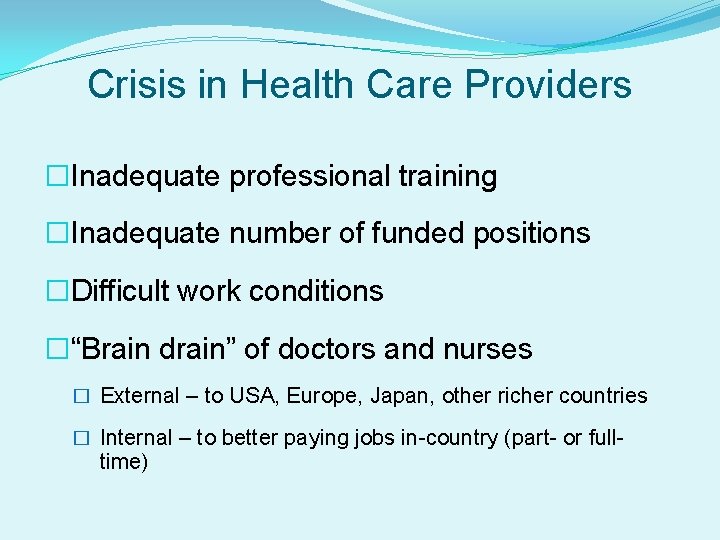
Crisis in Health Care Providers �Inadequate professional training �Inadequate number of funded positions �Difficult work conditions �“Brain drain” of doctors and nurses � External – to USA, Europe, Japan, other richer countries � Internal – to better paying jobs in-country (part- or full- time)
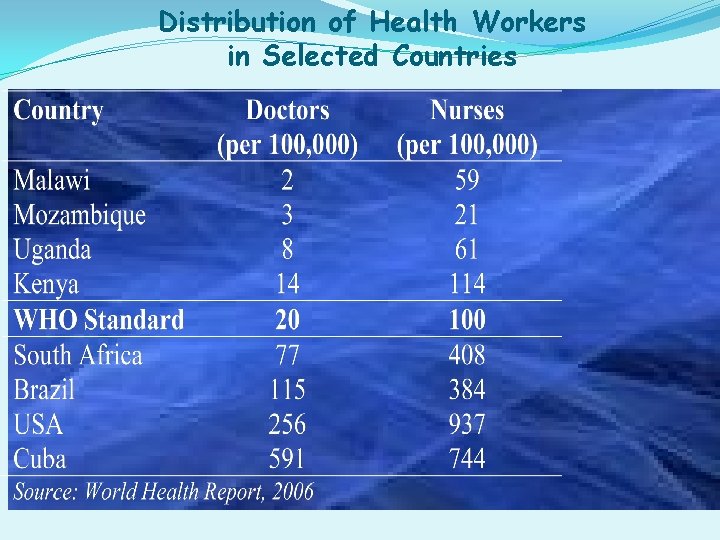
Distribution of Health Workers in Selected Countries
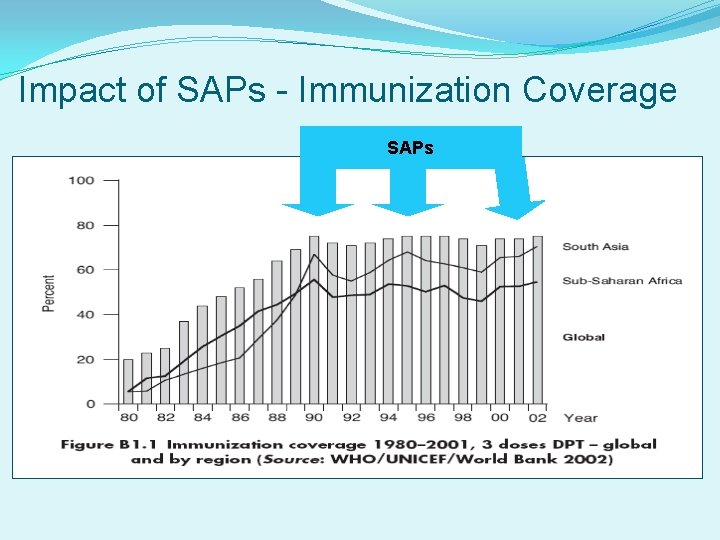
Impact of SAPs - Immunization Coverage SAPs
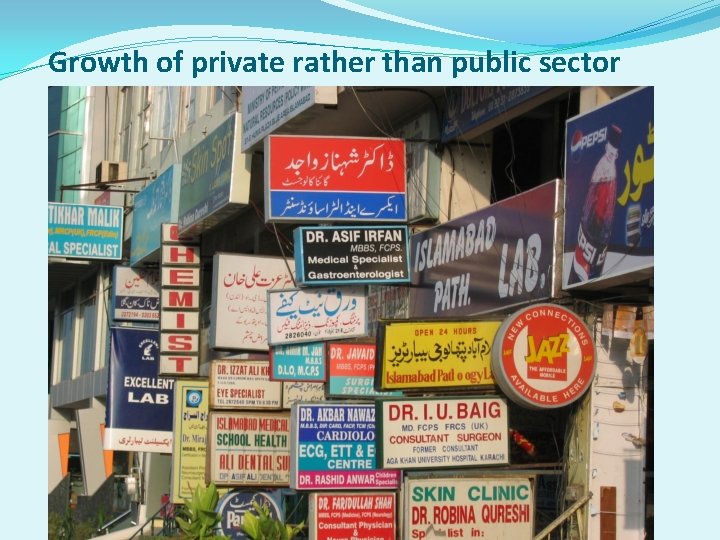
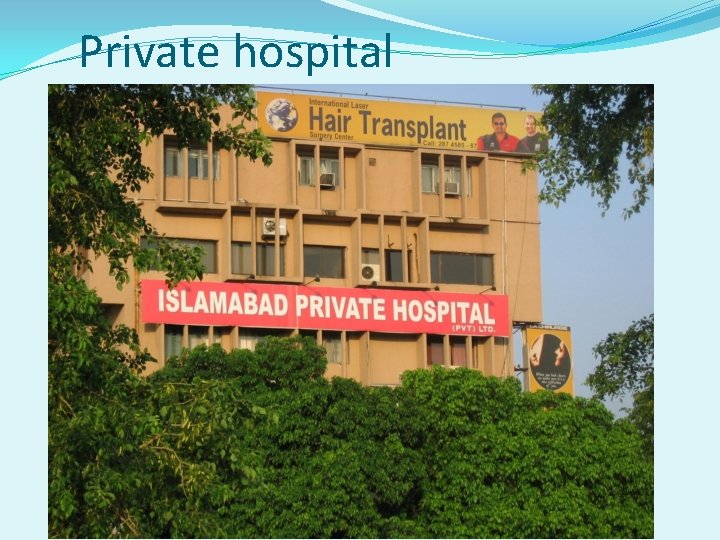
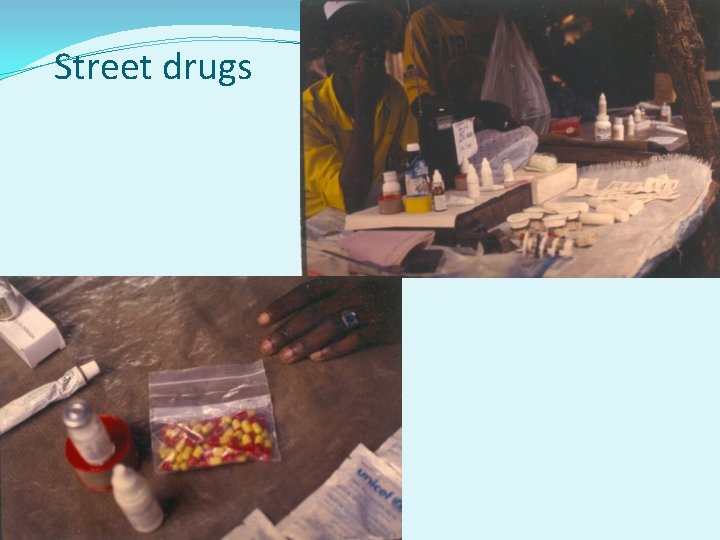
Growth of private rather than public sector
Private hospital
Street drugs
Effects of SAPs Enormously increased food, transport prices Huge levels of unemployment Non-living wage for those who remain working ($20 -40 per month) User fees for health, education, and other services Reduction in education, health care quality Social unrest – demonstrations, riots
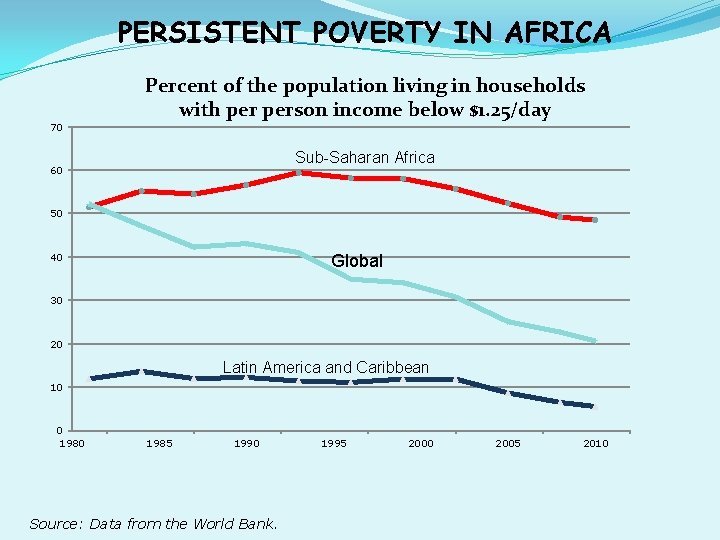
PERSISTENT POVERTY IN AFRICA 70 Percent of the population living in households with person income below $1. 25/day Sub-Saharan Africa 60 50 40 Global 30 20 Latin America and Caribbean 10 0 1985 1990 Source: Data from the World Bank. 1995 2000 2005 2010
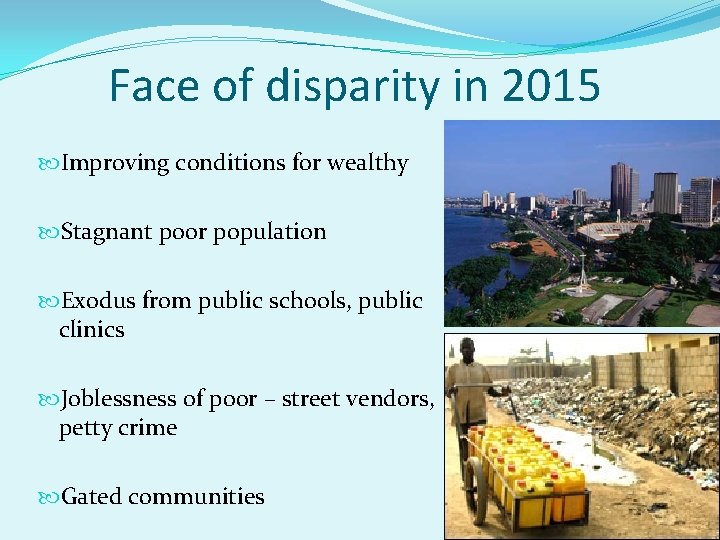
Face of disparity in 2015 Improving conditions for wealthy Stagnant poor population Exodus from public schools, public clinics Joblessness of poor – street vendors, petty crime Gated communities
Summary of Debt and SAPs Justification is to improve economic growth Benefit primarily to elites, corporate sector (opening up markets and access to raw materials) Of note: Donors recognized since 1980 s that SAPs would have negative human consequences …and accepted disparities UNICEF 1985 published “Structural Adjustment with a Human Face” UN agencies, donors accepted SAPs as necessary SAPs and debt repayment continue today
Dealing with the Consequences of Debt and SAPs Adjustment with a Human Face Bamako Initiative 1990’s Reform Heavily Indebted Poor Country Initiative (HIPC) in 1996 Multilateral Debt Relief Initiative (MDRI) in 2005
“Adjustment with a Human Face” (UNICEF) �Policies to protect the well-being of the most vulnerable during structural readjustment, but IN THE SHORT TERM (poverty alleviation program) �GOBI - Child survival programs �UNICEF study in 1995: � 6 of 10 countries - negative nutrition changes and/or IMR �Increased numbers of people under poverty line all preceded by decreases in GDP/capita
Bamako Initiative – 1987 (UNICEF and WHO) Formal statement adopted by African Ministers of Health in Bamako, Mali ‘Health of women and children - Funding and management of essential drugs at the community level’ Mandate: Drug charges to recover expenditures 1 st year proceeds for seed capital, 2 nd and successive years as replenishment CHCs - community health committees
1990’s “Reform" Continued debt repayment Sporadic growth, decreased wages, increasing prices Health care reform - WDR 1993 Intense pressure on IMF, World Bank for debt reduction
Health Care Reform – (World Bank) World Development Report 1993 1. Growth-enhancing macroeconomic policies (SAPs) Minimum package of Health Services ORT, Immunizations, Vit. A, Iodine 2. Calls for increased health aid for these programs 3. Diversity & competition in health care Privatization, NGOs, Franchising User fees Social insurance systems
HIPC Initiative 1996 (Heavily Indebted Poor Countries) Set up to reduce debt burden of poor countries (after sustained protests) Reformed in 1999, after more pressure Lengthy process (10+ years) Only 41 countries eligible by 2008 (33 in Africa) Does not include all debts (IMF, WB, not private or bilateral) Designed to reduce debt to “sustainable” levels Conditionality (SAPs) continued
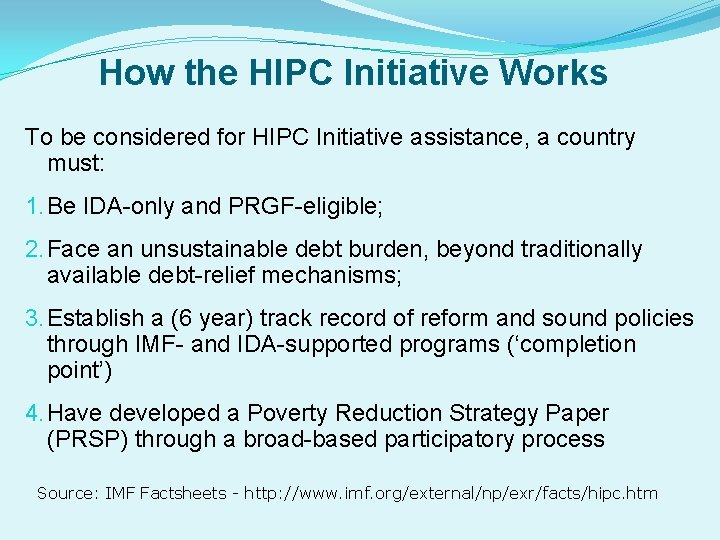
How the HIPC Initiative Works To be considered for HIPC Initiative assistance, a country must: 1. Be IDA-only and PRGF-eligible; 2. Face an unsustainable debt burden, beyond traditionally available debt-relief mechanisms; 3. Establish a (6 year) track record of reform and sound policies through IMF- and IDA-supported programs (‘completion point’) 4. Have developed a Poverty Reduction Strategy Paper (PRSP) through a broad-based participatory process Source: IMF Factsheets - http: //www. imf. org/external/np/exr/facts/hipc. htm
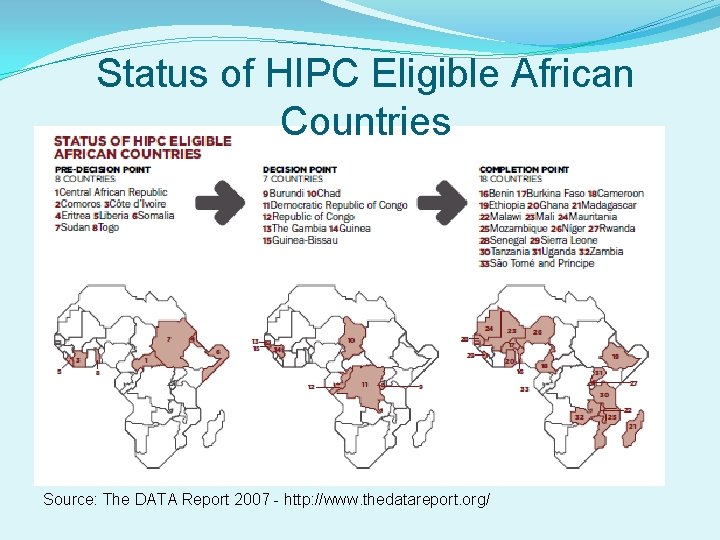
Status of HIPC Eligible African Countries Source: The DATA Report 2007 - http: //www. thedatareport. org/
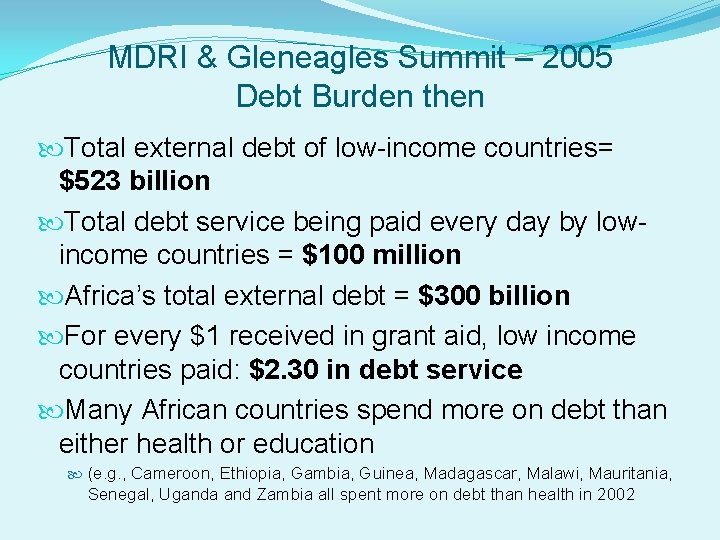
MDRI & Gleneagles Summit – 2005 Debt Burden then Total external debt of low-income countries= $523 billion Total debt service being paid every day by lowincome countries = $100 million Africa’s total external debt = $300 billion For every $1 received in grant aid, low income countries paid: $2. 30 in debt service Many African countries spend more on debt than either health or education (e. g. , Cameroon, Ethiopia, Gambia, Guinea, Madagascar, Malawi, Mauritania, Senegal, Uganda and Zambia all spent more on debt than health in 2002
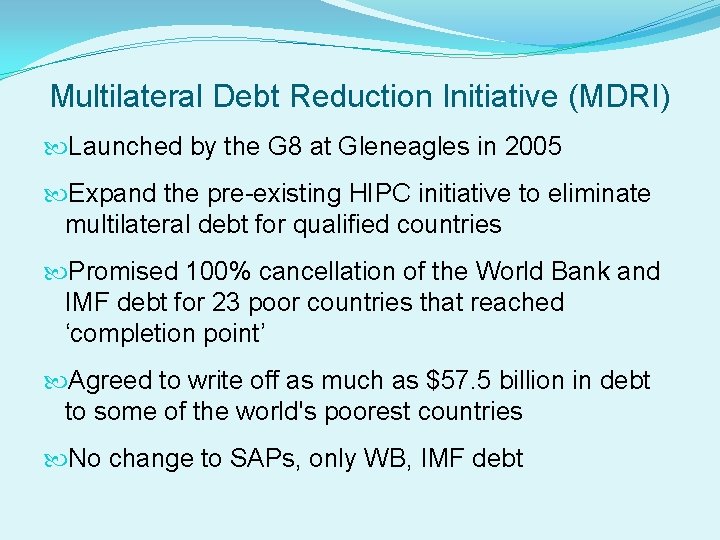
Multilateral Debt Reduction Initiative (MDRI) Launched by the G 8 at Gleneagles in 2005 Expand the pre-existing HIPC initiative to eliminate multilateral debt for qualified countries Promised 100% cancellation of the World Bank and IMF debt for 23 poor countries that reached ‘completion point’ Agreed to write off as much as $57. 5 billion in debt to some of the world's poorest countries No change to SAPs, only WB, IMF debt
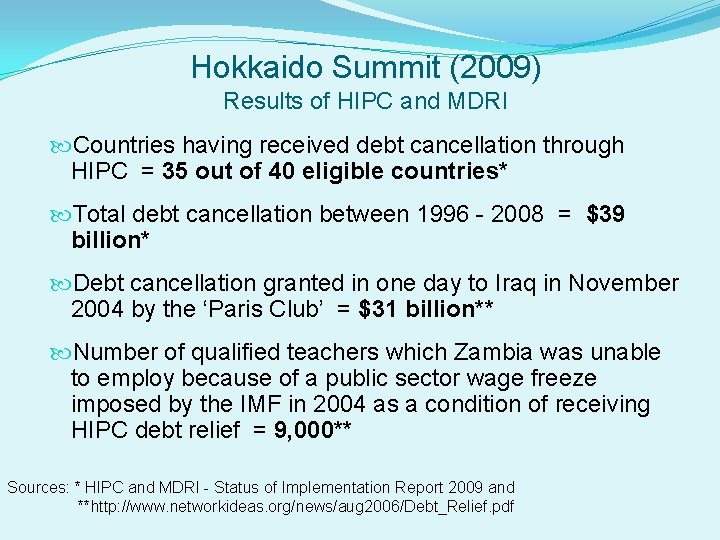
Hokkaido Summit (2009) Results of HIPC and MDRI Countries having received debt cancellation through HIPC = 35 out of 40 eligible countries* Total debt cancellation between 1996 - 2008 = $39 billion* Debt cancellation granted in one day to Iraq in November 2004 by the ‘Paris Club’ = $31 billion** Number of qualified teachers which Zambia was unable to employ because of a public sector wage freeze imposed by the IMF in 2004 as a condition of receiving HIPC debt relief = 9, 000** Sources: * HIPC and MDRI - Status of Implementation Report 2009 and **http: //www. networkideas. org/news/aug 2006/Debt_Relief. pdf
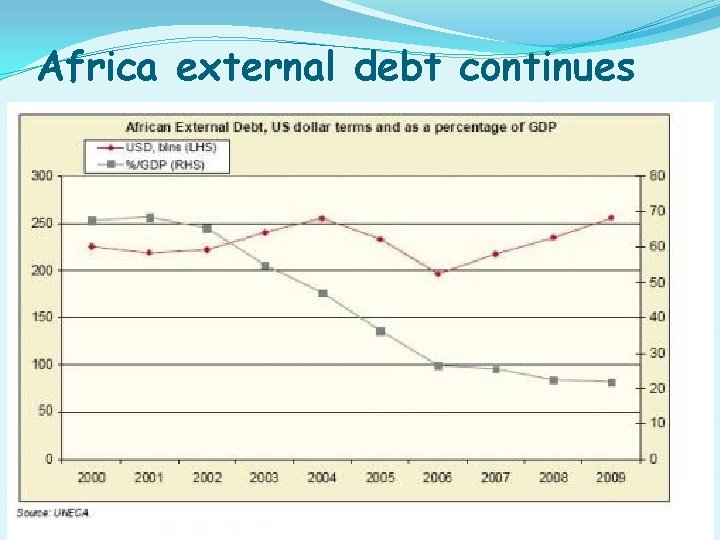
Africa external debt continues
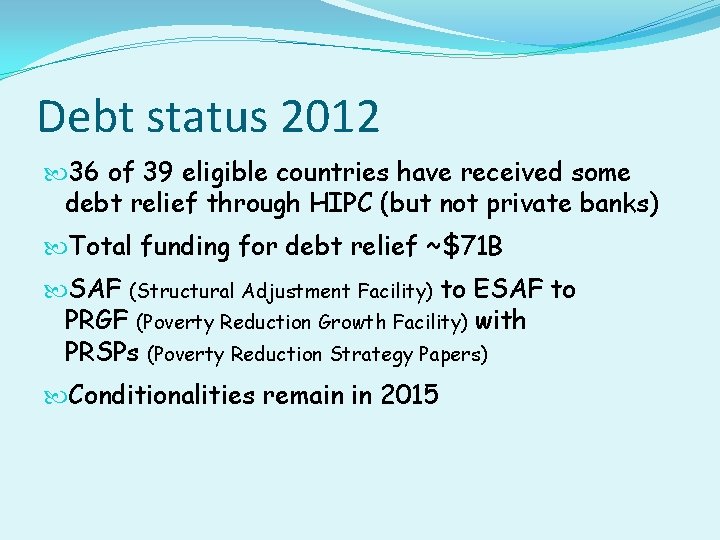
Debt status 2012 36 of 39 eligible countries have received some debt relief through HIPC (but not private banks) Total funding for debt relief ~$71 B SAF (Structural Adjustment Facility) to ESAF to PRGF (Poverty Reduction Growth Facility) with PRSPs (Poverty Reduction Strategy Papers) Conditionalities remain in 2015
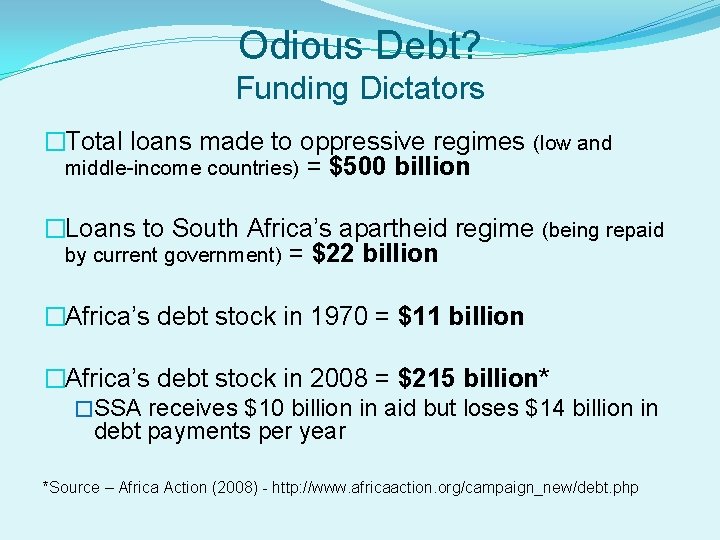
Odious Debt? Funding Dictators �Total loans made to oppressive regimes (low and middle-income countries) = $500 billion �Loans to South Africa’s apartheid regime (being repaid by current government) = $22 billion �Africa’s debt stock in 1970 = $11 billion �Africa’s debt stock in 2008 = $215 billion* �SSA receives $10 billion in aid but loses $14 billion in debt payments per year *Source – Africa Action (2008) - http: //www. africaaction. org/campaign_new/debt. php
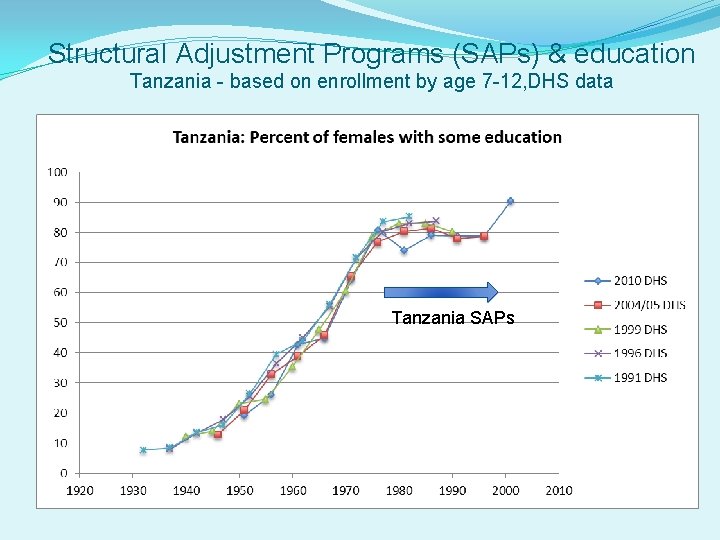
Debt Cancellation Works In Benin, 54% of the money saved through debt relief has been spent on health, including on rural primary health care and HIV programs. In Tanzania, debt relief enabled the government to abolish primary school fees, leading to a 66% increase in attendance. After Mozambique was granted debt relief, it was able to offer all children free immunization. Nurses salaries doubled. In Uganda, debt relief led to abolishing school fees (1997) and 2. 2 million people gaining access to water Source: The Data Report 2007 - http: //www. thedatareport. org/
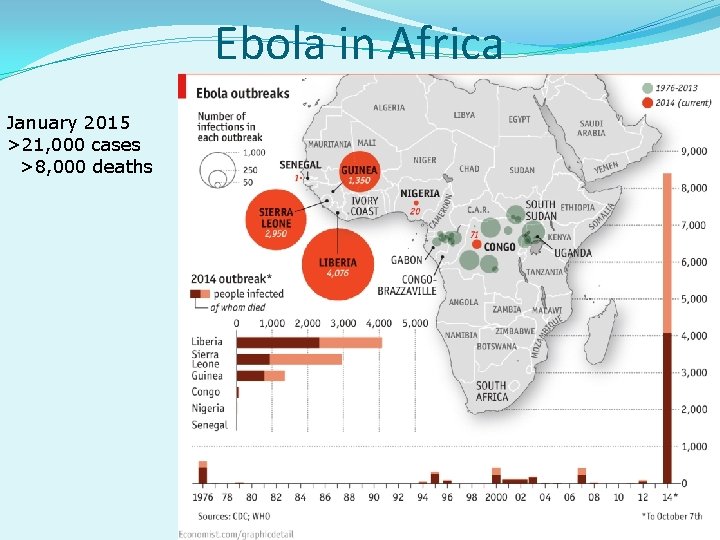
Ebola in Africa January 2015 >21, 000 cases >8, 000 deaths
2014 Ebola epidemic SAPs and ‘conditionalities’ Liberia Sierra Leone Guinea all had standard SAPs, conditionalities, and austerity programs imposed on them since the 1970 s Like 40 other African countries
Examples of IMF imposed policies Liberia: IMF Country Report No. 13/216 (July 2013) “Success in containing current spending levels will rely heavily on controlling the government wage bill Guinea: IMF Country Report (July 2014) “Adopt a civil service reform plan…” “Restrain the wage bill. . ” Sierra Leone: IMF Country Report 13/330(Nov 2013) “wages and salaries have been systematically higher than budgeted, compromising fiscal performance under the previous ECF-supported program” (extended credit facility)
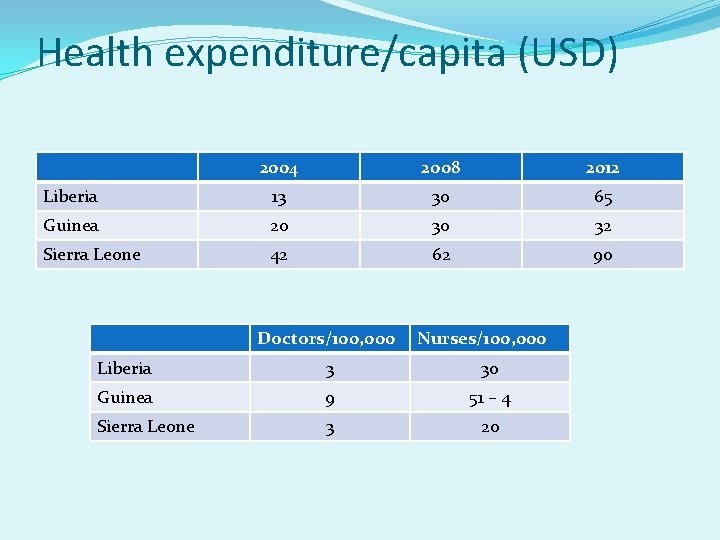
Health expenditure/capita (USD) 2004 2008 2012 Liberia 13 30 65 Guinea 20 30 32 Sierra Leone 42 62 90 Doctors/100, 000 Nurses/100, 000 Liberia 3 30 Guinea 9 51 – 4 Sierra Leone 3 20
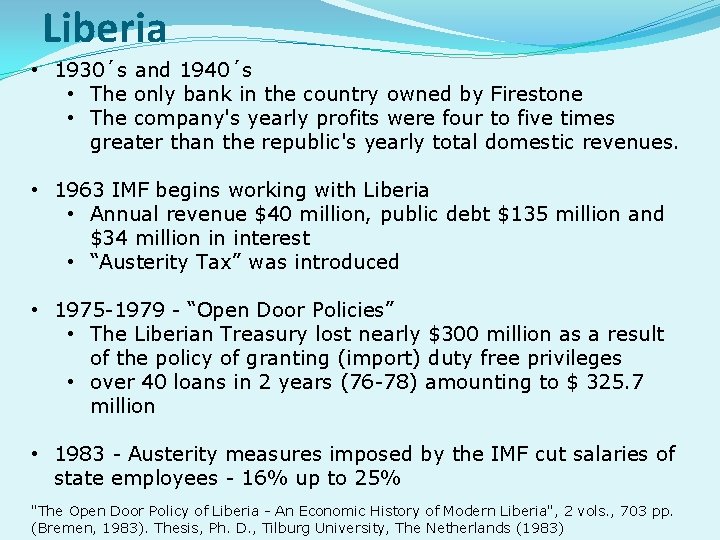
Liberia • 1930´s and 1940´s • The only bank in the country owned by Firestone • The company's yearly profits were four to five times greater than the republic's yearly total domestic revenues. • 1963 IMF begins working with Liberia • Annual revenue $40 million, public debt $135 million and $34 million in interest • “Austerity Tax” was introduced • 1975 -1979 - “Open Door Policies” • The Liberian Treasury lost nearly $300 million as a result of the policy of granting (import) duty free privileges • over 40 loans in 2 years (76 -78) amounting to $ 325. 7 million • 1983 - Austerity measures imposed by the IMF cut salaries of state employees - 16% up to 25% "The Open Door Policy of Liberia - An Economic History of Modern Liberia", 2 vols. , 703 pp. (Bremen, 1983). Thesis, Ph. D. , Tilburg University, The Netherlands (1983)
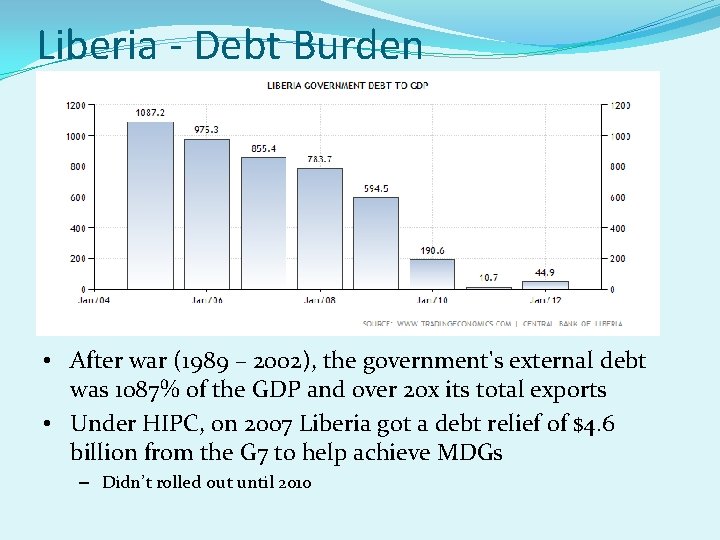
Liberia - Debt Burden • After war (1989 – 2002), the government's external debt was 1087% of the GDP and over 20 x its total exports • Under HIPC, on 2007 Liberia got a debt relief of $4. 6 billion from the G 7 to help achieve MDGs – Didn’t rolled out until 2010
Sources http: //allafrica. com/stories/201402040441. html http: //www. tradingeconomics. com/liberia/governme nt-debt-to-gdp "The Open Door Policy of Liberia - An Economic History of Modern Liberia", 2 vols. , 703 pp. (Bremen, 1983). Thesis, Ph. D. , Tilburg University, The Netherlands (1983)http: //www. liberiapastandpresent. org/PDF/The _Open_Door_deel 1. pdf

Next session: Life & Debt Movie and Discussion with Prof Sparke
- Slides: 57