
Debating Tips and Hints By Mr Kordyban Welcome
Debating Tips and Hints By Mr Kordyban

Welcome to the world of debating! Debates are a great way to practise you English! Be part of a team and have fun while competing! Debates help all 4 areas of English: Reading, Speaking, Listening, and Writing.
Debates are different from most presentations: What you say will change depending on what the other teams says, so you need to think on your feet! It’s almost like the debate is alive! Simply memorizing a presentation won’t work!
You need to LISTEN , REACT and ADAPT during the debate. For example Ø If they attack one of your main points, you need to defend it. Ø If they say something weak, you need to attack it. Ø If they ask a question, you need to answer it.
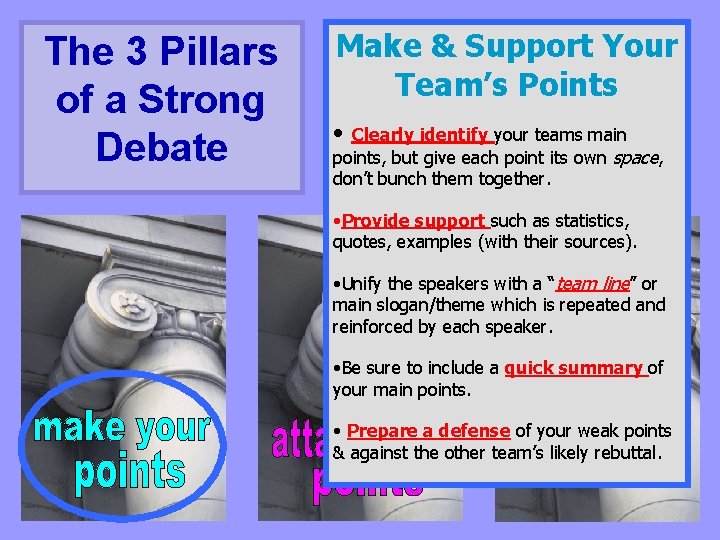
The 3 Pillars of a Strong Debate Make & Support Your Team’s Points • Clearly identify your teams main points, but give each point its own space, don’t bunch them together. • Provide support such as statistics, quotes, examples (with their sources). • Unify the speakers with a “team line” or main slogan/theme which is repeated and reinforced by each speaker. • Be sure to include a quick summary of your main points. • Prepare a defense of your weak points & against the other team’s likely rebuttal.
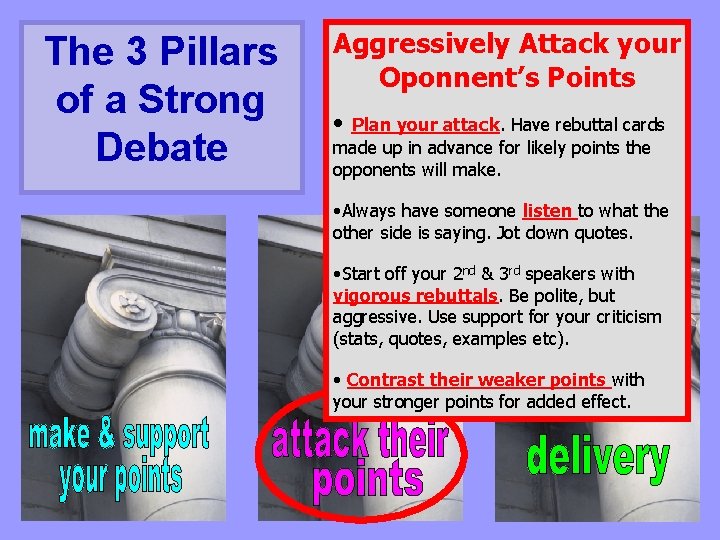
The 3 Pillars of a Strong Debate Aggressively Attack your Oponnent’s Points • Plan your attack. Have rebuttal cards made up in advance for likely points the opponents will make. • Always have someone listen to what the other side is saying. Jot down quotes. • Start off your 2 nd & 3 rd speakers with vigorous rebuttals. Be polite, but aggressive. Use support for your criticism (stats, quotes, examples etc). • Contrast their weaker points with your stronger points for added effect.
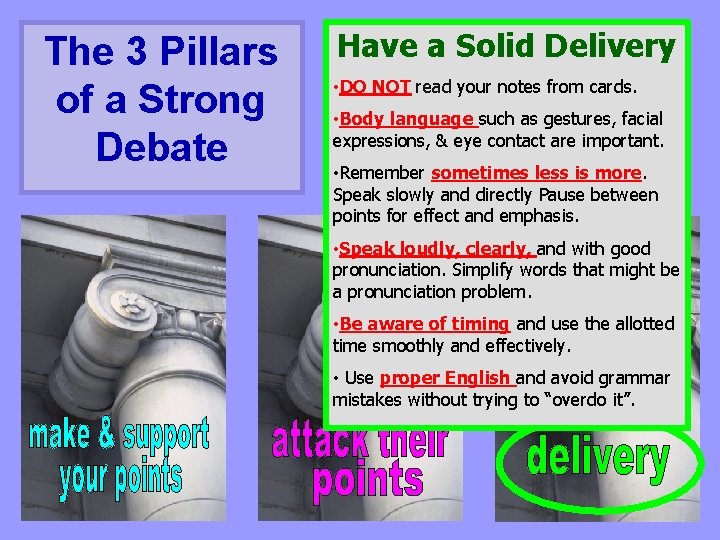
The 3 Pillars of a Strong Debate Have a Solid Delivery • DO NOT read your notes from cards. • Body language such as gestures, facial expressions, & eye contact are important. • Remember sometimes less is more. Speak slowly and directly Pause between points for effect and emphasis. • Speak loudly, clearly, and with good pronunciation. Simplify words that might be a pronunciation problem. • Be aware of timing and use the allotted time smoothly and effectively. • Use proper English and avoid grammar mistakes without trying to “overdo it”.

Also, remember that a debate is NOT an English language gunfight. Don’t try to use too many difficult words or fancy sentence structures. Often making your point in a simple and clear way is better. It is universally recognised that felines are greatly superior to canines with respect to personal hygiene and grooming.

Top 10 Things to Remember
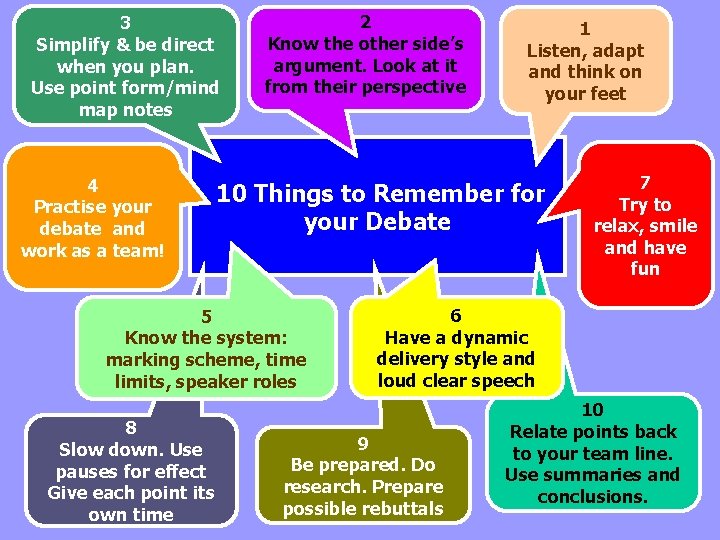
3 Simplify & be direct when you plan. Use point form/mind map notes 4 Practise your debate and work as a team! 2 Know the other side’s argument. Look at it from their perspective 10 Things to Remember for your Debate 5 Know the system: marking scheme, time limits, speaker roles 8 Slow down. Use pauses for effect Give each point its own time 1 Listen, adapt and think on your feet 7 Try to relax, smile and have fun 6 Have a dynamic delivery style and loud clear speech 9 Be prepared. Do research. Prepare possible rebuttals 10 Relate points back to your team line. Use summaries and conclusions.

Top 10 Things to Avoid
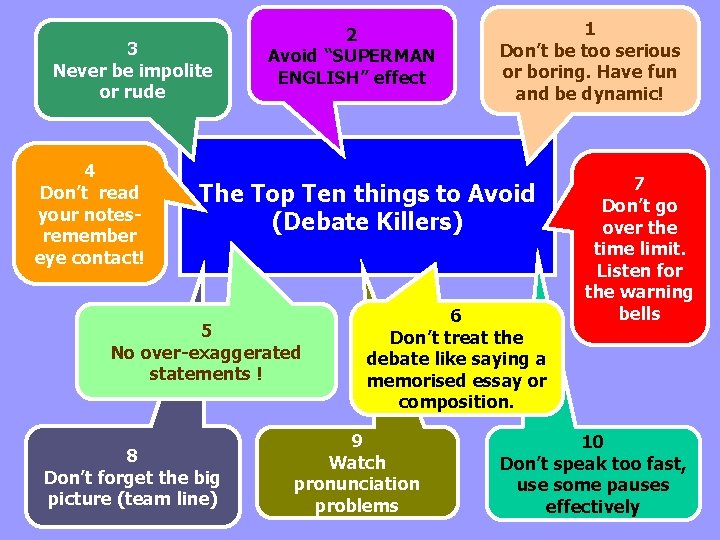
3 Never be impolite or rude 4 Don’t read your notesremember eye contact! 2 Avoid “SUPERMAN ENGLISH” effect 1 Don’t be too serious or boring. Have fun and be dynamic! The Top Ten things to Avoid (Debate Killers) 5 No over-exaggerated statements ! 8 Don’t forget the big picture (team line) 6 Don’t treat the debate like saying a memorised essay or composition. 9 Watch pronunciation problems 7 Don’t go over the time limit. Listen for the warning bells 10 Don’t speak too fast, use some pauses effectively
PLAN

PLAN • Brainstorm ideas then choose the best ones • Make a mind map with point form notes • Do the same thing for your opponents friendly can protect you Dogs are better pets for Hong Kong different sizes don’t need walks more trendy affectionate cleaner Cats are better pets for Hong Kong cheaper to feed don’t bark smaller for apartments
PREPARE
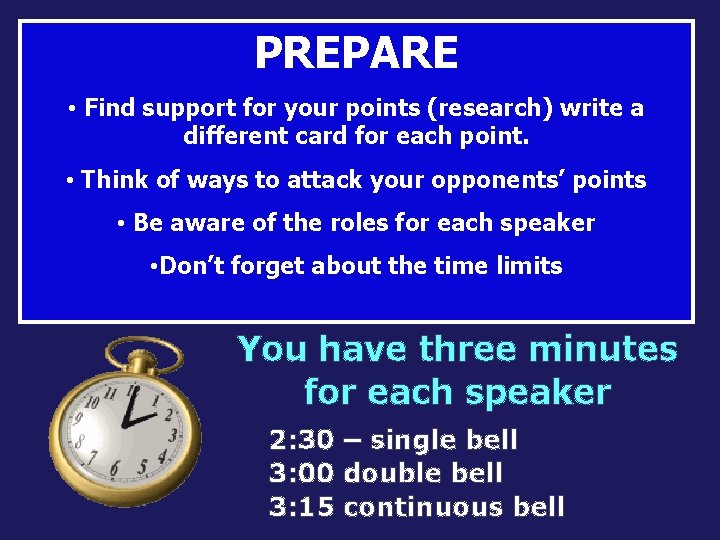
PREPARE • Find support for your points (research) write a different card for each point. • Think of ways to attack your opponents’ points • Be aware of the roles for each speaker • Don’t forget about the time limits You have three minutes for each speaker 2: 30 – single bell 3: 00 double bell 3: 15 continuous bell
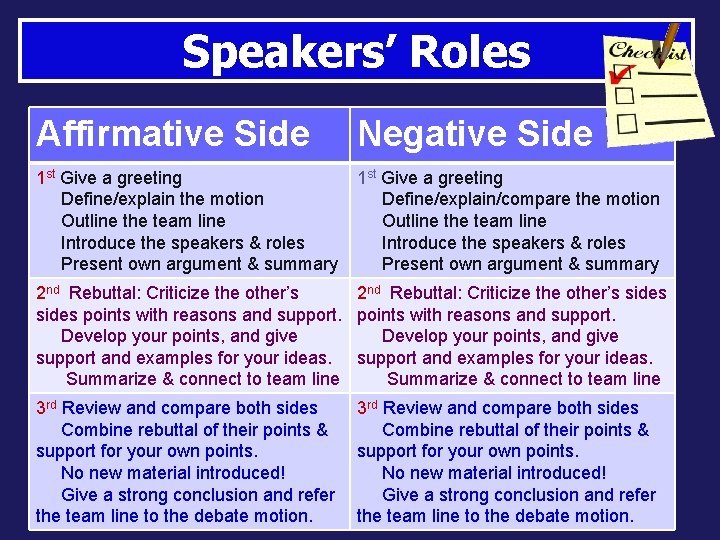
Speakers’ Roles Affirmative Side Negative Side 1 st Give a greeting Define/explain the motion Outline the team line Introduce the speakers & roles Present own argument & summary 1 st Give a greeting Define/explain/compare the motion Outline the team line Introduce the speakers & roles Present own argument & summary 2 nd Rebuttal: Criticize the other’s sides points with reasons and support. Develop your points, and give support and examples for your ideas. Summarize & connect to team line 3 rd Review and compare both sides Combine rebuttal of their points & support for your own points. No new material introduced! Give a strong conclusion and refer the team line to the debate motion.
Elements of a Debate Matter: the content Manner: the style & delivery Method: the structure/organisation
Elements of a Debate MATTER MANNER METHOD Ideas & arguments Eye Contact Fulfilling speakers’ roles Facts & opinions Voice quality Team work Evidence & examples Gestures & Body language Effective use of the time allowed Quotations & statistics Confidence & humour Good structures intro/body/conclusion) Try to do well in each of these sections! (e. g.

PRACTISE
PRACTISE • Have a separate card for each point and practise giving your delivery. Time it to see how long it takes. • Remember to work as a group. Practise with the others in your group so you know what they will say. • Practise rebuttals by imagining what they will say. Have different cards ready for their possible points. Be prepared to think fast if they have some new ideas

Let’s watch a debate ! It’s a great way to learn about debating.
- Slides: 22