
Debate I Basics Formats Presented by Doris L

Debate I: Basics & Formats Presented by Doris L. W. Chang
Presentation Outline ¡ What is “Debate”? ¡ What Can Debate Training Do for You? ¡ Debate Format ¡ Basic Glossary ¡ Work Cited
What Is Debate? A debate means “a regulated discussion of a proposition by two matched sides, providing reasoned arguments for and against a proposition. ” (Goodnight 149)
Rules of the Game ¡ “regulated”: agreed-upon rules Format, Speaker responsibilities (judges, affirmative, negative teams, timer) Proofs, Logical reasoning, cross-examination Rules of time, expected performances by both teams.
“proposition” 1: A proposition is a statement that is open to interpretation It shall be controversial, significant, debatable, durable, and most importantly, with a single idea
Proposition 2: Examples In a debate, the affirmative proposes to change the status quo with a carefully argued resolution with justification, plan, and advantages. RESOLVED: That six years of English in high school is adequate for a basic education. RESOLVED: That modern art lacks artistic skill and creativity RESOLVED: That AIDS education shall be introduced at elementary school level.
What Can Debating Do for You? It ¡ cultivates your leadership skills ¡ Consolidates your investigation & analysis skills ¡ Trains your critical listening/thinking skills ¡ Enriches your open-mindedness ¡ Equips you with better organization & speaking skills ¡ Builds your self-confidence ¡ Boosts your teamwork & cooperation ability ¡ Provides you the fun when wits match with competition
Debate Formats ¡ Policy Debate & Value Debate ¡ Political Debate—Lincoln-Douglas Presidential Debates (kennedy-Nixon Debate, 1960) Modified press conferences (since questions & issues are chosen by a panel rather than the candidates) ¡ Academic Debate Standard Debate Format (highshool/college) Cross-Examination Debate Format
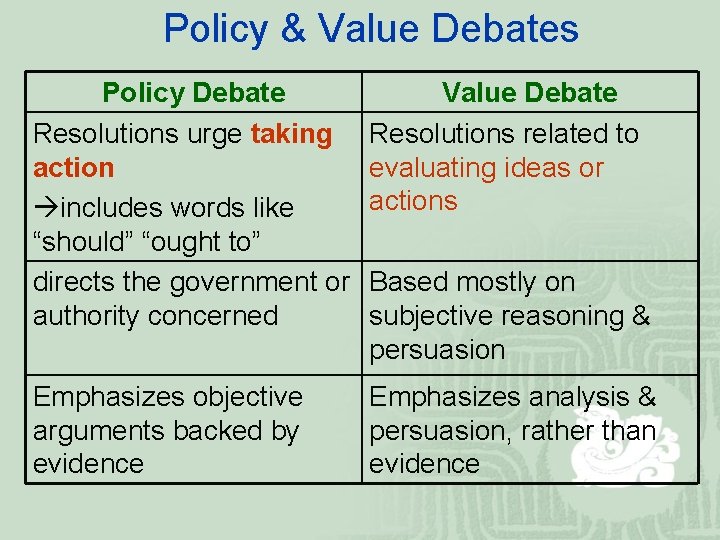
Policy & Value Debates Policy Debate Resolutions urge taking action includes words like “should” “ought to” directs the government or authority concerned Value Debate Resolutions related to evaluating ideas or actions Emphasizes objective arguments backed by evidence Emphasizes analysis & persuasion, rather than evidence Based mostly on subjective reasoning & persuasion
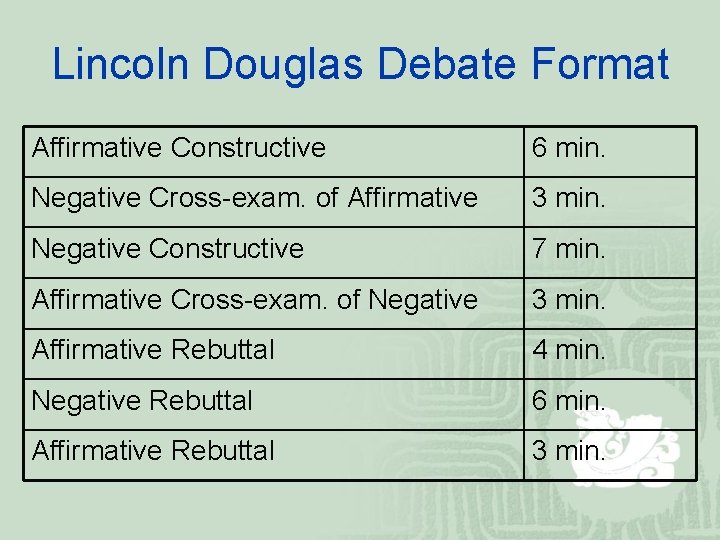
Lincoln Douglas Debate Format Affirmative Constructive 6 min. Negative Cross-exam. of Affirmative 3 min. Negative Constructive 7 min. Affirmative Cross-exam. of Negative 3 min. Affirmative Rebuttal 4 min. Negative Rebuttal 6 min. Affirmative Rebuttal 3 min.
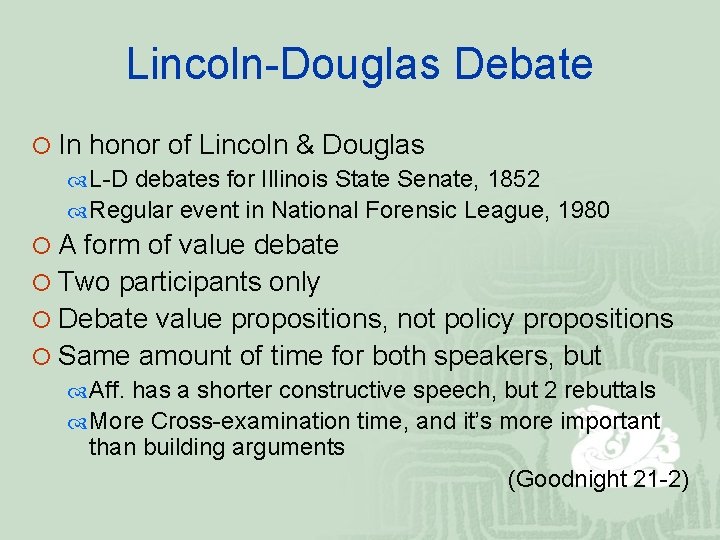
Lincoln-Douglas Debate ¡ In honor of Lincoln & Douglas L-D debates for Illinois State Senate, 1852 Regular event in National Forensic League, 1980 ¡ A form of value debate ¡ Two participants only ¡ Debate value propositions, not policy propositions ¡ Same amount of time for both speakers, but Aff. has a shorter constructive speech, but 2 rebuttals More Cross-examination time, and it’s more important than building arguments (Goodnight 21 -2)
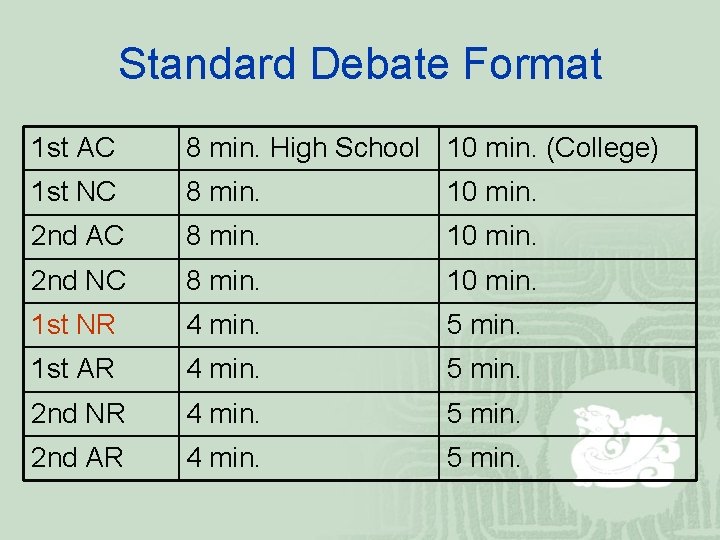
Standard Debate Format 1 st AC 8 min. High School 10 min. (College) 1 st NC 8 min. 10 min. 2 nd AC 8 min. 10 min. 2 nd NC 8 min. 10 min. 1 st NR 4 min. 5 min. 1 st AR 4 min. 5 min. 2 nd NR 4 min. 5 min. 2 nd AR 4 min. 5 min.
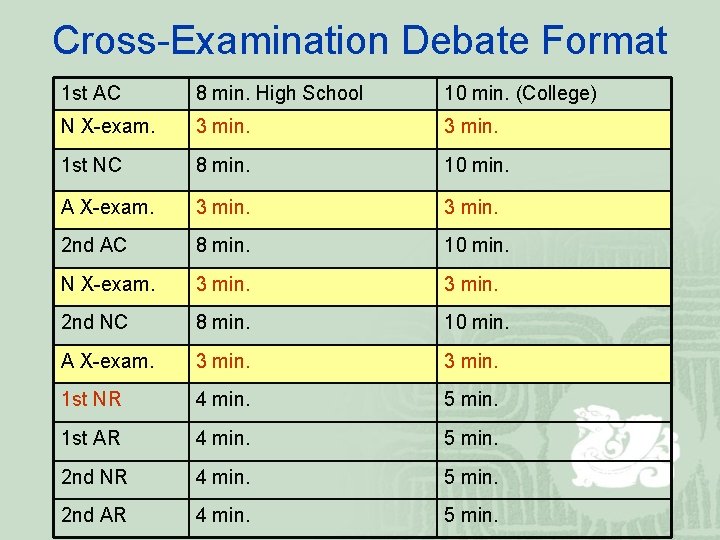
Cross-Examination Debate Format 1 st AC 8 min. High School 10 min. (College) N X-exam. 3 min. 1 st NC 8 min. 10 min. A X-exam. 3 min. 2 nd AC 8 min. 10 min. N X-exam. 3 min. 2 nd NC 8 min. 10 min. A X-exam. 3 min. 1 st NR 4 min. 5 min. 1 st AR 4 min. 5 min. 2 nd NR 4 min. 5 min. 2 nd AR 4 min. 5 min.
Basic Glossary (Goodnight 149 -151) ¡ Proposition ¡ Affirmative/negative ¡ Constructive: speech presenting the team’s major points ¡ Rebuttal: speech rebuilding attacked arguments, refuting opposing arguments, and summarizing the debate ¡ Flow Sheeting (flowing) ¡ Prep. time Presumption—the policy in effect should remain in effect Prima facie case— ¡ the aff. should not only overcome presumption, but present a case that is complete “at first sight, ” to state a justification, present a plan, list advantages, and provide sufficient proofs to make it strong enough.
Glossary 1 ¡ Burden of proof—the aff. ’s obligation to provide sufficient reason for adopting the proposition ¡ Topicality—issue of whether the aff. plan falls under and supports the resolution (151). ¡ Contention ¡ Voting issues: arguments the teams believe to be key issues that shall decide who wins the debate
Glossary 2 ¡ Debate brief the structure most debaters use for organizing their evidence, usually a page of arguments and evidence to be read as needed in debate rounds 1 single argument per sheet, several pieces of evidence to be quoted when needed. (Goodnight 81)
Proposition Formation 1. The proposition should include ¡ A single idea, significance, controversy, debatability, durability Problem area focused question proposition E. g. Welfare system medical care proposition Resolved: That the government should guarantee medical care for those with catastrophic illness 2.
Questions & Answers ¡ Sample Debate on LDT (Lie Detector Test) by students 2004
Work Cited Goodnight, Lynn. Getting Started in Debate. 2 nd Ed. Lincolnwood, Chicago: NTC, 1994.
- Slides: 20