
DEB theory microlectures Bas Kooijman Dept theoretical biology
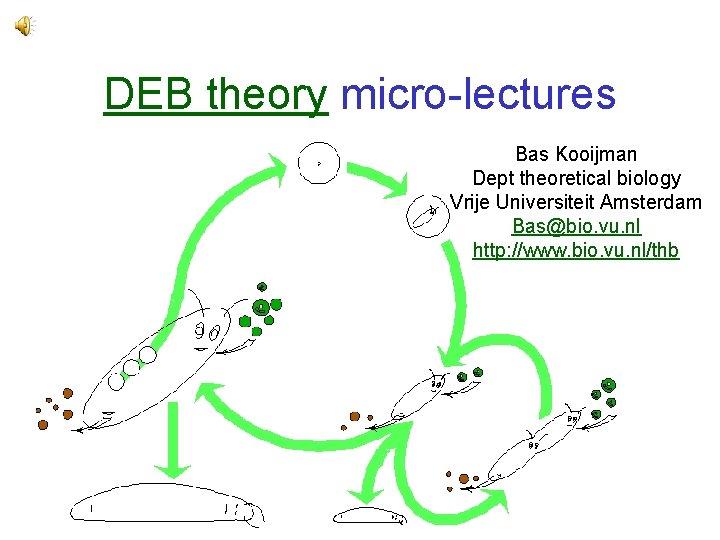
DEB theory micro-lectures Bas Kooijman Dept theoretical biology Vrije Universiteit Amsterdam Bas@bio. vu. nl http: //www. bio. vu. nl/thb
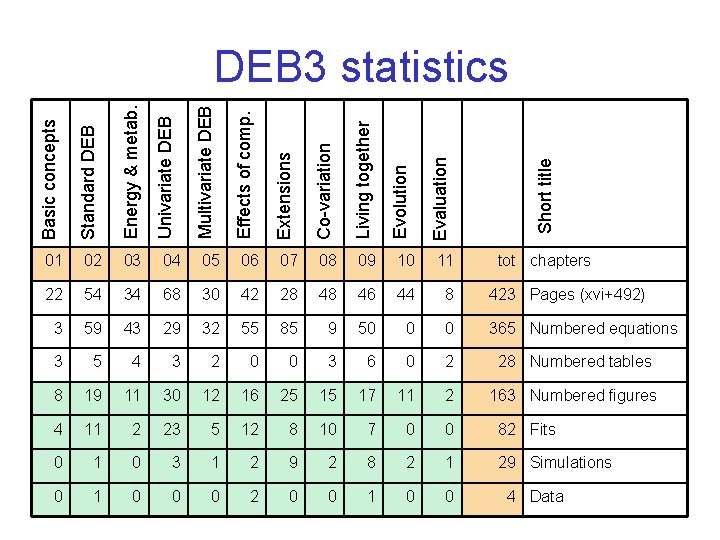
Co-variation Living together 05 06 07 08 09 10 11 22 54 34 68 30 42 28 48 46 44 8 423 Pages (xvi+492) 3 59 43 29 32 55 85 9 50 0 0 365 Numbered equations 3 5 4 3 2 0 0 3 6 0 2 28 Numbered tables 8 19 11 30 12 16 25 15 17 11 2 163 Numbered figures 4 11 2 23 5 12 8 10 7 0 0 82 Fits 0 1 0 3 1 2 9 2 8 2 1 29 Simulations 0 1 0 0 0 2 0 0 1 0 0 Short title Extensions 04 Evaluation Effects of comp. 03 Evolution Energy & metab. 02 Multivariate DEB Standard DEB 01 Univariate DEB Basic concepts DEB 3 statistics tot chapters 4 Data
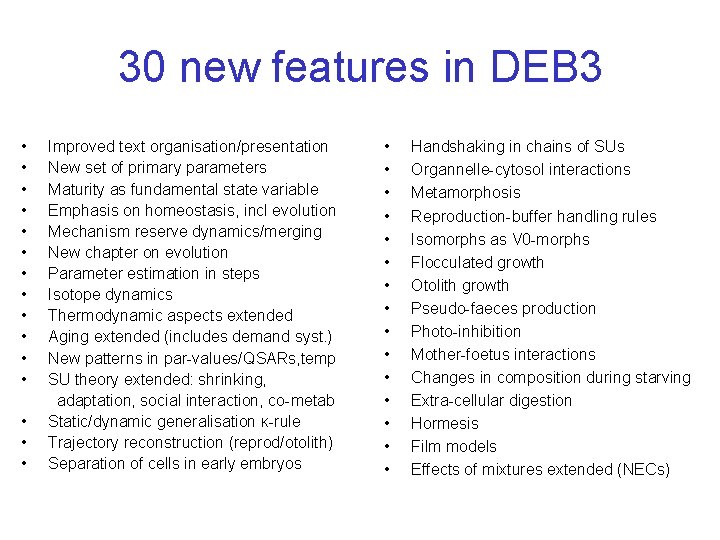
30 new features in DEB 3 • • • • Improved text organisation/presentation New set of primary parameters Maturity as fundamental state variable Emphasis on homeostasis, incl evolution Mechanism reserve dynamics/merging New chapter on evolution Parameter estimation in steps Isotope dynamics Thermodynamic aspects extended Aging extended (includes demand syst. ) New patterns in par-values/QSARs, temp SU theory extended: shrinking, adaptation, social interaction, co-metab Static/dynamic generalisation κ-rule Trajectory reconstruction (reprod/otolith) Separation of cells in early embryos • • • • Handshaking in chains of SUs Organnelle-cytosol interactions Metamorphosis Reproduction-buffer handling rules Isomorphs as V 0 -morphs Flocculated growth Otolith growth Pseudo-faeces production Photo-inhibition Mother-foetus interactions Changes in composition during starving Extra-cellular digestion Hormesis Film models Effects of mixtures extended (NECs)
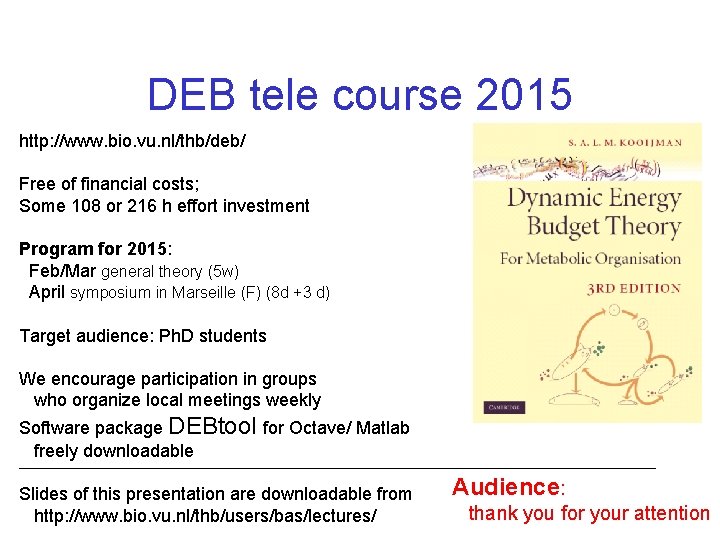
DEB tele course 2015 http: //www. bio. vu. nl/thb/deb/ Free of financial costs; Some 108 or 216 h effort investment Program for 2015: Feb/Mar general theory (5 w) April symposium in Marseille (F) (8 d +3 d) Target audience: Ph. D students We encourage participation in groups who organize local meetings weekly Cambridge Univ Press 2009 Software package DEBtool for Octave/ Matlab freely downloadable Slides of this presentation are downloadable from http: //www. bio. vu. nl/thb/users/bas/lectures/ Audience: thank you for your attention
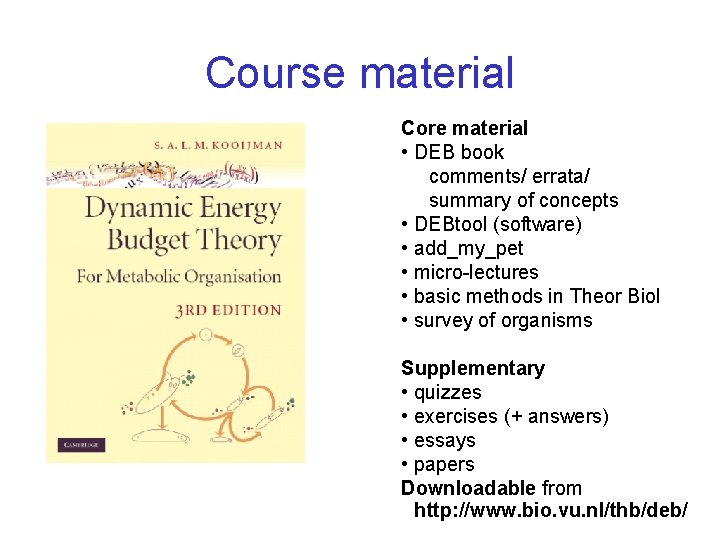
Course material Core material • DEB book comments/ errata/ summary of concepts • DEBtool (software) • add_my_pet • micro-lectures • basic methods in Theor Biol • survey of organisms Supplementary • quizzes • exercises (+ answers) • essays • papers Downloadable from http: //www. bio. vu. nl/thb/deb/
Assumed to be known Methods in Theoretical Biology http: //www. bio. vu. nl/thb/course/tb 80 -page document with methods/concepts that frequently occur in theoretical biology
Web facilities for DEB theory http: //www. bio. vu. nl/thb/deb • electronic laboratory freely downloadable software DEBtool add_my_pet data collection supporting material • Course (Black. Board powered) on DEB theory 5 weeks fundamental part in tele-mode 8 days practical part in classroom-mode in Lisbon 2011 3 days symposium in Lisbon 2011 • downloadable papers
Electronic DEB laboratory http: //www. bio. vu. nl/thb/deblab/ (free download site) DEBtool for research applications open source (Octave, Matlab) covers full range of DEB research (fundamental + applied) advanced regression routines for simultaneous model fitting add_my_pet data collection for wide variety of species pdf with background information Species. xls with overview pars_my_pet scripts to run implied properties mydata_my_pet scripts to estimate parameters predict_my_pet routines to compute expected values
Dynamic Energy Budget theory for metabolic organization • consists of a set of consistent and coherent assumptions • uses framework of general systems theory • links levels of organization scales in space and time: scale separation • quantitative; first principles only equivalent of theoretical physics • interplay between biology, mathematics, physics, chemistry, earth system sciences • fundamental to biology; many practical applications
Dynamic Energy Budget theory Question: Is it possible to “do” biology physical style, i. e. on a formal basis, no exceptions? Answer: Try and see for a core topic in biology: metabolic organisation. Question: The literature on microbial, plant and animal physiology hardly refers to each other; how can we achieve generality? Answer: Ignore existing literature, start afresh after having read all; See what all organisms have in common. Question: Metabolic organisation has many space-time levels; how do they interact? Answer: Levels have local coherence, not global; keep models simple using this, starting with individuals as dynamic systems.
Research strategy 1) use general physical-chemical principles to develop an educated quantitative expectation for the eco-physiological behaviour of a generalized species 2) estimate parameters for any specific case compare the values with expectations from scaling relationships deviations reveal specific evolutionary adaptations 3) study deviations from model expectations learn about the physical-chemical details that matter in this case but had to be ignored because they not always apply Deviations from a detailed generalized expectation provide access to species-specific (or case-specific) modifications
Some DEB pillars • life cycle perspective of individual as primary target embryo, juvenile, adult (levels in metabolic organization) • life as coupled chemical transformations (reserve & structure) • time, energy, entropy & mass balances • surface area/ volume relationships (spatial structure & transport) • homeostasis (stoichiometric constraints via Synthesizing Units) • syntrophy (basis for symbioses, evolutionary perspective) • intensive/extensive parameters: body size scaling
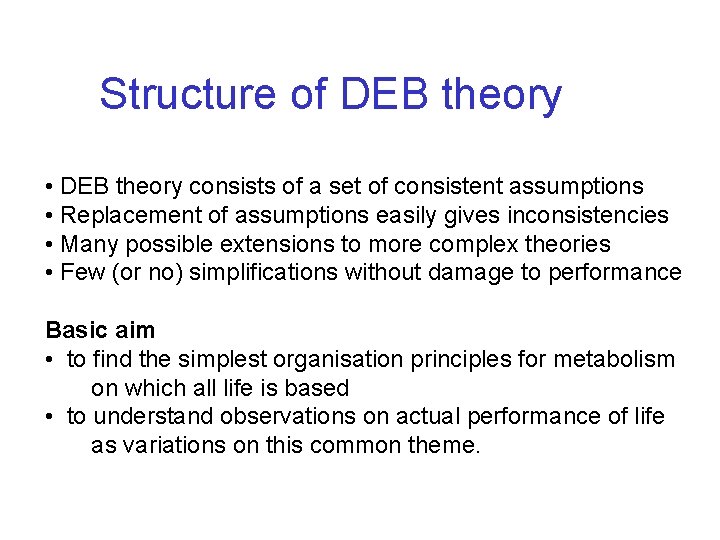
Structure of DEB theory • DEB theory consists of a set of consistent assumptions • Replacement of assumptions easily gives inconsistencies • Many possible extensions to more complex theories • Few (or no) simplifications without damage to performance Basic aim • to find the simplest organisation principles for metabolism on which all life is based • to understand observations on actual performance of life as variations on this common theme.
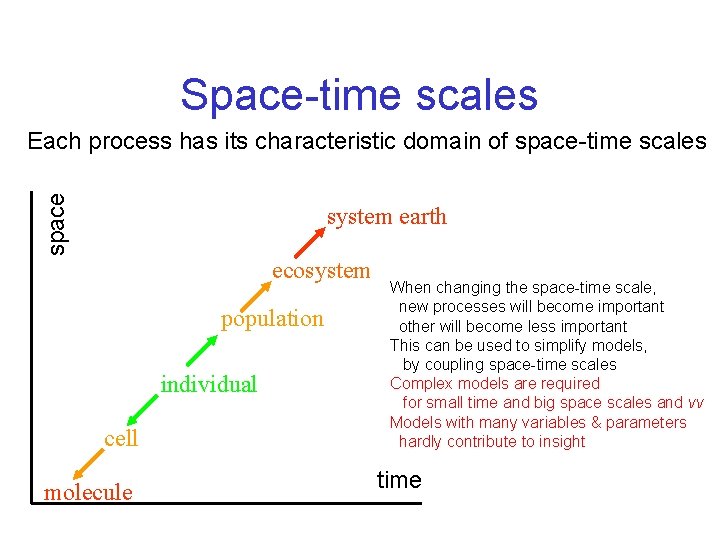
Space-time scales space Each process has its characteristic domain of space-time scales system earth ecosystem population individual cell molecule When changing the space-time scale, new processes will become important other will become less important This can be used to simplify models, by coupling space-time scales Complex models are required for small time and big space scales and vv Models with many variables & parameters hardly contribute to insight time
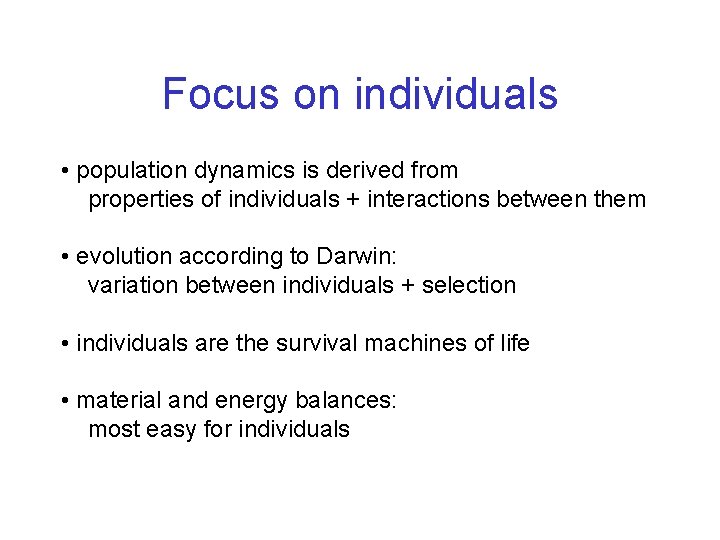
Focus on individuals • population dynamics is derived from properties of individuals + interactions between them • evolution according to Darwin: variation between individuals + selection • individuals are the survival machines of life • material and energy balances: most easy for individuals
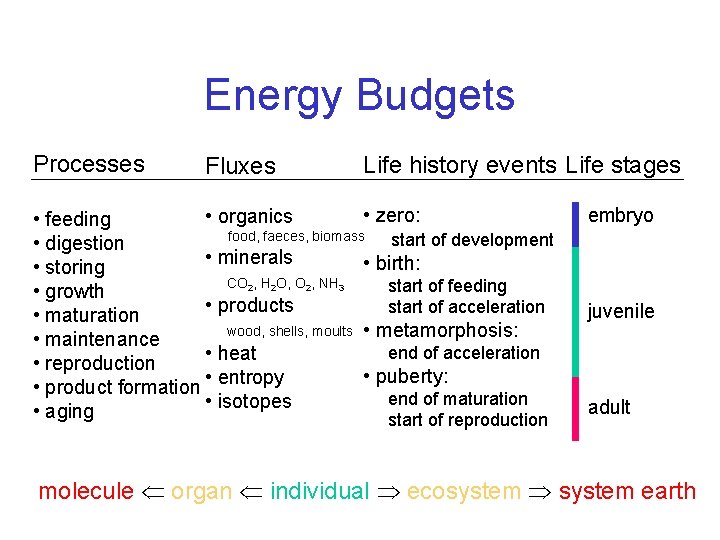
Energy Budgets Processes Fluxes Life history events Life stages • zero: • organics • feeding food, faeces, biomass start of development • digestion • minerals • birth: • storing CO 2, H 2 O, O 2, NH 3 start of feeding • growth • products start of acceleration • maturation wood, shells, moults • metamorphosis: • maintenance end of acceleration • heat • reproduction • puberty: • product formation • entropy end of maturation • isotopes • aging start of reproduction embryo juvenile adult molecule organ individual ecosystem earth
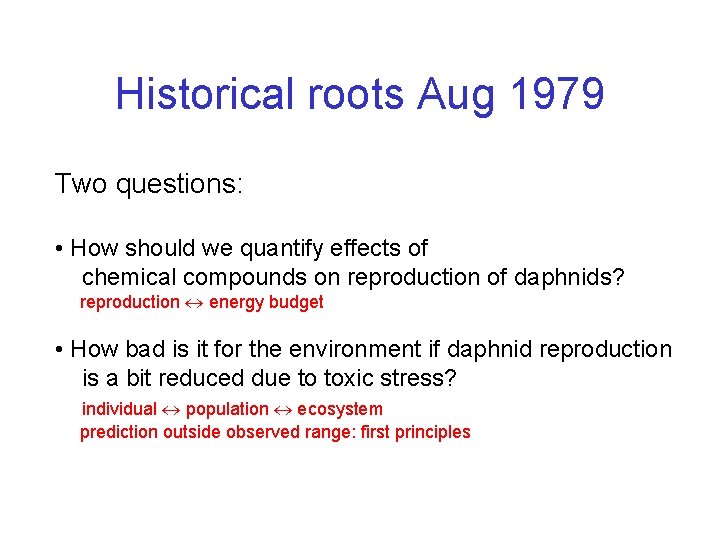
Historical roots Aug 1979 Two questions: • How should we quantify effects of chemical compounds on reproduction of daphnids? reproduction energy budget • How bad is it for the environment if daphnid reproduction is a bit reduced due to toxic stress? individual population ecosystem prediction outside observed range: first principles
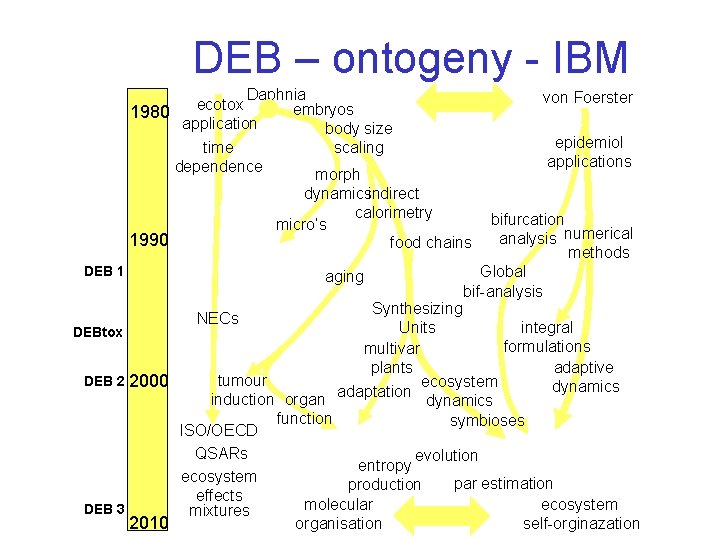
DEB – ontogeny - IBM Daphnia ecotox embryos 1980 application body size time scaling dependence morph dynamicsindirect calorimetry micro’s 1990 food chains DEB 1 aging von Foerster epidemiol applications bifurcation analysis numerical methods Global bif-analysis Synthesizing integral Units DEBtox formulations multivar adaptive plants DEB 2 2000 tumour ecosystem dynamics adaptation induction organ dynamics function symbioses ISO/OECD QSARs evolution entropy ecosystem par estimation production effects ecosystem molecular DEB 3 mixtures 2010 self-orginazation organisation NECs
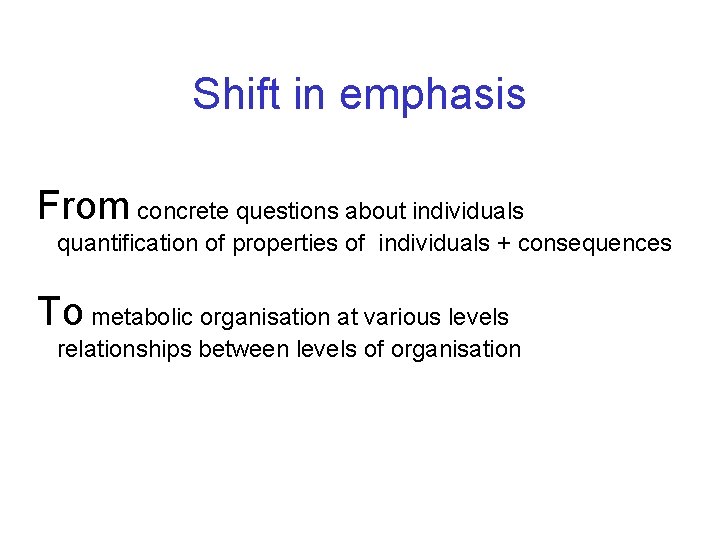
Shift in emphasis From concrete questions about individuals quantification of properties of individuals + consequences To metabolic organisation at various levels relationships between levels of organisation
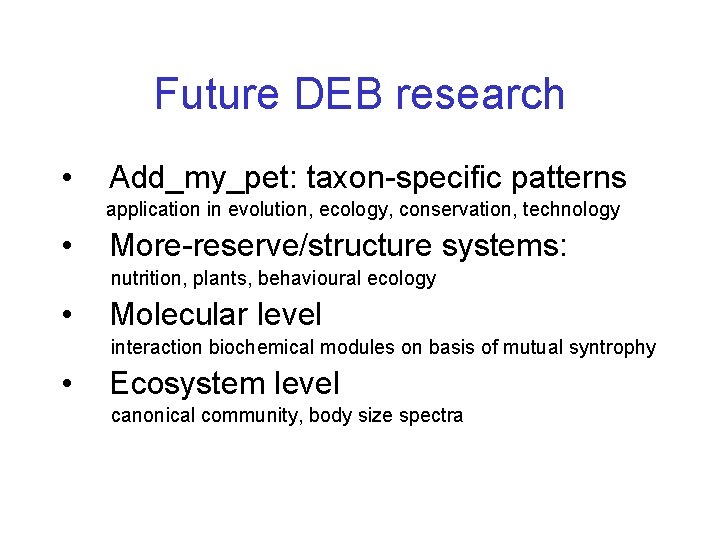
Future DEB research • Add_my_pet: taxon-specific patterns application in evolution, ecology, conservation, technology • More-reserve/structure systems: nutrition, plants, behavioural ecology • Molecular level interaction biochemical modules on basis of mutual syntrophy • Ecosystem level canonical community, body size spectra
Notation 1 http: //www. bio. vu. nl/thb/research/bib/Kooy 2010_n. pdf
General Notation 2 Indices for compounds Indices for transformations
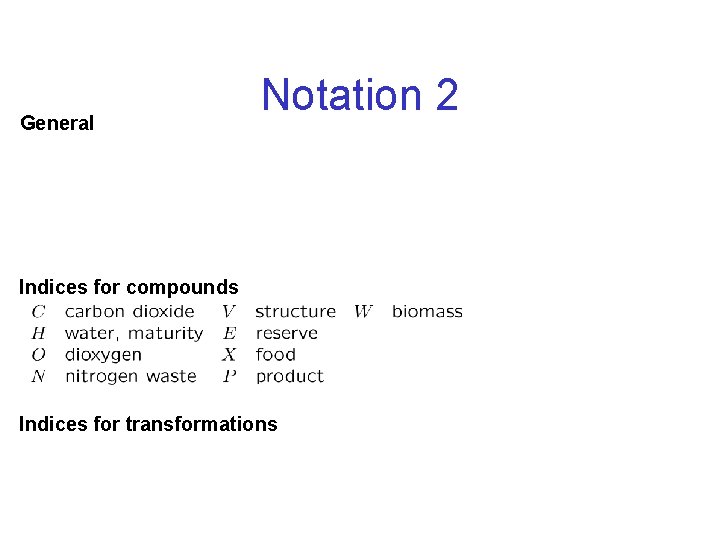
Notation 3 Notice that some symbols have more than one meaning: V as symbol stands for volume, and without index for volume of structure, as index stands for the compound structure E as symbol stands for energy, and without index for energy in reserve, as index stands for the compound reserve C, H, O, N as indices stand for mineral compounds as well as chemical elements the context defines the meaning Dots are used to • distinguish rates from states (dimension check) • allow scaling of time without the need to introduce new symbols if time is scaled to a dimensionless quantity, the dot is removed Numbers in slide titles refer to sections in DEB book for more info
Dynamic Energy Budget theory 1 Basic Concepts 2 Standard DEB model 3 Metabolism 4 Univariate DEB models 5 Multivariate DEB models 6 Effects of compounds 7 Extensions of DEB models 8 Co-variation of par values 9 Living together 10 Evolution 11 Evaluation
- Slides: 24