
Death What is Death Death is a process




- Slides: 18
Death
What is Death? • Death is a process and not a singular event. At the time of death, the following processes occur from seconds to hours later: • Heart stops beating, breathing ceases • Oxygen is no longer circulated throughout the body via the bloodstream • Brain dies within 3 -7 minutes without oxygen (almost always irreversible) • All other cells & organs begin to die off (up to 15 hours to donate) • Autolysis occurs (cells broken down by their own enzymes) • Muscles relax; bladder and bowels release
Attended Deaths • If you die at the hospital or hospice care, a physician will sign off on a medical certificate on cause of death • If COD is unknown, the person may go off for an autopsy or the family can request a private one (approximate cost $3, 000) • After autopsy, the body is returned to the custody of the family via transportation to a funeral home • The body is either embalmed or cremated according to the person’s wishes; decomposition does NOT occur
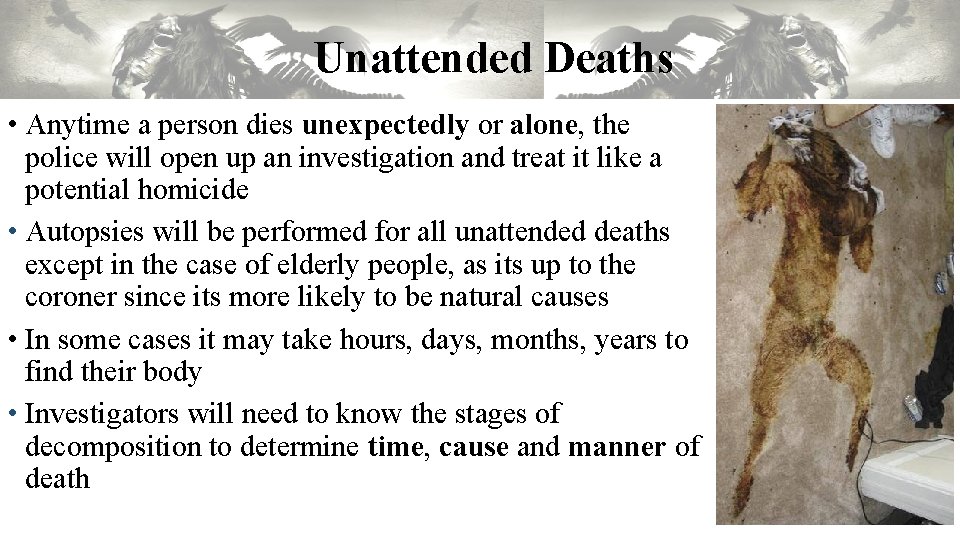
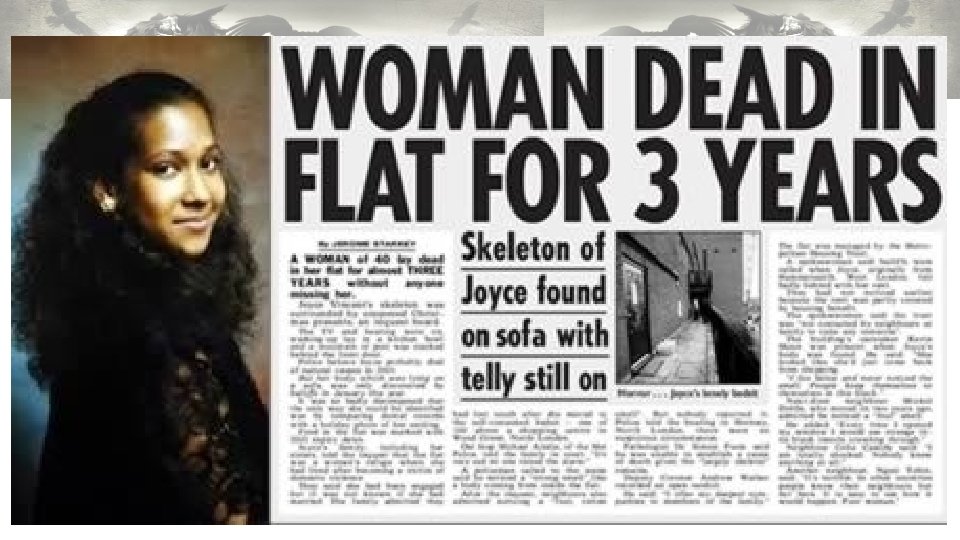
Unattended Deaths • Anytime a person dies unexpectedly or alone, the police will open up an investigation and treat it like a potential homicide • Autopsies will be performed for all unattended deaths except in the case of elderly people, as its up to the coroner since its more likely to be natural causes • In some cases it may take hours, days, months, years to find their body • Investigators will need to know the stages of decomposition to determine time, cause and manner of death
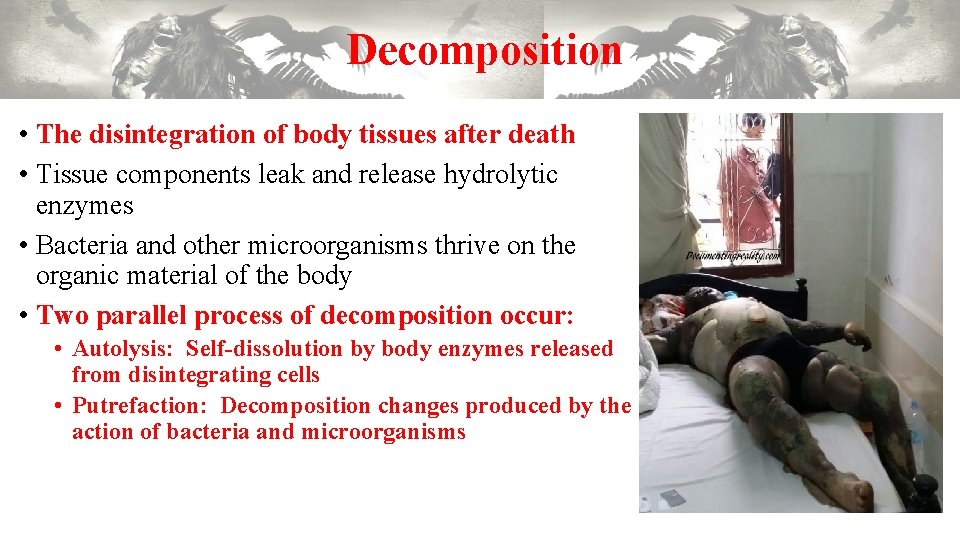
Decomposition • The disintegration of body tissues after death • Tissue components leak and release hydrolytic enzymes • Bacteria and other microorganisms thrive on the organic material of the body • Two parallel process of decomposition occur: • Autolysis: Self-dissolution by body enzymes released from disintegrating cells • Putrefaction: Decomposition changes produced by the action of bacteria and microorganisms
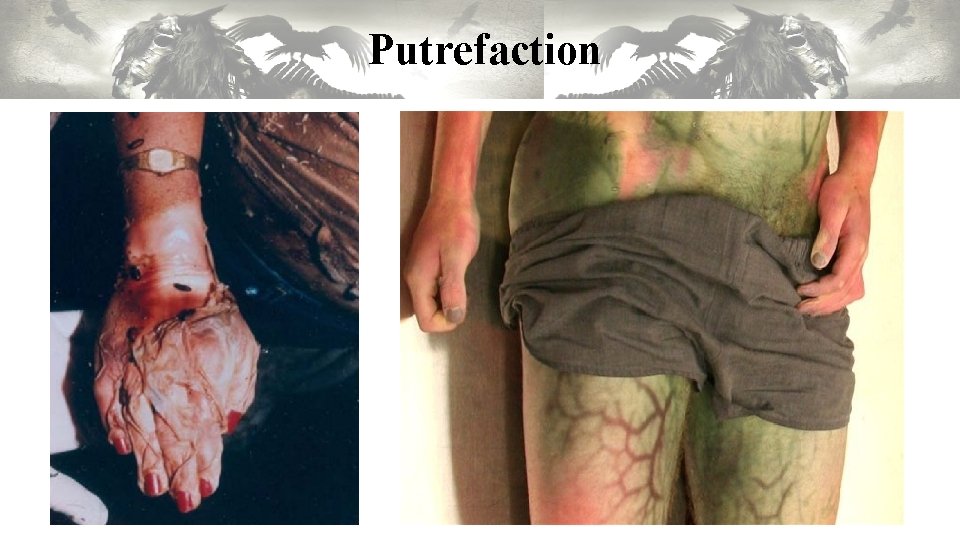
Putrefaction • The normal final sign of death • Starts immediately after death at the cellular level • Breakdown of protein and liquefaction of the body • Becomes visible in 48 -72 hours • Its onset may be sped up or delayed by several factors mainly: • Temperature • The ambient temperature can speed up or slow down this process • A fever prior to death can speed up putrefaction • Humidity • One week in air equals two weeks in water and eight weeks in soil
5 Stages of Decomposition • 1) Initial Decay (0 -3 days) • 2) Putrefaction (4 -10 days) • 3) Black Putrefaction (10 -20 days) • 4) Butyric Fermentation (20 -50 days) • 5) Dry Decay (50+ days)
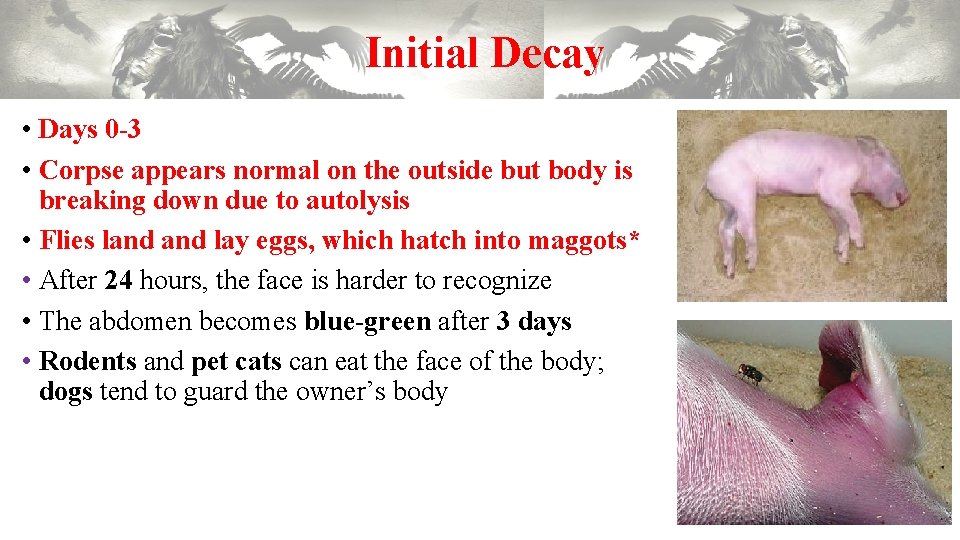
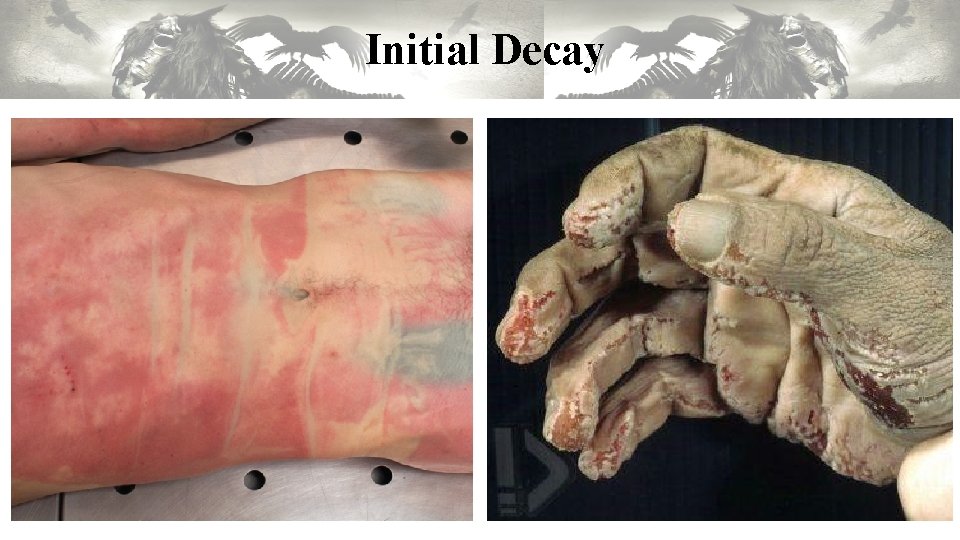
Initial Decay • Days 0 -3 • Corpse appears normal on the outside but body is breaking down due to autolysis • Flies land lay eggs, which hatch into maggots* • After 24 hours, the face is harder to recognize • The abdomen becomes blue-green after 3 days • Rodents and pet cats can eat the face of the body; dogs tend to guard the owner’s body
Initial Decay
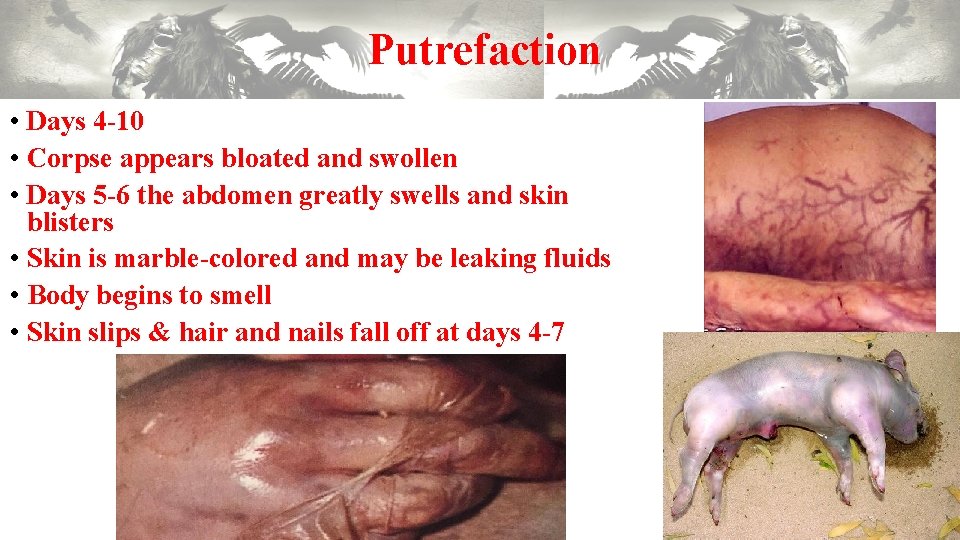
Putrefaction • Days 4 -10 • Corpse appears bloated and swollen • Days 5 -6 the abdomen greatly swells and skin blisters • Skin is marble-colored and may be leaking fluids • Body begins to smell • Skin slips & hair and nails fall off at days 4 -7
Putrefaction
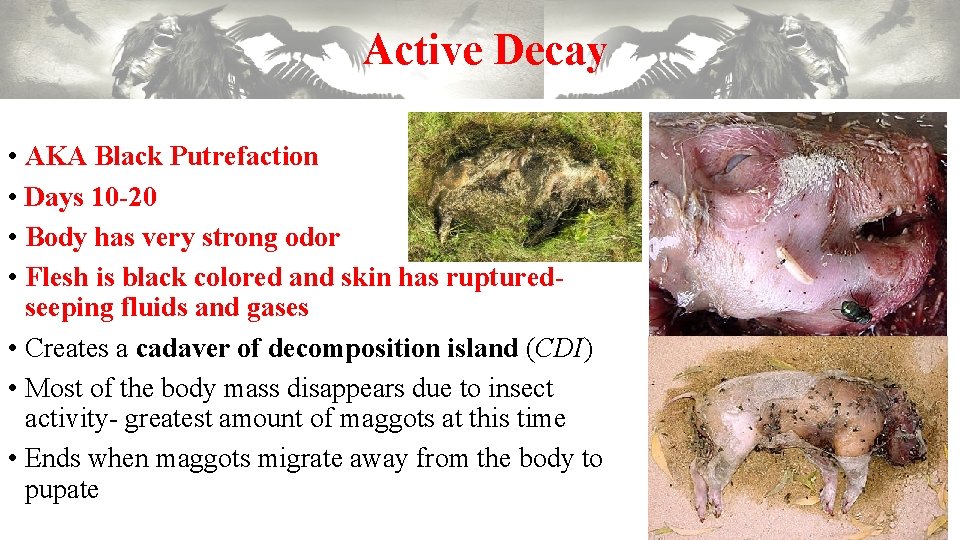
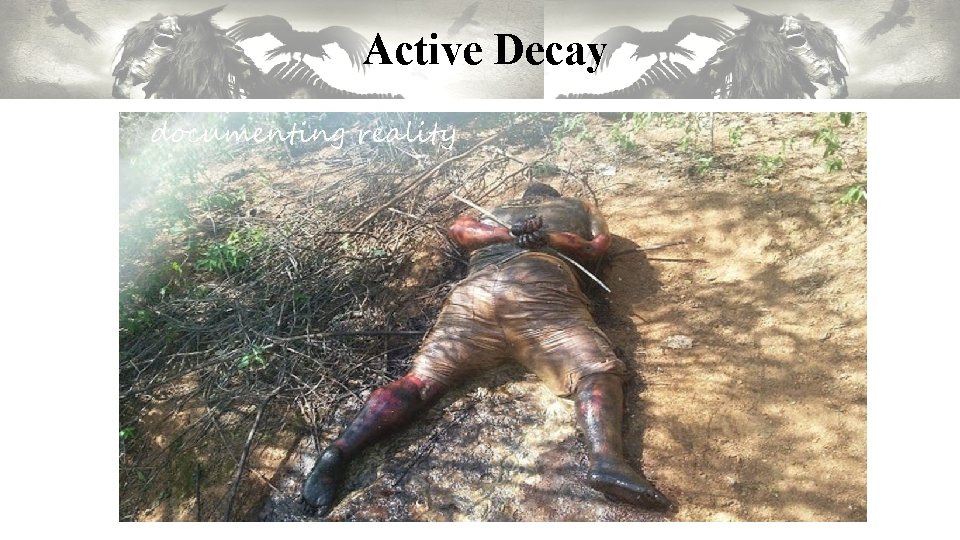
Active Decay • AKA Black Putrefaction • Days 10 -20 • Body has very strong odor • Flesh is black colored and skin has rupturedseeping fluids and gases • Creates a cadaver of decomposition island (CDI) • Most of the body mass disappears due to insect activity- greatest amount of maggots at this time • Ends when maggots migrate away from the body to pupate
Active Decay
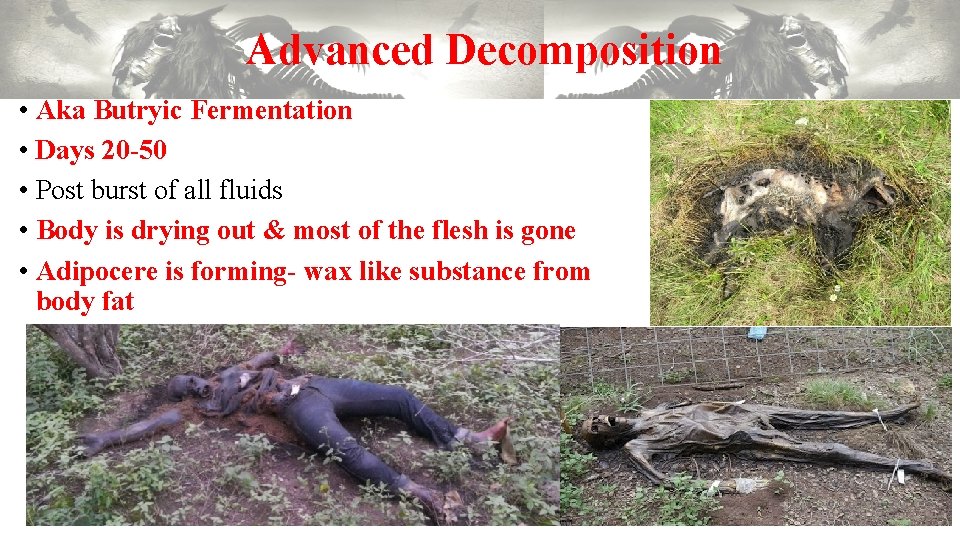
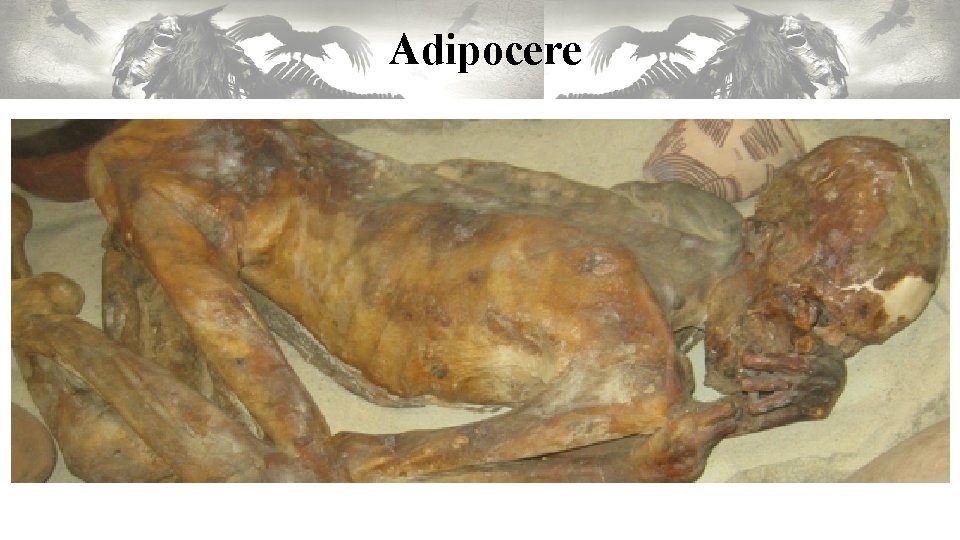
Advanced Decomposition • Aka Butryic Fermentation • Days 20 -50 • Post burst of all fluids • Body is drying out & most of the flesh is gone • Adipocere is forming- wax like substance from body fat
Adipocere
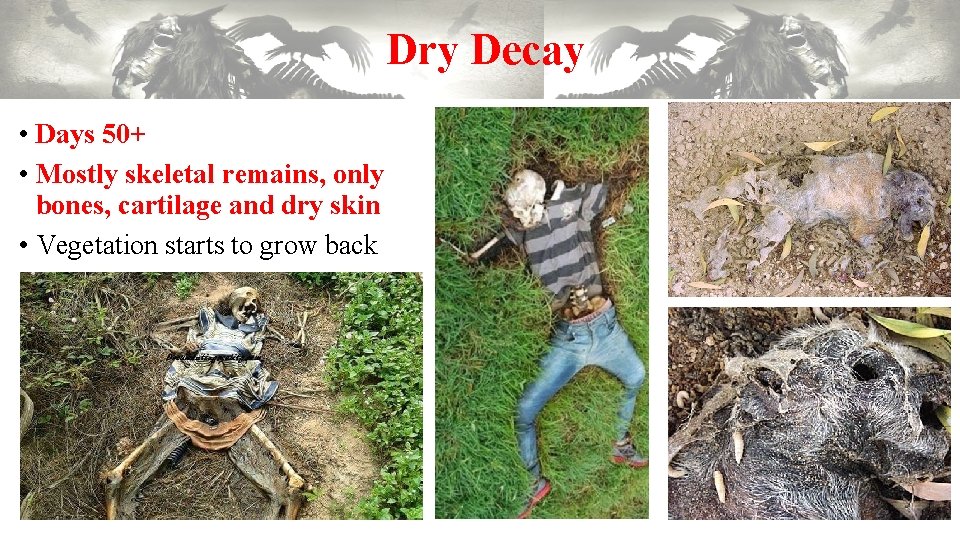
Dry Decay • Days 50+ • Mostly skeletal remains, only bones, cartilage and dry skin • Vegetation starts to grow back