
Death Investigation Death Investigation and Forensic Pathology Biology
Death Investigation
Death Investigation and Forensic Pathology Biology defines a living thing as follows: *any organism or living form that show’s characteristics of life Characteristics of life: • an organized structure, being made up of a cell or cells • requires energy to survive or sustain existence • ability to reproduce • ability to grow • ability to metabolize • ability to respond to stimuli • ability to adapt to the environment • ability to move • ability to respire http: //www. biology-online. org/dictionary/Living_thing
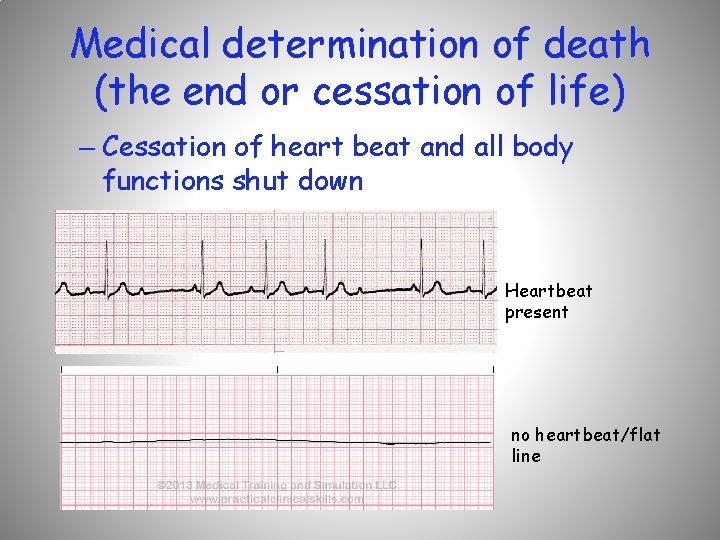
Medical determination of death (the end or cessation of life) – Cessation of heart beat and all body functions shut down Heartbeat present no heartbeat/flat line
Manners of Death • Natural: the body ceases to function on its own; May be contributing factors such as heart disease, terminal illness, etc. • Accidental: no due to natural causes, suicide or homicide; usually due to some misadventure or risk taken by an individual • Suicidal: deliberate taking of one’s own life • Homicidal: deliberate taking of someone else’s life
Causes, manner, and mechanism • Cause of death: the immediate reason for a person’s death (this is usually determined at autopsy if not already evident) • Manner: a mean by which someone dies (natural, accidental, suicide, homicide) • Mechanism: the specific body failure that leads to death
Case Example • The body of a 25 year old male is found in some brush along a creek bank. The body is sent to the medical examiner for autopsy. The medical examiner determines that there has been a severe brain hemorrhage from being hit in the head with a blunt object. (blunt force trauma to the head). • What is the cause, manner and mechanism of death?
Determining Time of Death • Physiological time of death: the point at which the deceased body ceases to function including vital organs • Estimated time of death: a best guess based on available information • Legal time of death: time when body was discovered or physically pronounced dead by another person; this is the time recorded on the death certificate

Examining the Corpse to Aid in Determining Time of Death • Rigor mortis: natural contraction and relaxation of the skeletal muscles after death due to chemical changes and a loss of ATP (adenosine triphosphate) – Beings usually in the small muscles of the face and spreads to larger muscles – Signs usually appear within the first 2 hours after death and can last for 20 -36 hours. – Can be used to approximate time of death because it occurs within the first 36 -48 hours – Common misconception: Rigor does not leave the body. This is wrong because it does leave and the muscles will eventually relax.
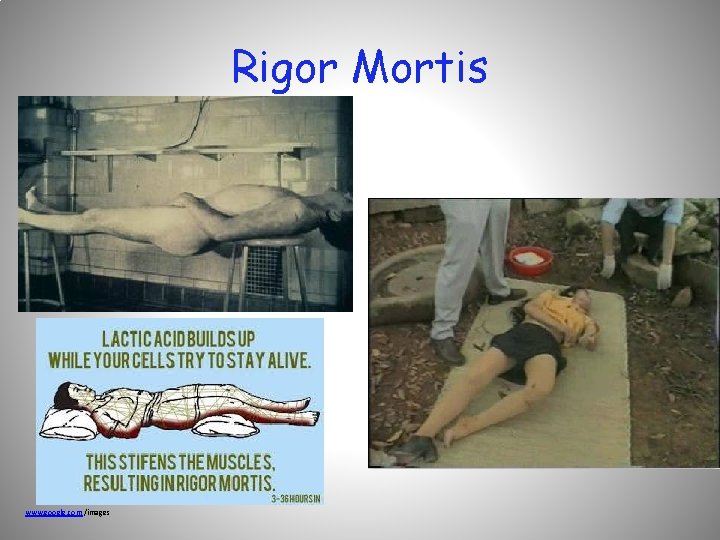
Rigor Mortis www. google. com /images
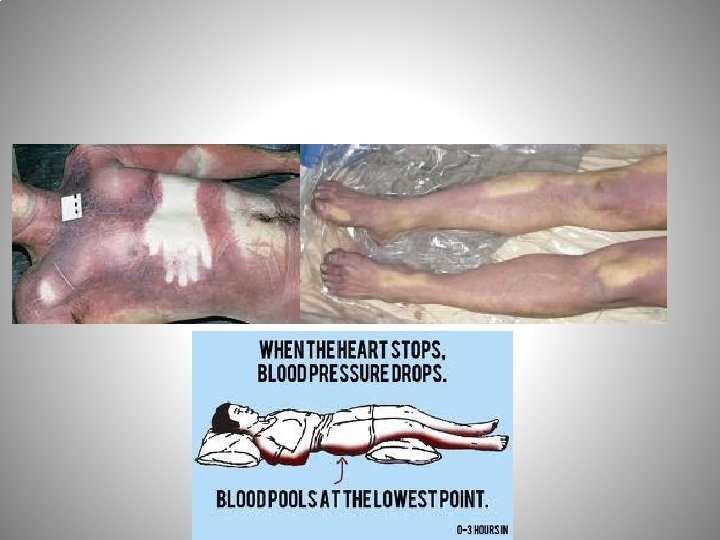
Livor Mortis • Lividity or (livor mortis) occurs when the blood stops moving in the body because the heart has stopped pumping. • Remaining blood will settle due to gravity giving the body a purple discolored area where the blood settles. • Lividity begins within 30 minutes of death and lasts for up to 12 hours. • Within the first 6 hours, it can be altered by moving the body. After 6 hours it becomes fixed because the blood vessels break down.
Algor Mortis • Body temperature begins to drop after death and skin becomes less elastic • A corpse of average weight in an air temperature of 20 degrees Celsius would experience a temperature drop of approximately 1. 5 degrees per hour. • Temperature change is faster: thin or malnourished corpse; low temperatures or windy conditions • Temperature change is slower: obesity; fever at time of death; high air temperature
Measuring Body Temperature • Human body temperature varies but on the average is 98 F or 37 C. Person’s with higher metabolism usually have slightly higher body temperatures. • The location where temperature is taken also affects reading: mouth (98 or 37) armpit (97. 6 or 36. 4) • Rectal temperature is closest to core body temperature.
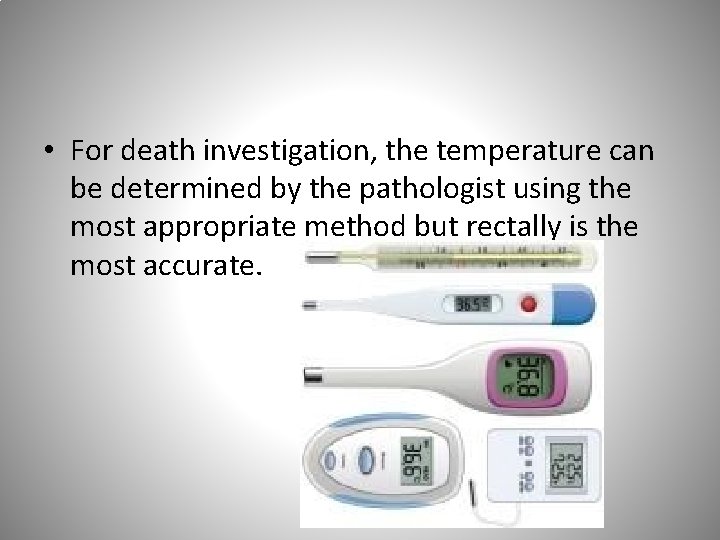
• For death investigation, the temperature can be determined by the pathologist using the most appropriate method but rectally is the most accurate.
Stages of Decomposition • Initial decay: the fresh stage – Corpse appears normal on the outside – Internally decomposition is occurring (autolysis) – Skin slippage starts due to fluid leaking out of cells • Putrefaction: bloated stage – Odor of decaying flesh present – Corpse appears swollen due to gases produced during internal decomposition processes; most noticeable in abdomen, mouth, tongue, genitalia – Bacteria inside body are feeding and producing gases
• Black putrefaction: – very strong odor – Parts of flesh appear black – Gases escape and corpse collapses (body is dissolving itself) • Butyric Fermentation: – Corpse begins to dry out; most flesh is gone • Dry Decay: – Corpse is almost dry; further decay is slow due to lack of moisture http: //australianmuseum. net. au/Stages-of. Decomposition
Factors Affecting Decomposition • Warm, wet weather speeds up decay • Cold, dry weather slows down decay • Large masses of larvae feeding on the corpse can also speed up decomposition because the temperature increases
Examination of the Eye The vitreous humor of the eye shows an increase in potassium level up to 24 hours post mortem.
Autopsy • The pathologist will gather information about the deceased: – Basic statistics such as height, weight, age, sex, ethnicity – Record external observations: marks, scars, tatoos, bruising, wounds, etc. – Recover and store any trace evidence – Extract blood and urine samples for toxicology or other studies
Cut a Y-incision and remove breast plate Remove, examine and weigh major organs Collect stomach contents and examine Take blood, urine and tissue samples if not already done • Open skull and examine brain • Return bodily contents; stitch up skull and body chest • Write up autopsy report/conclusions • •
Entomological Data • Forensic Entomology: • Early Cases: –Judge Sung Tz’u –Dr. Bergeret d’Arbois application of the scientific study of insects to criminal and civil investigations • It rarely links an individual to a crime or location. It provides data used to determine the time that elapsed between actual death and discovery of the body. (post mortem interval) • Duties of a Forensic Entomologist –Collect and prepare insects for identification –Provide accurate identifications –Make references on the age of larval stages based on size and stage of larvae present in a crime scene sample –Work with experts in other disciplines
Life Cycle of the Insect • Adult: –Hard body –Segmented –Six legs –One or two pairs of wings –Three distinct body regions • Head • Thorax • abdomen • Larval Forms –Soft body –Often no legs –Segmented –Worm-like Insects are one of the most numerous and diverse groups of Organisms with approximately one million species described and named.
• The insects of forensic interest are flies (dipterans) and beetles (coleopterans). • Two groups of flies, the blow fly and the flesh fly, live on carrions or carcasses. • Usually first to arrive to the corpse after death. • Adult blowfly: iridescent blue, green, copper or black body • Adult flesh fly: gray with three distinct longitudinal dark stripes on the dorsal thorax. • Some beetles will also occupy the corpse but are less common and arrive later. • Some flies prefer the fresh corpse and others later stages such as bloated or dry. • The ordered series of insects arriving to the corpse is called a succession.
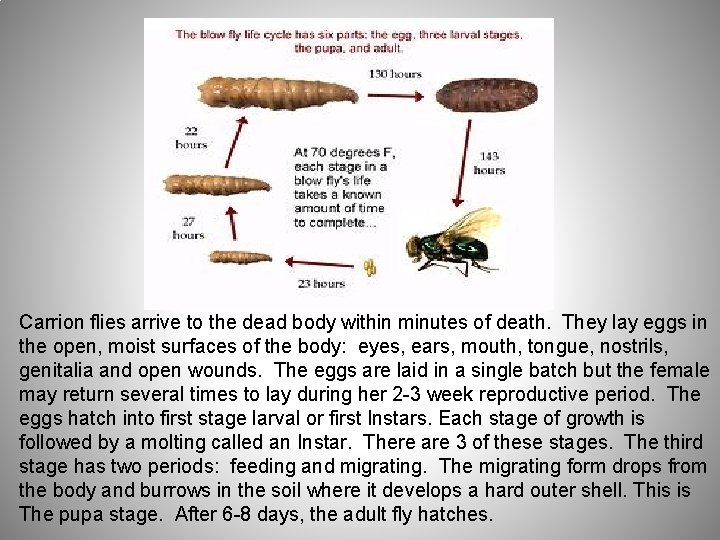
Carrion flies arrive to the dead body within minutes of death. They lay eggs in the open, moist surfaces of the body: eyes, ears, mouth, tongue, nostrils, genitalia and open wounds. The eggs are laid in a single batch but the female may return several times to lay during her 2 -3 week reproductive period. The eggs hatch into first stage larval or first Instars. Each stage of growth is followed by a molting called an Instar. There are 3 of these stages. The third stage has two periods: feeding and migrating. The migrating form drops from the body and burrows in the soil where it develops a hard outer shell. This is The pupa stage. After 6 -8 days, the adult fly hatches.
Factors affecting Fly Activity and Oviposition (laying of eggs) • If the body is protected from flies by enclosure such as a car trunk. • If there is a large larval mass causing increased rate of decomposition • If two or more species have colonized the same body • Flies are generally inactive at night and during rain • Time of year: some are active in spring, some fall, some year round

Video links http: //video. nationalgeographic. com /video/real-csi-sci
- Slides: 26