
Death and Loss Chapter 4 Facing Our Mortality

- Slides: 40
Death and Loss Chapter 4
Facing Our Mortality ò From a humanistic existential perspective, it is important to face the fact that our lives will end some day, because when we do this life become more precious. ò Acknowledgment of mortality gives a sense of urgency to do the things we want to do in life.
Facing Our Mortality ò Philosophies Mind over matter Suffering is inevitable and a “grace” Adversities can provide enlightenment We must develop an effective way of dealing with crisis The meaning we assign to death affects the meaning we find in life
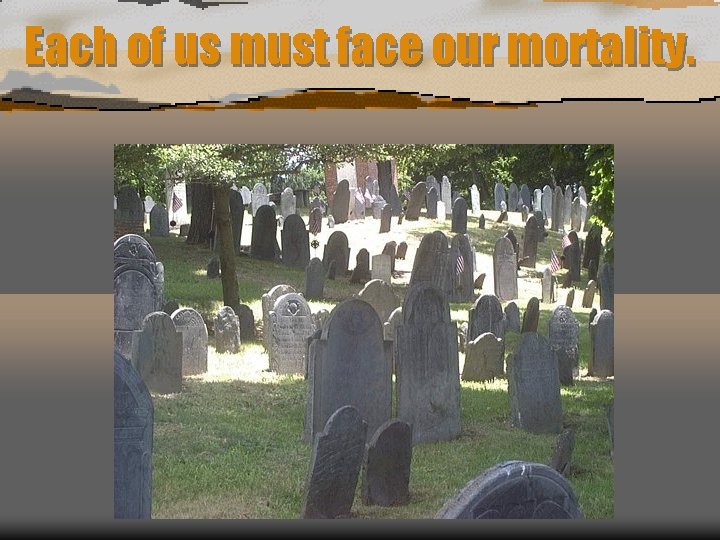
Each of us must face our mortality.
Are we a death-denying society? ò Does living in a society that avoids talking about death make facing our own inevitable end more difficult? What are some of the ways that U. S. culture hides death or makes us less aware of death?
Ways the U. S. Culture Denies Death Not discussing death Encouraging plastic surgery Placing our elderly in residential homes Failing to save for retirement Not buying long-term care insurance Using euphemisms for the word “death” Fitness/health craze Not making a will Not making funeral arrangements Cartoon characters are “killed” and then
Facing Our Mortality, continued People in the U. S. tend to avoid talking about death, which may make facing death more difficult. Having a serious illness may make a person feel like a “social leper. ” Instead, would it be a good idea to acknowledge death, so that we won’t have to fear it so much?
Facing Our Mortality, concluded ò Embracing the naturalness of death may enable us to enjoy life without fear. ò We may find that developing a more comfortable sense of death will lessen our fear of it. “ It is the denial of death that is partially responsible for people living empty, purposeless lives; for when you live as if you would live forever, it becomes too easy to postpone things that you must do” (E. ò
Means of Symbolically Conquering Death ò There a variety of ways that human beings attempt to come to terms with their mortality. ò Death does not have a solution but by being more accepting of it and less frightened by it, a person can live with the reality of death.
Means of Symbolically Conquering Death What are some of the ways mentioned in the chapter that people use to triumph over death?
Means of Symbolically Conquering Death Ways of facing and possibly accepting death include: Living on through one’s children Leaving a creative product behind, a “great work”; a legacy Exerting personal influence that outlives the person himself/herself Continuing on as an eternal part of nature on the molecular level Meeting death with machismo or defiance to “trump” death with a show of courage A life well and thoroughly lived can be a satisfying response to awareness on one’s mortality. Exercising power over others is a destructive way of handling one’s mortality.
Stages of Death Elisabeth Kubler-Ross worked with terminally ill patients, and she identified five stages of dying: – Denial – Anger – Bargaining – Depression – Acceptance
Your Turn! What do you think? Should Kubler. Ross’ list of the stages of death be a fixed series of stages to go through in order?
Your Turn! What do you think? Should Kubler-Ross’ list of the stages of death be a fixed series of stages to go through in order? Possible answer: When Kubler-Ross’ observations were first published, nurses sometimes chastised dying patients for “being in the wrong stage” or “not progressing quickly enough’ to the next stage. Also, some dying individuals felt guilty because they hadn’t “achieved acceptance. ” Obviously, these examples represent a serious misunderstanding of the emotional reactions to
The Grieving Process More often, it isn’t our own imminent death, but that of a loved one which afflicts us. The loss of a loved one typically precipitates a “normal” state of depression which we call grieving. It isn’t unusual for this process to last for a year. It is unusual for a person to still be grieving three or more years after losing a loved one,
Typical responses to facing death: disbelief, sadness, anger, feelings of helplessness and hopelessness, fear, guilt, lack of motivation and interest in usual activities a need to talk and stay focused on recounting events that lead up to the death, a resurfacing of psychological problems which the person may have struggled with at a prior time
Coping with Death ò ò ò Expect an array of emotions Forgive yourself for what you did or did not do for the person Try to be there for those suffering a terminal illness Talk to others who share in your grief Cry and/or scream when you feel it is necessary Seek help from friends/professionals- do not go through the experience alone
Choosing Death People who feel pessimistic and hopeless about their lives and about the future at risk for suicide ò Some elect suicide as a means for escaping from unbearable psychological pain ò Depression is linked with thought patterns that are self -defeating depressed people are not capable of rationally considering their options ò When depressed people are helped through the crisis of feeling suicidal, they are generally grateful ò
Choosing Death, concluded ò Assisted suicide and euthanasia has surfaced as an ethical issue ò Approximately 90% of Californians favor euthanasia under certain circumstances
Chapter 4 Activity ò Complete your text. “My Epitaph” on p. 112 of
Suicide Depressed people are at risk for suicide. Suicide ranks as the 7 th cause of death in the U. S. For youth ages 15 -24, suicide is the third most common cause of death. Approximately 1 person out of 100 attempts suicide during his or her life.
Gender and Suicide More women attempt suicide; more men succeed. The ratio of attempted suicides for male to female is 1: 4. The ratio of completed suicides for male to female is 4: 1. Men use more lethal means, typically guns. Women use poisons, especially
Why do people commit suicide? The psychological factor most frequently associated with a serious suicide intent is the person’s sense of hopelessness. Most people attempt suicide to escape a situation that they perceive as intolerable. They may decide that being dead is better than a futile struggle to find meaning in life. Contemplating suicide may give people a renewed sense of power over their own lives.
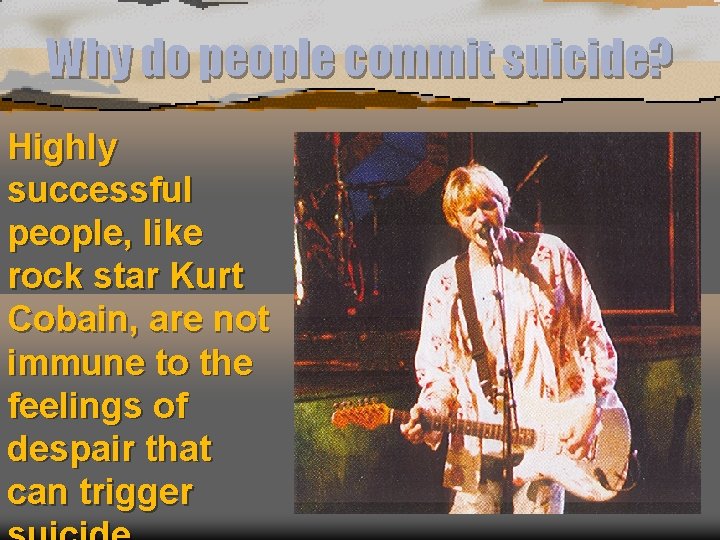
Why do people commit suicide? Highly successful people, like rock star Kurt Cobain, are not immune to the feelings of despair that can trigger
Why do people commit suicide? ò Not all who consider or attempt suicide want to die. ò Some symbolic meanings of suicide mean: A cry for help A form of self-punishment An act of hostility An attempt to control others An attempt to be noticed A relief from depression An escape from an impossible situation A relief from hopelessness An end to pain
Who is most at risk for suicide? ò Most suicides occur among older people. ò The groups most likely to commit suicide are: 1) depressed men over 40 years of age 2) single, divorced, or widowed persons 3) individuals who have experienced a recent bereavement 4) individuals who live alone 5) alcoholics (20% of alcoholic deaths are from
Assessing for Suicide Potential About 75% of completed suicides have a history of a previous attempt or threat. A person who has a concrete, workable plan, and the means to carry it out. Talk of suicide: Statements such as “I don’t want to go on living. ” Familiarity with lethal dosages of drugs or other forms of self-destruction
Assessing for Suicide Potential A sudden decision to make a will A sudden appearance of calm or improvement in mood in a previously agitated person A lack of concern about the usual deterrents to suicide such as hurting family, breaking religious rules, or the fact that suicide is an irreversible action. Conversely, the most reassuring reply is often a qualified denial, such as "Sometimes I think about it, but I would
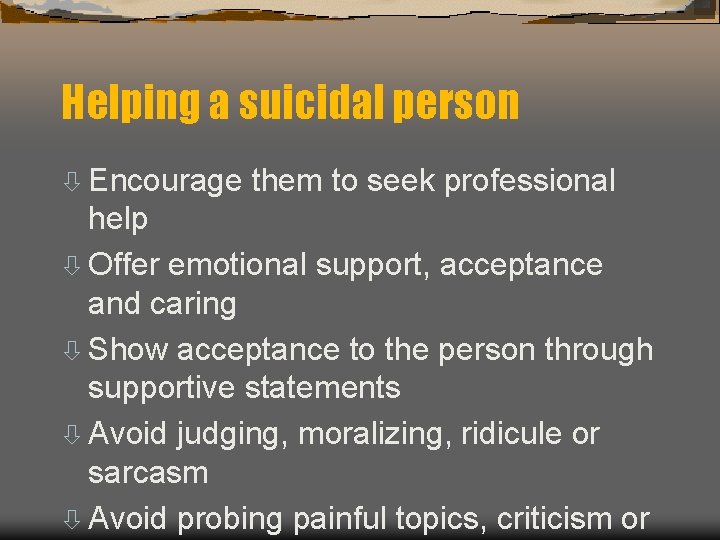
Helping a suicidal person ò Encourage them to seek professional help ò Offer emotional support, acceptance and caring ò Show acceptance to the person through supportive statements ò Avoid judging, moralizing, ridicule or sarcasm ò Avoid probing painful topics, criticism or
Your Viewpoint ò If individuals wish to take their own lives, what right or obligation do others have to interfere?
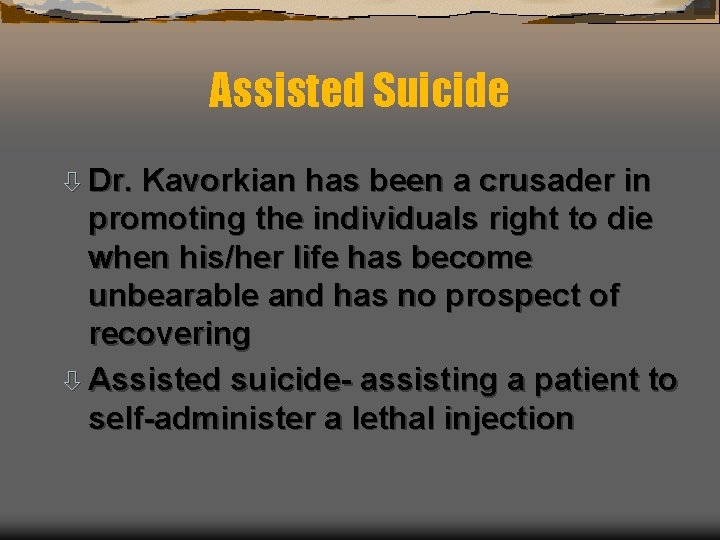
Assisted Suicide ò Dr. Kavorkian has been a crusader in promoting the individuals right to die when his/her life has become unbearable and has no prospect of recovering ò Assisted suicide- assisting a patient to self-administer a lethal injection
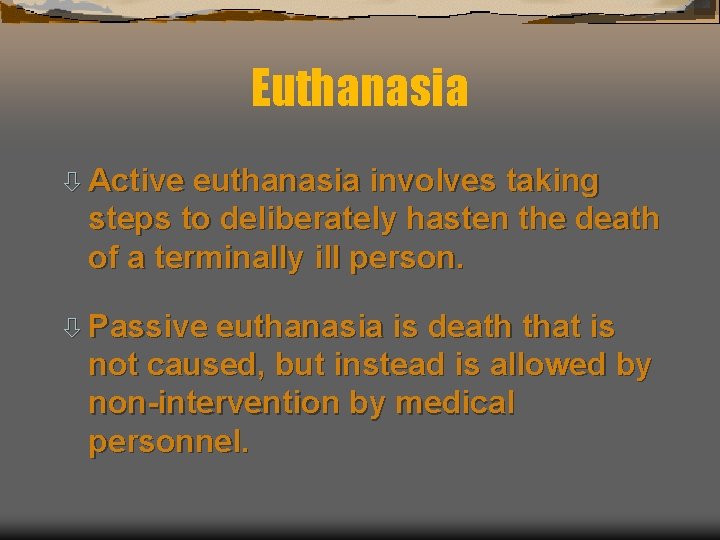
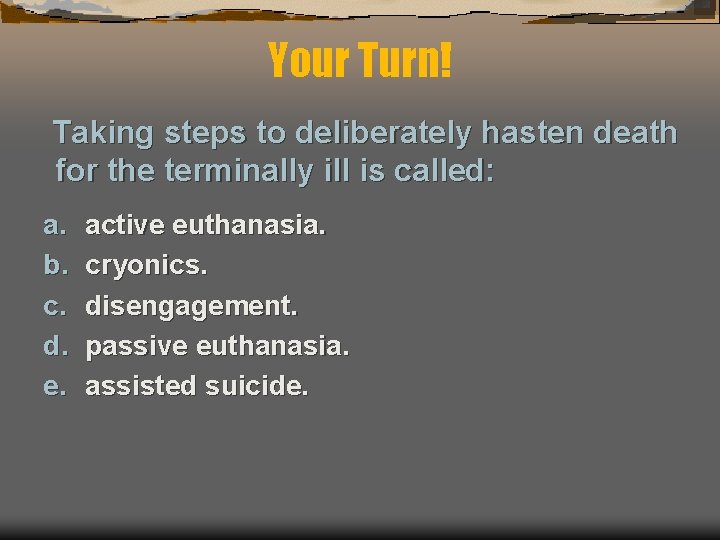
Euthanasia ò Active euthanasia involves taking steps to deliberately hasten the death of a terminally ill person. ò Passive euthanasia is death that is not caused, but instead is allowed by non-intervention by medical personnel.
Your Opinion ò Does an individual have a responsibility to stay alive under any circumstances? ò Does Dr. Kavorkian have the right to assist with suicide, considering his patients are experiencing extreme depression? ò Did you know? The most common concern
Being Psychologically “Dead” ò Living empty, joyless lives was equated with being psychologically dead. ò Being in a great hurry to get from one activity to the next may take away from our ability to appreciate our life experiences. ò Perhaps the best anecdote to this is to make much of occasions for celebrations.
Sources of Personal Growth ò Intellectual ò Social ò Physical and Emotional
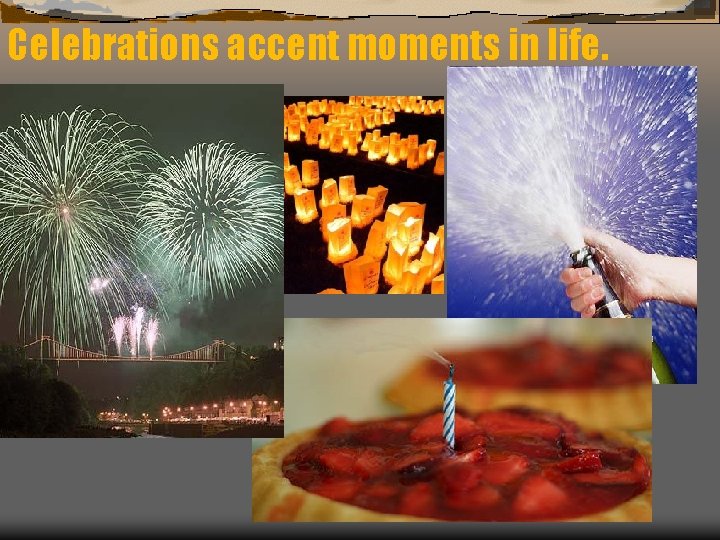
Celebrations accent moments in life.
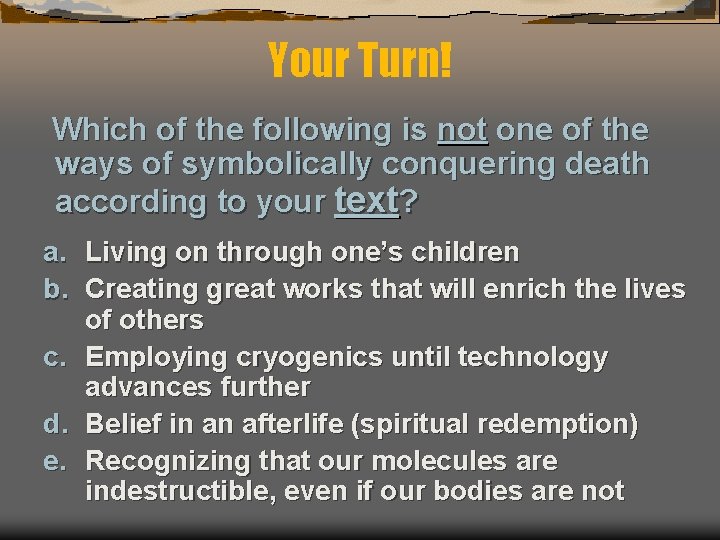
Your Turn! Which of the following is not one of the ways of symbolically conquering death according to your text? a. Living on through one’s children b. Creating great works that will enrich the lives of others c. Employing cryogenics until technology advances further d. Belief in an afterlife (spiritual redemption) e. Recognizing that our molecules are indestructible, even if our bodies are not
Your Turn! Taking steps to deliberately hasten death for the terminally ill is called: a. b. c. d. e. active euthanasia. cryonics. disengagement. passive euthanasia. assisted suicide.
Chapter 4 - Review
Death and Loss End of Presentation