
DEATH AND DYING Caring for the Pediatric Patient




- Slides: 22
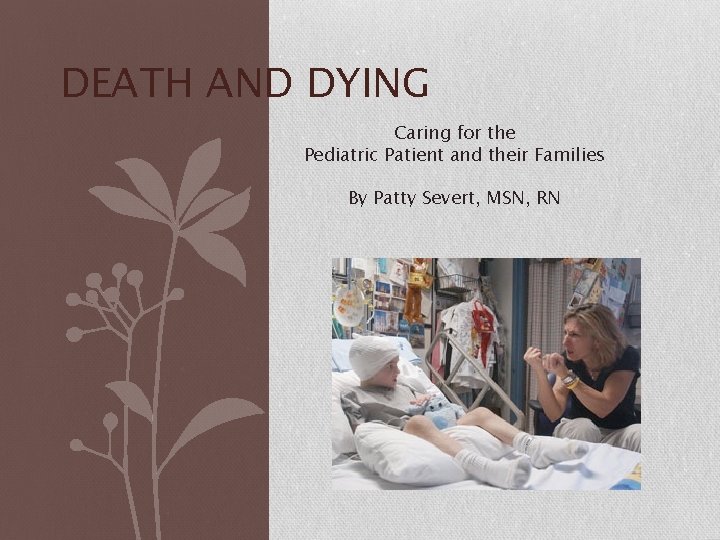
DEATH AND DYING Caring for the Pediatric Patient and their Families By Patty Severt, MSN, RN
Objectives for Learning Objective 1: Be able to state the differences between the death of an elderly loved one versus a pediatric loved one. Objective 2: Be able to examine the nurse’s perspective of losing a pediatric patient. Objective 3: Be able to apply various principles for consideration in caring for the dying child. Objective 4: Be able to incorporate the family and others into the dying child’s plan of care. Objective 5: Be able to apply the dying person’s Bill of Rights to the pediatric patient. Objective 6: Evaluate your own feelings about death and dying. Objective 7: Examine and understand what a child considers a loss. Objective 8: Examine and understand the child’s experience with death.
“There are lots of living things in our world. Each one has its special lifetime. All around us, everywhere, beginnings and endings are going on around us all the time. So, no matter how long they are, or how short, Lifetimes are really all the same. They have beginnings and endings, and there is living in between. ”(Sumner, 2006)
Children’s Experience with Death and Loss Significant deaths for children: q Parents q Grandparents q Siblings q Friends Significant losses for children: q Loss of parent d/t separation or divorce q Loss of a pet q Loss of a possession q relocation Significance of death and other losses to the child depend on: Ø __________________
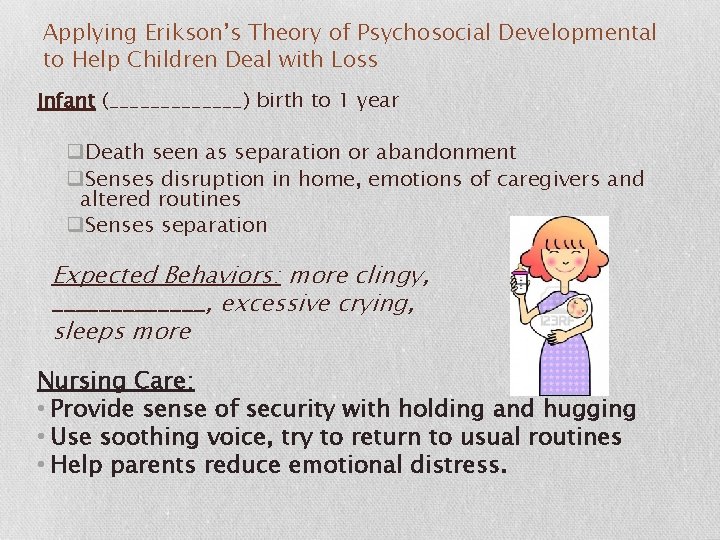
Applying Erikson’s Theory of Psychosocial Developmental to Help Children Deal with Loss Infant (_______) birth to 1 year q. Death seen as separation or abandonment q. Senses disruption in home, emotions of caregivers and altered routines q. Senses separation Expected Behaviors: more clingy, _______, excessive crying, sleeps more Nursing Care: • Provide sense of security with holding and hugging • Use soothing voice, try to return to usual routines • Help parents reduce emotional distress.
Applying Erikson’s Theory of Psychosocial Developmental to Help Children Deal with Loss Toddler (______________) Ages 1 -3 q. Does not understand true concept of death q. Aware of someone missing – separation anxiety q. Can not distinguish death from temporary separation or abandonment Expected Behaviors: _______, clingy, decreased activity, whiny, irritable, biting, hitting, crying; problems sleeping or eating; alternates between grieving and playing; fearful Nursing Care: • Continue _________ • Continue to __________(remove and put on clothes, brush teeth, feed self) • Use distraction • Be tolerant of regressive behaviors • Encourage parents to hold and cuddle toddler
Applying Erikson’s Theory of Psychosocial Developmental to Help Children Deal with Loss Preschool (__________) Ages 3 -6 q. Death is ______and dead person will return q. Confuses death with being asleep q. Death may be seen as punishment q____________(believes his/her actions caused death) q. Beginning experiences with death of animal or plants Expected Behaviors: • Regression • Uses play activities to cope • Asks when deceased will • • • come back or what they “did” Fears going to sleep, nightmares, afraid of dark Crying spells May mimic adult behavior Seems morbid/fascinated with death Asks many questions C/o abdominal pain Nursing care: • • • Be tolerant of regression Provide honest, consistent responses to questions Encourage usual routines Assure child you will be with him/her Encourage parents to keep memories alive with pix, reminder objects of loved ones Suggest rituals: cemetery, balloon release, planting flowers
Applying Erikson’s Theory of Psychosocial Developmental to Help Children Deal with Loss (continued. . ) School Age -Ages 6 -12 (____________) q Understands temporary separation vs death q Recognizes death as __________ q Begins to realize he/she will also die q By 9 -10, understanding of death same as adults q May have guilt or assume blame for death q May not realize death can occur at any age Expected behaviors: • • • Crying Moody, withdrawn Angry outburst May deny sadness and hide tears (act like an adult) Decreased concentration on schoolwork/refuse to go to school Develop morbid interest in dead things and death symbols Fear another loved one will die Try to comfort parents by taking over tasks ________ complaints – abd pain/HA Nursing Care: • Listen to child answer • • honestly Usual routines and activities involving child’s peers Reassure will not be abandoned Keep memories alive (cemetery, music, memory book, sew a quilt, plant a garden) Coping support groups; internet resources; encourage faith-based activities
Applying Erikson’s Theory of Psychosocial Developmental to Help Children Deal with Loss Adolescent - Ages 12 -18 (____________) q. Intellectually capable of understanding death q. Recognizes all people, including self, must die q. Better grasp between illness and death q. Sense of ____________ conflicts with death q. Recognizes effect of death on others Expected behaviors: • Severe depression • Mood swings • Withdrawal from friends • Angry; guilty; girls seek comfort from friends • Eating/sleeping issues attempt to confront or deny death as adversary (leads to risky or acting out behaviors) • Uses abstract or philosophic reasoning Nursing Care: • Be available and encourage open communication • Keep memories alive • Inform about counseling and support groups and internet resources • Encourage faith-based
Switching Gears
How do nurses feel about death? “Nurses are very committed to life and health. The dying patient is a contradiction to a nurse’s commitment. ” (TLC Nursing, 2013) q Many nurses see death of a patient as a failure (of care and skills). q However, nurses can help patients and their families in their end-of-life process with our education and compassion.
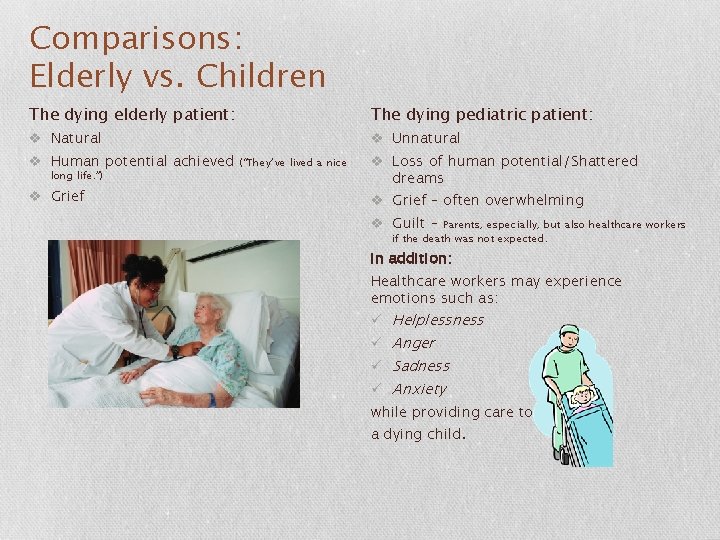
Comparisons: Elderly vs. Children The dying elderly patient: The dying pediatric patient: v Natural v Unnatural v Human potential achieved long life. ”) v Grief (“They’ve lived a nice v Loss of human potential/Shattered dreams v Grief – often overwhelming v Guilt – Parents, especially, but also healthcare workers if the death was not expected. In addition: Healthcare workers may experience emotions such as: ü Helplessness ü Anger ü Sadness ü Anxiety while providing care to a dying child.
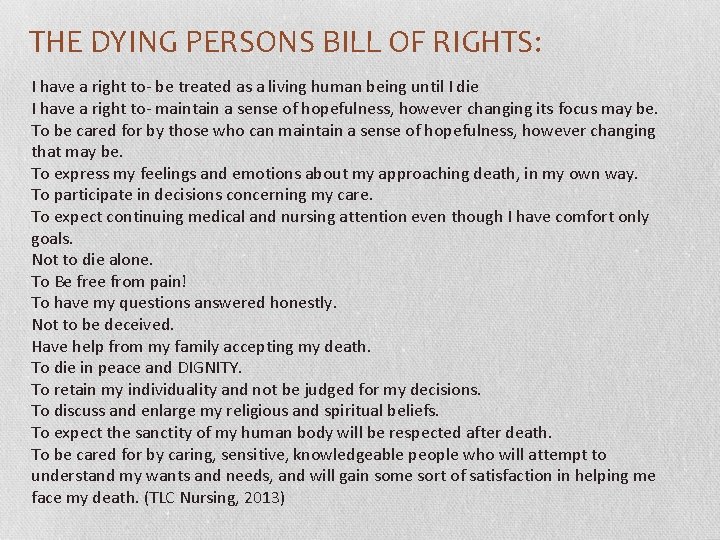
THE DYING PERSONS BILL OF RIGHTS: I have a right to- be treated as a living human being until I die I have a right to- maintain a sense of hopefulness, however changing its focus may be. To be cared for by those who can maintain a sense of hopefulness, however changing that may be. To express my feelings and emotions about my approaching death, in my own way. To participate in decisions concerning my care. To expect continuing medical and nursing attention even though I have comfort only goals. Not to die alone. To Be free from pain! To have my questions answered honestly. Not to be deceived. Have help from my family accepting my death. To die in peace and DIGNITY. To retain my individuality and not be judged for my decisions. To discuss and enlarge my religious and spiritual beliefs. To expect the sanctity of my human body will be respected after death. To be cared for by caring, sensitive, knowledgeable people who will attempt to understand my wants and needs, and will gain some sort of satisfaction in helping me face my death. (TLC Nursing, 2013)
Pediatric Deaths Nurses and staff must consider: o The individual o Their culture o Ethics o Legalities o Spirituality o Biological influences
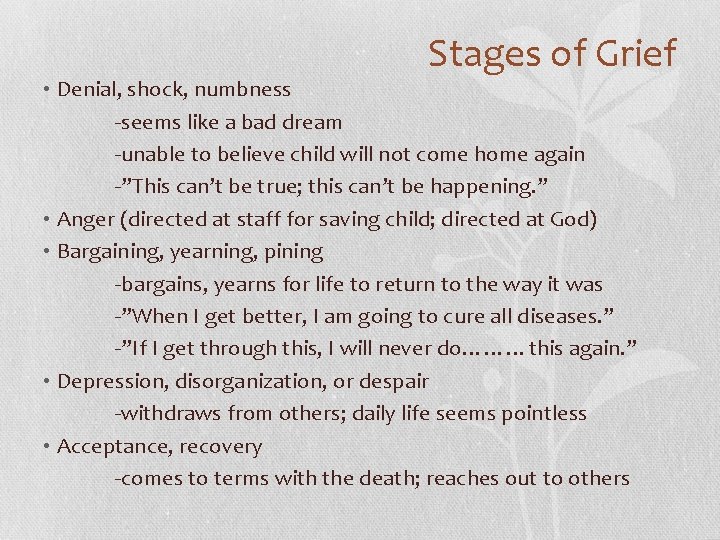
Stages of Grief • Denial, shock, numbness -seems like a bad dream -unable to believe child will not come home again -”This can’t be true; this can’t be happening. ” • Anger (directed at staff for saving child; directed at God) • Bargaining, yearning, pining -bargains, yearns for life to return to the way it was -”When I get better, I am going to cure all diseases. ” -”If I get through this, I will never do………this again. ” • Depression, disorganization, or despair -withdraws from others; daily life seems pointless • Acceptance, recovery -comes to terms with the death; reaches out to others
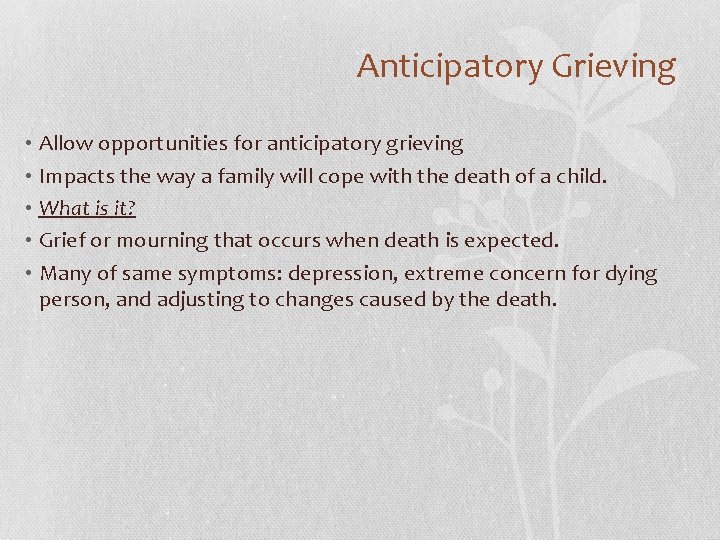
Anticipatory Grieving • Allow opportunities for anticipatory grieving • Impacts the way a family will cope with the death of a child. • What is it? • Grief or mourning that occurs when death is expected. • Many of same symptoms: depression, extreme concern for dying person, and adjusting to changes caused by the death.
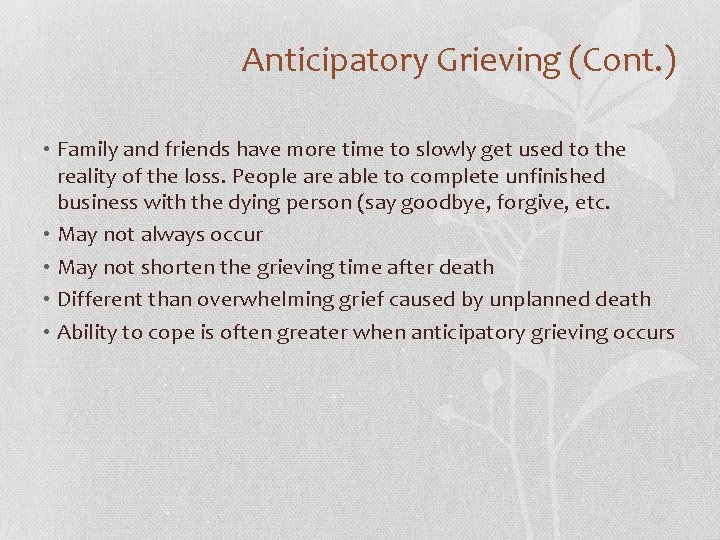
Anticipatory Grieving (Cont. ) • Family and friends have more time to slowly get used to the reality of the loss. People are able to complete unfinished business with the dying person (say goodbye, forgive, etc. • May not always occur • May not shorten the grieving time after death • Different than overwhelming grief caused by unplanned death • Ability to cope is often greater when anticipatory grieving occurs
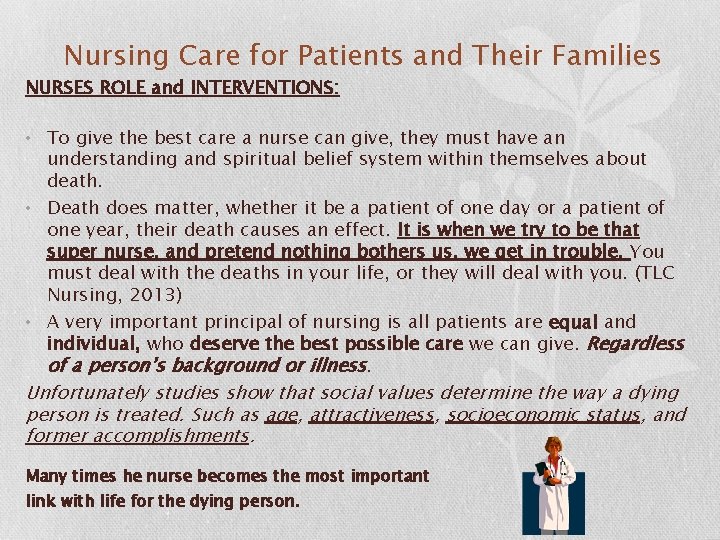
Nursing Care for Patients and Their Families NURSES ROLE and INTERVENTIONS: • To give the best care a nurse can give, they must have an understanding and spiritual belief system within themselves about death. • Death does matter, whether it be a patient of one day or a patient of one year, their death causes an effect. It is when we try to be that super nurse, and pretend nothing bothers us, we get in trouble. You must deal with the deaths in your life, or they will deal with you. (TLC Nursing, 2013) • A very important principal of nursing is all patients are equal and individual, who deserve the best possible care we can give. Regardless of a person’s background or illness. Unfortunately studies show that social values determine the way a dying person is treated. Such as age, attractiveness, socioeconomic status, and former accomplishments. Many times he nurse becomes the most important link with life for the dying person.
Nursing Care of the Dying Child and their Family Ø Provide comfort • pain meds (opioids) – usually PCA pump if child of age • distraction (massage) • position for optimal respiratory exchange Ø Assist the family and child with coping strategies Ø Assist child in a peaceful death Ø Facilitating Grief (work with chaplain) Ø Help Make Memories : * Footprints/handprints * Memory box (lock of hair, ID band, clothing, etc) * Scrapbook page * pictures
Nursing Care of the Dying Child and their Family (cont) Family support as the child dies: o Parents need to be present o Parents may want familiar staff on that day o Work closely with family – this is the memory they will have the rest of their lives o Private room for child and family o Ask about final moments o The child should NEVER be alone
Now I Lay me Down to Sleep https: //www. nowilaymedowntosleep. org/about/mission-and-history/
http: //youtu. be/Lm. JXw 5 wj. Tow