
Dealing with Scientific Rejectionism From Biophotonic Therapy to
Dealing with Scientific Rejectionism From Biophotonic Therapy to Immanuel Velikovsky
Scientific Rejectionism (SR) 1. SR, the reflexive rejection of new ideas by established scientists, has a long history; and it is going on right now! 2. In recent decades rejecters have been joined by professional skeptics. 3. Rejecters have credibility with the media and public. 4. They control journals (editor’s desk review, peer review). But the Internet and self-publishing offer other ways to spread ideas. 5. They have access to funding. Funders fund people, not ideas. 6. Rejecters ignore or fiercely attack those who challenge standard science.
The Psychology of Rejectionism 1. Many scientists fit into the Myers-Briggs Judging category: they excel at mathematics, technical detail, and judging. 2. They can be weak as Myers-Briggs Perceivers, lacking the imagination to detect new patterns and entertain unusual ideas. 3. Operating within the paradigm of normal, incremental science (Kuhn), they feel threatened by new and different ideas. 4. Perhaps rightly, many fear colleagues will think poorly of them for espousing or even mentioning a novel view that appears kooky or turns out to be wrong. 5. Trained to be critical thinkers, they pride themselves on their skepticism.
SR Stage 1: Ignore SR’s most powerful response to new ideas is to ignore them. Ignoring can go on for decades and can take many forms. 1. Many scientists are very busy and have no time for new ideas. 2. Scientists have their own ideas. Why pay attention to other people’s? 3. Previously energetic researchers can become lazy and stop questing. 4. Scientists reasonably prefer peer-reviewed papers to casual ones, but this keeps them from encountering breakthrough ideas. 5. Even if they read something new, they might feel uncertain or disagree with it.
SR Stage 2: Reject and Vilify 1. When a new idea gains traction, SR switches from Ignore to Reject and Vilify. 2. Rejecters focus on weaknesses and peripheral mistakes to distract attention from central, persuasive arguments for the idea. 3. Insisting on a mechanism of action and abundant quantitative data handed to them on a silver platter, they deny even provisional status to the idea. 4. They play parameter games and objection games. 5. Deeply ignorant regarding the new idea, rejecters put their egos into their objections. They must be told: “You need to do some reading!” 6. They try to deny proponents access to scientific journals and forums.
Confounders 1. False or unproven claims by hucksters (e. g. , supplements) 2. Genuine scientific errors (polywater, cold fusion? ) 3. Deliberate scientific fraud 4. Deniers of evolution and climate change who claim to be victims of SR 5. Dubious claims, sightings, and testimonials that skeptics love to bash Scientific rejecters and skeptics often can’t see (or pretend not to see) the difference between confounders and worthy new ideas. Also, all of us should be skeptical of some new ideas. E. g, The original surface of the Pacific Basin is now the surface of the southern hemisphere of Mars! Many new hypotheses turn out

Biophotonic Therapy
Biophotonic Therapy 1. Biophotonic Therapy (Ultraviolet Blood Irradiation, Photoluminescence Therapy, etc. ) uses ultraviolet and visible light to treat a small amount of blood, which is then reinfused. It can also be administered intravenously with a 633 nm low-intensity laser. 2. First deployed in the U. S. in 1928, BT is now used worldwide. There are perhaps 300 American practitioners. The original device has FDA clearance. 3. BT’s biochemical mechanisms of action are well-characterized. 4. It has a wide range of indications and some counter-indications. 5. BT is the leading phototherapy of infectious diseases. It stimulates an ancient
BT--Key Perceptions 1. The original misbranding (Ultraviolet and Irradiation) has spooked out many, including medical doctors. 2. Working out the proper dosage was a crucial step. BT has never caused cancer, but a massive overdose could harm respiration, etc. Often it is underdosed. 3. Light is a drug. BT can have side effects, but they tend to be smaller than those of drugs. 4. Although BT has a literature of some dozen books and 400 journal articles in Russian, German, and English, better clinical studies are needed.
BT and SR 1. 1940 s critics mistook BT’s mechanism of action, underdosed tests, and conducted sloppy, scattergun, AMA-funded clinical studies to discredit it. 2. BT is almost never mentioned in the standard medical literature, is never discussed by science writers, and is often overlooked in books on alternative medicine. Many physicians have never heard of it. 3. Skeptics ignore BT or attack it with arguments that reveal their ignorance. 4. Bias against Russian BT science has contributed to rejection. 5. Medical funders’ refusal to test BT against HIV, multidrug-resistant TB, etc. is a shocking case of criminal negligence.
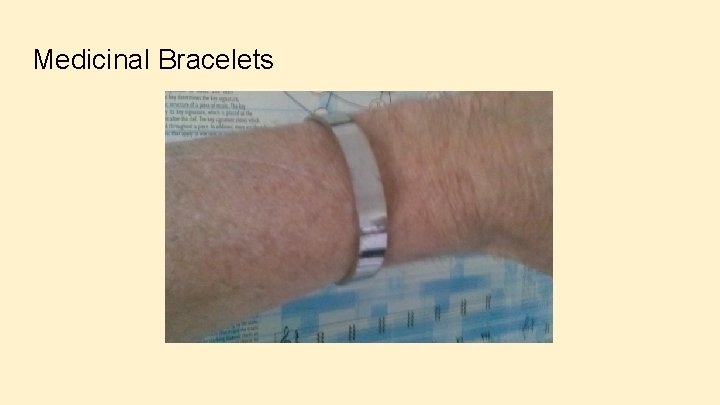
Medicinal Bracelets
The Science of Medicinal Bracelets 1. A 90% copper and 10% zinc bracelet works as a passive iontophoresis device. The sacrificial anode zinc is deposited by the copper cathode onto the skin in an electrochemical reaction that helps the skin absorb it. 2. Transdermal Micronutrition comes from our distant ancestors, who relied on the skin for food intake. In a case of iron deficiency, “anchoring” the body to a bracelet containing iron triggered a shift, characterized as being from a medusa-like stage to a polyp-like one, as well as a strong healing response. 3. Provisional indications include arthritis in the hands, tremor, prophylaxis (by substitution) against environmental toxic substances, Hidden Hunger for micronutrients in craving for food and drugs, and immunostimulation with zinc.
Medicinal Bracelets: Key Perceptions 1. Transdermal microminerals can have better action and fewer side effects than orally ingested microminerals. 2. They are most effective in malnutrition and disease states. 3. The many explanations of medicinal bracelets include biophysical ones (embedded magnets and electrical fields around copper rings affect RBCs). Bracelets can be a placebo but also convey effects beyond placebo. 4. Copper and zinc work best. Transdermal iron has scientific value but stains skin and clothing. Other elements could cause overdoses. 5. Silver anklets in South Asia may cause anemia by substitution of silver ions
Medicinal Bracelets and SR 1. Rejecters and skeptics never experiment with bracelets. They should be challenged to do so in order to be taken seriously. 2. The passive, inexpensive, imprecise nature of bracelets, the difficulty of defining a single main mechanism, the shortage of clinical data, and the lack of standardization allow the medical establishment to reject them. 3. Mainline scientists will not deal with them, even though every true scientist should be eager to understand their mechanisms. 4. Science writers and editors never address medicinal bracelets, though millions of people use them and there is some evidence of efficacy.
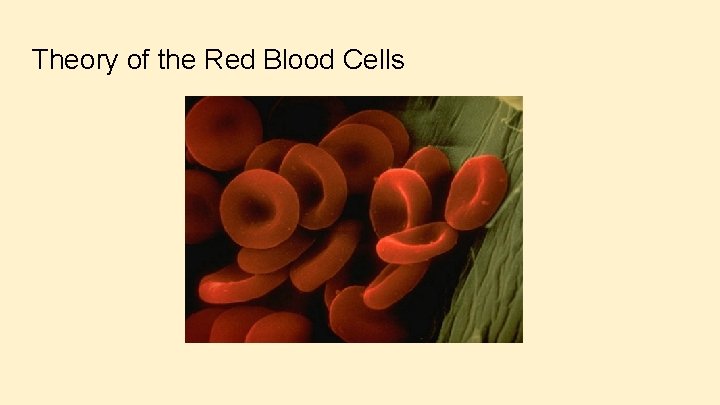
Theory of the Red Blood Cells
Theory of the Red Blood Cells 1. RBCs differ radically from other cells. They constitute a metacolony that operates in real time, with capabilities inherited from our distant ancestors. 2. Russian scientists determined that RBCs are the dermal-optic photoreceptor. 3. They match 18 criteria for the animal magnetoreceptor and analyzer. 4. They match 14 criteria for the cellular basis of consciousness, or more specifically for the solution of the binding problem of consciousness. 5. The RBC metacolony also seems to serve as the ultrasensitive Psi receptor, analyzer, and transmitter. If this can be demonstrated, it will provide the locus of the long-sought mechanism of parapsychology.
TRBC--Key Perceptions 1. RBCs sharply differ from other cells and have metakaryotoid characteristics, fitting them to act as a metacolony. 2. In real time the blood is a well-ordered system. 3. If the RBCs form the dermal-optic photoreceptor, then we must ask whether they also constitute the animal magnetoreceptor, the binding solution of consciousness, and the ultrasensitive Psi receptor. 4. Reception and analysis must take place in the same cells. 5. The iron in hemoglobin makes the RBCs a prime candidate for the animal magnetoreceptor.
TRBC and SR 1. A neuroscientist’s reaction to the RBCs as the binding cells: “The red blood cells!” 2. An alternative medicine researcher said: “I had an idea like this in the 1980 s”, followed soon after by “You don’t expect me to believe this? ” 3. The theory has already been published in self-published books and on a Website, so why should any journal publish it? 4. What editor and peer reviewers would possibly accept an article on TRBC? 5. Nobody will discuss TRBC or even attack it. 6. TRBC is, of course, a bit mind-bending! But the perceptions and the
Immanuel Velikovsky
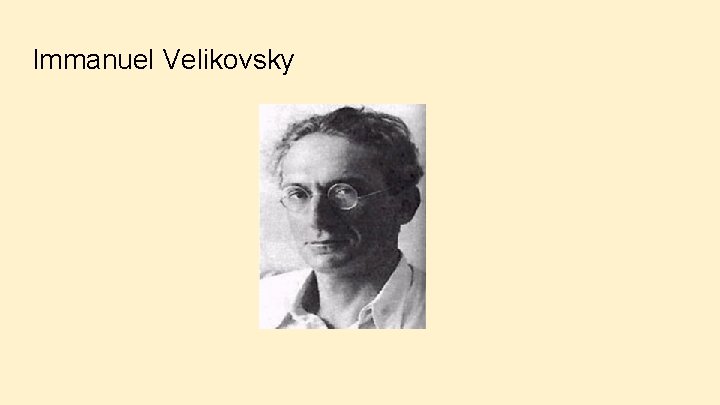
Immanuel Velikovsky, 1895 -1979 1. Velikovsky was a psychoanalyst and MD who was born in Russia and lived in Palestine before coming to the U. S. 2. A diligent investigator and brilliant thinker, he argued in his Worlds in Collision (1950) that Venus had emerged from Jupiter and approached Earth repeatedly as a comet during the Bronze Age. 3. Relying on detailed knowledge of the Hebrew Bible, Velikovsky studied planetary and Earth science, myths, written accounts, and iconography. 4. In the biggest controversy in planetary science since Copernicus and Galileo, many scientists aggressively attacked Velikovsky.
Immanuel Velikovsky--Key Perceptions 1. New reinterpretation and evidence show that Velikovsky was right about Venus, except that Jupiter’s gravity pulled it from the outer solar system. 2. Velikovsky also interpreted a passage in Herodotus to mean that four times Venus approached close enough to cause the Earth to turn over. We now know the mechanism and possess an array of new supporting evidence. 3. The Venus theory and the Reversing Earth theory are outstanding contributions with great explanatory power. 4. Together with other researchers, Velikovsky promoted a theory of The Electric Universe; and he wrote on geology and ancient chronology.
Velikovsky and SR 1. A determined contrarian, Velikovsky addressed a wide range of subjects. Sometimes he was right, sometimes not. He could be dogmatic. 2. Although wiser heads called for further investigation, Velikovsky’s critics rushed to judgment, denouncing him as the arch-pseudoscientist. 3. Nowadays, some planetary scientists have never heard of him. 4. Velikovsky is rarely mentioned in newer scientific literature, and then only to disparage him. 5. The Velikovsky case remains the greatest ongoing instance of SR against an individual scientist.
Final Thoughts 1. Western Civilization will not collapse if some people believe in Bigfoot. 2. The scientist with a new idea needs to protect himself/herself from frustration, waste of time (Get to No), bitterness, depression, and career damage. 3. Finding partners and emphasizing forerunners can restrain egotism. 4. Identifying a mechanism of action can prove very persuasive. 5. Scientists need instruction in the nurturing of new ideas. 6. Vested interests support SR, but often the driving force is group psychological commitment to a paradigm that rejecters view as scientific truth.
Reading List Thomas Kuhn. The Structure of Scientific Revolutions Brian Martin, ed. Confronting the Experts Immanuel Velikovsky. Worlds in Collision Dean Radin. Supernormal: Science, Yoga, and the Evidence for Extraordinary Psychic Abilities Peter Warlow. The Reversing Earth www. skepticalaboutskeptics. org www. scientiapress. com
- Slides: 24