
DEALING WITH BEHAVIORAL PROBLEMS Education 583 Dr Beverly
DEALING WITH BEHAVIORAL PROBLEMS Education 583 Dr. Beverly A. Doyle, Ph. D.
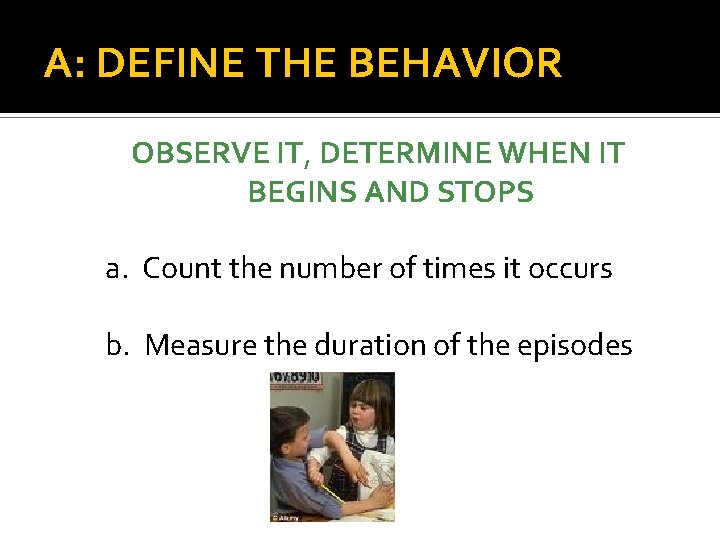
A: DEFINE THE BEHAVIOR OBSERVE IT, DETERMINE WHEN IT BEGINS AND STOPS a. Count the number of times it occurs b. Measure the duration of the episodes
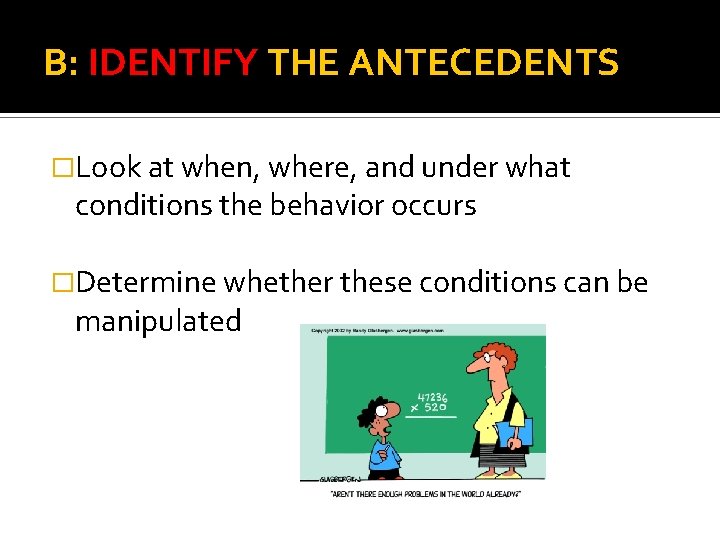
B: IDENTIFY THE ANTECEDENTS �Look at when, where, and under what conditions the behavior occurs �Determine whether these conditions can be manipulated
C: USE PRECORRECTION WHEN POSSIBLE � Teacher tries to anticipate the problem and replace it with a desired behavior � Describe the context in which the behavior occurs, and see if it can be modified � Teacher states behavior expected � Teacher instructs student in expected behavior a. Instruction d. prompts b. Examples e. Rewards or consequences c. Rehearsal

IDENTIFY THE CONSEQUENCES 1. Determine what events occur after the behavior has happened 2. Can this be modified.
IDENTIFY CHAINS OF EVENTS These are antecedents, behaviors and consequences 2. Individuals provide both consequences and antecedents for each other in on-going chains of events 3. Purpose of ABC analyses is to clarify sequences of classroom events. It helps us to see what each person is responding to and getting out of interactions 1.
IDENTIFY CHAINS OF EVENTS (2) 4. Questions that need responses include: a. What is the sequence of events surrounding the problem? b. What are the ABC’s of it? c. Can a predictable pattern of behavior be identified?
IDENTIFY COERCIVE INTERACTIONS 1. Antecedents, behaviors and consequences are characterized by escalating aversiveness a. Pupil find teachers demands aversive, and attempts avoidance by misbehavior; teacher finds this aversive and restates demand or increases them, students behavior increases
IDENTIFY PATTERNS AND STAGES OF BEHAVIOR 1. When the student is calm, recognize the behavior and try to sustain it. a. TRIGGER: Something happens to provoke the student such as conflicts with others, denial of a need or a change in routine. b. AGITATION: Increase in behavior which causes lapses in the ability to stay on task and concentrate
IDENTIFY PATTERNS AND STAGES OF BEHAVIOR (2) ACCELERATION: Student tries to draw peers or adults into a struggle or a coercive interaction; argues or defies D. PEAK: Student gets out of control and may become destructive or have a tantrum E. DE-ESCALATION: Student shows signs of confusion, withdrawal and may deny anything happened. C.
- Slides: 10