
Deadlocks Session 13 Deadlocks The Deadlock Problem System
Deadlocks Session - 13
Deadlocks • The Deadlock Problem • System Model • Deadlock Characterization • Methods for Handling Deadlocks • Deadlock Prevention • Deadlock Avoidance • Deadlock Detection • Recovery from Deadlock
Deadlocks • Several processes may compete for a finite number of resources • Process requests resources • Deadlock • Operating systems do not provide deadlock prevention facilities. • Responsibility of the programmers
Chapter Objectives • To develop a description of deadlocks, which prevent sets of concurrent processes from completing their tasks • To present a number of different methods for preventing or avoiding deadlocks in a computer system.
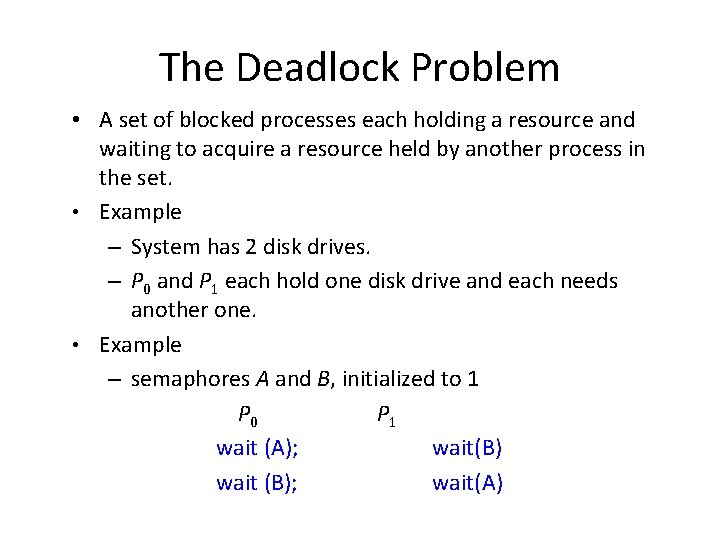
The Deadlock Problem • A set of blocked processes each holding a resource and waiting to acquire a resource held by another process in the set. • Example – System has 2 disk drives. – P 0 and P 1 each hold one disk drive and each needs another one. • Example – semaphores A and B, initialized to 1 P 0 P 1 wait (A); wait(B) wait (B); wait(A)
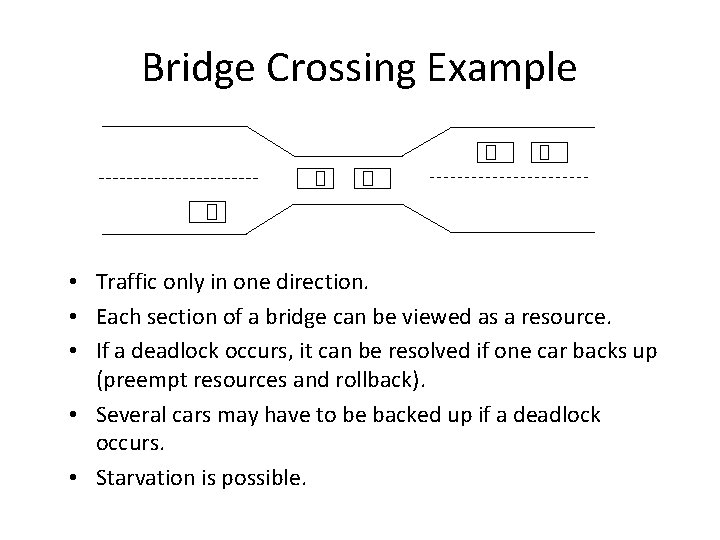
Bridge Crossing Example • Traffic only in one direction. • Each section of a bridge can be viewed as a resource. • If a deadlock occurs, it can be resolved if one car backs up (preempt resources and rollback). • Several cars may have to be backed up if a deadlock occurs. • Starvation is possible.
System Model • Resource types R 1, R 2, . . . , Rm CPU cycles, memory space, I/O devices, printer • Each resource type Ri has Wi instances. • The number of resources requested may not exceed the total number of resources available in the system • Each process utilizes a resource as follows: – request – use – Release • Request and release of resources • Wait() and signal() operations • Physical and logical resources
Deadlock Characterization Deadlock can arise if four conditions hold simultaneously. • Mutual exclusion: only one process at a time can use a resource. • Hold and wait: a process holding at least one resource is waiting to acquire additional resources held by other processes. • No preemption: a resource can be released only voluntarily by the process holding it, after that process has completed its task. • Circular wait: there exists a set {P 0, P 1, …, P 0} of waiting processes such that P 0 is waiting for a resource that is held by P 1, P 1 is waiting for a resource that is held by P 2, …, Pn– 1 is waiting for a resource that is held by Pn, and P 0 is waiting for a resource that is held by P 0.
Resource-Allocation Graph A set of vertices V and a set of edges E. • V is partitioned into two types: – P = {P 1, P 2, …, Pn}, the set consisting of all the processes in the system. – R = {R 1, R 2, …, Rm}, the set consisting of all resource types in the system. • request edge – directed edge P 1 Rj • assignment edge – directed edge Rj Pi
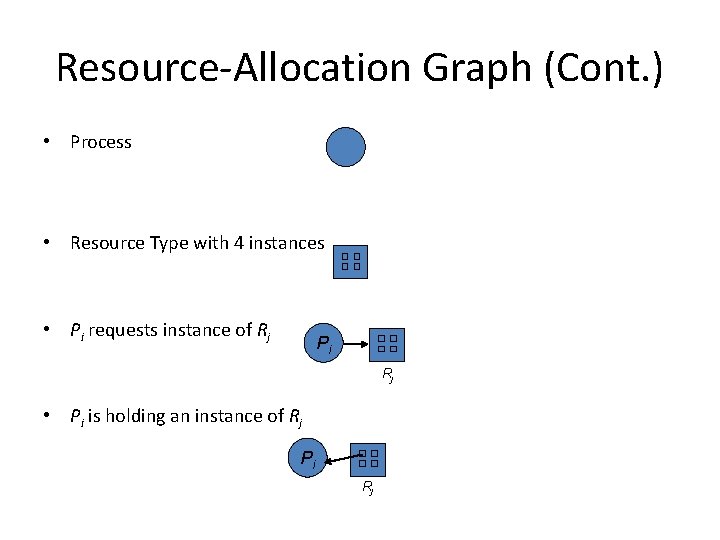
Resource-Allocation Graph (Cont. ) • Process • Resource Type with 4 instances • Pi requests instance of Rj Pi Rj • Pi is holding an instance of Rj Pi Rj
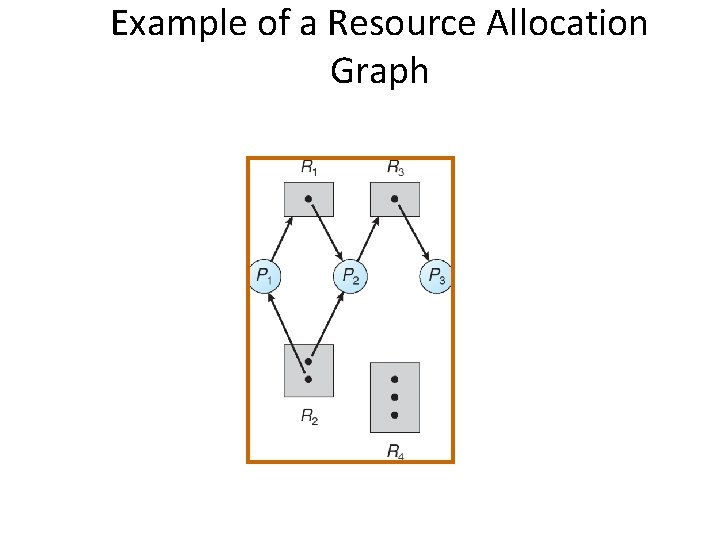
Example of a Resource Allocation Graph

Resource Allocation Graph With A Deadlock
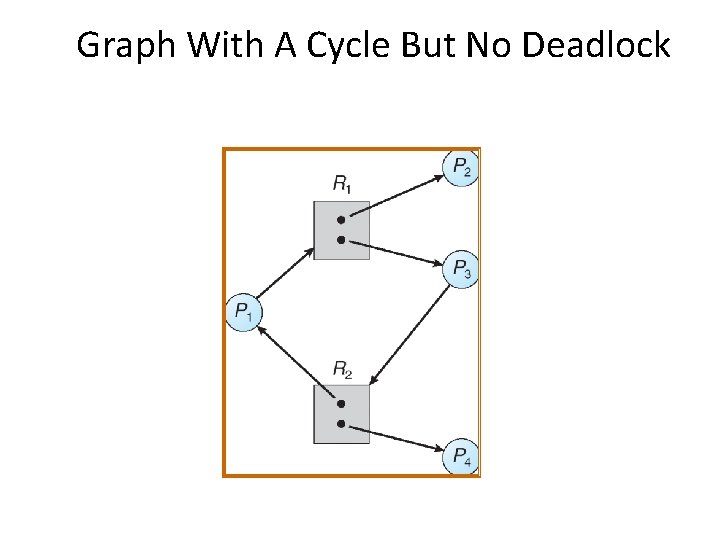
Graph With A Cycle But No Deadlock
Basic Facts • If graph contains no cycles no deadlock. • If graph contains a cycle – if only one instance per resource type, then deadlock. – if several instances per resource type, possibility of deadlock.
Methods for Handling Deadlocks • Ensure that the system will never enter a deadlock state. • Allow the system to enter a deadlock state, detect it and then recover. • Ignore the problem altogether, and pretend that deadlocks never occur in the system; used by most operating systems, including UNIX. • Deadlock prevention: set of methods for ensuring that atleast one of the necessary conditions cannot hold • Deadlock avoidance: OS can be given in advance additional information concerning which resource a process will request and use during its life time. • OS can decide for each request, the process must wait or not. resources currently available resources currently allocated to each process future requests and releases
Deadlock Prevention Restrain the ways request can be made. • Mutual Exclusion – not required for sharable resources; must hold for nonsharable resources. • Hold and Wait – must guarantee that whenever a process requests a resource, it does not hold any other resources. – Require process to request and be allocated all its resources before it begins execution, or allow process to request resources only when the process has none. – Low resource utilization; starvation possible.
Deadlock Prevention (Cont. ) • No Preemption – – If a process that is holding some resources requests another resource that cannot be immediately allocated to it, then all resources currently being held are released. – Preempted resources are added to the list of resources for which the process is waiting. – Process will be restarted only when it can regain its old resources, as well as the new ones that it is requesting. • Circular Wait – impose a total ordering of all resource types, and require that each process requests resources in an increasing order of enumeration.
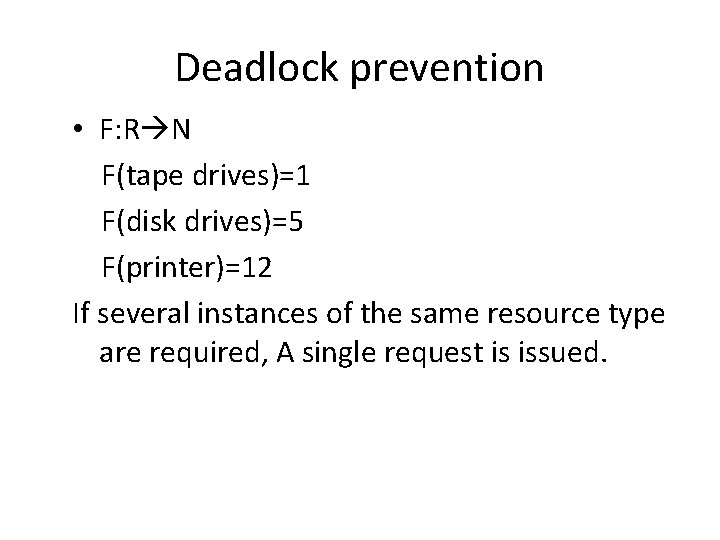
Deadlock prevention • F: R N F(tape drives)=1 F(disk drives)=5 F(printer)=12 If several instances of the same resource type are required, A single request is issued.
Deadlock Avoidance Requires that the system has some additional a priori information available. • Simplest and most useful model requires that each process declare the maximum number of resources of each type that it may need. • The deadlock-avoidance algorithm dynamically examines the resource-allocation state to ensure that there can never be a circular-wait condition. • Resource-allocation state is defined by the number of available and allocated resources, and the maximum demands of the processes.
Safe State • When a process requests an available resource, system must decide if immediate allocation leaves the system in a safe state. • System is in safe state if there exists a sequence <P 1, P 2, …, Pn> of ALL the processes is the systems such that for each Pi, the resources that Pi can still request can be satisfied by currently available resources + resources held by all the Pj, with j < i. • That is: – If Pi resource needs are not immediately available, then Pi can wait until all Pj have finished. – When Pj is finished, Pi can obtain needed resources, execute, return allocated resources, and terminate. – When Pi terminates, Pi +1 can obtain its needed resources, and so on.
Basic Facts • If a system is in safe state no deadlocks. • If a system is in unsafe state possibility of deadlock. • Avoidance ensure that a system will never enter an unsafe state.
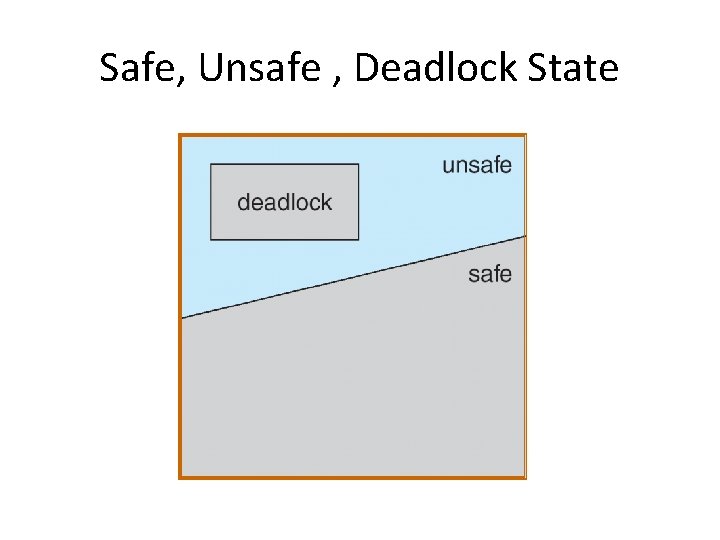
Safe, Unsafe , Deadlock State
End of Session 13
- Slides: 23