
Deadlocks q The dining philosophers problem q Deadlocks
Deadlocks q. The dining philosophers problem q. Deadlocks o Modeling deadlocks o Dealing with deadlocks Operating Systems, 2013, Meni Adler, Michael Elhadad & Amnon Meisels 1
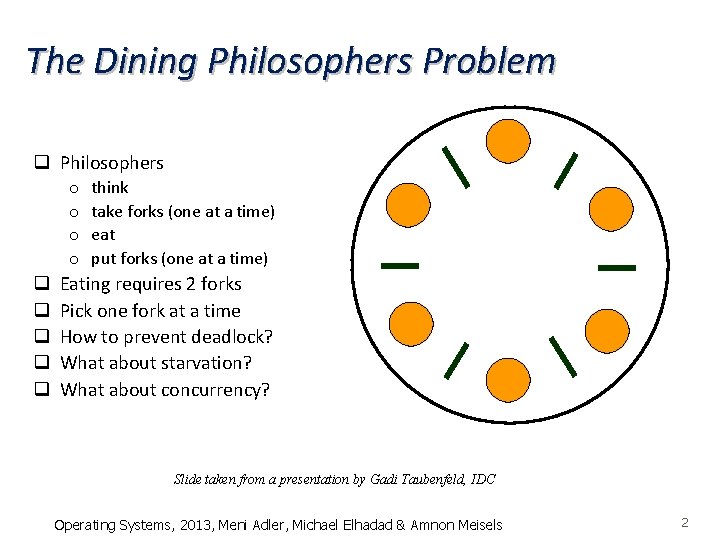
The Dining Philosophers Problem q Philosophers o o q q q think take forks (one at a time) eat put forks (one at a time) Eating requires 2 forks Pick one fork at a time How to prevent deadlock? What about starvation? What about concurrency? Slide taken from a presentation by Gadi Taubenfeld, IDC Operating Systems, 2013, Meni Adler, Michael Elhadad & Amnon Meisels 2
Dining philosophers: definition q Each process needs two resources q Every pair of processes compete for a specific resource q A process may proceed only if it is assigned both resources q Every process that is waiting for a resource should sleep (be blocked) q Every process that releases its two resources must wake -up the two competing processes for these resources, if they are interested Operating Systems, 2013, Meni Adler, Michael Elhadad & Amnon Meisels 3
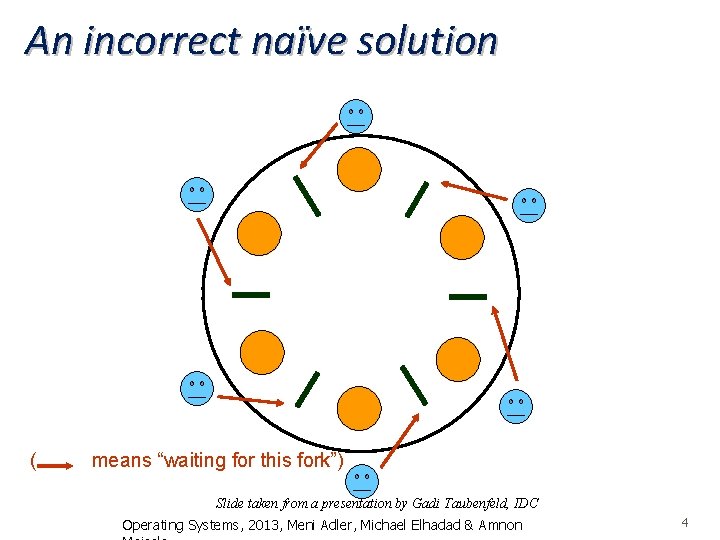
An incorrect naïve solution ( means “waiting for this fork”) Slide taken from a presentation by Gadi Taubenfeld, IDC Operating Systems, 2013, Meni Adler, Michael Elhadad & Amnon 4
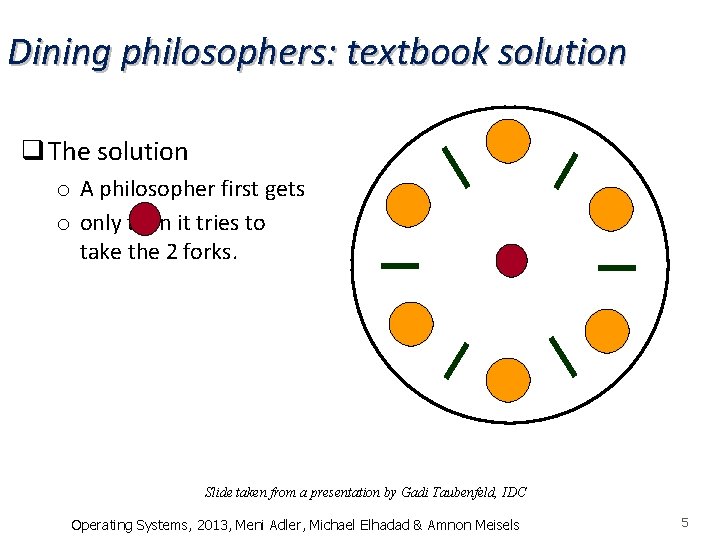
Dining philosophers: textbook solution q The solution o A philosopher first gets o only then it tries to take the 2 forks. Slide taken from a presentation by Gadi Taubenfeld, IDC Operating Systems, 2013, Meni Adler, Michael Elhadad & Amnon Meisels 5
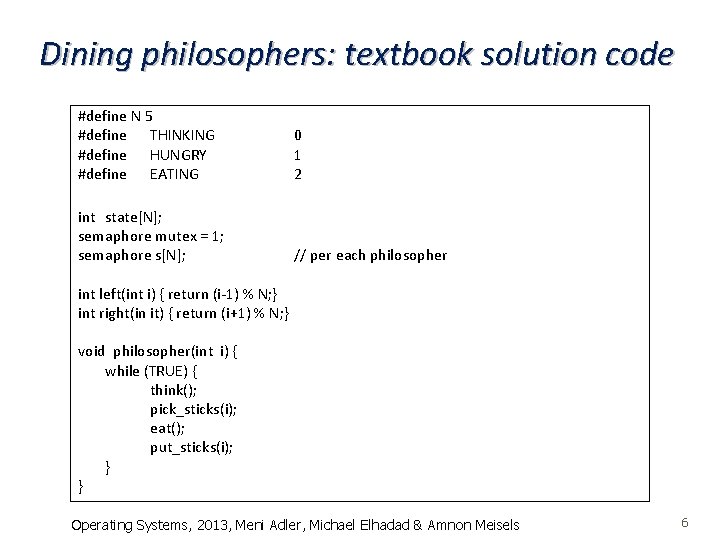
Dining philosophers: textbook solution code #define N 5 #define THINKING #define HUNGRY #define EATING 0 1 2 int state[N]; semaphore mutex = 1; semaphore s[N]; // per each philosopher int left(int i) { return (i-1) % N; } int right(in it) { return (i+1) % N; } void philosopher(int i) { while (TRUE) { think(); pick_sticks(i); eat(); put_sticks(i); } } Operating Systems, 2013, Meni Adler, Michael Elhadad & Amnon Meisels 6
![Dining philosophers: textbook solution code void pick_sticks(int i) { down(&mutex); state[i] = HUNGRY; test(i);](http://slidetodoc.com/presentation_image/e736b16f23c4b5f4bb26143db3449f55/image-7.jpg "Dining philosophers: textbook solution code void pick_sticks(int i) { down(&mutex); state[i] = HUNGRY; test(i);")
Dining philosophers: textbook solution code void pick_sticks(int i) { down(&mutex); state[i] = HUNGRY; test(i); up(&mutex); down(&s[i]); } void put_sticks(int i) { down(&mutex); state[i] = THINKING; test(left(i)); test(right(i)); up(&mutex); } void test(int i) { if (state[i] == HUNGRY && state[left(i)] != EATING && state[right(i)] != EATING) { state[i] = EATING; up(&s[i]); } } Is the algorithm deadlock-free? What about starvation? Operating Systems, 2013, Meni Adler, Michael Elhadad & Amnon 7
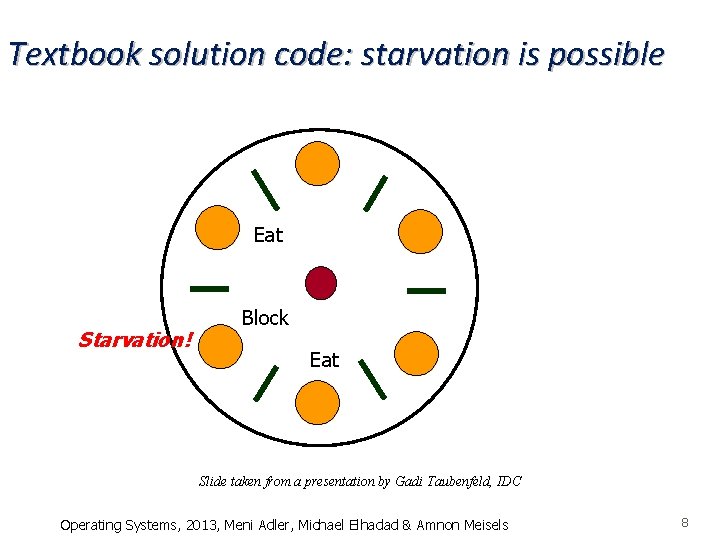
Textbook solution code: starvation is possible Eat Starvation! Block Eat Slide taken from a presentation by Gadi Taubenfeld, IDC Operating Systems, 2013, Meni Adler, Michael Elhadad & Amnon Meisels 8
![Monitor-based implementation monitor dining. Philosophers condition self[N]; integer state[N]; procedure pick_sticks(i) { state[i] :](http://slidetodoc.com/presentation_image/e736b16f23c4b5f4bb26143db3449f55/image-9.jpg "Monitor-based implementation monitor dining. Philosophers condition self[N]; integer state[N]; procedure pick_sticks(i) { state[i] :")
Monitor-based implementation monitor dining. Philosophers condition self[N]; integer state[N]; procedure pick_sticks(i) { state[i] : = HUNGRY; test(i); if state[i] <> EATING then wait(self[i]); } procedure put_sticks(i) { state[i] : = THINKING; test(LEFT); test(RIGHT); } procedure test(i) { if (state[LEFT] <> EATING && state[RIGHT] <> EATING && state[i] = HUNGRY) { state[i] : = EATING; signal(self[i]); } } for i : = 0 to N-1 do state[i] : = THINKING; end monitor Operating Systems, 2013, Meni Adler, Michael Elhadad & Amnon Meisels 9
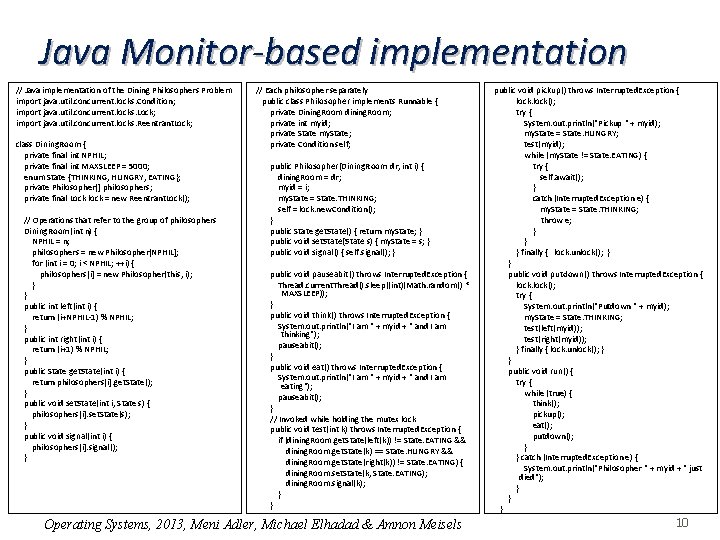
Java Monitor-based implementation // Java implementation of the Dining Philosophers Problem import java. util. concurrent. locks. Condition; import java. util. concurrent. locks. Lock; import java. util. concurrent. locks. Reentrant. Lock; class Dining. Room { private final int NPHIL; private final int MAXSLEEP = 5000; enum State {THINKING, HUNGRY, EATING}; private Philosopher[] philosophers; private final Lock lock = new Reentrant. Lock(); // Operations that refer to the group of philosophers Dining. Room(int n) { NPHIL = n; philosophers = new Philosopher[NPHIL]; for (int i = 0; i < NPHIL; ++i) { philosophers[i] = new Philosopher(this, i); } } public int left(int i) { return (i+NPHIL-1) % NPHIL; } public int right(int i) { return (i+1) % NPHIL; } public State get. State(int i) { return philosophers[i]. get. State(); } public void set. State(int i, State s) { philosophers[i]. set. State(s); } public void signal(int i) { philosophers[i]. signal(); } // Each philosopher separately public class Philosopher implements Runnable { private Dining. Room dining. Room; private int myid; private State my. State; private Condition self; public Philosopher(Dining. Room dr, int i) { dining. Room = dr; myid = i; my. State = State. THINKING; self = lock. new. Condition(); } public State get. State() { return my. State; } public void set. State(State s) { my. State = s; } public void signal() { self. signal(); } public void pauseabit() throws Interrupted. Exception { Thread. current. Thread(). sleep((int)(Math. random() * MAXSLEEP)); } public void think() throws Interrupted. Exception { System. out. println("I am " + myid + " and I am thinking"); pauseabit(); } public void eat() throws Interrupted. Exception { System. out. println("I am " + myid + " and I am eating"); pauseabit(); } // Invoked while holding the mutex lock public void test(int k) throws Interrupted. Exception { if (dining. Room. get. State(left(k)) != State. EATING && dining. Room. get. State(k) == State. HUNGRY && dining. Room. get. State(right(k)) != State. EATING) { dining. Room. set. State(k, State. EATING); dining. Room. signal(k); } Operating Systems, 2013, Meni Adler, Michael Elhadad & Amnon Meisels public void pickup() throws Interrupted. Exception { lock(); try { System. out. println("Pickup " + myid); my. State = State. HUNGRY; test(myid); while (my. State != State. EATING) { try { self. await(); } catch (Interrupted. Exception e) { my. State = State. THINKING; throw e; } } finally { lock. unlock(); } public void putdown() throws Interrupted. Exception { lock(); try { System. out. println("Putdown " + myid); my. State = State. THINKING; test(left(myid)); test(right(myid)); } finally { lock. unlock(); } public void run() { try { while (true) { think(); pickup(); eat(); putdown(); } catch (Interrupted. Exception e) { System. out. println("Philosopher " + myid + " just died"); } } 10
Textbook solution disadvantages q An inefficient solution o reduces to mutual exclusion o not enough concurrency o Starvation possible Operating Systems, 2013, Meni Adler, Michael Elhadad & Amnon Meisels 11
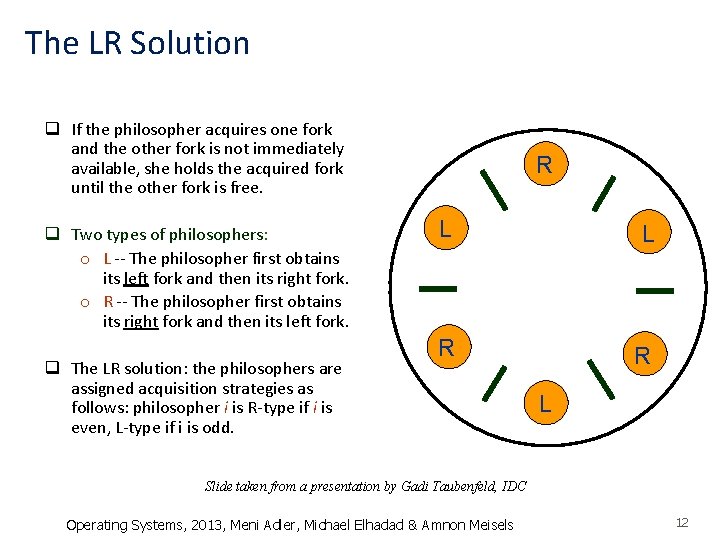
The LR Solution q If the philosopher acquires one fork and the other fork is not immediately available, she holds the acquired fork until the other fork is free. q Two types of philosophers: o L -- The philosopher first obtains its left fork and then its right fork. o R -- The philosopher first obtains its right fork and then its left fork. q The LR solution: the philosophers are assigned acquisition strategies as follows: philosopher i is R-type if i is even, L-type if i is odd. R L L R R L Slide taken from a presentation by Gadi Taubenfeld, IDC Operating Systems, 2013, Meni Adler, Michael Elhadad & Amnon Meisels 12
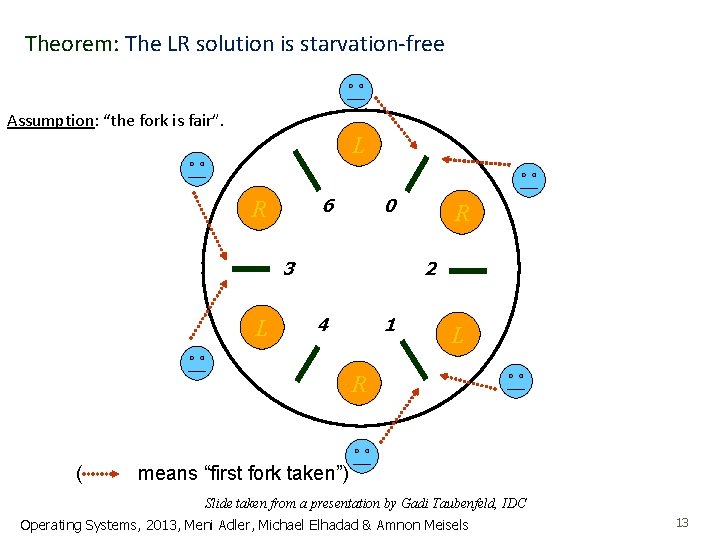
Theorem: The LR solution is starvation-free Assumption: “the fork is fair”. L 6 R 0 3 L R 2 4 1 L R ( means “first fork taken”) Slide taken from a presentation by Gadi Taubenfeld, IDC Operating Systems, 2013, Meni Adler, Michael Elhadad & Amnon Meisels 13
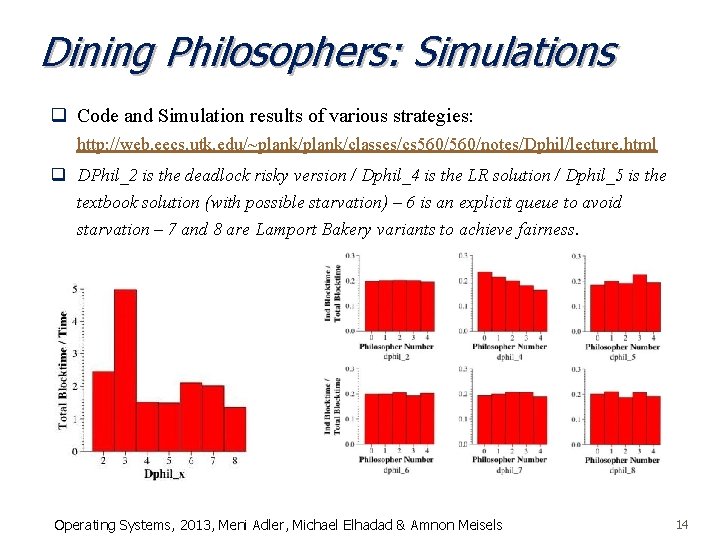
Dining Philosophers: Simulations q Code and Simulation results of various strategies: http: //web. eecs. utk. edu/~plank/classes/cs 560/notes/Dphil/lecture. html q DPhil_2 is the deadlock risky version / Dphil_4 is the LR solution / Dphil_5 is the textbook solution (with possible starvation) – 6 is an explicit queue to avoid starvation – 7 and 8 are Lamport Bakery variants to achieve fairness. Operating Systems, 2013, Meni Adler, Michael Elhadad & Amnon Meisels 14

Deadlocks q The dining philosophers problem q Deadlocks o Modeling deadlocks o Dealing with deadlocks Operating Systems, 2013, Meni Adler, Michael Elhadad & Amnon Meisels 15
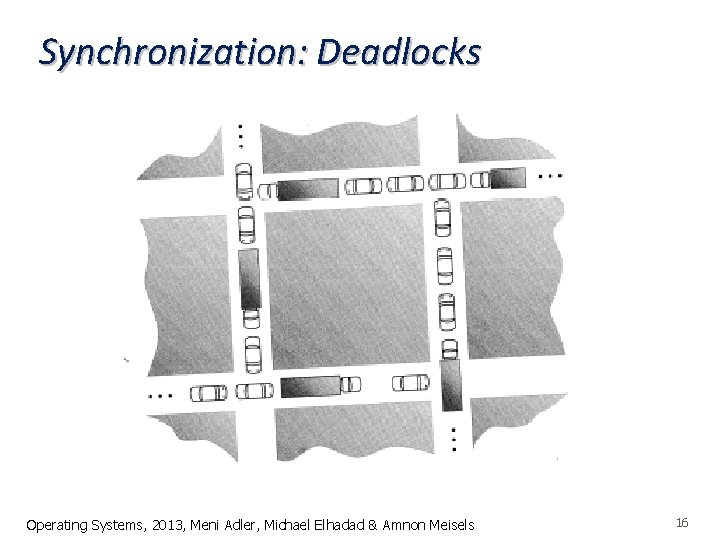
Synchronization: Deadlocks Operating Systems, 2013, Meni Adler, Michael Elhadad & Amnon Meisels 16
Deadlocks q Deadlock of Resource Allocation: o o Process A requests and gets Tape drive Process B requests and gets Fast Modem Process A requests Fast Modem and blocks Process B requests Tape drive and blocks q Deadlock situation: Neither process can make progress and no process can release its allocated device (resource) q Both resources (devices) require exclusive access Operating Systems, 2013, Meni Adler, Michael Elhadad & Amnon Meisels 17
Resources q Resources - Tapes, Disks, Printers, Database Records, semaphores, etc. q Some resources are non-preemptable (i. e. , tape drive) q It is easier to avoid deadlock with preemptable resources (e. g. , main memory, database records) q Resource allocation procedure o Request Iterate o Use o Release only at the end – and leave q Block process while waiting for Resources Operating Systems, 2013, Meni Adler, Michael Elhadad & Amnon Meisels 18
Defining Deadlocks q A set of processes is deadlocked if each process is waiting for an event that can only be caused by another process in the set q Necessary conditions for deadlock: 1. Mutual exclusion: exclusive use of resources 2. Hold and wait: process can request resource while holding another resource 3. No preemption: only holding process can release resource 4. Circular wait: there is an oriented circle of processes, each of which is waiting for a resource held by the next in the circle Operating Systems, 2013, Meni Adler, Michael Elhadad & Amnon Meisels 19
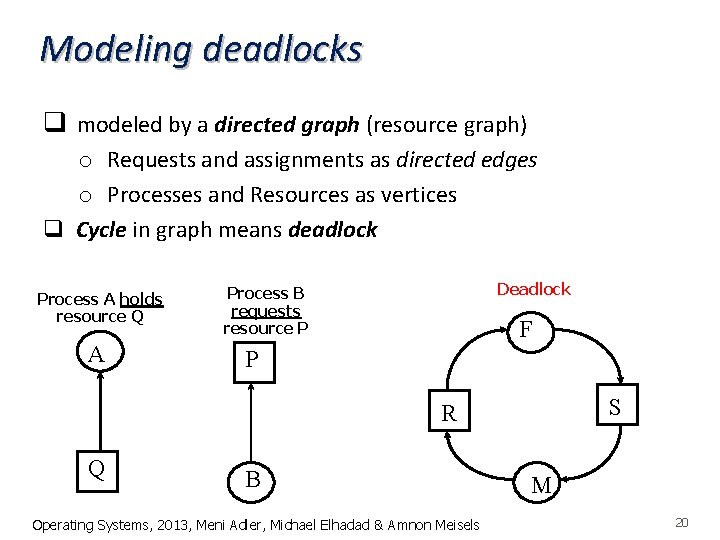
Modeling deadlocks q modeled by a directed graph (resource graph) o Requests and assignments as directed edges o Processes and Resources as vertices q Cycle in graph means deadlock Process A holds resource Q A Deadlock Process B requests resource P F P S R Q B Operating Systems, 2013, Meni Adler, Michael Elhadad & Amnon Meisels M 20
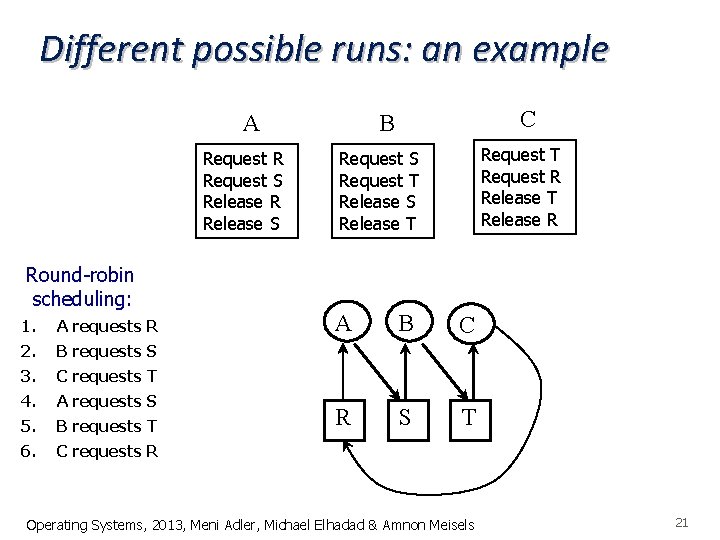
Different possible runs: an example A Request R Request S Release R Release S Round-robin scheduling: 1. A requests R 2. B requests S 3. C requests T 4. A requests S 5. B requests T 6. C requests R C B Request T Request R Release T Release R Request S Request T Release S Release T A B C R S T Operating Systems, 2013, Meni Adler, Michael Elhadad & Amnon Meisels 21
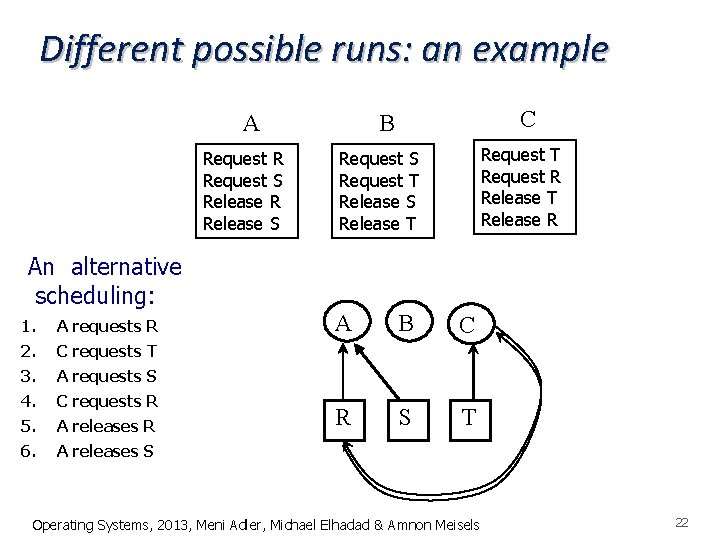
Different possible runs: an example A Request R Request S Release R Release S C B Request T Request R Release T Release R Request S Request T Release S Release T An alternative scheduling: 1. A requests R 2. C requests T 3. A requests S 4. C requests R 5. A releases R 6. A releases S A B C R S T Operating Systems, 2013, Meni Adler, Michael Elhadad & Amnon Meisels 22
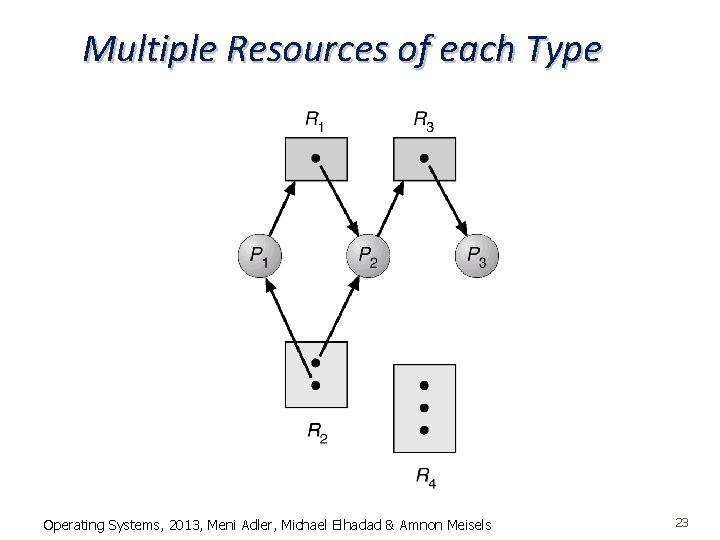
Multiple Resources of each Type Operating Systems, 2013, Meni Adler, Michael Elhadad & Amnon Meisels 23
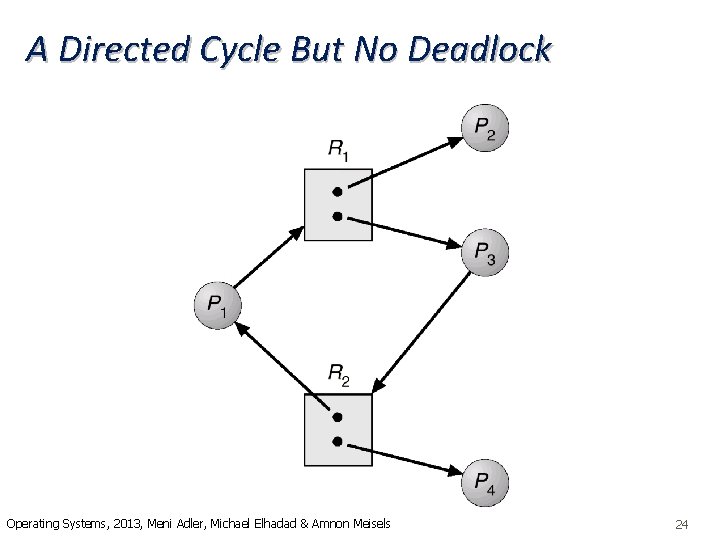
A Directed Cycle But No Deadlock Operating Systems, 2013, Meni Adler, Michael Elhadad & Amnon Meisels 24
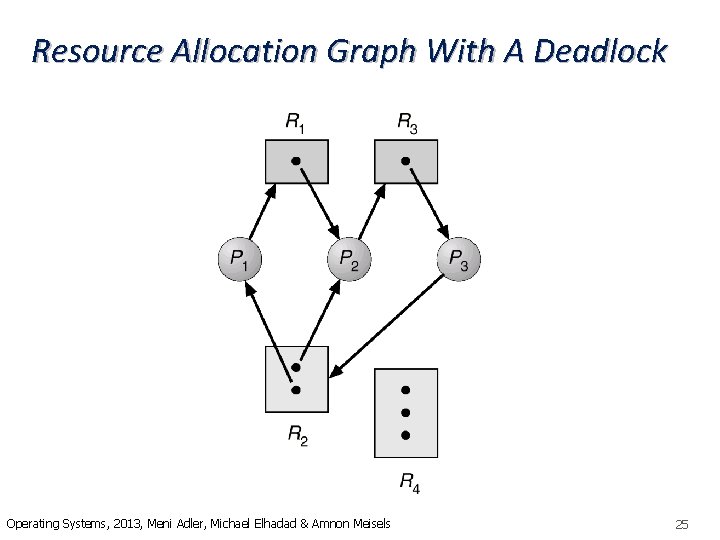
Resource Allocation Graph With A Deadlock Operating Systems, 2013, Meni Adler, Michael Elhadad & Amnon Meisels 25
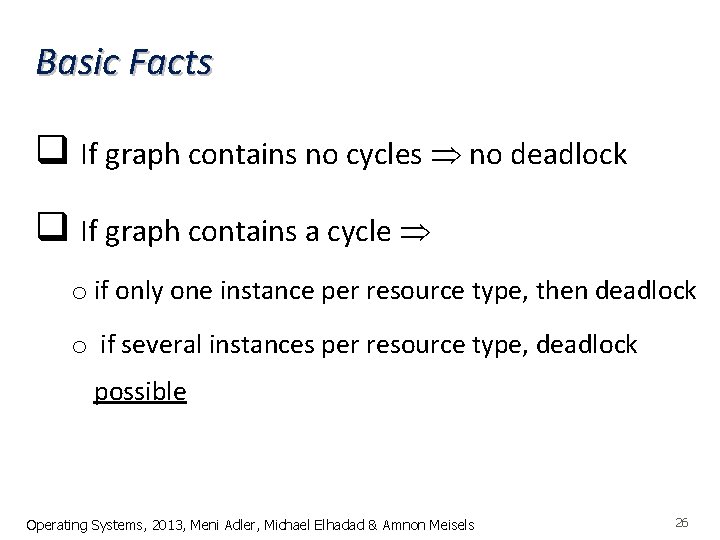
Basic Facts q If graph contains no cycles no deadlock q If graph contains a cycle o if only one instance per resource type, then deadlock o if several instances per resource type, deadlock possible Operating Systems, 2013, Meni Adler, Michael Elhadad & Amnon Meisels 26
Dealing with Deadlocks q The dining philosophers problem q Deadlocks o Modeling deadlocks o Dealing with deadlocks Operating Systems, 2013, Meni Adler, Michael Elhadad & Amnon Meisels 27
Dealing with Deadlocks q Possible Strategies: o Prevention structurally negate one of the four necessary conditions o Avoidance allocate resources carefully, so as to avoid deadlocks o Detection and recovery o Do nothing (The “ostrich algorithm’’) deadlocks are rare and hard to tackle. . . do nothing Example: Unix - process table with 1000 entries and 100 processes each requesting 20 FORK calls. . . Deadlock. users prefer a rare deadlock over frequent refusal of FORK Operating Systems, 2013, Meni Adler, Michael Elhadad & Amnon Meisels 28
Deadlock prevention q Attack one of the 4 necessary conditions: 1. Mutual exclusion o Minimize exclusive allocation of devices o Use spooling: only spooling process requests access (not good for all devices - Tapes; Process Tables); may fill up spools (disk space deadlock). . . 2. Hold and Wait o Request all resources immediately (before execution) Problem: resources not known in advance, inefficient or o to get a new resource, free everything, then request everything again (including new resource) Operating Systems, 2013, Meni Adler, Michael Elhadad & Amnon Meisels 29
Attack one of the 4 necessary conditions (cont'd) 3. No preemption o Not always possible (e. g. , printer) 4. Circular wait condition o Allow holding only a single resource (too restrictive) o Number resources, allow requests only in ascending order: Request only resources numbered higher than anything currently held Impractical in general Operating Systems, 2013, Meni Adler, Michael Elhadad & Amnon Meisels 30
Deadlock Avoidance q System grants resources only if it is safe q basic assumption: maximum resources required by each process is known in advance Safe state: q Not deadlocked q There is a scheduling that satisfies all possible future requests Operating Systems, 2013, Meni Adler, Michael Elhadad & Amnon Meisels 31
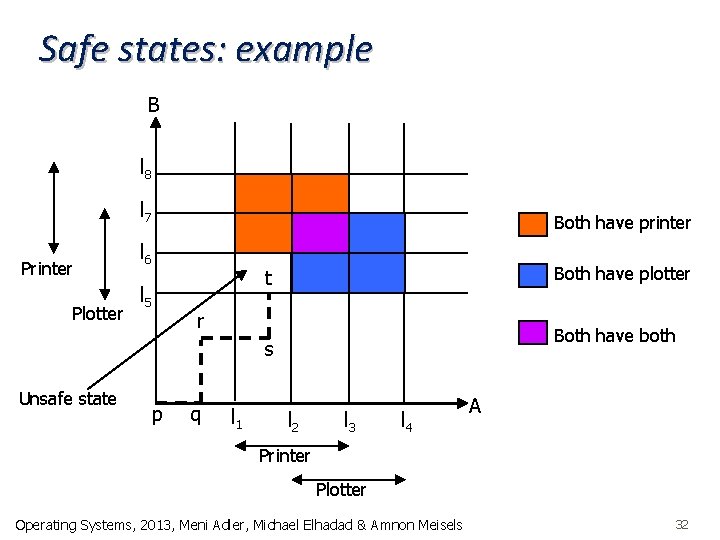
Safe states: example B l 8 l 7 Printer Plotter Both have printer l 6 l 5 Both have plotter t r Both have both s Unsafe state p q l 1 l 2 l 3 l 4 A Printer Plotter Operating Systems, 2013, Meni Adler, Michael Elhadad & Amnon Meisels 32
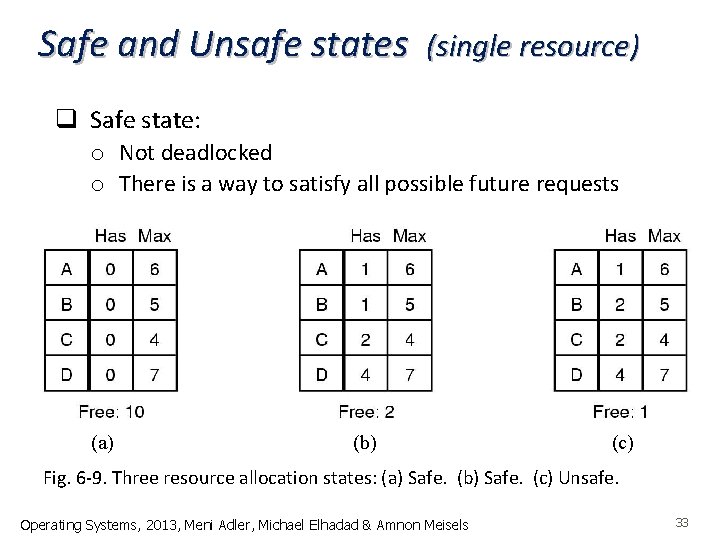
Safe and Unsafe states (single resource) q Safe state: o Not deadlocked o There is a way to satisfy all possible future requests (a) (b) (c) Fig. 6 -9. Three resource allocation states: (a) Safe. (b) Safe. (c) Unsafe. Operating Systems, 2013, Meni Adler, Michael Elhadad & Amnon Meisels 33
Banker's Algorithm, Dijkstra 1965 (single resource) q Checks whether a state is safe 1. Pick a process that can terminate after fulfilling the rest of its requirements (enough free resources) 2. Free all its resources (simulation) 3. Mark process as terminated 4. If all processes marked, report “safe”, halt 5. If no process can terminate, report “unsafe”, halt 6. Go to step 1 Operating Systems, 2013, Meni Adler, Michael Elhadad & Amnon Meisels 34
Multiple resources of each kind q Assume n processes and m resource classes q Use two matrixes and two vectors: o Current allocation matrix Cn x m o Request matrix Rn x m (remaining requests) o Existing resources vector Em o Available resources vector Am Operating Systems, 2013, Meni Adler, Michael Elhadad & Amnon Meisels 35
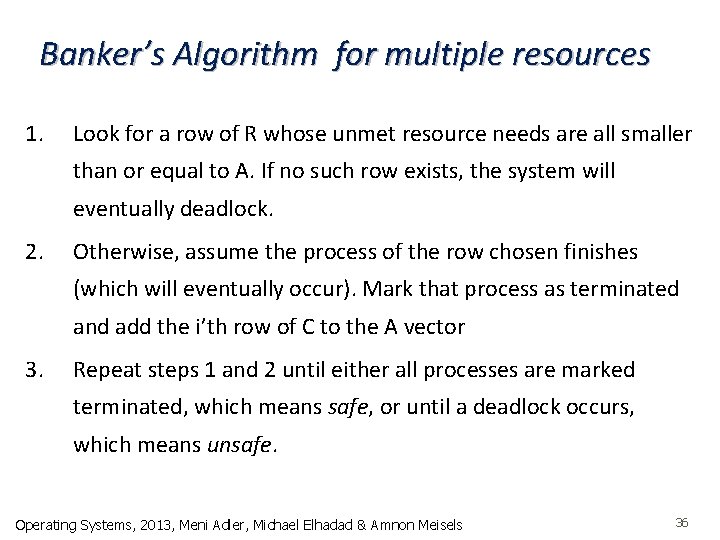
Banker’s Algorithm for multiple resources 1. Look for a row of R whose unmet resource needs are all smaller than or equal to A. If no such row exists, the system will eventually deadlock. 2. Otherwise, assume the process of the row chosen finishes (which will eventually occur). Mark that process as terminated and add the i’th row of C to the A vector 3. Repeat steps 1 and 2 until either all processes are marked terminated, which means safe, or until a deadlock occurs, which means unsafe. Operating Systems, 2013, Meni Adler, Michael Elhadad & Amnon Meisels 36
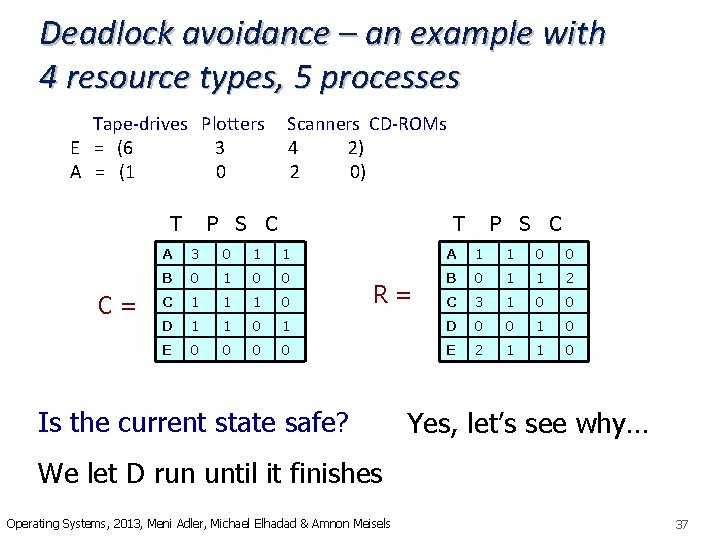
Deadlock avoidance – an example with 4 resource types, 5 processes Tape-drives Plotters Scanners CD-ROMs E = (6 3 4 2) A = (1 0 2 0) T C= P S C T P S C A 3 0 1 1 A 1 1 0 0 B 0 1 1 2 C 1 1 1 0 C 3 1 0 0 D 1 1 0 1 D 0 0 1 0 E 0 0 E 2 1 1 0 R= Is the current state safe? Yes, let’s see why… We let D run until it finishes Operating Systems, 2013, Meni Adler, Michael Elhadad & Amnon Meisels 37
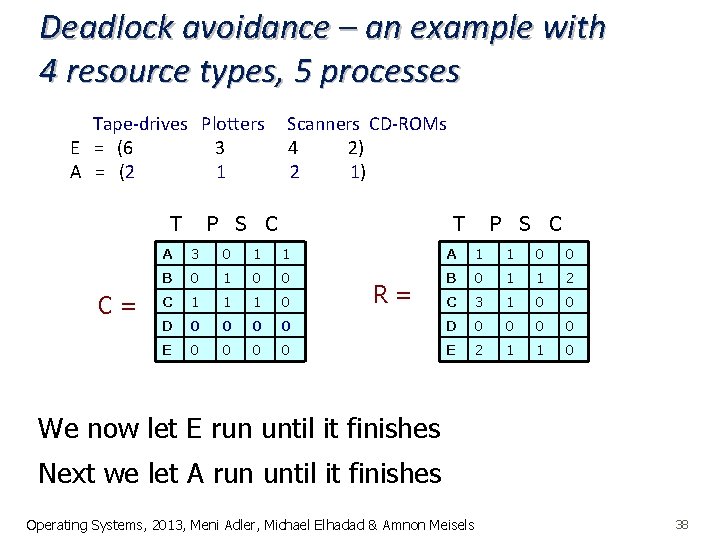
Deadlock avoidance – an example with 4 resource types, 5 processes Tape-drives Plotters Scanners CD-ROMs E = (6 3 4 2) A = (2 1 2 1) T C= P S C T P S C A 3 0 1 1 A 1 1 0 0 B 0 1 1 2 C 1 1 1 0 C 3 1 0 0 D 0 0 0 0 E 2 1 1 0 R= We now let E run until it finishes Next we let A run until it finishes Operating Systems, 2013, Meni Adler, Michael Elhadad & Amnon Meisels 38
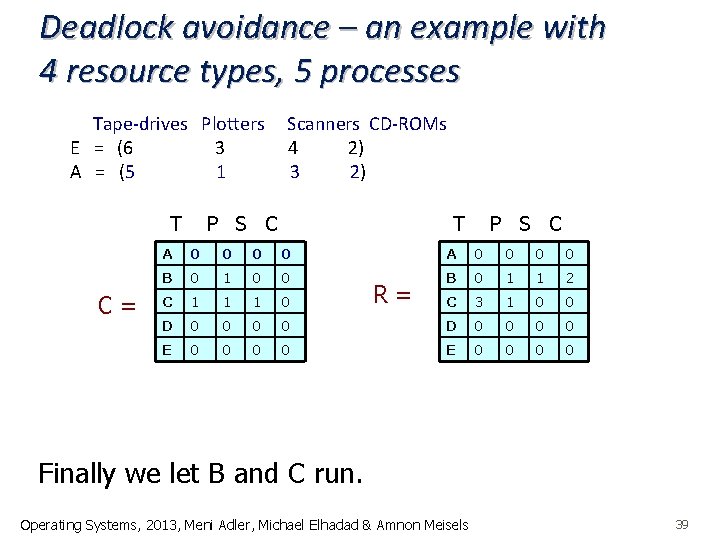
Deadlock avoidance – an example with 4 resource types, 5 processes Tape-drives Plotters Scanners CD-ROMs E = (6 3 4 2) A = (5 1 3 2) T C= P S C T P S C A 0 0 0 0 B 0 1 1 2 C 1 1 1 0 C 3 1 0 0 D 0 0 0 0 E 0 0 0 0 R= Finally we let B and C run. Operating Systems, 2013, Meni Adler, Michael Elhadad & Amnon Meisels 39
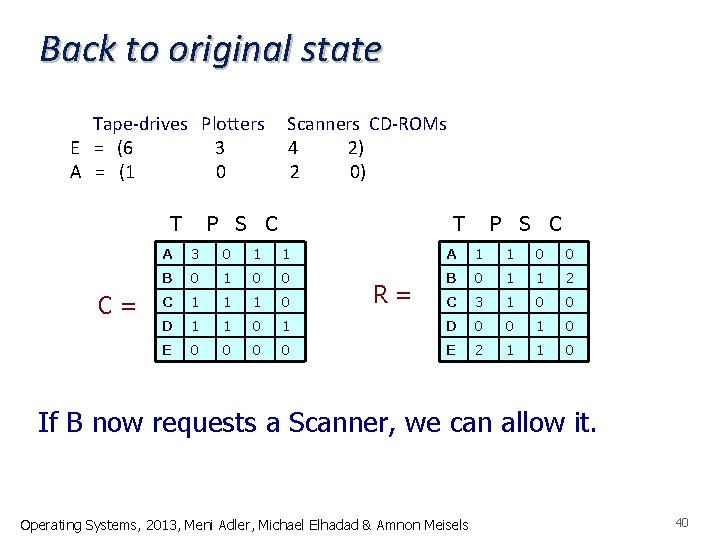
Back to original state Tape-drives Plotters Scanners CD-ROMs E = (6 3 4 2) A = (1 0 2 0) T C= P S C T P S C A 3 0 1 1 A 1 1 0 0 B 0 1 1 2 C 1 1 1 0 C 3 1 0 0 D 1 1 0 1 D 0 0 1 0 E 0 0 E 2 1 1 0 R= If B now requests a Scanner, we can allow it. Operating Systems, 2013, Meni Adler, Michael Elhadad & Amnon Meisels 40
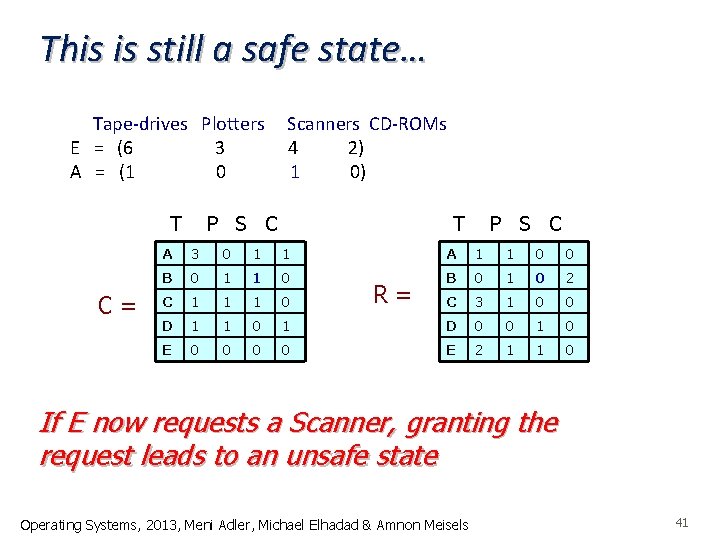
This is still a safe state… Tape-drives Plotters Scanners CD-ROMs E = (6 3 4 2) A = (1 0 1 0) T C= P S C T P S C A 3 0 1 1 A 1 1 0 0 B 0 1 1 0 B 0 1 0 2 C 1 1 1 0 C 3 1 0 0 D 1 1 0 1 D 0 0 1 0 E 0 0 E 2 1 1 0 R= If E now requests a Scanner, granting the request leads to an unsafe state Operating Systems, 2013, Meni Adler, Michael Elhadad & Amnon Meisels 41
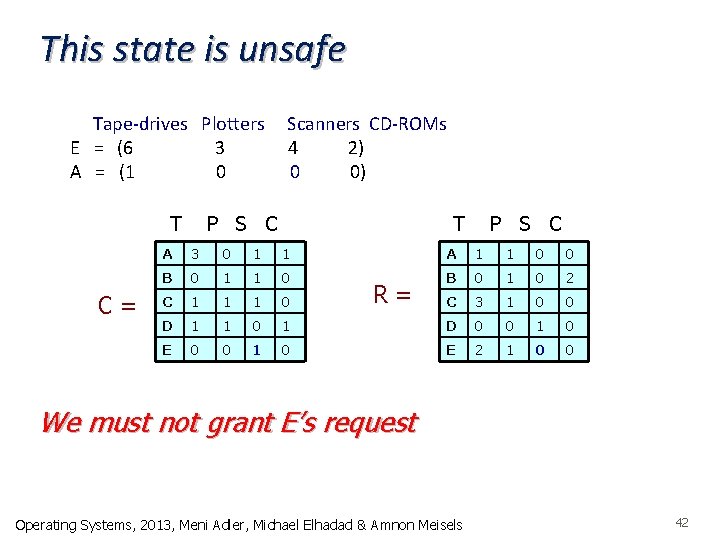
This state is unsafe Tape-drives Plotters Scanners CD-ROMs E = (6 3 4 2) A = (1 0 0) T C= P S C T P S C A 3 0 1 1 A 1 1 0 0 B 0 1 1 0 B 0 1 0 2 C 1 1 1 0 C 3 1 0 0 D 1 1 0 1 D 0 0 1 0 E 2 1 0 0 R= We must not grant E’s request Operating Systems, 2013, Meni Adler, Michael Elhadad & Amnon Meisels 42
Deadlock Avoidance is not practical q Maximum resource request per process is unknown beforehand q Resources may disappear q New processes (or resources) may appear Operating Systems, 2013, Meni Adler, Michael Elhadad & Amnon Meisels 43
Deadlock Detection and Recovery q Find if a deadlock exists q if it does, find which processes and resources it involves q Detection: detect cycles in resource graph q Algorithm: DFS + node and arc marking Operating Systems, 2013, Meni Adler, Michael Elhadad & Amnon Meisels 44
Find cycles: For each node, N, in the graph, perform the following 5 steps with N as the starting node 1. Initialize L to the empty list and designate all arcs as unmarked 2. Add the current node to the end of L and check if the node appears twice in L. If it does, the graph contains a cycle, terminate. 3. If there any unmarked arcs from the given node, go to 4. , if not go to 5. 4. Pick an unmarked outgoing arc and mark it. Follow it to the new current node and go to 2. 5. We have reached a deadend. Go back to the previous node, make it the current node and go to 3. If all arcs are marked and the node is the initial node, there are no cycles in the graph, terminate Operating Systems, 2013, Meni Adler, Michael Elhadad & Amnon Meisels 45
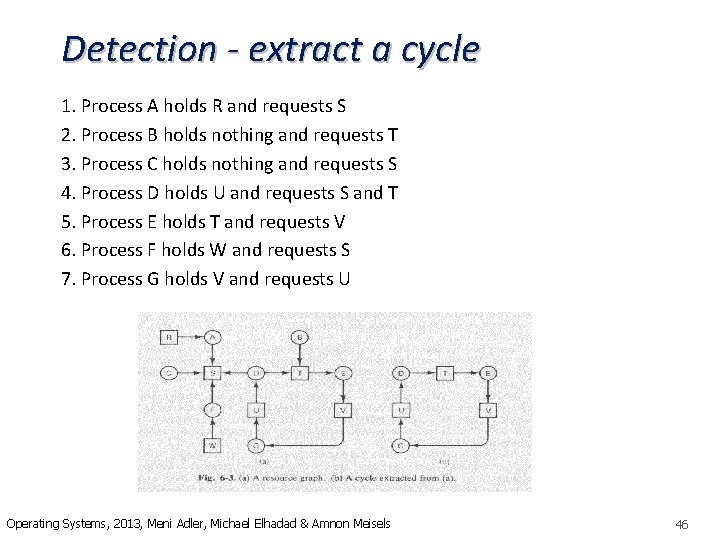
Detection - extract a cycle 1. Process A holds R and requests S 2. Process B holds nothing and requests T 3. Process C holds nothing and requests S 4. Process D holds U and requests S and T 5. Process E holds T and requests V 6. Process F holds W and requests S 7. Process G holds V and requests U Operating Systems, 2013, Meni Adler, Michael Elhadad & Amnon Meisels 46
When should the system check for deadlock ? q Whenever a request is made - too expensive. q Every k time units. q Whenever CPU utilization drops below some threshold (indication of a possible deadlock). Operating Systems, 2013, Meni Adler, Michael Elhadad & Amnon Meisels 47
Recovery q Preemption - possible in some rare cases temporarily take a resource away from its current owner q Rollback - possible with checkpointing Keep former states of processes (checkpoints) to enable release of resources and going back q Killing a process - easy way out, may cause problems in some cases, depending on process being re-runable… q Bottom line: hard to recover from deadlock, avoid it Operating Systems, 2013, Meni Adler, Michael Elhadad & Amnon Meisels 48
Factors Determining Process to “Kill” 1. 2. 3. 4. 5. 6. What the priority of the process is How long the process has computed, and how much longer the program will compute before completing its designated task How many and what type of resources the process has used (for example, whether the resources are simple or preempt) How many more resources the process needs in order to complete How many processes will need to be terminated Whether the process is interactive or batch Operating Systems, 2013, Meni Adler, Michael Elhadad & Amnon Meisels 49
Example - deadlocks in DBMSs q For database records that need locking first and then updating (two-phase locking) q Deadlocks occur frequently because records are dynamically requested by competing processes q DBMSs, therefore, need to employ deadlock detection and recovery procedures q Recovery is possible - transactions are “checkpointed” - release everything and restart Operating Systems, 2013, Meni Adler, Michael Elhadad & Amnon Meisels 50
Additional deadlock issues q Deadlocks may occur with respect to actions of processes, not resources - waiting for semaphores q Starvation can result from a bad allocation policy (such as smallest-file-first, for printing) and for the “starved” process will be equivalent to a deadlock (cannot finish running) q Summary of deadlock treatment: o Ignore problem o Detect and recover o Avoid (be only in safe states) o Prevent by using an allocation policy or conditions Operating Systems, 2013, Meni Adler, Michael Elhadad & Amnon Meisels 53
The Situation in Practice q Most OSs in use, and specifically Windows, Solaris, Linux ignore deadlock or do not detect it q Tools to kill processes but usually without loss of data q In Windows NT there is a system call Wait. For. Multiple. Objects that requests all resources at once o System provides all resources, if free o There is no lock of resources if only few are free o Prevents Hold & Wait, but difficult to implement! Operating Systems, 2013, Meni Adler, Michael Elhadad & Amnon Meisels 54
Linux: the Big Kernel Lock Linux was first designed with Coarse-Grained Locking q The whole kernel was wrapped in a giant lock around it to avoid deadlocks (kernel / interrupt handlers / user threads) introduced in Linux 2. 0. q Work began in 2008 to remove the big kernel lock: http: //kerneltrap. org/Linux/Removing_the_Big_Kernel _Lock q It was carefully replaced with fine-grained locks until it was removed in Linux 2. 6. 39 (in 2011!) https: //lwn. net/Articles/424657/ Operating Systems, 2013, Meni Adler, Michael Elhadad & Amnon Meisels 55
Xv 6 and deadlocks q Xv 6 uses a few coarse data-structure specific locks; for example, xv 6 uses a single lock protecting the process table and its invariants, which are described in Chapter 5. q A more fine-grained approach would be to have a lock per entry in the process table so that threads working on different entries in the process table can proceed in parallel. q However, it complicates operations that have invariants over the whole process table, since they might have to take out several locks. q To avoid such deadlocks, all code paths must acquire locks in the same order. Deadlock avoidance is another example illustrating why locks must be part of a function’s specification: the caller must invoke functions in a consistent order so that the functions acquire locks in the same order q Because xv 6 uses coarse-grained locks and xv 6 is simple, xv 6 has few lock-order chains. The longest chain is only two deep. For example, ideintr holds the ide lock while calling wakeup, which acquires the ptable lock. There a number of other examples involving sleep and wakeup. These orderings come about because sleep and wakeup have a complicated invariant, as discussed in Chapter 5. q In the file system there a number of examples of chains of two because the file system must, for example, acquire a lock on a directory and the lock on a file in that directory to unlink a file from its parent directory correctly. Xv 6 always acquires the locks in the order first parent directory and then the file Operating Systems, 2013, Meni Adler, Michael Elhadad & Amnon Meisels 56
- Slides: 54