
Deadlock Example Process 1 Process 2 Resource 1
![Banker’s Algorithm • Let maxc[i, j] be the maximum claim for Rj by pi](https://slidetodoc.com/presentation_image_h2/d1bfaabc3759d98f167335c524d0f9aa/image-22.jpg "Banker’s Algorithm • Let maxc[i, j] be the maximum claim for Rj by pi")
![Banker’s Algorithm • Copy the alloc[i, j] table to alloc’[i, j] • Given C,](https://slidetodoc.com/presentation_image_h2/d1bfaabc3759d98f167335c524d0f9aa/image-23.jpg "Banker’s Algorithm • Copy the alloc[i, j] table to alloc’[i, j] • Given C,")
- Slides: 57
Deadlock
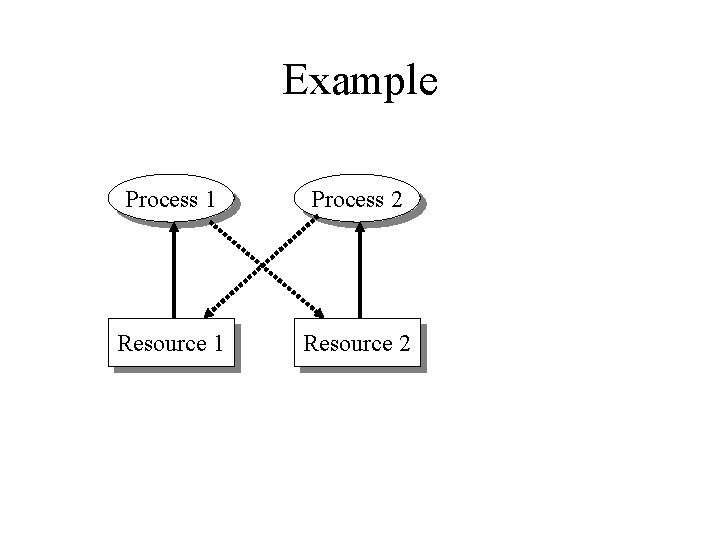
Example Process 1 Process 2 Resource 1 Resource 2
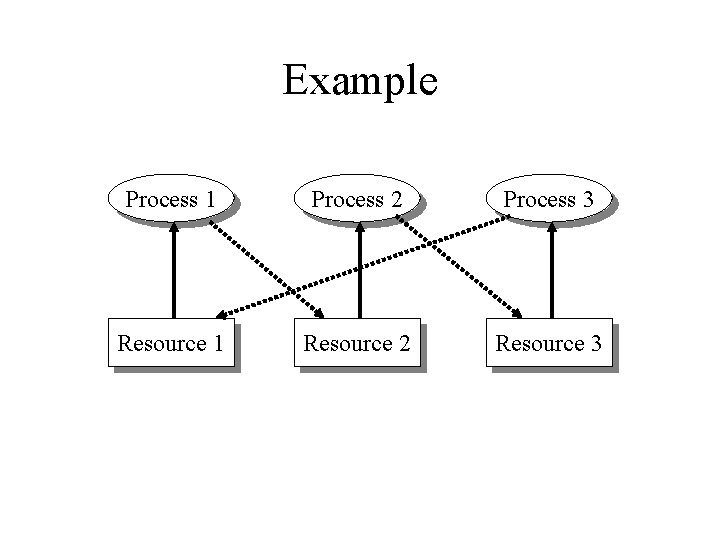
Example Process 1 Process 2 Process 3 Resource 1 Resource 2 Resource 3
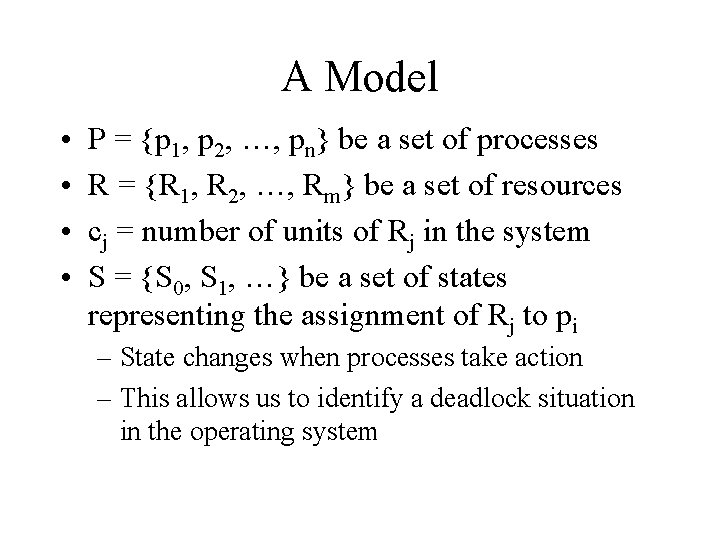
A Model • • P = {p 1, p 2, …, pn} be a set of processes R = {R 1, R 2, …, Rm} be a set of resources cj = number of units of Rj in the system S = {S 0, S 1, …} be a set of states representing the assignment of Rj to pi – State changes when processes take action – This allows us to identify a deadlock situation in the operating system
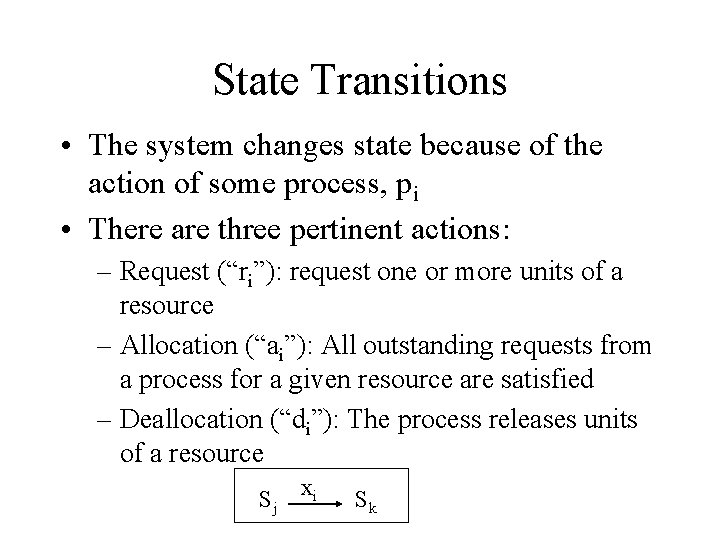
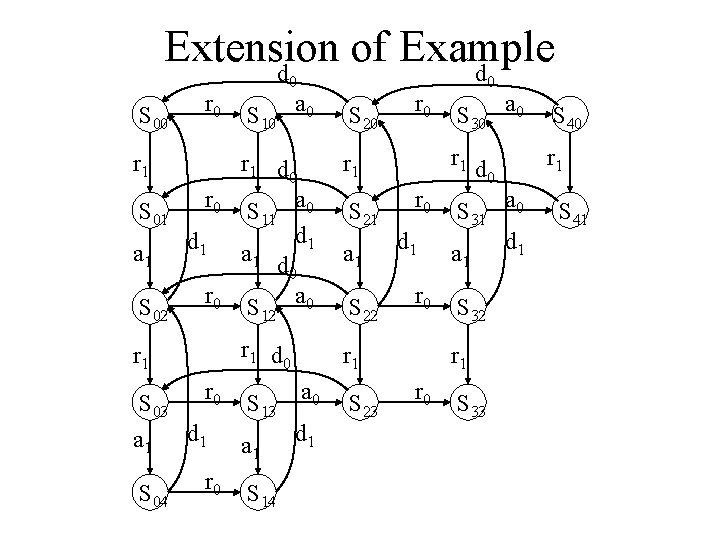
State Transitions • The system changes state because of the action of some process, pi • There are three pertinent actions: – Request (“ri”): request one or more units of a resource – Allocation (“ai”): All outstanding requests from a process for a given resource are satisfied – Deallocation (“di”): The process releases units of a resource Sj xi Sk
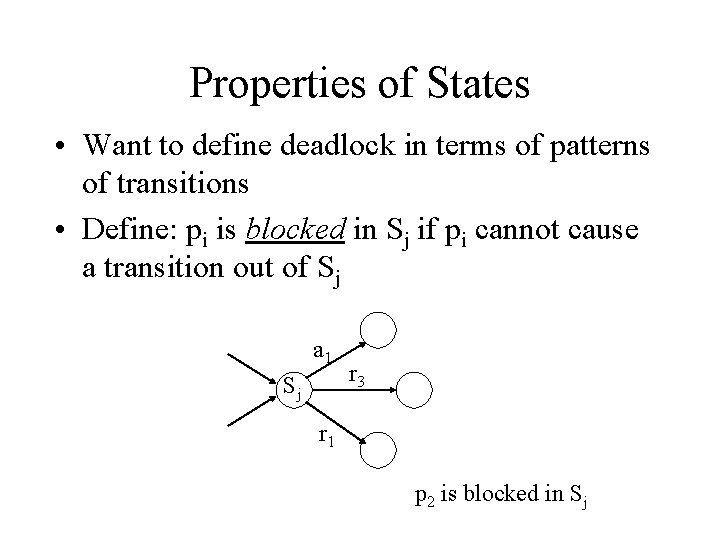
Properties of States • Want to define deadlock in terms of patterns of transitions • Define: pi is blocked in Sj if pi cannot cause a transition out of Sj a 1 Sj r 3 r 1 p 2 is blocked in Sj
Properties of States (cont) • If pi is blocked in Sj, and will also be blocked in every Sk reachable from Sj, then pi is deadlocked • Sj is called a deadlock state
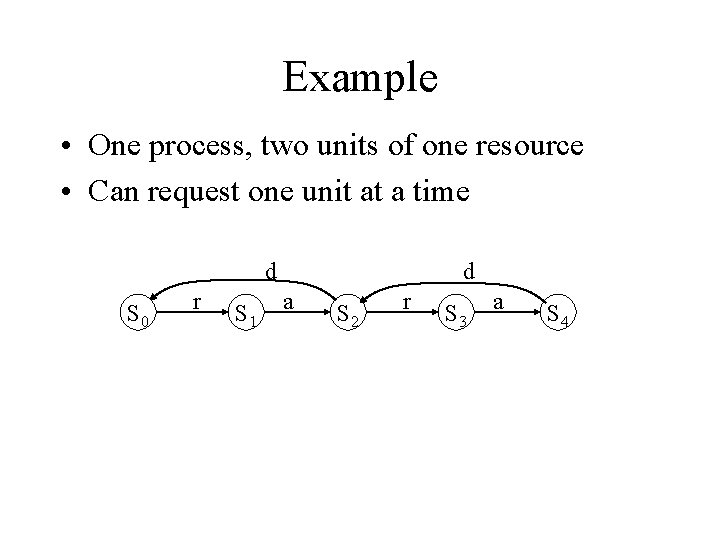
Example • One process, two units of one resource • Can request one unit at a time d S 0 r S 1 d a S 2 r S 3 a S 4
Extension of Example d d S 00 r 1 S 01 a 1 S 02 r 1 r 0 d 1 r 0 0 S 10 a 0 S 20 r 1 d 0 S 11 a 0 d 1 a 1 d 0 S a 0 r 1 d 0 r 1 12 r 0 S a 0 S 03 13 a 1 d 1 r 0 S S 04 14 S 21 a 1 S 22 S 23 r 0 d 1 r 0 0 S 30 a 0 S 40 r 1 d 0 r 1 S 31 a 0 d 1 a 1 S 32 r 1 r 0 S 33 S 41
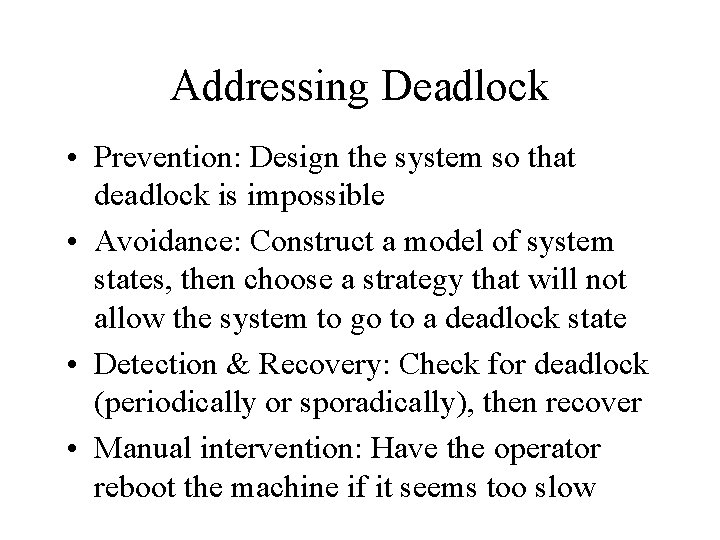
Addressing Deadlock • Prevention: Design the system so that deadlock is impossible • Avoidance: Construct a model of system states, then choose a strategy that will not allow the system to go to a deadlock state • Detection & Recovery: Check for deadlock (periodically or sporadically), then recover • Manual intervention: Have the operator reboot the machine if it seems too slow
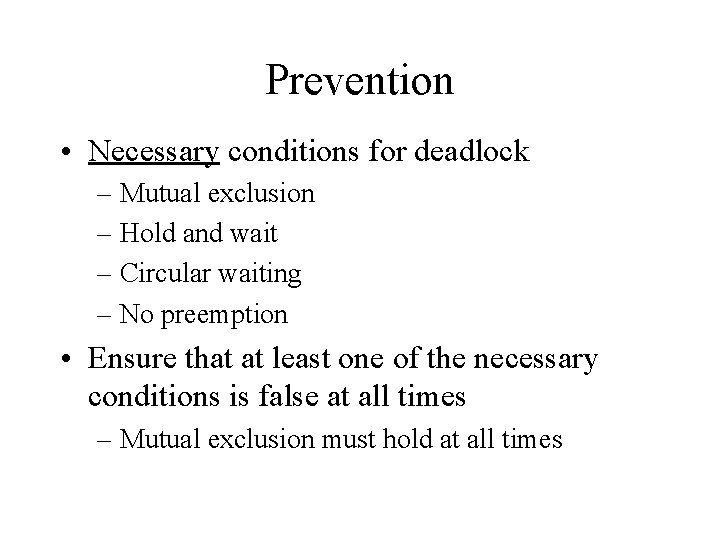
Prevention • Necessary conditions for deadlock – Mutual exclusion – Hold and wait – Circular waiting – No preemption • Ensure that at least one of the necessary conditions is false at all times – Mutual exclusion must hold at all times
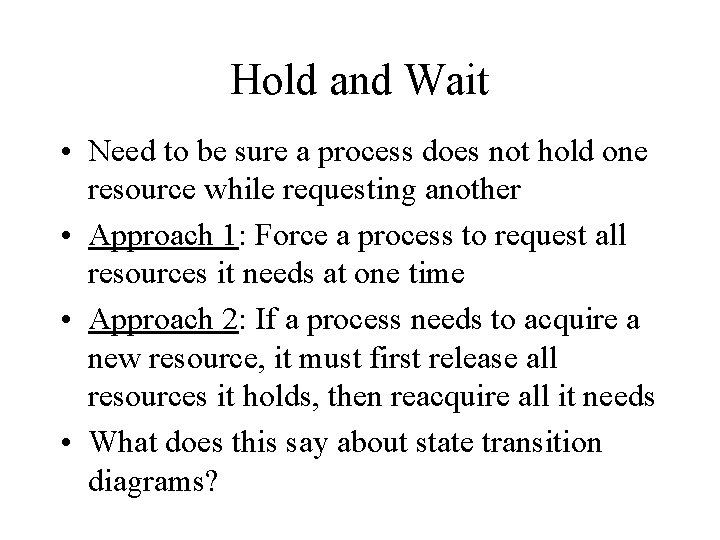
Hold and Wait • Need to be sure a process does not hold one resource while requesting another • Approach 1: Force a process to request all resources it needs at one time • Approach 2: If a process needs to acquire a new resource, it must first release all resources it holds, then reacquire all it needs • What does this say about state transition diagrams?
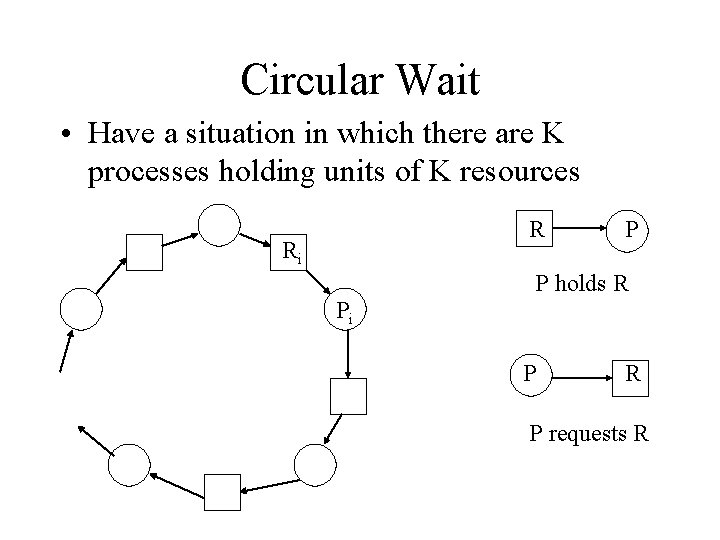
Circular Wait • Have a situation in which there are K processes holding units of K resources R Ri P P holds R Pi P R P requests R
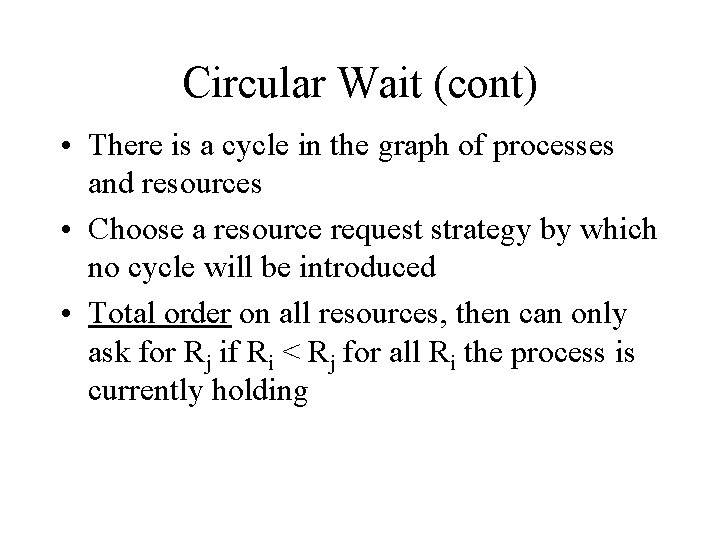
Circular Wait (cont) • There is a cycle in the graph of processes and resources • Choose a resource request strategy by which no cycle will be introduced • Total order on all resources, then can only ask for Rj if Ri < Rj for all Ri the process is currently holding
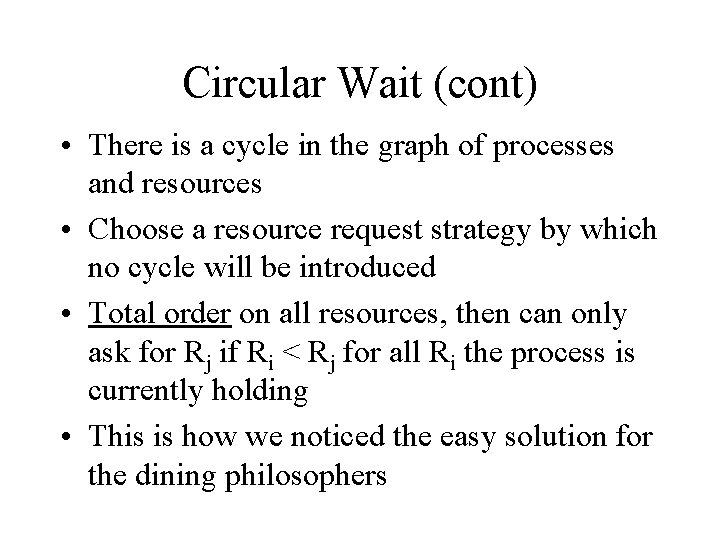
Circular Wait (cont) • There is a cycle in the graph of processes and resources • Choose a resource request strategy by which no cycle will be introduced • Total order on all resources, then can only ask for Rj if Ri < Rj for all Ri the process is currently holding • This is how we noticed the easy solution for the dining philosophers
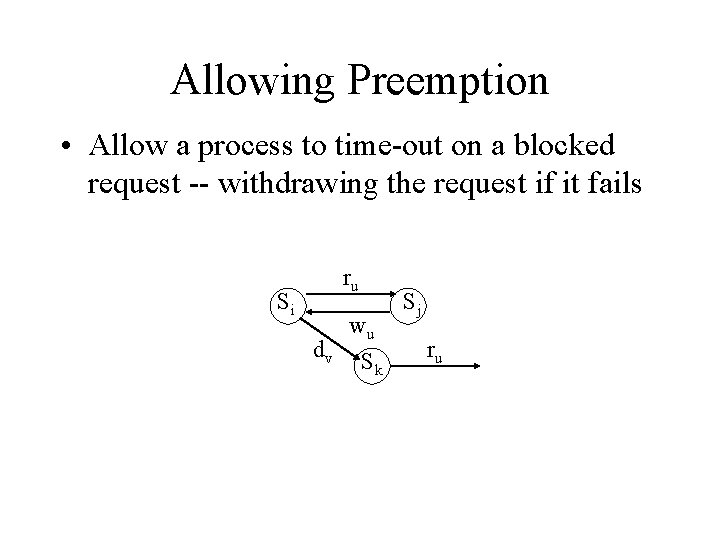
Allowing Preemption • Allow a process to time-out on a blocked request -- withdrawing the request if it fails ru Si dv wu Sk Sj ru
Avoidance • Define a model of system states, then choose a strategy that will guarantee that the system will not go to a deadlock state • Requires extra information, e. g. , the maximum claim for each process • Allows resource manager to see the worst case that could happen, then to allow transitions based on that knowledge
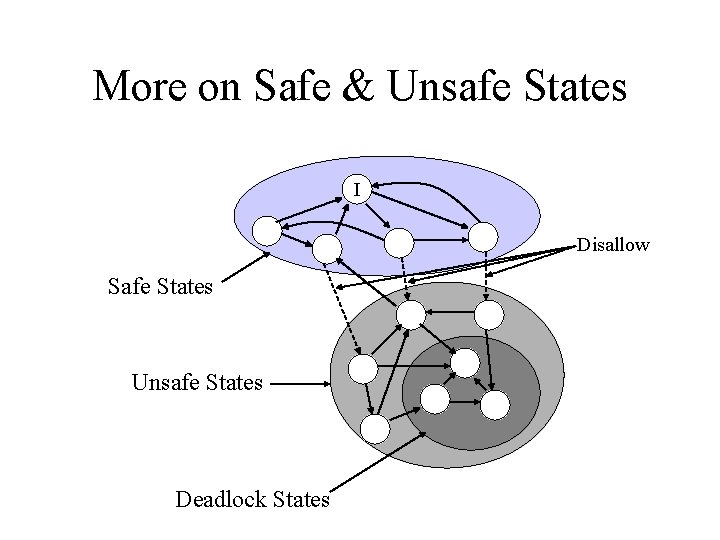
Safe vs Unsafe States • Safe state: one in which the system can assure that any sequence of subsequent transitions leads back to the initial state – Even if all exercise their maximum claim, there is an allocation strategy by which all claims can be met • Unsafe state: one in which the system cannot guarantee that the system will transition back to the initial state – Unsafe state can lead to a deadlock state if too many processes exercise their maximum claim at once
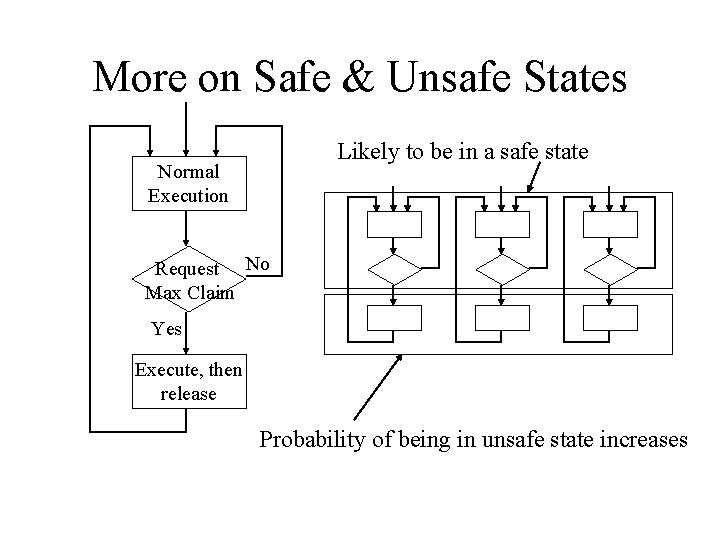
More on Safe & Unsafe States Likely to be in a safe state Normal Execution Request No Max Claim Yes Execute, then release Probability of being in unsafe state increases
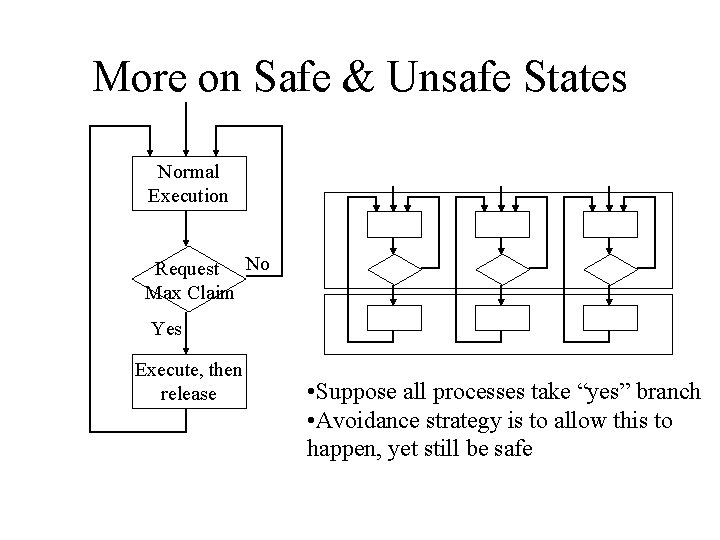
More on Safe & Unsafe States Normal Execution Request No Max Claim Yes Execute, then release • Suppose all processes take “yes” branch • Avoidance strategy is to allow this to happen, yet still be safe
More on Safe & Unsafe States I Disallow Safe States Unsafe States Deadlock States
Banker’s Algorithm • Let maxc[i, j] be the maximum claim for Rj by pi • Let alloc[i, j] be the number of units of Rj held by pi • Can always compute – avail[j] = cj - S 0 i< nalloc[i, j] – Then number of available units of Rj • Should be able to determine if the state is safe or not using this info
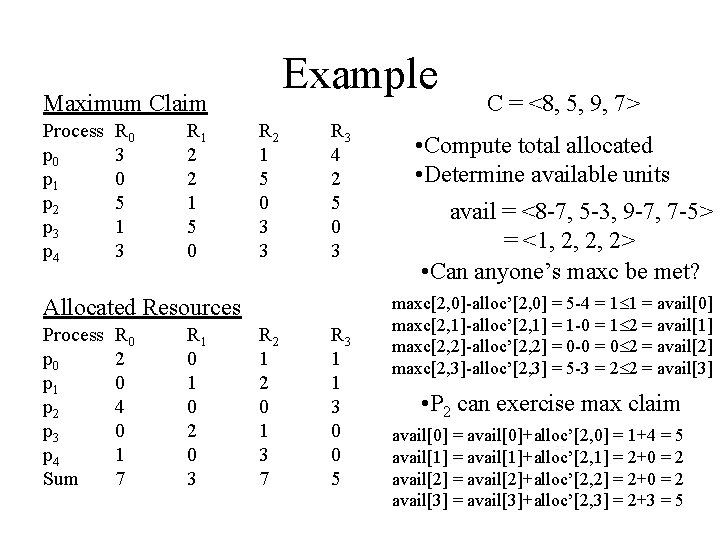
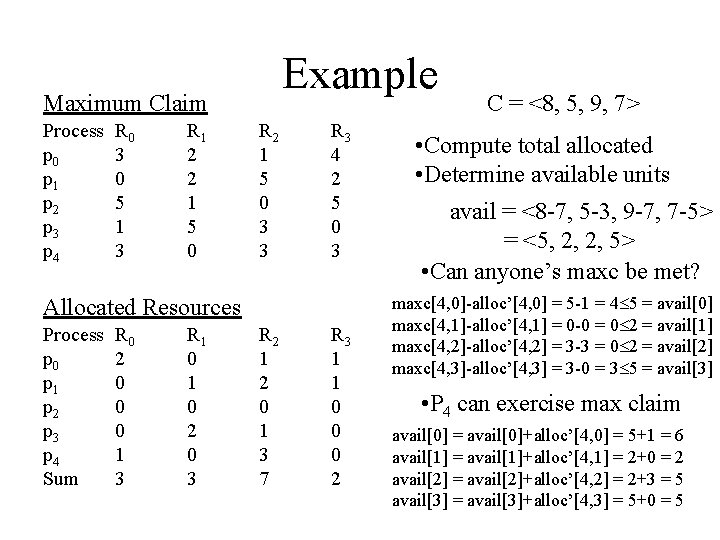
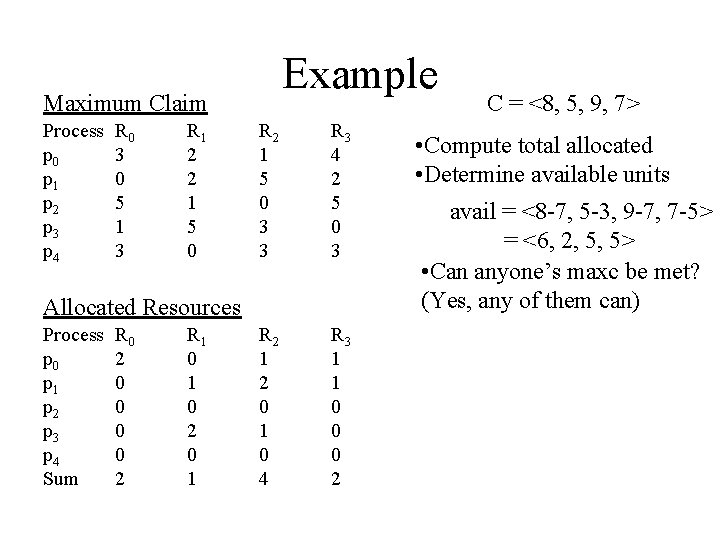
Banker’s Algorithm • Copy the alloc[i, j] table to alloc’[i, j] • Given C, maxc and alloc’, compute avail vector • Find pi: maxc[i, j] - alloc’[i, j] avail[j] for 0 j < m and 0 i < n. – If no such pi exists, the state is unsafe – If alloc’[i, j] is 0 for all i and j, the state is safe • Set alloc’[i, j] to 0; deallocate all resources held by pi; go to Step 2
Example Maximum Claim Process p 0 p 1 p 2 p 3 p 4 R 0 3 0 5 1 3 R 1 2 2 1 5 0 R 2 1 5 0 3 3 R 3 4 2 5 0 3 Allocated Resources Process p 0 p 1 p 2 p 3 p 4 Sum R 0 2 0 4 0 1 7 R 1 0 2 0 3 R 2 1 2 0 1 3 7 R 3 1 1 3 0 0 5 C = <8, 5, 9, 7> • Compute total allocated • Determine available units avail = <8 -7, 5 -3, 9 -7, 7 -5> = <1, 2, 2, 2> • Can anyone’s maxc be met? maxc[2, 0]-alloc’[2, 0] = 5 -4 = 1 1 = avail[0] maxc[2, 1]-alloc’[2, 1] = 1 -0 = 1 2 = avail[1] maxc[2, 2]-alloc’[2, 2] = 0 -0 = 0 2 = avail[2] maxc[2, 3]-alloc’[2, 3] = 5 -3 = 2 2 = avail[3] • P 2 can exercise max claim avail[0] = avail[0]+alloc’[2, 0] = 1+4 = 5 avail[1] = avail[1]+alloc’[2, 1] = 2+0 = 2 avail[2] = avail[2]+alloc’[2, 2] = 2+0 = 2 avail[3] = avail[3]+alloc’[2, 3] = 2+3 = 5
Example Maximum Claim Process p 0 p 1 p 2 p 3 p 4 R 0 3 0 5 1 3 R 1 2 2 1 5 0 R 2 1 5 0 3 3 R 3 4 2 5 0 3 Allocated Resources Process p 0 p 1 p 2 p 3 p 4 Sum R 0 2 0 0 0 1 3 R 1 0 2 0 3 R 2 1 2 0 1 3 7 R 3 1 1 0 0 0 2 C = <8, 5, 9, 7> • Compute total allocated • Determine available units avail = <8 -7, 5 -3, 9 -7, 7 -5> = <5, 2, 2, 5> • Can anyone’s maxc be met? maxc[4, 0]-alloc’[4, 0] = 5 -1 = 4 5 = avail[0] maxc[4, 1]-alloc’[4, 1] = 0 -0 = 0 2 = avail[1] maxc[4, 2]-alloc’[4, 2] = 3 -3 = 0 2 = avail[2] maxc[4, 3]-alloc’[4, 3] = 3 -0 = 3 5 = avail[3] • P 4 can exercise max claim avail[0] = avail[0]+alloc’[4, 0] = 5+1 = 6 avail[1] = avail[1]+alloc’[4, 1] = 2+0 = 2 avail[2] = avail[2]+alloc’[4, 2] = 2+3 = 5 avail[3] = avail[3]+alloc’[4, 3] = 5+0 = 5
Example Maximum Claim Process p 0 p 1 p 2 p 3 p 4 R 0 3 0 5 1 3 R 1 2 2 1 5 0 R 2 1 5 0 3 3 R 3 4 2 5 0 3 R 2 1 2 0 1 0 4 R 3 1 1 0 0 0 2 Allocated Resources Process p 0 p 1 p 2 p 3 p 4 Sum R 0 2 0 0 2 R 1 0 2 0 1 C = <8, 5, 9, 7> • Compute total allocated • Determine available units avail = <8 -7, 5 -3, 9 -7, 7 -5> = <6, 2, 5, 5> • Can anyone’s maxc be met? (Yes, any of them can)
Detection & Recovery • Check for deadlock (periodically or sporadically), then recover • Can be far more aggressive with allocation • No maximum claim, no safe/unsafe states • Differentiate between – Serially reusable resources: A unit must be allocated before being released – Consumable resources: Never release acquired resources; resource count is number currently available
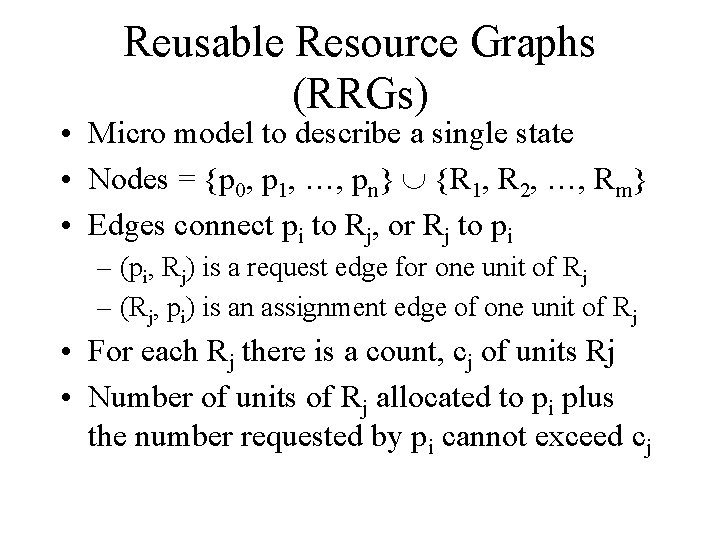
Reusable Resource Graphs (RRGs) • Micro model to describe a single state • Nodes = {p 0, p 1, …, pn} {R 1, R 2, …, Rm} • Edges connect pi to Rj, or Rj to pi – (pi, Rj) is a request edge for one unit of Rj – (Rj, pi) is an assignment edge of one unit of Rj • For each Rj there is a count, cj of units Rj • Number of units of Rj allocated to pi plus the number requested by pi cannot exceed cj
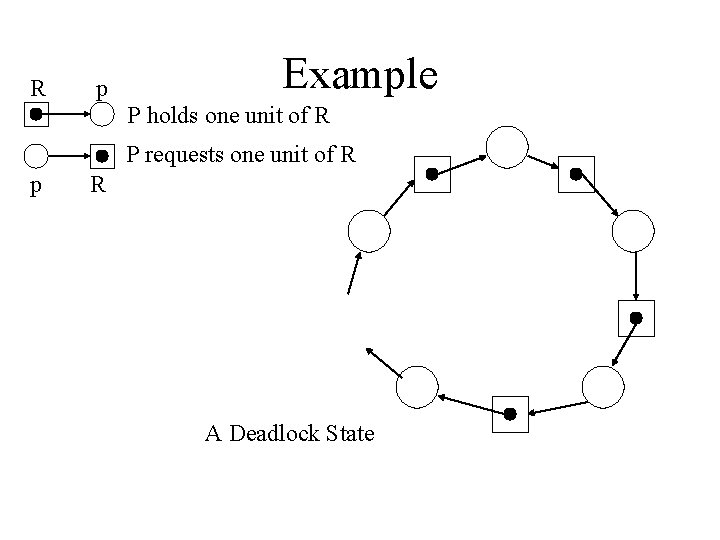
R p Example P holds one unit of R P requests one unit of R p R A Deadlock State
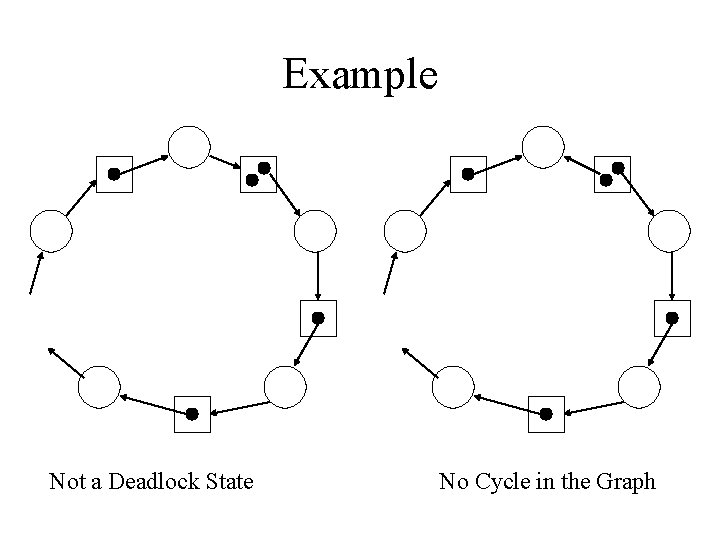
Example Not a Deadlock State No Cycle in the Graph
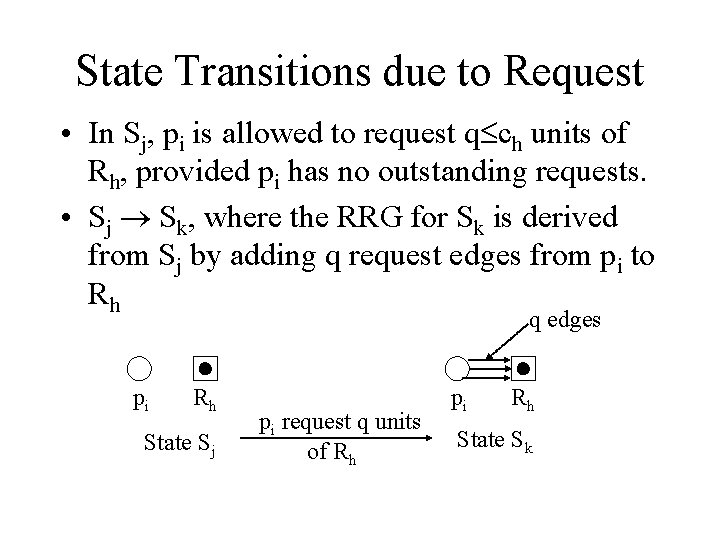
State Transitions due to Request • In Sj, pi is allowed to request q ch units of Rh, provided pi has no outstanding requests. • Sj Sk, where the RRG for Sk is derived from Sj by adding q request edges from pi to Rh q edges pi Rh State Sj pi request q units of Rh pi Rh State Sk
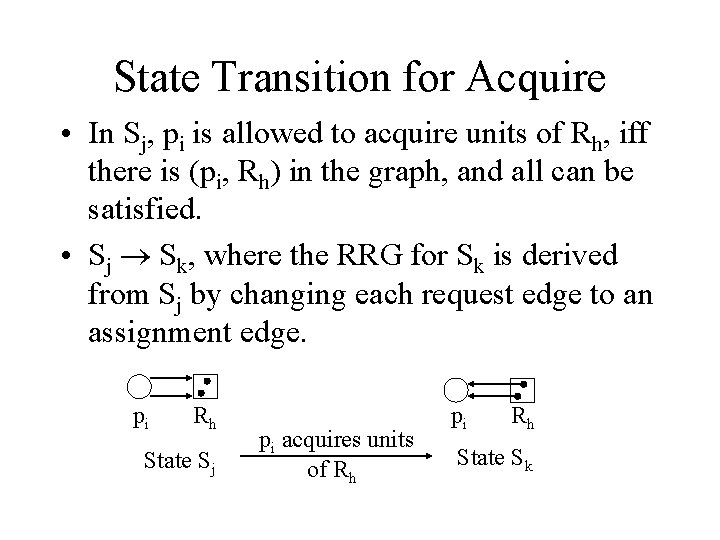
State Transition for Acquire • In Sj, pi is allowed to acquire units of Rh, iff there is (pi, Rh) in the graph, and all can be satisfied. • Sj Sk, where the RRG for Sk is derived from Sj by changing each request edge to an assignment edge. pi Rh State Sj pi acquires units of Rh pi Rh State Sk
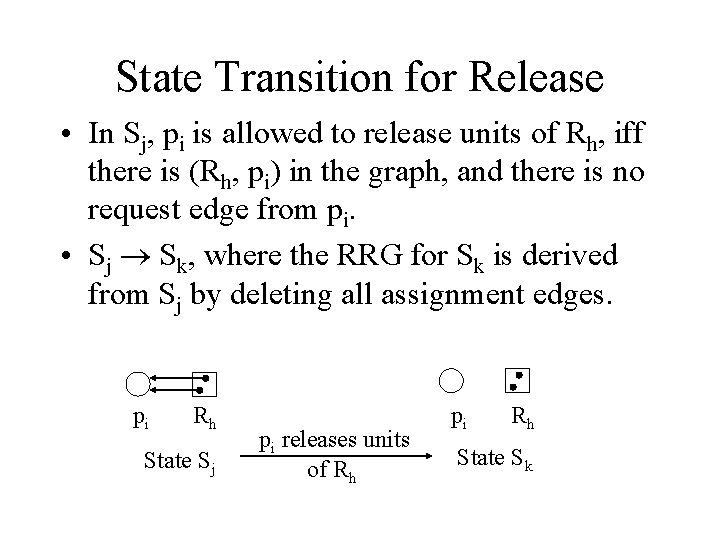
State Transition for Release • In Sj, pi is allowed to release units of Rh, iff there is (Rh, pi) in the graph, and there is no request edge from pi. • Sj Sk, where the RRG for Sk is derived from Sj by deleting all assignment edges. pi Rh State Sj pi releases units of Rh pi Rh State Sk
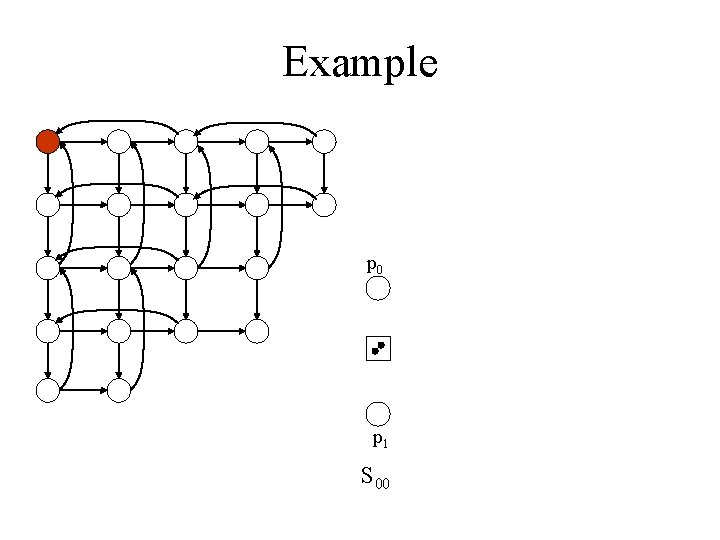
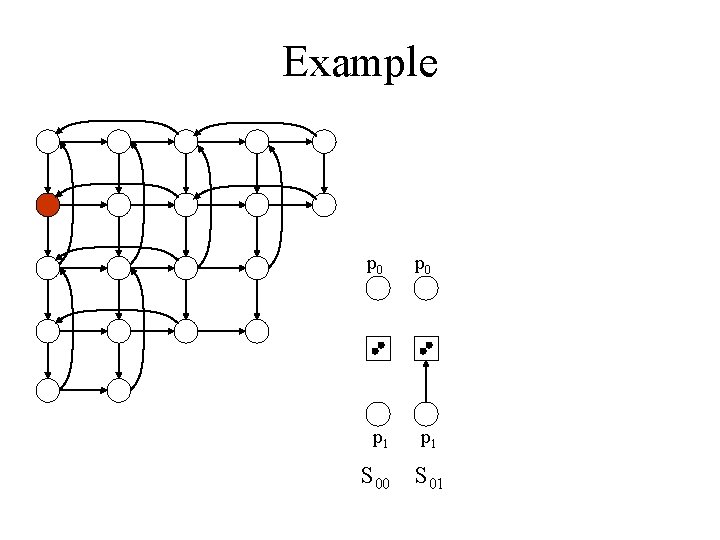
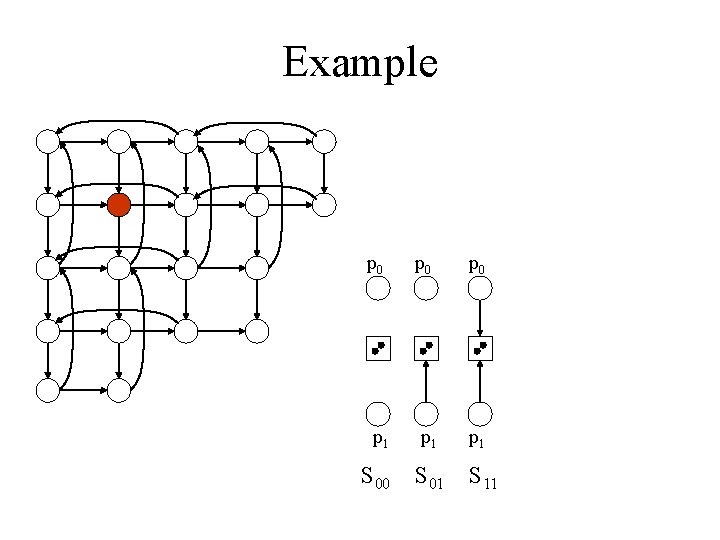
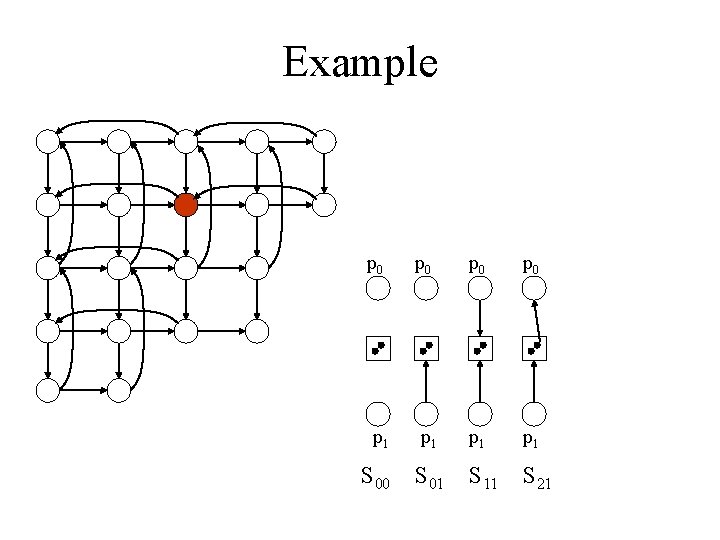
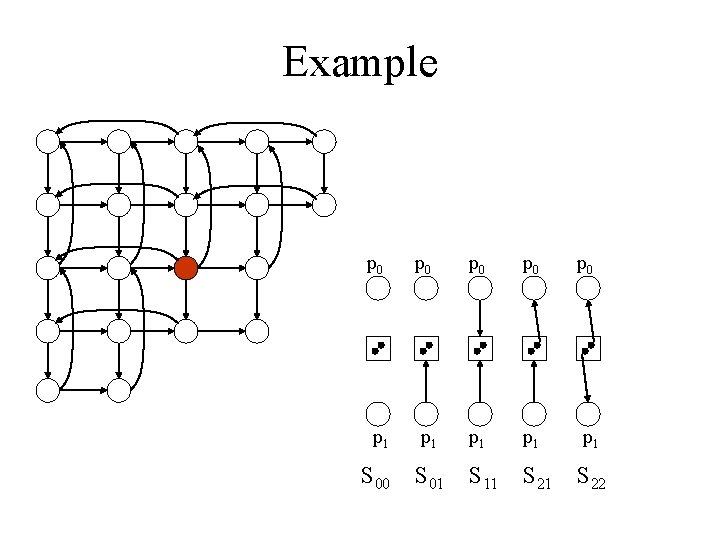
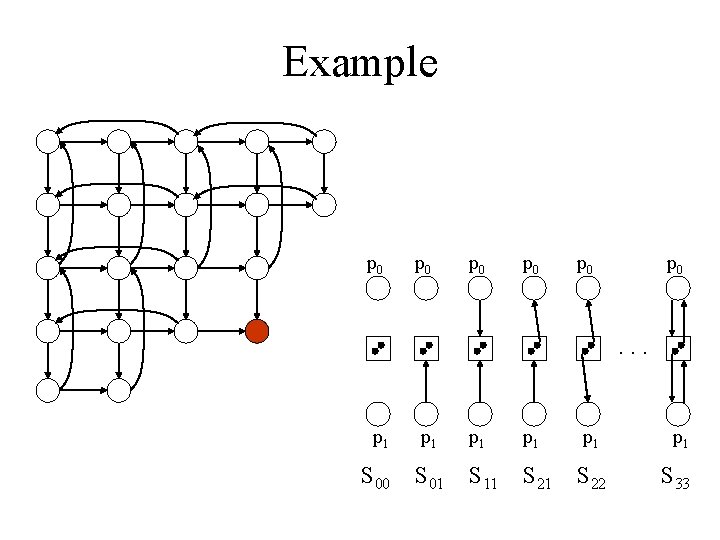
Example p 0 p 1 S 00
Example p 0 p 1 S 00 S 01
Example p 0 p 0 p 1 p 1 S 00 S 01 S 11
Example p 0 p 0 p 1 p 1 S 00 S 01 S 11 S 21
Example p 0 p 0 p 0 p 1 p 1 p 1 S 00 S 01 S 11 S 22
Example p 0 p 0 p 0 . . . p 1 p 1 p 1 S 00 S 01 S 11 S 22 S 33
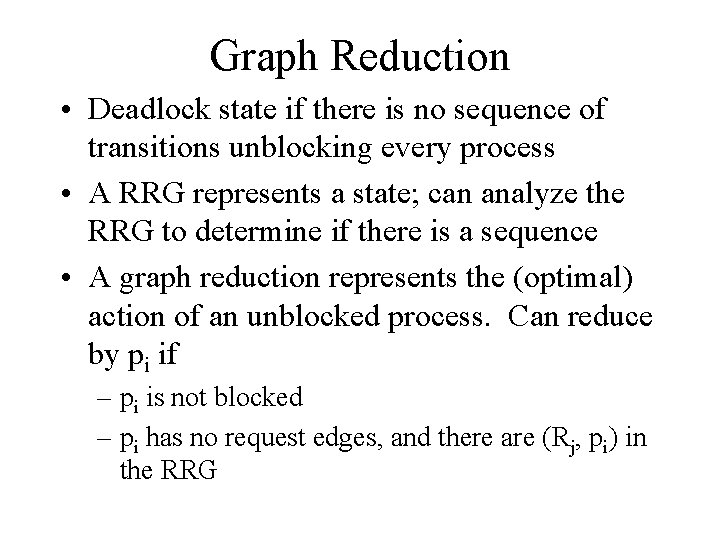
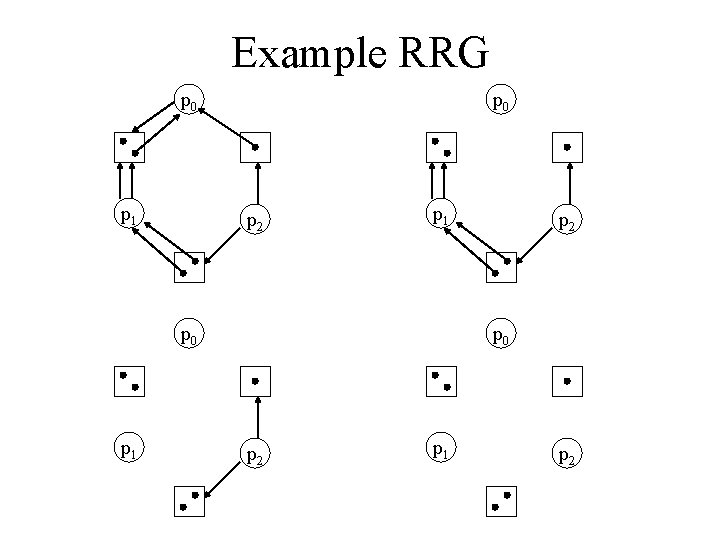
Graph Reduction • Deadlock state if there is no sequence of transitions unblocking every process • A RRG represents a state; can analyze the RRG to determine if there is a sequence • A graph reduction represents the (optimal) action of an unblocked process. Can reduce by pi if – pi is not blocked – pi has no request edges, and there are (Rj, pi) in the RRG
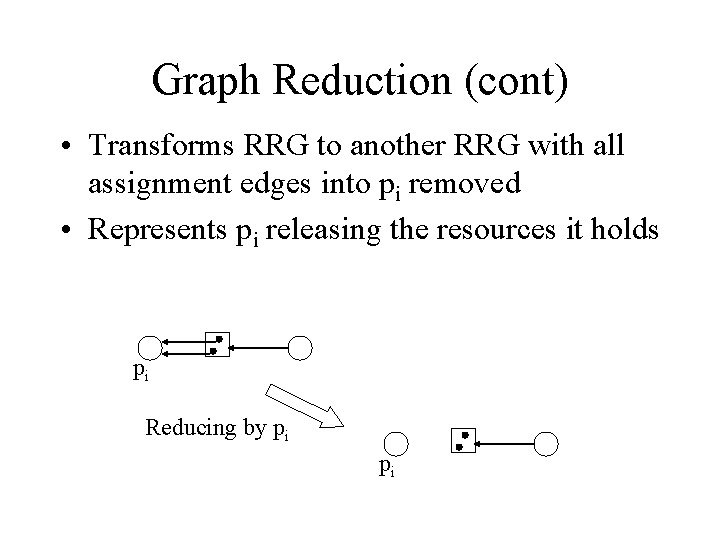
Graph Reduction (cont) • Transforms RRG to another RRG with all assignment edges into pi removed • Represents pi releasing the resources it holds pi Reducing by pi pi
Graph Reduction (cont) • A RRG is completely reducible if there a sequence of reductions that leads to a RRG with no edges • A state is a deadlock state if and only if the RRG is not completely reducible.
Example RRG p 0 p 1 p 0 p 2 p 1 p 0 p 1 p 2 p 0 p 2 p 1 p 2
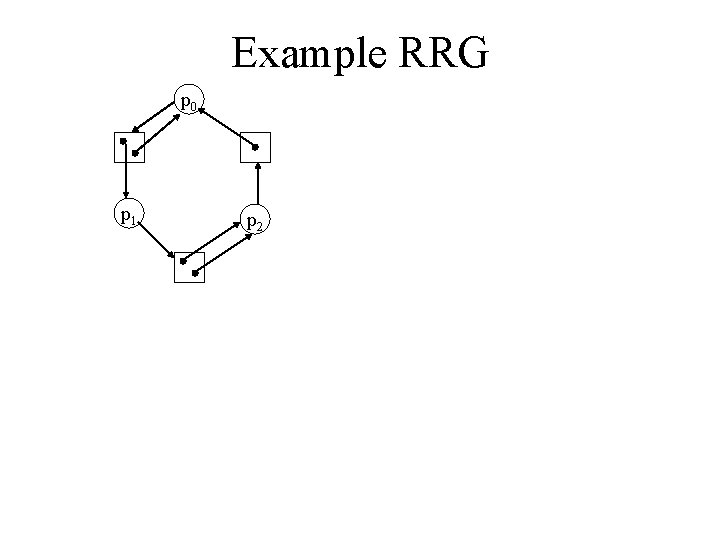
Example RRG p 0 p 1 p 2
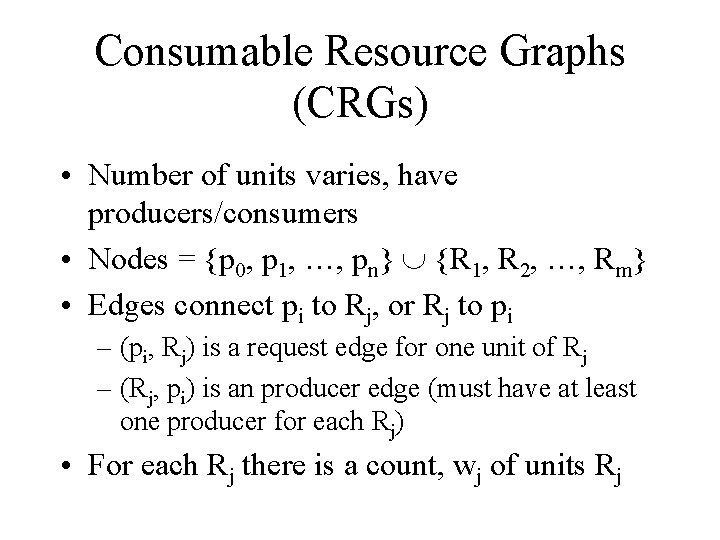
Consumable Resource Graphs (CRGs) • Number of units varies, have producers/consumers • Nodes = {p 0, p 1, …, pn} {R 1, R 2, …, Rm} • Edges connect pi to Rj, or Rj to pi – (pi, Rj) is a request edge for one unit of Rj – (Rj, pi) is an producer edge (must have at least one producer for each Rj) • For each Rj there is a count, wj of units Rj
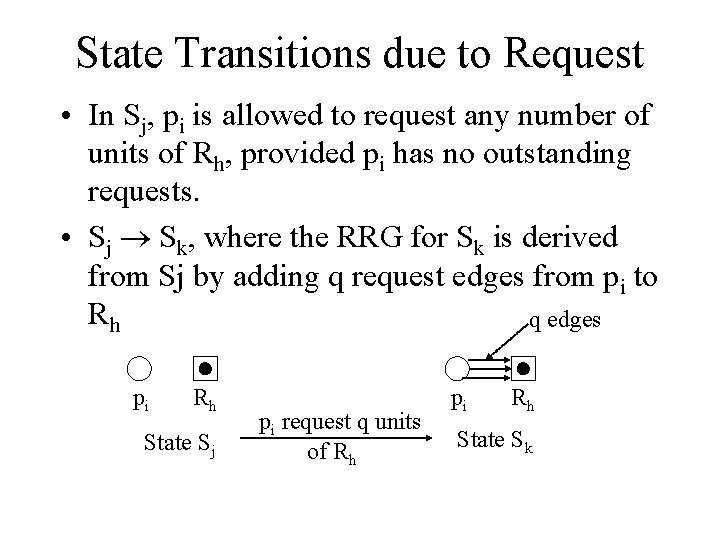
State Transitions due to Request • In Sj, pi is allowed to request any number of units of Rh, provided pi has no outstanding requests. • Sj Sk, where the RRG for Sk is derived from Sj by adding q request edges from pi to Rh q edges pi Rh State Sj pi request q units of Rh pi Rh State Sk
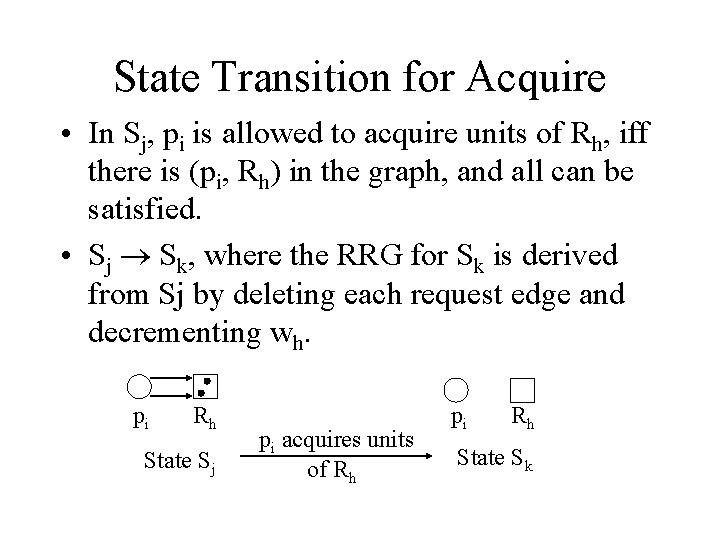
State Transition for Acquire • In Sj, pi is allowed to acquire units of Rh, iff there is (pi, Rh) in the graph, and all can be satisfied. • Sj Sk, where the RRG for Sk is derived from Sj by deleting each request edge and decrementing wh. pi Rh State Sj pi acquires units of Rh pi Rh State Sk
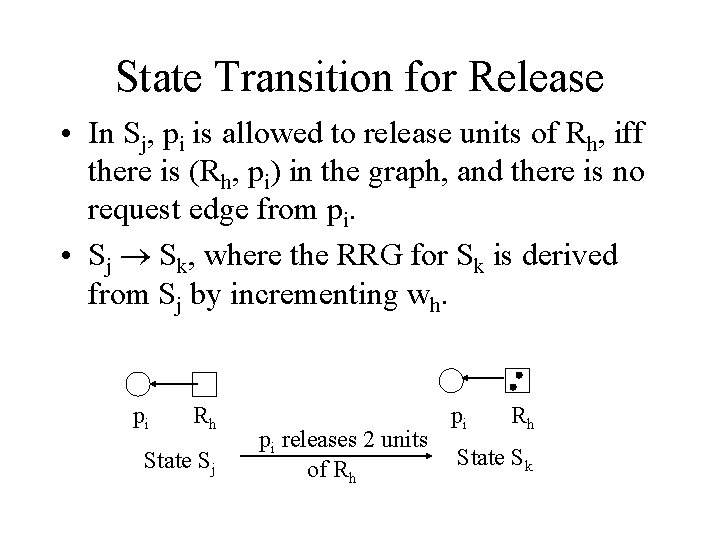
State Transition for Release • In Sj, pi is allowed to release units of Rh, iff there is (Rh, pi) in the graph, and there is no request edge from pi. • Sj Sk, where the RRG for Sk is derived from Sj by incrementing wh. pi Rh State Sj pi releases 2 units of Rh pi Rh State Sk
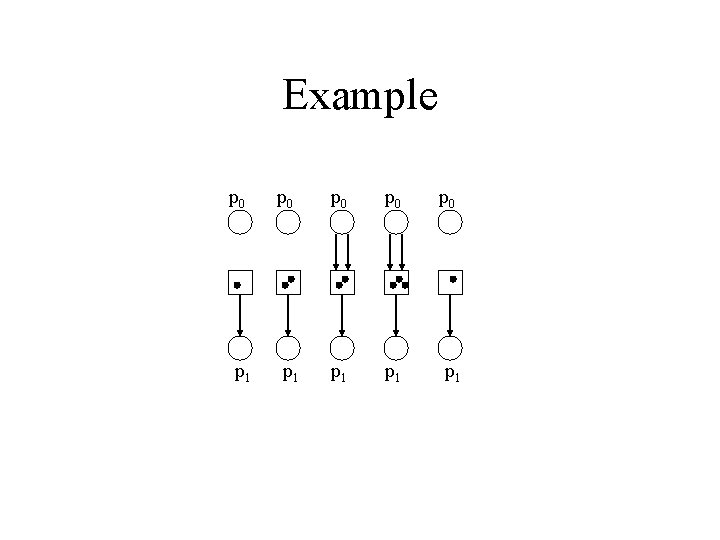
Example p 0 p 0 p 0 p 1 p 1 p 1
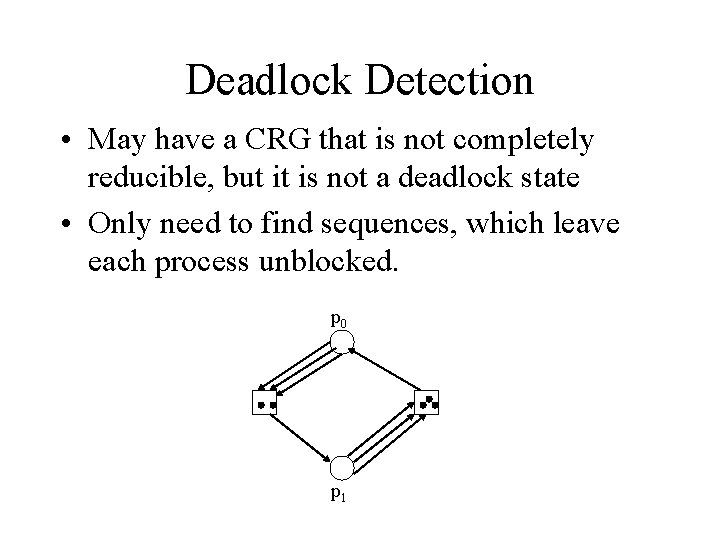
Deadlock Detection • May have a CRG that is not completely reducible, but it is not a deadlock state • For each process: – Find at least one sequence which leaves each process unblocked. • There may be different sequences for different processes -- not necessarily an efficient approach
Deadlock Detection • May have a CRG that is not completely reducible, but it is not a deadlock state • Only need to find sequences, which leave each process unblocked. p 0 p 1
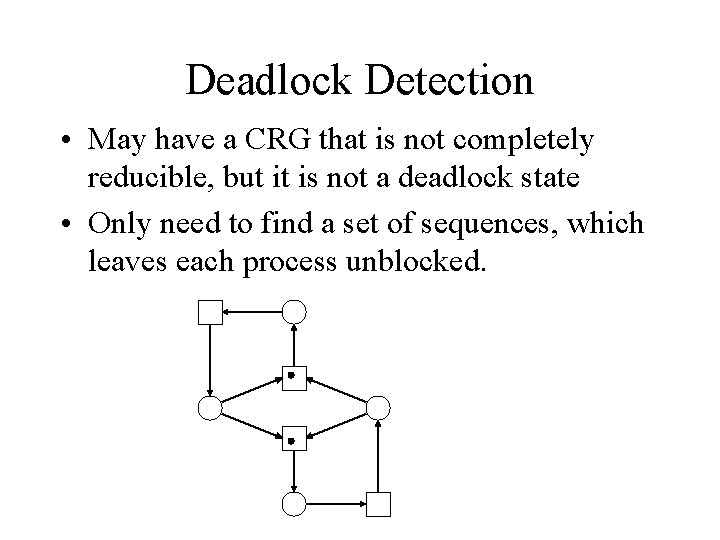
Deadlock Detection • May have a CRG that is not completely reducible, but it is not a deadlock state • Only need to find a set of sequences, which leaves each process unblocked.
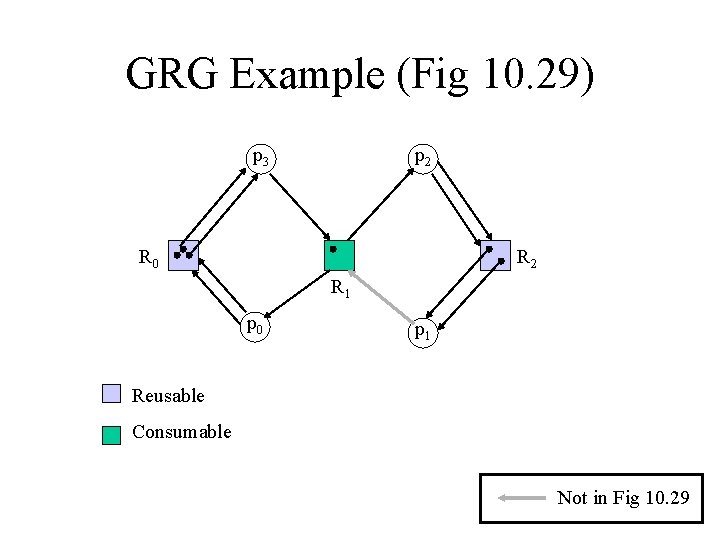
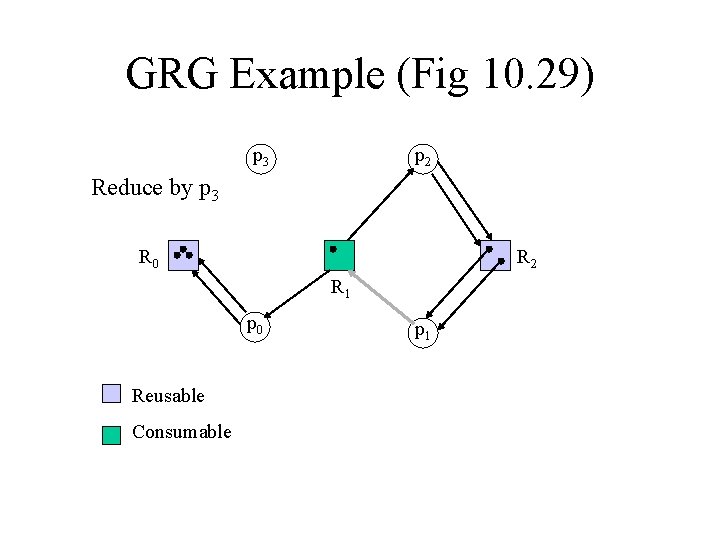
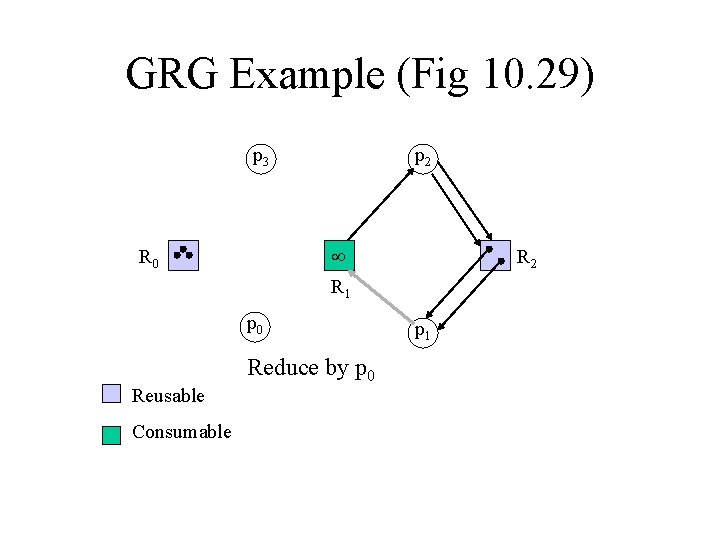
General Resource Graphs • Have consumable and reusable resources • Apply consumable reductions to consumables, and reusable reductions to reusables • See Figure 10. 29
GRG Example (Fig 10. 29) p 3 p 2 R 0 R 2 R 1 p 0 p 1 Reusable Consumable Not in Fig 10. 29
GRG Example (Fig 10. 29) p 3 p 2 Reduce by p 3 R 0 R 2 R 1 p 0 Reusable Consumable p 1
GRG Example (Fig 10. 29) p 3 p 2 R 1 R 0 p 0 Reduce by p 0 Reusable Consumable R 2 p 1
Recovery • No magic here – Choose a blocked resource – Preempt it (releasing its resources) – Run the detection algorithm – Iterate if until the state is not a deadlock state