
Deadlock 1 Permanent blocking of a set of
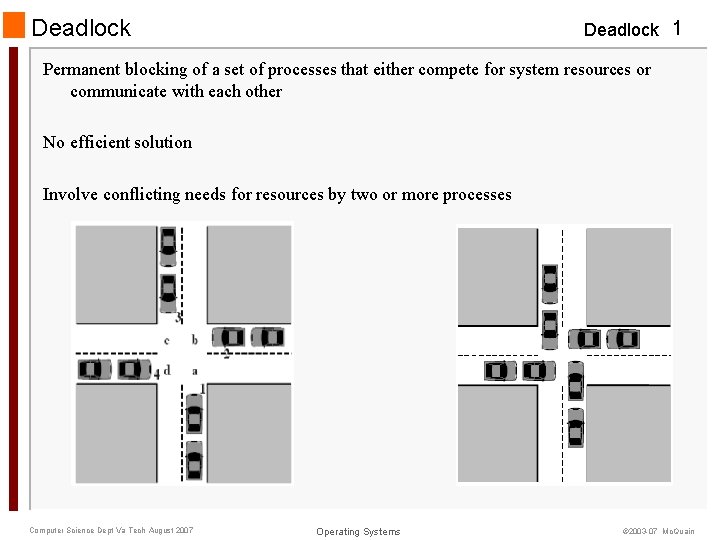
Deadlock 1 Permanent blocking of a set of processes that either compete for system resources or communicate with each other No efficient solution Involve conflicting needs for resources by two or more processes Computer Science Dept Va Tech August 2007 Operating Systems © 2003 -07 Mc. Quain
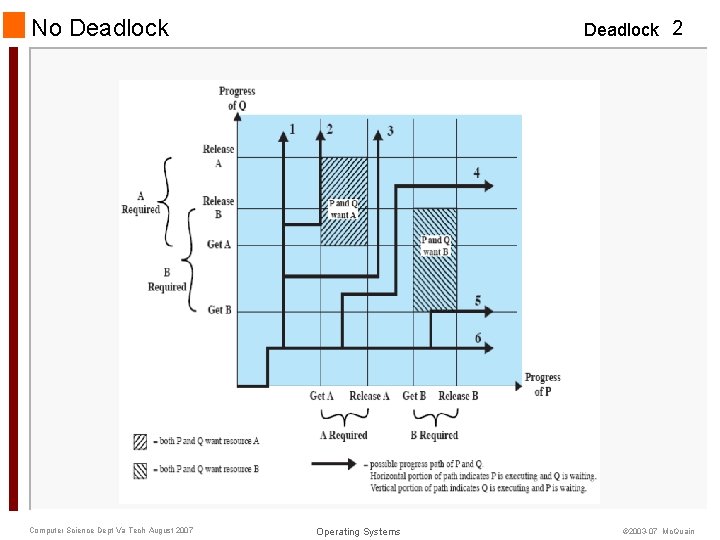
No Deadlock Computer Science Dept Va Tech August 2007 Deadlock 2 Operating Systems © 2003 -07 Mc. Quain
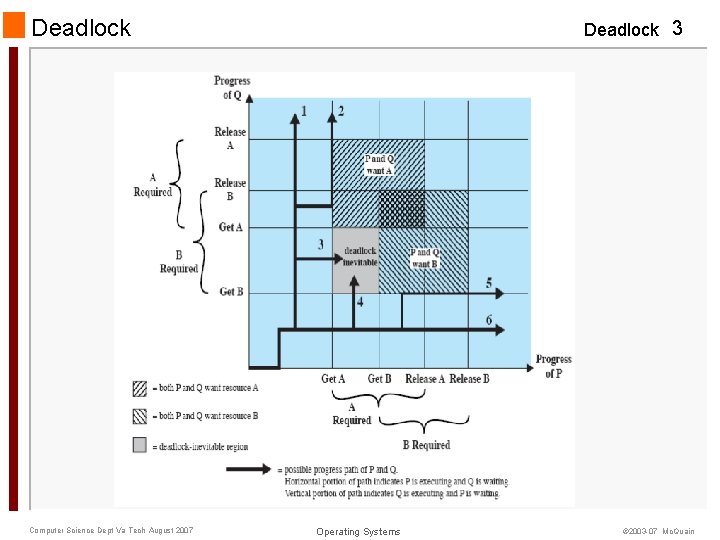
Deadlock Computer Science Dept Va Tech August 2007 Deadlock 3 Operating Systems © 2003 -07 Mc. Quain
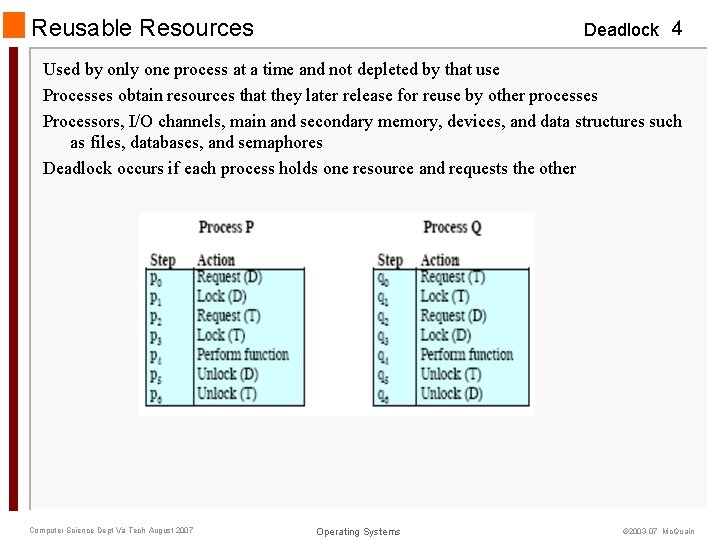
Reusable Resources Deadlock 4 Used by only one process at a time and not depleted by that use Processes obtain resources that they later release for reuse by other processes Processors, I/O channels, main and secondary memory, devices, and data structures such as files, databases, and semaphores Deadlock occurs if each process holds one resource and requests the other Computer Science Dept Va Tech August 2007 Operating Systems © 2003 -07 Mc. Quain
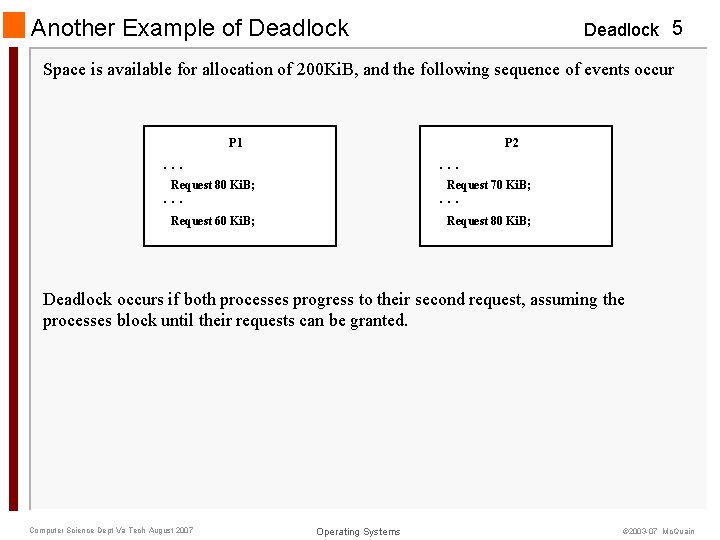
Another Example of Deadlock 5 Space is available for allocation of 200 Ki. B, and the following sequence of events occur P 1 P 2 . . . Request 80 Ki. B; Request 70 Ki. B; . . . Request 60 Ki. B; Request 80 Ki. B; Deadlock occurs if both processes progress to their second request, assuming the processes block until their requests can be granted. Computer Science Dept Va Tech August 2007 Operating Systems © 2003 -07 Mc. Quain
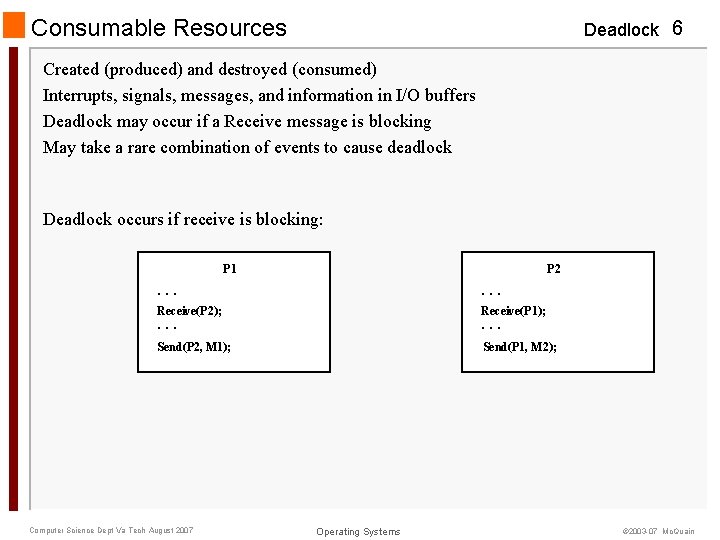
Consumable Resources Deadlock 6 Created (produced) and destroyed (consumed) Interrupts, signals, messages, and information in I/O buffers Deadlock may occur if a Receive message is blocking May take a rare combination of events to cause deadlock Deadlock occurs if receive is blocking: P 1 P 2 . . . Receive(P 2); Receive(P 1); Send(P 2, M 1); Send(P 1, M 2); . . . Computer Science Dept Va Tech August 2007 . . . Operating Systems © 2003 -07 Mc. Quain
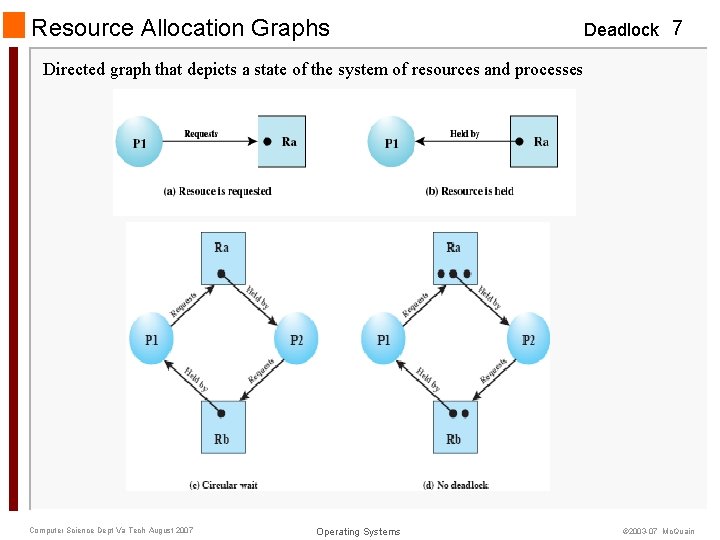
Resource Allocation Graphs Deadlock 7 Directed graph that depicts a state of the system of resources and processes Computer Science Dept Va Tech August 2007 Operating Systems © 2003 -07 Mc. Quain
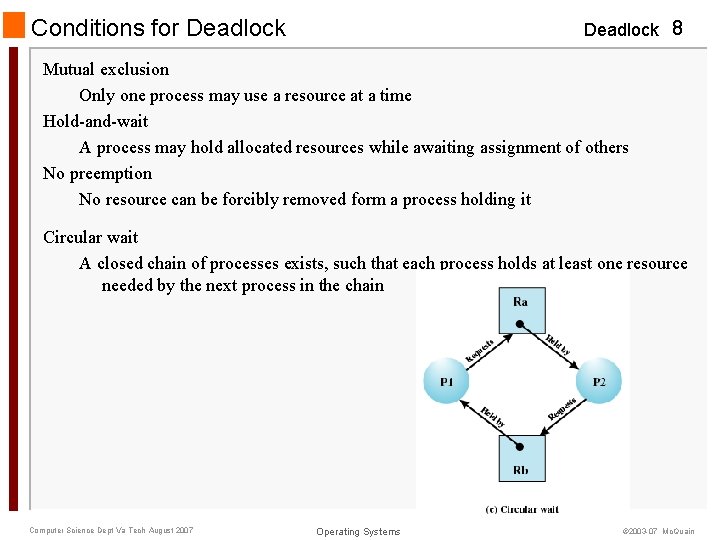
Conditions for Deadlock 8 Mutual exclusion Only one process may use a resource at a time Hold-and-wait A process may hold allocated resources while awaiting assignment of others No preemption No resource can be forcibly removed form a process holding it Circular wait A closed chain of processes exists, such that each process holds at least one resource needed by the next process in the chain Computer Science Dept Va Tech August 2007 Operating Systems © 2003 -07 Mc. Quain
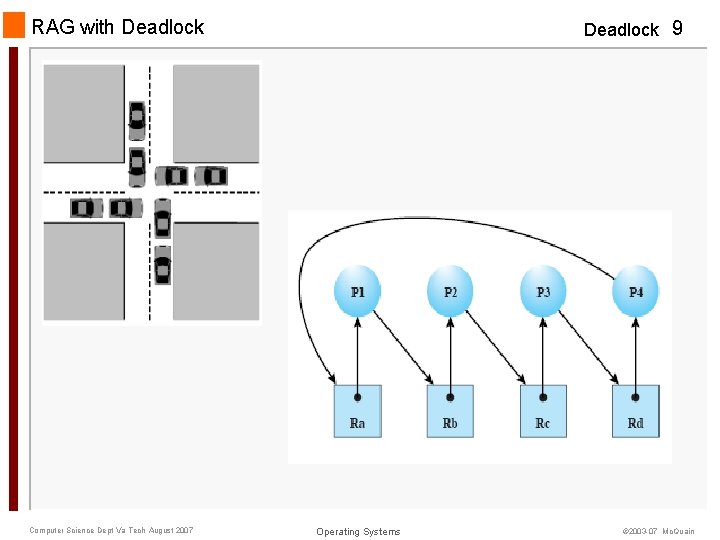
RAG with Deadlock Computer Science Dept Va Tech August 2007 Deadlock 9 Operating Systems © 2003 -07 Mc. Quain

Possibility of Deadlock Mutual Exclusion Deadlock 10 Circular wait No preemption Hold and wait Computer Science Dept Va Tech August 2007 Operating Systems © 2003 -07 Mc. Quain
Deadlock Prevention Deadlock 11 Goal Design the system so that deadlock is logically impossible Mutual Exclusion Must be supported by the operating system Hold and Wait Require a process request all of its required resources at one time? No Preemption Process must release resource and request again? Operating system may preempt a process to require it releases its resources? Circular Wait Define a linear ordering of resource types? Computer Science Dept Va Tech August 2007 Operating Systems © 2003 -07 Mc. Quain
Deadlock Avoidance Deadlock 12 Goal Deny requests that might lead to the occurrence of deadlock A decision is made dynamically whether the current resource allocation request will, if granted, potentially lead to a deadlock Requires knowledge of future process request Do not start a process if its demands might lead to deadlock Computer Science Dept Va Tech August 2007 Do not grant an incremental resource request to a process if this allocation might lead to deadlock Operating Systems © 2003 -07 Mc. Quain
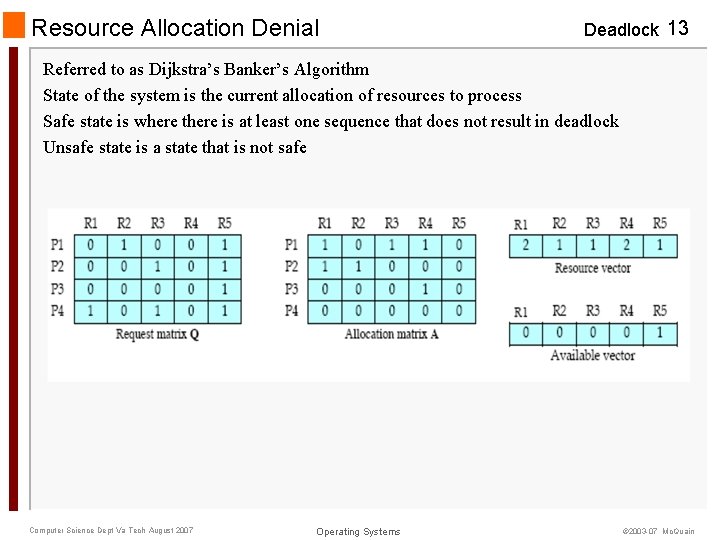
Resource Allocation Denial Deadlock 13 Referred to as Dijkstra’s Banker’s Algorithm State of the system is the current allocation of resources to process Safe state is where there is at least one sequence that does not result in deadlock Unsafe state is a state that is not safe Computer Science Dept Va Tech August 2007 Operating Systems © 2003 -07 Mc. Quain
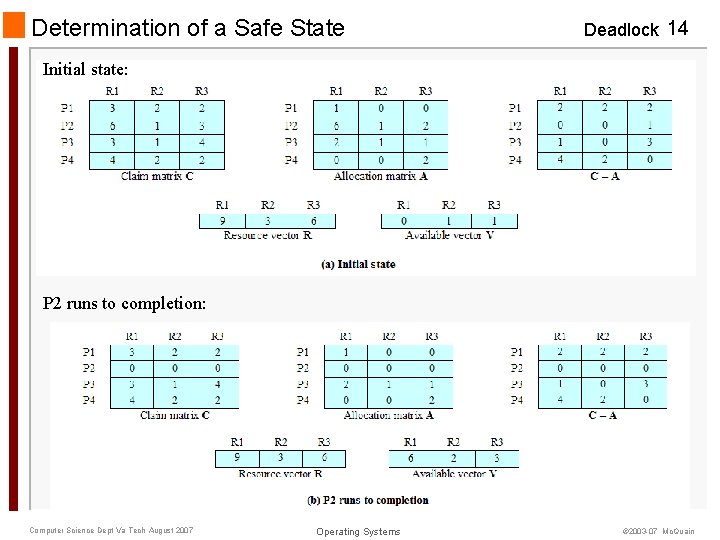
Determination of a Safe State Deadlock 14 Initial state: P 2 runs to completion: Computer Science Dept Va Tech August 2007 Operating Systems © 2003 -07 Mc. Quain
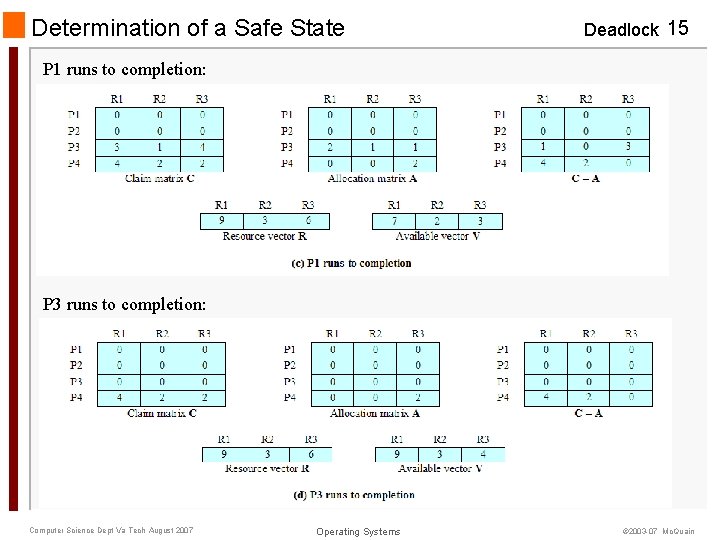
Determination of a Safe State Deadlock 15 P 1 runs to completion: P 3 runs to completion: Computer Science Dept Va Tech August 2007 Operating Systems © 2003 -07 Mc. Quain
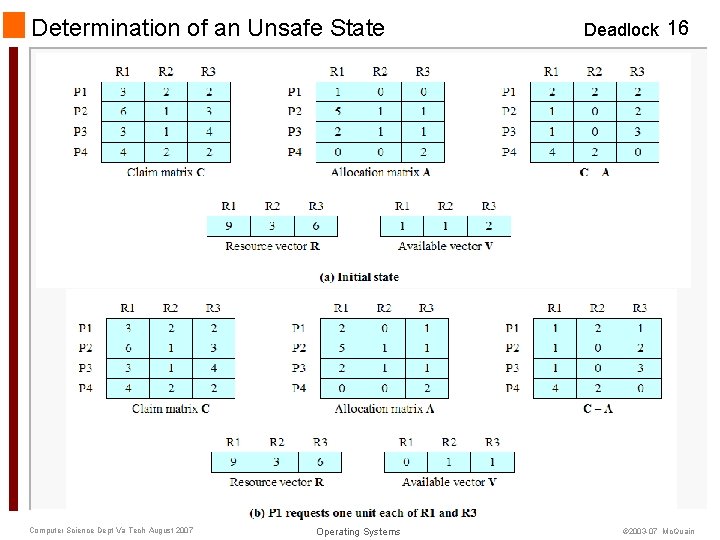
Determination of an Unsafe State Computer Science Dept Va Tech August 2007 Operating Systems Deadlock 16 © 2003 -07 Mc. Quain
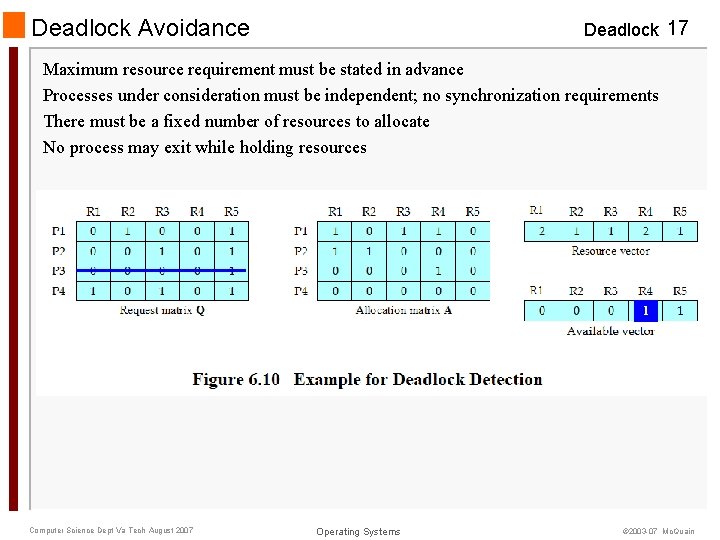
Deadlock Avoidance Deadlock 17 Maximum resource requirement must be stated in advance Processes under consideration must be independent; no synchronization requirements There must be a fixed number of resources to allocate No process may exit while holding resources 1 Computer Science Dept Va Tech August 2007 Operating Systems © 2003 -07 Mc. Quain
Strategies once Deadlock Detected Deadlock 18 Abort all deadlocked processes Back up each deadlocked process to some previously defined checkpoint, and restart all process Original deadlock may occur Successively abort deadlocked processes until deadlock no longer exists Successively preempt resources until deadlock no longer exists Computer Science Dept Va Tech August 2007 Operating Systems © 2003 -07 Mc. Quain
Selection Criteria Deadlocked Processes Deadlock 19 Least amount of processor time consumed so far Least number of lines of output produced so far Most estimated time remaining Least total resources allocated so far Lowest priority Computer Science Dept Va Tech August 2007 Operating Systems © 2003 -07 Mc. Quain
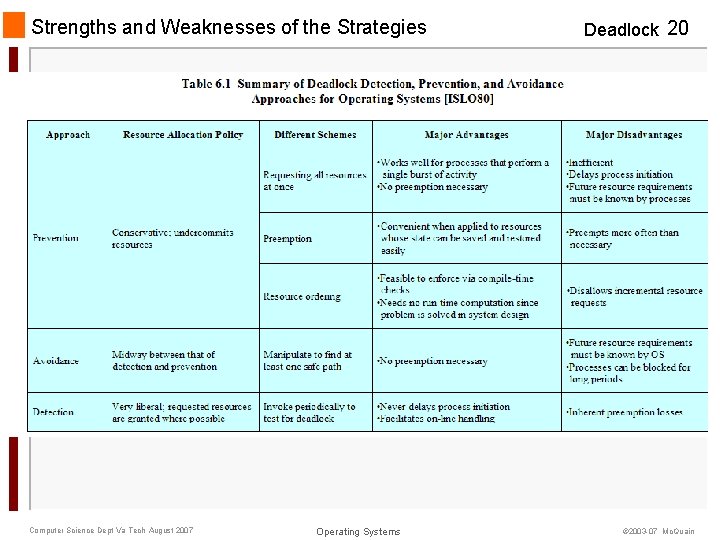
Strengths and Weaknesses of the Strategies Computer Science Dept Va Tech August 2007 Operating Systems Deadlock 20 © 2003 -07 Mc. Quain
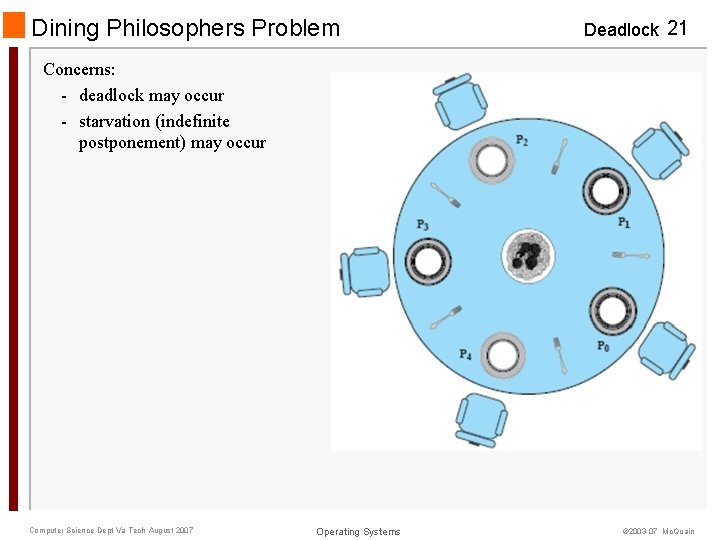
Dining Philosophers Problem Deadlock 21 Concerns: - deadlock may occur - starvation (indefinite postponement) may occur Computer Science Dept Va Tech August 2007 Operating Systems © 2003 -07 Mc. Quain
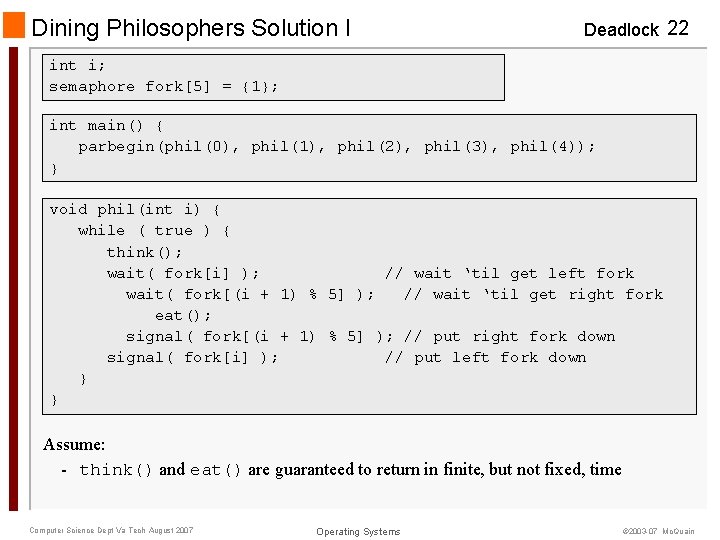
Dining Philosophers Solution I Deadlock 22 int i; semaphore fork[5] = {1}; int main() { parbegin(phil(0), phil(1), phil(2), phil(3), phil(4)); } void phil(int i) { while ( true ) { think(); wait( fork[i] ); // wait ‘til get left fork wait( fork[(i + 1) % 5] ); // wait ‘til get right fork eat(); signal( fork[(i + 1) % 5] ); // put right fork down signal( fork[i] ); // put left fork down } } Assume: - think() and eat() are guaranteed to return in finite, but not fixed, time Computer Science Dept Va Tech August 2007 Operating Systems © 2003 -07 Mc. Quain
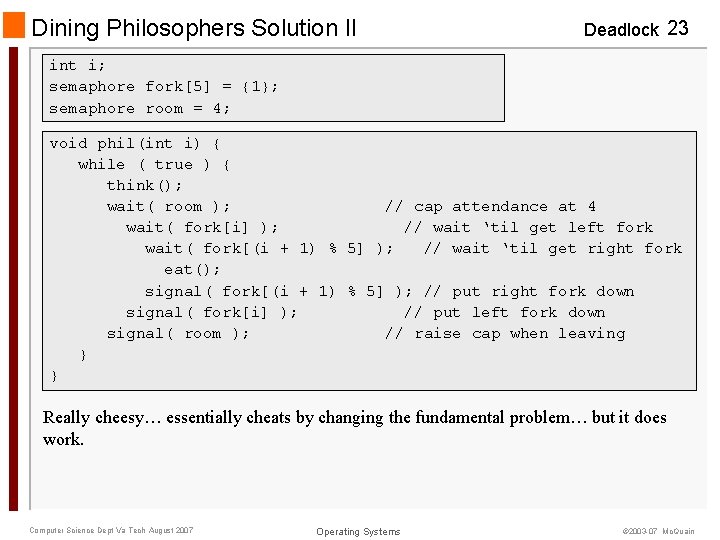
Dining Philosophers Solution II Deadlock 23 int i; semaphore fork[5] = {1}; semaphore room = 4; void phil(int i) { while ( true ) { think(); wait( room ); // cap attendance at 4 wait( fork[i] ); // wait ‘til get left fork wait( fork[(i + 1) % 5] ); // wait ‘til get right fork eat(); signal( fork[(i + 1) % 5] ); // put right fork down signal( fork[i] ); // put left fork down signal( room ); // raise cap when leaving } } Really cheesy… essentially cheats by changing the fundamental problem… but it does work. Computer Science Dept Va Tech August 2007 Operating Systems © 2003 -07 Mc. Quain
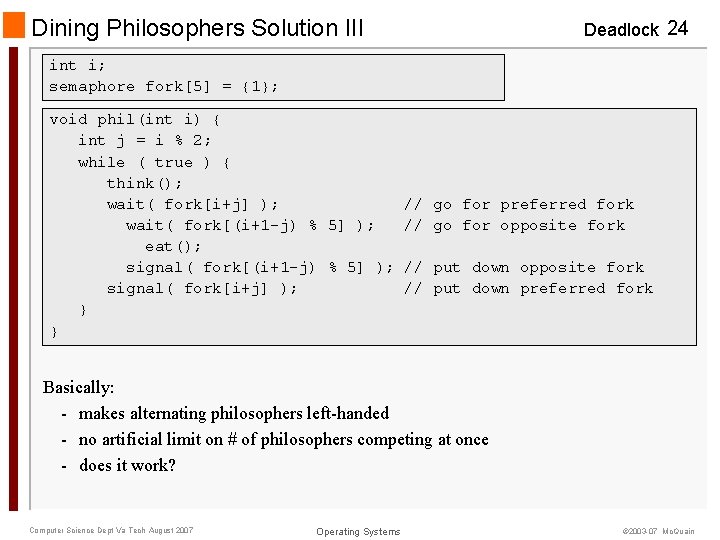
Dining Philosophers Solution III Deadlock 24 int i; semaphore fork[5] = {1}; void phil(int i) { int j = i % 2; while ( true ) { think(); wait( fork[i+j] ); wait( fork[(i+1 -j) % 5] ); eat(); signal( fork[(i+1 -j) % 5] ); signal( fork[i+j] ); } } // go for preferred fork // go for opposite fork // put down preferred fork Basically: - makes alternating philosophers left-handed - no artificial limit on # of philosophers competing at once - does it work? Computer Science Dept Va Tech August 2007 Operating Systems © 2003 -07 Mc. Quain
- Slides: 24