
Deadlock 1 2 Represented by Baxshin Yahya Supervised

Deadlock 1. 2 Represented by: Baxshin Yahya Supervised by: Noora Sh. Ahmed
Outline • Deadlock detection • Recovery from Deadlock
Deadlock detection If a system has not deadlock-prevention or a deadlock avoidance algorithm, then a deadlock situation may occur, at this time system must has : • An algorithm that examines the state of the system to determine whether a deadlock has occurred(deadlock detection). • An algorithm to recover from the deadlock(recovery scheme). The deadlock detection depended on type of instance resources , and we have tow type of instance resources : 1. Single Instance of Each Resource Type 2. Several Instances of a Resource Type
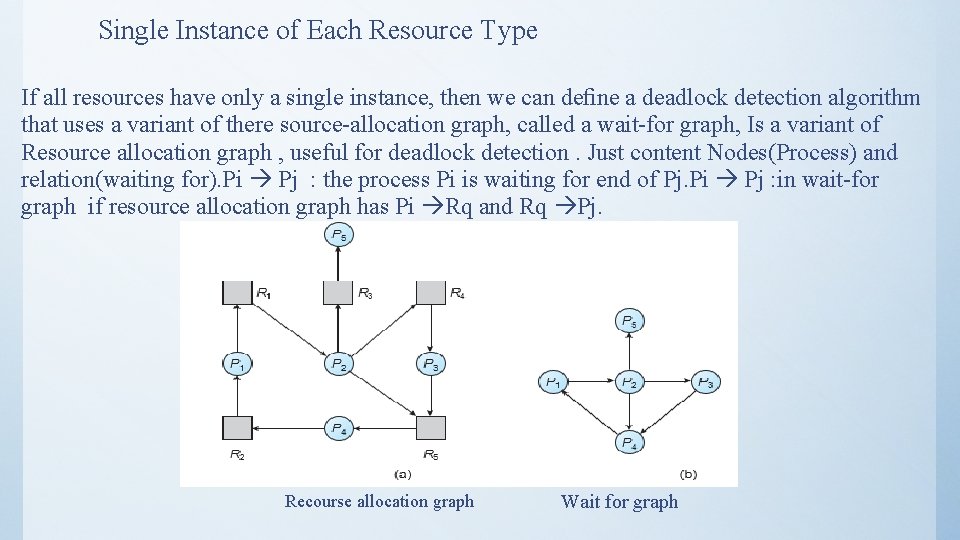
Single Instance of Each Resource Type If all resources have only a single instance, then we can define a deadlock detection algorithm that uses a variant of there source-allocation graph, called a wait-for graph, Is a variant of Resource allocation graph , useful for deadlock detection. Just content Nodes(Process) and relation(waiting for). Pi Pj : the process Pi is waiting for end of Pj. Pi Pj : in wait-for graph if resource allocation graph has Pi Rq and Rq Pj. Recourse allocation graph Wait for graph

Several Instances of a Resource Type • In this type for one resource the system has more than one resource type. detection algorithm that is applicable to such a system. The algorithm employs several time-varying data structures that are similar to those used in the banker’s algorithm. in algorithm used this: • m: is number of recourse type. • n: is number of process. • Available. A vector of length m indicates the number of available resources of each type. • Allocation. An n × m matrix defines the number of resources of each type currently allocated to each process. • Request. An n × m matrix indicates the current request of each process. If Request[i][j] equals k, then process Pi is requesting k more instances of resource type Rj.
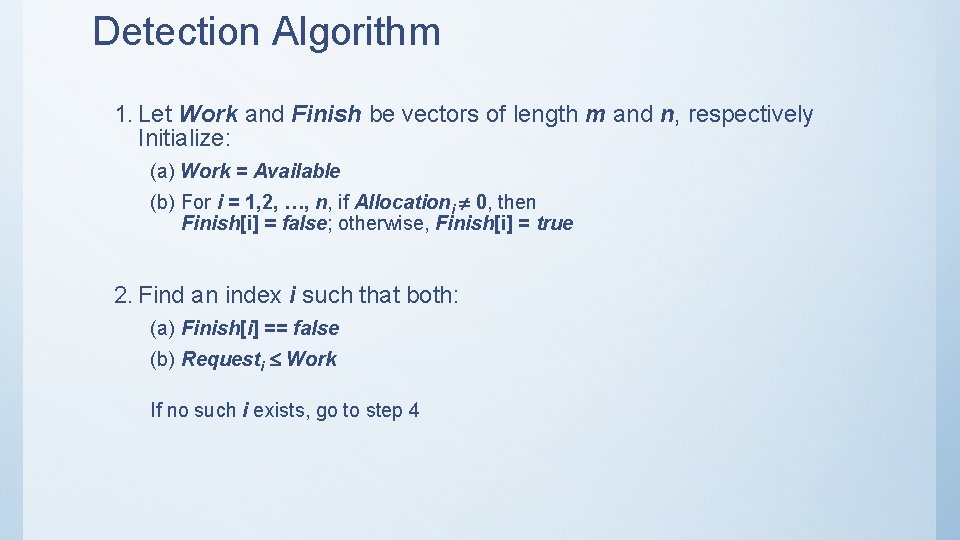
Detection Algorithm 1. Let Work and Finish be vectors of length m and n, respectively Initialize: (a) Work = Available (b) For i = 1, 2, …, n, if Allocationi 0, then Finish[i] = false; otherwise, Finish[i] = true 2. Find an index i such that both: (a) Finish[i] == false (b) Requesti Work If no such i exists, go to step 4
![Detection Algorithm (Cont. ) 3. Work = Work + Allocationi Finish[i] = true go](http://slidetodoc.com/presentation_image_h2/17dbcc6a11a7e68f6e69eb09619362a7/image-7.jpg "Detection Algorithm (Cont. ) 3. Work = Work + Allocationi Finish[i] = true go")
Detection Algorithm (Cont. ) 3. Work = Work + Allocationi Finish[i] = true go to step 2 4. If Finish[i] == false, for some i, 1 i n, then the system is in deadlock state. Moreover, if Finish[i] == false, then Pi is deadlocked Algorithm requires an order of O(m x n 2) operations to detect whether the system is in deadlocked state
Detection-Algorithm Usage • When should we invoke the detection algorithm ? The answer depends on two factors: 1. How often is a deadlock likely to occur? 2. How many processes will be affected by deadlock when it happens? • If deadlocks occur frequently , then the detection algorithm should be invoked frequently. • Resources allocated to deadlocked processes will be idle until the deadlock can be broken. In addition, the number of processes involved in the deadlock cycle may grow.
Recovery from Deadlock: • When a detection algorithm determines that a deadlock exists, inform the operator that a deadlock has occurred , let the operator deal with the deadlock manually. • let the system recover from the deadlock automatically. • There are two options for recovery a deadlock. 1. Process Termination. 2. Resource Preemption.
Process Termination • Abort all deadlocked processes. This method will break the deadlock cycle, and the results of these partial computations must be discarded and recomputed later. • Abort one process at a time until the deadlock cycle is eliminated. This method in curs considerable overhead , after each process is aborted , a deadlock-detection algorithm must be invoked to determine whether any processes are still deadlocked. Which process should Abort. decided by : priority of process. How long process has computed , and how much longer computation. Resource of process that used. And resource process needed to end. How many process will need to terminate, if process interactive or batch.
Resource Preemption we successively preempt some resources from processes and give the sere sources to other processes until the deadlock cycle is broken. If preemption is required to deal with deadlocks , then three issues need to be addressed: 1. Selecting a victim. minimize cost. Cost factors may include such parameters as the number of resources a deadlocked process is holding and the amount of time the process has thus far consumed. 2. Rollback. If we preempt a resource from a process , what should be done with that process? Clearly , it can not continue with its normal execution , We must roll back the process to some safe state and restart it from that state. it is difficult to determine what a safe state is, the simplest solution is a total rollback: abort the process and then restart it. 3. Starvation. same process is always picked as a victim. include the number of rollbacks in the cost factor.

Thank you
Reference • Operating Systems Concepts 9 th Edition , Abraham Silberschatz, peter Baer Galvin, Greg Gagne • https: //www. geeksforgeeks. org/operating-system-resource-allocation-graph-rag
- Slides: 13