
De Moivres Theorem The Complex Plane Complex Number

De. Moivre’s Theorem The Complex Plane

Complex Number l A complex number z = x + yi can be interpreted geometrically as the point (x, y) in the complex plane. The x-axis is the real axis and the y-axis is the imaginary axis.
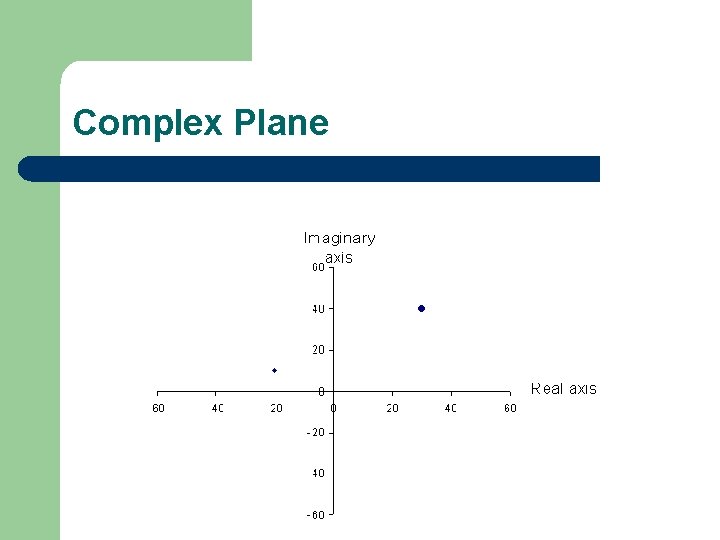
Complex Plane
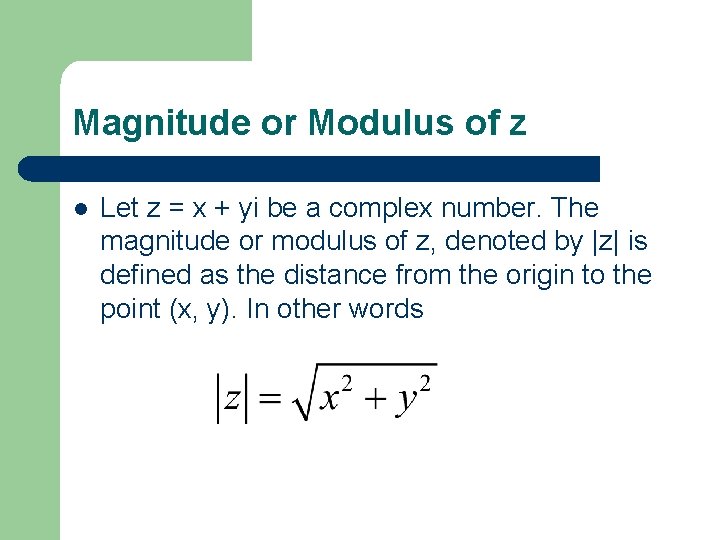
Magnitude or Modulus of z l Let z = x + yi be a complex number. The magnitude or modulus of z, denoted by |z| is defined as the distance from the origin to the point (x, y). In other words
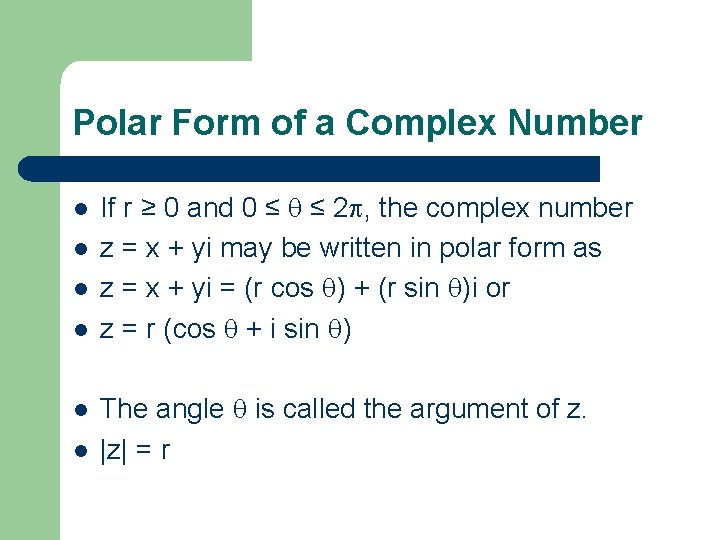
Polar Form of a Complex Number l l l If r ≥ 0 and 0 ≤ q ≤ 2 p, the complex number z = x + yi may be written in polar form as z = x + yi = (r cos q) + (r sin q)i or z = r (cos q + i sin q) The angle q is called the argument of z. |z| = r
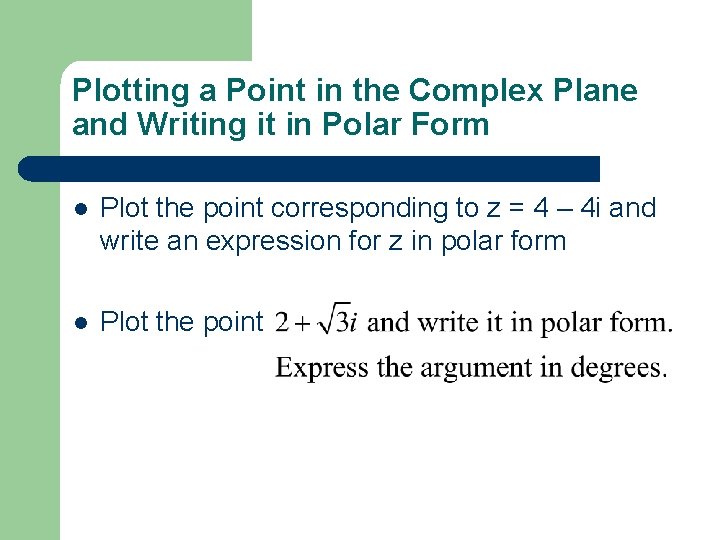
Plotting a Point in the Complex Plane and Writing it in Polar Form l Plot the point corresponding to z = 4 – 4 i and write an expression for z in polar form l Plot the point
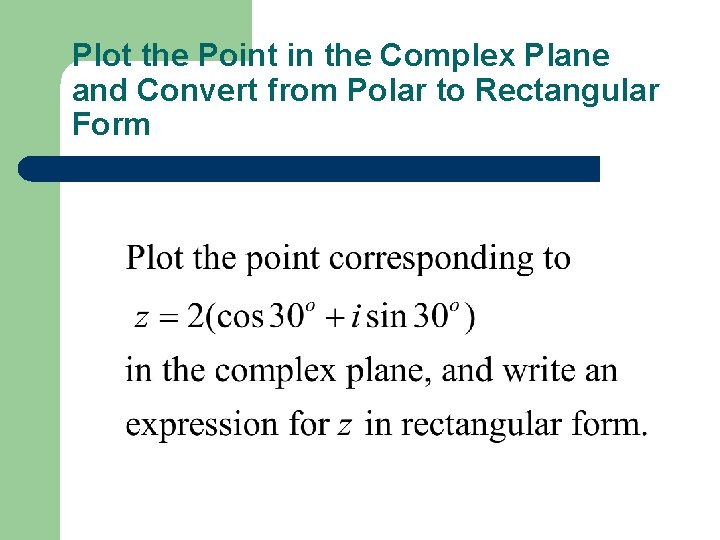
Plot the Point in the Complex Plane and Convert from Polar to Rectangular Form
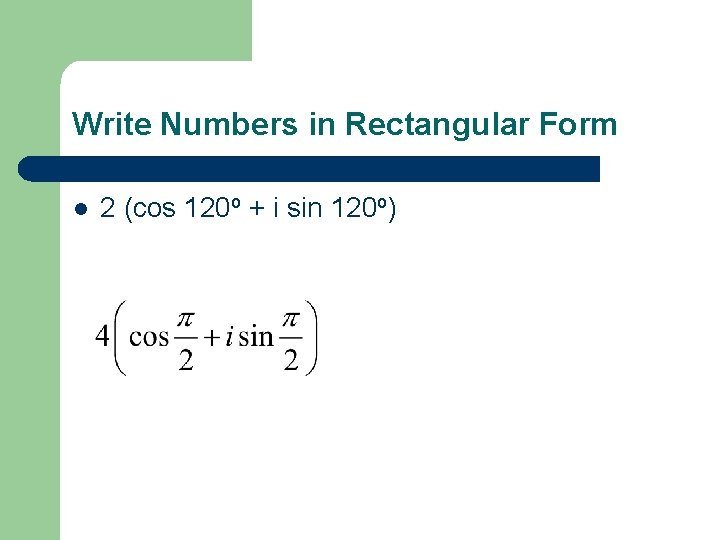
Write Numbers in Rectangular Form l 2 (cos 120 o + i sin 120 o)
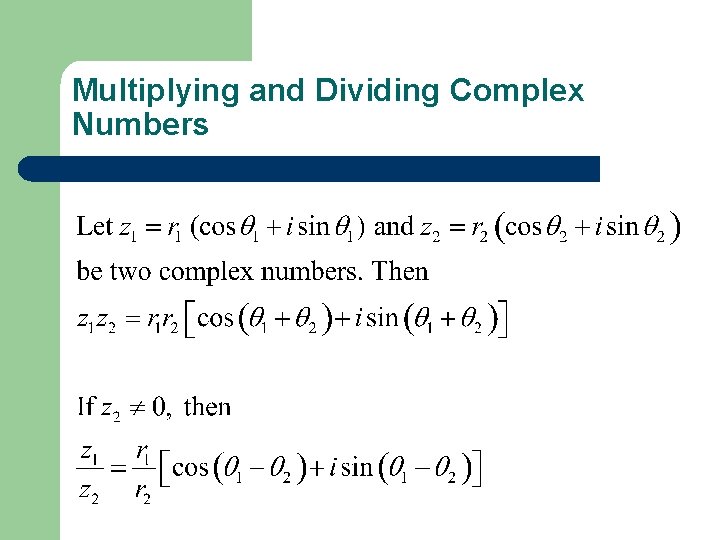
Multiplying and Dividing Complex Numbers
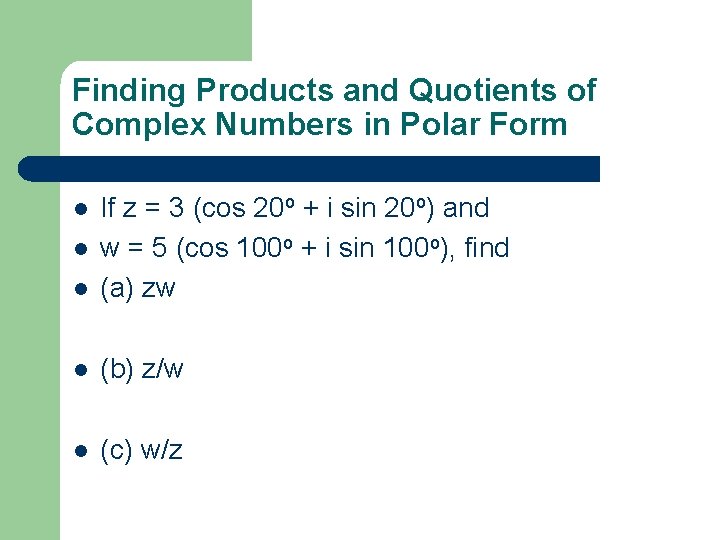
Finding Products and Quotients of Complex Numbers in Polar Form l If z = 3 (cos 20 o + i sin 20 o) and w = 5 (cos 100 o + i sin 100 o), find (a) zw l (b) z/w l (c) w/z l l
De. Moivre’s Theorem l l De. Moivre’s Theorem is a formula for raising a complex number to the power n. If z = r (cos q + i sin q) is a complex number, then zn = rn [(cos (nq) + i sin (nq)] where n ≥ 1 is a positive integer.
![Using De. Moivre’s Theorem l Write [2(cos 20 o + i sin 20 o)]3](http://slidetodoc.com/presentation_image/3e46992a9a3dc47fe5099dcdd734f403/image-12.jpg "Using De. Moivre’s Theorem l Write [2(cos 20 o + i sin 20 o)]3")
Using De. Moivre’s Theorem l Write [2(cos 20 o + i sin 20 o)]3 in the standard form a + bi.
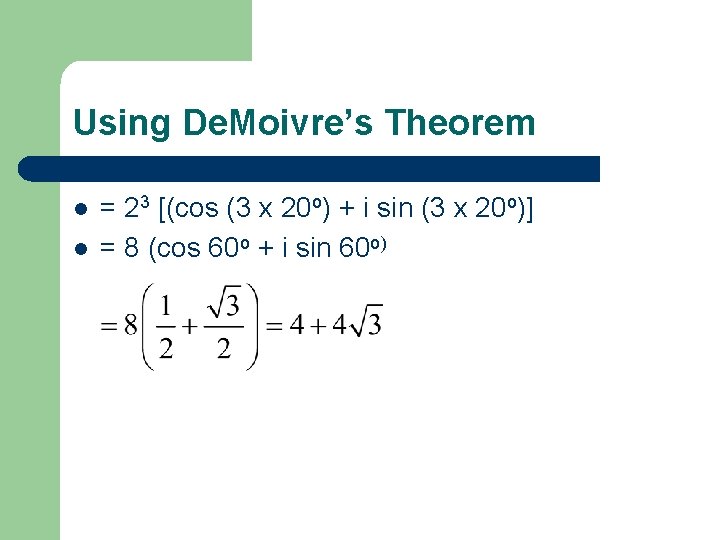
Using De. Moivre’s Theorem l l = 23 [(cos (3 x 20 o) + i sin (3 x 20 o)] = 8 (cos 60 o + i sin 60 o)
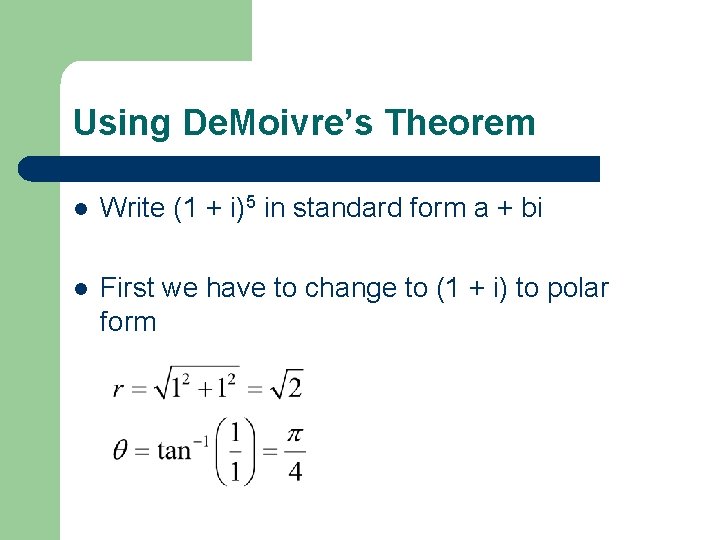
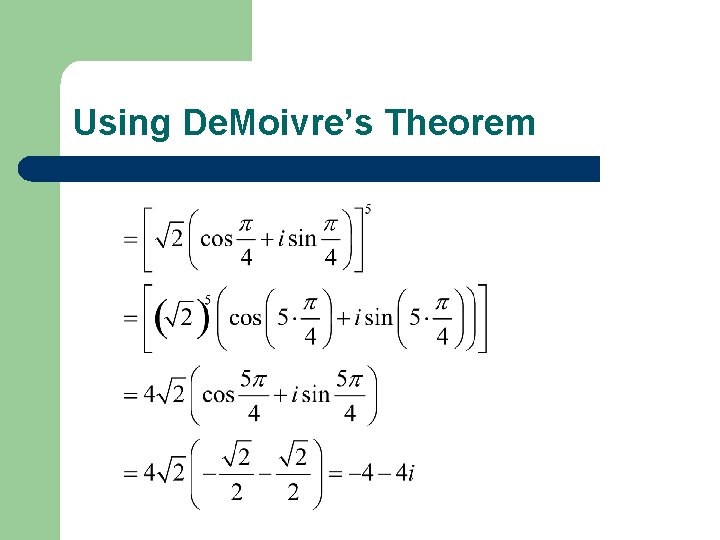
Using De. Moivre’s Theorem l Write (1 + i)5 in standard form a + bi l First we have to change to (1 + i) to polar form
Using De. Moivre’s Theorem
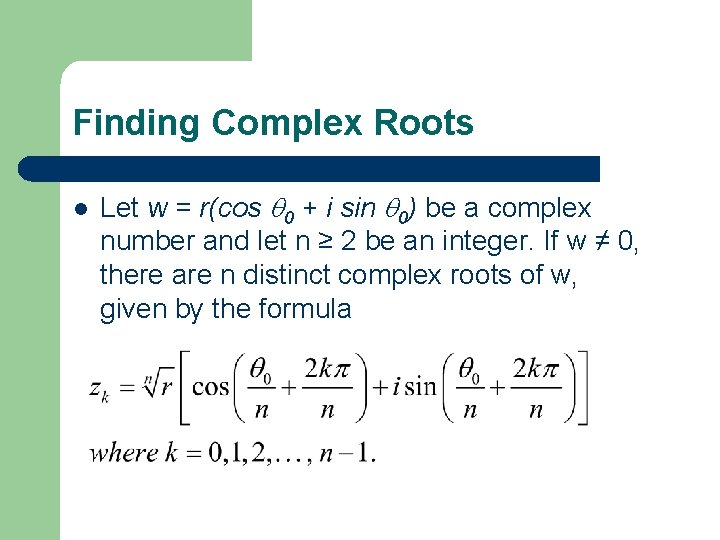
Finding Complex Roots l Let w = r(cos q 0 + i sin q 0) be a complex number and let n ≥ 2 be an integer. If w ≠ 0, there are n distinct complex roots of w, given by the formula
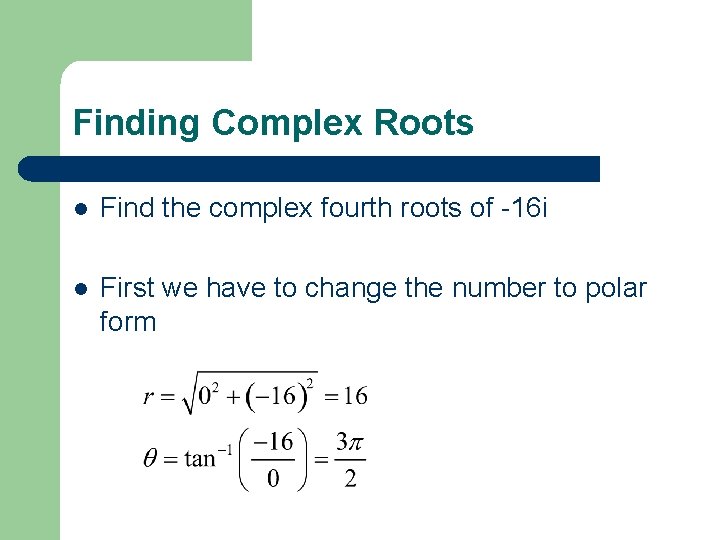
Finding Complex Roots l Find the complex fourth roots of -16 i l First we have to change the number to polar form
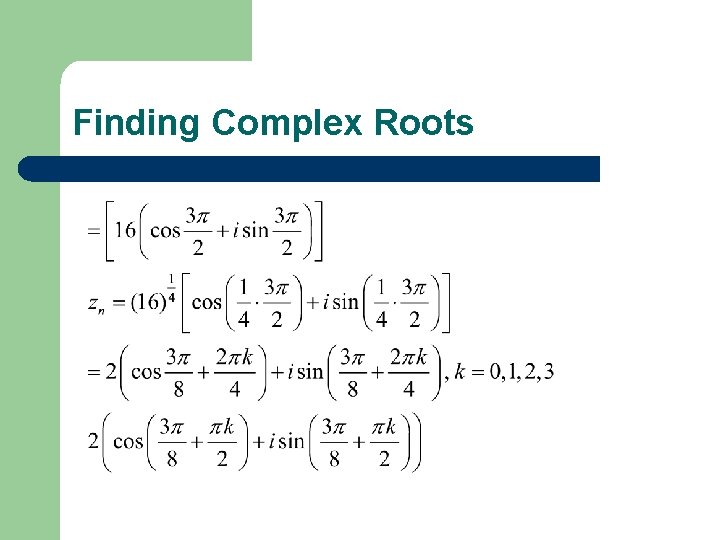
Finding Complex Roots

Finding Complex Roots
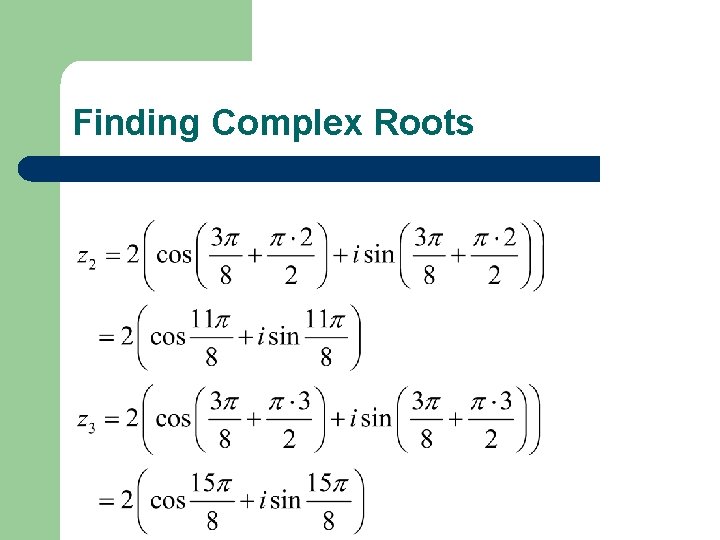
Finding Complex Roots
- Slides: 20