
DDo STraceback Paper Group 23 Characterization Ozgur Ozturk
DDo. S/Traceback Paper Group # 23: Characterization Ozgur Ozturk CSE 581 - W 02 Internet Technologies Instructed by Wu-chang Feng 02/25/02 DDo. S/Traceback-Characterisation Ozgur Ozturk 1
Paper List • “Inferring Internet Denial-of-Service Activity” [MOORE] – D. Moore @ CAIDA – G. Voelker, S. Savage @ UCSD – 2001 USENIX Security Symposium 02/25/02 DDo. S/Traceback-Characterisation Ozgur Ozturk 2

Moore Outline • • • Underlying Mechanisms of Do. S Attacks The Backscatter Analysis Techniques for classifying attacks Validation Observations and Results Conclusions 02/25/02 DDo. S/Traceback-Characterisation Ozgur Ozturk 3
Moore Abstract • Backscatter analysis provides quantitative data for a global view on Do. S activity using local monitoring • Videos • Traffic Characterisation (How Data Gathered) – http: //www. caida. org/outreach/resources/animations/passive _monitoring/traffic_char. mpg (1 min 12 s) • TCP Port Analysis – http: //www. caida. org/outreach/resources/animations/passive _monitoring/tcp_port_analysis. mpg (2 min 15 s) • Backscatter – http: //www. caida. org/outreach/resources/animations/passive _monitoring/backscatter. mpg (1 min 26) 02/25/02 DDo. S/Traceback-Characterisation Ozgur Ozturk 4
Moore Do. S Attacks Background • Logic Attacks – Exploit Software Flaws – e. g. Ping of Death • Flooding Attacks – Overwhelm CPU, Memory, Bandwidth – e. g. SYN flood, ICMP flood 02/25/02 DDo. S/Traceback-Characterisation Ozgur Ozturk 5

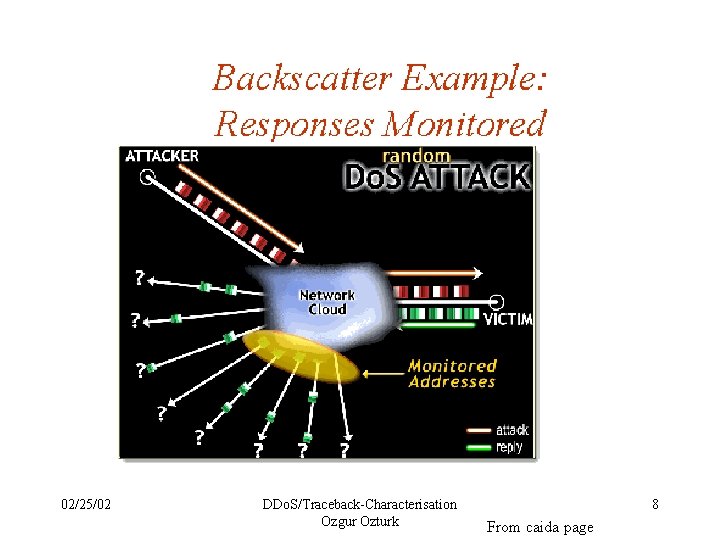
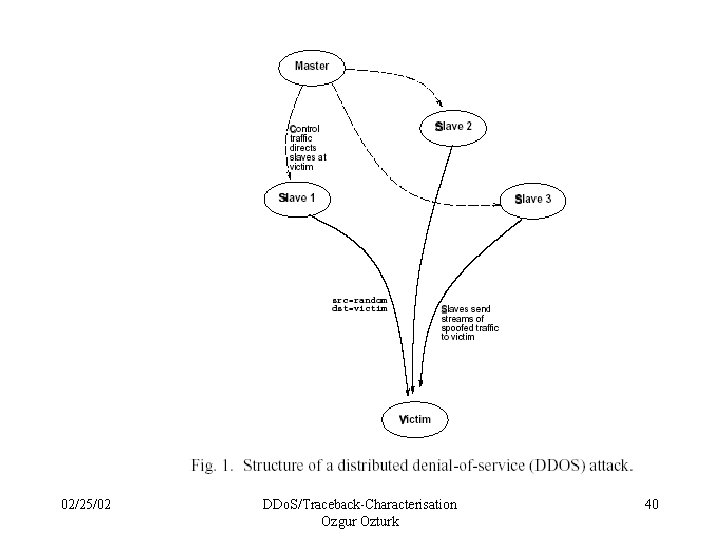
Flooding Attacks- Backscatter • Attackers spoof source address randomly – Small frequent packets. (packet/sec bottleneck) – e. g. TCP SYN -> victim allocate data structure for arriving packets (for unmatched to existing connections) • Victims, in turn, respond to attack packets • Remotely controlled “Zombies” for DDo. S 02/25/02 DDo. S/Traceback-Characterisation Ozgur Ozturk 6
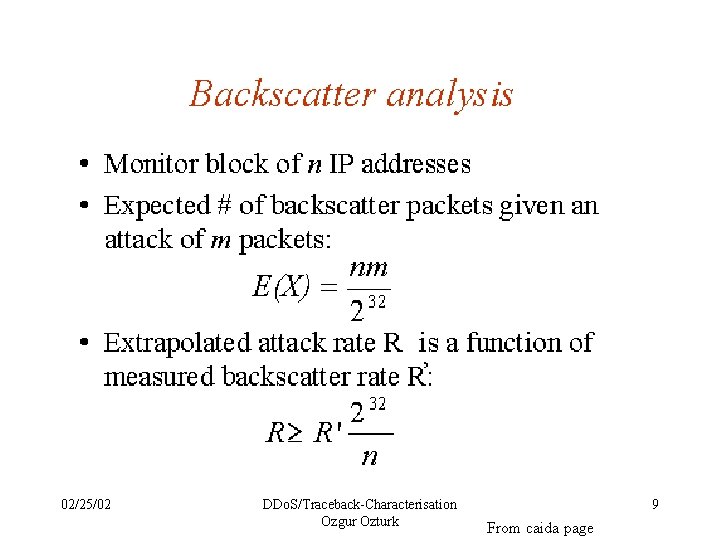
Randomness in IP addresses • Unsolicited responses (backscatter) equally distributed across IP space • Received backscatter is evidence of an attacker elsewhere 02/25/02 DDo. S/Traceback-Characterisation Ozgur Ozturk 7
02/25/02 DDo. S/Traceback-Characterisation Ozgur Ozturk 8 From caida page
02/25/02 DDo. S/Traceback-Characterisation Ozgur Ozturk 9 From caida page
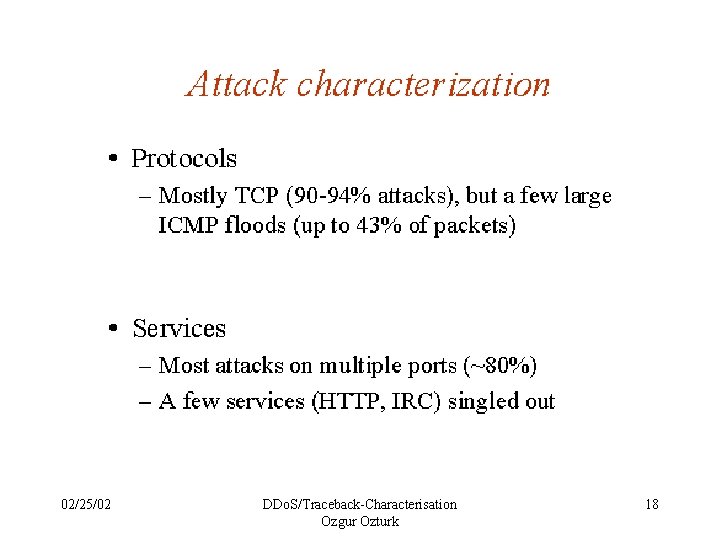
Assumptions • Address Uniformity • Reliable delivery – Backscatter not lost • Backscatter hypothesis – Unsolicited packets represent backscatter • In fact any server can send – Reflector attack may not be detected • Not random IP-forgery – Some attacks (e. g. TCP-RST) doesn’t produce backscatter. 02/25/02 DDo. S/Traceback-Characterisation Ozgur Ozturk 10
• Cluster packages – TCP- ICMP Single attack- multiple attacks – start and end times of attacks • small number of longer attacks • or many short attacks 02/25/02 DDo. S/Traceback-Characterisation Ozgur Ozturk 11
02/25/02 DDo. S/Traceback-Characterisation Ozgur Ozturk 12
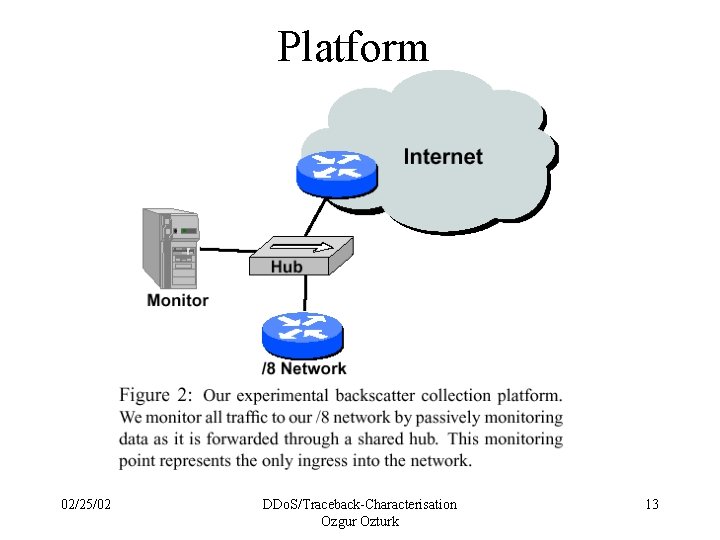
Platform 02/25/02 DDo. S/Traceback-Characterisation Ozgur Ozturk 13
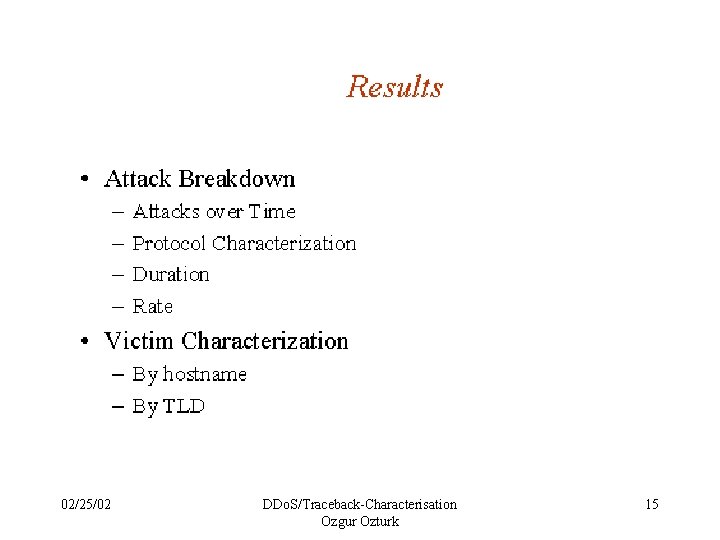
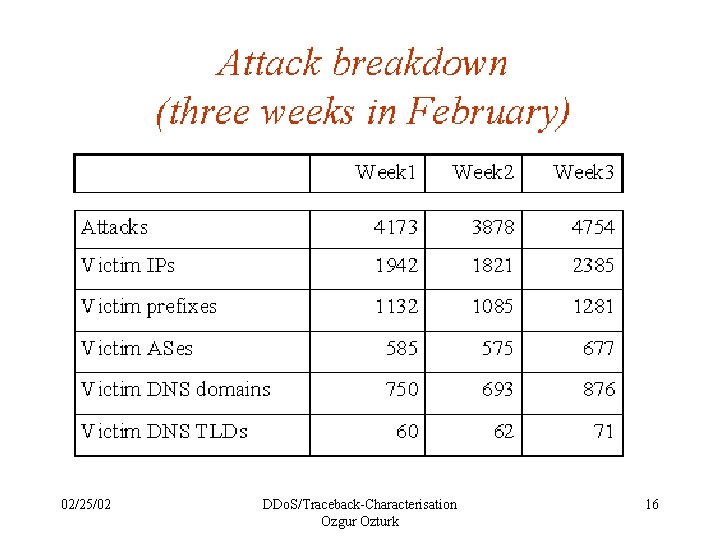
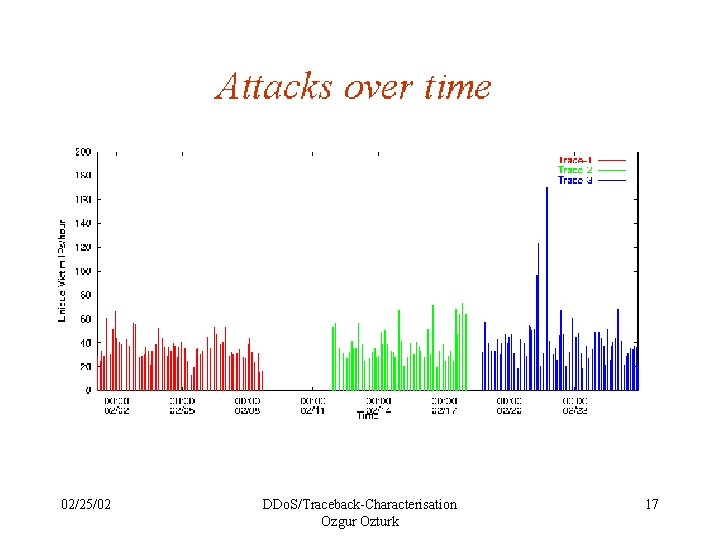
Results • 13000 attacks • 5000 victim IP addresses on 2000 domains • 200 million backscatter packets – *256 < Real attack packets 02/25/02 DDo. S/Traceback-Characterisation Ozgur Ozturk 14
02/25/02 DDo. S/Traceback-Characterisation Ozgur Ozturk 15
02/25/02 DDo. S/Traceback-Characterisation Ozgur Ozturk 16
02/25/02 DDo. S/Traceback-Characterisation Ozgur Ozturk 17
02/25/02 DDo. S/Traceback-Characterisation Ozgur Ozturk 18
02/25/02 DDo. S/Traceback-Characterisation Ozgur Ozturk 19
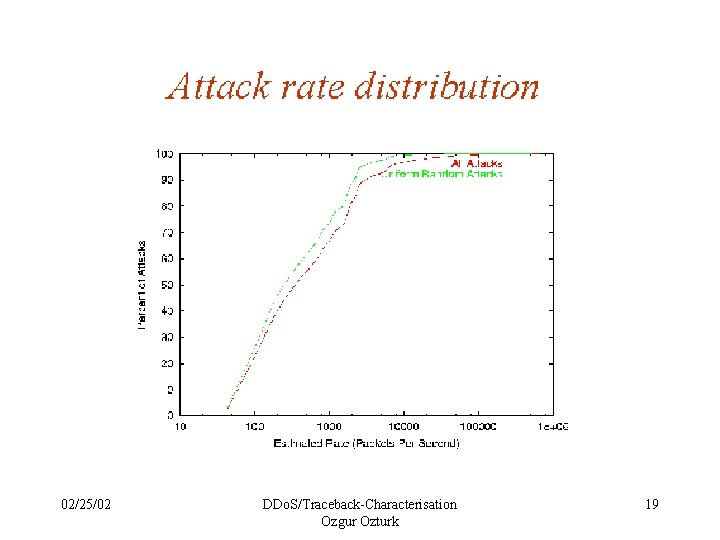
How threatening • 500 packets enough to overwhelm server – 38 -46 % of attacks (unif. -all) • 14000 packets for firewall – 0. 3 -2. 4 % of attacks (unif. -all) 02/25/02 DDo. S/Traceback-Characterisation Ozgur Ozturk 20
02/25/02 DDo. S/Traceback-Characterisation Ozgur Ozturk 21
02/25/02 DDo. S/Traceback-Characterisation Ozgur Ozturk 22
02/25/02 DDo. S/Traceback-Characterisation Ozgur Ozturk 23
Autonomous Systems 02/25/02 DDo. S/Traceback-Characterisation Ozgur Ozturk 24
02/25/02 DDo. S/Traceback-Characterisation Ozgur Ozturk 25
02/25/02 DDo. S/Traceback-Characterisation Ozgur Ozturk 26
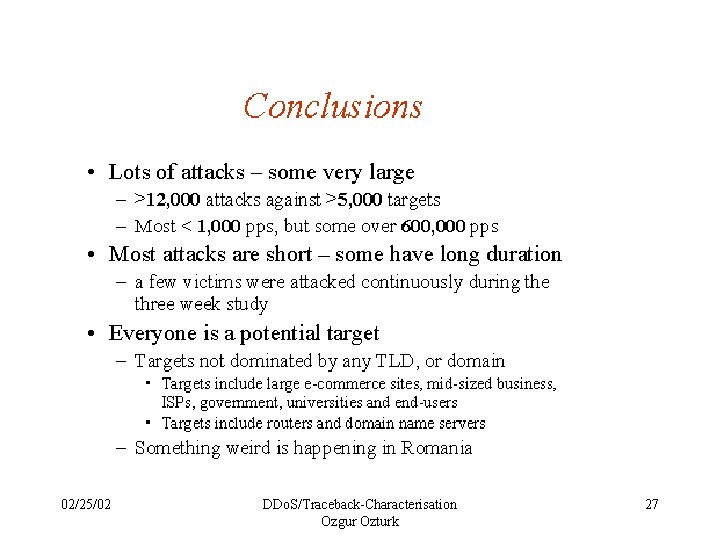
02/25/02 DDo. S/Traceback-Characterisation Ozgur Ozturk 27
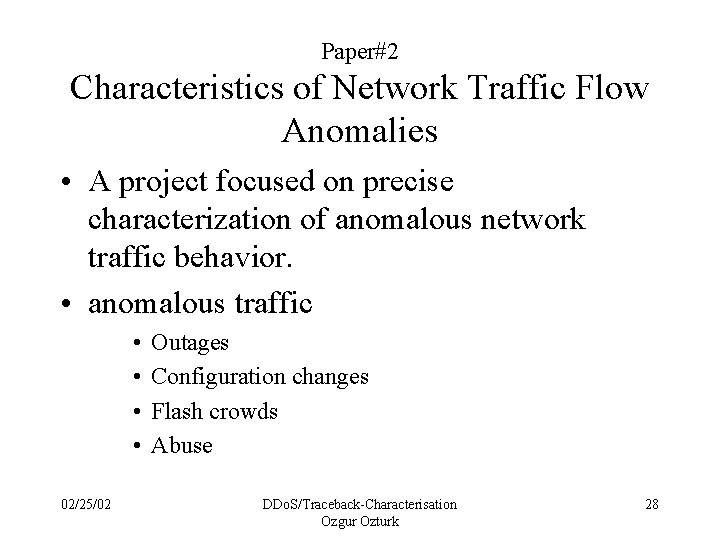
Paper#2 Characteristics of Network Traffic Flow Anomalies • A project focused on precise characterization of anomalous network traffic behavior. • anomalous traffic • • 02/25/02 Outages Configuration changes Flash crowds Abuse DDo. S/Traceback-Characterisation Ozgur Ozturk 28
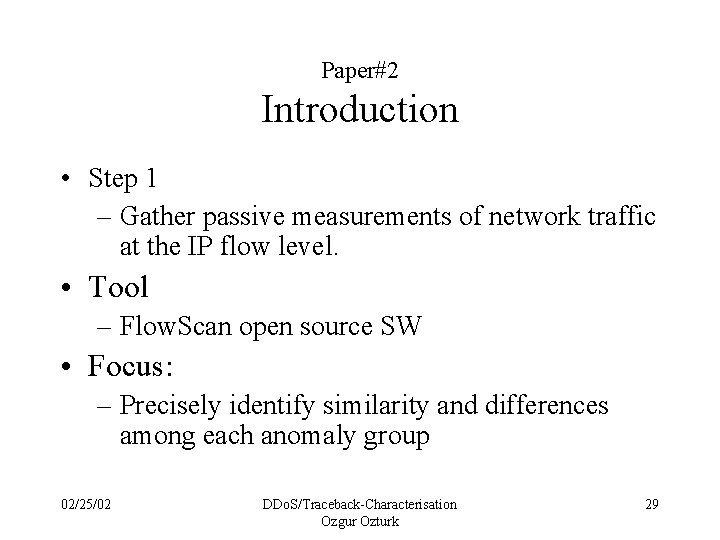
Paper#2 Introduction • Step 1 – Gather passive measurements of network traffic at the IP flow level. • Tool – Flow. Scan open source SW • Focus: – Precisely identify similarity and differences among each anomaly group 02/25/02 DDo. S/Traceback-Characterisation Ozgur Ozturk 29
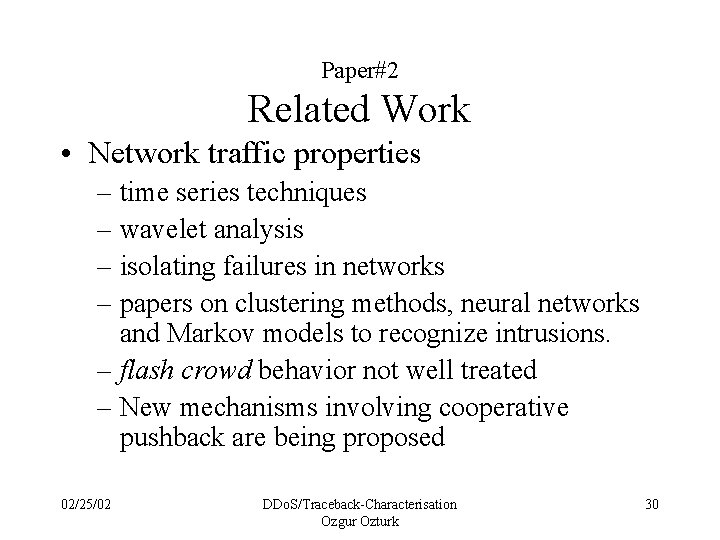
Paper#2 Related Work • Network traffic properties – time series techniques – wavelet analysis – isolating failures in networks – papers on clustering methods, neural networks and Markov models to recognize intrusions. – flash crowd behavior not well treated – New mechanisms involving cooperative pushback are being proposed 02/25/02 DDo. S/Traceback-Characterisation Ozgur Ozturk 30
Paper#2 Flow. Scan • Flow. Scan collects Netflow data exported by Cisco routers in a network. • Netflow data includes source and destination AS/IP/port pairs, packet and byte counts, flow start and end times and protocol information. • Flow. Scan maintains a set of counters based upon the attributes of each flow reported by a router. 02/25/02 DDo. S/Traceback-Characterisation Ozgur Ozturk 31
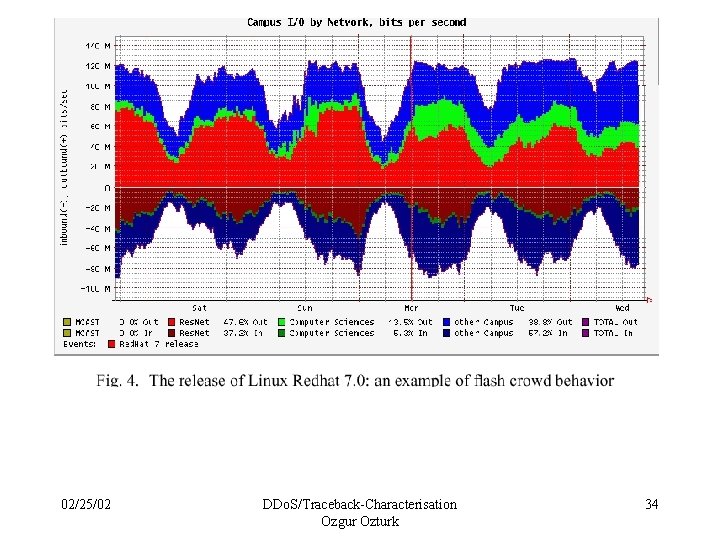
Paper#2 Anomaly Identification • Three general categories – Network Operation Anomalies • device outages, configuration changes • traffic reaching environmental limits – Flash Crowd Anomalies • Software release (e. g. UW is a Red. Hat Linux mirror site) • or External interest in a site (national publicity) • Rapid rise in traffic flows of particular type (eg. FTP flows) – Network Abuse Anomalies 02/25/02 DDo. S/Traceback-Characterisation Ozgur Ozturk 32
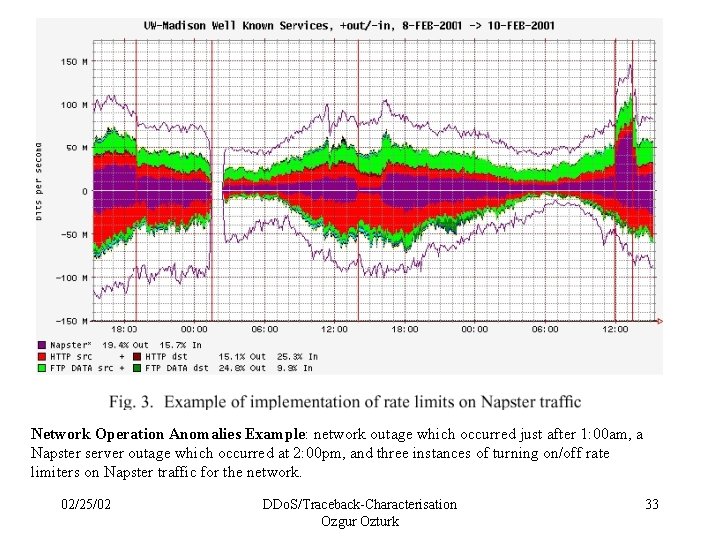
Network Operation Anomalies Example: network outage which occurred just after 1: 00 am, a Napster server outage which occurred at 2: 00 pm, and three instances of turning on/off rate limiters on Napster traffic for the network. 02/25/02 DDo. S/Traceback-Characterisation Ozgur Ozturk 33
02/25/02 DDo. S/Traceback-Characterisation Ozgur Ozturk 34
Paper#2 3 rd anomaly type: Network Abuse Anomalies • Do. S flood attacks and port scans • Different from network operation and flash crowd anomalies – not always readily apparent in bit or packet rate measurements – flow count measurements clearly indicate abuse activity 02/25/02 DDo. S/Traceback-Characterisation Ozgur Ozturk 35
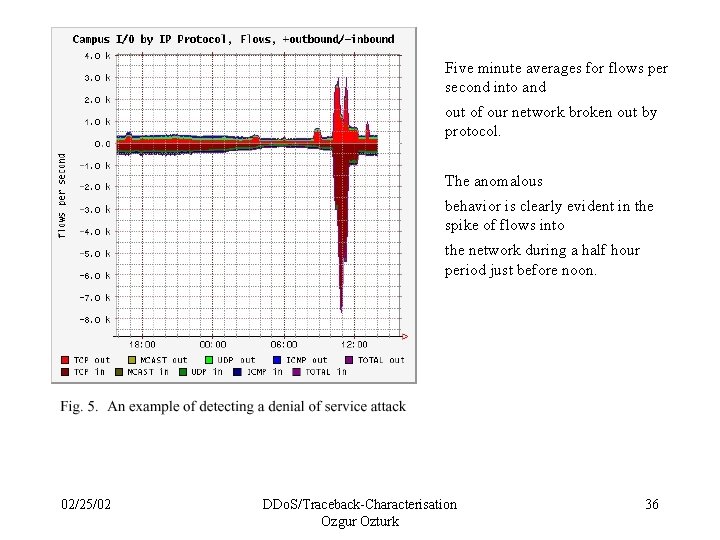
Five minute averages for flows per second into and out of our network broken out by protocol. The anomalous behavior is clearly evident in the spike of flows into the network during a half hour period just before noon. 02/25/02 DDo. S/Traceback-Characterisation Ozgur Ozturk 36
Paper#2 Anomaly Characteristics Analysis Process st • 1 step: isolate each of the anomalies in data sets & group them into the three general categories mentioned. • 2 nd Step: apply time series analysis – analyzing stationarity, correlation structures and testing various time series models to see if any are accurate statistical representations of anomaly data model developing • final step: apply wavelet analysis 02/25/02 DDo. S/Traceback-Characterisation Ozgur Ozturk 37
Paper#2 Future Work • Various directions – Evaluate 1 min VS 5 min. s • Accuracy VS dataset size – anomaly data collection process across multiple sites • larger datasets • correlations of behavior across sites 02/25/02 DDo. S/Traceback-Characterisation Ozgur Ozturk 38
Paper#3 An Analysis of Using Reflectors for Distributed Denial-of-Service Attacks • Overview – Definition of DDOS attack. – Different Trace back schemes. – Reflectors. – Defenses against Reflectors. – Filtering out Reflector Replies. – Implications of Using Reflector for Trace back. 02/25/02 DDo. S/Traceback-Characterisation Ozgur Ozturk 39
02/25/02 DDo. S/Traceback-Characterisation Ozgur Ozturk 40
Trace back schemes – Trace back schemes for spoofed packets • ITRACE (ICMP Trace) – Volume based • Probabilistic packet marking. – Computational difficulties – scaling. • Source Path Isolation Engine (SPIE). – Does trace back information help? 02/25/02 DDo. S/Traceback-Characterisation Ozgur Ozturk 41
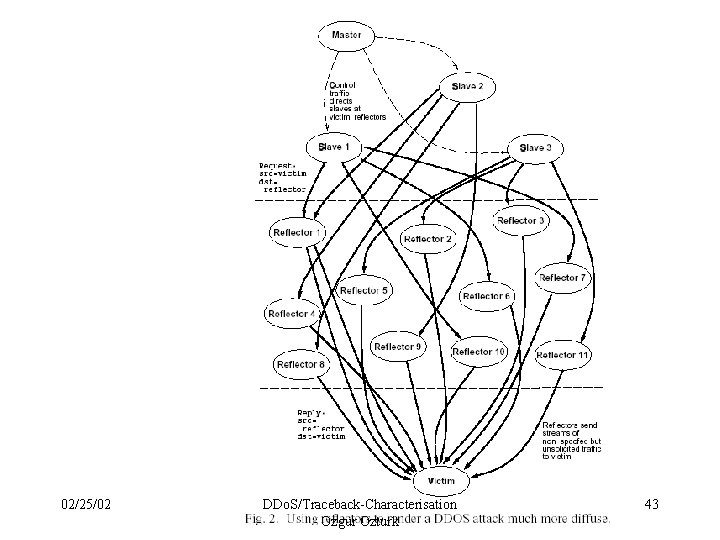
Reflectors • A reflector is any IP host that will return a packet or more if sent a packet. Examples: 02/25/02 – Web servers: return SYN ACKS or RSTs in response to SYN or other TCP packets. – DNS servers: return query replies in response to query requests. – Routers: return ICMP Time Exceeded or Host Unreachable messages in response to particular IP packets. DDo. S/Traceback-Characterisation 42 Ozgur Ozturk
02/25/02 DDo. S/Traceback-Characterisation Ozgur Ozturk 43
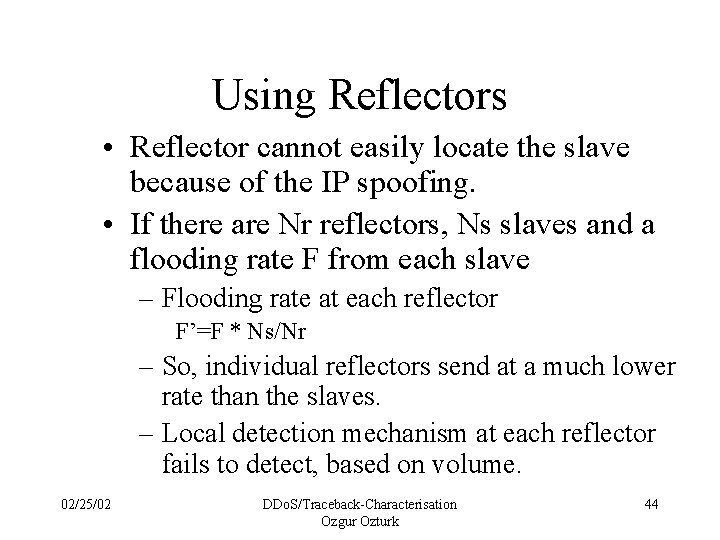
Using Reflectors • Reflector cannot easily locate the slave because of the IP spoofing. • If there are Nr reflectors, Ns slaves and a flooding rate F from each slave – Flooding rate at each reflector F’=F * Ns/Nr – So, individual reflectors send at a much lower rate than the slaves. – Local detection mechanism at each reflector fails to detect, based on volume. 02/25/02 DDo. S/Traceback-Characterisation Ozgur Ozturk 44
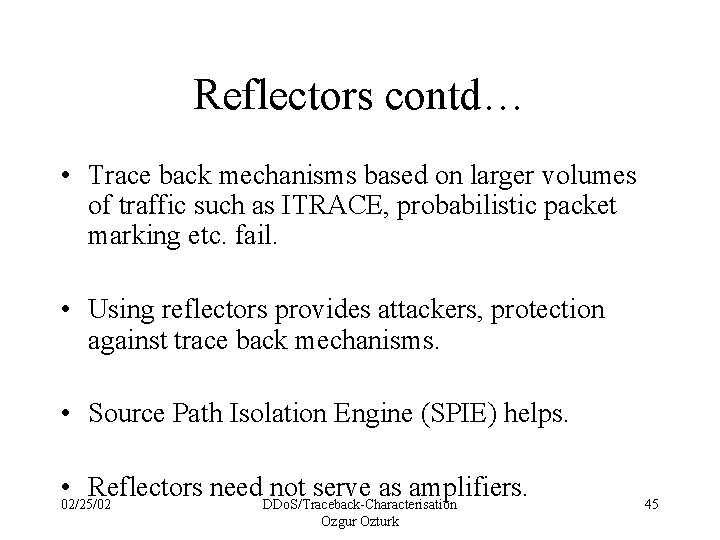
Reflectors contd… • Trace back mechanisms based on larger volumes of traffic such as ITRACE, probabilistic packet marking etc. fail. • Using reflectors provides attackers, protection against trace back mechanisms. • Source Path Isolation Engine (SPIE) helps. • Reflectors need. DDo. S/Traceback-Characterisation not serve as amplifiers. 02/25/02 Ozgur Ozturk 45
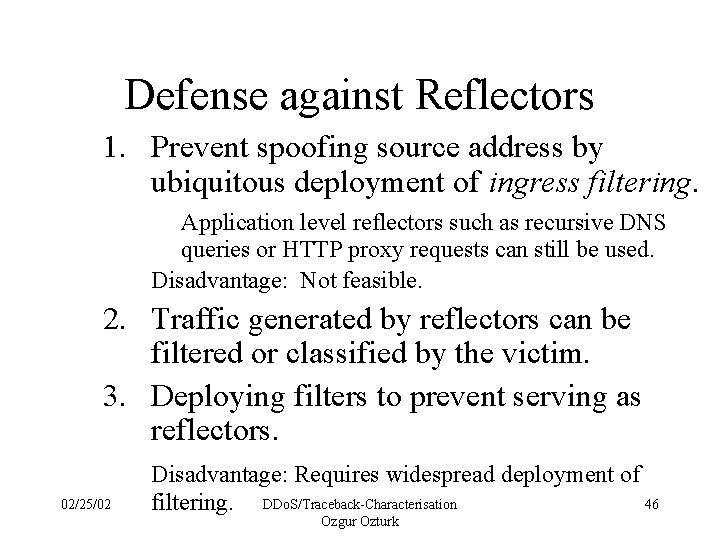
Defense against Reflectors 1. Prevent spoofing source address by ubiquitous deployment of ingress filtering. Application level reflectors such as recursive DNS queries or HTTP proxy requests can still be used. Disadvantage: Not feasible. 2. Traffic generated by reflectors can be filtered or classified by the victim. 3. Deploying filters to prevent serving as reflectors. 02/25/02 Disadvantage: Requires widespread deployment of 46 filtering. DDo. S/Traceback-Characterisation Ozgur Ozturk
Defense against Reflectors … 4. Deploy trace back mechanisms that incorporate the reflector end-host software itself in the scheme, allowing trace back through the reflector back to the slave. Disadvantage: Enormous deployment difficulties. 5. Intrusion Detection Systems (IDS) monitor a site’s network for active slaves. Disadvantage: Requires widespread deployment of security technology. 02/25/02 DDo. S/Traceback-Characterisation Ozgur Ozturk 47
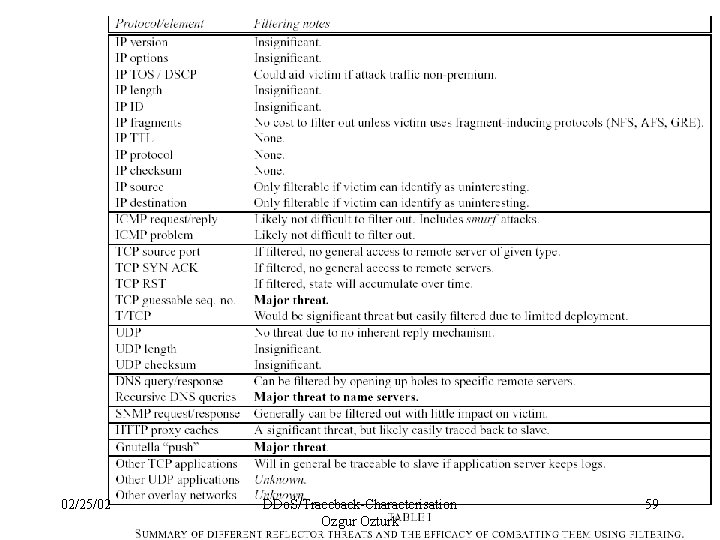
Filtering out Reflector replies • IP packets – Type of service (TOS/DSCP). (for scenarios in future) • Difficult for the attacker to manipulate a reflector into having a particular DSCP attached traffic. • If the traffic in general is premium then it will be difficult for the attacker to force the premium marking, given the financial motivation to secure use of the premium traffic. 02/25/02 DDo. S/Traceback-Characterisation Ozgur Ozturk 48
IP packets – IP Fragments • Make it difficult for the victim to filter the protocol header information. • Victim can filter out all fragmented traffic. – Because of limited use of fragments in Internet. – Suffer little degradation. – Other than protocols like NFS, AFS etc. – IP protocol field • Filter out uninteresting protocol traffic. – IP source and destination address • Filter out the unknown or suspicious sourced traffic. 02/25/02 DDo. S/Traceback-Characterisation Ozgur Ozturk 49
Types of ICMP reflector replies: 1. ICMP echo, timestamp, address mask, router solicitation, information request/reply. 1. 2. ICMP echo is widely used. Smurf attacks. 2. ICMP source quench, unreachable, time exceeded, parameter problem, and redirect. Important ICMP messages: 1. 2. 3. 02/25/02 Host unreachable. Time exceeded. Need fragmentation. DDo. S/Traceback-Characterisation Ozgur Ozturk 50
TCP • Reflector can only be made to send – SYN ACK by sending an initial SYN. • Filtering leads to no-remote access. – RST by sending a FIN. • Filtering RST results in clogging of stale connections state. • During flooding, the victim can eliminate TCP-based reflectors by filtering port 80 sourced traffic. 02/25/02 DDo. S/Traceback-Characterisation Ozgur Ozturk 51
TCP • Predictable TCP sequence numbers – If reflector stack has guessable TCP sequence numbers, it’s a DISASTER for the victim. – Attacker can drive the Reflector TCP state machine, making it send ACKs, data segments. – Attack can be amplified by transmitting large items and exploiting “ACK splitting” techniques. 02/25/02 DDo. S/Traceback-Characterisation Ozgur Ozturk 52
TCP for Transactions (T/TCP) • Spoof initial SYN packet with acceptable seq. no. – Make an expensive request. • Factors that limit the T/TCP attack – T/TCP server will begin in slow start. • Unless the server’s stack has predictable seq. no. – Amenable to stateless packet filtering. – T/TCP is not widely deployed. 02/25/02 DDo. S/Traceback-Characterisation Ozgur Ozturk 53
• UDP – Filter out based on port numbers. – Not a major threat. • DNS – Reflector sending DNS reply in response to a spoofed DNS request. • Victim can configure its local DNS servers so as to filter out unknown DNS server responses. – If the victim is a name server • Attacker can query a large number of DNS servers which in turn recursively query the Victim. • Victim server gets bombarded due to multiple queries. 02/25/02 DDo. S/Traceback-Characterisation Ozgur Ozturk 54
DNS • The DNS queries needn’t even be spoofed. • Caching at the reflector server doesn’t help. • DNS reflection appears to be a serious threat for DDOS attacks on name servers. – Solution: To provide filtering in name servers so as to serve recursive queries from local addresses, coupled with ingress filtering. 02/25/02 DDo. S/Traceback-Characterisation Ozgur Ozturk 55
• SNMP (UDP-based request/reply) – Sites that fail to block off-site access to SNMP provide a large number of reflectors. – SNMP attack is sourced at port 161. – Filtering out the external SNMP messages leads to major problem for service providers. • Configure the filter to receive SNMP messages from interested hosts. • HTTP – HTTP proxy caches provide a way that an HTTP client can manipulate a proxy server into initiating a connection to a victim web server. – HTTP proxy servers act as reflectors for the DDOS attacks. 02/25/02 DDo. S/Traceback-Characterisation Ozgur Ozturk 56
• HTTP - Limitations – Proxies can be configured to serve a restricted set of clients. – There are not enough proxy caches to constitute a large pool of possible reflectors. – Connection between slave and the reflector cannot be spoofed unless the reflecting proxy has predictable sequence numbers. Logging helps in identifying the slave’s location. • Definitely a major threat if servers running on stacks with predictable sequence numbers are widely deployed. 02/25/02 DDo. S/Traceback-Characterisation Ozgur Ozturk 57
Gnutella • Gnutella includes a “push” facility that instructs the server to connect to a given IP address and port in order to deliver the Gnutella item. • Gnutella connection to the IP host is separated from the initial client making it impossible to trace back to the slave. • Only fix is to modify the protocol to include path information with “push” directives • Gnutella could be a major problem for DDOS reflector attacks. 02/25/02 DDo. S/Traceback-Characterisation Ozgur Ozturk 58
02/25/02 DDo. S/Traceback-Characterisation Ozgur Ozturk 59
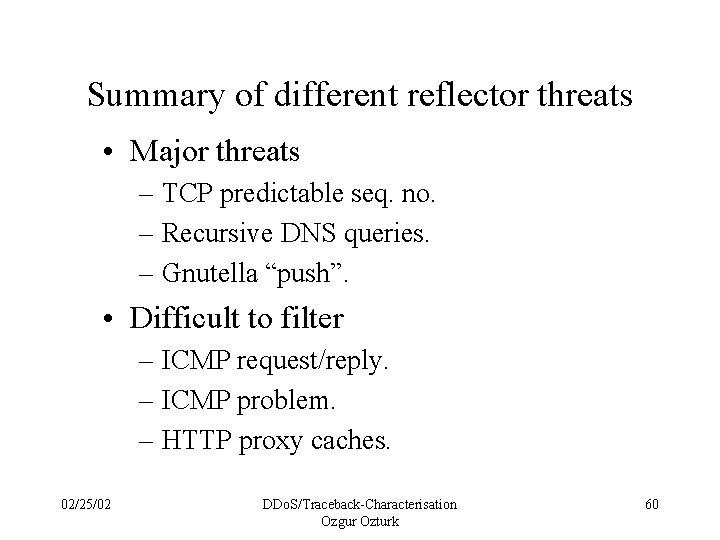
Summary of different reflector threats • Major threats – TCP predictable seq. no. – Recursive DNS queries. – Gnutella “push”. • Difficult to filter – ICMP request/reply. – ICMP problem. – HTTP proxy caches. 02/25/02 DDo. S/Traceback-Characterisation Ozgur Ozturk 60
Implications of Reflector attacks for Trace back. • Major advantage to attackers – Protection from trace back mechanisms. – Cannot trace back directly to slave so one of reflector operator should do. • Administratively cumbersome. • Trace back schemes such as SPIE can help. • Non-spoofed reflector attacks will expose the slave to quick trace back. 02/25/02 DDo. S/Traceback-Characterisation Ozgur Ozturk 61
Reverse ITRACE • R-ITRACE routers send ICMP messages to the source of the just-processed packet rather than its destination (unlike ITRACE). • Routers on the path between slave and the reflector will send ICMP messages to Victim to enable trace back to the slaves. • Efficacy does not depend on Nr but only on Ns. 02/25/02 DDo. S/Traceback-Characterisation Ozgur Ozturk 62
- Slides: 62