
DDM COMMUNICATION STRATEGY 2020 DISTRICT DEVELOPMENT MODEL 1
- Slides: 34
#DDM COMMUNICATION STRATEGY 2020 DISTRICT DEVELOPMENT MODEL 1
PURPOSE The DDM is an all-of-government development approach: § To this end, there is a need for an all-of-government communication framework with the purpose of outlining a strategic approach to effectively communicating the DDM, its messages and information. WHY DDM STRATEGY FRAMEWORK a. The communication strategy is developed to – “drive messages, educate, raise awareness and understanding of the new district approach adopted by government, an all-of-government approach to development for the 6 th administration in particular outlining how we intend to manage and communicate the key messages and content of the District Development Model (DDM) to all identified stakeholders and targeted audiences. b. The strategy framework calls for a proactive, accelerated, heightened and aligned integrated communication across the three spheres of government. Therefore, messages will be communicated and amplified within the broader context of a government plan to develop and improve the lives of communities. c. Building a positive image of government arising from the communication of DDM messages and information. 2
The democratic government recognized the importance of constant communications with communities The starting point for the post 1994 communication system was the Constitution and Bill of Rights, which guarantees freedom of expression, and the right of access to information - Committed to openness, accountability & transparency. Government's mandate requires that communication should expand access to information that would enable the public to participate in the country’s transformation and in bettering their own lives; that it should bring the realities of our emergent and thriving democracy to the attention of the all COMMUNITIES. 3
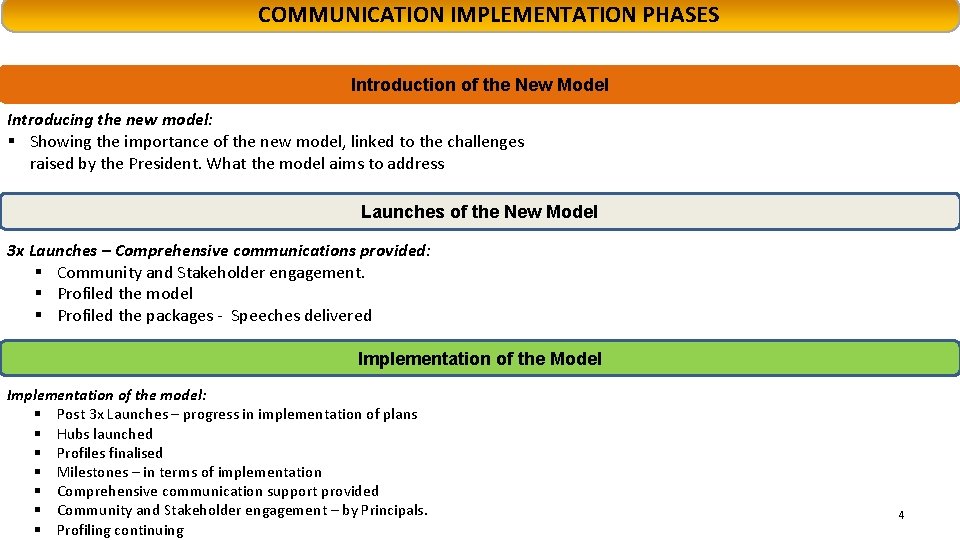
COMMUNICATION IMPLEMENTATION PHASES Introduction of the New Model Introducing the new model: § Showing the importance of the new model, linked to the challenges raised by the President. What the model aims to address Launches of the New Model 3 x Launches – Comprehensive communications provided: § Community and Stakeholder engagement. § Profiled the model § Profiled the packages - Speeches delivered Implementation of the Model Implementation of the model: § Post 3 x Launches – progress in implementation of plans § Hubs launched § Profiles finalised § Milestones – in terms of implementation § Comprehensive communication support provided § Community and Stakeholder engagement – by Principals. § Profiling continuing 4
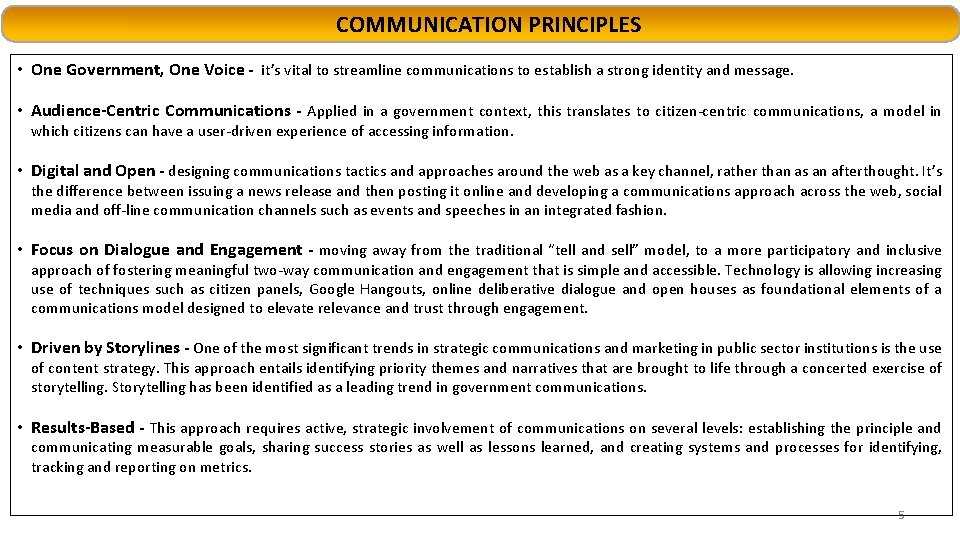
COMMUNICATION PRINCIPLES • One Government, One Voice - it’s vital to streamline communications to establish a strong identity and message. • Audience-Centric Communications - Applied in a government context, this translates to citizen-centric communications, a model in which citizens can have a user-driven experience of accessing information. • Digital and Open - designing communications tactics and approaches around the web as a key channel, rather than as an afterthought. It’s the difference between issuing a news release and then posting it online and developing a communications approach across the web, social media and off-line communication channels such as events and speeches in an integrated fashion. • Focus on Dialogue and Engagement - moving away from the traditional “tell and sell” model, to a more participatory and inclusive approach of fostering meaningful two-way communication and engagement that is simple and accessible. Technology is allowing increasing use of techniques such as citizen panels, Google Hangouts, online deliberative dialogue and open houses as foundational elements of a communications model designed to elevate relevance and trust through engagement. • Driven by Storylines - One of the most significant trends in strategic communications and marketing in public sector institutions is the use of content strategy. This approach entails identifying priority themes and narratives that are brought to life through a concerted exercise of storytelling. Storytelling has been identified as a leading trend in government communications. • Results-Based - This approach requires active, strategic involvement of communications on several levels: establishing the principle and communicating measurable goals, sharing success stories as well as lessons learned, and creating systems and processes for identifying, tracking and reporting on metrics. 5
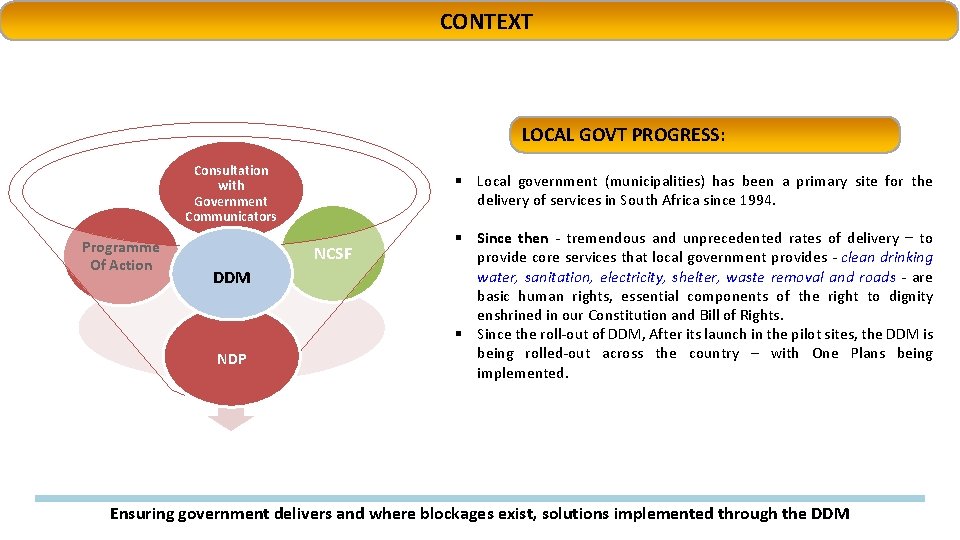
CONTEXT LOCAL GOVT PROGRESS: Consultation with Government Communicators Programme Of Action § Local government (municipalities) has been a primary site for the delivery of services in South Africa since 1994. NCSF DDM NDP § Since then - tremendous and unprecedented rates of delivery – to provide core services that local government provides - clean drinking water, sanitation, electricity, shelter, waste removal and roads - are basic human rights, essential components of the right to dignity enshrined in our Constitution and Bill of Rights. § Since the roll-out of DDM, After its launch in the pilot sites, the DDM is being rolled-out across the country – with One Plans being implemented. Ensuring government delivers and where blockages exist, solutions implemented through the DDM
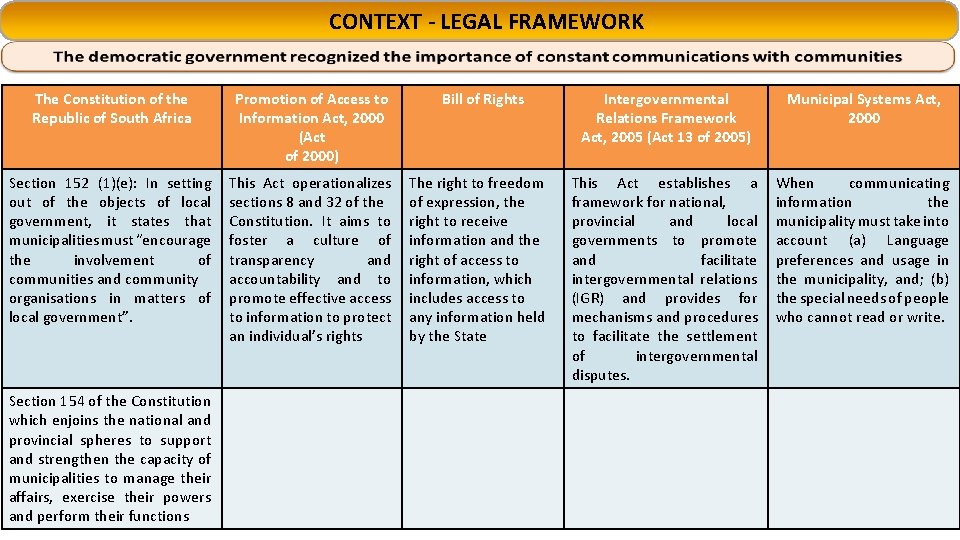
CONTEXT - LEGAL FRAMEWORK The Constitution of the Republic of South Africa Promotion of Access to Information Act, 2000 (Act of 2000) Section 152 (1)(e): In setting out of the objects of local government, it states that municipalities must “encourage the involvement of communities and community organisations in matters of local government”. This Act operationalizes sections 8 and 32 of the Constitution. It aims to foster a culture of transparency and accountability and to promote effective access to information to protect an individual’s rights Section 154 of the Constitution which enjoins the national and provincial spheres to support and strengthen the capacity of municipalities to manage their affairs, exercise their powers and perform their functions Bill of Rights The right to freedom of expression, the right to receive information and the right of access to information, which includes access to any information held by the State Intergovernmental Relations Framework Act, 2005 (Act 13 of 2005) Municipal Systems Act, 2000 This Act establishes a framework for national, provincial and local governments to promote and facilitate intergovernmental relations (IGR) and provides for mechanisms and procedures to facilitate the settlement of intergovernmental disputes. When communicating information the municipality must take into account (a) Language preferences and usage in the municipality, and; (b) the special needs of people who cannot read or write. 7
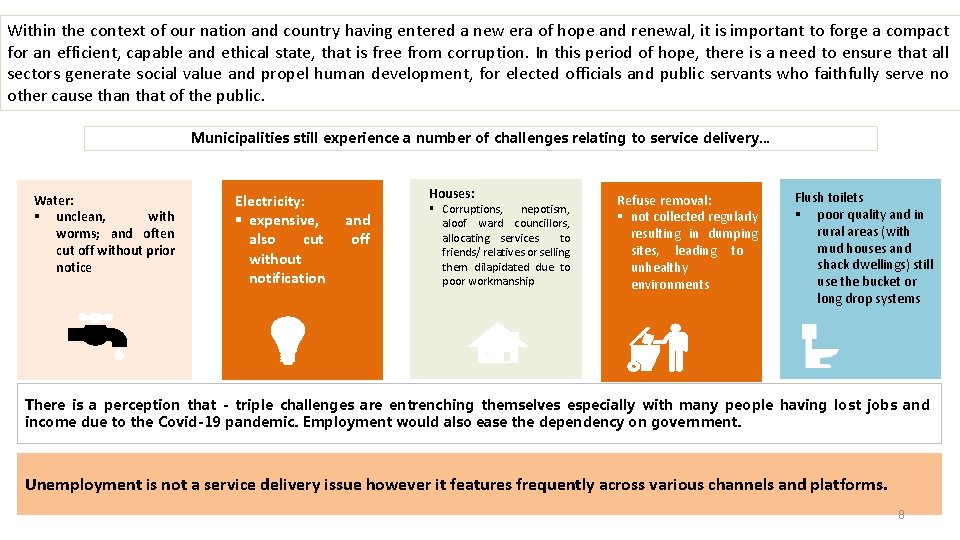
Within the context of our nation and country having entered a new era of hope and renewal, it is important to forge a compact for an efficient, capable and ethical state, that is free from corruption. In this period of hope, there is a need to ensure that all sectors generate social value and propel human development, for elected officials and public servants who faithfully serve no other cause than that of the public. Municipalities still experience a number of challenges relating to service delivery… Water: § unclean, with worms; and often cut off without prior notice Electricity: § expensive, also cut without notification Houses: and off § Corruptions, nepotism, aloof ward councillors, allocating services to friends/ relatives or selling them dilapidated due to poor workmanship Refuse removal: § not collected regularly resulting in dumping sites, leading to unhealthy environments Flush toilets § poor quality and in rural areas (with mud houses and shack dwellings) still use the bucket or long drop systems There is a perception that - triple challenges are entrenching themselves especially with many people having lost jobs and income due to the Covid-19 pandemic. Employment would also ease the dependency on government. Unemployment is not a service delivery issue however it features frequently across various channels and platforms. 8
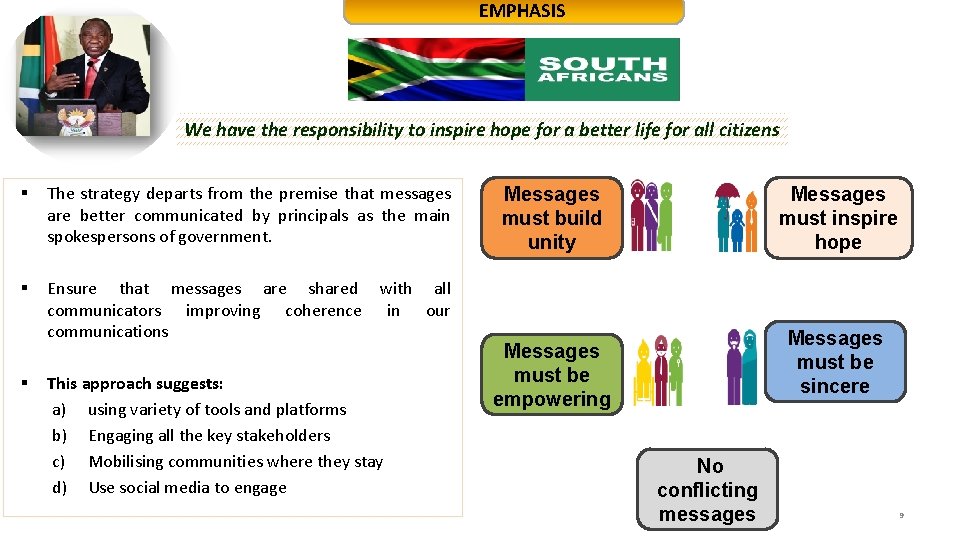
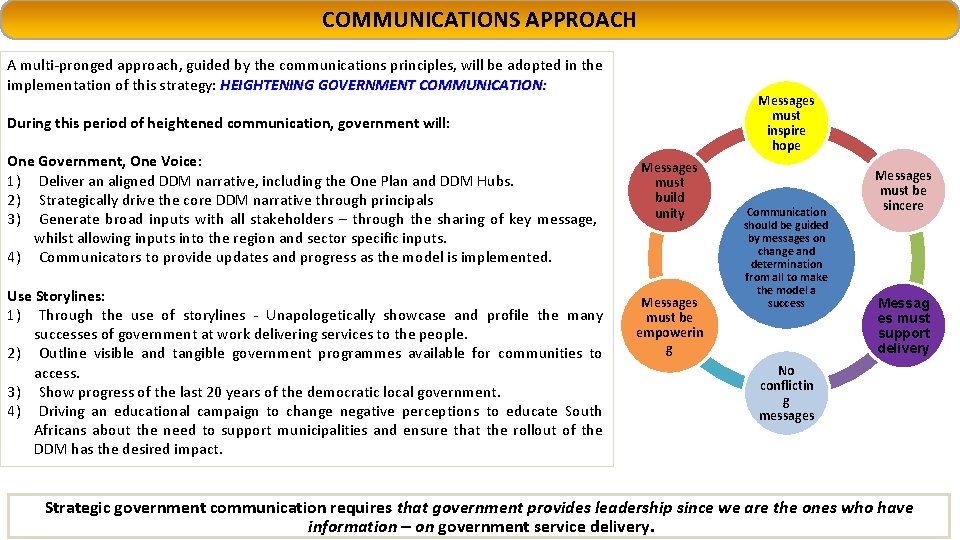
EMPHASIS We have the responsibility to inspire hope for a better life for all citizens § The strategy departs from the premise that messages are better communicated by principals as the main spokespersons of government. § Ensure that messages are shared with all communicators improving coherence in our communications § This approach suggests: a) using variety of tools and platforms b) Engaging all the key stakeholders c) Mobilising communities where they stay d) Use social media to engage Messages must build unity Messages must inspire hope Messages must be sincere Messages must be empowering No conflicting messages 9
ISSUES IN THE ENVIRONMENT a) An assessment of both the domestic and international communication environments suggests multiple influences that can impact on the messages about DDM. To this effect, this communication strategy is to be alive to the dynamic environment within which it is implemented as this will contribute to increased focus to firmly be on the work of government. b) Despite the contested environment, the enthusiasm following another successful national democratic election and ahead of the local elections – is providing government an opportunity to energise South Africans around our democracy and freedom, and around building united action to deal with the challenges that our nation faces as the sixth administration move to grow South Africa through the DDM. c) The negative reports about the work of municipalities (and government in general) paint a negative picture about the country and service delivery. This negative media coverage in the domestic media (both print and electronic), feeds the international media and thus creating a negative picture about South Africa abroad. d) Continued poor performance of some municipalities as outlined by the Auditor General report – is a cause of concern as the media continues to cover the story negatively, intensified by the Covid-19 pandemic. e) Some of the municipalities are experiencing poor performance, mismanagement, bad service record and mishandling of finances and this has led to the failure of some municipalities to pay their bulk accounts of Eskom and Water Boards; nonpayment of municipal employees; no delivery of services, etc. DISTRICT DEVELOPMENT MODEL 10
KEY CHALLENGES Communication challenges emanate from the current perennial challenges that continue to drag down the performance of municipalities and government as a whole, leading to poor service delivery which have led to protests across the country. KEY OBJECTIVES This communication strategy will guide the entire intervention and it sets the tone and direction for all communication activities, products and materials work in harmony to achieve the desired step change. § Internal Comms § External Comms a. Introduce the new model into the psyche of communities through communication and ensuring that citizens understand why the model was introduced and its goal. b. Mobilising for support; c. Promoting collaboration with stakeholders; d. Build trust between government and communities; e. Increasing Awareness of the DDM model, the Hubs as well as implementation roll-out; f. Educating Communities and encouraging a cultural change in favour of communities playing a key role in support of government work. DISTRICT DEVELOPMENT MODEL 11
OUR NARRATIVE a) The District Development Model is a new integrated planning model for Cooperative Governance which seeks to be a new integrated, district-based, service delivery approach aimed at fast-tracking service delivery & development and ensure that municipalities are adequately supported and resourced to carry out their mandate. b) The DDM aims to integrate service delivery that will be more practical, achievable, implementable, measurable and clearly aligned to the key development priorities of the government. c) The DDM approach has benefits for local economies with district and national economies as it ensures that planning, spending and implementation across the three spheres of government is integrated and aligned, with the development of single and integrated One Plans for all 44 districts and 8 metro spaces, develop with the interest of “people first’. d) The effective roll-out, coupled with efficient monitoring and evaluation systems of the DDM, has the potential to yield positive results in the future for the 44 districts and 8 metros in the long-term. e) The DDM is being piloted in e. Thekwini, OR Tambo and Waterberg to practically refine the approach, develop requisite frameworks, tools and lessons learned to improve the broader DDM roll out in the other metro and district spaces. f) The One Plan validates local government as an epicentre for service delivery and development. g) The One Plan puts the existing 44 districts and eight metros at the centre of service delivery and development initiatives h) The DDM aims to address challenges by unlocking any blockages to service delivery and development. i) The district-driven model is directed at turning plans into action, and ensuring proper project management, tracking, monitoring and evaluation. j) These investments are being extended to districts and metros which are key to unlocking economic potential and creating jobs. DISTRICT DEVELOPMENT MODEL 12
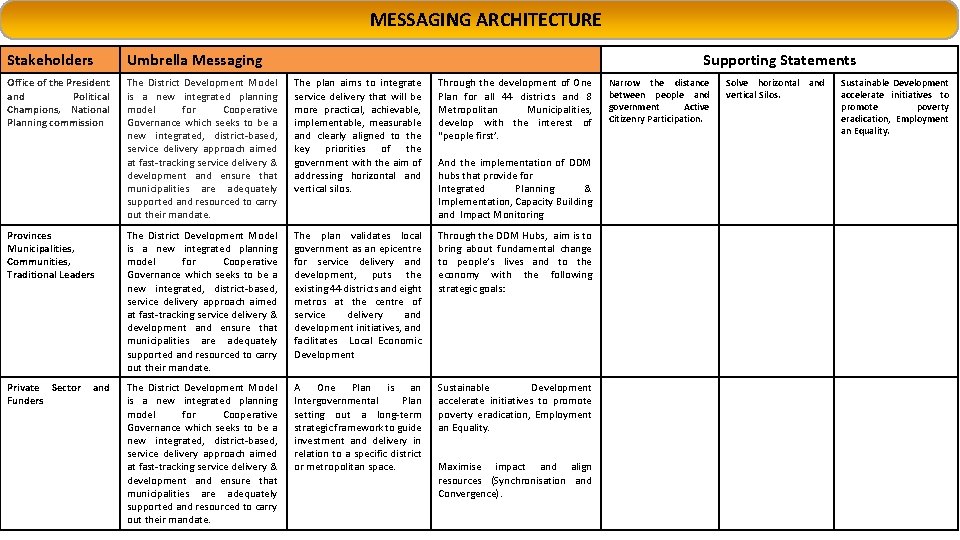
MESSAGING ARCHITECTURE Stakeholders Umbrella Messaging Office of the President and Political Champions, National Planning commission The District Development Model is a new integrated planning model for Cooperative Governance which seeks to be a new integrated, district-based, service delivery approach aimed at fast-tracking service delivery & development and ensure that municipalities are adequately supported and resourced to carry out their mandate. The plan aims to integrate service delivery that will be more practical, achievable, implementable, measurable and clearly aligned to the key priorities of the government with the aim of addressing horizontal and vertical silos. Through the development of One Plan for all 44 districts and 8 Metropolitan Municipalities, develop with the interest of “people first’. Provinces Municipalities, Communities, Traditional Leaders The District Development Model is a new integrated planning model for Cooperative Governance which seeks to be a new integrated, district-based, service delivery approach aimed at fast-tracking service delivery & development and ensure that municipalities are adequately supported and resourced to carry out their mandate. The plan validates local government as an epicentre for service delivery and development, puts the existing 44 districts and eight metros at the centre of service delivery and development initiatives, and facilitates Local Economic Development Through the DDM Hubs, aim is to bring about fundamental change to people’s lives and to the economy with the following strategic goals: Private Sector Funders The District Development Model is a new integrated planning model for Cooperative Governance which seeks to be a new integrated, district-based, service delivery approach aimed at fast-tracking service delivery & development and ensure that municipalities are adequately supported and resourced to carry out their mandate. A One Plan is an Intergovernmental Plan setting out a long-term strategic framework to guide investment and delivery in relation to a specific district or metropolitan space. Sustainable Development accelerate initiatives to promote poverty eradication, Employment an Equality. and Supporting Statements And the implementation of DDM hubs that provide for Integrated Planning & Implementation, Capacity Building and Impact Monitoring Maximise impact and align resources (Synchronisation and Convergence). Narrow the distance between people and government Active Citizenry Participation. Solve horizontal and vertical Silos. Sustainable Development accelerate initiatives to promote poverty eradication, Employment an Equality.
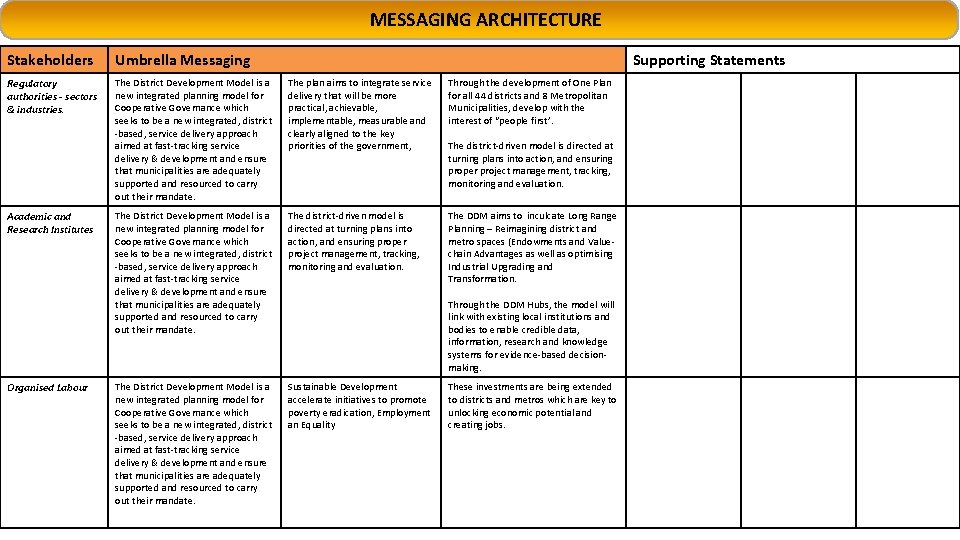
MESSAGING ARCHITECTURE Stakeholders Umbrella Messaging Regulatory authorities - sectors & industries. The District Development Model is a new integrated planning model for Cooperative Governance which seeks to be a new integrated, district -based, service delivery approach aimed at fast-tracking service delivery & development and ensure that municipalities are adequately supported and resourced to carry out their mandate. The plan aims to integrate service delivery that will be more practical, achievable, implementable, measurable and clearly aligned to the key priorities of the government, Through the development of One Plan for all 44 districts and 8 Metropolitan Municipalities, develop with the interest of “people first’. The District Development Model is a new integrated planning model for Cooperative Governance which seeks to be a new integrated, district -based, service delivery approach aimed at fast-tracking service delivery & development and ensure that municipalities are adequately supported and resourced to carry out their mandate. The district-driven model is directed at turning plans into action, and ensuring proper project management, tracking, monitoring and evaluation. The DDM aims to inculcate Long Range Planning – Reimagining district and metro spaces (Endowments and Valuechain Advantages as well as optimising Industrial Upgrading and Transformation. The District Development Model is a new integrated planning model for Cooperative Governance which seeks to be a new integrated, district -based, service delivery approach aimed at fast-tracking service delivery & development and ensure that municipalities are adequately supported and resourced to carry out their mandate. Sustainable Development accelerate initiatives to promote poverty eradication, Employment an Equality Academic and Research Institutes Organised Labour Supporting Statements The district-driven model is directed at turning plans into action, and ensuring proper project management, tracking, monitoring and evaluation. Through the DDM Hubs, the model will link with existing local institutions and bodies to enable credible data, information, research and knowledge systems for evidence-based decisionmaking. These investments are being extended to districts and metros which are key to unlocking economic potential and creating jobs.
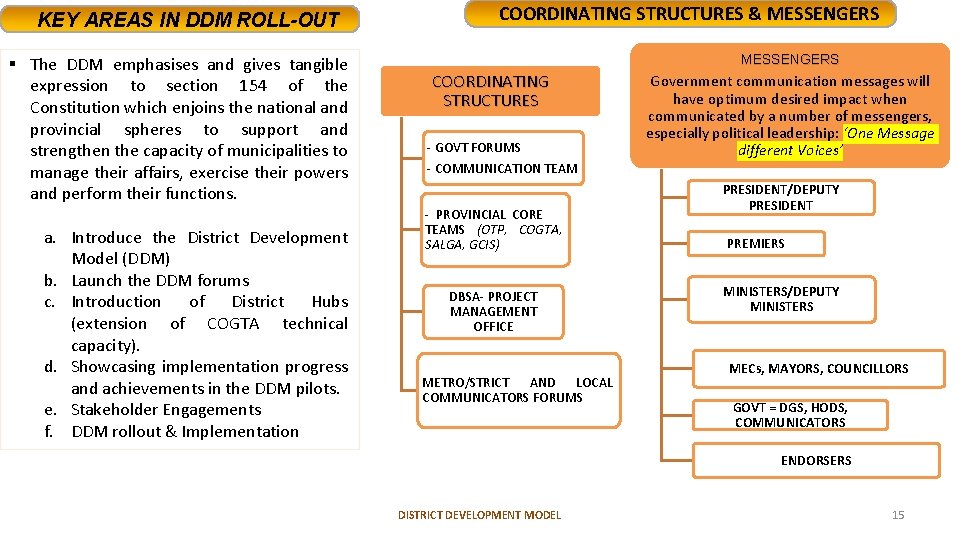
KEY AREAS IN DDM ROLL-OUT § The DDM emphasises and gives tangible expression to section 154 of the Constitution which enjoins the national and provincial spheres to support and strengthen the capacity of municipalities to manage their affairs, exercise their powers and perform their functions. a. Introduce the District Development Model (DDM) b. Launch the DDM forums c. Introduction of District Hubs (extension of COGTA technical capacity). d. Showcasing implementation progress and achievements in the DDM pilots. e. Stakeholder Engagements f. DDM rollout & Implementation COORDINATING STRUCTURES & MESSENGERS COORDINATING STRUCTURES - GOVT FORUMS - COMMUNICATION TEAM - PROVINCIAL CORE TEAMS (OTP, COGTA, SALGA, GCIS) DBSA- PROJECT MANAGEMENT OFFICE METRO/STRICT AND LOCAL COMMUNICATORS FORUMS Government communication messages will have optimum desired impact when communicated by a number of messengers, especially political leadership: ‘One Message different Voices’ PRESIDENT/DEPUTY PRESIDENT PREMIERS MINISTERS/DEPUTY MINISTERS MECs, MAYORS, COUNCILLORS GOVT = DGS, HODS, COMMUNICATORS ENDORSERS DISTRICT DEVELOPMENT MODEL 15
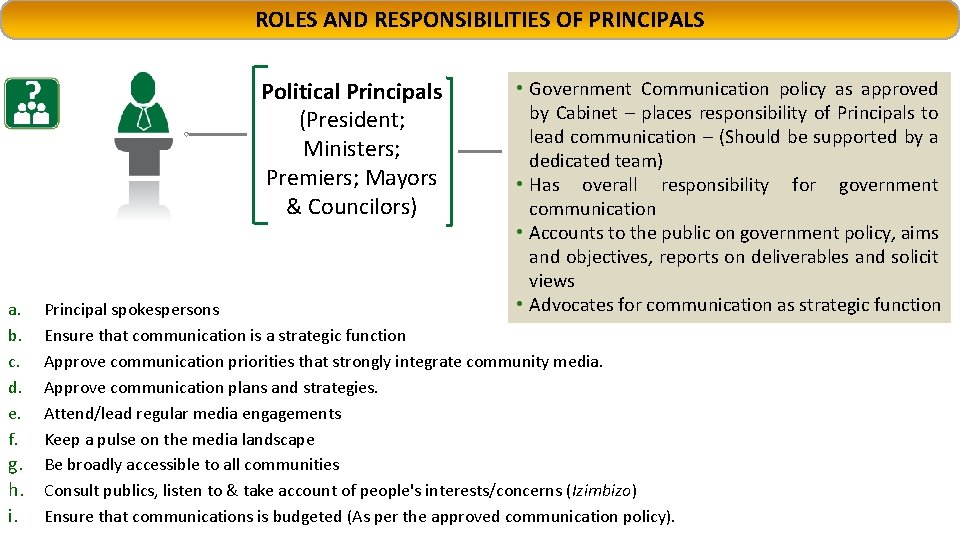
ROLES AND RESPONSIBILITIES OF PRINCIPALS Political Principals (President; Ministers; Premiers; Mayors & Councilors) a. b. c. d. e. f. g. h. i. • Government Communication policy as approved by Cabinet – places responsibility of Principals to lead communication – (Should be supported by a dedicated team) • Has overall responsibility for government communication • Accounts to the public on government policy, aims and objectives, reports on deliverables and solicit views • Advocates for communication as strategic function Principal spokespersons Ensure that communication is a strategic function Approve communication priorities that strongly integrate community media. Approve communication plans and strategies. Attend/lead regular media engagements Keep a pulse on the media landscape Be broadly accessible to all communities Consult publics, listen to & take account of people's interests/concerns (Izimbizo) Ensure that communications is budgeted (As per the approved communication policy).
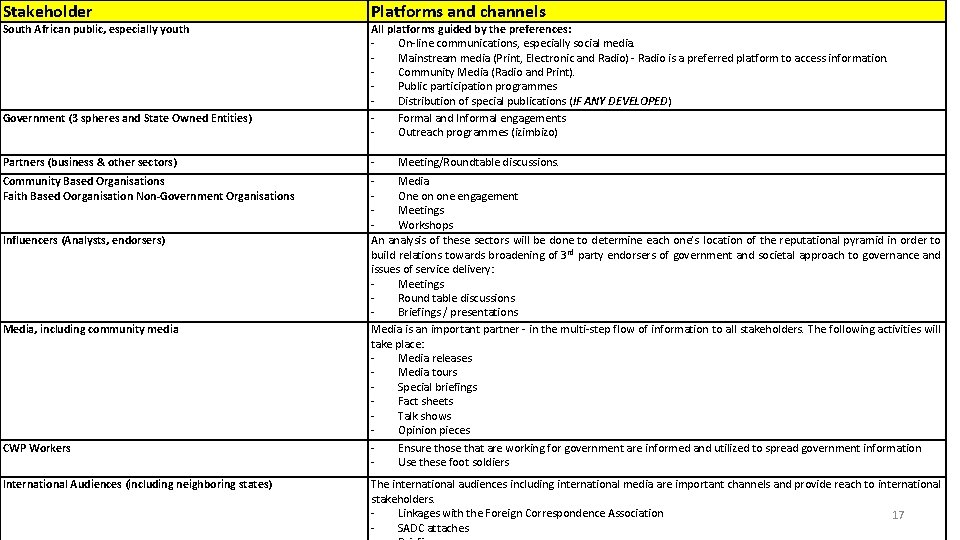
Stakeholder South African public, especially youth Government (3 spheres and State Owned Entities) Platforms and channels All platforms guided by the preferences: On-line communications, especially social media. Mainstream media (Print, Electronic and Radio) - Radio is a preferred platform to access information. Community Media (Radio and Print). Public participation programmes Distribution of special publications (IF ANY DEVELOPED) Formal and Informal engagements Outreach programmes (izimbizo) Partners (business & other sectors) - Community Based Organisations Faith Based Oorganisation Non-Government Organisations Media One on one engagement Meetings Workshops An analysis of these sectors will be done to determine each one’s location of the reputational pyramid in order to build relations towards broadening of 3 rd party endorsers of government and societal approach to governance and issues of service delivery: Meetings Round table discussions Briefings / presentations Media is an important partner - in the multi-step flow of information to all stakeholders. The following activities will take place: Media releases Media tours Special briefings Fact sheets Talk shows Opinion pieces Ensure those that are working for government are informed and utilized to spread government information Use these foot soldiers Influencers (Analysts, endorsers) Media, including community media CWP Workers International Audiences (including neighboring states) Meeting/Roundtable discussions. The international audiences including international media are important channels and provide reach to international stakeholders. Linkages with the Foreign Correspondence Association 17 SADC attaches
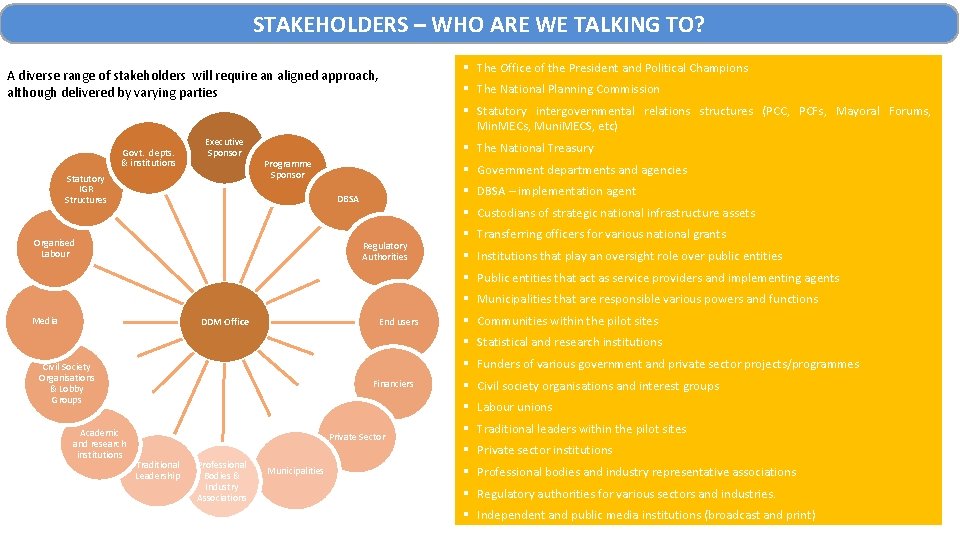
STAKEHOLDERS – WHO ARE WE TALKING TO? § The Office of the President and Political Champions A diverse range of stakeholders will require an aligned approach, although delivered by varying parties § The National Planning Commission § Statutory intergovernmental relations structures (PCC, PCFs, Mayoral Forums, Min. MECs, Muni. MECS, etc) Govt. depts. & institutions Executive Sponsor Statutory IGR Structures § The National Treasury Programme Sponsor § Government departments and agencies § DBSA – implementation agent DBSA Organised Labour § Custodians of strategic national infrastructure assets Regulatory Authorities § Transferring officers for various national grants § Institutions that play an oversight role over public entities § Public entities that act as service providers and implementing agents § Municipalities that are responsible various powers and functions Media End users DDM Office § Communities within the pilot sites § Statistical and research institutions § Funders of various government and private sector projects/programmes Civil Society Organisations & Lobby Groups Academic and research institutions Financiers § Civil society organisations and interest groups § Labour unions Private Sector Traditional Leadership Professional Bodies & Industry Associations Municipalities § Traditional leaders within the pilot sites § Private sector institutions § Professional bodies and industry representative associations § Regulatory authorities for various sectors and industries. § Independent and public media institutions (broadcast and print) 18
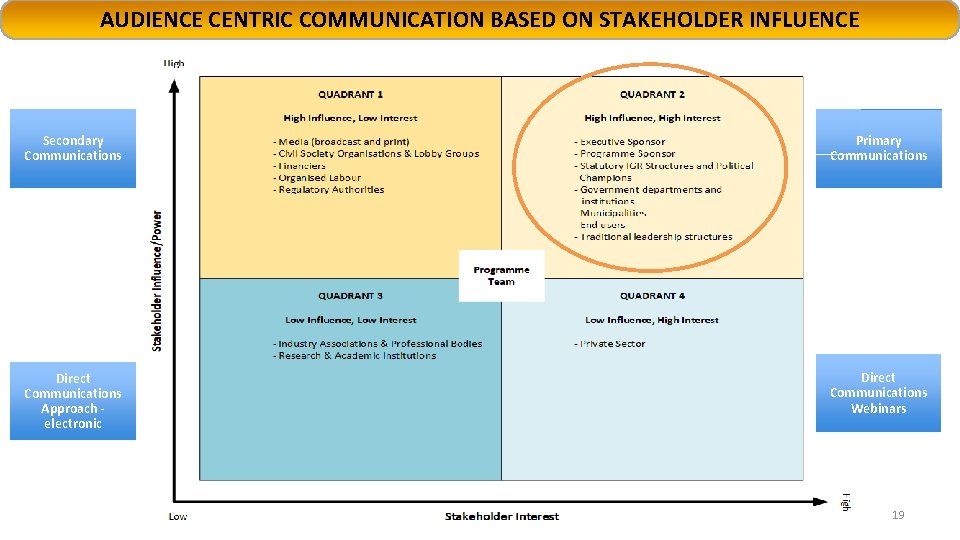
AUDIENCE CENTRIC COMMUNICATION BASED ON STAKEHOLDER INFLUENCE Secondary Communications Primary Communications Direct Communications Approach electronic Direct Communications Webinars 19
COMMUNICATIONS APPROACH A multi-pronged approach, guided by the communications principles, will be adopted in the implementation of this strategy: HEIGHTENING GOVERNMENT COMMUNICATION: Messages must inspire hope During this period of heightened communication, government will: One Government, One Voice: 1) Deliver an aligned DDM narrative, including the One Plan and DDM Hubs. 2) Strategically drive the core DDM narrative through principals 3) Generate broad inputs with all stakeholders – through the sharing of key message, whilst allowing inputs into the region and sector specific inputs. 4) Communicators to provide updates and progress as the model is implemented. Use Storylines: 1) Through the use of storylines - Unapologetically showcase and profile the many successes of government at work delivering services to the people. 2) Outline visible and tangible government programmes available for communities to access. 3) Show progress of the last 20 years of the democratic local government. 4) Driving an educational campaign to change negative perceptions to educate South Africans about the need to support municipalities and ensure that the rollout of the DDM has the desired impact. Messages must build unity Messages must be empowerin g Communication should be guided by messages on change and determination from all to make the model a success Messages must be sincere Messag es must support delivery No conflictin g messages Strategic government communication requires that government provides leadership since we are the ones who have information – on government service delivery.
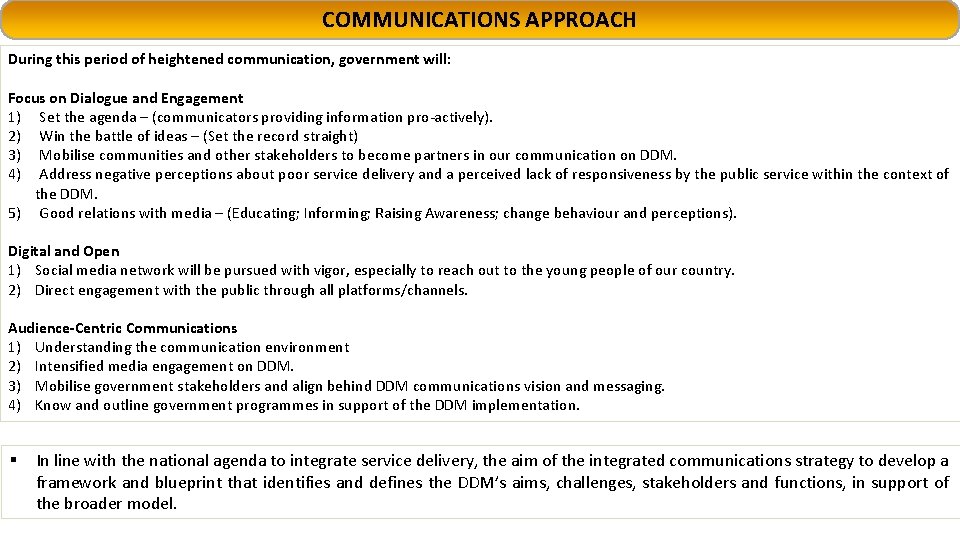
COMMUNICATIONS APPROACH During this period of heightened communication, government will: Focus on Dialogue and Engagement 1) Set the agenda – (communicators providing information pro-actively). 2) Win the battle of ideas – (Set the record straight) 3) Mobilise communities and other stakeholders to become partners in our communication on DDM. 4) Address negative perceptions about poor service delivery and a perceived lack of responsiveness by the public service within the context of the DDM. 5) Good relations with media – (Educating; Informing; Raising Awareness; change behaviour and perceptions). Digital and Open 1) Social media network will be pursued with vigor, especially to reach out to the young people of our country. 2) Direct engagement with the public through all platforms/channels. Audience-Centric Communications 1) Understanding the communication environment 2) Intensified media engagement on DDM. 3) Mobilise government stakeholders and align behind DDM communications vision and messaging. 4) Know and outline government programmes in support of the DDM implementation. § In line with the national agenda to integrate service delivery, the aim of the integrated communications strategy to develop a framework and blueprint that identifies and defines the DDM’s aims, challenges, stakeholders and functions, in support of the broader model.
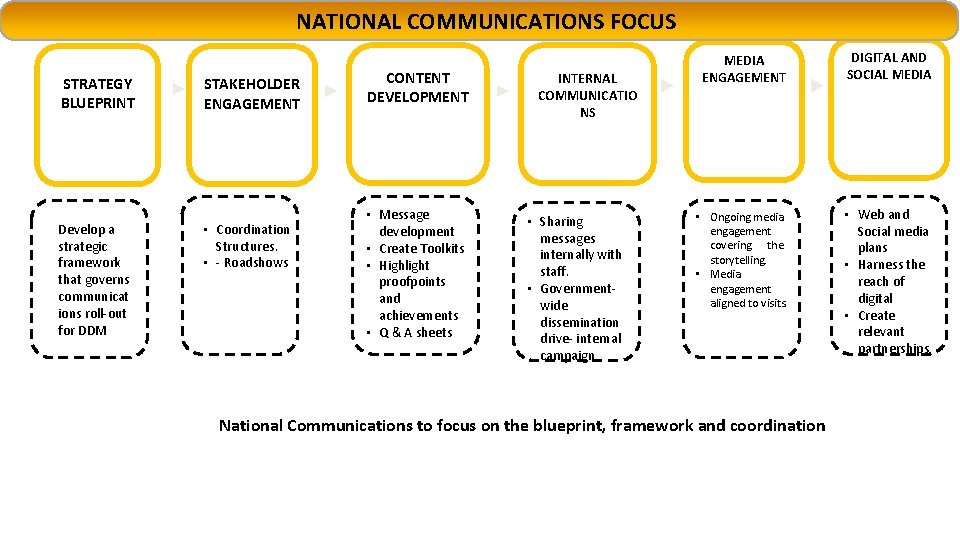
NATIONAL COMMUNICATIONS FOCUS STRATEGY BLUEPRINT Develop a strategic framework that governs communicat ions roll-out for DDM ► STAKEHOLDER ENGAGEMENT • Coordination Structures. • - Roadshows ► CONTENT DEVELOPMENT • Message development • Create Toolkits • Highlight proofpoints and achievements • Q & A sheets ► INTERNAL COMMUNICATIO NS • Sharing messages internally with staff. • Governmentwide dissemination drive- internal campaign MEDIA ENGAGEMENT DIGITAL AND SOCIAL MEDIA • Ongoing media engagement covering the storytelling. • Media engagement aligned to visits. • Web and Social media plans • Harness the reach of digital • Create relevant partnerships National Communications to focus on the blueprint, framework and coordination
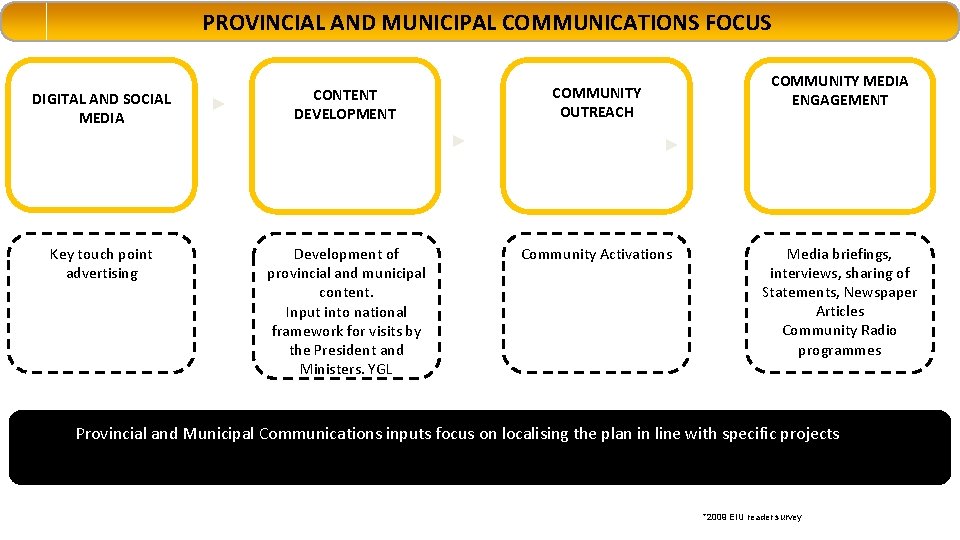
PROVINCIAL AND MUNICIPAL COMMUNICATIONS FOCUS DIGITAL AND SOCIAL MEDIA ► CONTENT DEVELOPMENT ► Key touch point advertising Development of provincial and municipal content. Input into national framework for visits by the President and Ministers. YGL COMMUNITY MEDIA ENGAGEMENT COMMUNITY OUTREACH ► Community Activations Media briefings, interviews, sharing of Statements, Newspaper Articles Community Radio programmes Provincial and Municipal Communications inputs focus on localising the plan in line with specific projects *2009 EIU reader survey
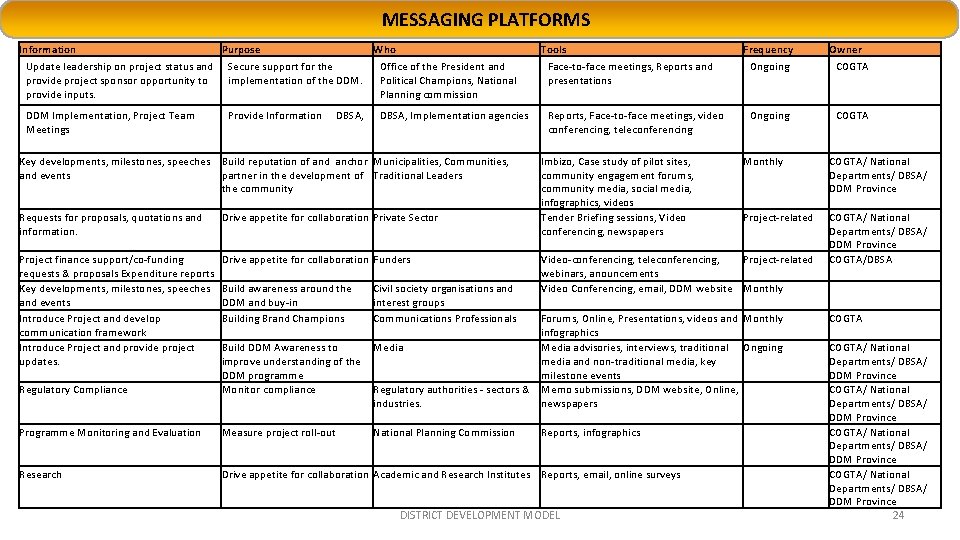
MESSAGING PLATFORMS Information Purpose Who Tools Frequency Owner Update leadership on project status and provide project sponsor opportunity to provide inputs. Secure support for the implementation of the DDM. Office of the President and Political Champions, National Planning commission Face-to-face meetings, Reports and presentations Ongoing COGTA DDM Implementation, Project Team Meetings Provide Information DBSA, Implementation agencies Reports, Face-to-face meetings, video conferencing, teleconferencing Ongoing COGTA DBSA, Key developments, milestones, speeches Build reputation of and anchor Municipalities, Communities, and events partner in the development of Traditional Leaders the community Requests for proposals, quotations and information. Drive appetite for collaboration Private Sector Project finance support/co-funding requests & proposals Expenditure reports Key developments, milestones, speeches and events Introduce Project and develop communication framework Introduce Project and provide project updates. Drive appetite for collaboration Funders Build awareness around the DDM and buy-in Building Brand Champions Civil society organisations and interest groups Communications Professionals Imbizo, Case study of pilot sites, community engagement forums, community media, social media, infographics, videos Tender Briefing sessions, Video conferencing, newspapers Monthly COGTA/ National Departments/ DBSA/ DDM Province Project-related COGTA/ National Departments/ DBSA/ DDM Province COGTA/DBSA Video-conferencing, teleconferencing, Project-related webinars, anouncements Video Conferencing, email, DDM website Monthly Forums, Online, Presentations, videos and Monthly infographics Media advisories, interviews, traditional Ongoing media and non-traditional media, key milestone events Regulatory authorities - sectors & Memo submissions, DDM website, Online, industries. newspapers Regulatory Compliance Build DDM Awareness to improve understanding of the DDM programme Monitor compliance Programme Monitoring and Evaluation Measure project roll-out Research Drive appetite for collaboration Academic and Research Institutes Reports, email, online surveys National Planning Commission Reports, infographics DISTRICT DEVELOPMENT MODEL COGTA/ National Departments/ DBSA/ DDM Province COGTA/ National Departments/ DBSA/ DDM Province 24
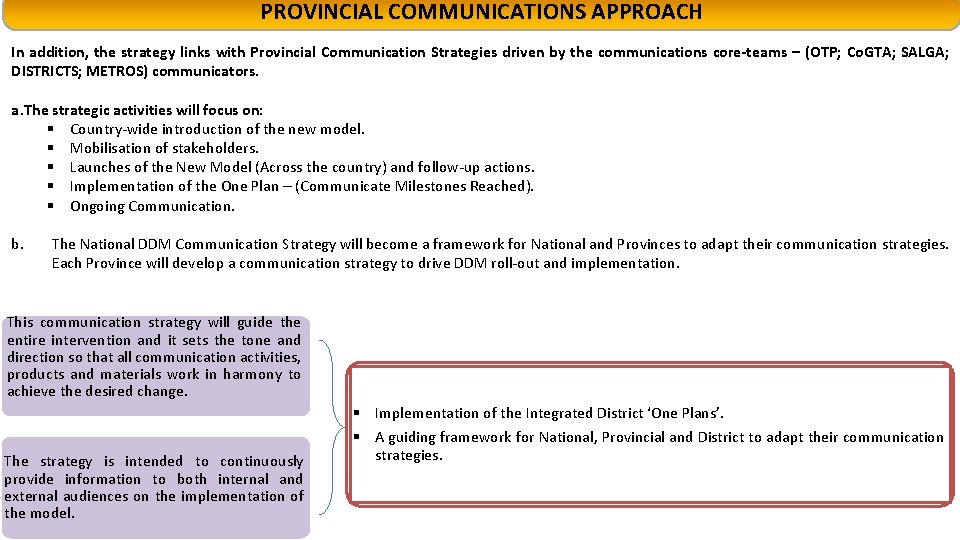
PROVINCIAL COMMUNICATIONS APPROACH In addition, the strategy links with Provincial Communication Strategies driven by the communications core-teams – (OTP; Co. GTA; SALGA; DISTRICTS; METROS) communicators. a. The strategic activities will focus on: § Country-wide introduction of the new model. § Mobilisation of stakeholders. § Launches of the New Model (Across the country) and follow-up actions. § Implementation of the One Plan – (Communicate Milestones Reached). § Ongoing Communication. b. The National DDM Communication Strategy will become a framework for National and Provinces to adapt their communication strategies. Each Province will develop a communication strategy to drive DDM roll-out and implementation. This communication strategy will guide the entire intervention and it sets the tone and direction so that all communication activities, products and materials work in harmony to achieve the desired change. The strategy is intended to continuously provide information to both internal and external audiences on the implementation of the model. § Implementation of the Integrated District ‘One Plans’. § A guiding framework for National, Provincial and District to adapt their communication strategies.
CONCLUSION Finally – through this approach: § Place all stakeholders at the centre of our communication. § Recognise that communication is not a once off process – engage the publics by educating them and raising awareness about the coming elections. § Ensure strategic, correctly packaged and consistent messages are constantly shared with targeted audiences. § Un-interruptedly repeat messages – this will surely ensure greater impact on our audiences. § Use the current programmes in municipalities to heighten and upscale communication § Begin now with radical communication of government messages until post elections in 2021 (Action and high impactoriented communication)
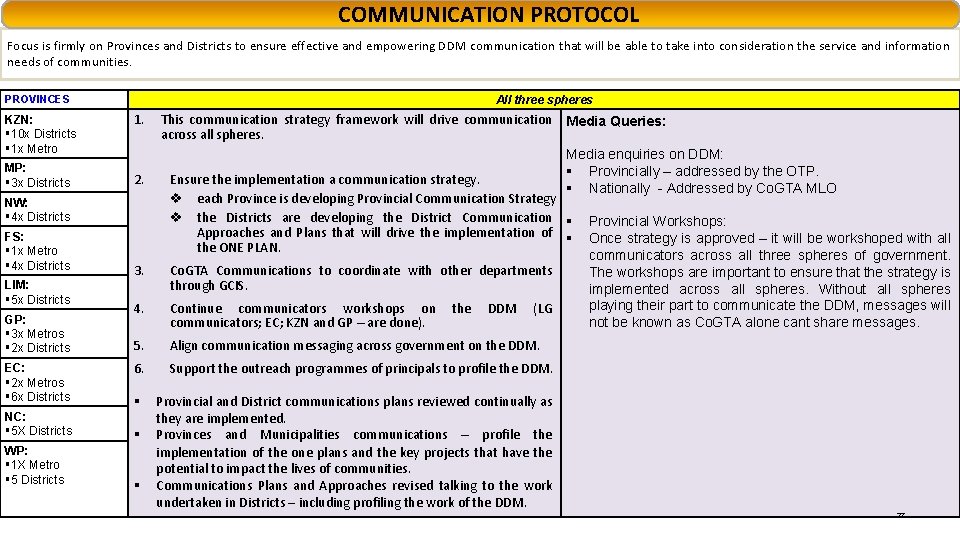
COMMUNICATION PROTOCOL Focus is firmly on Provinces and Districts to ensure effective and empowering DDM communication that will be able to take into consideration the service and information needs of communities. PROVINCES KZN: § 10 x Districts § 1 x Metro MP: § 3 x Districts All three spheres 1. 2. NW: § 4 x Districts FS: § 1 x Metro § 4 x Districts LIM: § 5 x Districts GP: § 3 x Metros § 2 x Districts EC: § 2 x Metros § 6 x Districts NC: § 5 X Districts WP: § 1 X Metro § 5 Districts This communication strategy framework will drive communication across all spheres. Media enquiries on DDM: § Provincially – addressed by the OTP. § Nationally - Addressed by Co. GTA MLO Ensure the implementation a communication strategy. v each Province is developing Provincial Communication Strategy v the Districts are developing the District Communication § Approaches and Plans that will drive the implementation of § the ONE PLAN. 3. Co. GTA Communications to coordinate with other departments through GCIS. 4. Continue communicators workshops on communicators; EC; KZN and GP – are done). 5. Align communication messaging across government on the DDM. 6. Support the outreach programmes of principals to profile the DDM. § § § Media Queries: the DDM (LG Provincial Workshops: Once strategy is approved – it will be workshoped with all communicators across all three spheres of government. The workshops are important to ensure that the strategy is implemented across all spheres. Without all spheres playing their part to communicate the DDM, messages will not be known as Co. GTA alone cant share messages. Provincial and District communications plans reviewed continually as they are implemented. Provinces and Municipalities communications – profile the implementation of the one plans and the key projects that have the potential to impact the lives of communities. Communications Plans and Approaches revised talking to the work undertaken in Districts – including profiling the work of the DDM. 27
ANNEXURE A ABOUT DDM DISTRICT DEVELOPMENT MODEL 28
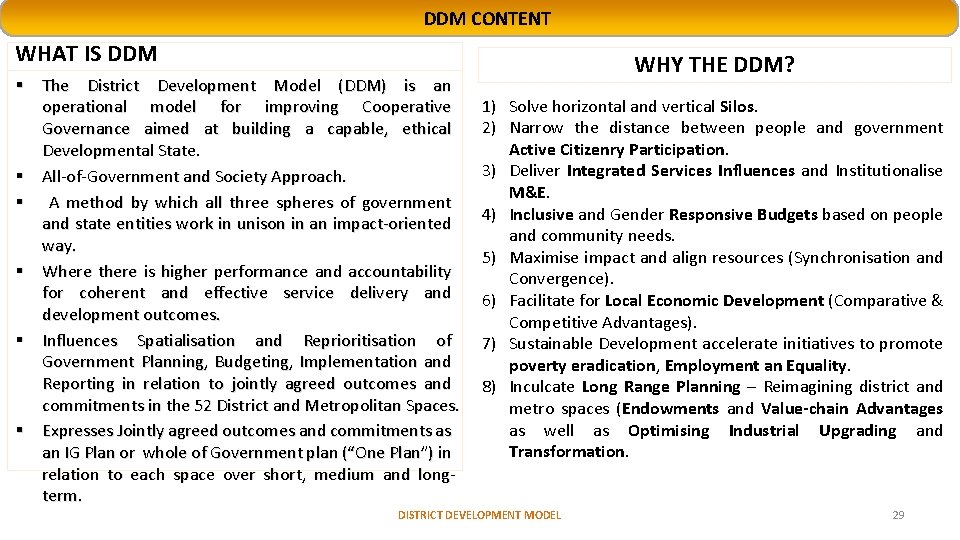
DDM CONTENT WHAT IS DDM § The District Development Model (DDM) is an operational model for improving Cooperative Governance aimed at building a capable, ethical Developmental State. § All-of-Government and Society Approach. § A method by which all three spheres of government and state entities work in unison in an impact-oriented way. § Where there is higher performance and accountability for coherent and effective service delivery and development outcomes. § Influences Spatialisation and Reprioritisation of Government Planning, Budgeting, Implementation and Reporting in relation to jointly agreed outcomes and commitments in the 52 District and Metropolitan Spaces. § Expresses Jointly agreed outcomes and commitments as an IG Plan or whole of Government plan (“One Plan”) in relation to each space over short, medium and longterm. WHY THE DDM? 1) Solve horizontal and vertical Silos. 2) Narrow the distance between people and government Active Citizenry Participation. 3) Deliver Integrated Services Influences and Institutionalise M&E. 4) Inclusive and Gender Responsive Budgets based on people and community needs. 5) Maximise impact and align resources (Synchronisation and Convergence). 6) Facilitate for Local Economic Development (Comparative & Competitive Advantages). 7) Sustainable Development accelerate initiatives to promote poverty eradication, Employment an Equality. 8) Inculcate Long Range Planning – Reimagining district and metro spaces (Endowments and Value-chain Advantages as well as Optimising Industrial Upgrading and Transformation. DISTRICT DEVELOPMENT MODEL 29
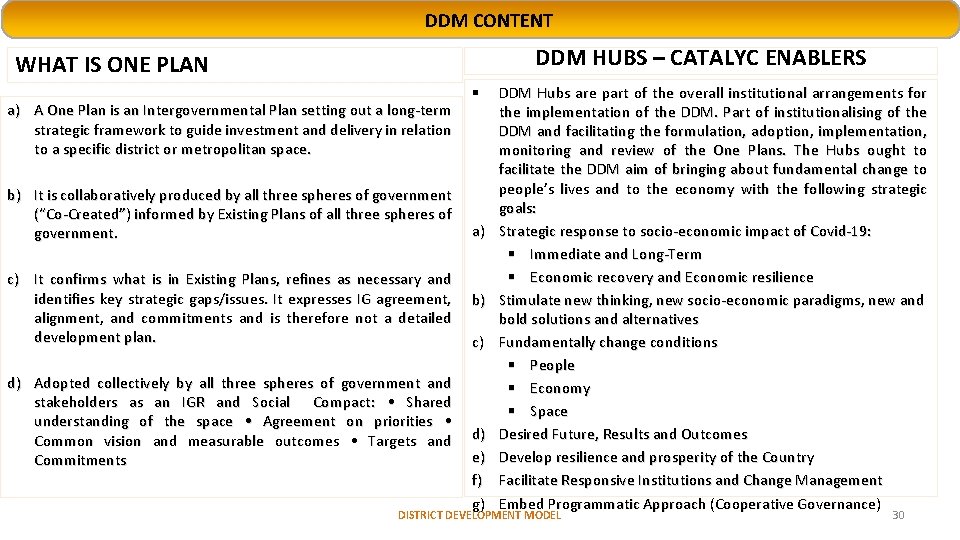
DDM CONTENT DDM HUBS – CATALYC ENABLERS WHAT IS ONE PLAN a) A One Plan is an Intergovernmental Plan setting out a long-term strategic framework to guide investment and delivery in relation to a specific district or metropolitan space. b) It is collaboratively produced by all three spheres of government (“Co-Created”) informed by Existing Plans of all three spheres of government. c) It confirms what is in Existing Plans, refines as necessary and identifies key strategic gaps/issues. It expresses IG agreement, alignment, and commitments and is therefore not a detailed development plan. d) Adopted collectively by all three spheres of government and stakeholders as an IGR and Social Compact: • Shared understanding of the space • Agreement on priorities • Common vision and measurable outcomes • Targets and Commitments § a) b) c) d) e) f) g) DDM Hubs are part of the overall institutional arrangements for the implementation of the DDM. Part of institutionalising of the DDM and facilitating the formulation, adoption, implementation, monitoring and review of the One Plans. The Hubs ought to facilitate the DDM aim of bringing about fundamental change to people’s lives and to the economy with the following strategic goals: Strategic response to socio-economic impact of Covid-19: § Immediate and Long-Term § Economic recovery and Economic resilience Stimulate new thinking, new socio-economic paradigms, new and bold solutions and alternatives Fundamentally change conditions § People § Economy § Space Desired Future, Results and Outcomes Develop resilience and prosperity of the Country Facilitate Responsive Institutions and Change Management Embed Programmatic Approach (Cooperative Governance) DISTRICT DEVELOPMENT MODEL 30
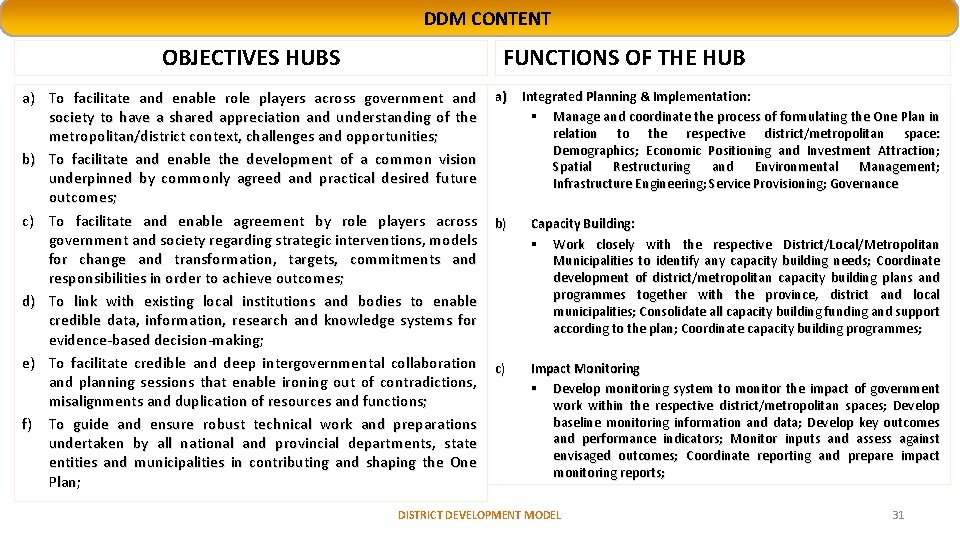
DDM CONTENT OBJECTIVES HUBS FUNCTIONS OF THE HUB a) To facilitate and enable role players across government and society to have a shared appreciation and understanding of the metropolitan/district context, challenges and opportunities; b) To facilitate and enable the development of a common vision underpinned by commonly agreed and practical desired future outcomes; c) To facilitate and enable agreement by role players across government and society regarding strategic interventions, models for change and transformation, targets, commitments and responsibilities in order to achieve outcomes; d) To link with existing local institutions and bodies to enable credible data, information, research and knowledge systems for evidence-based decision-making; e) To facilitate credible and deep intergovernmental collaboration and planning sessions that enable ironing out of contradictions, misalignments and duplication of resources and functions; f) To guide and ensure robust technical work and preparations undertaken by all national and provincial departments, state entities and municipalities in contributing and shaping the One Plan; a) Integrated Planning & Implementation: § Manage and coordinate the process of formulating the One Plan in relation to the respective district/metropolitan space: Demographics; Economic Positioning and Investment Attraction; Spatial Restructuring and Environmental Management; Infrastructure Engineering; Service Provisioning; Governance b) Capacity Building: § Work closely with the respective District/Local/Metropolitan Municipalities to identify any capacity building needs; Coordinate development of district/metropolitan capacity building plans and programmes together with the province, district and local municipalities; Consolidate all capacity building funding and support according to the plan; Coordinate capacity building programmes; c) Impact Monitoring § Develop monitoring system to monitor the impact of government work within the respective district/metropolitan spaces; Develop baseline monitoring information and data; Develop key outcomes and performance indicators; Monitor inputs and assess against envisaged outcomes; Coordinate reporting and prepare impact monitoring reports; DISTRICT DEVELOPMENT MODEL 31
ANNEXURE B COGTA DDM COMMS IMPLEMENTATION PLAN DISTRICT DEVELOPMENT MODEL 32
DISCUSSIONS/INPUTS
Thank You!