
DDI The Movie 2 Applications of the Architecture

- Slides: 34
DDI The Movie 2: Applications of the Architecture (early draft) By I-Lin Kuo
Table of Contents • Modules and Instrument Documentation • The Variable • Ontologies and Tagging
Modules and Instrument Documentation Chapter 1
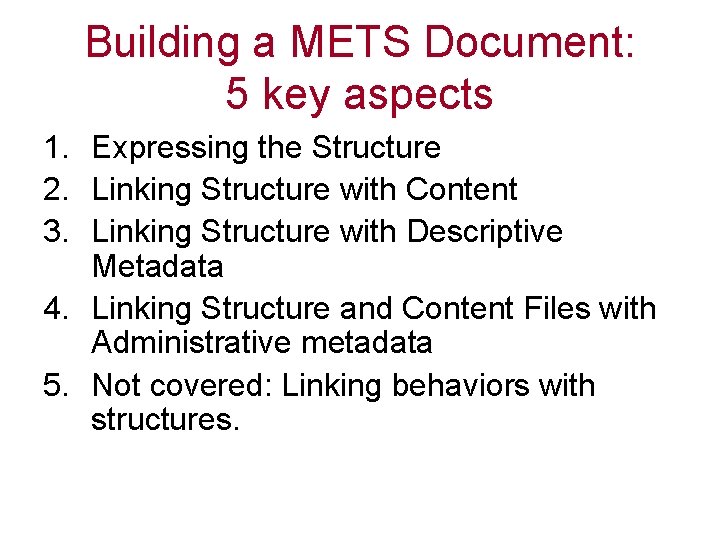
Suggested Approach to Instrument Documentation • METS has an extremely well-designed structure map which describes the logical structure of its objects of interest. See http: //www. loc. gov/standards/mets/present ations/METSIntro 2. ppt • Basically, a skeleton of a structure is created which then contains pointers to items. See next slide for the recipe for building METS.
Building a METS Document: 5 key aspects 1. Expressing the Structure 2. Linking Structure with Content 3. Linking Structure with Descriptive Metadata 4. Linking Structure and Content Files with Administrative metadata 5. Not covered: Linking behaviors with structures.
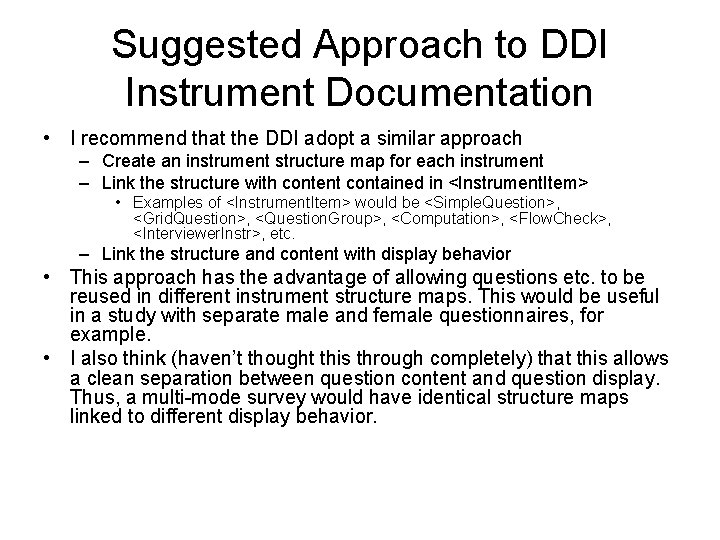
Suggested Approach to DDI Instrument Documentation • I recommend that the DDI adopt a similar approach – Create an instrument structure map for each instrument – Link the structure with content contained in <Instrument. Item> • Examples of <Instrument. Item> would be <Simple. Question>, <Grid. Question>, <Question. Group>, <Computation>, <Flow. Check>, <Interviewer. Instr>, etc. – Link the structure and content with display behavior • This approach has the advantage of allowing questions etc. to be reused in different instrument structure maps. This would be useful in a study with separate male and female questionnaires, for example. • I also think (haven’t thought this through completely) that this allows a clean separation between question content and question display. Thus, a multi-mode survey would have identical structure maps linked to different display behavior.
The Variable Chapter 2
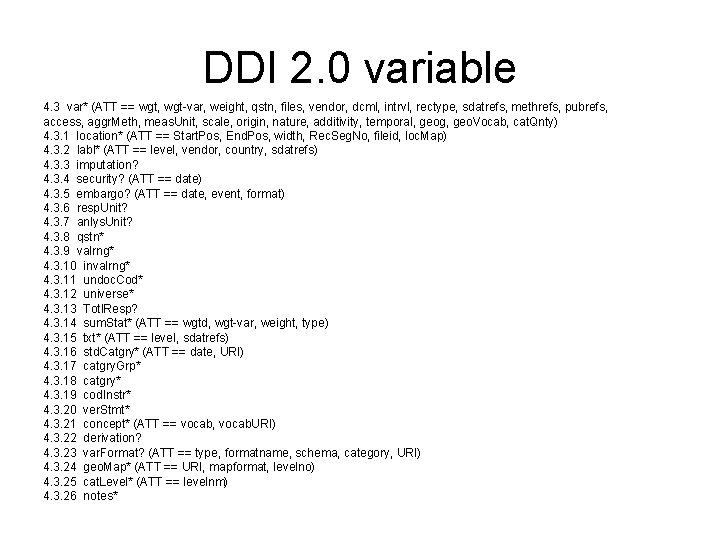
DDI 2. 0 variable 4. 3 var* (ATT == wgt, wgt-var, weight, qstn, files, vendor, dcml, intrvl, rectype, sdatrefs, methrefs, pubrefs, access, aggr. Meth, meas. Unit, scale, origin, nature, additivity, temporal, geog, geo. Vocab, cat. Qnty) 4. 3. 1 location* (ATT == Start. Pos, End. Pos, width, Rec. Seg. No, fileid, loc. Map) 4. 3. 2 labl* (ATT == level, vendor, country, sdatrefs) 4. 3. 3 imputation? 4. 3. 4 security? (ATT == date) 4. 3. 5 embargo? (ATT == date, event, format) 4. 3. 6 resp. Unit? 4. 3. 7 anlys. Unit? 4. 3. 8 qstn* 4. 3. 9 valrng* 4. 3. 10 invalrng* 4. 3. 11 undoc. Cod* 4. 3. 12 universe* 4. 3. 13 Totl. Resp? 4. 3. 14 sum. Stat* (ATT == wgtd, wgt-var, weight, type) 4. 3. 15 txt* (ATT == level, sdatrefs) 4. 3. 16 std. Catgry* (ATT == date, URI) 4. 3. 17 catgry. Grp* 4. 3. 18 catgry* 4. 3. 19 cod. Instr* 4. 3. 20 ver. Stmt* 4. 3. 21 concept* (ATT == vocab, vocab. URI) 4. 3. 22 derivation? 4. 3. 23 var. Format? (ATT == type, formatname, schema, category, URI) 4. 3. 24 geo. Map* (ATT == URI, mapformat, levelno) 4. 3. 25 cat. Level* (ATT == levelnm) 4. 3. 26 notes*
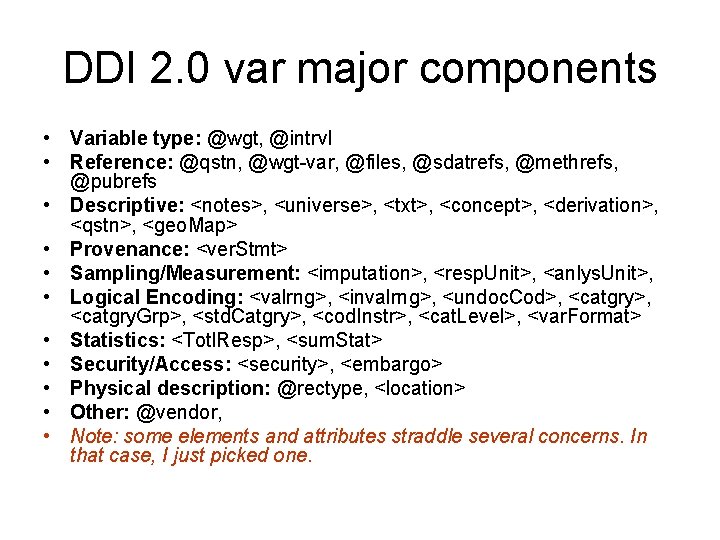
DDI 2. 0 var major components • Variable type: @wgt, @intrvl • Reference: @qstn, @wgt-var, @files, @sdatrefs, @methrefs, @pubrefs • Descriptive: <notes>, <universe>, <txt>, <concept>, <derivation>, <qstn>, <geo. Map> • Provenance: <ver. Stmt> • Sampling/Measurement: <imputation>, <resp. Unit>, <anlys. Unit>, • Logical Encoding: <valrng>, <invalrng>, <undoc. Cod>, <catgry. Grp>, <std. Catgry>, <cod. Instr>, <cat. Level>, <var. Format> • Statistics: <Totl. Resp>, <sum. Stat> • Security/Access: <security>, <embargo> • Physical description: @rectype, <location> • Other: @vendor, • Note: some elements and attributes straddle several concerns. In that case, I just picked one.
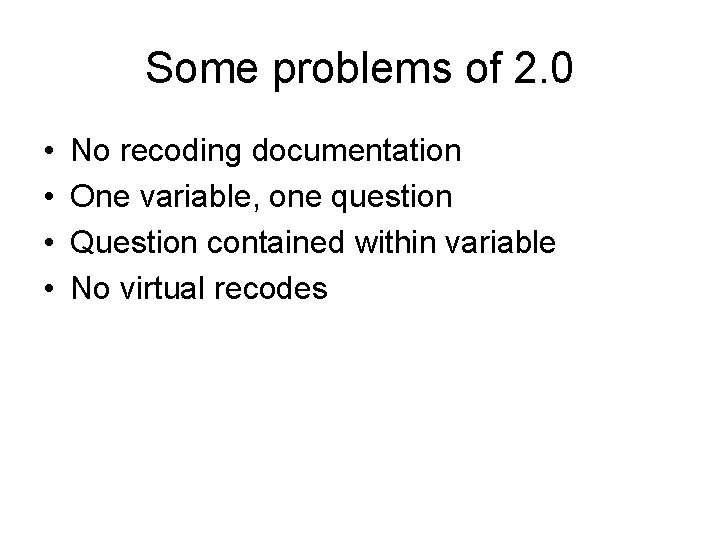
Some problems of 2. 0 • • No recoding documentation One variable, one question Question contained within variable No virtual recodes
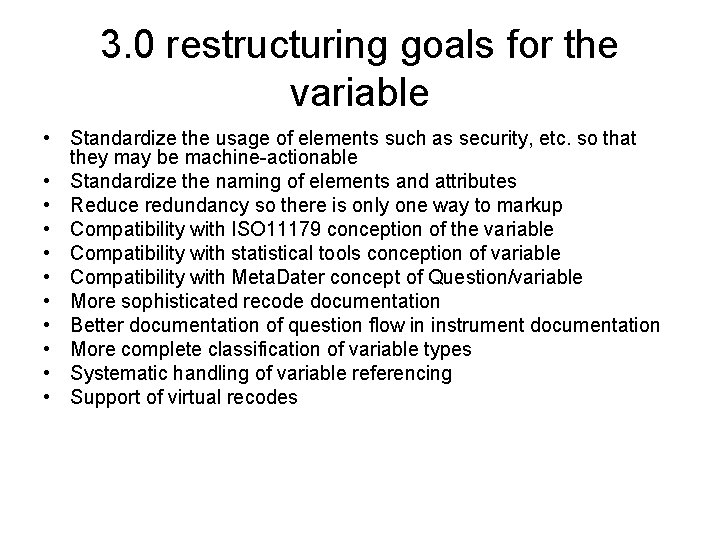
3. 0 restructuring goals for the variable • Standardize the usage of elements such as security, etc. so that they may be machine-actionable • Standardize the naming of elements and attributes • Reduce redundancy so there is only one way to markup • Compatibility with ISO 11179 conception of the variable • Compatibility with statistical tools conception of variable • Compatibility with Meta. Dater concept of Question/variable • More sophisticated recode documentation • Better documentation of question flow in instrument documentation • More complete classification of variable types • Systematic handling of variable referencing • Support of virtual recodes
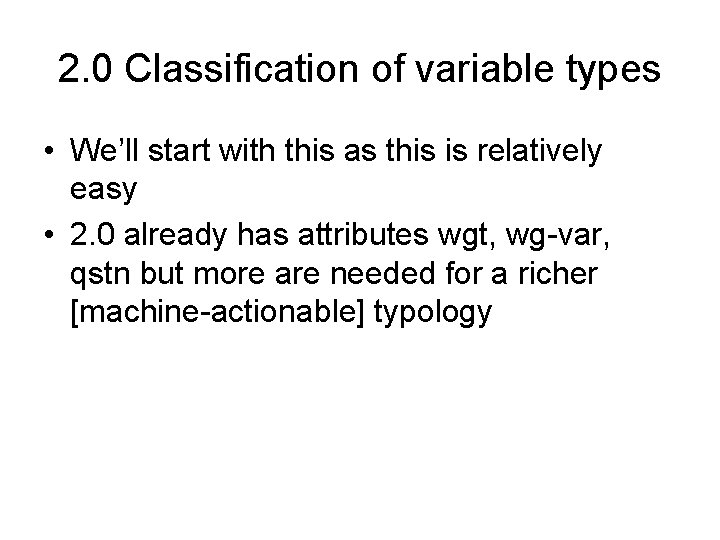
2. 0 Classification of variable types • We’ll start with this as this is relatively easy • 2. 0 already has attributes wgt, wg-var, qstn but more are needed for a richer [machine-actionable] typology
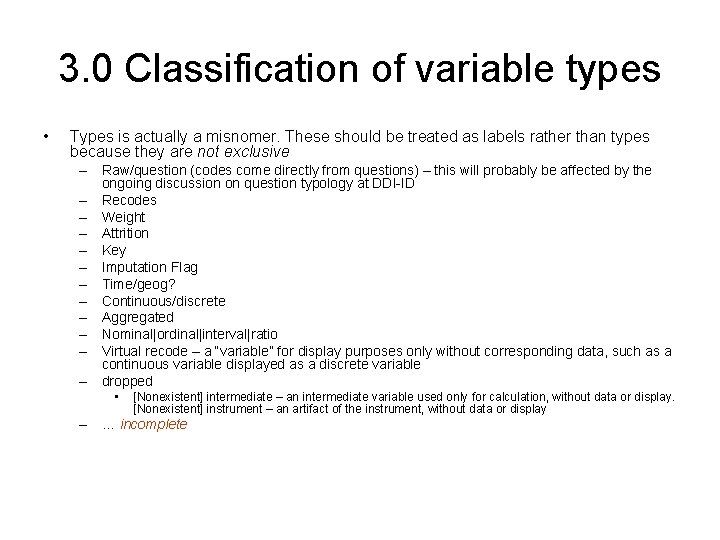
3. 0 Classification of variable types • Types is actually a misnomer. These should be treated as labels rather than types because they are not exclusive – Raw/question (codes come directly from questions) – this will probably be affected by the ongoing discussion on question typology at DDI-ID – Recodes – Weight – Attrition – Key – Imputation Flag – Time/geog? – Continuous/discrete – Aggregated – Nominal|ordinal|interval|ratio – Virtual recode – a “variable” for display purposes only without corresponding data, such as a continuous variable displayed as a discrete variable – dropped • [Nonexistent] intermediate – an intermediate variable used only for calculation, without data or display. [Nonexistent] instrument – an artifact of the instrument, without data or display – … incomplete
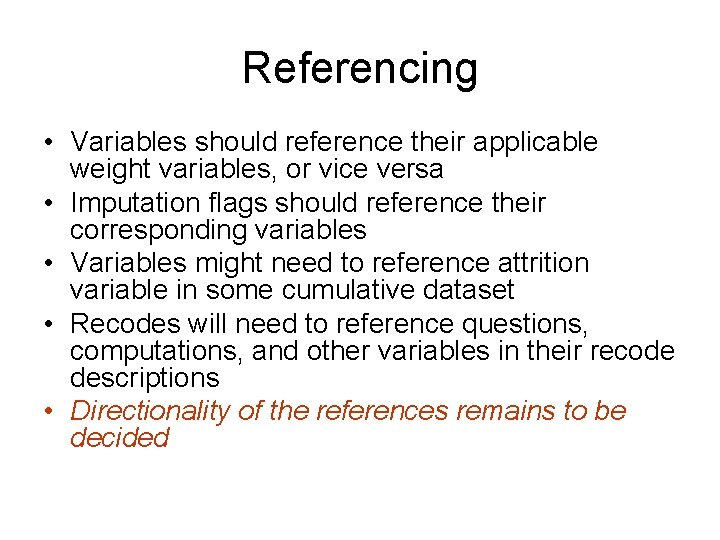
Referencing • Variables should reference their applicable weight variables, or vice versa • Imputation flags should reference their corresponding variables • Variables might need to reference attrition variable in some cumulative dataset • Recodes will need to reference questions, computations, and other variables in their recode descriptions • Directionality of the references remains to be decided
Machine-actionable consequences • Identification of keys enables complex files functionality • Weight, imputation flag, and attrition references may allow statistics to be intelligently calculated on the fly
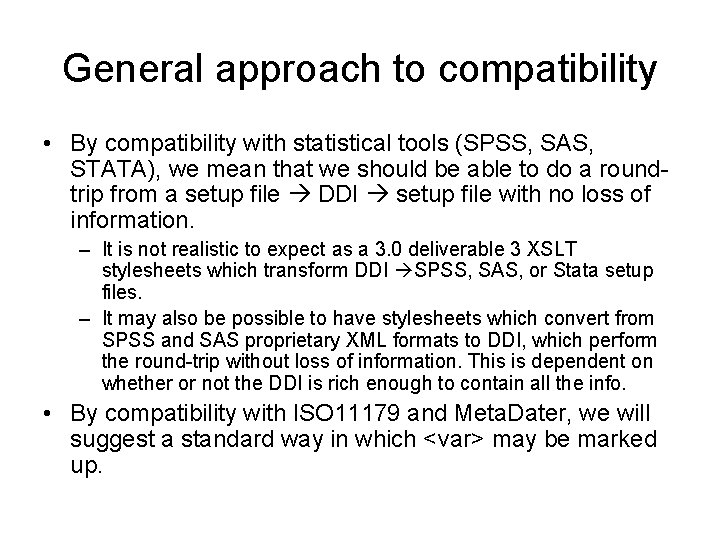
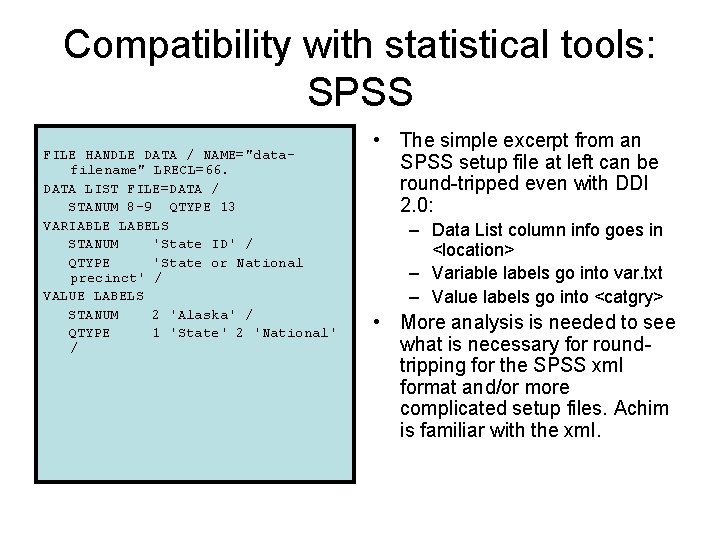
General approach to compatibility • By compatibility with statistical tools (SPSS, SAS, STATA), we mean that we should be able to do a roundtrip from a setup file DDI setup file with no loss of information. – It is not realistic to expect as a 3. 0 deliverable 3 XSLT stylesheets which transform DDI SPSS, SAS, or Stata setup files. – It may also be possible to have stylesheets which convert from SPSS and SAS proprietary XML formats to DDI, which perform the round-trip without loss of information. This is dependent on whether or not the DDI is rich enough to contain all the info. • By compatibility with ISO 11179 and Meta. Dater, we will suggest a standard way in which <var> may be marked up.
Compatibility with statistical tools: SPSS FILE HANDLE DATA / NAME="datafilename" LRECL=66. DATA LIST FILE=DATA / STANUM 8 -9 QTYPE 13 VARIABLE LABELS STANUM 'State ID' / QTYPE 'State or National precinct' / VALUE LABELS STANUM 2 'Alaska' / QTYPE 1 'State' 2 'National' / • The simple excerpt from an SPSS setup file at left can be round-tripped even with DDI 2. 0: – Data List column info goes in <location> – Variable labels go into var. txt – Value labels go into <catgry> • More analysis is needed to see what is necessary for roundtripping for the SPSS xml format and/or more complicated setup files. Achim is familiar with the xml.
Compatibility with statistical tools: Stata _column(8) _column(10) _column(13) _column(16) _column(17) int int float label define STANUM label define QTYPE STANUM : STANUM PRECINCT QTYPE : QTYPE BACKSIDE : BACKSIDE WGT %2 f %3 f %1 f %6. 3 f "State ID" "Sample precinct number" "State or National precinct" "Backside completion flag" "Respondent weight" 2 "Alaska" ; 1 "State" 2 "National" ; • Int/float map to DDI 2. 0’s <var. Format>. Q: are all stata’s types map-able into DDI types? • Does “%6. 3 f” map to DDI? If not, we need to add a place for it. • The notation : STANUM indicates that perhaps formats/categories may be shared by different variables. If this is true, then <catgry> would have to be moved out of <var> • More analysis needed. I’m not too familiar with stata.
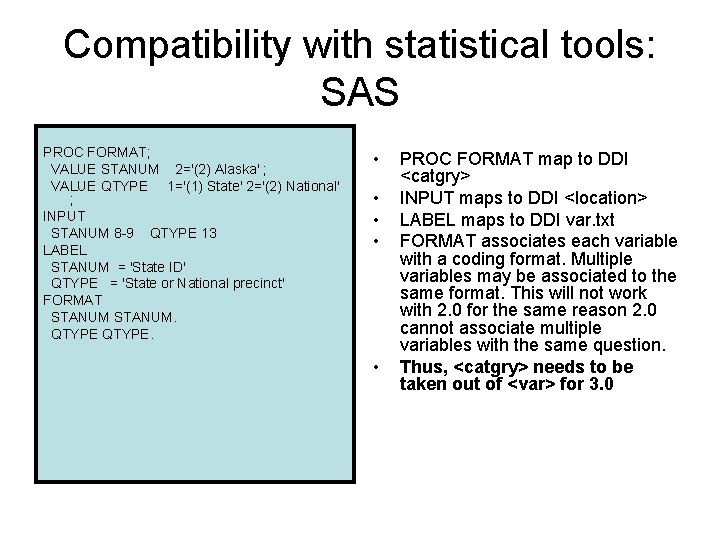
Compatibility with statistical tools: SAS PROC FORMAT; VALUE STANUM 2='(2) Alaska' ; VALUE QTYPE 1='(1) State' 2='(2) National' ; INPUT STANUM 8 -9 QTYPE 13 LABEL STANUM = 'State ID' QTYPE = 'State or National precinct' FORMAT STANUM. QTYPE. • • • PROC FORMAT map to DDI <catgry> INPUT maps to DDI <location> LABEL maps to DDI var. txt FORMAT associates each variable with a coding format. Multiple variables may be associated to the same format. This will not work with 2. 0 for the same reason 2. 0 cannot associate multiple variables with the same question. Thus, <catgry> needs to be taken out of <var> for 3. 0
Compatibility with Meta. Dater • Still a lot of reading yet to do on this one….
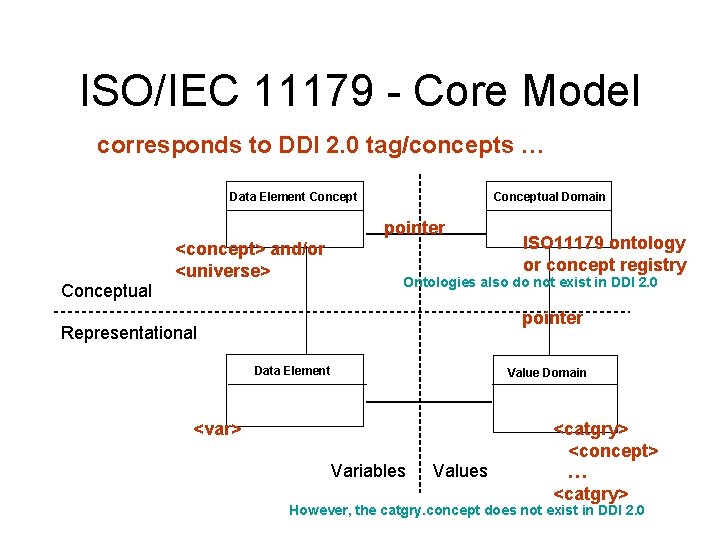
Compatibility with ISO 11179 • Harmonization steps based on Dan Gilman’s 2003 presentation http: //www. iassistdata. org/conferences/20 03/presentations/ • Goal: seek to harmonize with ISO 11179 at the variable model level so that DDI may be used as a transport/exchange format for ISO 11179.
ISO/IEC 11179 - Core Model corresponds to DDI 2. 0 tag/concepts … Data Element Conceptual Domain pointer <concept> and/or <universe> Conceptual ISO 11179 ontology or concept registry Ontologies also do not exist in DDI 2. 0 pointer Representational Data Element Value Domain <var> Variables Values <catgry> <concept> … <catgry> However, the catgry. concept does not exist in DDI 2. 0
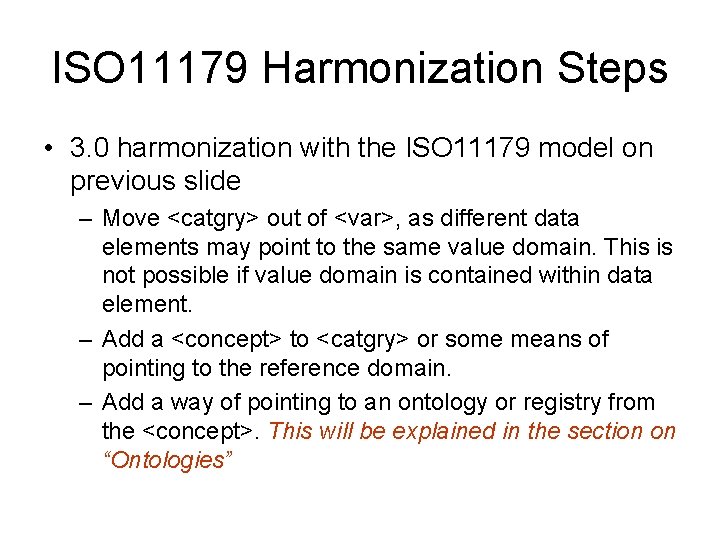
ISO 11179 Harmonization Steps • 3. 0 harmonization with the ISO 11179 model on previous slide – Move <catgry> out of <var>, as different data elements may point to the same value domain. This is not possible if value domain is contained within data element. – Add a <concept> to <catgry> or some means of pointing to the reference domain. – Add a way of pointing to an ontology or registry from the <concept>. This will be explained in the section on “Ontologies”
Additional analysis needed • Changes in the structure for the variable have to be analyzed for its impact on other concerns: – Nested categories – N-Cubes
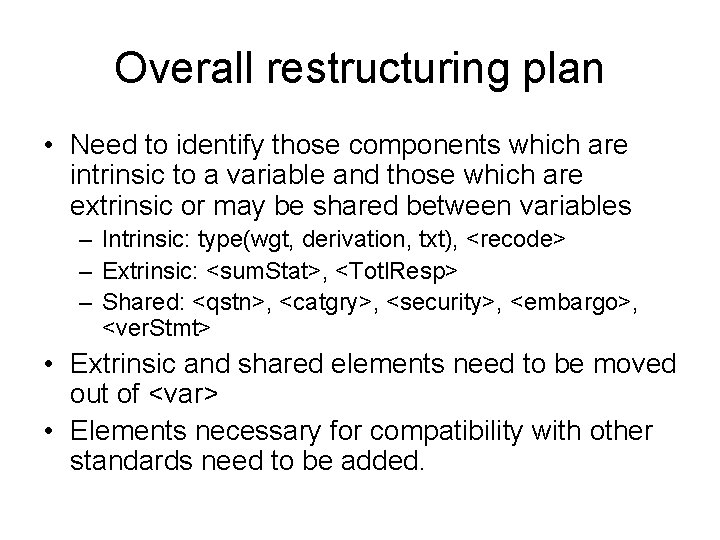
Overall restructuring plan • Need to identify those components which are intrinsic to a variable and those which are extrinsic or may be shared between variables – Intrinsic: type(wgt, derivation, txt), <recode> – Extrinsic: <sum. Stat>, <Totl. Resp> – Shared: <qstn>, <catgry>, <security>, <embargo>, <ver. Stmt> • Extrinsic and shared elements need to be moved out of <var> • Elements necessary for compatibility with other standards need to be added.
Ontologies and Tagging Chapter ?
Rel-tag microformat • Problem: How can we associate keywords to a web page? • Old solution: “meta” keywords in an html page • 2005 solution: rel-tag microformat, popularized by the technorati blog aggregator to allow blog authors to tag content to aid the technorati search engine. • This isn’t the same as the DDI problem but the solution is instructive.
Rel-tag microformat details • Example: <a href="http: //technorati. com/tag/tech" rel="tag">technology</a> – The last segment of the path – “tech” – is the tag – The preceding part – http: //technorati. com/tag -- is the space which knows what to do with the tag – “technology” is the visible part of the tag – ‘rel=“tag”’ identifies this as a rel-tag rather than a normal anchor • See http: //microformats. org/wiki/reltag or google for more details
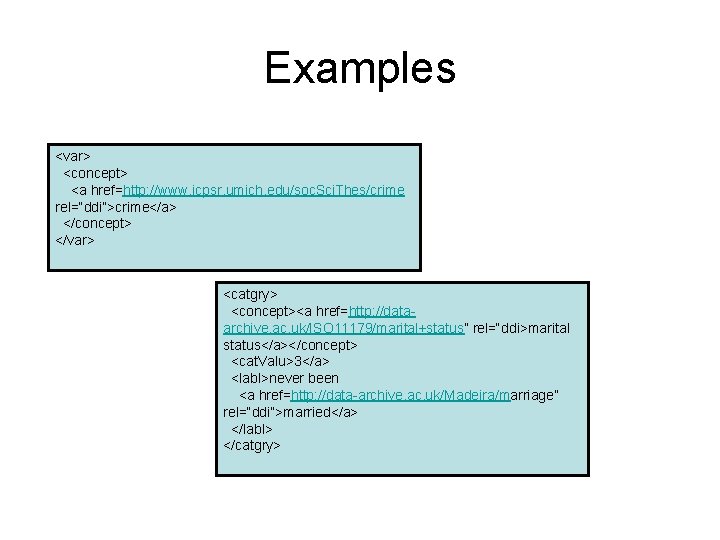
DDI ontology problem • Problem: How can we associate words in DDI markup to controlled vocabularies or ontologies such as Madeira, ICPSR social science thesaurus, or ISO 11179 concept registry? • Note that the rel-tag microformat already contains 75% of what we need: – The authority – The space – The tag = the keyword • So we can probably modify this to suit our needs
Examples <var> <concept> <a href=http: //www. icpsr. umich. edu/soc. Sci. Thes/crime rel=“ddi”>crime</a> </concept> </var> <catgry> <concept><a href=http: //dataarchive. ac. uk/ISO 11179/marital+status” rel=“ddi>marital status</a></concept> <cat. Valu>3</a> <labl>never been <a href=http: //data-archive. ac. uk/Madeira/marriage” rel=“ddi”>married</a> </labl> </catgry>
Rel-tag flexibility • Note that tags can occur anywhere and are not restricted to <concept> • The visible part does not have to match the keyword • Different ontologies may be used simultaneously
Applications of rel-tags • ISO 11179: Rel-tags plus the variable restructuring suggested in the previous chapter “The Variable” give the DDI variable a compatibility with the ISO 11179 data element/variable model • Comparative data search: Rel-tags provide a way to implement the “upward-pointing” to a controlled vocabulary that Wendy and Jostein talked about last week. This implementation does not conflict with the variable-variable link mechanism needed for Reto. • Madeira: rel-tags allow Madeira to mark up individual words in <catgry>
Shortcoming • As currently used, rel-tags do not allow for nested tags.
Summary • DDI should look into rel-tags or some variant to be used with ontologies