
DDEVELOPING AN ADULT SAFEGUARDING COMPETENCY FRAMEWORK Facilitators Paul

- Slides: 13
DDEVELOPING AN ADULT SAFEGUARDING COMPETENCY FRAMEWORK Facilitators: Paul Burnett Jude Bradford
WELCOME and INTRODUCTIONS
Agenda q Context for this session q What is a competency framework? q Why is a competency framework useful? q Would you support the development of such a framework for the Isle of Man SAP? q What would you want it to look like?
Context q SCB has a Safeguarding Competency Framework (SCF) that supports its training and development offer q OHR has agreed to incorporate the Children’s SCF in the new Government Performance Review arrangements q We want to consider whether we should develop an Adult SCF q If agreed we would aim to develop before the new Government performance arrangements are launched so it too could be included alongside the Children’s SCF
What is a Safeguarding Competency Framework? q Sets out the minimum safeguarding competences required in different roles i. e. the knowledge, expertise, skills and attributes a person requires to fulfil the safeguarding responsibilities in their job role; q Provides a framework against which managers and staff can identify safeguarding training and development needs for individuals or teams;
Why is a Safeguarding Competency Framework helpful? q Enables training needs of the workforce to be understood q Enables training programmes to be designed to meet identified needs q Assists in subsequent performance review meetings q Provides a framework against which the impact of training and development can be evaluated. q Can be linked to R&I Minimum Standards and assist in improving performance in inspection
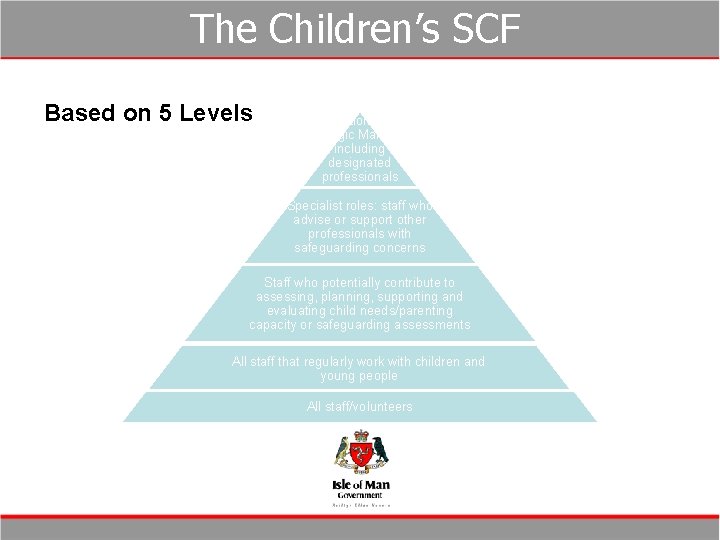
The Children’s SCF Based on 5 Levels Operational and Strategic Managers including designated professionals Specialist roles: staff who advise or support other professionals with safeguarding concerns Staff who potentially contribute to assessing, planning, supporting and evaluating child needs/parenting capacity or safeguarding assessments All staff that regularly work with children and young people All staff/volunteers
Responsibilities of Employers q Identifying competencies for all roles q Ensuring that their employees are competent and confident in carrying out their responsibilities for safeguarding q Identifying training and development needs against competency framework each year q Ensure that level 1 training on Child Protection is undertaken by all staff q Identify mandatory training and ensure attendance
Responsibilities of Employers q Be responsive to learning outcomes from serious case reviews, identified local themes impacting safeguarding children and the Island community q Identify adequate resources and support for interagency training q Release staff to attend the appropriate inter agency training and development q Ensure staff receive relevant single agency training
Responsibilities of Employers q Develop a training plan q Audit employees training needs and contribute to the identification of the TDG priorities for Training q keep a record of who has attended training and when they should next attend
SCB and Training and Development Group q Collect and analyse needs assessment q Establish the number of practitioners that require training at each level q Agree what is mandatory and what is discretionary training q Formulate multi-agency training plan that reflects identified need q Ensure training is delivered to a consistently high standard – and is commissioned to secure efficient use of resources
SCB and Training and Development Group q Ensure that there is a robust monitoring and evaluation framework to test the impact of training – based on collection of management information from employers q Reporting to the Board on delivery and impact and responding to priorities in the Safeguarding Boards Business Plans
Your views q Would you agree that it would be a good idea to develop a safeguarding competency framework for adult safeguarding? q If so, do you think the model adopted by the SCB provides a basis for an adult model – what would you keep, what would you remove, what would you add? q Does the five level competency level work in the adult arena – or would you amend this? q What adaptations would you make to the level descriptors to make it relevant to adult safeguarding work?