
DCS 800 ABB DC Drives 1 DCS 800
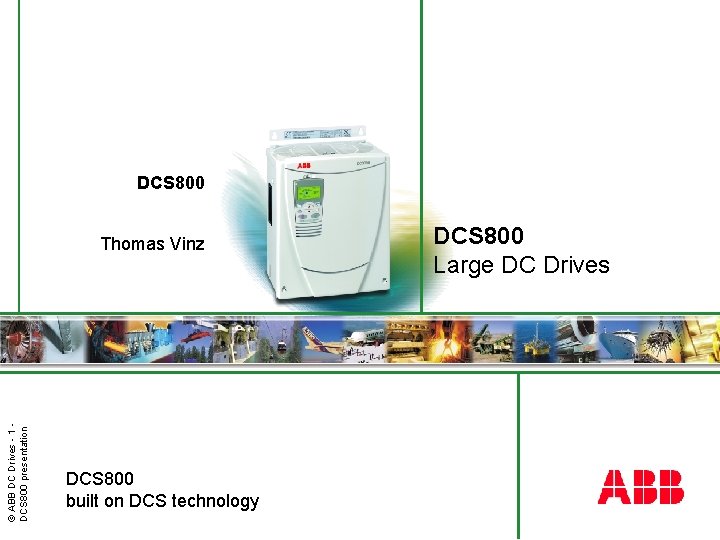
DCS 800 © ABB DC Drives - 1 DCS 800 presentation Thomas Vinz DCS 800 built on DCS technology DCS 800 Large DC Drives
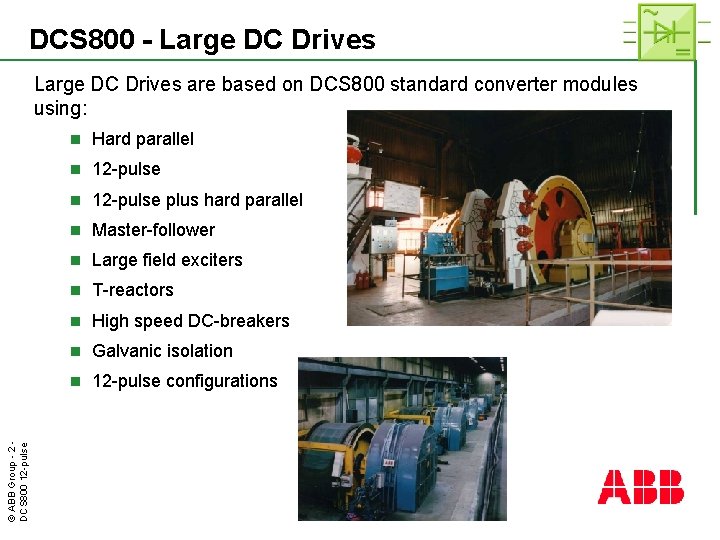
DCS 800 - Large DC Drives © ABB Group - 2 DCS 800 12 -pulse Large DC Drives are based on DCS 800 standard converter modules using: n Hard parallel n 12 -pulse plus hard parallel n Master-follower n Large field exciters n T-reactors n High speed DC-breakers n Galvanic isolation n 12 -pulse configurations
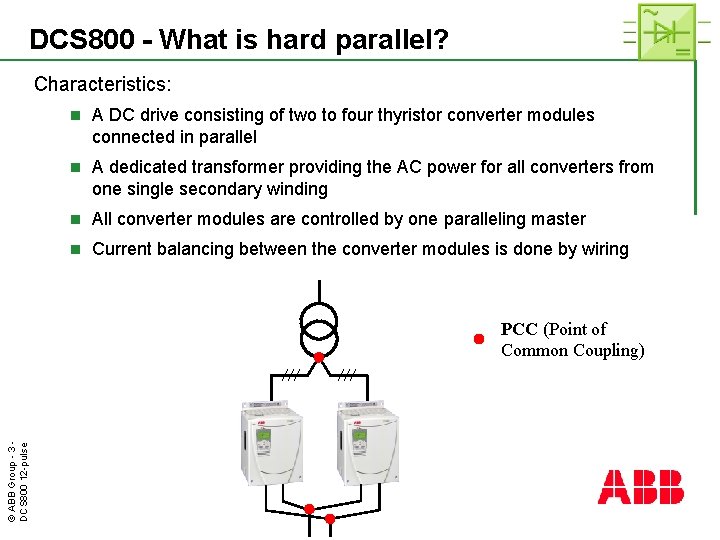
DCS 800 - What is hard parallel? Characteristics: n A DC drive consisting of two to four thyristor converter modules connected in parallel n A dedicated transformer providing the AC power for all converters from one single secondary winding n All converter modules are controlled by one paralleling master n Current balancing between the converter modules is done by wiring © ABB Group - 3 DCS 800 12 -pulse PCC (Point of Common Coupling)
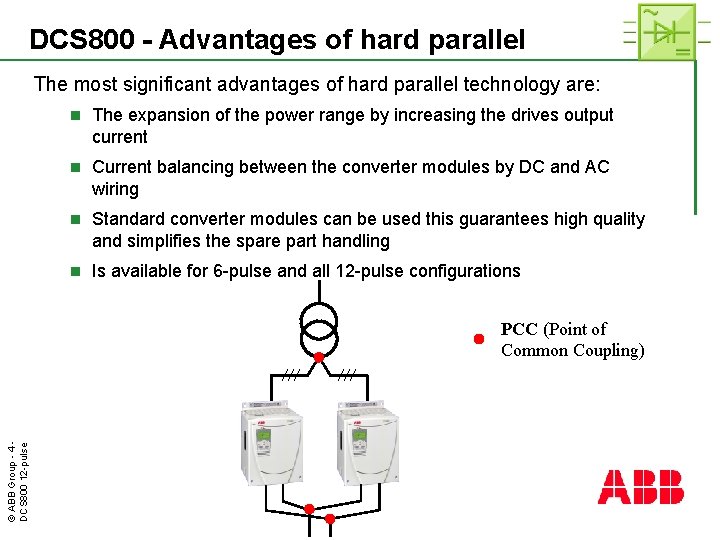
DCS 800 - Advantages of hard parallel The most significant advantages of hard parallel technology are: n The expansion of the power range by increasing the drives output current n Current balancing between the converter modules by DC and AC wiring n Standard converter modules can be used this guarantees high quality and simplifies the spare part handling n Is available for 6 -pulse and all 12 -pulse configurations © ABB Group - 4 DCS 800 12 -pulse PCC (Point of Common Coupling)
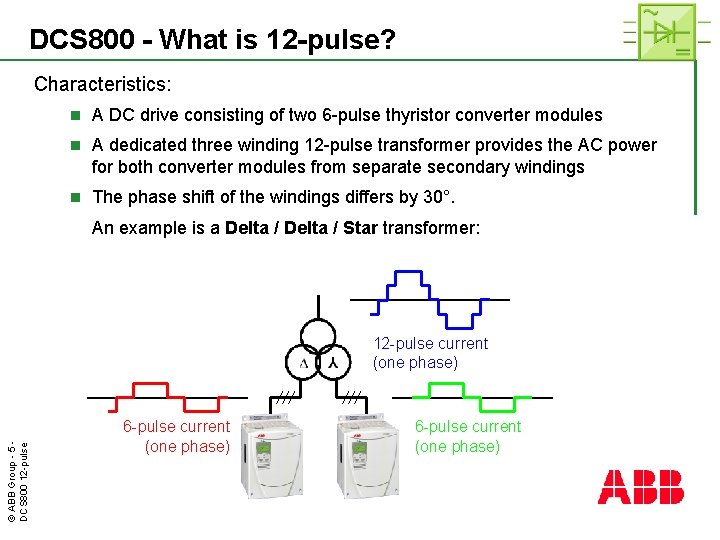
DCS 800 - What is 12 -pulse? Characteristics: n A DC drive consisting of two 6 -pulse thyristor converter modules n A dedicated three winding 12 -pulse transformer provides the AC power for both converter modules from separate secondary windings n The phase shift of the windings differs by 30°. An example is a Delta / Star transformer: © ABB Group - 5 DCS 800 12 -pulse current (one phase) 6 -pulse current (one phase)
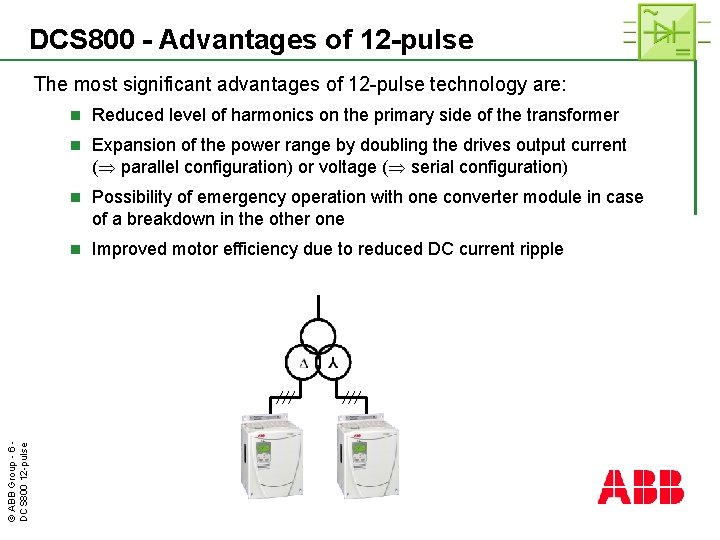
DCS 800 - Advantages of 12 -pulse © ABB Group - 6 DCS 800 12 -pulse The most significant advantages of 12 -pulse technology are: n Reduced level of harmonics on the primary side of the transformer n Expansion of the power range by doubling the drives output current ( parallel configuration) or voltage ( serial configuration) n Possibility of emergency operation with one converter module in case of a breakdown in the other one n Improved motor efficiency due to reduced DC current ripple
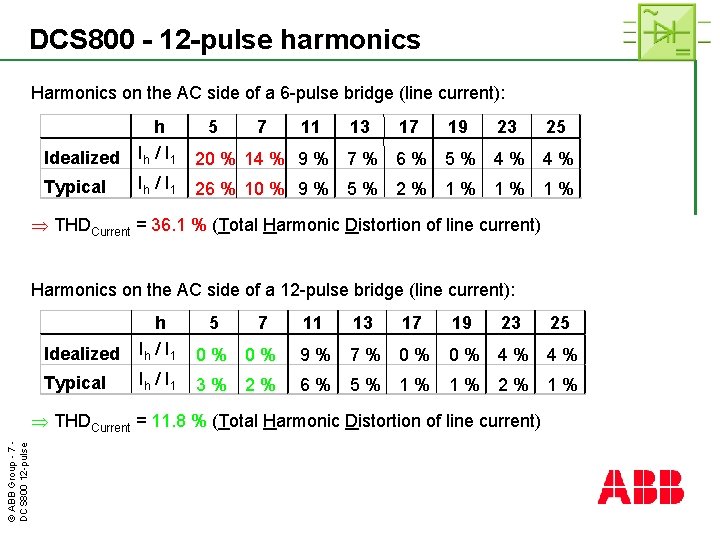
DCS 800 - 12 -pulse harmonics Harmonics on the AC side of a 6 -pulse bridge (line current): Idealized h Ih / I 1 Typical Ih / I 1 5 7 11 13 17 19 23 25 20 % 14 % 9 % 7 % 6% 5% 4% 4% 26 % 10 % 9 % 5 % 2% 1% 1% 1% THDCurrent = 36. 1 % (Total Harmonic Distortion of line current) Harmonics on the AC side of a 12 -pulse bridge (line current): 5 7 11 13 17 19 23 25 Idealized h Ih / I 1 0% 0% 9% 7% 0% 0% 4% 4% Typical Ih / I 1 3% 2% 6% 5% 1% 1% 2% 1% © ABB Group - 7 DCS 800 12 -pulse THDCurrent = 11. 8 % (Total Harmonic Distortion of line current)
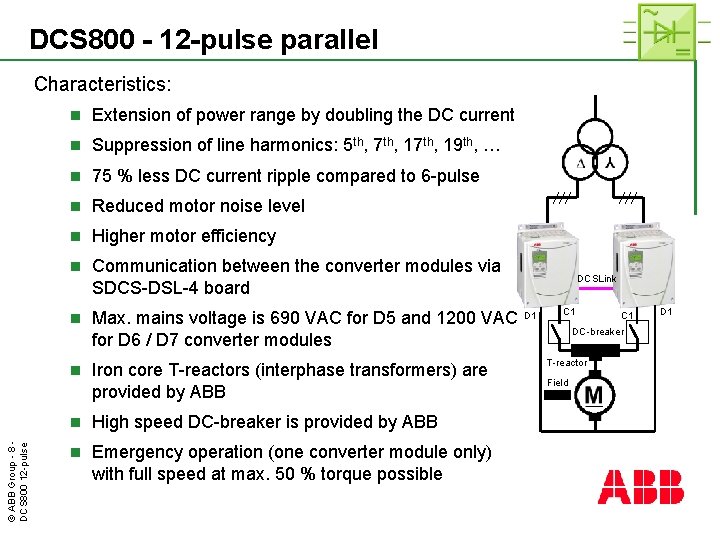
DCS 800 - 12 -pulse parallel © ABB Group - 8 DCS 800 12 -pulse Characteristics: n Extension of power range by doubling the DC current n Suppression of line harmonics: 5 th, 7 th, 19 th, … n 75 % less DC current ripple compared to 6 -pulse n Reduced motor noise level n Higher motor efficiency n Communication between the converter modules via SDCS-DSL-4 board n Max. mains voltage is 690 VAC for D 5 and 1200 VAC for D 6 / D 7 converter modules n Iron core T-reactors (interphase transformers) are provided by ABB n High speed DC-breaker is provided by ABB n Emergency operation (one converter module only) with full speed at max. 50 % torque possible DCSLink D 1 C 1 DC-breaker T-reactor Field D 1
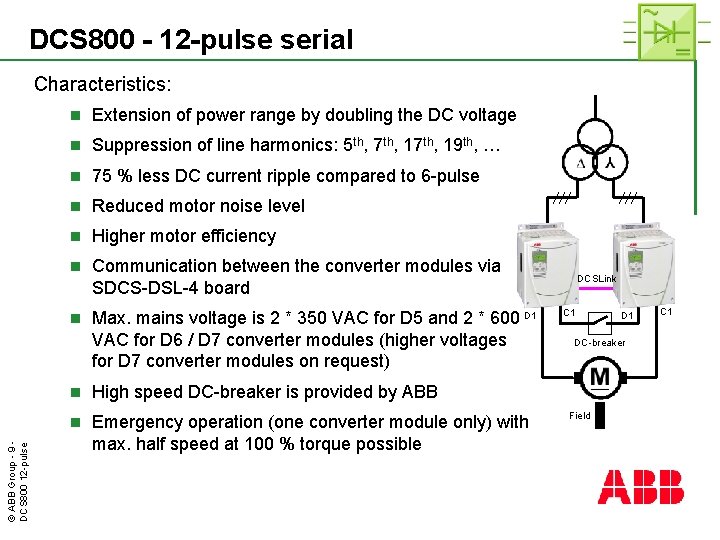
DCS 800 - 12 -pulse serial © ABB Group - 9 DCS 800 12 -pulse Characteristics: n Extension of power range by doubling the DC voltage n Suppression of line harmonics: 5 th, 7 th, 19 th, … n 75 % less DC current ripple compared to 6 -pulse n Reduced motor noise level n Higher motor efficiency n Communication between the converter modules via SDCS-DSL-4 board n Max. mains voltage is 2 * 350 VAC for D 5 and 2 * 600 D 1 VAC for D 6 / D 7 converter modules (higher voltages for D 7 converter modules on request) n High speed DC-breaker is provided by ABB n Emergency operation (one converter module only) with max. half speed at 100 % torque possible DCSLink C 1 DC-breaker Field C 1
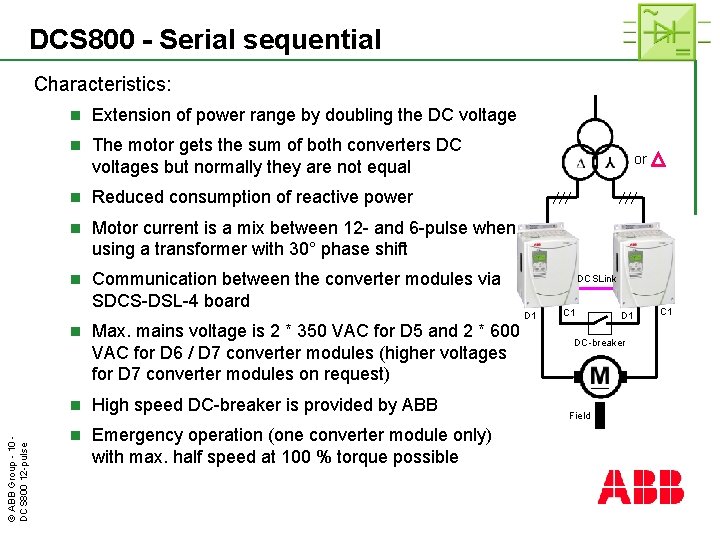
DCS 800 - Serial sequential © ABB Group - 10 DCS 800 12 -pulse Characteristics: n Extension of power range by doubling the DC voltage n The motor gets the sum of both converters DC voltages but normally they are not equal n Reduced consumption of reactive power n Motor current is a mix between 12 - and 6 -pulse when using a transformer with 30° phase shift n Communication between the converter modules via SDCS-DSL-4 board n Max. mains voltage is 2 * 350 VAC for D 5 and 2 * 600 VAC for D 6 / D 7 converter modules (higher voltages for D 7 converter modules on request) n High speed DC-breaker is provided by ABB n Emergency operation (one converter module only) with max. half speed at 100 % torque possible or DCSLink D 1 C 1 DC-breaker Field C 1
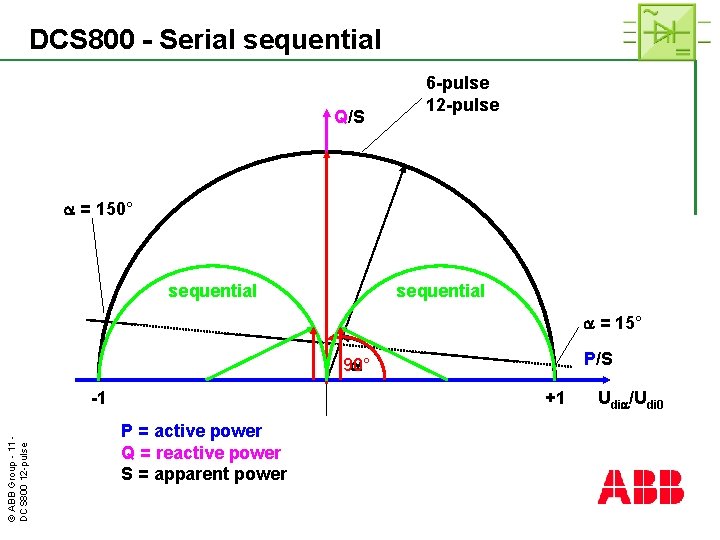
DCS 800 - Serial sequential Q/S 6 -pulse 12 -pulse = 150° sequential = 15° P/S 90° © ABB Group - 11 DCS 800 12 -pulse -1 +1 P = active power Q = reactive power S = apparent power Udi /Udi 0
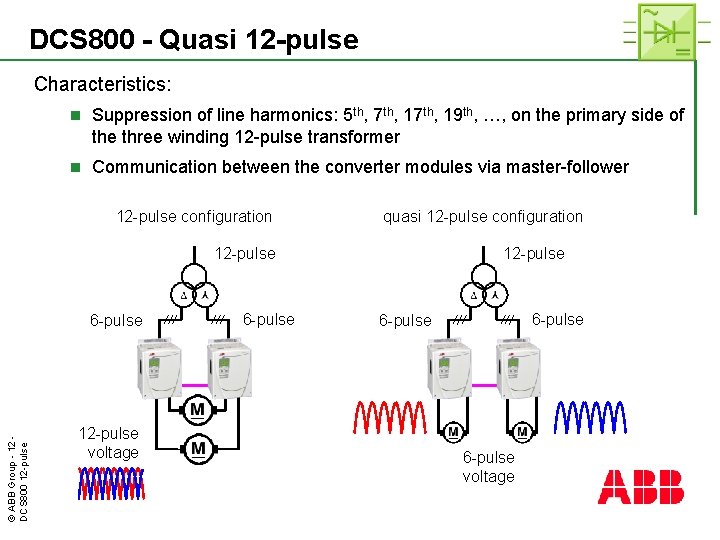
DCS 800 - Quasi 12 -pulse Characteristics: n Suppression of line harmonics: 5 th, 7 th, 19 th, …, on the primary side of the three winding 12 -pulse transformer n Communication between the converter modules via master-follower 12 -pulse configuration quasi 12 -pulse configuration 12 -pulse © ABB Group - 12 DCS 800 12 -pulse 6 -pulse 12 -pulse voltage 6 -pulse 12 -pulse 6 -pulse voltage
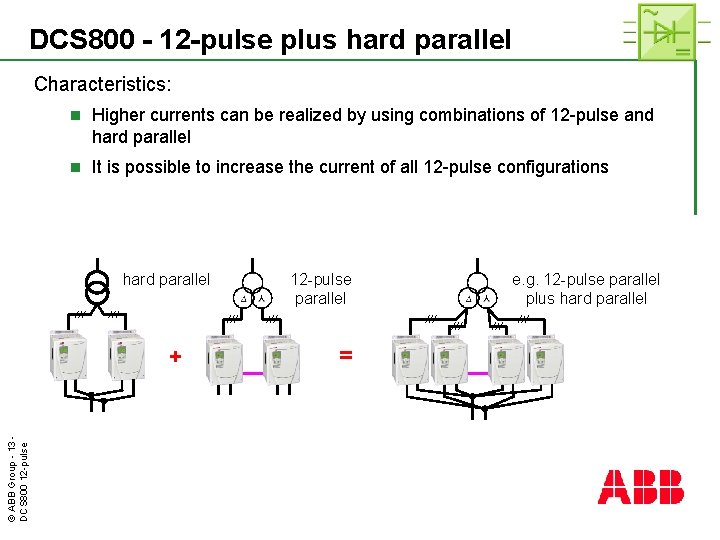
DCS 800 - 12 -pulse plus hard parallel Characteristics: n Higher currents can be realized by using combinations of 12 -pulse and hard parallel n It is possible to increase the current of all 12 -pulse configurations hard parallel © ABB Group - 13 DCS 800 12 -pulse + 12 -pulse parallel = e. g. 12 -pulse parallel plus hard parallel
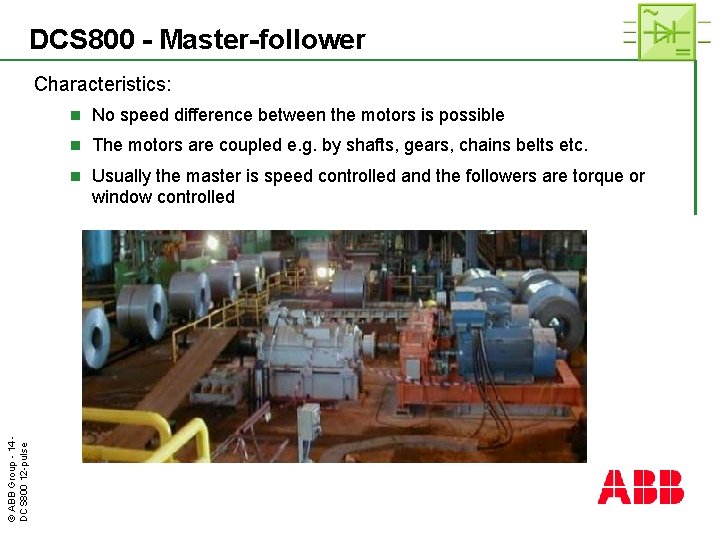
DCS 800 - Master-follower © ABB Group - 14 DCS 800 12 -pulse Characteristics: n No speed difference between the motors is possible n The motors are coupled e. g. by shafts, gears, chains belts etc. n Usually the master is speed controlled and the followers are torque or window controlled
DCS 800 - Large field exciters © ABB Group - 15 DCS 800 12 -pulse Characteristics: n For high field currents a standard DCS 800 converter module can be used as field exciter n The standard module can be adapted to become a field exciter by means of parameters n The parameters are available in the standard firmware n Field currents of up to 520 A are possible (higher field currents on request) n The standard module has to be protected against damage from overvoltage by a DCF 506
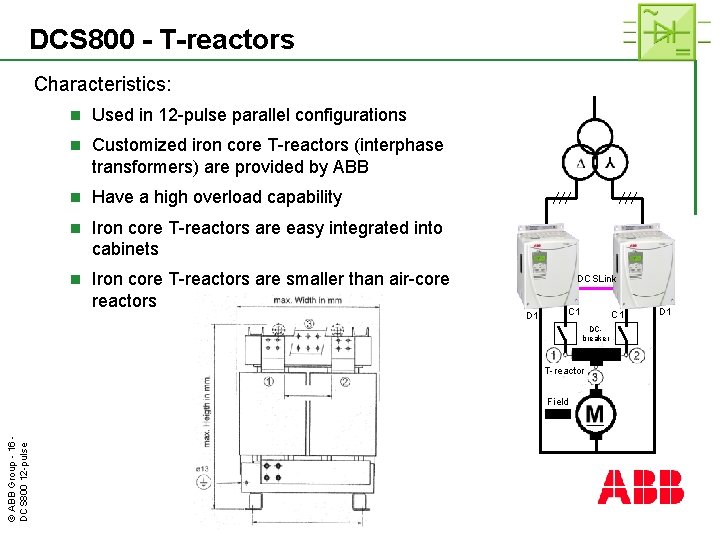
DCS 800 - T-reactors Characteristics: n Used in 12 -pulse parallel configurations n Customized iron core T-reactors (interphase transformers) are provided by ABB n Have a high overload capability n Iron core T-reactors are easy integrated into cabinets n Iron core T-reactors are smaller than air-core reactors DCSLink D 1 C 1 DCbreaker T-reactor © ABB Group - 16 DCS 800 12 -pulse Field D 1
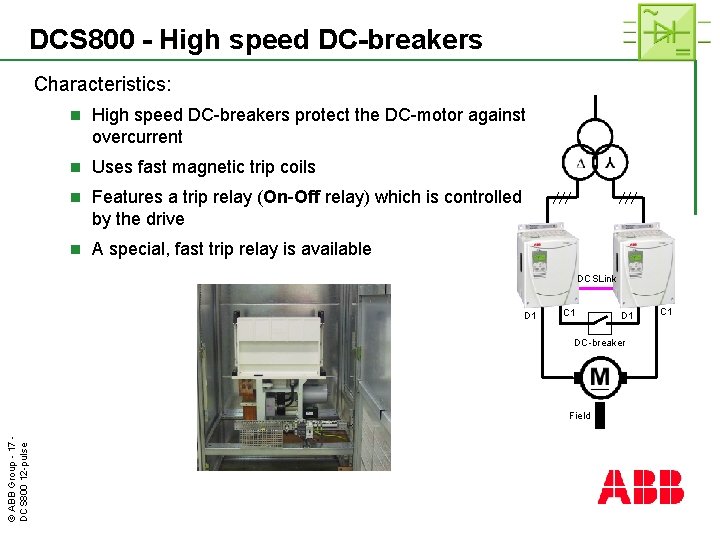
DCS 800 - High speed DC-breakers Characteristics: n High speed DC-breakers protect the DC-motor against overcurrent n Uses fast magnetic trip coils n Features a trip relay (On-Off relay) which is controlled by the drive n A special, fast trip relay is available DCSLink D 1 C 1 DC-breaker © ABB Group - 17 DCS 800 12 -pulse Field C 1
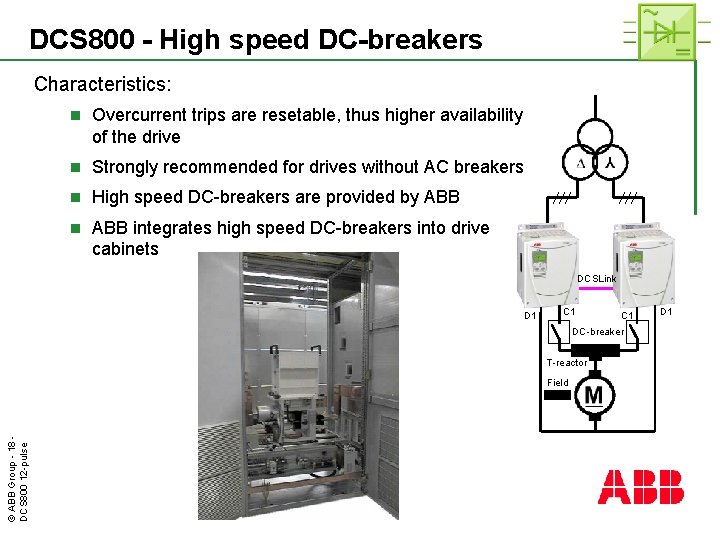
DCS 800 - High speed DC-breakers Characteristics: n Overcurrent trips are resetable, thus higher availability of the drive n Strongly recommended for drives without AC breakers n High speed DC-breakers are provided by ABB n ABB integrates high speed DC-breakers into drive cabinets DCSLink D 1 C 1 DC-breaker T-reactor © ABB Group - 18 DCS 800 12 -pulse Field D 1
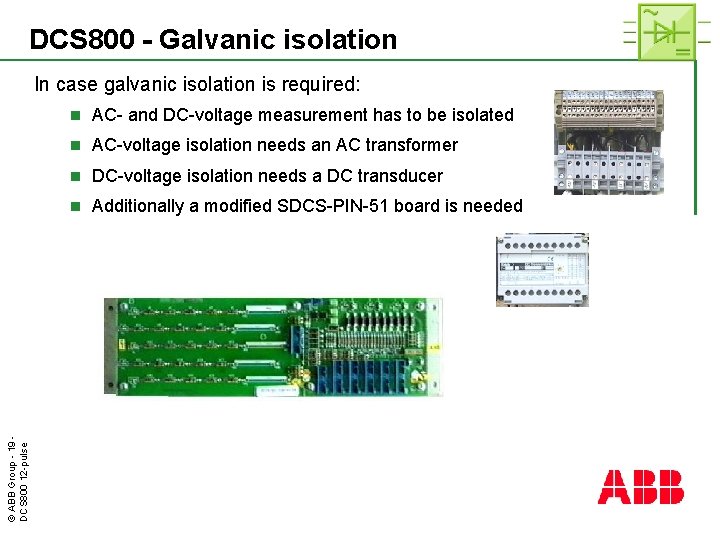
DCS 800 - Galvanic isolation © ABB Group - 19 DCS 800 12 -pulse In case galvanic isolation is required: n AC- and DC-voltage measurement has to be isolated n AC-voltage isolation needs an AC transformer n DC-voltage isolation needs a DC transducer n Additionally a modified SDCS-PIN-51 board is needed
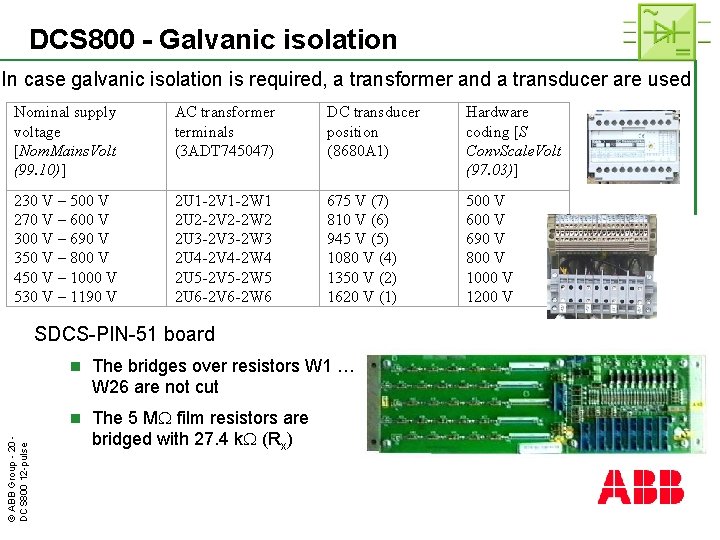
DCS 800 - Galvanic isolation In case galvanic isolation is required, a transformer and a transducer are used Nominal supply voltage [Nom. Mains. Volt (99. 10)] AC transformer terminals (3 ADT 745047) DC transducer position (8680 A 1) Hardware coding [S Conv. Scale. Volt (97. 03)] 230 V – 500 V 270 V – 600 V 300 V – 690 V 350 V – 800 V 450 V – 1000 V 530 V – 1190 V 2 U 1 -2 V 1 -2 W 1 2 U 2 -2 V 2 -2 W 2 2 U 3 -2 V 3 -2 W 3 2 U 4 -2 V 4 -2 W 4 2 U 5 -2 V 5 -2 W 5 2 U 6 -2 V 6 -2 W 6 675 V (7) 810 V (6) 945 V (5) 1080 V (4) 1350 V (2) 1620 V (1) 500 V 690 V 800 V 1000 V 1200 V © ABB Group - 20 DCS 800 12 -pulse SDCS-PIN-51 board n The bridges over resistors W 1 … W 26 are not cut n The 5 M film resistors are bridged with 27. 4 k (Rx)
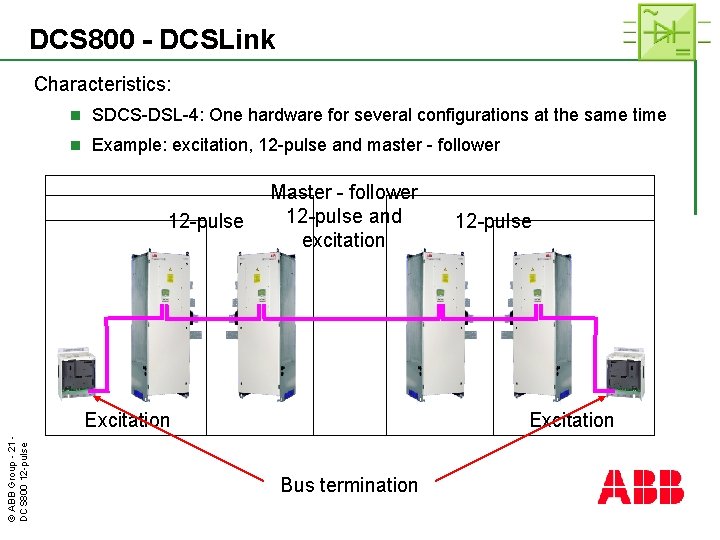
DCS 800 - DCSLink Characteristics: n SDCS-DSL-4: One hardware for several configurations at the same time n Example: excitation, 12 -pulse and master - follower 12 -pulse Master - follower 12 -pulse and excitation © ABB Group - 21 DCS 800 12 -pulse Excitation Bus termination
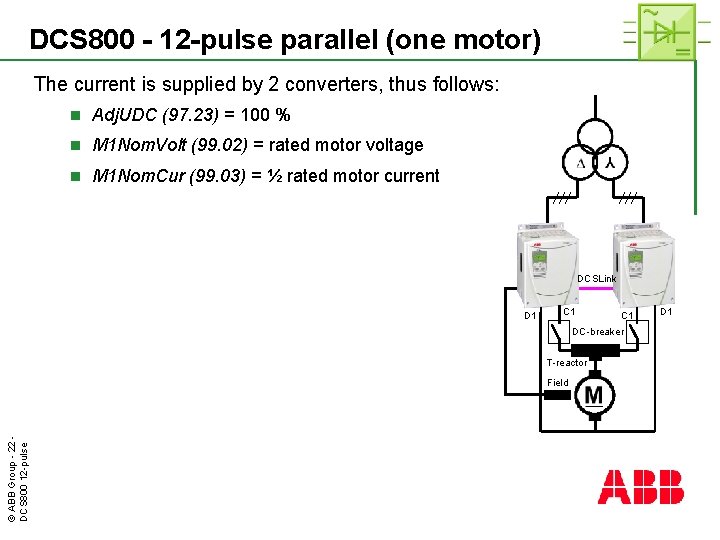
DCS 800 - 12 -pulse parallel (one motor) The current is supplied by 2 converters, thus follows: n Adj. UDC (97. 23) = 100 % n M 1 Nom. Volt (99. 02) = rated motor voltage n M 1 Nom. Cur (99. 03) = ½ rated motor current DCSLink D 1 C 1 DC-breaker T-reactor © ABB Group - 22 DCS 800 12 -pulse Field D 1
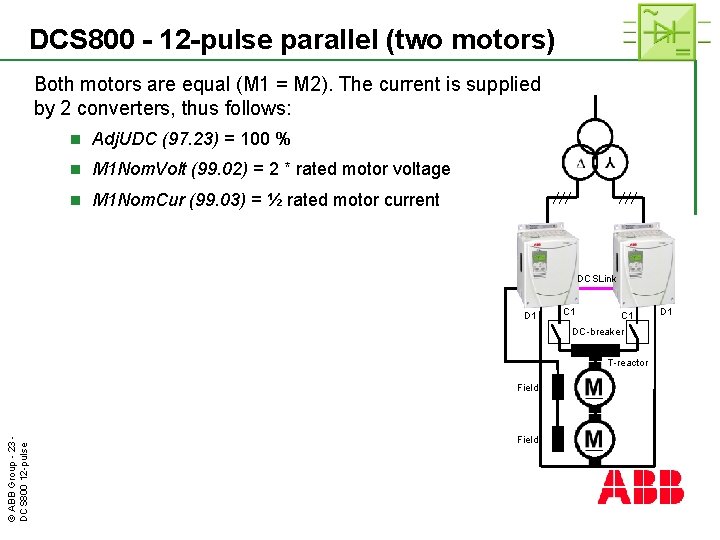
DCS 800 - 12 -pulse parallel (two motors) Both motors are equal (M 1 = M 2). The current is supplied by 2 converters, thus follows: n Adj. UDC (97. 23) = 100 % n M 1 Nom. Volt (99. 02) = 2 * rated motor voltage n M 1 Nom. Cur (99. 03) = ½ rated motor current DCSLink D 1 C 1 DC-breaker T-reactor © ABB Group - 23 DCS 800 12 -pulse Field D 1
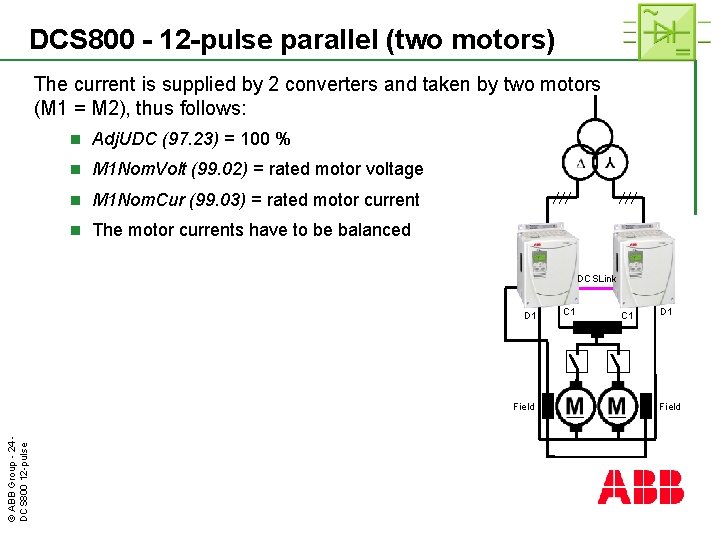
DCS 800 - 12 -pulse parallel (two motors) The current is supplied by 2 converters and taken by two motors (M 1 = M 2), thus follows: n Adj. UDC (97. 23) = 100 % n M 1 Nom. Volt (99. 02) = rated motor voltage n M 1 Nom. Cur (99. 03) = rated motor current n The motor currents have to be balanced DCSLink D 1 © ABB Group - 24 DCS 800 12 -pulse Field C 1 D 1 Field
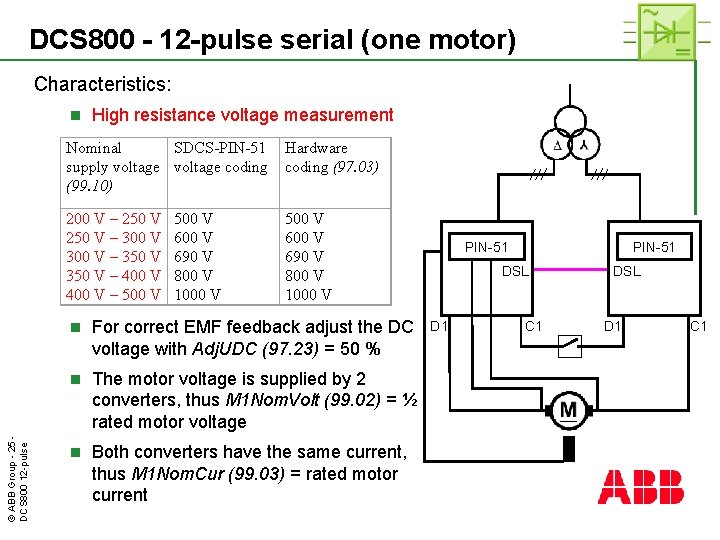
DCS 800 - 12 -pulse serial (one motor) Characteristics: © ABB Group - 25 DCS 800 12 -pulse n High resistance voltage measurement Nominal SDCS-PIN-51 supply voltage coding (99. 10) Hardware coding (97. 03) 200 V – 250 V – 300 V – 350 V – 400 V – 500 V 600 V 690 V 800 V 1000 V 500 V 690 V 800 V 1000 V n For correct EMF feedback adjust the DC voltage with Adj. UDC (97. 23) = 50 % n The motor voltage is supplied by 2 converters, thus M 1 Nom. Volt (99. 02) = ½ rated motor voltage n Both converters have the same current, thus M 1 Nom. Cur (99. 03) = rated motor current PIN-51 DSL D 1 C 1
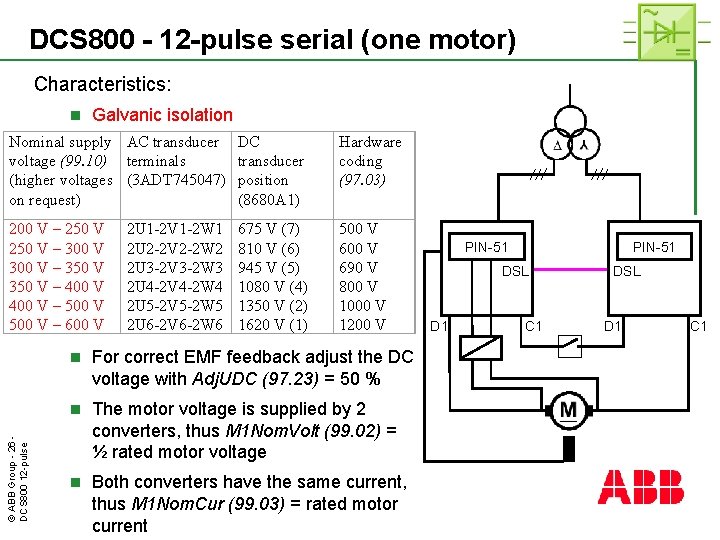
DCS 800 - 12 -pulse serial (one motor) Characteristics: n Galvanic isolation DC transducer position (8680 A 1) Hardware coding (97. 03) 200 V – 250 V – 300 V – 350 V – 400 V – 500 V – 600 V 675 V (7) 810 V (6) 945 V (5) 1080 V (4) 1350 V (2) 1620 V (1) 500 V 690 V 800 V 1000 V 1200 V © ABB Group - 26 DCS 800 12 -pulse Nominal supply AC transducer voltage (99. 10) terminals (higher voltages (3 ADT 745047) on request) 2 U 1 -2 V 1 -2 W 1 2 U 2 -2 V 2 -2 W 2 2 U 3 -2 V 3 -2 W 3 2 U 4 -2 V 4 -2 W 4 2 U 5 -2 V 5 -2 W 5 2 U 6 -2 V 6 -2 W 6 n For correct EMF feedback adjust the DC voltage with Adj. UDC (97. 23) = 50 % n The motor voltage is supplied by 2 converters, thus M 1 Nom. Volt (99. 02) = ½ rated motor voltage n Both converters have the same current, thus M 1 Nom. Cur (99. 03) = rated motor current PIN-51 DSL D 1 C 1
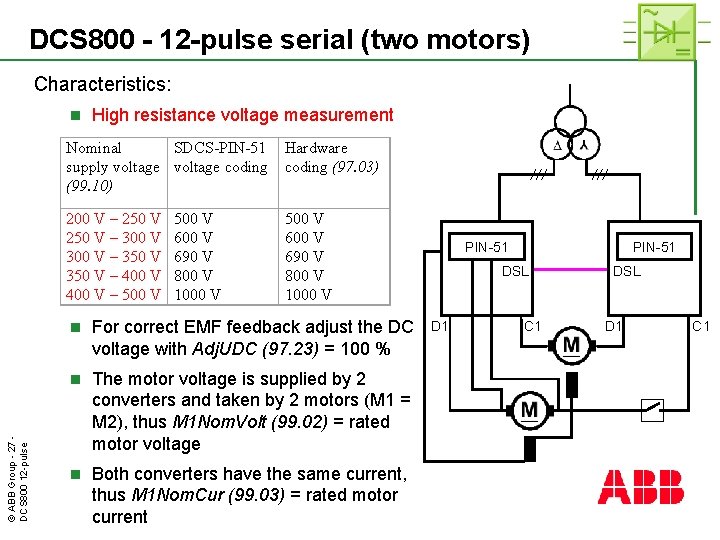
DCS 800 - 12 -pulse serial (two motors) Characteristics: © ABB Group - 27 DCS 800 12 -pulse n High resistance voltage measurement Nominal SDCS-PIN-51 supply voltage coding (99. 10) Hardware coding (97. 03) 200 V – 250 V – 300 V – 350 V – 400 V – 500 V 600 V 690 V 800 V 1000 V 500 V 690 V 800 V 1000 V n For correct EMF feedback adjust the DC voltage with Adj. UDC (97. 23) = 100 % n The motor voltage is supplied by 2 converters and taken by 2 motors (M 1 = M 2), thus M 1 Nom. Volt (99. 02) = rated motor voltage n Both converters have the same current, thus M 1 Nom. Cur (99. 03) = rated motor current PIN-51 DSL D 1 C 1
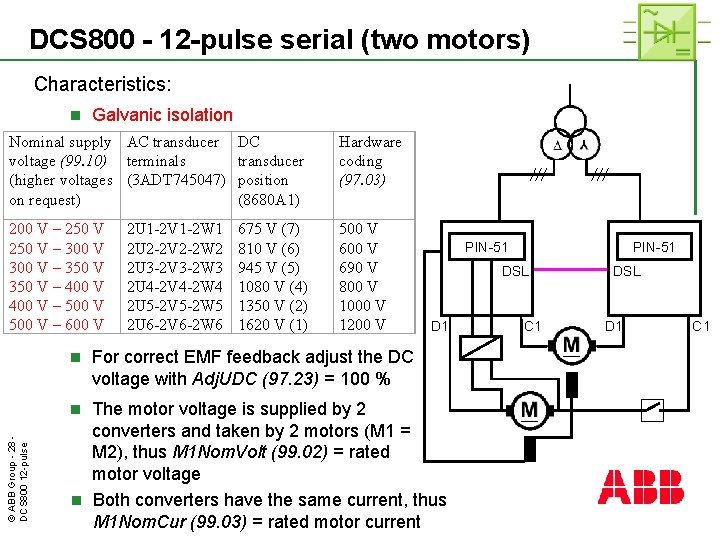
DCS 800 - 12 -pulse serial (two motors) Characteristics: n Galvanic isolation Nominal supply AC transducer voltage (99. 10) terminals (higher voltages (3 ADT 745047) on request) DC transducer position (8680 A 1) Hardware coding (97. 03) 200 V – 250 V – 300 V – 350 V – 400 V – 500 V – 600 V 675 V (7) 810 V (6) 945 V (5) 1080 V (4) 1350 V (2) 1620 V (1) 500 V 690 V 800 V 1000 V 1200 V n PIN-51 DSL D 1 For correct EMF feedback adjust the DC voltage with Adj. UDC (97. 23) = 100 % The motor voltage is supplied by 2 converters and taken by 2 motors (M 1 = M 2), thus M 1 Nom. Volt (99. 02) = rated motor voltage n Both converters have the same current, thus M 1 Nom. Cur (99. 03) = rated motor current n © ABB Group - 28 DCS 800 12 -pulse 2 U 1 -2 V 1 -2 W 1 2 U 2 -2 V 2 -2 W 2 2 U 3 -2 V 3 -2 W 3 2 U 4 -2 V 4 -2 W 4 2 U 5 -2 V 5 -2 W 5 2 U 6 -2 V 6 -2 W 6 C 1 DSL D 1 C 1
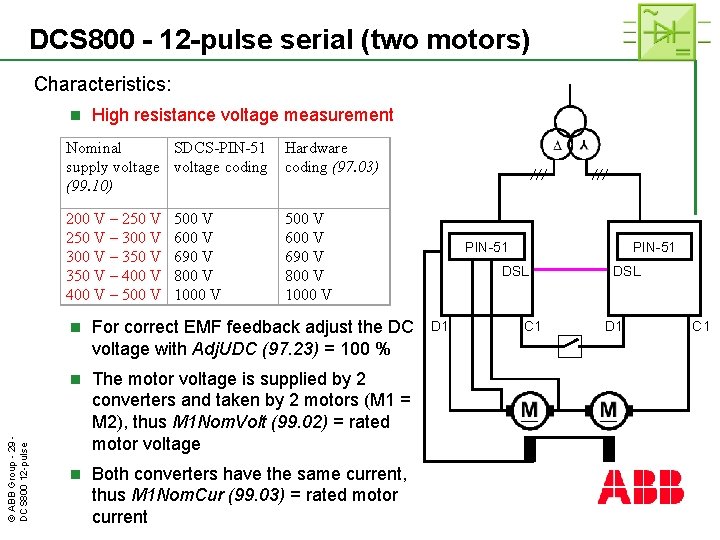
DCS 800 - 12 -pulse serial (two motors) Characteristics: © ABB Group - 29 DCS 800 12 -pulse n High resistance voltage measurement Nominal SDCS-PIN-51 supply voltage coding (99. 10) Hardware coding (97. 03) 200 V – 250 V – 300 V – 350 V – 400 V – 500 V 600 V 690 V 800 V 1000 V 500 V 690 V 800 V 1000 V n For correct EMF feedback adjust the DC voltage with Adj. UDC (97. 23) = 100 % n The motor voltage is supplied by 2 converters and taken by 2 motors (M 1 = M 2), thus M 1 Nom. Volt (99. 02) = rated motor voltage n Both converters have the same current, thus M 1 Nom. Cur (99. 03) = rated motor current PIN-51 DSL D 1 C 1
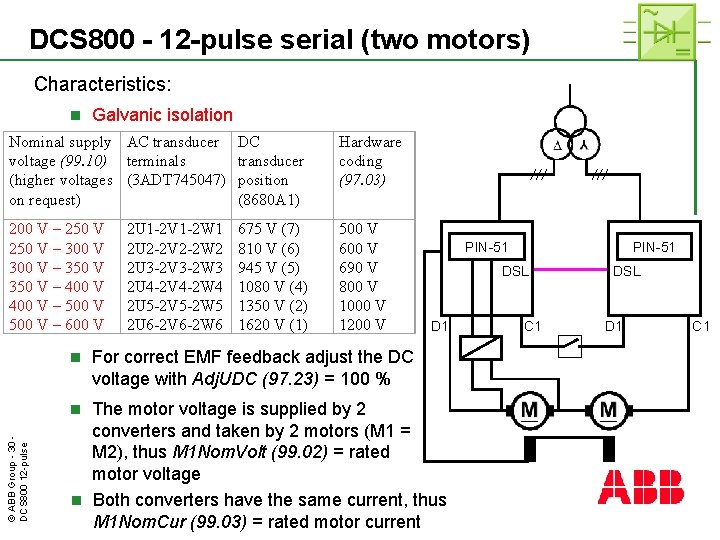
DCS 800 - 12 -pulse serial (two motors) Characteristics: n Galvanic isolation Nominal supply AC transducer voltage (99. 10) terminals (higher voltages (3 ADT 745047) on request) DC transducer position (8680 A 1) Hardware coding (97. 03) 200 V – 250 V – 300 V – 350 V – 400 V – 500 V – 600 V 675 V (7) 810 V (6) 945 V (5) 1080 V (4) 1350 V (2) 1620 V (1) 500 V 690 V 800 V 1000 V 1200 V n PIN-51 DSL D 1 For correct EMF feedback adjust the DC voltage with Adj. UDC (97. 23) = 100 % The motor voltage is supplied by 2 converters and taken by 2 motors (M 1 = M 2), thus M 1 Nom. Volt (99. 02) = rated motor voltage n Both converters have the same current, thus M 1 Nom. Cur (99. 03) = rated motor current n © ABB Group - 30 DCS 800 12 -pulse 2 U 1 -2 V 1 -2 W 1 2 U 2 -2 V 2 -2 W 2 2 U 3 -2 V 3 -2 W 3 2 U 4 -2 V 4 -2 W 4 2 U 5 -2 V 5 -2 W 5 2 U 6 -2 V 6 -2 W 6 C 1 DSL D 1 C 1
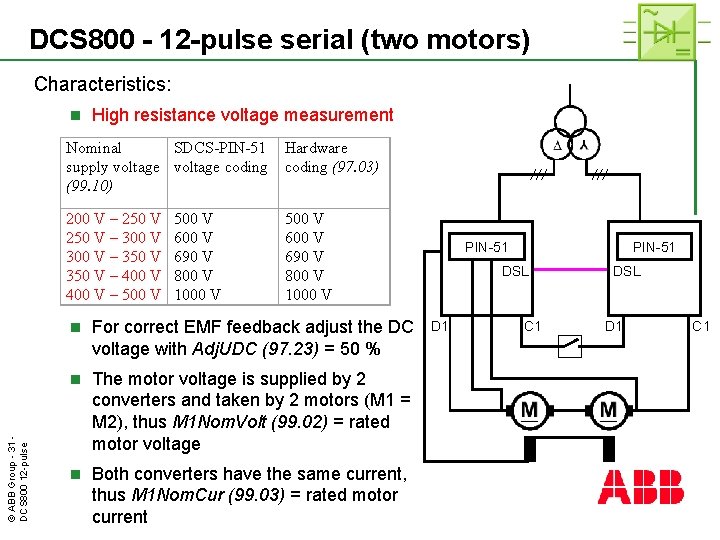
DCS 800 - 12 -pulse serial (two motors) Characteristics: © ABB Group - 31 DCS 800 12 -pulse n High resistance voltage measurement Nominal SDCS-PIN-51 supply voltage coding (99. 10) Hardware coding (97. 03) 200 V – 250 V – 300 V – 350 V – 400 V – 500 V 600 V 690 V 800 V 1000 V 500 V 690 V 800 V 1000 V n For correct EMF feedback adjust the DC voltage with Adj. UDC (97. 23) = 50 % n The motor voltage is supplied by 2 converters and taken by 2 motors (M 1 = M 2), thus M 1 Nom. Volt (99. 02) = rated motor voltage n Both converters have the same current, thus M 1 Nom. Cur (99. 03) = rated motor current PIN-51 DSL D 1 C 1
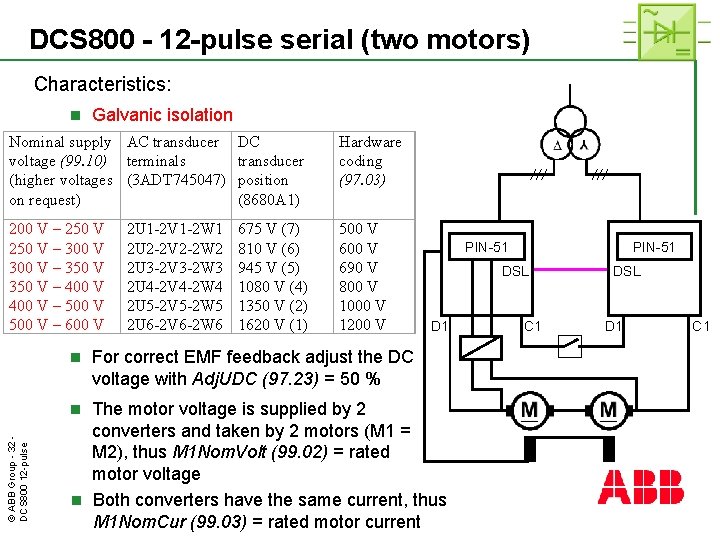
DCS 800 - 12 -pulse serial (two motors) Characteristics: n Galvanic isolation Nominal supply AC transducer voltage (99. 10) terminals (higher voltages (3 ADT 745047) on request) DC transducer position (8680 A 1) Hardware coding (97. 03) 200 V – 250 V – 300 V – 350 V – 400 V – 500 V – 600 V 675 V (7) 810 V (6) 945 V (5) 1080 V (4) 1350 V (2) 1620 V (1) 500 V 690 V 800 V 1000 V 1200 V n PIN-51 DSL D 1 For correct EMF feedback adjust the DC voltage with Adj. UDC (97. 23) = 50 % The motor voltage is supplied by 2 converters and taken by 2 motors (M 1 = M 2), thus M 1 Nom. Volt (99. 02) = rated motor voltage n Both converters have the same current, thus M 1 Nom. Cur (99. 03) = rated motor current n © ABB Group - 32 DCS 800 12 -pulse 2 U 1 -2 V 1 -2 W 1 2 U 2 -2 V 2 -2 W 2 2 U 3 -2 V 3 -2 W 3 2 U 4 -2 V 4 -2 W 4 2 U 5 -2 V 5 -2 W 5 2 U 6 -2 V 6 -2 W 6 C 1 DSL D 1 C 1
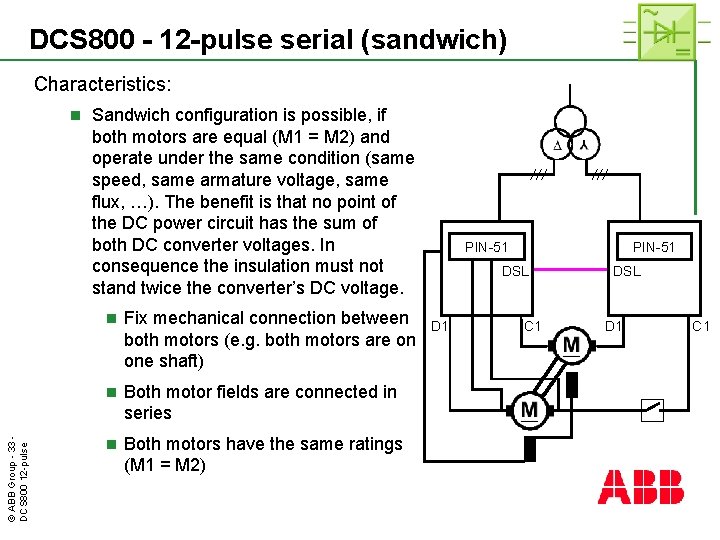
DCS 800 - 12 -pulse serial (sandwich) Characteristics: © ABB Group - 33 DCS 800 12 -pulse n Sandwich configuration is possible, if both motors are equal (M 1 = M 2) and operate under the same condition (same speed, same armature voltage, same flux, …). The benefit is that no point of the DC power circuit has the sum of both DC converter voltages. In consequence the insulation must not stand twice the converter’s DC voltage. n Fix mechanical connection between both motors (e. g. both motors are on one shaft) n Both motor fields are connected in series n Both motors have the same ratings (M 1 = M 2) PIN-51 DSL D 1 C 1
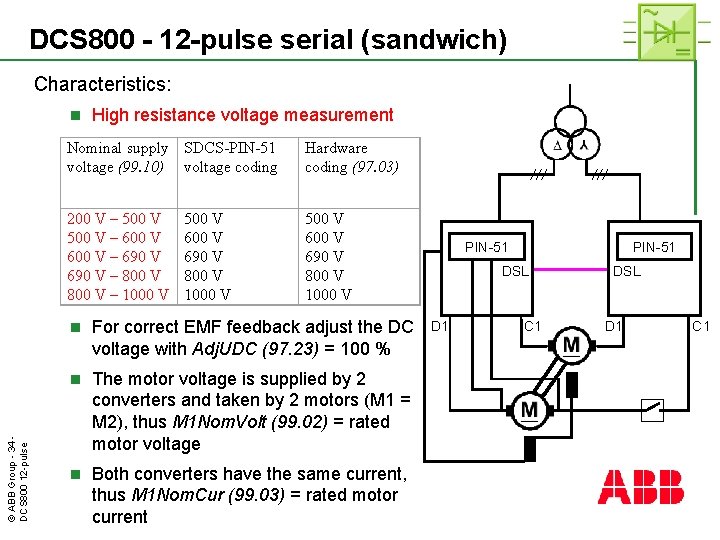
DCS 800 - 12 -pulse serial (sandwich) Characteristics: © ABB Group - 34 DCS 800 12 -pulse n High resistance voltage measurement Nominal supply SDCS-PIN-51 voltage (99. 10) voltage coding Hardware coding (97. 03) 200 V – 500 V – 600 V – 690 V – 800 V – 1000 V 500 V 600 V 690 V 800 V 1000 V n For correct EMF feedback adjust the DC voltage with Adj. UDC (97. 23) = 100 % n The motor voltage is supplied by 2 converters and taken by 2 motors (M 1 = M 2), thus M 1 Nom. Volt (99. 02) = rated motor voltage n Both converters have the same current, thus M 1 Nom. Cur (99. 03) = rated motor current PIN-51 DSL D 1 C 1
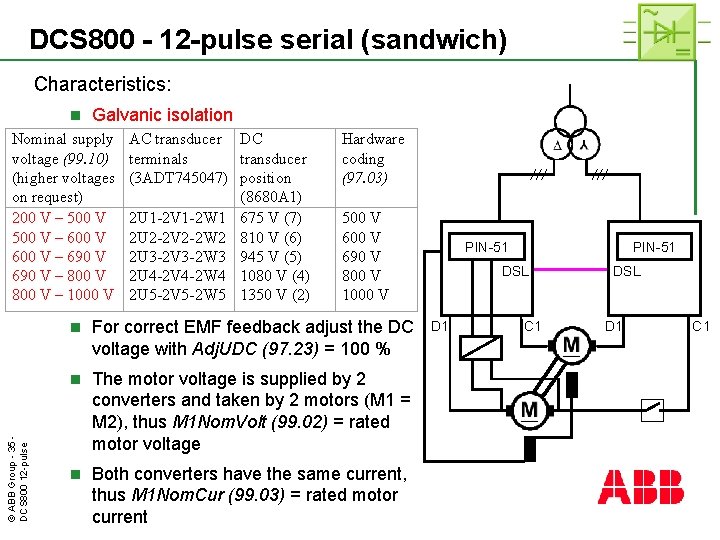
DCS 800 - 12 -pulse serial (sandwich) Characteristics: n Galvanic isolation © ABB Group - 35 DCS 800 12 -pulse Nominal supply voltage (99. 10) (higher voltages on request) 200 V – 500 V – 600 V – 690 V – 800 V – 1000 V AC transducer DC terminals transducer (3 ADT 745047) position (8680 A 1) 2 U 1 -2 V 1 -2 W 1 675 V (7) 2 U 2 -2 V 2 -2 W 2 810 V (6) 2 U 3 -2 V 3 -2 W 3 945 V (5) 2 U 4 -2 V 4 -2 W 4 1080 V (4) 2 U 5 -2 V 5 -2 W 5 1350 V (2) Hardware coding (97. 03) 500 V 690 V 800 V 1000 V n For correct EMF feedback adjust the DC voltage with Adj. UDC (97. 23) = 100 % n The motor voltage is supplied by 2 converters and taken by 2 motors (M 1 = M 2), thus M 1 Nom. Volt (99. 02) = rated motor voltage n Both converters have the same current, thus M 1 Nom. Cur (99. 03) = rated motor current PIN-51 DSL D 1 C 1
DCS 800 © ABB Group - 36 DCS 800 12 -pulse Thank You for Your attention!
- Slides: 37