
DCP Vision Recommendations Downtown Plan Neighborhood Council Working
DCP Vision & Recommendations Downtown Plan – Neighborhood Council Working Group DRAFT March 30, 2016 1
Vision - Downtown is Our Urban Neighborhood • Deliver on Goals for Circulation, Mobility and Parking • Meet Residents’ Needs for Open Space • Incentivize Housing, Local Business, Retail, Restaurants and Night Life • Height Limits for All Projects • >30% Affordable Housing Required • Deliver on Sustainability Goals of Air, Power, Water, Solar, Public Protection and Schools 2
DCP and DSP Concerns • DCP 2016 a repackaging and marketing of DSP 2014 with focus of maximizing growth in Downtown • Allows Tier 3 projects of up to 100, 000 sq. ft. e. g. , black building at NW corner 2 nd and Wilshire (was 60, 000 in DSP) to be built using a checklist of benefits and a DR (only public comment is at Planning Commission with no City Council input unless appealed ) • Focus on consolidation of lots and incentivizing big projects • Added a 9 th Opportunity Site (Vons – Lincoln & Broadway) • GAMP (Gateway Access Master Plan) is a separate plan for large lots on south side of Downtown and freeway realignment (Sears. BBB, Expo and Wyndam Hotel) 3
DCP and DSP EIR Concerns • Throughout DSP/DCP there was no comparison to existing zoning or size of existing physical structure and no rationale for changes • Open space may be public or private; no difference between at grade open vs. private balconies, rooftops, etc. • Plan has 6 sub-districts which could easily be consolidated (consolidate mixed-use neighborhood, core neighborhood, Ocean transition and Promenade under Downtown Core) (consolidate Lincoln and Wilshire as Mixed-Use Blvd. Low) 4
DCP and DSP Concerns • Community Benefits are enhanced project mitigations, amenities and elements required by Santa Monica ordinance & State/Federal law • Historic Preservation omitted from Community Benefits • Traffic & Parking continues to focus on goals & aspirations not definition, design and placement • DSP EIR states that best environment project is – Alternative 2 – Elimination of Tier 3 Projects 5
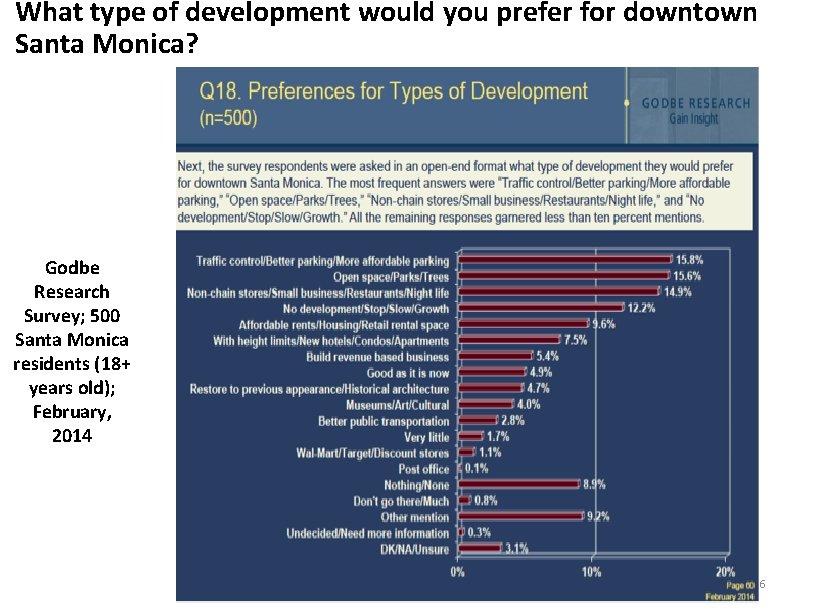
What type of development would you prefer for downtown Santa Monica? Godbe Research Survey; 500 Santa Monica residents (18+ years old); February, 2014 6
Circulation and Mobility • Fund a Circulator Bus Connecting Neighborhoods with Expo, Downtown, Beach, Pier and Civic Center • Create a TMO as Mandatory/Incentivize and Publicly Report TDM Compliance (AVR Reports) • Remove Sufficient Street Parking to Widen Sidewalks, Allow Drop-Offs/Pick-Ups and Create Bus/Bike Lanes on Ocean, Olympic and 4 th 7
Circulation and Mobility (contd. ) • Seek Long Term Pedestrian/Vehicle Separation with new Over/Underpasses on 4 th/Colorado and Ocean/Colorado • Consider One-Way Streets for East and North/South Traffic • Sidewalk Widths of 20 feet Throughout Downtown • Provide Parking Near Freeway Exits 8
Open Space • Require minimum 30% Open Space per each project – Santa Monica is “park poor” • Allow in-lieu payments to encourage larger open spaces • Privately-Owned Public Space (POP), Streets and Sidewalks are not Open Space or a Community Benefit • Create a Downtown Urban Park/Plaza at 4 th/5 th & Arizona with at least 60% Open Space 9
Development Standards • Simplify to Three Zones: • Downtown Core (Ocean to 7 th and Wilshire to Santa Monica/Broadway) • Neighborhood Adjacent/MUB-Low (North Side of Wilshire and East Side of Lincoln from 2 nd St. to Lincoln/Freeway) • Transit Adjacent (Ocean to Lincoln from Santa Monica/Broadway to Freeway) 10
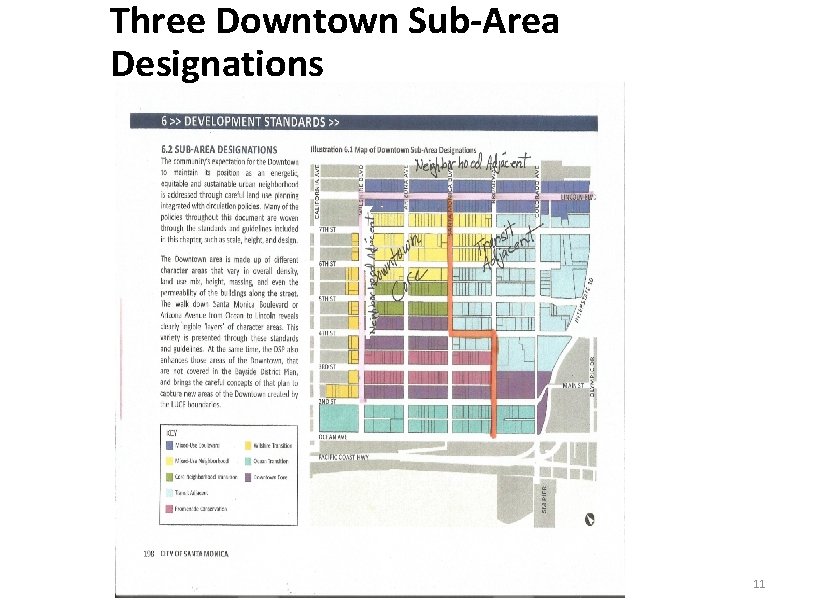
Three Downtown Sub-Area Designations 11
Development Standards (contd. ) • Limit Lot Consolidation to Two Parcels (100 feet Façade Width) • Lower Development Review Approval < 50, 000 SF • Include All Large Sites in DCP Zoning • Projects that exceed Zoning Go on Ballot • Encourage Mid-Block Passages (Paseos) as Required Open Space with Small Rentable Business Spaces 12
Development Standards (contd. ) • Encourage outside dining tables with minimal fees and enforcement standards • Eliminate Tier 3 Height Incentive for Landmark Parcels or Adjacent Parcels and Structures of Merit(transfer of development rights) • All Buildings LEED Platinum, Incentivize Adaptive Reuse and Renewable Energy 13
Community Benefits • Simplify Tier 2 & 3 Community Benefits to Increases above Tier 1 Plus Findings • Applicable to Projects <50, 000 SF • Raise Bar with Significant Fees • Consider Historical Preservation Fee • Consider Annual Community Benefits Payments for Transportation Circulator 14
Infrastructure • Require Projects to Pay for Infrastructure Expenses e. g. , larger water & sewer pipes, power transmission upgrades • Require 2030 Plans for Schools, Police, Fire, Sewer, Water, Parks, Open Space and Energy • Require Analysis of Future Expenses & Financing Alternatives • Require Shading Consideration for Renewable Energy/Solar 15
Infrastructure (contd. ) • Focus on Water Retention to Recharge Aquifer with permeable surfaces and more ground level open space • Require identification and linkages via DCP to all projects throughout Downtown e. g. , Fire Station, Police, Emergency Response to Disaster 16
Performance Measures • Create a 2010 Baseline of Housing (Market, Affordable), Water Usage, Pedestrian, Bike and Vehicle Counts and Report Progress Annually (No Net New Trips) • Create a 2010 Baseline of Community Benefits Funds & Uses and Report Balances and Spending Annually 17
- Slides: 17