
DCIPS Overview Army Intelligence Personnel Management Office IPMO
- Slides: 27
DCIPS Overview Army Intelligence Personnel Management Office (IPMO)
Agenda § § § § DCIPS Defined Implementation Timelines Items not affected by DCIPS The DCIPS Star DCIPS Transformational Goals Core Tenets of DCIPS Benefits DCIPS Pay Band Conversion DCIPS Performance Management System DCIPS Pay Pools DCIPS Communications Online Resources Questions 2
DCIPS Authorities and Background § Title 10, United States Code (1601 -1614) – Authority to hire, develop, and retain a diverse, versatile, and highly qualified workforce to perform both the Defense and National Intelligence missions § Legislation passed in October 1996 – SECDEF authorized to establish a personnel system to meet the needs of the Defense Intelligence Community § DCIPS is being developed in coordination with: – Office of Director of National Intelligence (ODNI) – Under Secretary of Defense Intelligence (USD(I)) – Do. D’s National Security Personnel System PEO § DCIPS delivers a common competitive, pay-for-performance personnel system for all Do. D Intelligence Components *New System is Applicable to White Collar (“GG”) Workforce 3
What is DCIPS? A competitive, pay-for-performance management system that: – Coordinates Do. D’s National Security Personnel System (NSPS) and the Office of the Director of National Intelligence (ODNI) Pay Modernization efforts – Supports Do. D 1400. 25 -M (Volume 2001 - 2012) – Focuses on results – Promotes a culture that values and recognizes talent – Applies to all Do. D Intelligence Component Civilians – Aligns with the broader Intelligence Community – Builds on the National Geospatial-Intelligence Agency’s (NGA) 10 -year experience with performance-based pay 4
DCIPS Does NOT Impact: § Benefit laws on retirement, health, and life insurance, etc. § Travel/subsistence expenses § Deployment incentives § Application of Merit System principles § Veterans’ Preference principles § Whistleblower Protections § Anti-discrimination laws 5
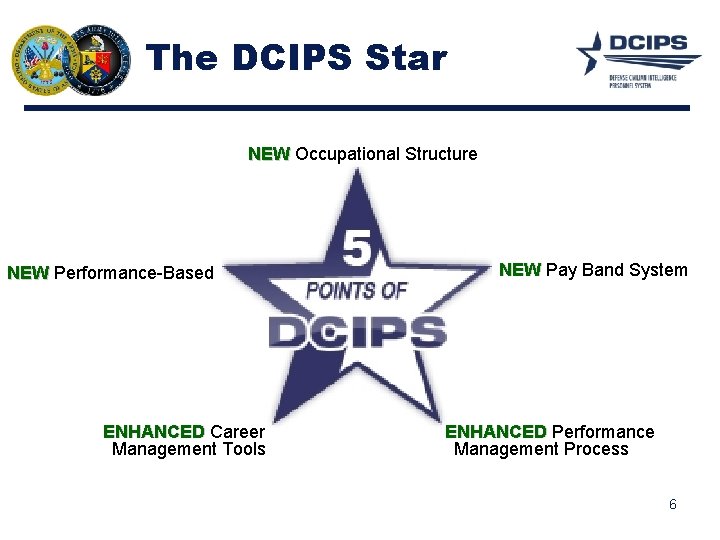
The DCIPS Star NEW Occupational Structure NEW Performance-Based ENHANCED Career Management Tools NEW Pay Band System ENHANCED Performance Management Process 6
DCIPS Transformational Goals § Performance Management – Align results to organizational goals § Occupational Structure – Align with ODNI’s mission and work categories § Compensation Structure – Based on performance contributions § Workforce Shaping – Emphasize performance over longevity § Organizational Management – Performance management and pay flexibilities § Training and Professional Development – Right skills at the right time § Staffing Flexibilities – Right person for the right job 7
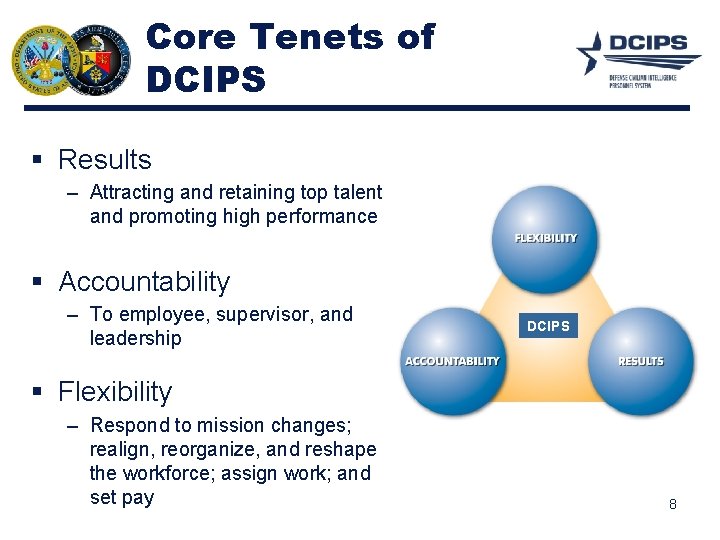
Core Tenets of DCIPS § Results – Attracting and retaining top talent and promoting high performance § Accountability – To employee, supervisor, and leadership DCIPS § Flexibility – Respond to mission changes; realign, reorganize, and reshape the workforce; assign work; and set pay 8
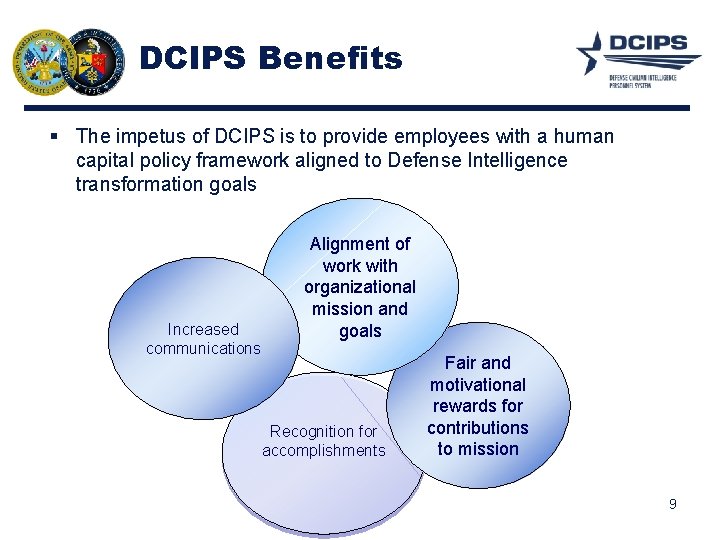
DCIPS Benefits § The impetus of DCIPS is to provide employees with a human capital policy framework aligned to Defense Intelligence transformation goals Increased communications Alignment of work with organizational mission and goals Recognition for accomplishments Fair and motivational rewards for contributions to mission 9
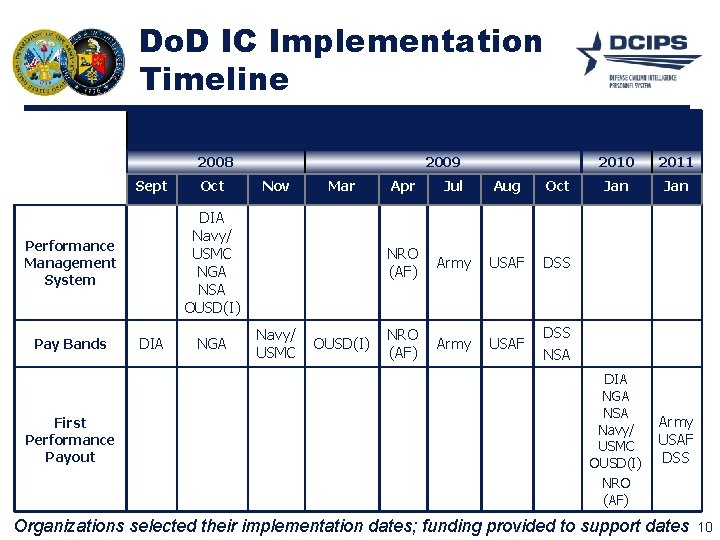
Do. D IC Implementation Timeline 2008 Sept First Performance Payout Nov Mar DIA Navy/ USMC NGA NSA OUSD(I) Performance Management System Pay Bands Oct 2009 DIA NGA Navy/ USMC OUSD(I) Apr Jul Aug Oct NRO (AF) Army USAF DSS NSA 2010 2011 Jan DIA NGA NSA Navy/ USMC OUSD(I) NRO (AF) Army USAF DSS Organizations selected their implementation dates; funding provided to support dates 10
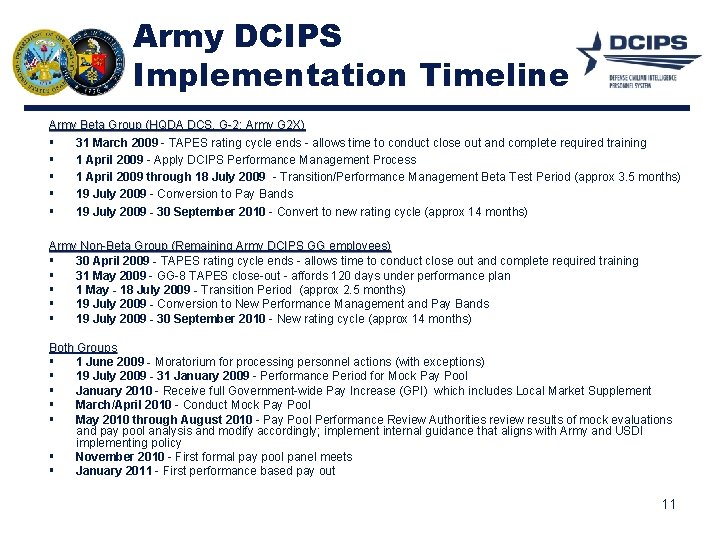
Army DCIPS Implementation Timeline Army Beta Group (HQDA DCS, G-2; Army G 2 X) § 31 March 2009 - TAPES rating cycle ends - allows time to conduct close out and complete required training § 1 April 2009 - Apply DCIPS Performance Management Process § 1 April 2009 through 18 July 2009 - Transition/Performance Management Beta Test Period (approx 3. 5 months) § 19 July 2009 - Conversion to Pay Bands § 19 July 2009 - 30 September 2010 - Convert to new rating cycle (approx 14 months) Army Non-Beta Group (Remaining Army DCIPS GG employees) § 30 April 2009 - TAPES rating cycle ends - allows time to conduct close out and complete required training § 31 May 2009 - GG-8 TAPES close-out - affords 120 days under performance plan § 1 May - 18 July 2009 - Transition Period (approx 2. 5 months) § 19 July 2009 - Conversion to New Performance Management and Pay Bands § 19 July 2009 - 30 September 2010 - New rating cycle (approx 14 months) Both Groups § 1 June 2009 - Moratorium for processing personnel actions (with exceptions) § 19 July 2009 - 31 January 2009 - Performance Period for Mock Pay Pool § January 2010 - Receive full Government-wide Pay Increase (GPI) which includes Local Market Supplement § March/April 2010 - Conduct Mock Pay Pool § May 2010 through August 2010 - Pay Pool Performance Review Authorities review results of mock evaluations and pay pool analysis and modify accordingly; implement internal guidance that aligns with Army and USDI implementing policy § November 2010 - First formal pay pool panel meets § January 2011 - First performance based pay out 11
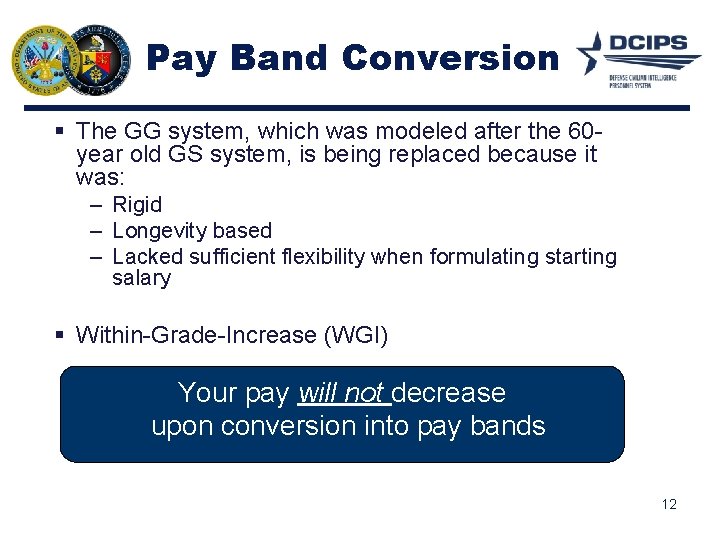
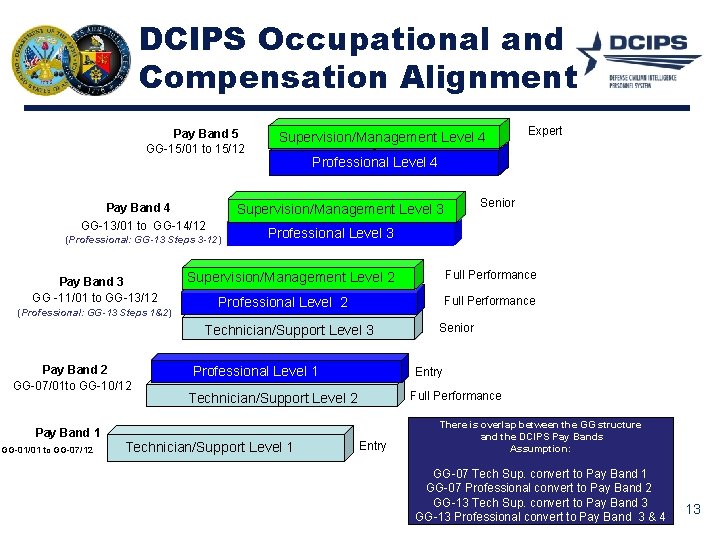
Pay Band Conversion § The GG system, which was modeled after the 60 year old GS system, is being replaced because it was: – Rigid – Longevity based – Lacked sufficient flexibility when formulating starting salary § Within-Grade-Increase (WGI) Your pay will not decrease upon conversion into pay bands 12
DCIPS Occupational and Compensation Alignment Pay Band 5 GG-15/01 to 15/12 Pay Band 4 GG-13/01 to GG-14/12 (Professional: GG-13 Steps 1&2) - Full Performance Supervision/Management Level 2 Full Performance Professional Level 2 Professional Level 1 Full Performance Technician/Support Level 2 Technician/Support Level 1 Senior Entry Pay Band 1 GG-01/01 to GG-07/12 Senior Professional Level 3 Technician/Support Level 3 Pay Band 2 GG-07/01 to GG-10/12 Expert Professional Level 4 Supervision/Management Level 3 (Professional: GG-13 Steps 3 -12) Pay Band 3 GG -11/01 to GG-13/12 Supervision/Management Level 4 Entry There is overlap between the GG structure and the DCIPS Pay Bands Assumption: GG-07 Tech Sup. convert to Pay Band 1 GG-07 Professional convert to Pay Band 2 GG-13 Tech Sup. convert to Pay Band 3 GG-13 Professional convert to Pay Band 3 & 4 13
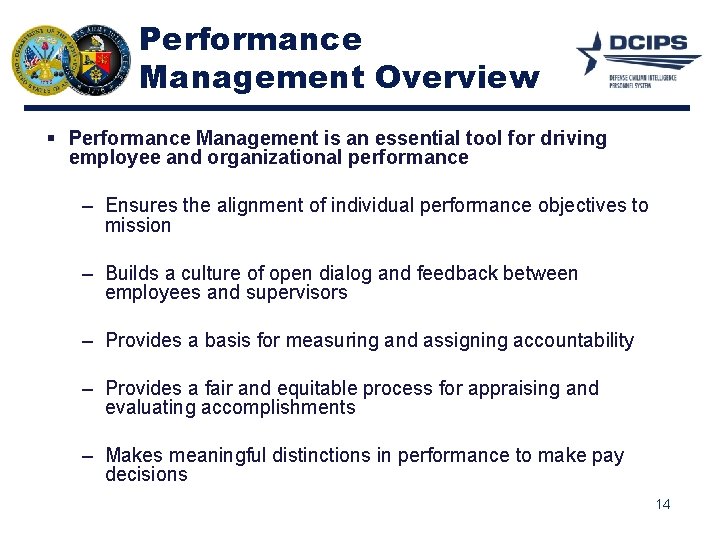
Performance Management Overview § Performance Management is an essential tool for driving employee and organizational performance – Ensures the alignment of individual performance objectives to mission – Builds a culture of open dialog and feedback between employees and supervisors – Provides a basis for measuring and assigning accountability – Provides a fair and equitable process for appraising and evaluating accomplishments – Makes meaningful distinctions in performance to make pay decisions 14
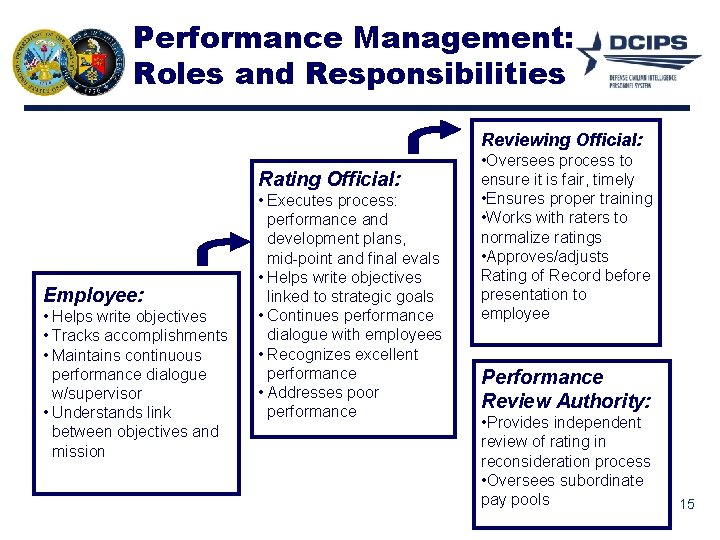
Performance Management: Roles and Responsibilities Reviewing Official: Rating Official: Employee: • Helps write objectives • Tracks accomplishments • Maintains continuous performance dialogue w/supervisor • Understands link between objectives and mission • Executes process: performance and development plans, mid-point and final evals • Helps write objectives linked to strategic goals • Continues performance dialogue with employees • Recognizes excellent performance • Addresses poor performance • Oversees process to ensure it is fair, timely • Ensures proper training • Works with raters to normalize ratings • Approves/adjusts Rating of Record before presentation to employee Performance Review Authority: • Provides independent review of rating in reconsideration process • Oversees subordinate pay pools 15
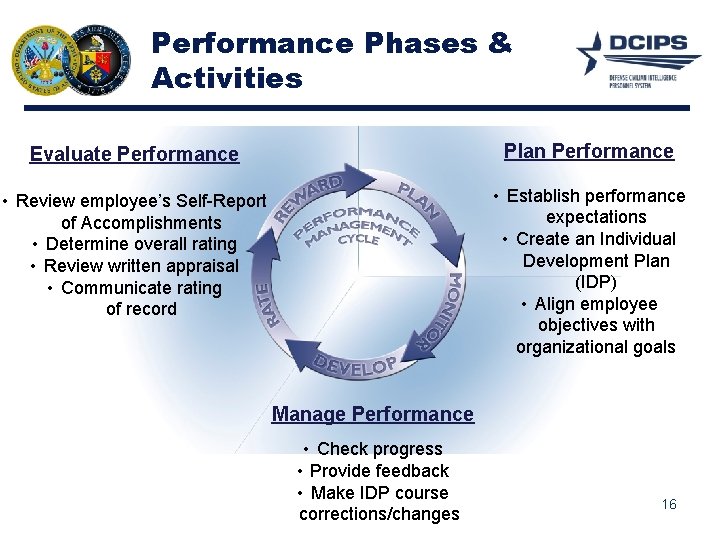
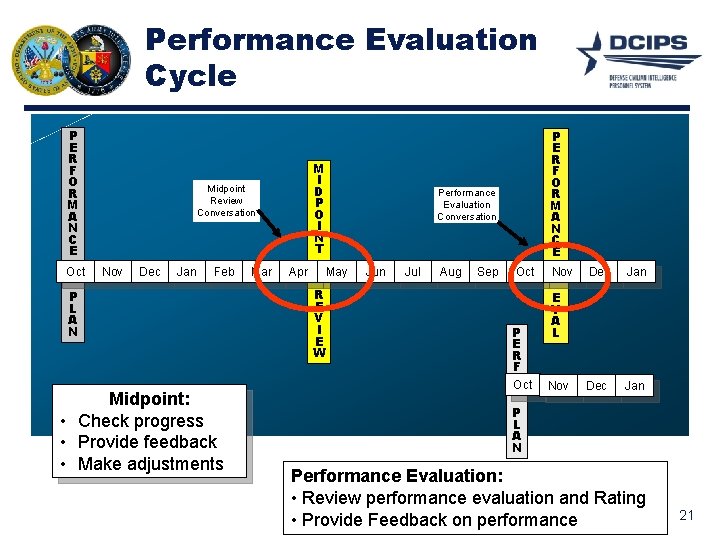
Performance Phases & Activities Evaluate Performance Plan Performance • Review employee’s Self-Report of Accomplishments • Determine overall rating • Review written appraisal • Communicate rating of record • Establish performance expectations • Create an Individual Development Plan (IDP) • Align employee objectives with organizational goals Manage Performance • Check progress • Provide feedback • Make IDP course corrections/changes 16
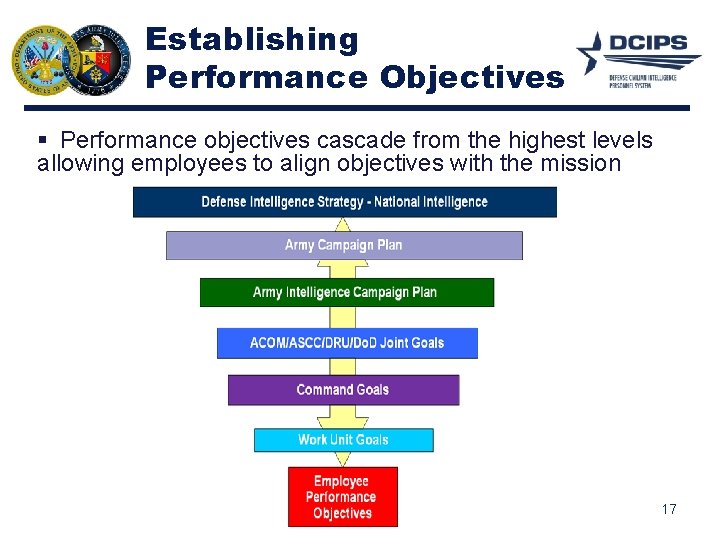
Establishing Performance Objectives § Performance objectives cascade from the highest levels allowing employees to align objectives with the mission 17
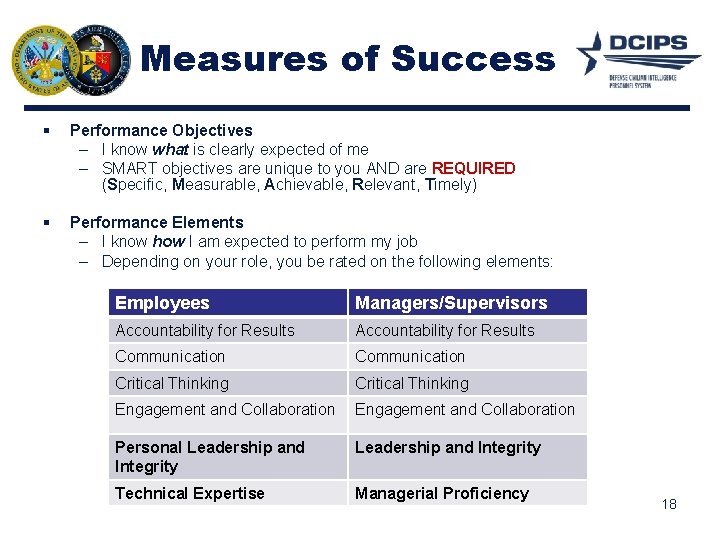
Measures of Success § Performance Objectives – I know what is clearly expected of me – SMART objectives are unique to you AND are REQUIRED (Specific, Measurable, Achievable, Relevant, Timely) § Performance Elements – I know how I am expected to perform my job – Depending on your role, you be rated on the following elements: Employees Managers/Supervisors Accountability for Results Communication Critical Thinking Engagement and Collaboration Personal Leadership and Integrity Technical Expertise Managerial Proficiency 18
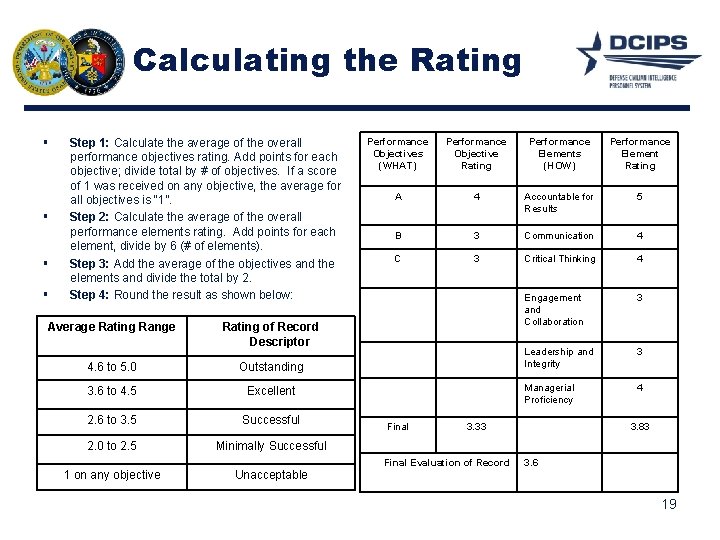
Calculating the Rating § § Step 1: Calculate the average of the overall performance objectives rating. Add points for each objective; divide total by # of objectives. If a score of 1 was received on any objective, the average for all objectives is “ 1”. Step 2: Calculate the average of the overall performance elements rating. Add points for each element, divide by 6 (# of elements). Step 3: Add the average of the objectives and the elements and divide the total by 2. Step 4: Round the result as shown below: Average Rating Range Performance Objectives (WHAT) Performance Objective Rating Performance Elements (HOW) Performance Element Rating A 4 Accountable for Results 5 B 3 Communication 4 C 3 Critical Thinking 4 Engagement and Collaboration 3 Leadership and Integrity 3 Managerial Proficiency 4 Rating of Record Descriptor 4. 6 to 5. 0 Outstanding 3. 6 to 4. 5 Excellent 2. 6 to 3. 5 Successful 2. 0 to 2. 5 Minimally Successful 1 on any objective Unacceptable Final 3. 33 Final Evaluation of Record 3. 83 3. 6 19
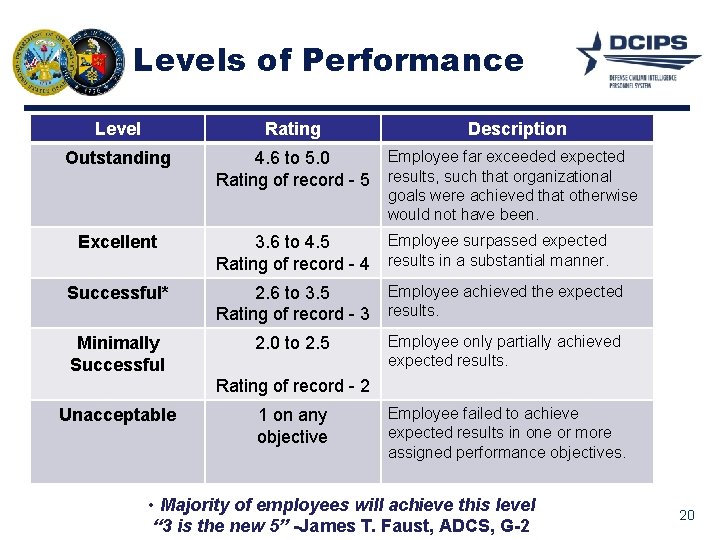
Levels of Performance Level Rating Outstanding Description Employee far exceeded expected 4. 6 to 5. 0 Rating of record - 5 results, such that organizational goals were achieved that otherwise would not have been. Excellent Successful* Minimally Successful Employee surpassed expected 3. 6 to 4. 5 Rating of record - 4 results in a substantial manner. Employee achieved the expected 2. 6 to 3. 5 Rating of record - 3 results. 2. 0 to 2. 5 Employee only partially achieved expected results. Rating of record - 2 Unacceptable 1 on any objective Employee failed to achieve expected results in one or more assigned performance objectives. • Majority of employees will achieve this level “ 3 is the new 5” -James T. Faust, ADCS, G-2 20
Performance Evaluation Cycle P E R F O R M A N C E Oct M I D P O I N T Midpoint Review Conversation Nov Dec Jan Feb P L A N Midpoint: • Check progress • Provide feedback • Make adjustments Mar Apr Performance Evaluation Conversation May R E V I E W P E R F O R M A N C E Jun Jul Aug Sep Oct P E R F Oct Nov Dec Jan E V A L Nov P L A N Performance Evaluation: • Review performance evaluation and Rating • Provide Feedback on performance 21
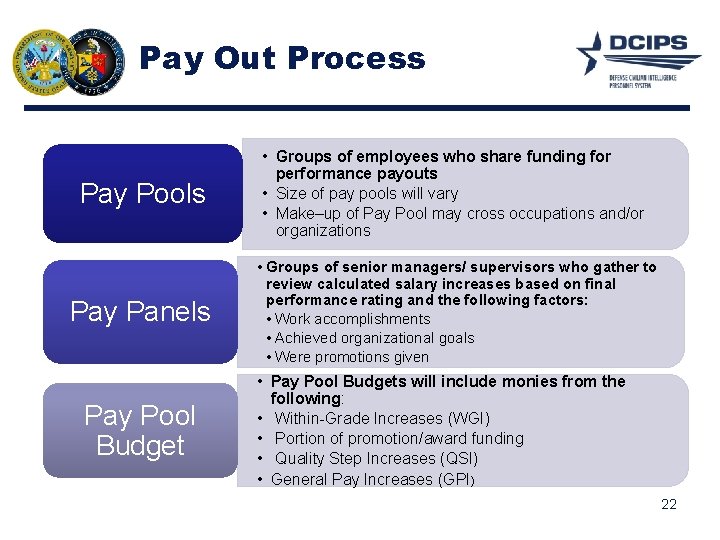
Pay Out Process Pay Pools • Groups of employees who share funding for performance payouts • Size of pay pools will vary • Make–up of Pay Pool may cross occupations and/or organizations Pay Panels • Groups of senior managers/ supervisors who gather to review calculated salary increases based on final performance rating and the following factors: • Work accomplishments • Achieved organizational goals • Were promotions given Pay Pool Budget • Pay Pool Budgets will include monies from the following: • Within-Grade Increases (WGI) • Portion of promotion/award funding • Quality Step Increases (QSI) • General Pay Increases (GPI) 22
DCIPS Communications § Transition Managers and Army G-2 will provide communication messages on a consistent basis § Communication mediums: – – – Monthly Newsletters Workforce Emails DCIPS Website Town Halls/Executive Road Shows Transition Manager Summit 23
USD(I) DCIPS Website NIPRnet: http: //dcips. dtic. mil/index. html 24
Army IPMO DCIPS Website NIPRnet: http: //www. dami. army. pentagon. mil/site/dcips/ SIPRnet: http: //www. dami. army. smil. mil/site/dcips JWICS: http: //www. dami. ic. gov/site/dcips 25
Questions 26
Contact Us Ms. Yolanda Watson Chief, Intelligence Personnel Management Office (IPMO) Phone: 703 -695 -2443 Ms. Vieanna Huertas DCIPS Implementation Lead, IPMO Phone: 703 -695 -1070 Mr. Mark Johnson DCIPS Alternate Implementation Lead, IPMO Phone: 703 -695 - 3689 DCIPS E-Mail Inbox NIPRnet: DCIPS@us. army. mil JWICS: DCIPS@dami. ic. gov SIPRnet: DCIPS@dami. us. army. smil. mil 27