
DC CIRCUITS Recommended Books 2 Title Author Basic

DC CIRCUITS
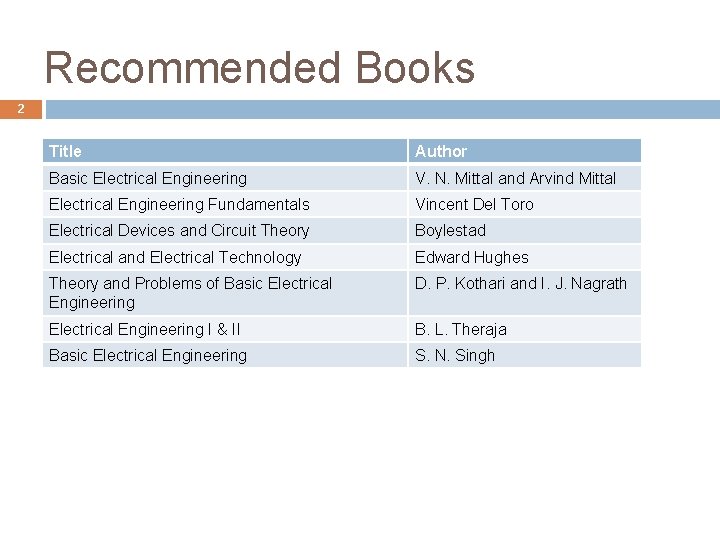
Recommended Books 2 Title Author Basic Electrical Engineering V. N. Mittal and Arvind Mittal Electrical Engineering Fundamentals Vincent Del Toro Electrical Devices and Circuit Theory Boylestad Electrical and Electrical Technology Edward Hughes Theory and Problems of Basic Electrical Engineering D. P. Kothari and I. J. Nagrath Electrical Engineering I & II B. L. Theraja Basic Electrical Engineering S. N. Singh
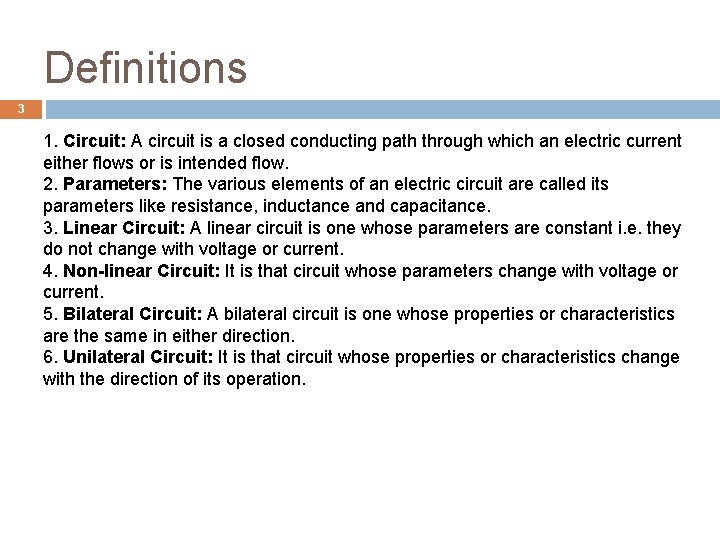
Definitions 3 1. Circuit: A circuit is a closed conducting path through which an electric current either flows or is intended flow. 2. Parameters: The various elements of an electric circuit are called its parameters like resistance, inductance and capacitance. 3. Linear Circuit: A linear circuit is one whose parameters are constant i. e. they do not change with voltage or current. 4. Non-linear Circuit: It is that circuit whose parameters change with voltage or current. 5. Bilateral Circuit: A bilateral circuit is one whose properties or characteristics are the same in either direction. 6. Unilateral Circuit: It is that circuit whose properties or characteristics change with the direction of its operation.
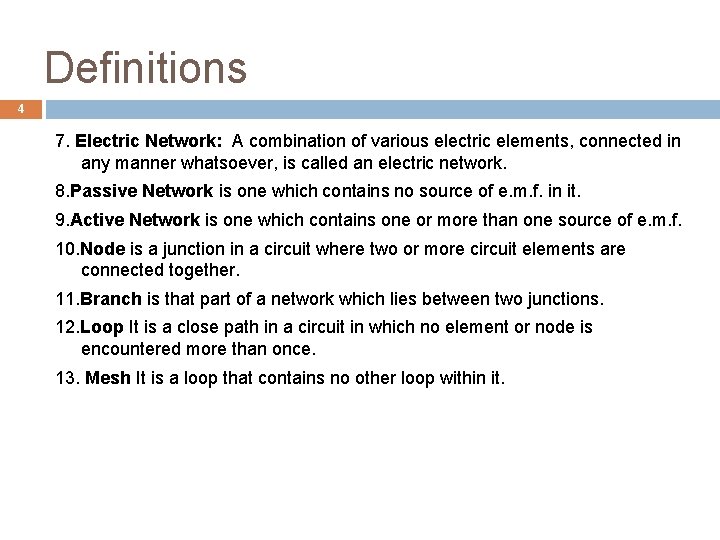
Definitions 4 7. Electric Network: A combination of various electric elements, connected in any manner whatsoever, is called an electric network. 8. Passive Network is one which contains no source of e. m. f. in it. 9. Active Network is one which contains one or more than one source of e. m. f. 10. Node is a junction in a circuit where two or more circuit elements are connected together. 11. Branch is that part of a network which lies between two junctions. 12. Loop It is a close path in a circuit in which no element or node is encountered more than once. 13. Mesh It is a loop that contains no other loop within it.
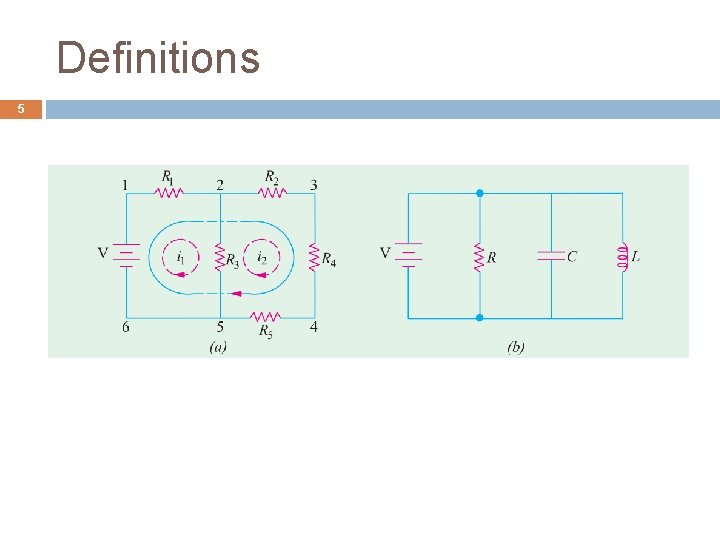
Definitions 5
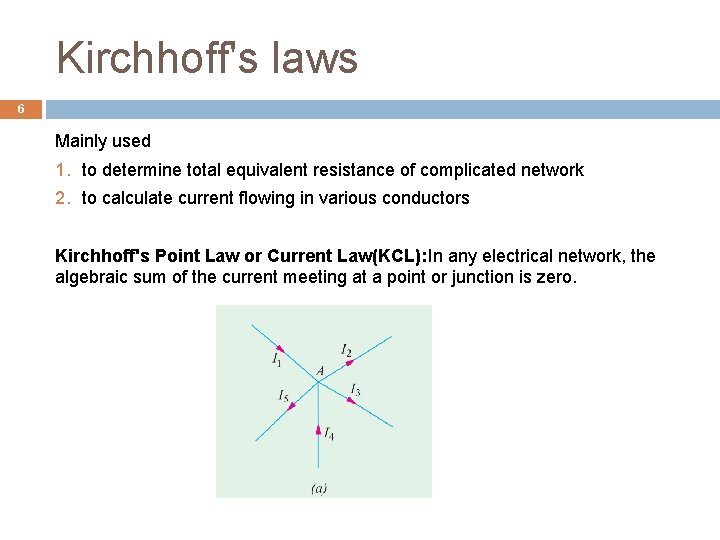
Kirchhoff's laws 6 Mainly used 1. to determine total equivalent resistance of complicated network 2. to calculate current flowing in various conductors Kirchhoff's Point Law or Current Law(KCL): In any electrical network, the algebraic sum of the current meeting at a point or junction is zero.
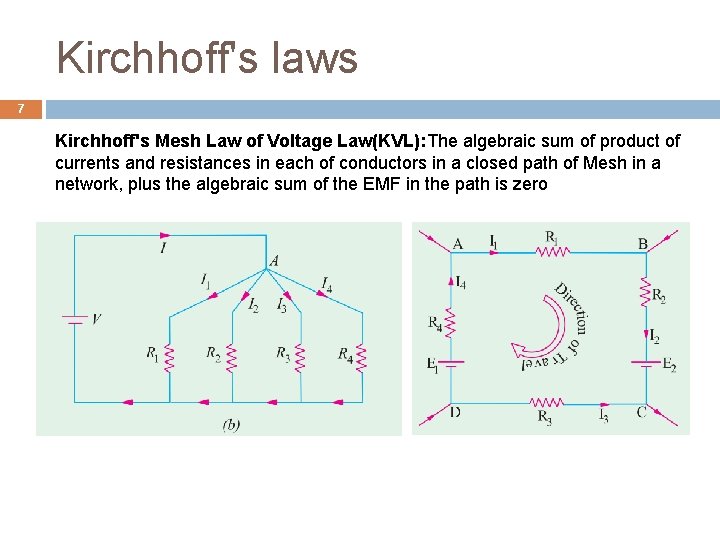
Kirchhoff's laws 7 Kirchhoff's Mesh Law of Voltage Law(KVL): The algebraic sum of product of currents and resistances in each of conductors in a closed path of Mesh in a network, plus the algebraic sum of the EMF in the path is zero
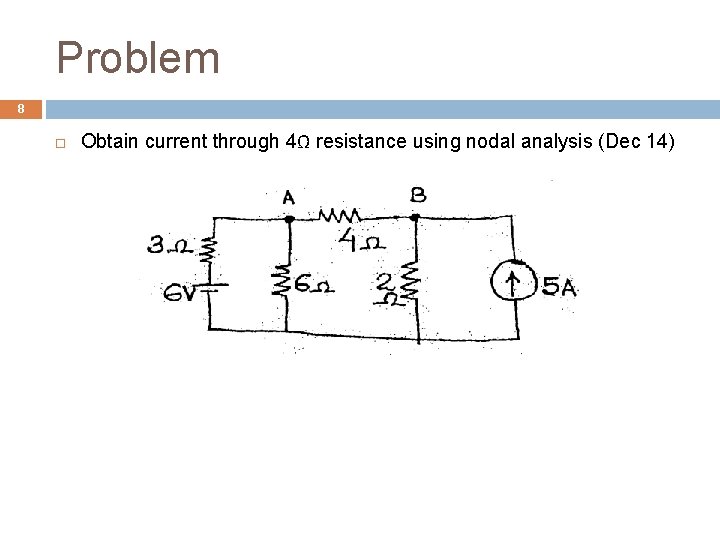
Problem 8 Obtain current through 4Ω resistance using nodal analysis (Dec 14)
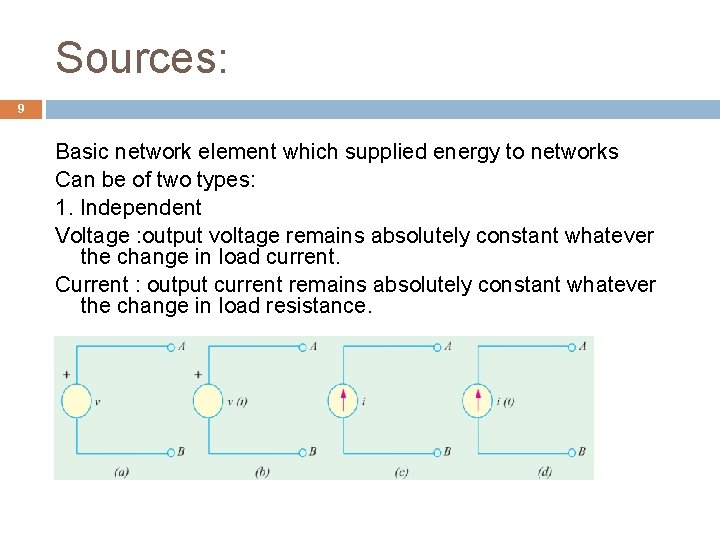
Sources: 9 Basic network element which supplied energy to networks Can be of two types: 1. Independent Voltage : output voltage remains absolutely constant whatever the change in load current. Current : output current remains absolutely constant whatever the change in load resistance.
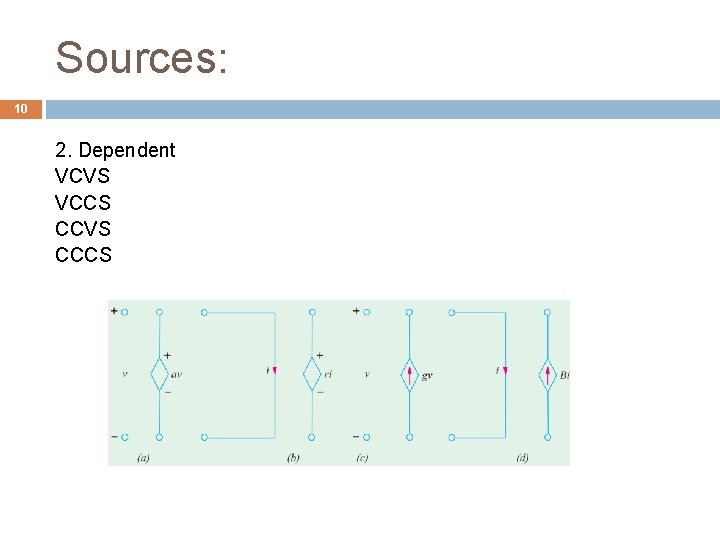
Sources: 10 2. Dependent VCVS VCCS CCVS CCCS
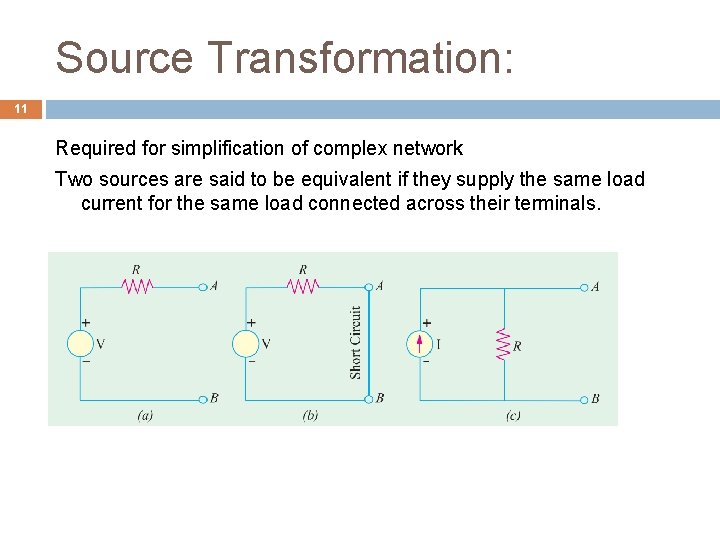
Source Transformation: 11 Required for simplification of complex network Two sources are said to be equivalent if they supply the same load current for the same load connected across their terminals.
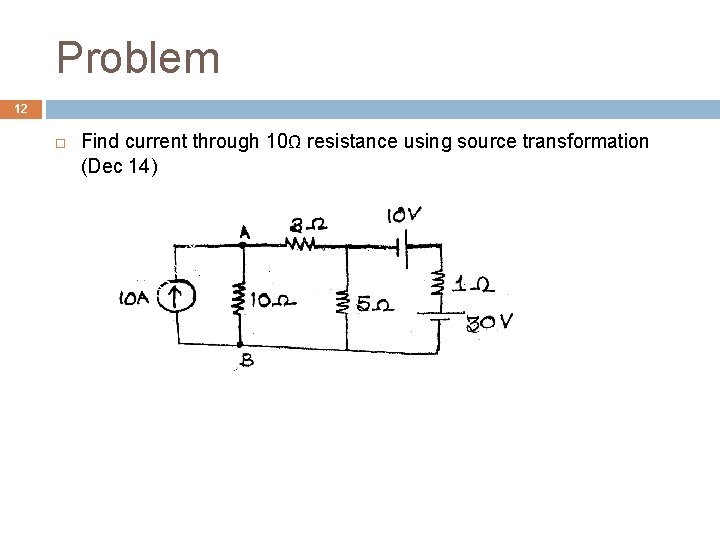
Problem 12 Find current through 10Ω resistance using source transformation (Dec 14)
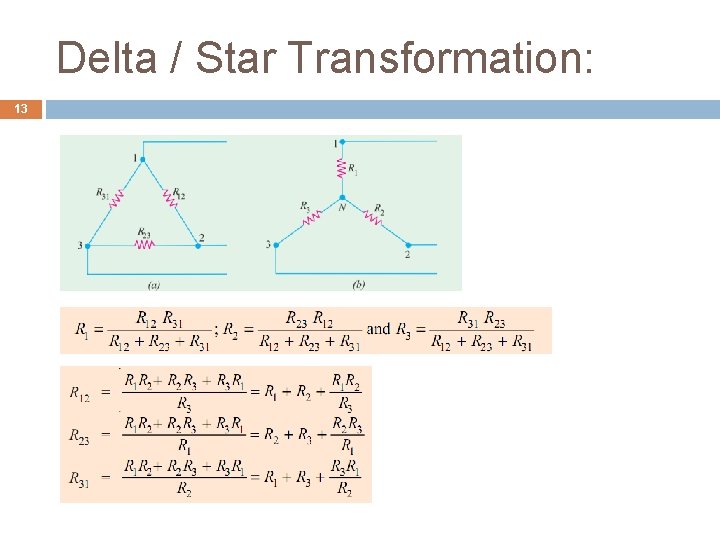
Delta / Star Transformation: 13
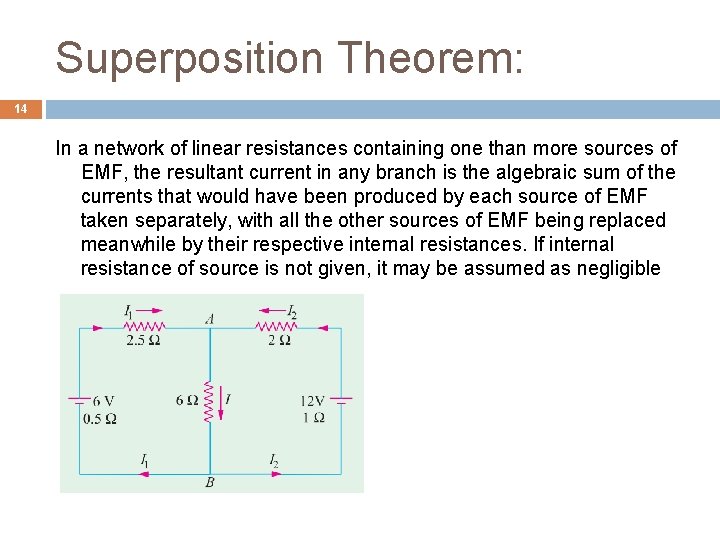
Superposition Theorem: 14 In a network of linear resistances containing one than more sources of EMF, the resultant current in any branch is the algebraic sum of the currents that would have been produced by each source of EMF taken separately, with all the other sources of EMF being replaced meanwhile by their respective internal resistances. If internal resistance of source is not given, it may be assumed as negligible
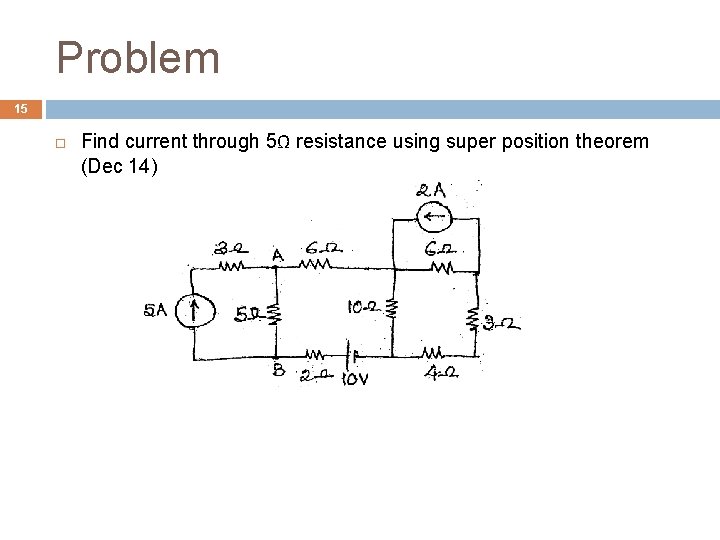
Problem 15 Find current through 5Ω resistance using super position theorem (Dec 14)
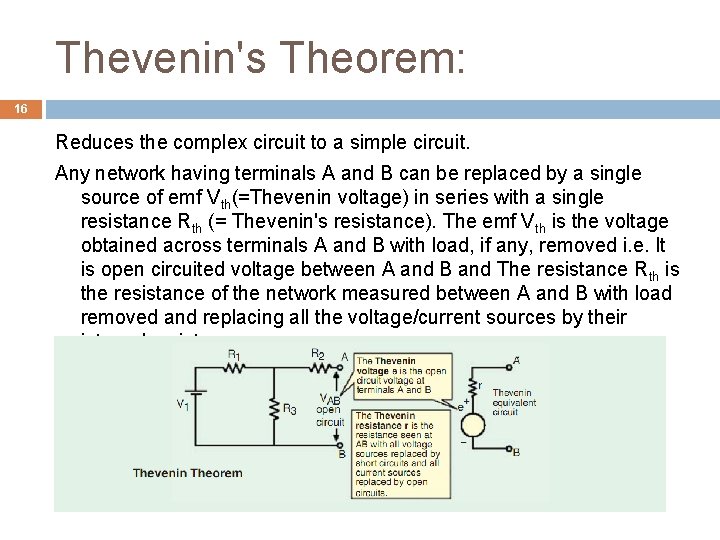
Thevenin's Theorem: 16 Reduces the complex circuit to a simple circuit. Any network having terminals A and B can be replaced by a single source of emf Vth(=Thevenin voltage) in series with a single resistance Rth (= Thevenin's resistance). The emf Vth is the voltage obtained across terminals A and B with load, if any, removed i. e. It is open circuited voltage between A and B and The resistance Rth is the resistance of the network measured between A and B with load removed and replacing all the voltage/current sources by their internal resistances.
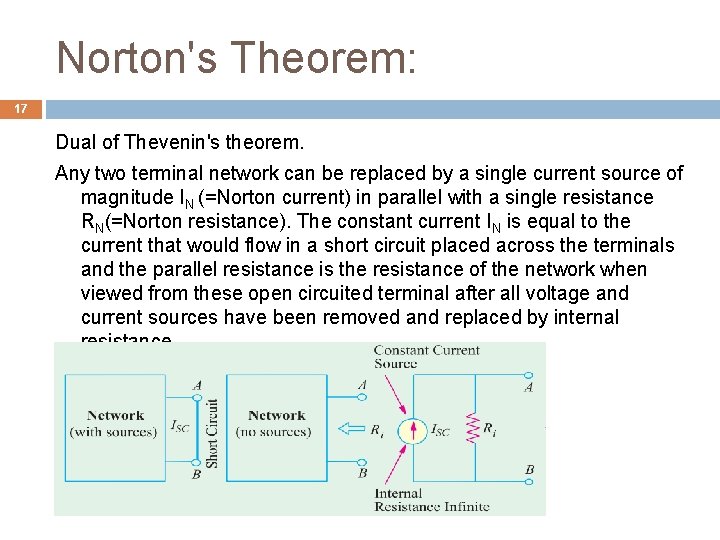
Norton's Theorem: 17 Dual of Thevenin's theorem. Any two terminal network can be replaced by a single current source of magnitude IN (=Norton current) in parallel with a single resistance RN(=Norton resistance). The constant current IN is equal to the current that would flow in a short circuit placed across the terminals and the parallel resistance is the resistance of the network when viewed from these open circuited terminal after all voltage and current sources have been removed and replaced by internal resistance.
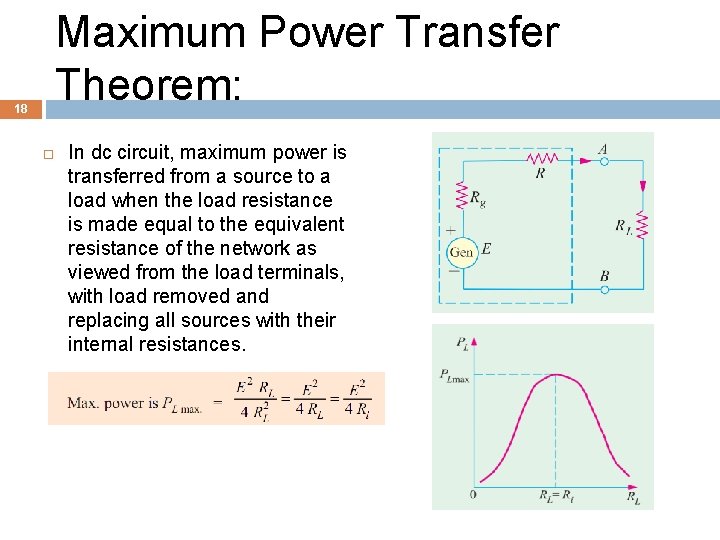
Maximum Power Transfer Theorem: 18 In dc circuit, maximum power is transferred from a source to a load when the load resistance is made equal to the equivalent resistance of the network as viewed from the load terminals, with load removed and replacing all sources with their internal resistances.
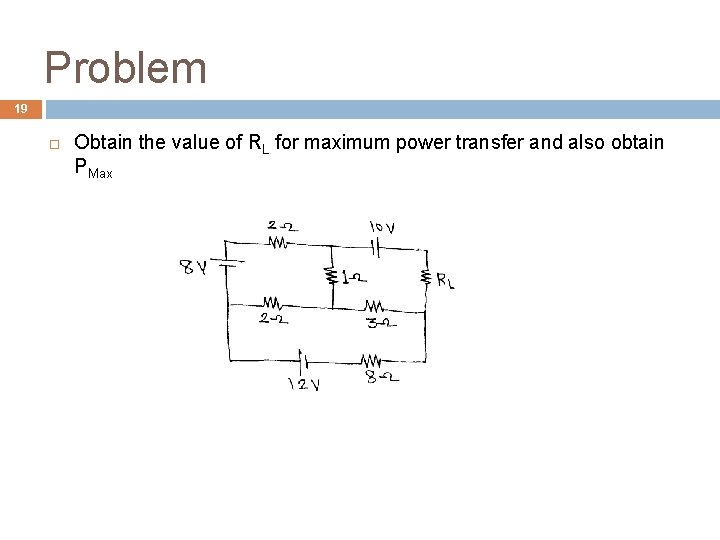
Problem 19 Obtain the value of RL for maximum power transfer and also obtain PMax
THANK YOU ACKNOWLEDGEMENT: TEXTBOOK OF ELECTRICAL TECHNOLOGY VOL I & II BY B. L. THERAJA
- Slides: 20