
DC Circuit RESISTORS August 08 2020 How resistors

- Slides: 8
DC Circuit: RESISTORS August 08, 2020 How resistors work? Series circuits Parallel circuits Ohm’s Law Applications: V=I X R q Adjust current flow I=V/R q Adjust & divide voltage levels R=V/I q Terminate transmission lines Power Dissipation (Watts) q Bias active components P=V X I P = I 2 x R P = V 2 / R Kirchhoff’s Current Law: At any node/junction – the sum of currents flowing into that node/junction is equal to the sum of currents flowing out of that node/junction. Kirchhoff’s Voltage Law: The sum of all voltage drops around any closed loop must equal zero.
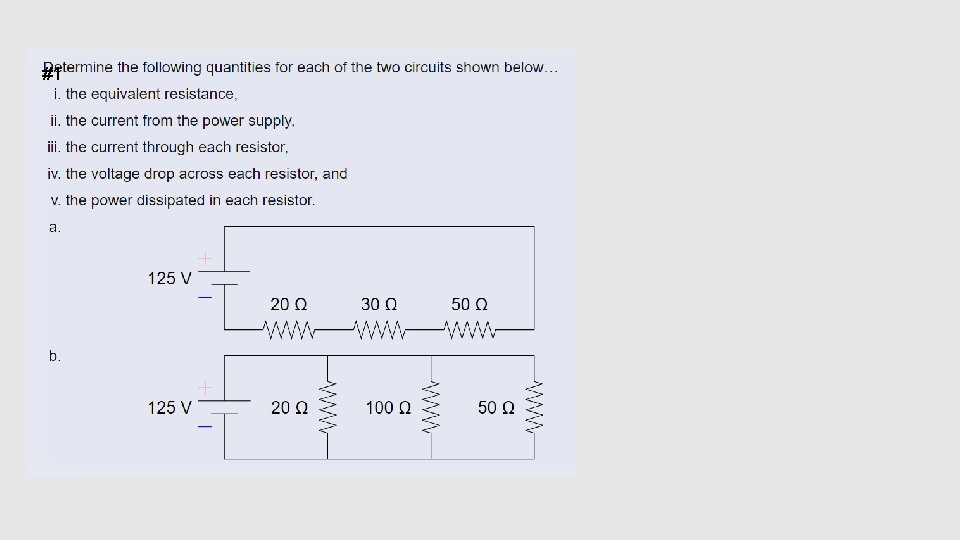
#1
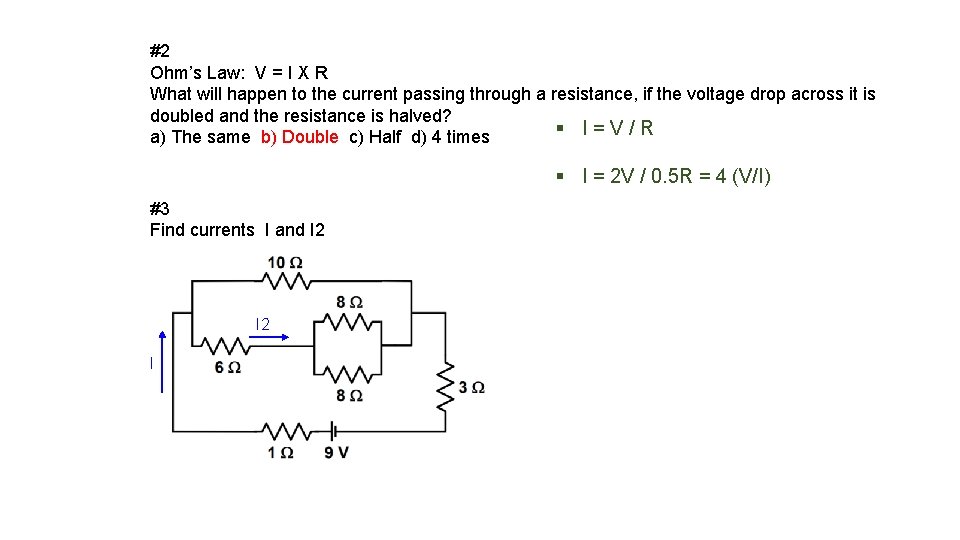
#2 Ohm’s Law: V = I X R What will happen to the current passing through a resistance, if the voltage drop across it is doubled and the resistance is halved? § I=V/R a) The same b) Double c) Half d) 4 times § I = 2 V / 0. 5 R = 4 (V/I) #3 Find currents I and I 2 I
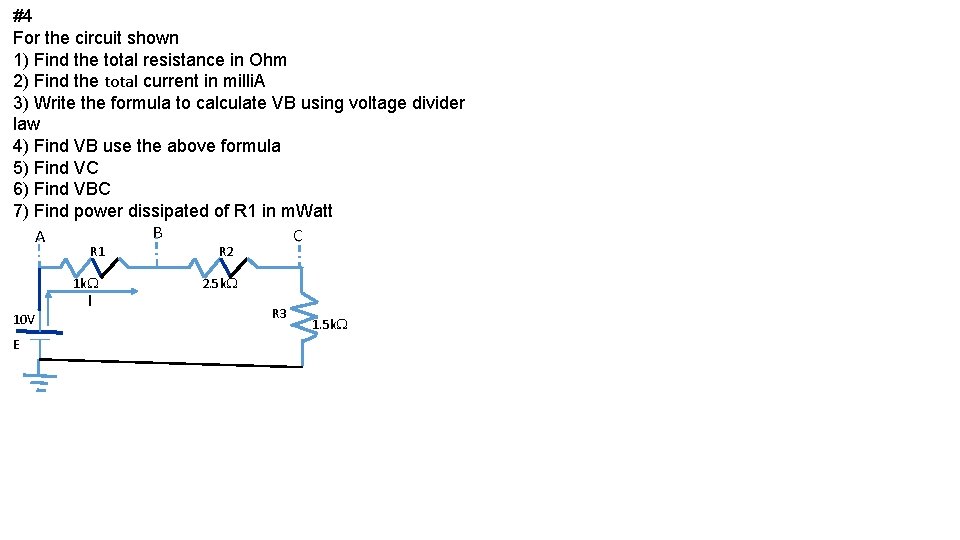
#4 For the circuit shown 1) Find the total resistance in Ohm 2) Find the total current in milli. A 3) Write the formula to calculate VB using voltage divider law 4) Find VB use the above formula 5) Find VC 6) Find VBC 7) Find power dissipated of R 1 in m. Watt B C A R 1 1 k I 10 V E R 2 2. 5 k R 3 1. 5 k
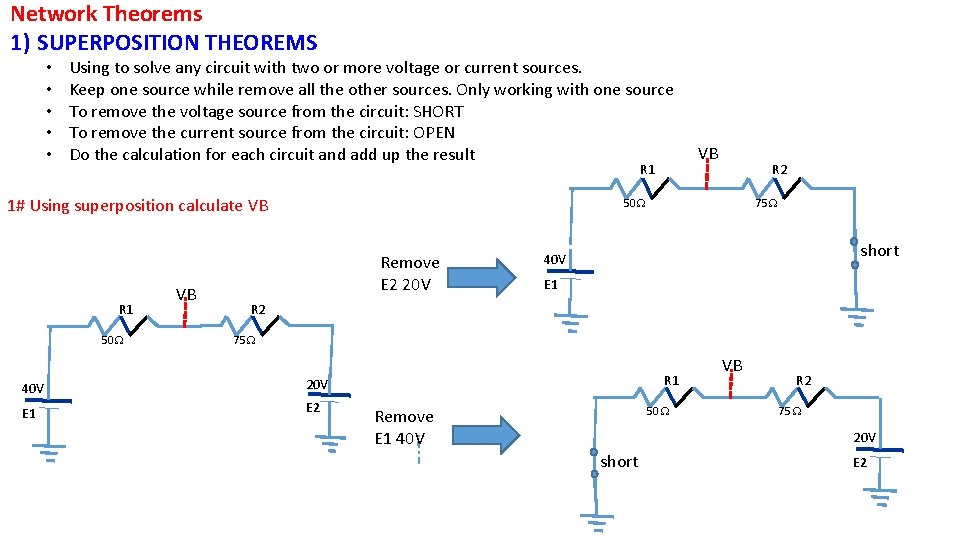
Network Theorems 1) SUPERPOSITION THEOREMS • • • Using to solve any circuit with two or more voltage or current sources. Keep one source while remove all the other sources. Only working with one source To remove the voltage source from the circuit: SHORT To remove the current source from the circuit: OPEN Do the calculation for each circuit and add up the result R 1 1# Using superposition calculate VB R 1 50 VB VB R 2 75 50 Remove E 2 20 V short 40 V E 1 R 2 75 40 V 20 V E 1 E 2 R 1 50 Remove E 1 40 V VB R 2 75 20 V short E 2
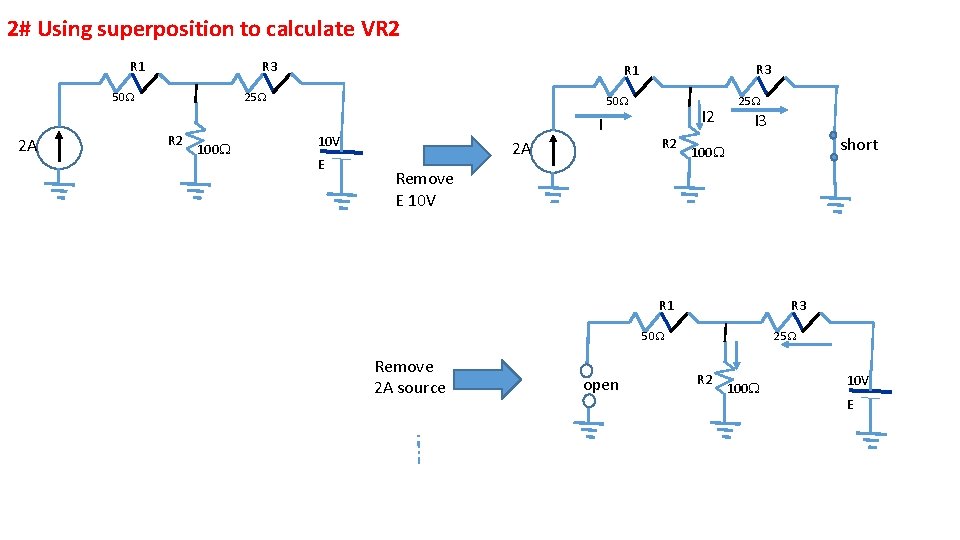
2# Using superposition to calculate VR 2 R 3 R 1 25 50 2 A R 2 100 R 3 R 1 50 10 V E I 2 I R 2 2 A 25 I 3 short 100 Remove E 10 V R 3 R 1 25 50 Remove 2 A source open R 2 100 10 V E
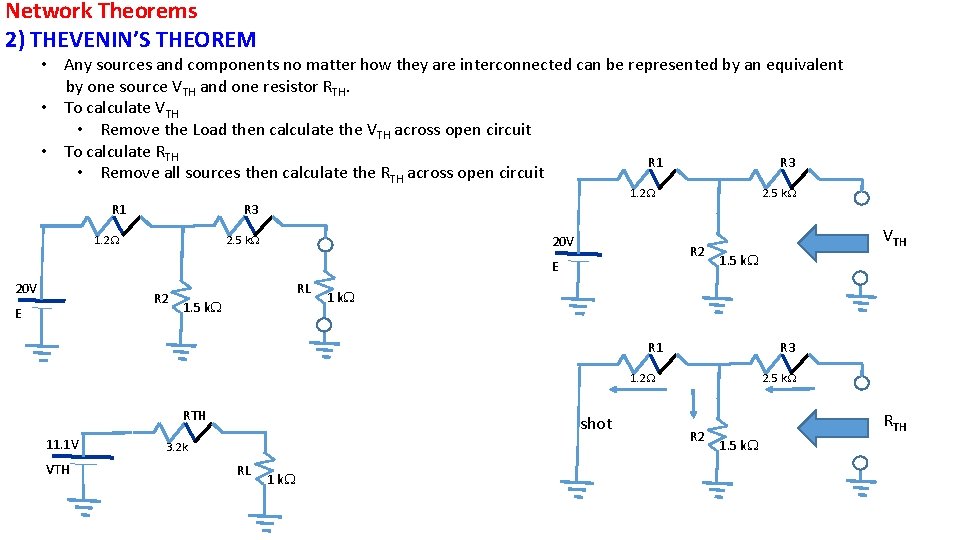
Network Theorems 2) THEVENIN’S THEOREM • Any sources and components no matter how they are interconnected can be represented by an equivalent by one source VTH and one resistor RTH. • To calculate VTH • Remove the Load then calculate the VTH across open circuit • To calculate RTH R 3 R 1 • Remove all sources then calculate the RTH across open circuit 2. 5 k 1. 2 R 3 R 1 2. 5 k 1. 2 20 V R 2 E RL 1. 5 k VTH 1. 5 k 1 k R 3 R 1 2. 5 k 1. 2 RTH 11. 1 V VTH shot 3. 2 k RL 1 k R 2 RTH 1. 5 k
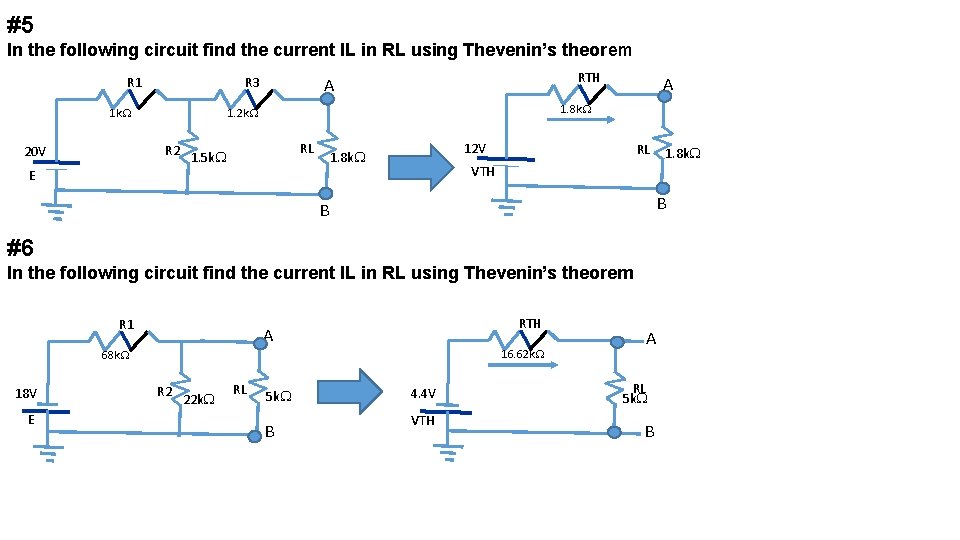
#5 In the following circuit find the current IL in RL using Thevenin’s theorem R 1 R 3 1 k A 1. 8 k 1. 2 k R 2 20 V RTH A RL 1. 5 k 12 V 1. 8 k RL 1. 8 k VTH E B B #6 In the following circuit find the current IL in RL using Thevenin’s theorem R 1 RTH A 16. 62 k 68 k 18 V E R 2 22 k RL 5 k B 4. 4 V VTH A RL 5 k B