
DC Ammeter v Galvanometer is a PMMC instrument
- Slides: 14
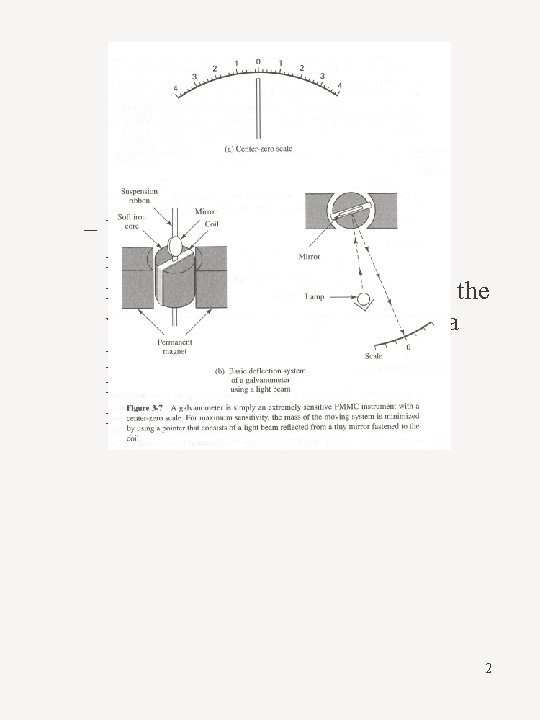
DC Ammeter v Galvanometer – is a PMMC instrument designed to be sensitive to extremely low current levels. – The simplest galvanometer is a very sensitive instrument with the type of center-zero scale. – The torque equation for a galvanometer is exactly as discussed in the previous section. – The most sensitive moving-coil galvanometer use taut-band suspension, and the controlling torque is generated by the twist in the suspension ribbon. 1
– With the moving-coil weight reduced to the lowest possible minimum for greatest sensitivity, the weight of t he pointer can create a problem. The solution is by mounting a small mirror on the moving coil instead of a pointer. 2
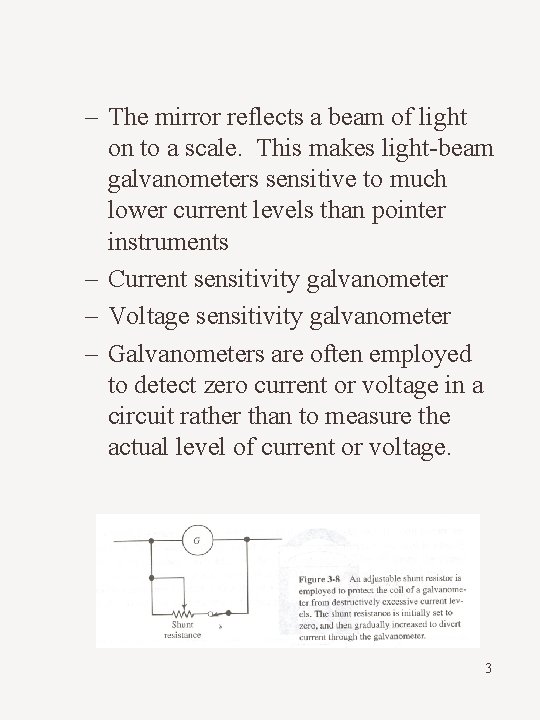
– The mirror reflects a beam of light on to a scale. This makes light-beam galvanometers sensitive to much lower current levels than pointer instruments – Current sensitivity galvanometer – Voltage sensitivity galvanometer – Galvanometers are often employed to detect zero current or voltage in a circuit rather than to measure the actual level of current or voltage. 3
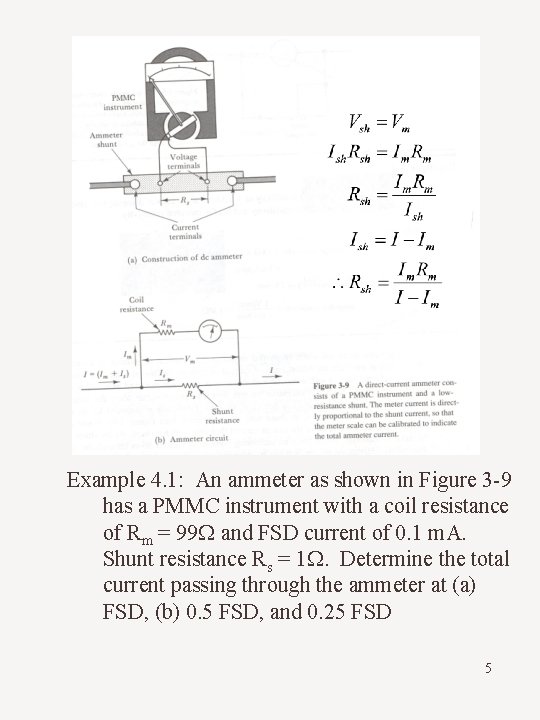
v DC Ammeter – is always connected in series – low internal resistance – maximum pointer deflection is produced by a very small current – For a large currents, the instrument must be modified by connecting a very low shunt resister – Extension of Ranges of Ammeter • Single Shunt Type of Ammeter 4
Example 4. 1: An ammeter as shown in Figure 3 -9 has a PMMC instrument with a coil resistance of Rm = 99 and FSD current of 0. 1 m. A. Shunt resistance Rs = 1. Determine the total current passing through the ammeter at (a) FSD, (b) 0. 5 FSD, and 0. 25 FSD 5
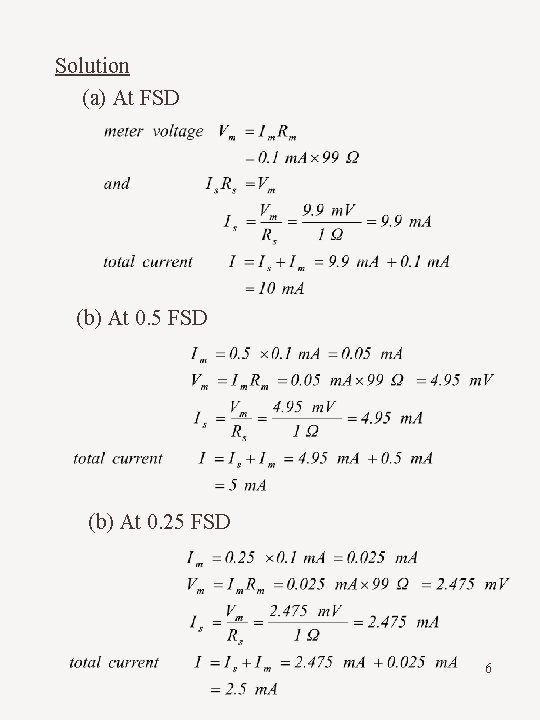
Solution (a) At FSD (b) At 0. 5 FSD (b) At 0. 25 FSD 6
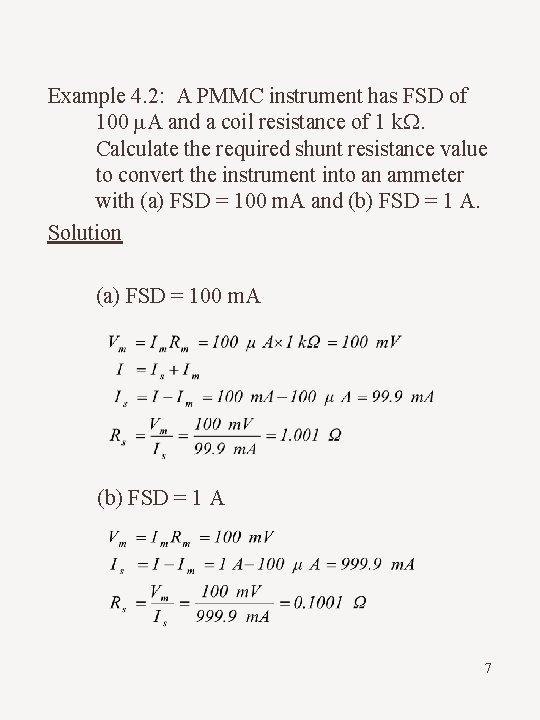
Example 4. 2: A PMMC instrument has FSD of 100 A and a coil resistance of 1 k. Calculate the required shunt resistance value to convert the instrument into an ammeter with (a) FSD = 100 m. A and (b) FSD = 1 A. Solution (a) FSD = 100 m. A (b) FSD = 1 A 7
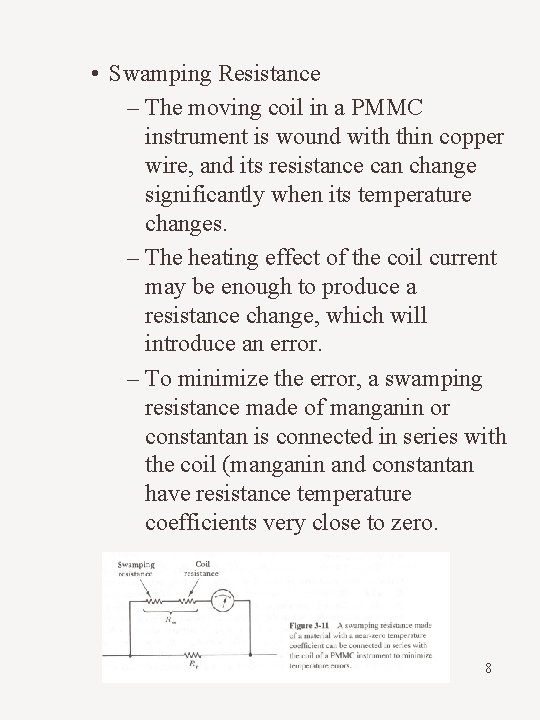
• Swamping Resistance – The moving coil in a PMMC instrument is wound with thin copper wire, and its resistance can change significantly when its temperature changes. – The heating effect of the coil current may be enough to produce a resistance change, which will introduce an error. – To minimize the error, a swamping resistance made of manganin or constantan is connected in series with the coil (manganin and constantan have resistance temperature coefficients very close to zero. 8
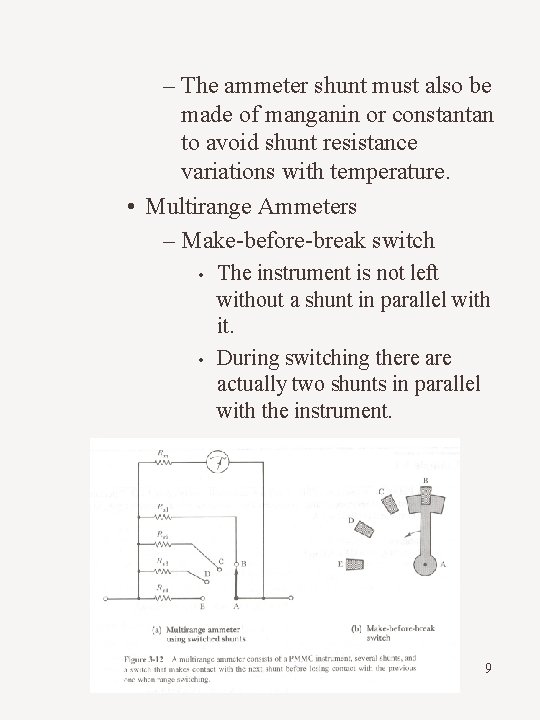
– The ammeter shunt must also be made of manganin or constantan to avoid shunt resistance variations with temperature. • Multirange Ammeters – Make-before-break switch • • The instrument is not left without a shunt in parallel with it. During switching there actually two shunts in parallel with the instrument. 9
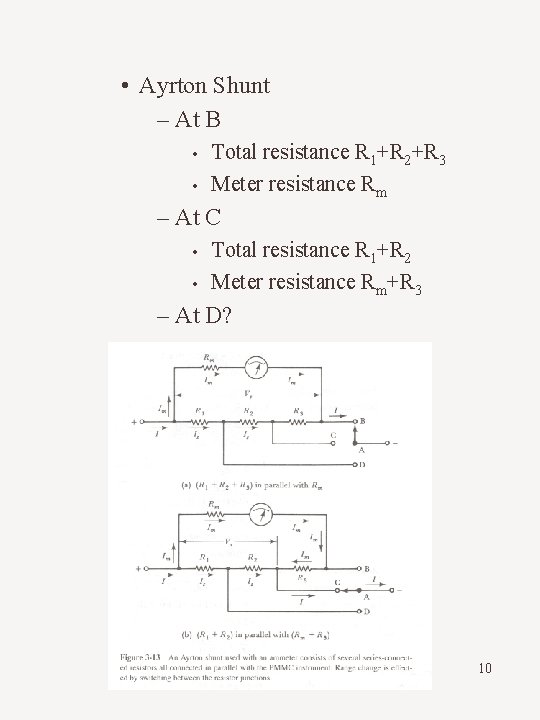
• Ayrton Shunt – At B • • Total resistance R 1+R 2+R 3 Meter resistance Rm – At C • • Total resistance R 1+R 2 Meter resistance Rm+R 3 – At D? 10
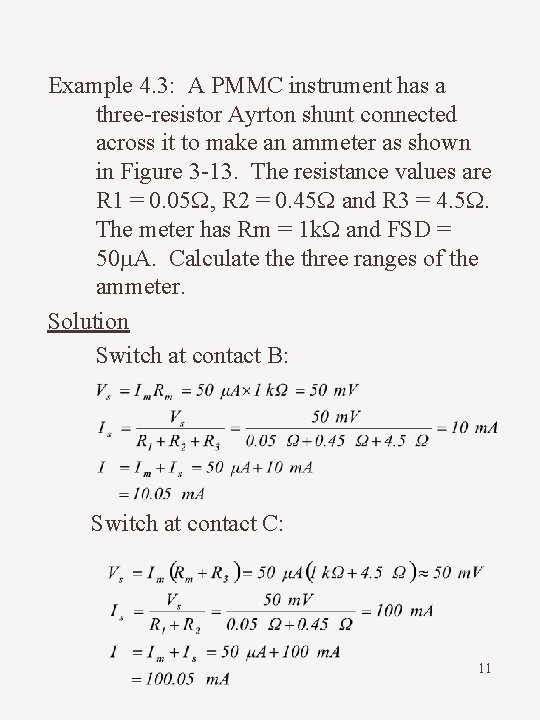
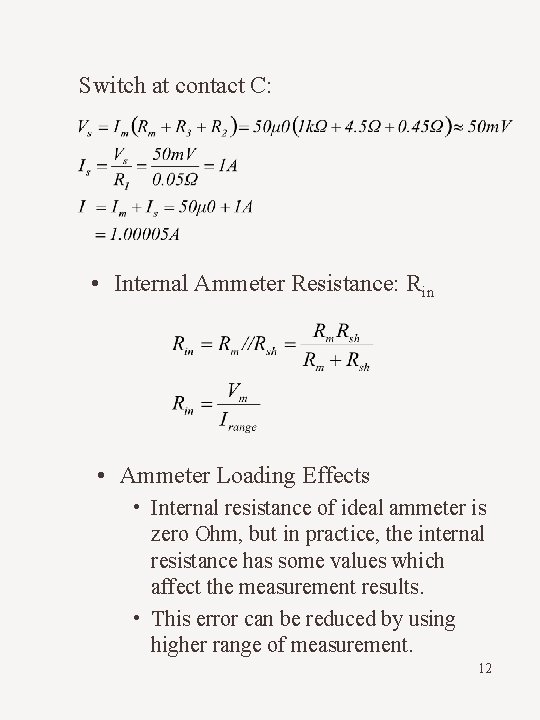
Example 4. 3: A PMMC instrument has a three-resistor Ayrton shunt connected across it to make an ammeter as shown in Figure 3 -13. The resistance values are R 1 = 0. 05 , R 2 = 0. 45 and R 3 = 4. 5. The meter has Rm = 1 k and FSD = 50 A. Calculate three ranges of the ammeter. Solution Switch at contact B: Switch at contact C: 11
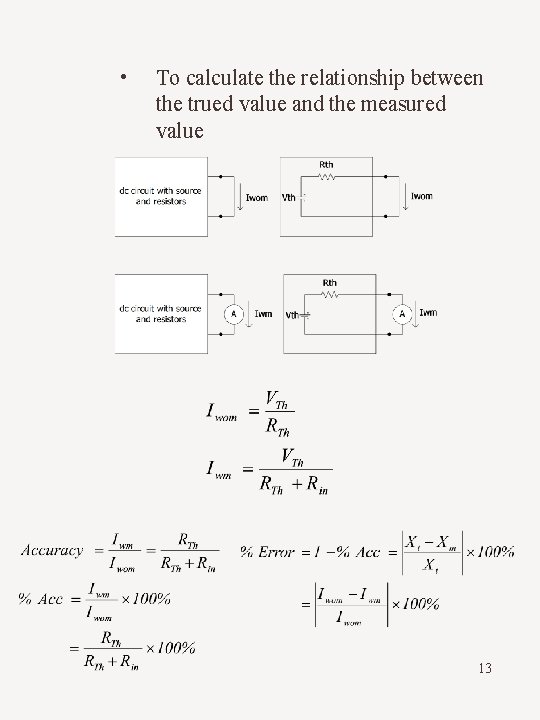
Switch at contact C: • Internal Ammeter Resistance: Rin • Ammeter Loading Effects • Internal resistance of ideal ammeter is zero Ohm, but in practice, the internal resistance has some values which affect the measurement results. • This error can be reduced by using higher range of measurement. 12
• To calculate the relationship between the trued value and the measured value 13
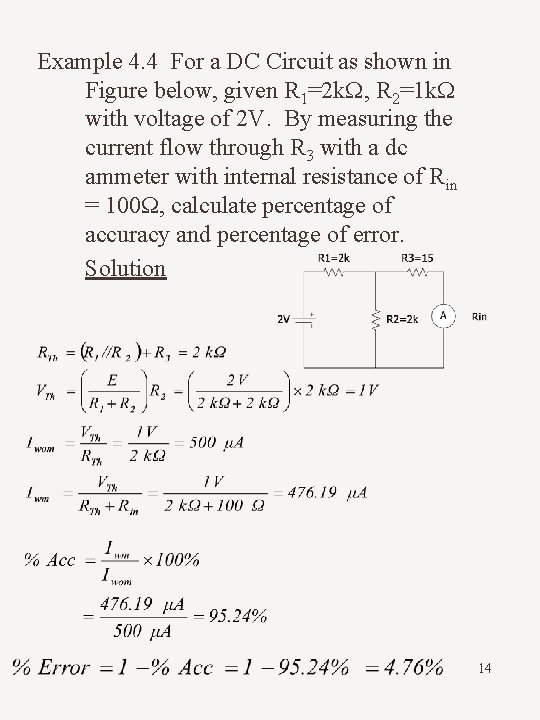
Example 4. 4 For a DC Circuit as shown in Figure below, given R 1=2 k , R 2=1 k with voltage of 2 V. By measuring the current flow through R 3 with a dc ammeter with internal resistance of Rin = 100Ω, calculate percentage of accuracy and percentage of error. Solution 14