
DBT Mission Cabinet Secretariat Direct Benefit Transfer Overview
DBT Mission Cabinet Secretariat Direct Benefit Transfer – Overview and Progress 6 th March, 2019

Direct Benefits Transfer (DBT) DBT is a significant governance reform to improve public service delivery by ensuring efficient, transparent and targeted delivery of government subsidies, benefits and services. D B T Direct – to targeted identified beneficiary Benefits: Cash (subsidy, pensions, stipends etc) and In-kind (Distribution of subsidized or free food, fertilizer, medicines etc) Transfers – Electronic; Authentication-based 2

Objectives of DBT § Create transparency in benefit transfers to beneficiaries § Accurate identification & targeting of beneficiaries § Ensure greater inclusion and ease of availing services § Curb leakages in the benefit delivery processes § Curbs ‘Rent Seeking’ – elimination of middlemen/agents § Create greater accountability on behalf of the Government § Facilitating reforms in Government processes through re-engineering § Increase efficiency in scheme delivery processes § Ensure effectiveness of schemes through timely implementation 3
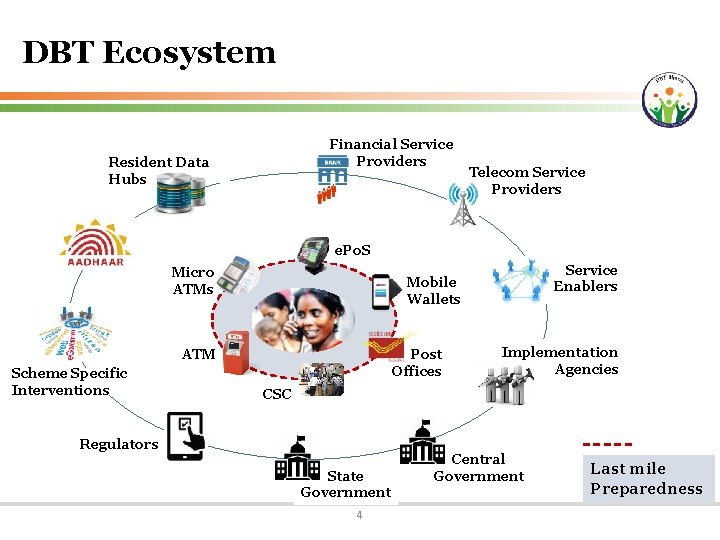
DBT Ecosystem Financial Service Providers Resident Data Hubs Telecom Service Providers e. Po. S Micro ATMs ATM Scheme Specific Interventions Service Enablers Mobile Wallets Post Offices Implementation Agencies CSC Regulators State Government 4 Central Government Last mile Preparedness
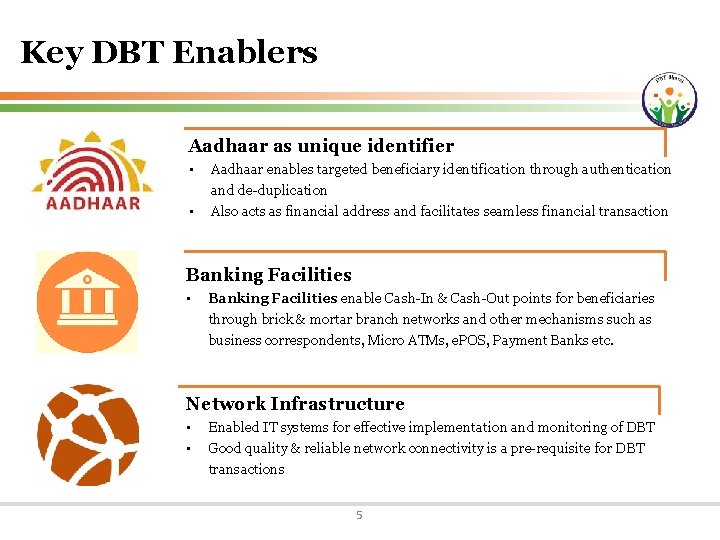
Key DBT Enablers Aadhaar as unique identifier • Aadhaar enables targeted beneficiary identification through authentication and de-duplication • Also acts as financial address and facilitates seamless financial transaction Banking Facilities • Banking Facilities enable Cash-In & Cash-Out points for beneficiaries through brick & mortar branch networks and other mechanisms such as business correspondents, Micro ATMs, e. POS, Payment Banks etc. Network Infrastructure • • Enabled IT systems for effective implementation and monitoring of DBT Good quality & reliable network connectivity is a pre-requisite for DBT transactions 5
DBT process § Assessment of Schemes for DBT applicability § Beneficiary Digitization through Scheme Management System § Beneficiary Registration, de-duplication using Aadhaar authentication § Electronic Fund Transfers directly to beneficiaries' bank account and Digital Identity linked beneficiary bank account (for cash-based schemes) § Beneficiary Authentication at time of benefit transfer § Calculating monthly Government expenditure (preferably per beneficiary expenditure) in providing in-kind benefit § Respects diversity of large & complex IT System through data-exchange frameworks Note: DBT is considered as electronic payments in case of cash schemes and Aadhaarauthenticated expenditure in case of in-kind schemes 6
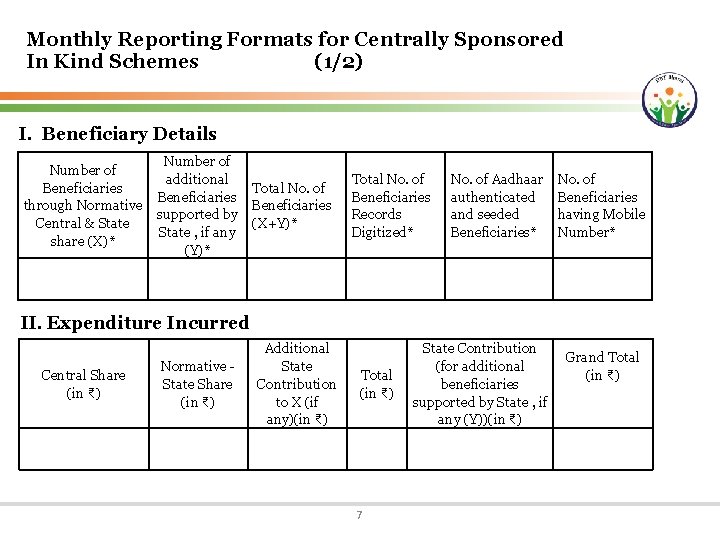
Monthly Reporting Formats for Centrally Sponsored In Kind Schemes (1/2) I. Beneficiary Details Number of Beneficiaries through Normative Central & State share (X)* Number of additional Beneficiaries supported by State , if any (Y)* Total No. of Beneficiaries (X+Y)* Total No. of Beneficiaries Records Digitized* No. of Aadhaar authenticated and seeded Beneficiaries* No. of Beneficiaries having Mobile Number* II. Expenditure Incurred Central Share (in ₹) Normative State Share (in ₹) Additional State Contribution to X (if any)(in ₹) Total (in ₹) 7 State Contribution (for additional beneficiaries supported by State , if any (Y))(in ₹) Grand Total (in ₹)
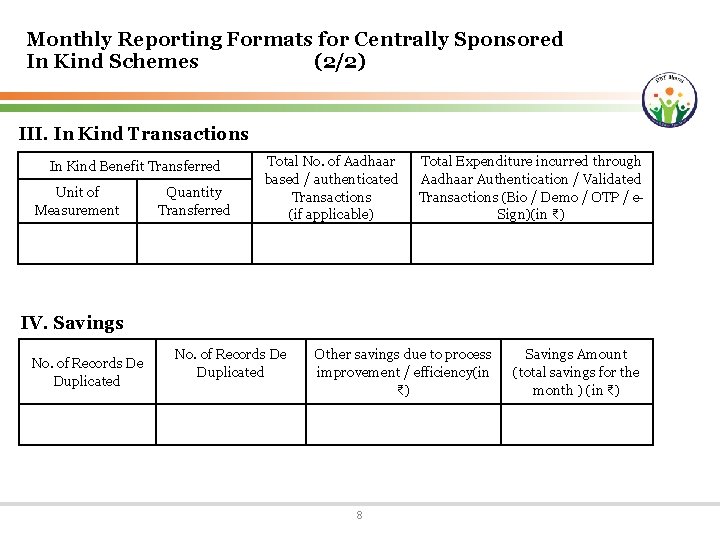
Monthly Reporting Formats for Centrally Sponsored In Kind Schemes (2/2) III. In Kind Transactions In Kind Benefit Transferred Unit of Measurement Quantity Transferred Total No. of Aadhaar based / authenticated Transactions (if applicable) Total Expenditure incurred through Aadhaar Authentication / Validated Transactions (Bio / Demo / OTP / e. Sign)(in ₹) IV. Savings No. of Records De Duplicated Other savings due to process improvement / efficiency(in ₹) 8 Savings Amount (total savings for the month ) (in ₹)
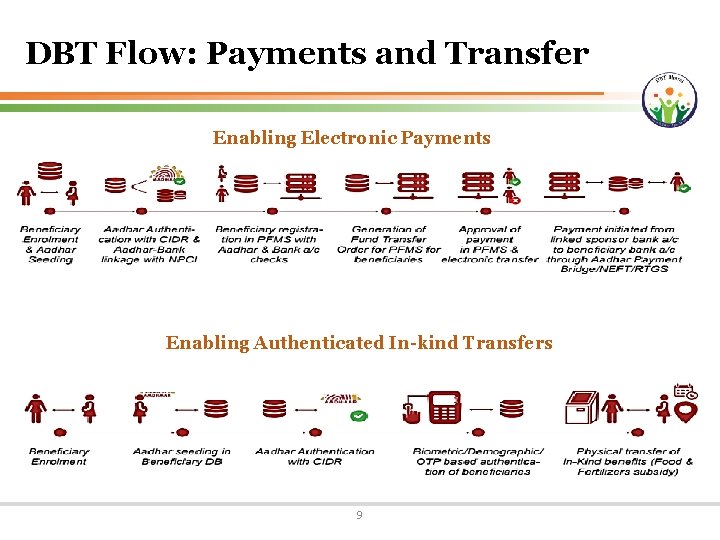
DBT Flow: Payments and Transfer Enabling Electronic Payments Enabling Authenticated In-kind Transfers 9
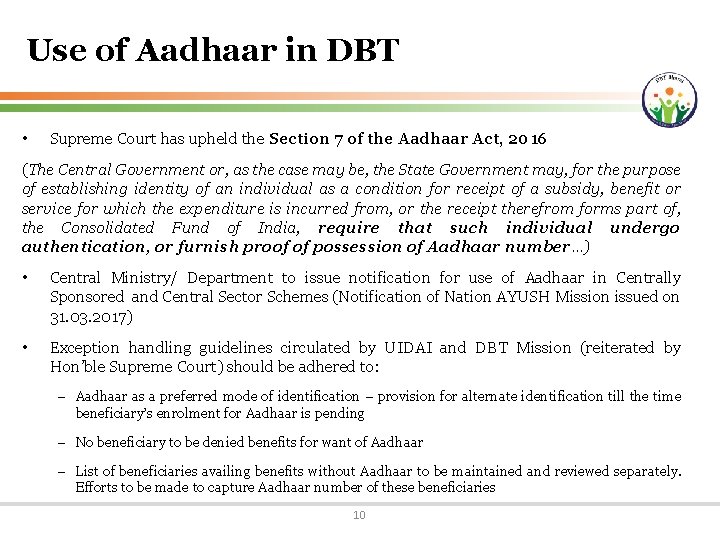
Use of Aadhaar in DBT • Supreme Court has upheld the Section 7 of the Aadhaar Act, 2016 (The Central Government or, as the case may be, the State Government may, for the purpose of establishing identity of an individual as a condition for receipt of a subsidy, benefit or service for which the expenditure is incurred from, or the receipt therefrom forms part of, the Consolidated Fund of India, require that such individual undergo authentication, or furnish proof of possession of Aadhaar number…) • Central Ministry/ Department to issue notification for use of Aadhaar in Centrally Sponsored and Central Sector Schemes (Notification of Nation AYUSH Mission issued on 31. 03. 2017) • Exception handling guidelines circulated by UIDAI and DBT Mission (reiterated by Hon’ble Supreme Court) should be adhered to: – Aadhaar as a preferred mode of identification – provision for alternate identification till the time beneficiary’s enrolment for Aadhaar is pending – No beneficiary to be denied benefits for want of Aadhaar – List of beneficiaries availing benefits without Aadhaar to be maintained and reviewed separately. Efforts to be made to capture Aadhaar number of these beneficiaries 10
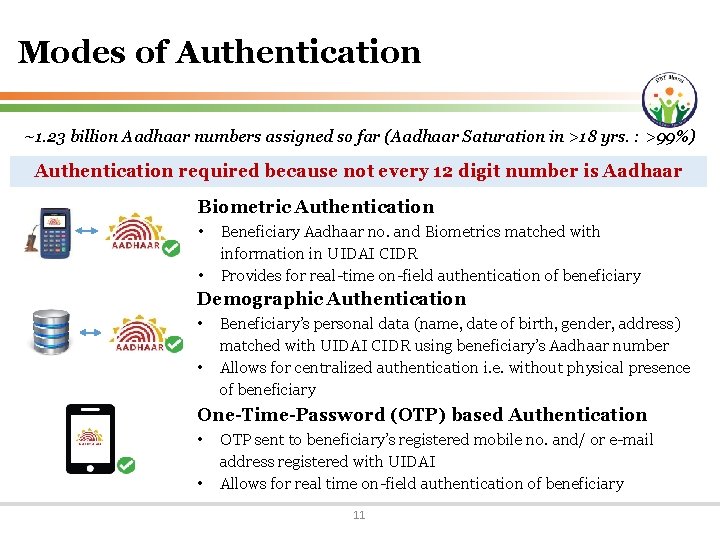
Modes of Authentication ~1. 23 billion Aadhaar numbers assigned so far (Aadhaar Saturation in >18 yrs. : >99%) Authentication required because not every 12 digit number is Aadhaar Biometric Authentication • • Beneficiary Aadhaar no. and Biometrics matched with information in UIDAI CIDR Provides for real-time on-field authentication of beneficiary Demographic Authentication • • Beneficiary’s personal data (name, date of birth, gender, address) matched with UIDAI CIDR using beneficiary’s Aadhaar number Allows for centralized authentication i. e. without physical presence of beneficiary One-Time-Password (OTP) based Authentication • • OTP sent to beneficiary’s registered mobile no. and/ or e-mail address registered with UIDAI Allows for real time on-field authentication of beneficiary 11
Compliance with Standards § Migrate old systems to adopt Local Government Directory and new systems to be developed based on LGD compliance § For cash schemes, use of DBT Scheme Code (Unique scheme codes for all DBT schemes implemented in Ministries/Departments and States/UTs) for beneficiary payment transactions § Compliance to Data & Meta Data Standards published by Meit. Y § Compliance to UIDAI Security Standards for storing of Aadhaar numbers; Integration with UIDAI for Demographic, OTP-based and/or Biometric Authentication should allow for authentications services using Virtual ID § Compliance to Cyber security protocols / standards, Data privacy § Compliance to Government of India website guidelines 12
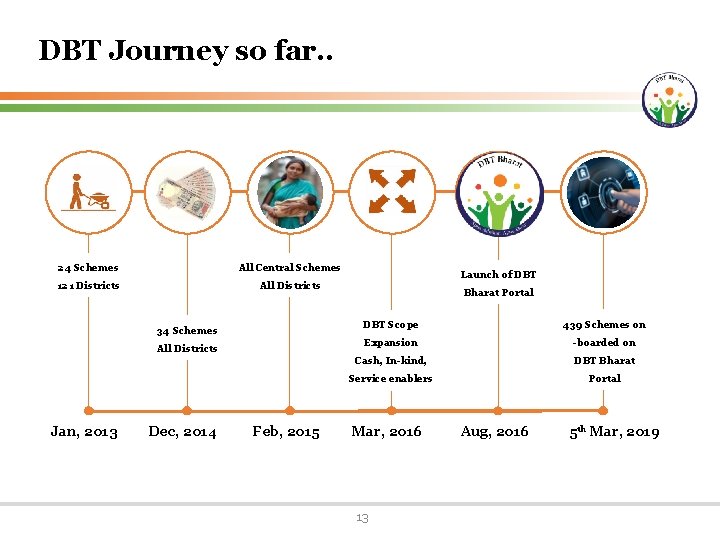
DBT Journey so far. . 24 Schemes All Central Schemes 121 Districts All Districts 34 Schemes All Districts Jan, 2013 Dec, 2014 Feb, 2015 Launch of DBT Bharat Portal DBT Scope 439 Schemes on Expansion -boarded on Cash, In-kind, DBT Bharat Service enablers Portal Mar, 2016 13 Aug, 2016 5 th Mar, 2019
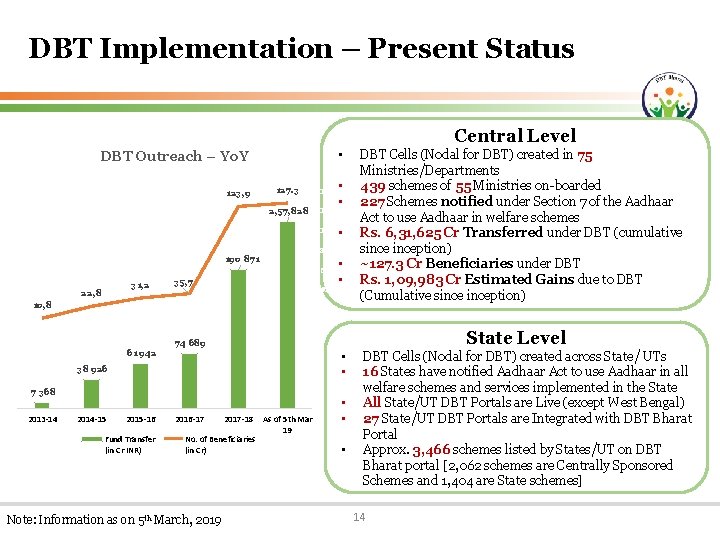
DBT Implementation – Present Status Central Level • DBT Outreach – Yo. Y 123, 9 300 000 127. 3 140 2, 57, 828 120 100 60 31, 2 22, 8 • 80 190 871 200 000 • • 35, 7 40 10, 8 • • DBT Cells (Nodal for DBT) created in 75 Ministries/Departments 439 schemes of 55 Ministries on-boarded 227 Schemes notified under Section 7 of the Aadhaar Act to use Aadhaar in welfare schemes Rs. 6, 31, 625 Cr Transferred under DBT (cumulative sinception) ~127. 3 Cr Beneficiaries under DBT Rs. 1, 09, 983 Cr Estimated Gains due to DBT (Cumulative sinception) 20 0 100 000 61 942 74 689 -20 -40 38 926 • • -60 7 368 - 2013 -14 State Level 2014 -15 2015 -16 Fund Transfer (in Cr INR) 2016 -17 2017 -18 No. of Beneficiaries (in Cr) Note: Information as on 5 th March, 2019 As of 5 th Mar 19 -80 • • • DBT Cells (Nodal for DBT) created across State/ UTs 16 States have notified Aadhaar Act to use Aadhaar in all welfare schemes and services implemented in the State All State/UT DBT Portals are Live (except West Bengal) 27 State/UT DBT Portals are Integrated with DBT Bharat Portal Approx. 3, 466 schemes listed by States/UT on DBT Bharat portal [2, 062 schemes are Centrally Sponsored Schemes and 1, 404 are State schemes] 14
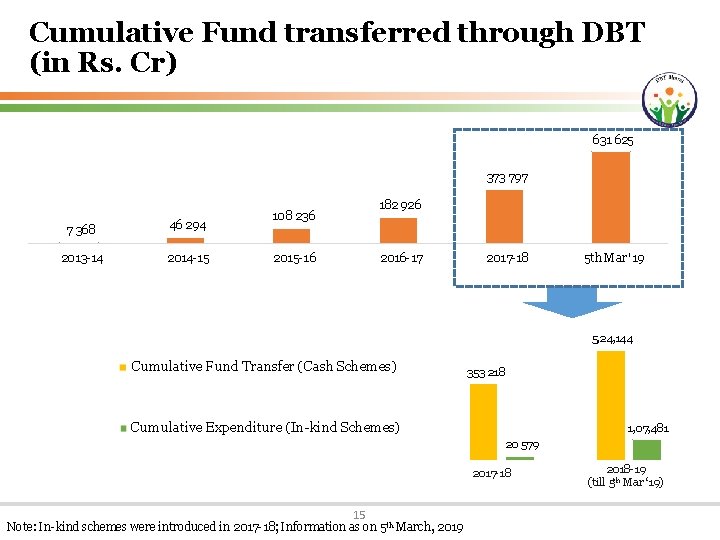
Cumulative Fund transferred through DBT (in Rs. Cr) 631 625 373 797 7 368 46 294 2013 -14 2014 -15 108 236 2015 -16 182 926 2016 -17 2017 -18 5 th Mar '19 5, 24, 144 Cumulative Fund Transfer (Cash Schemes) 353 218 Cumulative Expenditure (In-kind Schemes) 1, 07, 481 20 579 2017 -18 15 Note: In-kind schemes were introduced in 2017 -18; Information as on 5 th March, 2019 2018 -19 (till 5 th Mar ‘ 19)
National AYUSH Mission : Way Forward § Scheme management system has been developed for National AYUSH Mission § Login ids for data entry to be generated at the hospital / facility level or at district level § Digitized beneficiary database to be prepared to ensure rightful targeting § Scheme portal to allow for Aadhaar seeding and authentication of beneficiaries (including through VID) § UIDAI’s guidelines with respect to storing of Aadhaar numbers to be adhered to § Exception handling guidelines of DBT Mission & UIDAI to be followed so that no beneficiary is denied benefits for want of Aadhaar. Detailed exception handling guidelines for the field functionaries and officials to be issued, if required § Infrastructure to ensure last-mile delivery of benefits: Strengthening of physical infrastructure for registration and authentication of beneficiaries § Efforts may be made to ensure that data on expenditure and disbursal of medicines is maintained at the level of hospital / facility § Flow of DBT data between Scheme management system, DBT Bharat portal and State/UT DBT portals every month through web-services 16
Thank You
- Slides: 17