
DBGroup unimore Big Data Integration Prof Sonia Bergamaschi
DBGroup @ unimore Big Data Integration Prof. Sonia Bergamaschi Department of Engineering “Enzo Ferrari” University of Modena and Reggio Emilia IC 3 K 2014 – Rome, Italy, 21 -24 October Prof. Sonia Bergamaschi Department of Engineering “Enzo Ferrari” – Università di Modena e Reggio Emilia 1
DBGroup @ unimore Outline • Motivation • Schema alignment • Record linkage • Data fusion • Emerging topics IC 3 K 2014 – Rome, Italy, 21 -24 October Prof. Sonia Bergamaschi Department of Engineering “Enzo Ferrari” – Università di Modena e Reggio Emilia 2
DBGroup @ unimore What is “Big Data Integration? ” • Big Data Integration (BDI)= Big data + Data Integration • Data Integration: easy access to multiple data sources – Virtual: mediated schema, query reformulation, link + fuse answers – Warehouse: materialized data, easy querying, consistency issues • Big data in the context of data integration: still about the V’s – Size: large volume of sources, changing at high velocity – Complexity: huge variety of sources, of questionable IC 3 K 2014 – Rome, Italy, 21 -24 October Prof. Sonia Bergamaschi Department of Engineering “Enzo Ferrari” – Università di Modena e Reggio Emilia 3
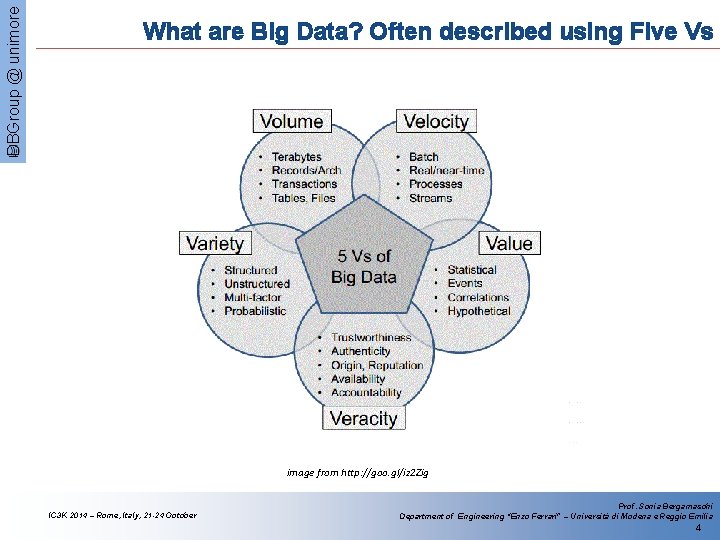
DBGroup @ unimore What are Big Data? Often described using Five Vs image from http: //goo. gl/iz 2 Zig IC 3 K 2014 – Rome, Italy, 21 -24 October Prof. Sonia Bergamaschi Department of Engineering “Enzo Ferrari” – Università di Modena e Reggio Emilia 4
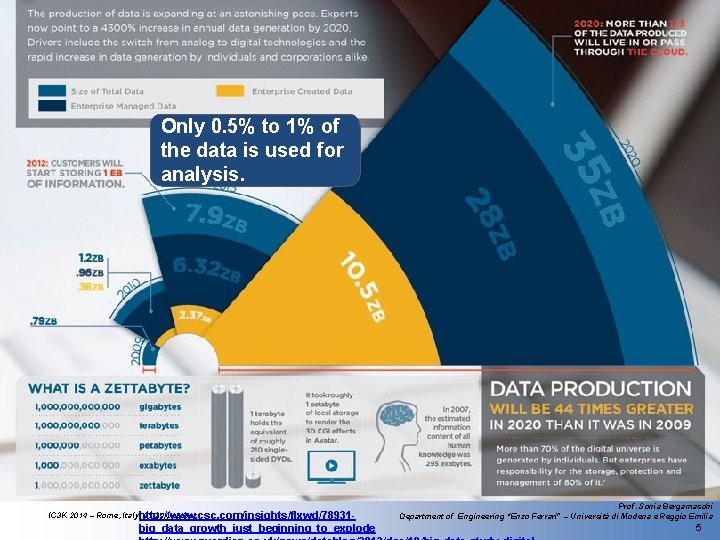
DBGroup @ unimore Only 0. 5% to 1% of the data is used for analysis. IC 3 K 2014 – Rome, Italy, http: //www. csc. com/insights/flxwd/7893121 -24 October big_data_growth_just_beginning_to_explode Prof. Sonia Bergamaschi Department of Engineering “Enzo Ferrari” – Università di Modena e Reggio Emilia 5
DBGroup @ unimore Questions typically asked on Big Data • What if your data volume gets so large and varied you don't know how to deal with it? • Do you store all your data? • Do you analyze it all? • What is coverage, skew, quality? • How can you find out which data points are really important? • How can you use it to your best advantage? IC 3 K 2014 – Rome, Italy, 21 -24 October [Seth 2014] Prof. Sonia Bergamaschi Department of Engineering “Enzo Ferrari” – Università di Modena e Reggio Emilia 6
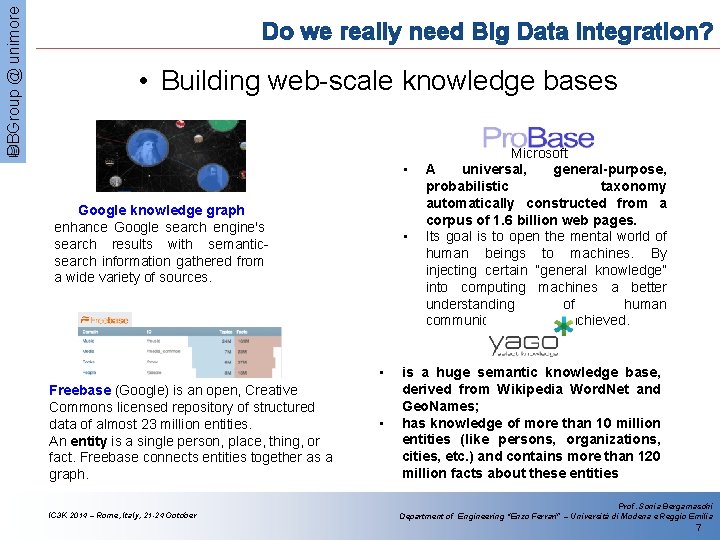
DBGroup @ unimore Do we really need Big Data Integration? • Building web-scale knowledge bases • Google knowledge graph enhance Google search engine's search results with semanticsearch information gathered from a wide variety of sources. • • Freebase (Google) is an open, Creative Commons licensed repository of structured data of almost 23 million entities. An entity is a single person, place, thing, or fact. Freebase connects entities together as a graph. IC 3 K 2014 – Rome, Italy, 21 -24 October • Microsoft A universal, general-purpose, probabilistic taxonomy automatically constructed from a corpus of 1. 6 billion web pages. Its goal is to open the mental world of human beings to machines. By injecting certain “general knowledge” into computing machines a better understanding of human communication can be achieved. is a huge semantic knowledge base, derived from Wikipedia Word. Net and Geo. Names; has knowledge of more than 10 million entities (like persons, organizations, cities, etc. ) and contains more than 120 million facts about these entities Prof. Sonia Bergamaschi Department of Engineering “Enzo Ferrari” – Università di Modena e Reggio Emilia 7
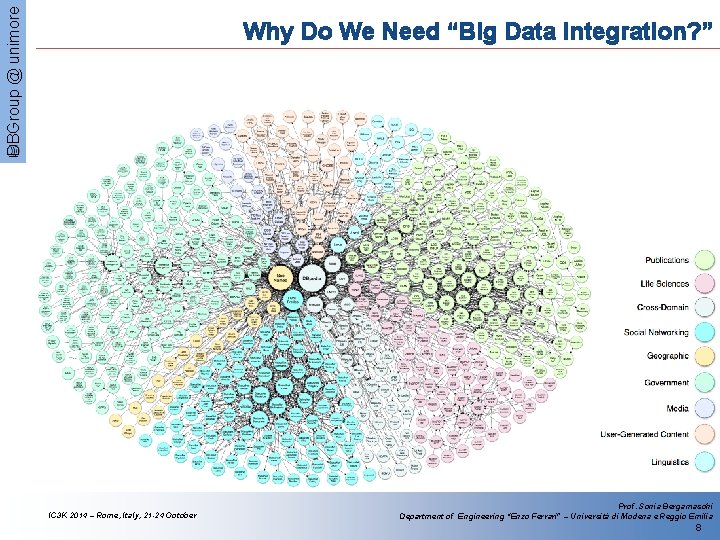
DBGroup @ unimore Why Do We Need “Big Data Integration? ” IC 3 K 2014 – Rome, Italy, 21 -24 October Prof. Sonia Bergamaschi Department of Engineering “Enzo Ferrari” – Università di Modena e Reggio Emilia 8
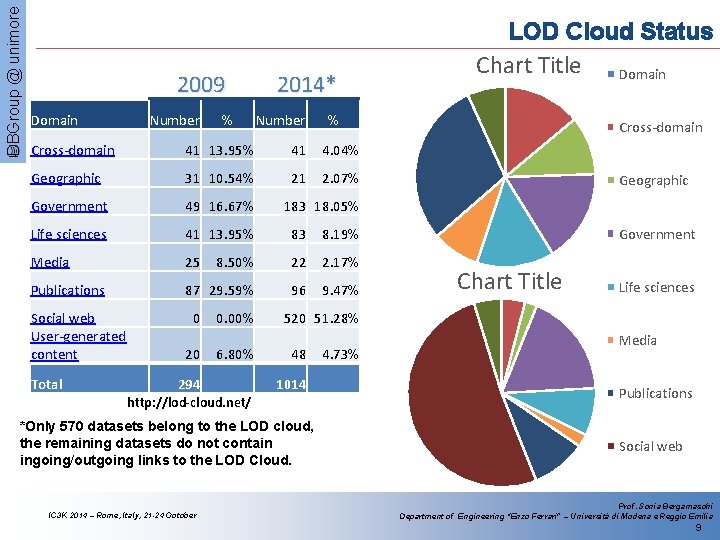
DBGroup @ unimore 2009 Domain Number % 2014* Number % Cross-domain 41 13. 95% 41 4. 04% Geographic 31 10. 54% 21 2. 07% Government 49 16. 67% Life sciences 41 13. 95% 83 8. 19% Media 25 8. 50% 22 2. 17% Publications 87 29. 59% 96 9. 47% Social web User-generated content Total 0 0. 00% 20 6. 80% 294 Cross-domain Geographic 183 18. 05% Government Chart Title Life sciences 520 51. 28% 48 1014 http: //lod-cloud. net/ *Only 570 datasets belong to the LOD cloud, the remaining datasets do not contain ingoing/outgoing links to the LOD Cloud. IC 3 K 2014 – Rome, Italy, 21 -24 October LOD Cloud Status Chart Title Domain 4. 73% Media Publications Social web Prof. Sonia Bergamaschi Department of Engineering “Enzo Ferrari” – Università di Modena e Reggio Emilia 9
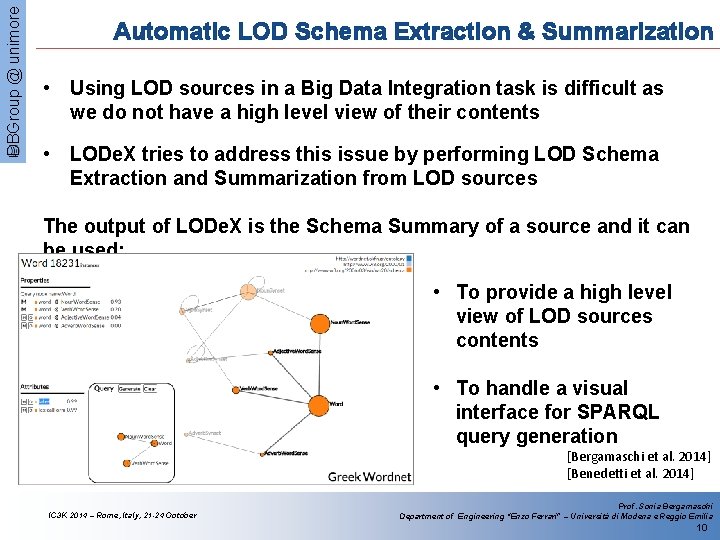
DBGroup @ unimore Automatic LOD Schema Extraction & Summarization • Using LOD sources in a Big Data Integration task is difficult as we do not have a high level view of their contents • LODe. X tries to address this issue by performing LOD Schema Extraction and Summarization from LOD sources The output of LODe. X is the Schema Summary of a source and it can be used: • To provide a high level view of LOD sources contents • To handle a visual interface for SPARQL query generation [Bergamaschi et al. 2014] [Benedetti et al. 2014] IC 3 K 2014 – Rome, Italy, 21 -24 October Prof. Sonia Bergamaschi Department of Engineering “Enzo Ferrari” – Università di Modena e Reggio Emilia 10
DBGroup @ unimore Current Focus on Big Data • Focus on verticals advertising‚ social media‚ retail‚ financial services, telecom and healthcare – Aggregate data, focused on transactions, limited integration (limited complexity), analytics to find (simple) patterns – Emphasis on technologies to handle volume/scale, and to lesser extent velocity: Hadoop, No. SQL, MPP (Massive Parallel Processing) for data warehouse: DWA (Data Warehousing Appliance), …. – Full faith in the power of data (no hypothesis), bottom up analysis IC 3 K 2014 – Rome, Italy, 21 -24 October Prof. Sonia Bergamaschi Department of Engineering “Enzo Ferrari” – Università di Modena e Reggio Emilia 11
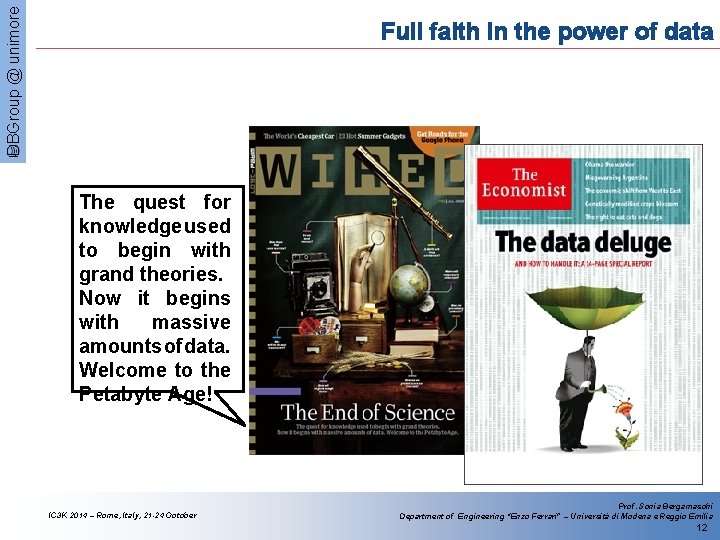
DBGroup @ unimore Full faith in the power of data The quest for knowledge used to begin with grand theories. Now it begins with massive amounts of data. Welcome to the Petabyte Age! IC 3 K 2014 – Rome, Italy, 21 -24 October Prof. Sonia Bergamaschi Department of Engineering “Enzo Ferrari” – Università di Modena e Reggio Emilia 12
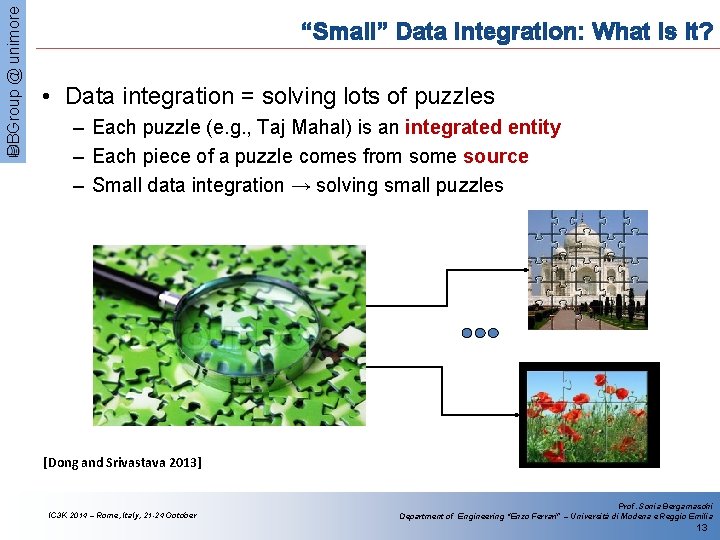
DBGroup @ unimore “Small” Data Integration: What Is It? • Data integration = solving lots of puzzles – Each puzzle (e. g. , Taj Mahal) is an integrated entity – Each piece of a puzzle comes from some source – Small data integration → solving small puzzles [Dong and Srivastava 2013] IC 3 K 2014 – Rome, Italy, 21 -24 October Prof. Sonia Bergamaschi Department of Engineering “Enzo Ferrari” – Università di Modena e Reggio Emilia 13
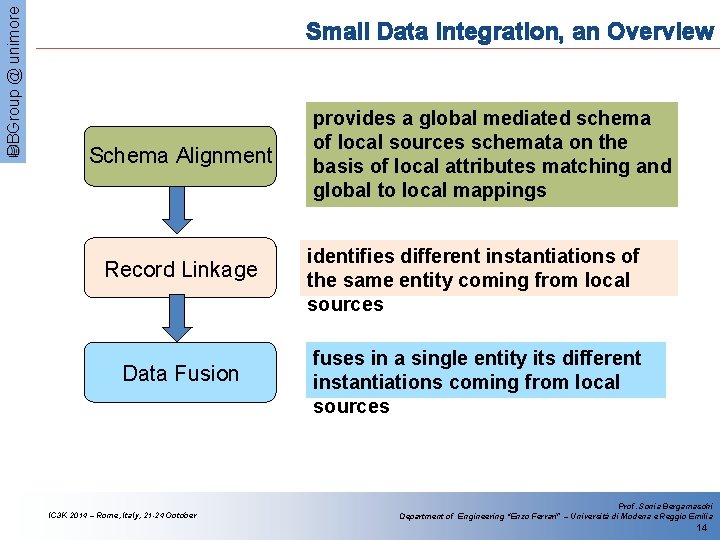
DBGroup @ unimore Small Data Integration, an Overview Schema Alignment Record Linkage Data Fusion IC 3 K 2014 – Rome, Italy, 21 -24 October provides a global mediated schema of local sources schemata on the basis of local attributes matching and global to local mappings identifies different instantiations of the same entity coming from local sources fuses in a single entity its different instantiations coming from local sources Prof. Sonia Bergamaschi Department of Engineering “Enzo Ferrari” – Università di Modena e Reggio Emilia 14
DBGroup @ unimore Virtual Data Integration www. datariver. it [Berg. SIGMOD 99] IC 3 K 2014 – Rome, Italy, 21 -24 October Prof. Sonia Bergamaschi Department of Engineering “Enzo Ferrari” – Università di Modena e Reggio Emilia
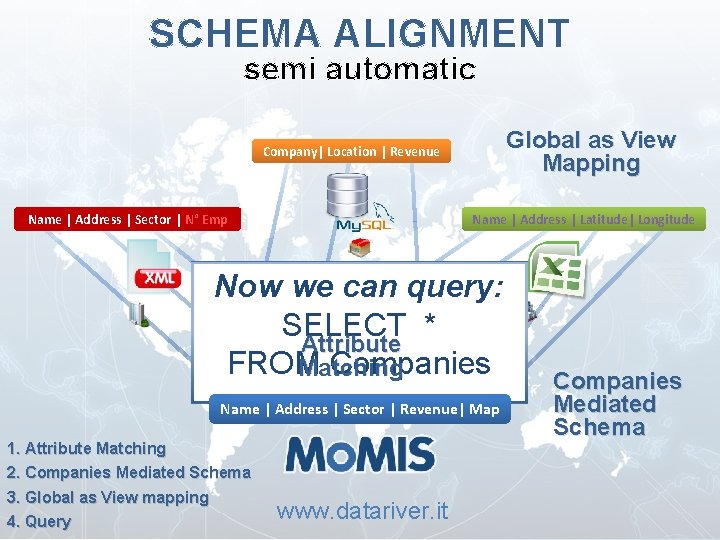
DBGroup @ unimore SCHEMA ALIGNMENT semi automatic Global as View Mapping Company| Location | Revenue Name | Address | Sector | N° Emp Name || Address || Latitude| Lomgitude Longitude s Now we can query: SELECT * Attribute FROM Companies Matching Name | Address | Sector | Revenue| Map 1. Attribute Matching 2. Companies Mediated Schema 3. Global as View mapping IC 3 K 2014 – Rome, Italy, 21 -24 October 4. Query www. datariver. it Companies Mediated Schema Prof. Sonia Bergamaschi Department of Engineering “Enzo Ferrari” – Università di Modena e Reggio Emilia
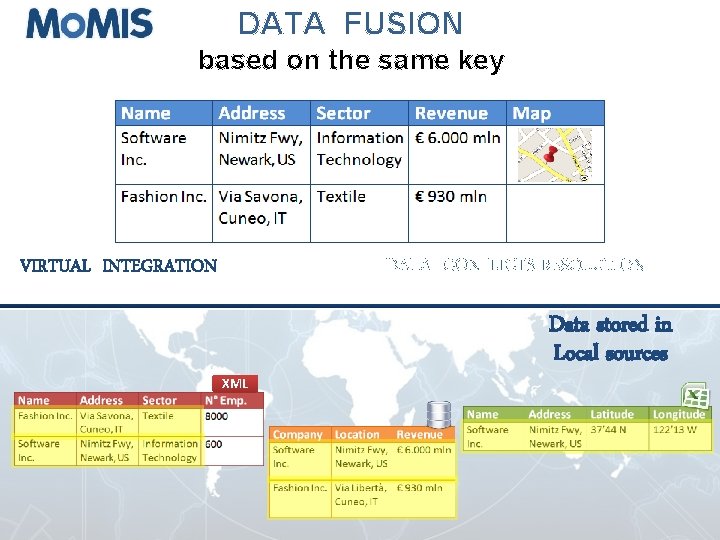
DBGroup @ unimore DATA FUSION based on the same key DATA CONFLICTS RESOLUTION VIRTUAL INTEGRATION XML IC 3 K 2014 – Rome, Italy, 21 -24 October Data stored in Local sources Prof. Sonia Bergamaschi Department of Engineering “Enzo Ferrari” – Università di Modena e Reggio Emilia
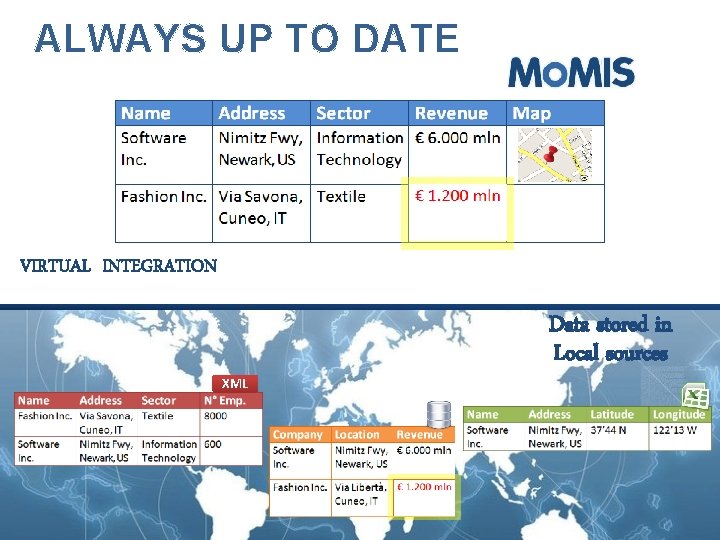
DBGroup @ unimore ALWAYS UP TO DATE VIRTUAL INTEGRATION XML IC 3 K 2014 – Rome, Italy, 21 -24 October Data stored in Local sources Prof. Sonia Bergamaschi Department of Engineering “Enzo Ferrari” – Università di Modena e Reggio Emilia
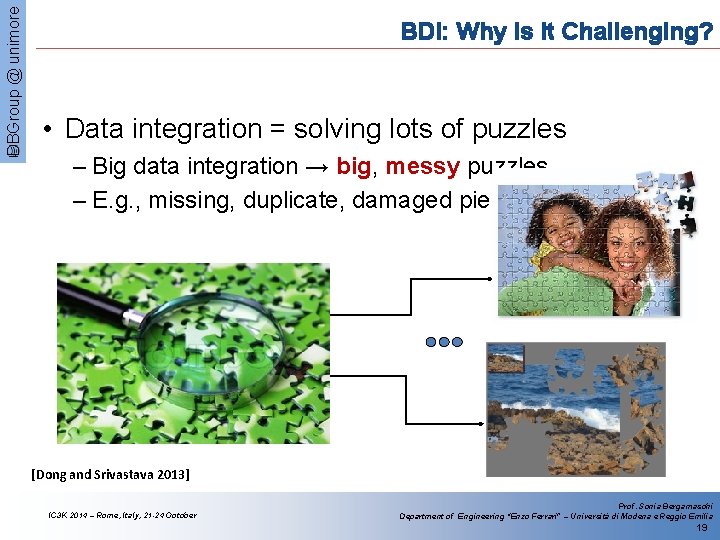
DBGroup @ unimore BDI: Why is it Challenging? • Data integration = solving lots of puzzles – Big data integration → big, messy puzzles – E. g. , missing, duplicate, damaged pieces [Dong and Srivastava 2013] IC 3 K 2014 – Rome, Italy, 21 -24 October Prof. Sonia Bergamaschi Department of Engineering “Enzo Ferrari” – Università di Modena e Reggio Emilia 19
DBGroup @ unimore BDI: Why is it Challenging? Number of structured sources: Volume o 150 million high quality relational tables on the web o 10 s of millions of high quality deep web sources • Challenges: – Difficult to do schema alignment even if we restrict the integration within a single specific domain – Expensive to warehouse all the integrated data – Infeasible to support virtual integration Rate of change in structured sources: Velocity o Many sources provide rapidly changing data, e. g. , stock prices o 450, 000 databases, 1. 25 M query interfaces on the web • Challenges: – Difficult to understand evolution of semantics – Extremely expensive to warehouse data history – Infeasible to capture rapid data changes in a timely fashion [Dong and Srivastava 2013] IC 3 K 2014 – Rome, Italy, 21 -24 October Prof. Sonia Bergamaschi Department of Engineering “Enzo Ferrari” – Università di Modena e Reggio Emilia 20
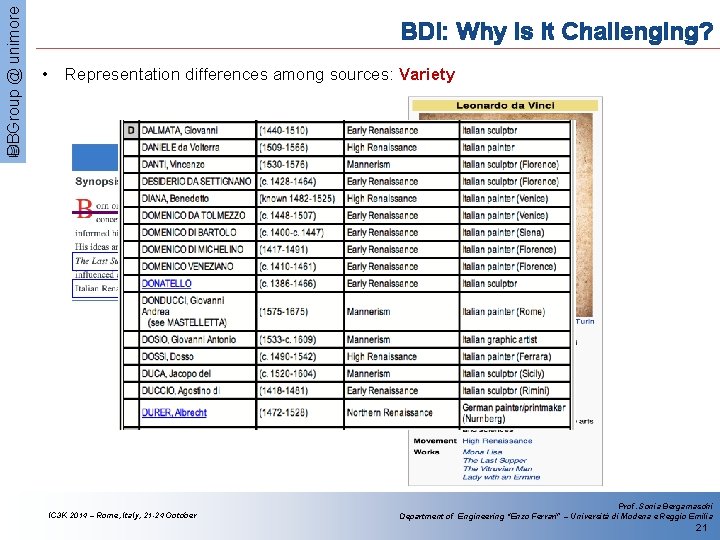
DBGroup @ unimore BDI: Why is it Challenging? • Representation differences among sources: Variety Free-text extractors IC 3 K 2014 – Rome, Italy, 21 -24 October Prof. Sonia Bergamaschi Department of Engineering “Enzo Ferrari” – Università di Modena e Reggio Emilia 21
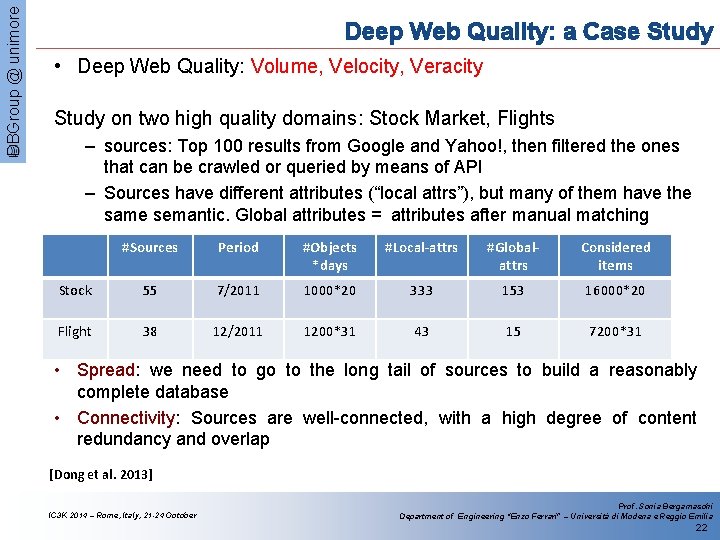
DBGroup @ unimore Deep Web Quality: a Case Study • Deep Web Quality: Volume, Velocity, Veracity Study on two high quality domains: Stock Market, Flights – sources: Top 100 results from Google and Yahoo!, then filtered the ones that can be crawled or queried by means of API – Sources have different attributes (“local attrs”), but many of them have the same semantic. Global attributes = attributes after manual matching #Sources Period #Objects *days #Local-attrs #Globalattrs Considered items Stock 55 7/2011 1000*20 333 153 16000*20 Flight 38 12/2011 1200*31 43 15 7200*31 • Spread: we need to go to the long tail of sources to build a reasonably complete database • Connectivity: Sources are well-connected, with a high degree of content redundancy and overlap [Dong et al. 2013] IC 3 K 2014 – Rome, Italy, 21 -24 October Prof. Sonia Bergamaschi Department of Engineering “Enzo Ferrari” – Università di Modena e Reggio Emilia 22
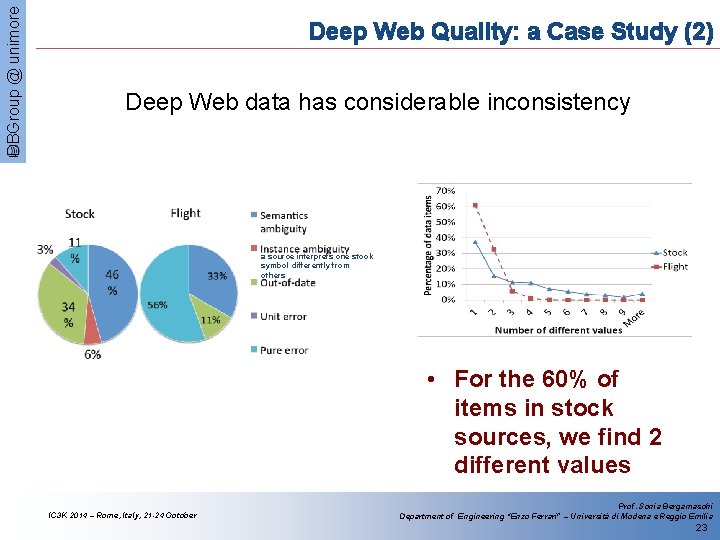
DBGroup @ unimore Deep Web Quality: a Case Study (2) Deep Web data has considerable inconsistency a source interprets one stock symbol differently from others • For the 60% of items in stock sources, we find 2 different values IC 3 K 2014 – Rome, Italy, 21 -24 October Prof. Sonia Bergamaschi Department of Engineering “Enzo Ferrari” – Università di Modena e Reggio Emilia 23
DBGroup @ unimore Outline • Motivation • Schema alignment • Record linkage • Data fusion • Emerging topics IC 3 K 2014 – Rome, Italy, 21 -24 October Prof. Sonia Bergamaschi Department of Engineering “Enzo Ferrari” – Università di Modena e Reggio Emilia 24
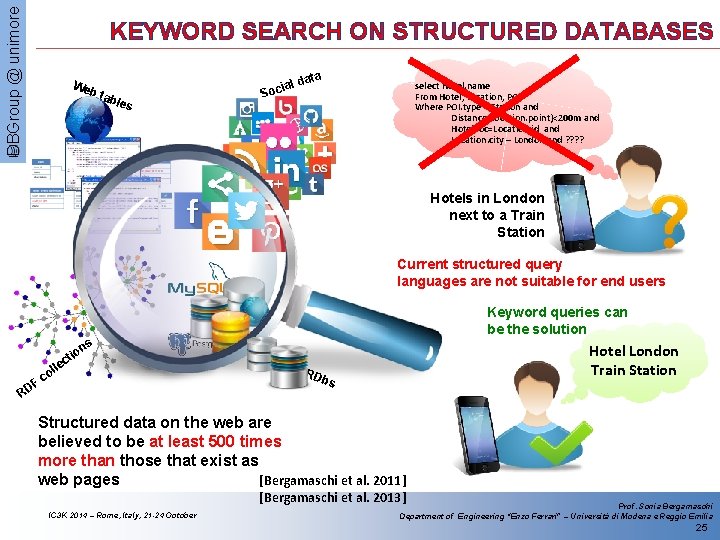
DBGroup @ unimore KEYWORD SEARCH ON STRUCTURED DATABASES We b ta ble s ial Soc data select Hotel. name From Hotel, Location, POI Where POI. type = Station and Distance(Location. point)<200 m and Hotel. loc=Location. id and Location. city – London and ? ? Hotels in London next to a Train Station Current structured query languages are not suitable for end users Keyword queries can be the solution ns DF co io ct lle R Hotel London Train Station RD bs Structured data on the web are believed to be at least 500 times more than those that exist as [Bergamaschi et al. 2011] web pages [Bergamaschi et al. 2013] IC 3 K 2014 – Rome, Italy, 21 -24 October Prof. Sonia Bergamaschi Department of Engineering “Enzo Ferrari” – Università di Modena e Reggio Emilia 25
DBGroup @ unimore Keyword Search in BDI: Beyond Schema Alignment • The user poses keyword queries that are matched against source relations and their attributes; • the system uses metadata (e. g. , foreign keys, links, schema mappings, synonyms, and taxonomies) to create multiple ranked queries linking the matches to keywords; the set of queries is attached to a Web query form and the user may pose specific queries by filling in parameters in the form • the answers are ranked annotated with data provenance, and the user provides feedback on the utility of the answers, from which the system ultimately learns to assign costs to sources and associations, as a result changing the ranking of the queries used to generate results. [Talukdar et al. 2008] IC 3 K 2014 – Rome, Italy, 21 -24 October Prof. Sonia Bergamaschi Department of Engineering “Enzo Ferrari” – Università di Modena e Reggio Emilia 26
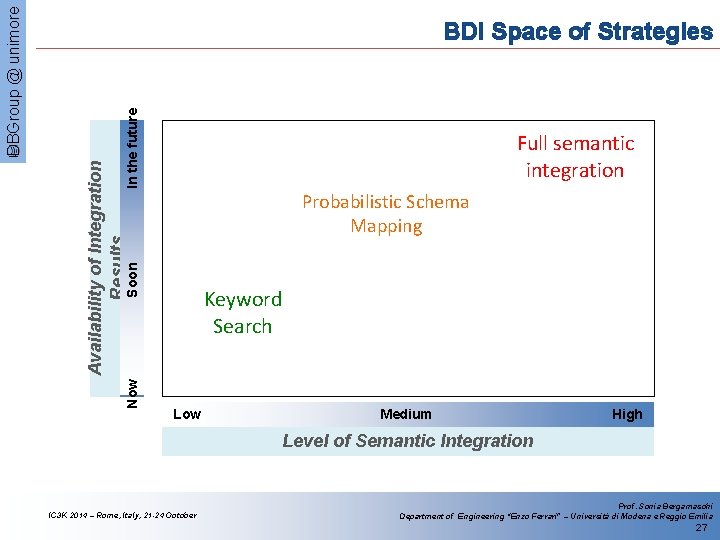
In the future Full semantic integration Availability of Integration Results Probabilistic Schema Mapping Soon Now DBGroup @ unimore BDI Space of Strategies Keyword Search Low Medium High Level of Semantic Integration IC 3 K 2014 – Rome, Italy, 21 -24 October Prof. Sonia Bergamaschi Department of Engineering “Enzo Ferrari” – Università di Modena e Reggio Emilia 27
DBGroup @ unimore Bootstrapping DI Systems • Thesis: completely automated data integration is feasible, but … – Need to model uncertainty about semantics of attributes in sources • Automatic creation of a mediated schema from a set of sources – Uncertainty → Probabilistic mediated schemas – P-mediated schemas offer benefits in modeling uncertainty • Automatic creation of mappings from sources to mediated schema – Probabilistic mappings use weighted attribute correspondences IC 3 K 2014 – Rome, Italy, 21 -24 October Prof. Sonia Bergamaschi Department of Engineering “Enzo Ferrari” – Università di Modena e Reggio Emilia 28
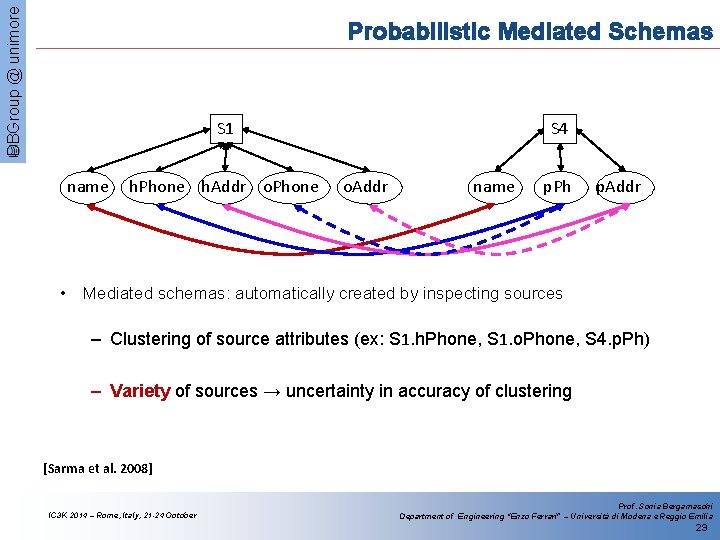
DBGroup @ unimore Probabilistic Mediated Schemas S 1 name h. Phone h. Addr o. Phone S 4 o. Addr name p. Ph p. Addr • Mediated schemas: automatically created by inspecting sources – Clustering of source attributes (ex: S 1. h. Phone, S 1. o. Phone, S 4. p. Ph) – Variety of sources → uncertainty in accuracy of clustering [Sarma et al. 2008] IC 3 K 2014 – Rome, Italy, 21 -24 October Prof. Sonia Bergamaschi Department of Engineering “Enzo Ferrari” – Università di Modena e Reggio Emilia 29
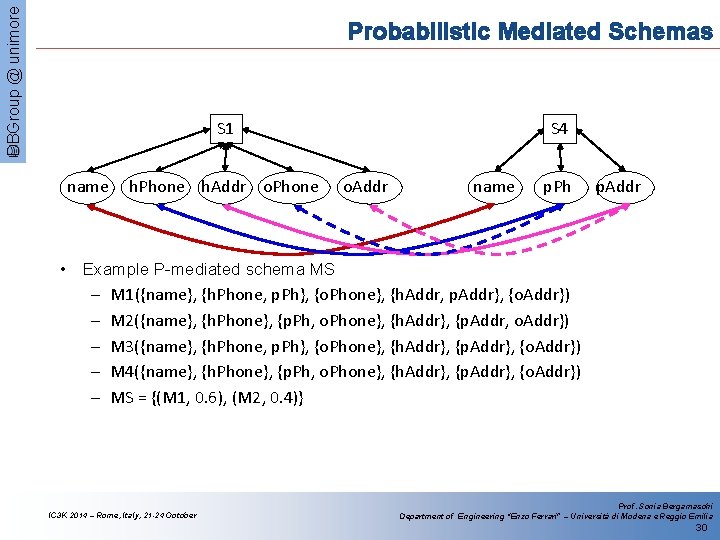
DBGroup @ unimore Probabilistic Mediated Schemas S 1 name h. Phone h. Addr o. Phone S 4 o. Addr name p. Ph p. Addr • Example P-mediated schema MS – M 1({name}, {h. Phone, p. Ph}, {o. Phone}, {h. Addr, p. Addr}, {o. Addr}) – M 2({name}, {h. Phone}, {p. Ph, o. Phone}, {h. Addr}, {p. Addr, o. Addr}) – M 3({name}, {h. Phone, p. Ph}, {o. Phone}, {h. Addr}, {p. Addr}, {o. Addr}) – M 4({name}, {h. Phone}, {p. Ph, o. Phone}, {h. Addr}, {p. Addr}, {o. Addr}) – MS = {(M 1, 0. 6), (M 2, 0. 4)} IC 3 K 2014 – Rome, Italy, 21 -24 October Prof. Sonia Bergamaschi Department of Engineering “Enzo Ferrari” – Università di Modena e Reggio Emilia 30
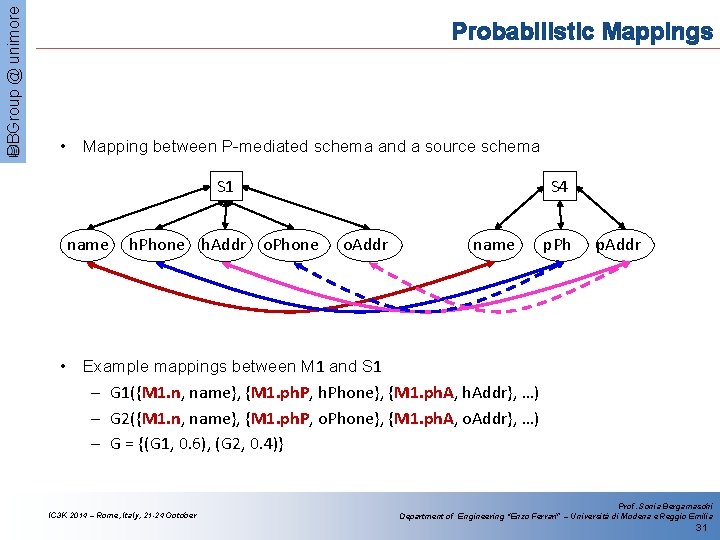
DBGroup @ unimore Probabilistic Mappings • Mapping between P-mediated schema and a source schema S 1 name h. Phone h. Addr o. Phone S 4 o. Addr name p. Ph p. Addr • Example mappings between M 1 and S 1 – G 1({M 1. n, name}, {M 1. ph. P, h. Phone}, {M 1. ph. A, h. Addr}, …) – G 2({M 1. n, name}, {M 1. ph. P, o. Phone}, {M 1. ph. A, o. Addr}, …) – G = {(G 1, 0. 6), (G 2, 0. 4)} IC 3 K 2014 – Rome, Italy, 21 -24 October Prof. Sonia Bergamaschi Department of Engineering “Enzo Ferrari” – Università di Modena e Reggio Emilia 31
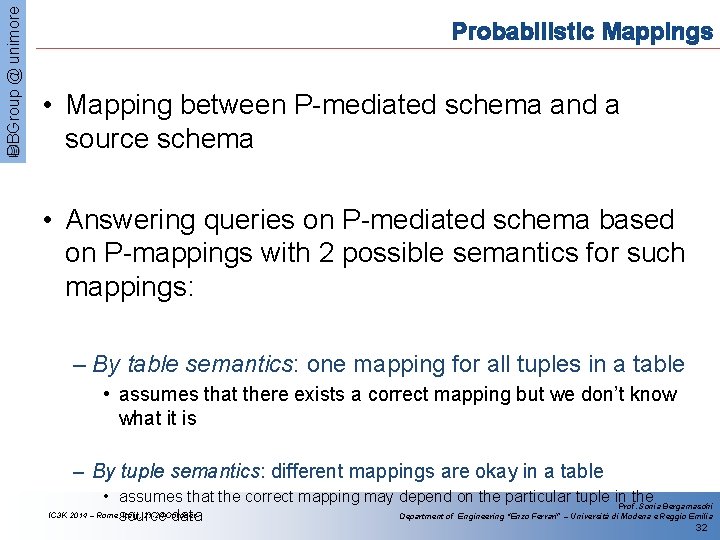
DBGroup @ unimore Probabilistic Mappings • Mapping between P-mediated schema and a source schema • Answering queries on P-mediated schema based on P-mappings with 2 possible semantics for such mappings: – By table semantics: one mapping for all tuples in a table • assumes that there exists a correct mapping but we don’t know what it is – By tuple semantics: different mappings are okay in a table • assumes that the correct mapping may depend on the particular tuple in the Prof. Sonia Bergamaschi IC 3 K 2014 – Rome, source Italy, 21 -24 October Department of Engineering “Enzo Ferrari” – Università di Modena e Reggio Emilia data 32
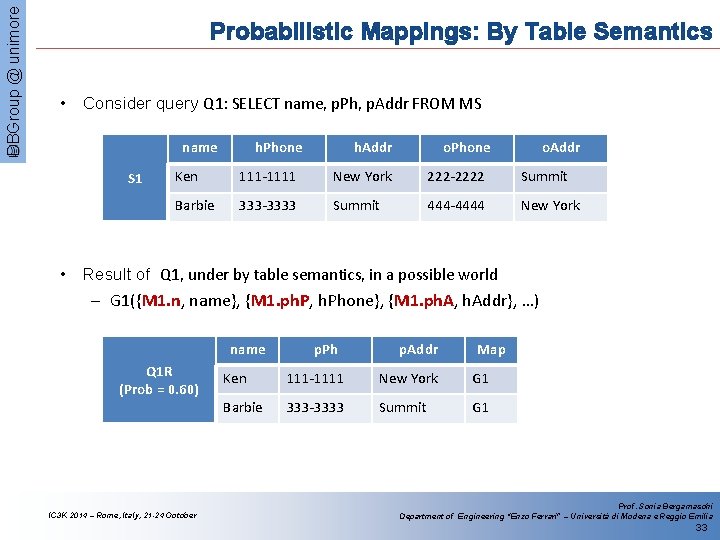
DBGroup @ unimore Probabilistic Mappings: By Table Semantics • Consider query Q 1: SELECT name, p. Ph, p. Addr FROM MS name S 1 h. Phone h. Addr o. Phone o. Addr Ken 111 -1111 New York 222 -2222 Summit Barbie 333 -3333 Summit 444 -4444 New York • Result of Q 1, under by table semantics, in a possible world – G 1({M 1. n, name}, {M 1. ph. P, h. Phone}, {M 1. ph. A, h. Addr}, …) name Q 1 R (Prob = 0. 60) IC 3 K 2014 – Rome, Italy, 21 -24 October p. Ph p. Addr Map Ken 111 -1111 New York G 1 Barbie 333 -3333 Summit G 1 Prof. Sonia Bergamaschi Department of Engineering “Enzo Ferrari” – Università di Modena e Reggio Emilia 33
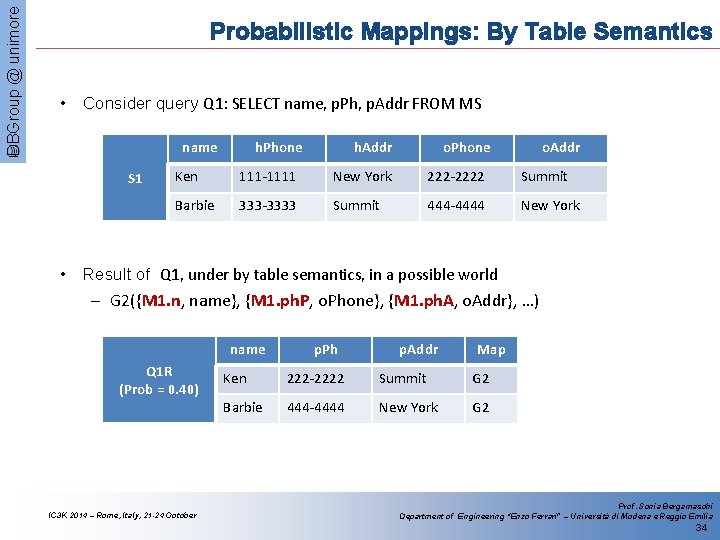
DBGroup @ unimore Probabilistic Mappings: By Table Semantics • Consider query Q 1: SELECT name, p. Ph, p. Addr FROM MS name S 1 h. Phone h. Addr o. Phone o. Addr Ken 111 -1111 New York 222 -2222 Summit Barbie 333 -3333 Summit 444 -4444 New York • Result of Q 1, under by table semantics, in a possible world – G 2({M 1. n, name}, {M 1. ph. P, o. Phone}, {M 1. ph. A, o. Addr}, …) name Q 1 R (Prob = 0. 40) IC 3 K 2014 – Rome, Italy, 21 -24 October p. Ph p. Addr Map Ken 222 -2222 Summit G 2 Barbie 444 -4444 New York G 2 Prof. Sonia Bergamaschi Department of Engineering “Enzo Ferrari” – Università di Modena e Reggio Emilia 34
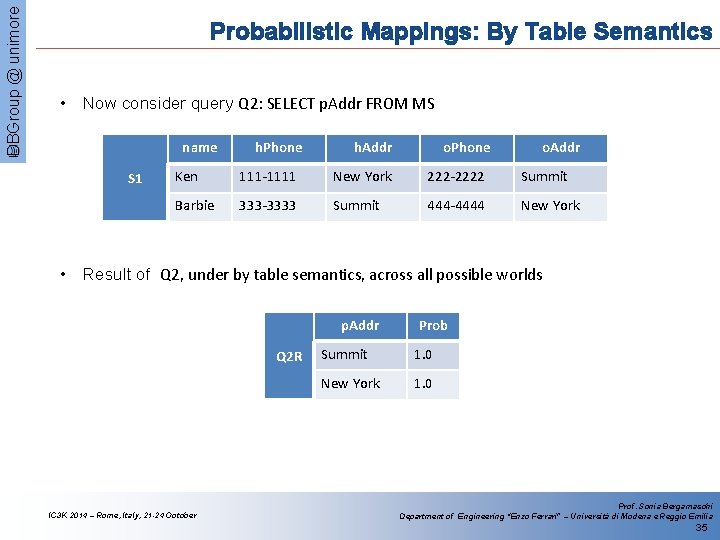
DBGroup @ unimore Probabilistic Mappings: By Table Semantics • Now consider query Q 2: SELECT p. Addr FROM MS name S 1 h. Phone h. Addr o. Phone o. Addr Ken 111 -1111 New York 222 -2222 Summit Barbie 333 -3333 Summit 444 -4444 New York • Result of Q 2, under by table semantics, across all possible worlds p. Addr Q 2 R IC 3 K 2014 – Rome, Italy, 21 -24 October Prob Summit 1. 0 New York 1. 0 Prof. Sonia Bergamaschi Department of Engineering “Enzo Ferrari” – Università di Modena e Reggio Emilia 35
DBGroup @ unimore Outline • Motivation • Schema alignment • Record linkage • Data fusion • Emerging topics IC 3 K 2014 – Rome, Italy, 21 -24 October Prof. Sonia Bergamaschi Department of Engineering “Enzo Ferrari” – Università di Modena e Reggio Emilia 36
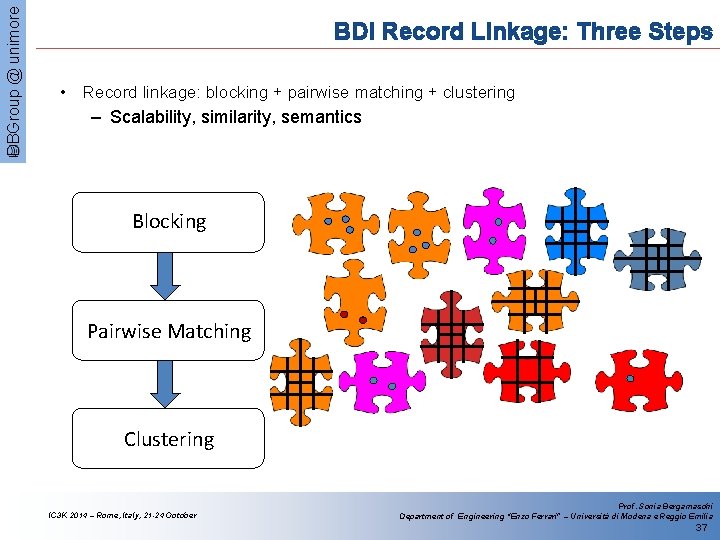
DBGroup @ unimore BDI Record Linkage: Three Steps • Record linkage: blocking + pairwise matching + clustering – Scalability, similarity, semantics Blocking Pairwise Matching Clustering IC 3 K 2014 – Rome, Italy, 21 -24 October Prof. Sonia Bergamaschi Department of Engineering “Enzo Ferrari” – Università di Modena e Reggio Emilia 37
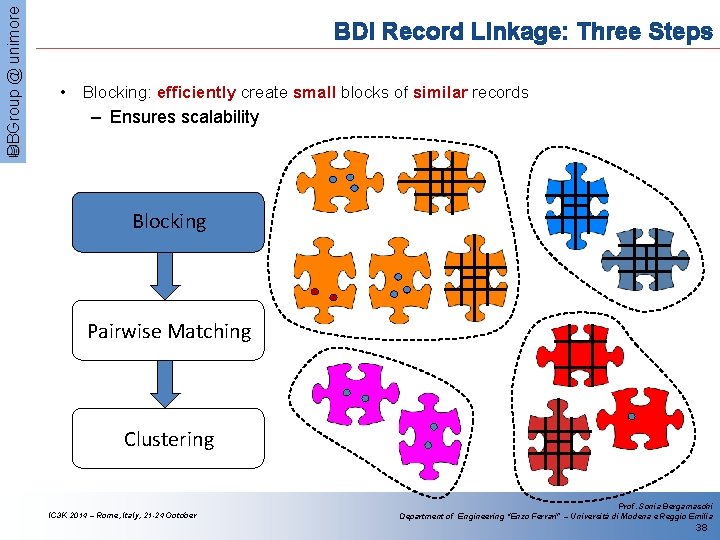
DBGroup @ unimore BDI Record Linkage: Three Steps • Blocking: efficiently create small blocks of similar records – Ensures scalability Blocking Pairwise Matching Clustering IC 3 K 2014 – Rome, Italy, 21 -24 October Prof. Sonia Bergamaschi Department of Engineering “Enzo Ferrari” – Università di Modena e Reggio Emilia 38
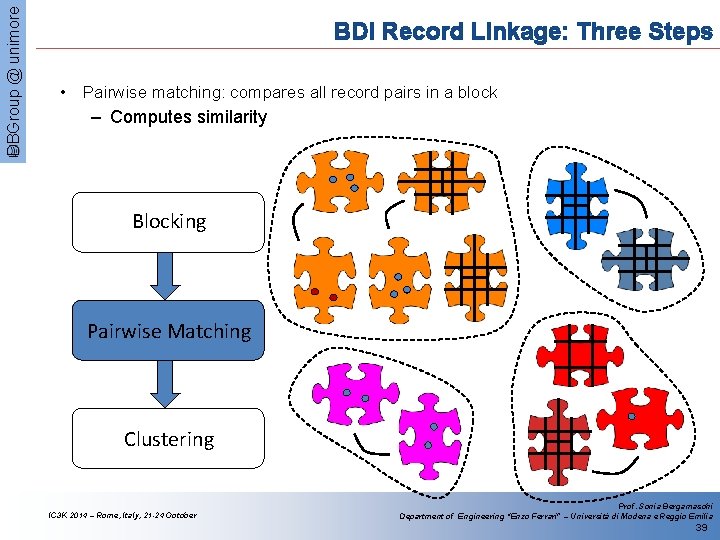
DBGroup @ unimore BDI Record Linkage: Three Steps • Pairwise matching: compares all record pairs in a block – Computes similarity Blocking Pairwise Matching Clustering IC 3 K 2014 – Rome, Italy, 21 -24 October Prof. Sonia Bergamaschi Department of Engineering “Enzo Ferrari” – Università di Modena e Reggio Emilia 39
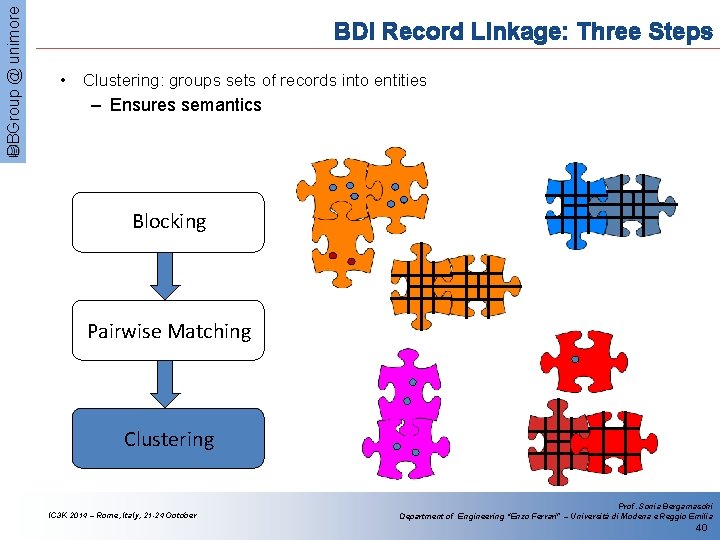
DBGroup @ unimore BDI Record Linkage: Three Steps • Clustering: groups sets of records into entities – Ensures semantics Blocking Pairwise Matching Clustering IC 3 K 2014 – Rome, Italy, 21 -24 October Prof. Sonia Bergamaschi Department of Engineering “Enzo Ferrari” – Università di Modena e Reggio Emilia 40
DBGroup @ unimore Challenge for Record Linkage: Matching with Unstructured Data • Matching product offers: 1000 s of stores, millions of products – Product offers are terse, unstructured text – Many similar but different product offers – Same product has different descriptions, missing + wrong values • Challenging scenarios for record linkage – Matching structured specifications with unstructured offers – Matching unstructured offers with each other [Kannan et al. 2008] IC 3 K 2014 – Rome, Italy, 21 -24 October Prof. Sonia Bergamaschi Department of Engineering “Enzo Ferrari” – Università di Modena e Reggio Emilia 41
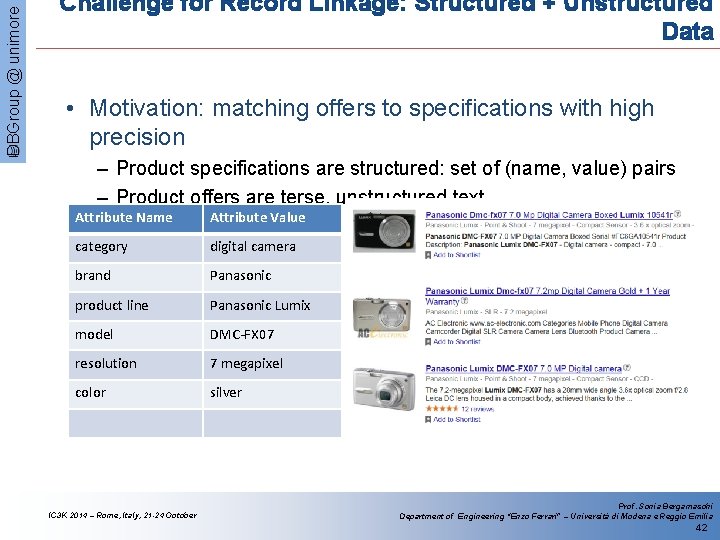
DBGroup @ unimore Challenge for Record Linkage: Structured + Unstructured Data • Motivation: matching offers to specifications with high precision – Product specifications are structured: set of (name, value) pairs – Product offers are terse, unstructured text Attribute Name Attribute Value category digital camera brand Panasonic product line Panasonic Lumix model DMC-FX 07 resolution 7 megapixel color silver IC 3 K 2014 – Rome, Italy, 21 -24 October Prof. Sonia Bergamaschi Department of Engineering “Enzo Ferrari” – Università di Modena e Reggio Emilia 42
DBGroup @ unimore Technologies for BDI: Record Linkage Using Map. Reduce • Motivation: despite use of blocking, record linkage is expensive – Can record linkage be effectively parallelized? • Basic: use Map. Reduce to execute blocking-based record linkage in parallel – Map tasks can read records and perform redistribution based on blocking key – All entities of the same block are assigned to same Reduce task – Different blocks matched in parallel by multiple Reduce tasks →Difficult to tune the blocking function to get balanced workload Challenge: data skew → unbalanced workload [Kolb et al. 2012] IC 3 K 2014 – Rome, Italy, 21 -24 October Prof. Sonia Bergamaschi Department of Engineering “Enzo Ferrari” – Università di Modena e Reggio Emilia 43
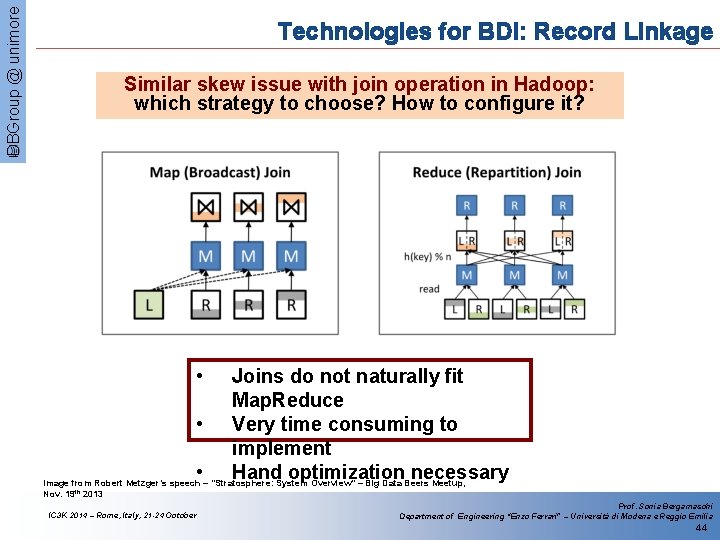
DBGroup @ unimore Technologies for BDI: Record Linkage Similar skew issue with join operation in Hadoop: which strategy to choose? How to configure it? • Joins do not naturally fit Map. Reduce • Very time consuming to implement • Hand optimization necessary Image from Robert Metzger’s speech – “Stratosphere: System Overview” – Big Data Beers Meetup, Nov. 19 th 2013 IC 3 K 2014 – Rome, Italy, 21 -24 October Prof. Sonia Bergamaschi Department of Engineering “Enzo Ferrari” – Università di Modena e Reggio Emilia 44
DBGroup @ unimore Technologies for BDI: Record Linkage (2) Challenge: data skew → unbalanced workload • Key ideas for load balancing: – Preprocessing MR job to determine blocking key distribution • It worth the overhead since the reduce phase consumes the vast majority of the overall runtime (95%) – Redistribution of Map tasks to Reduce tasks to balance workload • Two load balancing strategies: – Block. Split: split large blocks into sub-blocks – Pair. Range: global enumeration and redistribution of all pairs [Kolb et al. 2012] IC 3 K 2014 – Rome, Italy, 21 -24 October Prof. Sonia Bergamaschi Department of Engineering “Enzo Ferrari” – Università di Modena e Reggio Emilia 45
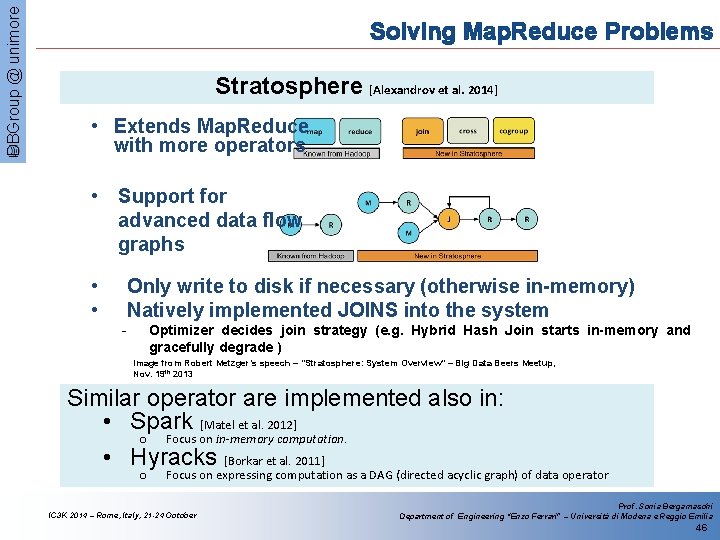
DBGroup @ unimore Solving Map. Reduce Problems Stratosphere [Alexandrov et al. 2014] • Extends Map. Reduce with more operators • Support for advanced data flow graphs • • Only write to disk if necessary (otherwise in-memory) Natively implemented JOINS into the system - Optimizer decides join strategy (e. g. Hybrid Hash Join starts in-memory and gracefully degrade ) Image from Robert Metzger’s speech – “Stratosphere: System Overview” – Big Data Beers Meetup, Nov. 19 th 2013 Similar operator are implemented also in: • Spark [Matel et al. 2012] o Focus on in-memory computation. • Hyracks [Borkar et al. 2011] o Focus on expressing computation as a DAG (directed acyclic graph) of data operator IC 3 K 2014 – Rome, Italy, 21 -24 October Prof. Sonia Bergamaschi Department of Engineering “Enzo Ferrari” – Università di Modena e Reggio Emilia 46
DBGroup @ unimore Outline • Motivation • Schema alignment • Record linkage • Data fusion • Emerging topics IC 3 K 2014 – Rome, Italy, 21 -24 October Prof. Sonia Bergamaschi Department of Engineering “Enzo Ferrari” – Università di Modena e Reggio Emilia 47
DBGroup @ unimore Technologies for BDI: Data Fusion Basic Solution: Naïve Voting • Supports difference of opinion, allows conflict resolution • Works well for independent sources that have similar accuracy But… • When sources have different accuracies? – Need to give more weight to votes by knowledgeable sources • When sources copy from other sources? – Need to reduce the weight of votes by copiers IC 3 K 2014 – Rome, Italy, 21 -24 October Prof. Sonia Bergamaschi Department of Engineering “Enzo Ferrari” – Università di Modena e Reggio Emilia 48
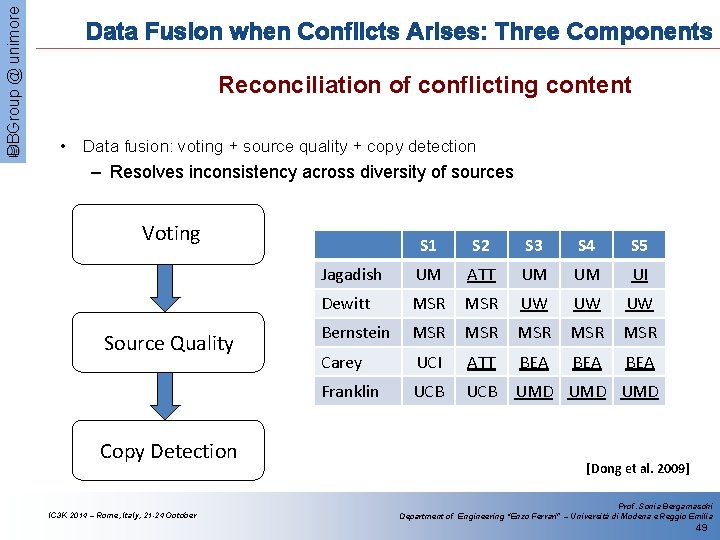
DBGroup @ unimore Data Fusion when Conflicts Arises: Three Components Reconciliation of conflicting content • Data fusion: voting + source quality + copy detection – Resolves inconsistency across diversity of sources USP Voting Source Quality Copy Detection IC 3 K 2014 – Rome, Italy, 21 -24 October S 1 S 2 S 3 S 4 S 5 Jagadish UM ATT UM UM UI Dewitt MSR UW UW UW Bernstein MSR MSR MSR Carey UCI ATT BEA BEA Franklin UCB UMD UMD [Dong et al. 2009] Prof. Sonia Bergamaschi Department of Engineering “Enzo Ferrari” – Università di Modena e Reggio Emilia 49
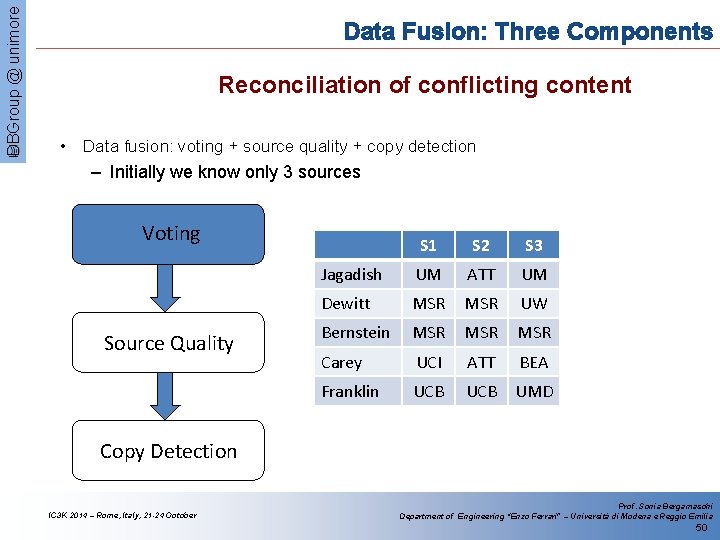
DBGroup @ unimore Data Fusion: Three Components Reconciliation of conflicting content • Data fusion: voting + source quality + copy detection – Initially we know only 3 sources USP Voting Source Quality S 1 S 2 S 3 Jagadish UM ATT UM Dewitt MSR UW Bernstein MSR MSR Carey UCI ATT BEA Franklin UCB UMD Copy Detection IC 3 K 2014 – Rome, Italy, 21 -24 October Prof. Sonia Bergamaschi Department of Engineering “Enzo Ferrari” – Università di Modena e Reggio Emilia 50
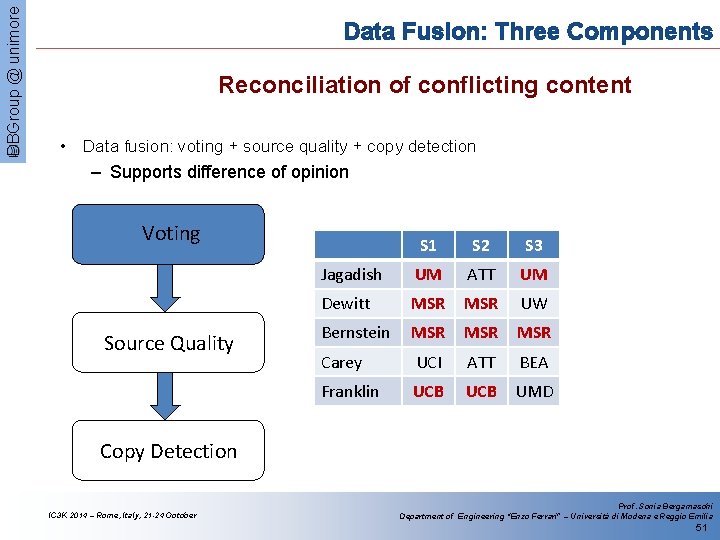
DBGroup @ unimore Data Fusion: Three Components Reconciliation of conflicting content • Data fusion: voting + source quality + copy detection – Supports difference of opinion USP Voting Source Quality S 1 S 2 S 3 Jagadish UM ATT UM Dewitt MSR UW Bernstein MSR MSR Carey UCI ATT BEA Franklin UCB UMD Copy Detection IC 3 K 2014 – Rome, Italy, 21 -24 October Prof. Sonia Bergamaschi Department of Engineering “Enzo Ferrari” – Università di Modena e Reggio Emilia 51
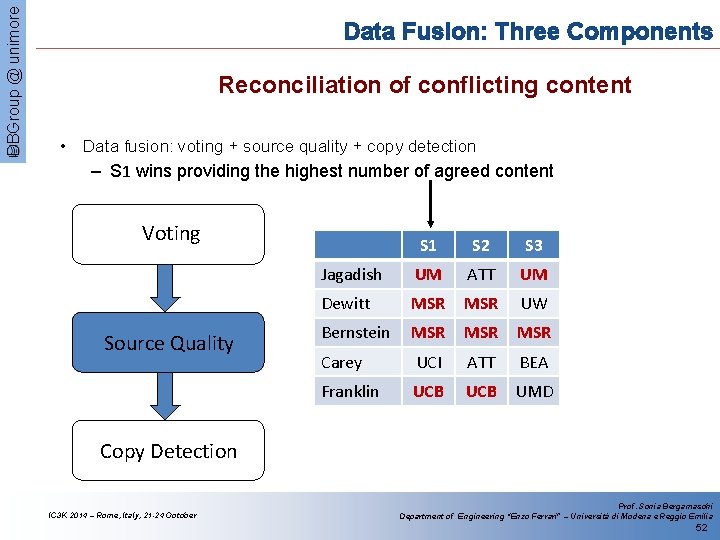
DBGroup @ unimore Data Fusion: Three Components Reconciliation of conflicting content • Data fusion: voting + source quality + copy detection – S 1 wins providing the highest number of agreed content USP Voting Source Quality S 1 S 2 S 3 Jagadish UM ATT UM Dewitt MSR UW Bernstein MSR MSR Carey UCI ATT BEA Franklin UCB UMD Copy Detection IC 3 K 2014 – Rome, Italy, 21 -24 October Prof. Sonia Bergamaschi Department of Engineering “Enzo Ferrari” – Università di Modena e Reggio Emilia 52
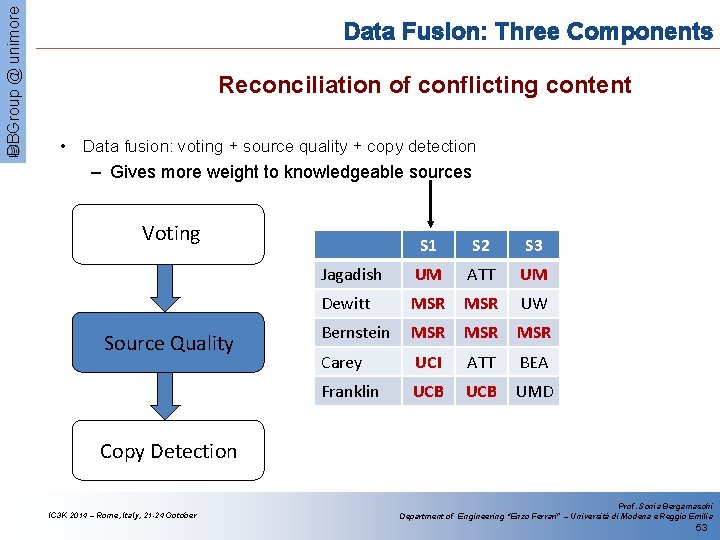
DBGroup @ unimore Data Fusion: Three Components Reconciliation of conflicting content • Data fusion: voting + source quality + copy detection – Gives more weight to knowledgeable sources USP Voting Source Quality S 1 S 2 S 3 Jagadish UM ATT UM Dewitt MSR UW Bernstein MSR MSR Carey UCI ATT BEA Franklin UCB UMD Copy Detection IC 3 K 2014 – Rome, Italy, 21 -24 October Prof. Sonia Bergamaschi Department of Engineering “Enzo Ferrari” – Università di Modena e Reggio Emilia 53
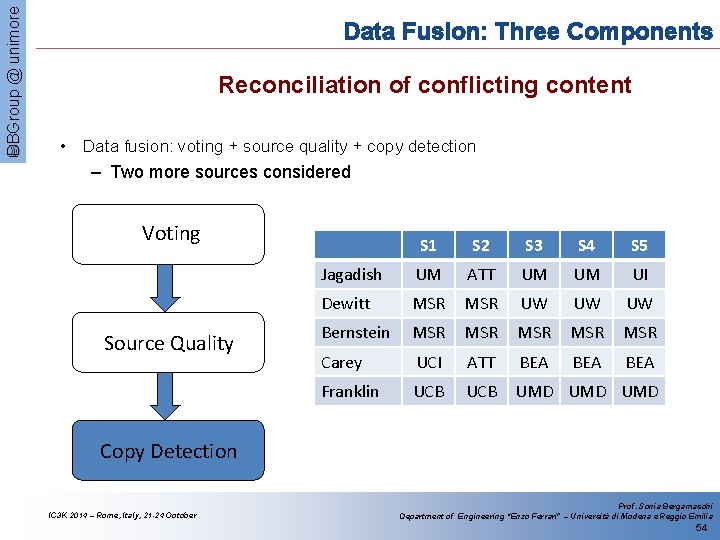
DBGroup @ unimore Data Fusion: Three Components Reconciliation of conflicting content • Data fusion: voting + source quality + copy detection – Two more sources considered USP Voting Source Quality S 1 S 2 S 3 S 4 S 5 Jagadish UM ATT UM UM UI Dewitt MSR UW UW UW Bernstein MSR MSR MSR Carey UCI ATT BEA BEA Franklin UCB UMD UMD Copy Detection IC 3 K 2014 – Rome, Italy, 21 -24 October Prof. Sonia Bergamaschi Department of Engineering “Enzo Ferrari” – Università di Modena e Reggio Emilia 54
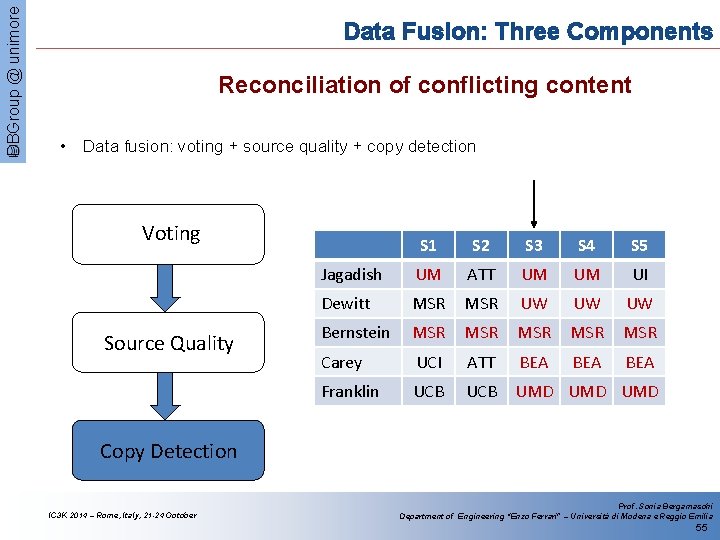
DBGroup @ unimore Data Fusion: Three Components Reconciliation of conflicting content • Data fusion: voting + source quality + copy detection USP Voting Source Quality S 1 S 2 S 3 S 4 S 5 Jagadish UM ATT UM UM UI Dewitt MSR UW UW UW Bernstein MSR MSR MSR Carey UCI ATT BEA BEA Franklin UCB UMD UMD Copy Detection IC 3 K 2014 – Rome, Italy, 21 -24 October Prof. Sonia Bergamaschi Department of Engineering “Enzo Ferrari” – Università di Modena e Reggio Emilia 55
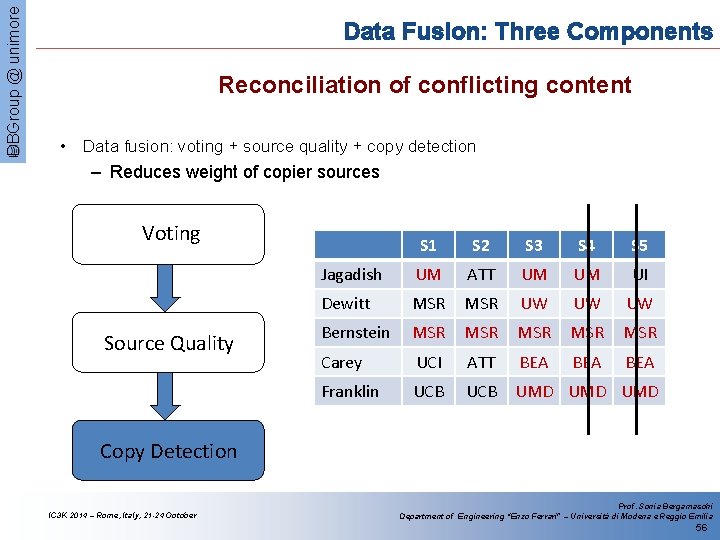
DBGroup @ unimore Data Fusion: Three Components Reconciliation of conflicting content • Data fusion: voting + source quality + copy detection – Reduces weight of copier sources USP Voting Source Quality S 1 S 2 S 3 S 4 S 5 Jagadish UM ATT UM UM UI Dewitt MSR UW UW UW Bernstein MSR MSR MSR Carey UCI ATT BEA BEA Franklin UCB UMD UMD Copy Detection IC 3 K 2014 – Rome, Italy, 21 -24 October Prof. Sonia Bergamaschi Department of Engineering “Enzo Ferrari” – Università di Modena e Reggio Emilia 56
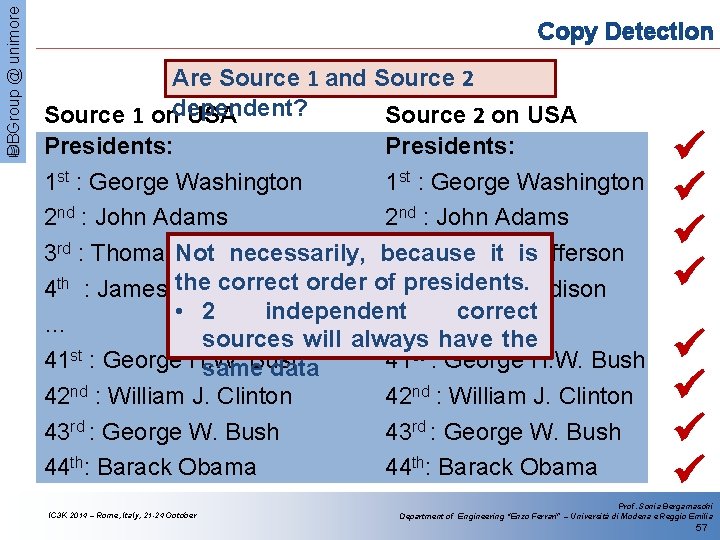
DBGroup @ unimore Copy Detection Are Source 1 and Source 2 Source 1 ondependent? USA Source 2 on USA Presidents: 1 st : George Washington 2 nd : John Adams necessarily, because it is 3 rd : Thomas. Not Jefferson 3 rd : Thomas Jefferson the correct order of 4 thpresidents. 4 th : James Madison • 2 independent correct … … sources will always have the st : George H. W. Bush 41 same data 42 nd : William J. Clinton 43 rd : George W. Bush 44 th: Barack Obama 57 IC 3 K 2014 – Rome, Italy, 21 -24 October Prof. Sonia Bergamaschi Department of Engineering “Enzo Ferrari” – Università di Modena e Reggio Emilia 57
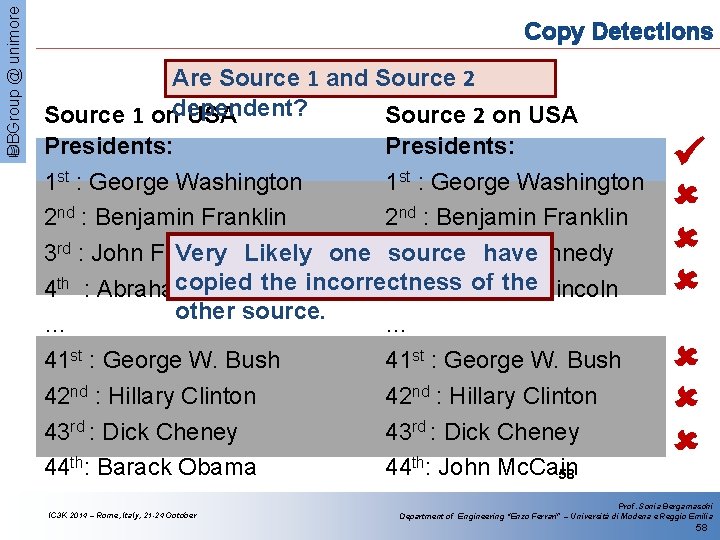
DBGroup @ unimore Copy Detections Are Source 1 and Source 2 Source 1 ondependent? USA Source 2 on USA Presidents: 1 st : George Washington 2 nd : Benjamin Franklin rd : Johnhave Likely one 3 source 3 rd : John F. Very Kennedy F. Kennedy copied the incorrectness of the Lincoln 4 th : Abraham other source. … … 41 st : George W. Bush 42 nd : Hillary Clinton 43 rd : Dick Cheney 44 th: Barack Obama 44 th: John Mc. Cain 58 IC 3 K 2014 – Rome, Italy, 21 -24 October Prof. Sonia Bergamaschi Department of Engineering “Enzo Ferrari” – Università di Modena e Reggio Emilia 58
DBGroup @ unimore Outline • Motivation • Schema alignment • Record linkage • Data fusion • Emerging topics IC 3 K 2014 – Rome, Italy, 21 -24 October Prof. Sonia Bergamaschi Department of Engineering “Enzo Ferrari” – Università di Modena e Reggio Emilia 59
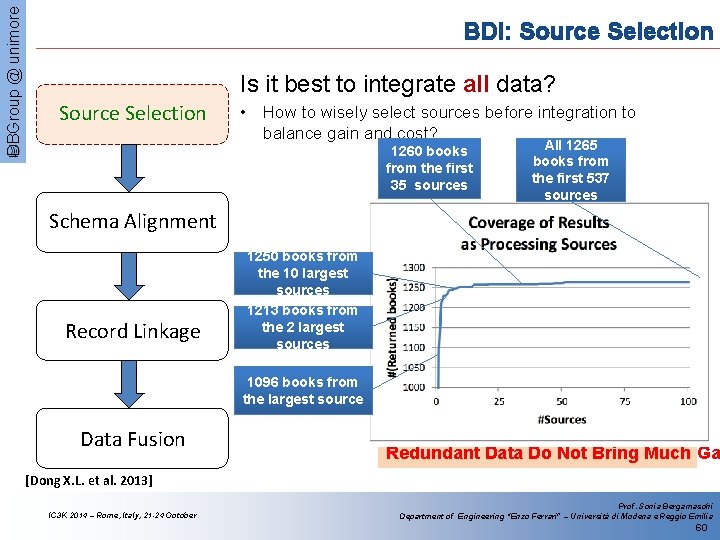
DBGroup @ unimore BDI: Source Selection Is it best to integrate all data? Source Selection • How to wisely select sources before integration to balance gain and cost? 1260 books from the first 35 sources All 1265 books from the first 537 sources Schema Alignment Record Linkage 1250 books from the 10 largest sources 1213 books from the 2 largest sources 1096 books from the largest source Data Fusion Redundant Data Do Not Bring Much Ga [Dong X. L. et al. 2013] IC 3 K 2014 – Rome, Italy, 21 -24 October Prof. Sonia Bergamaschi Department of Engineering “Enzo Ferrari” – Università di Modena e Reggio Emilia 60
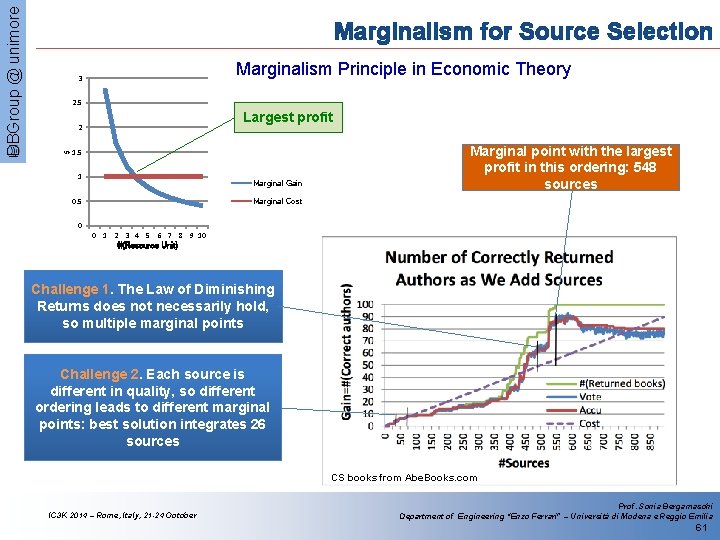
Marginalism Principle in Economic Theory 3 2. 5 Largest profit 2 $ DBGroup @ unimore Marginalism for Source Selection 1. 5 1 Marginal Gain Marginal point with the largest profit in this ordering: 548 sources Marginal Cost 0. 5 0 0 1 2 3 4 5 6 7 8 9 10 #(Resource Unit) Challenge 1. The Law of Diminishing Returns does not necessarily hold, so multiple marginal points Challenge 2. Each source is different in quality, so different ordering leads to different marginal points: best solution integrates 26 sources CS books from Abe. Books. com IC 3 K 2014 – Rome, Italy, 21 -24 October Prof. Sonia Bergamaschi Department of Engineering “Enzo Ferrari” – Università di Modena e Reggio Emilia 61
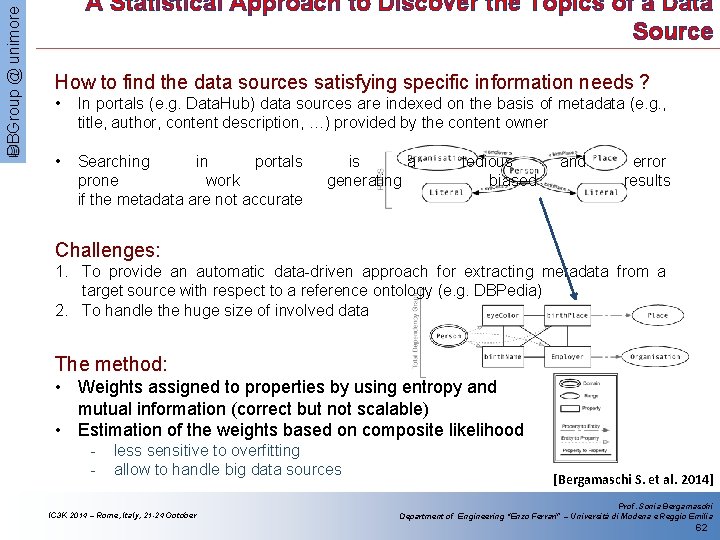
DBGroup @ unimore A Statistical Approach to Discover the Topics of a Data Source How to find the data sources satisfying specific information needs ? • In portals (e. g. Data. Hub) data sources are indexed on the basis of metadata (e. g. , title, author, content description, …) provided by the content owner • Searching in portals prone work if the metadata are not accurate is a generating tedious biased and error results Challenges: 1. To provide an automatic data-driven approach for extracting metadata from a target source with respect to a reference ontology (e. g. DBPedia) 2. To handle the huge size of involved data The method: • Weights assigned to properties by using entropy and mutual information (correct but not scalable) • Estimation of the weights based on composite likelihood - less sensitive to overfitting allow to handle big data sources IC 3 K 2014 – Rome, Italy, 21 -24 October [Bergamaschi S. et al. 2014] Prof. Sonia Bergamaschi Department of Engineering “Enzo Ferrari” – Università di Modena e Reggio Emilia 62
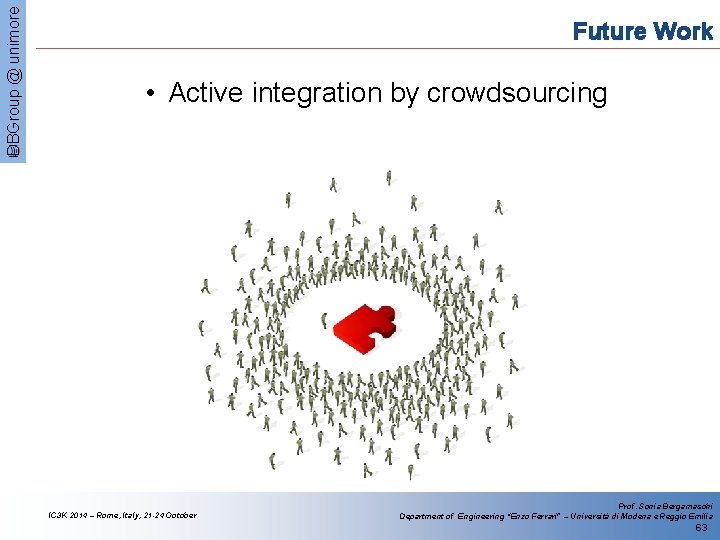
DBGroup @ unimore Future Work • Active integration by crowdsourcing IC 3 K 2014 – Rome, Italy, 21 -24 October Prof. Sonia Bergamaschi Department of Engineering “Enzo Ferrari” – Università di Modena e Reggio Emilia 63
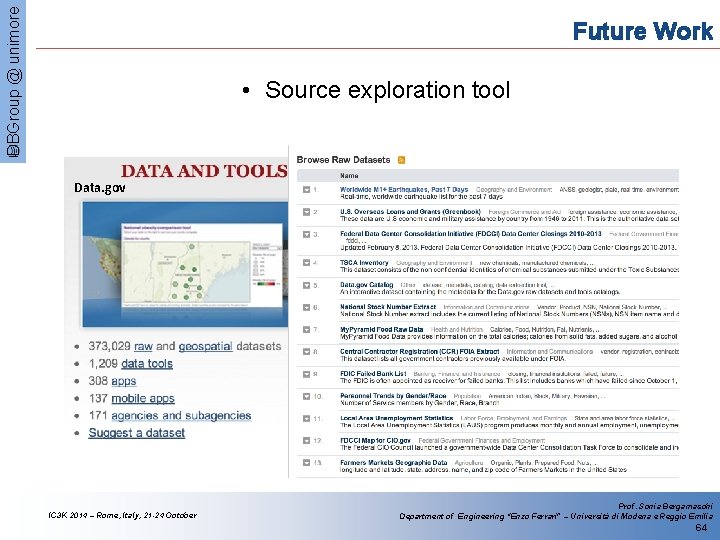
DBGroup @ unimore Future Work • Source exploration tool Data. gov IC 3 K 2014 – Rome, Italy, 21 -24 October Prof. Sonia Bergamaschi Department of Engineering “Enzo Ferrari” – Università di Modena e Reggio Emilia 64
DBGroup @ unimore Conclusions • Big data integration is an important area of research – Knowledge bases, linked data, geo-spatial fusion, scientific data • Much interesting work has been done in this area – Schema alignment, record linkage, data fusion – Challenges due to volume, velocity, variety, veracity • A lot more research needs to be done! IC 3 K 2014 – Rome, Italy, 21 -24 October Prof. Sonia Bergamaschi Department of Engineering “Enzo Ferrari” – Università di Modena e Reggio Emilia 65
DBGroup @ unimore Thank You! IC 3 K 2014 – Rome, Italy, 21 -24 October Prof. Sonia Bergamaschi Department of Engineering “Enzo Ferrari” – Università di Modena e Reggio Emilia 66
DBGroup @ unimore References Motivation: [Seth 2014] Amit Seth: “Transforming Big Data into Smart Data “ , 2014 www. slideshare. net/apsheth/transforming-bigdata-into-smart-data-deriving-value-via-harnessing-volume-variety-and-velocity-using-semantic-techniques-andtechnologies [LOD 14] http: //lod-cloud. net/ [Benedetti et al. 2014] F. Benedetti, S. Bergamaschi, and L. Po, “A visual summary for linked open data sources, ” 2014, to appear in International Semantic Web Conference (Posters & Demos). [Bergamaschi et al. 2014] F. Benedetti, S. Bergamaschi, and L. Po, “Online index extraction from linked open data sources, ” 2014, to appear in Linked Data for Information Extraction (LD 4 IE) Workshop held at International Semantic Web Conference. [Dong and Srivastava 2013] X. L. Dong, and D. Srivastava. "Big data integration. ” ICDE, 2013 IEEE 29 th [Bergamaschi et al. 1999] Sonia Bergamaschi, Silvana Castano, and Maurizio Vincini. "Semantic integration of semistructured and structured data sources. " ACM Sigmod Record 28. 1 (1999): 54 -59. [Dong et al. 2013] Xian Li, Xin Luna Dong, Kenneth B. Lyons, Weiyi Meng, Divesh Srivastava: Truth Finding on the deep web: Is the problem solved? PVLDB, 6(2) (2013) Schema alignment: [Bergamaschi et al. 2011] Sonia Bergamaschi, et al. "Keyword search over relational databases: a metadata approach. " Proceedings of the 2011 ACM SIGMOD International Conference on Management of data. ACM, 2011. IC 3 K 2014 – Rome, Italy, 21 -24 October Prof. Sonia Bergamaschi Department of Engineering “Enzo Ferrari” – Università di Modena e Reggio Emilia 67
DBGroup @ unimore References [Bergamaschi et al. 2013] Sonia Bergamaschi, Francesco Guerra, and Giovanni Simonini. "Keyword Search over Relational Databases: Issues, Approaches and Open Challenges. " Bridging Between Information Retrieval and Databases. Springer Berlin Heidelberg, 2014. 54 -73. [Talukdar et al. 2008] Partha Pratim Talukdar, Marie Jacob, Muhammad Salman Mehmood, Koby Crammer, Zachary G. Ives, Fernando Pereira, Sudipto Guha: Learning to create data-integrating queries. PVLDB 1(1): 785 -796 (2008) [Sarma et al. 2008] Anish Das Sarma, Xin Dong, Alon Y. Halevy: Bootstrapping pay-as-you-go data integration systems. SIGMOD Conference 2008: 861 -874 Record linkage [Kannan et al. 2008] Anitha Kannan, Inmar E. Givoni, Rakesh Agrawal, Ariel Fuxman: Matching unstructured product offers to structured product specifications. KDD 2011: 404 -412 [Kolb et al. 2012] Lars Kolb, Andreas Thor, Erhard Rahm: Load Balancing for Map. Reduce-based Entity Resolution. ICDE 2012: 618 -629 [Alexandrov et al. 2014] Alexander Alexandrov , Rico Bergmann , Stephan Ewen , Johann-Christoph Freytag , Fabian Hueske , Arvid Heise , Odej Kao , Marcus Leich , Ulf Leser , Volker Markl , Felix Naumann , Mathias Peters , Astrid Rheinländer , Matthias J. Sax , Sebastian Schelter , Mareike Höger , Kostas Tzoumas , Daniel Warneke, “The Stratosphere platform for Big Data Analytics”. VLDB Journal 2014 [Matel et al. 2012] Zaharia, Matei, et al. "Resilient distributed datasets: A fault-tolerant abstraction for in-memory cluster computing. " Proceedings of the 9 th USENIX conference on Networked Systems Design and Implementation. USENIX Association, 2012. IC 3 K 2014 – Rome, Italy, 21 -24 October Prof. Sonia Bergamaschi Department of Engineering “Enzo Ferrari” – Università di Modena e Reggio Emilia 68
DBGroup @ unimore References [Borkar et al. 2011] Borkar, V. , Carey, M. , Grover, R. , Onose, N. , & Vernica, R. (2011, April). Hyracks: A flexible and extensible foundation for data-intensive computing. In Data Engineering (ICDE), 2011 IEEE 27 th International Conference on (pp. 1151 -1162). IEEE. Data fusion: [Dong et al. 2009] Xin Luna Dong, Laure Berti-Equille, Divesh Srivastava: Integrating Conflicting Data: The Role of Source Dependence. PVLDB 2(1): 550 -561 (2009) Emerging topics: [Dong X. L. et al. 2013] Xin Luna Dong, Barna Saha, Divesh Srivastava: Less is More: Selecting Sources Wisely for Integration. PVLDB 6(2): 37 -48 (2013) [Bergamaschi S. et al. 2014] S. Bergamaschi, D. Ferrari, F. Guerra, G. Simonini “Discovering the topics of a data source: a statistical approach ” 2014, Surfacing the Deep and the Social Web (SDSW) Workshop held at ISWC IC 3 K 2014 – Rome, Italy, 21 -24 October Prof. Sonia Bergamaschi Department of Engineering “Enzo Ferrari” – Università di Modena e Reggio Emilia 69
- Slides: 69