
DBAE DiscipleBased Art Education Melanie Lindsey Dan TheoryMethodology
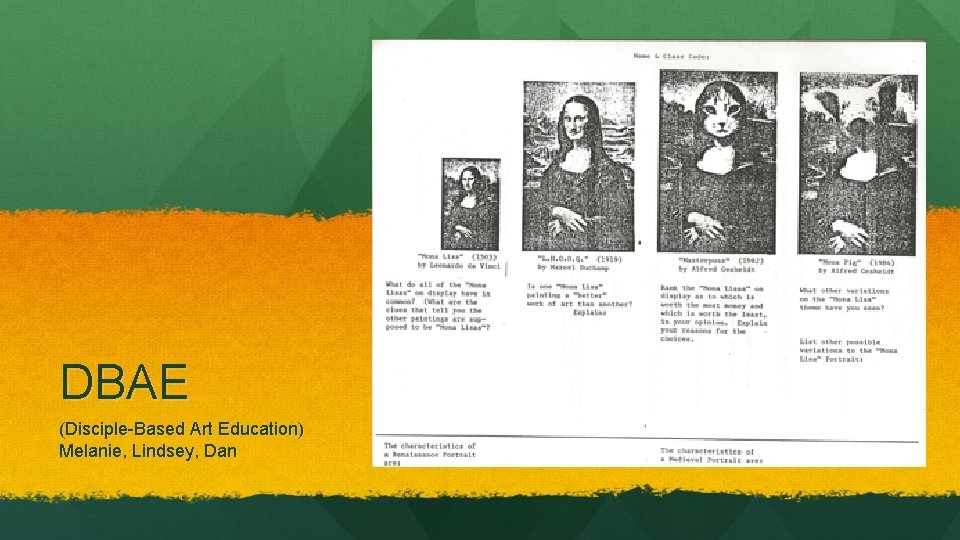
DBAE (Disciple-Based Art Education) Melanie, Lindsey, Dan
Theory/Methodology Inquiry-based training- The focus is on the students interests, judgment, reasoning and critical thinking skills. Students are required to analyze, synthesize, explain, justify, criticize and make critical judgments about the work of art being studied. DBAE has broader educational goals and more structured and directed curriculum. DBAE is not a curriculum, it is a method of teaching and learning. DBAE aims to make arts education relate to other academic disciplines, and to create a standardized framework for evaluation. There are four disciplines in the study of art Art Production (Making of art, the various components of making) Art Criticism (the examination and discussion of style, formal principals of design and elements of art- color, line, perspective, texture, and shading) Art History (the history of objects and the history of people through art) Aesthetics (the philosophy of art- what is art? What is good art? Unanswerable questions, its not about the answer but about the act of thinking about what they are doing feeling when viewing/creating art.
Example of Application to Curriculum Open-ended inquiry, group discussions and problem-solving play significant roles in the curriculum, and classroom. Teachers are viewed as important collaborators in the process and disseminate information and provide direction when necessary. Curriculum is written with sequentially organized and articulated content at all grade levels. Works of art are central to the organization of curriculum and integration of content from the disciplines. Curriculum is structured to reflect comparable concern and respect for each of the four art disciplines. Curriculum is organized to increase student learning and understanding. This involves a recognition of appropriate developmental levels. Example: Describe how the art making process relates to the scientific method. Use art and science terms to justify your answer.
Application to Curriculum continued The arts are brought in to the general curriculum thereby enriching and extending that curriculum. Comprehensive discipline-based art education has the potential to produce higher standardized test scores, greater enthusiasm for learning, higher attendance rates, a decrease in behavior problems, an increase in higher order thinking skills, and revitalization of teacher excitement and commitment.
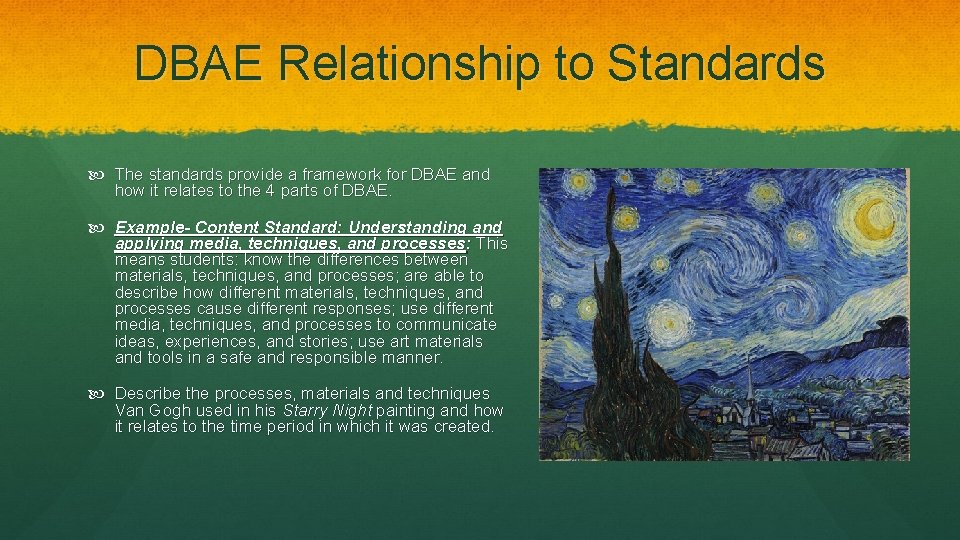
DBAE Relationship to Standards The standards provide a framework for DBAE and how it relates to the 4 parts of DBAE. Example- Content Standard: Understanding and applying media, techniques, and processes: This means students: know the differences between materials, techniques, and processes; are able to describe how different materials, techniques, and processes cause different responses; use different media, techniques, and processes to communicate ideas, experiences, and stories; use art materials and tools in a safe and responsible manner. Describe the processes, materials and techniques Van Gogh used in his Starry Night painting and how it relates to the time period in which it was created.
- Slides: 5