
Day One Volume and Cubes I can model
Day One Volume and Cubes
I can model and apply volume formulas for right rectangular prisms to solve real-world and mathematical problems involving rectangular prisms.
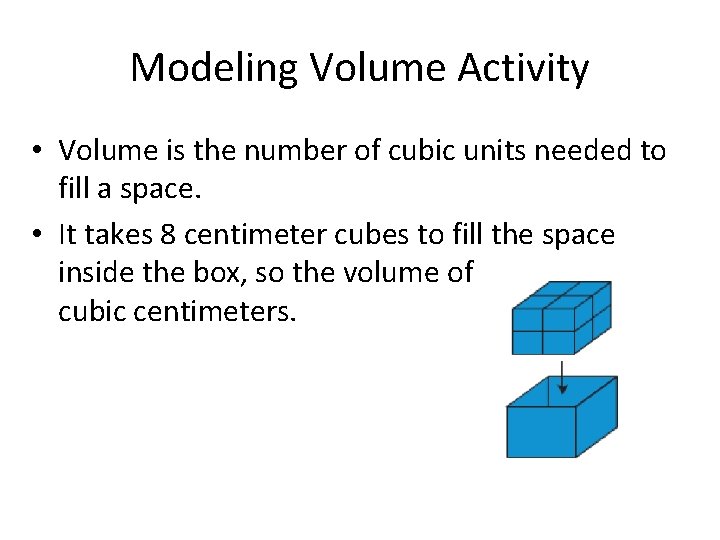
Modeling Volume Activity • Volume is the number of cubic units needed to fill a space. • It takes 8 centimeter cubes to fill the space inside the box, so the volume of the box is 8 cubic centimeters.
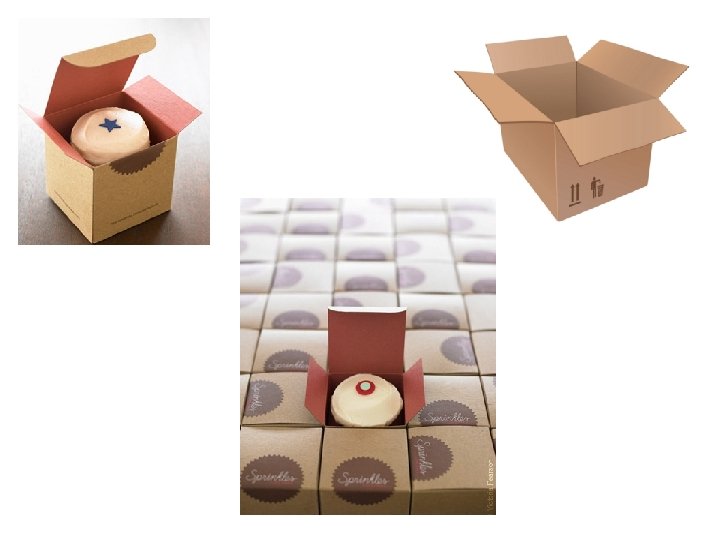
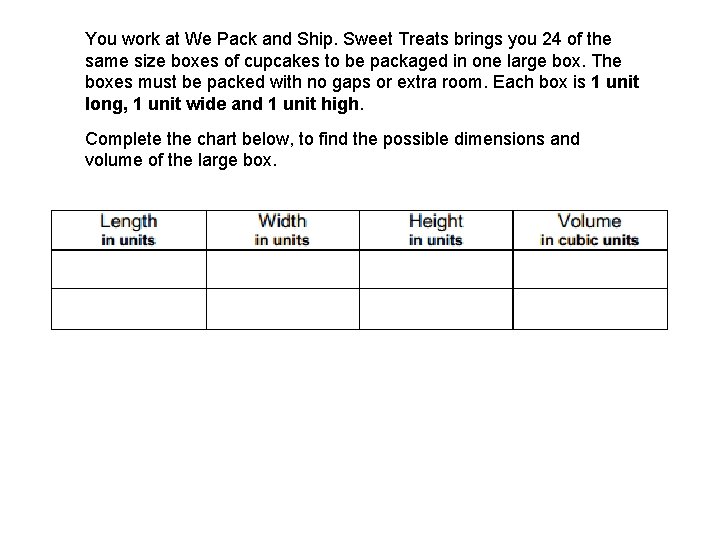
You work at We Pack and Ship. Sweet Treats brings you 24 of the same size boxes of cupcakes to be packaged in one large box. The boxes must be packed with no gaps or extra room. Each box is 1 unit long, 1 unit wide and 1 unit high. Complete the chart below, to find the possible dimensions and volume of the large box.
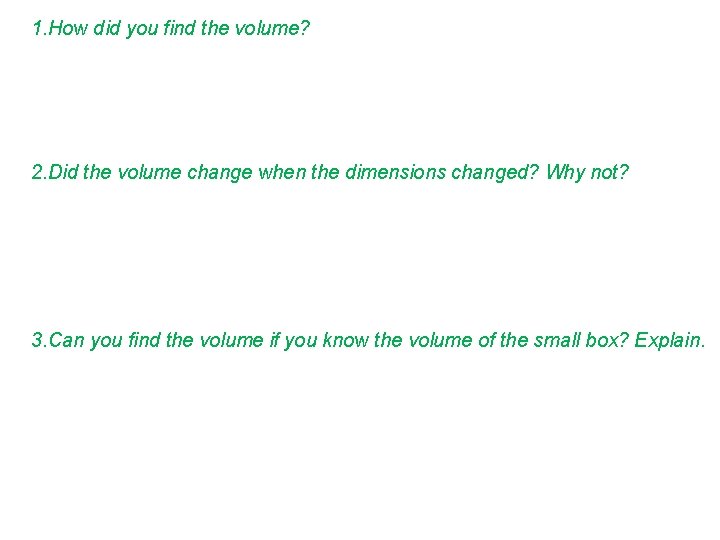
1. How did you find the volume? 2. Did the volume change when the dimensions changed? Why not? 3. Can you find the volume if you know the volume of the small box? Explain.
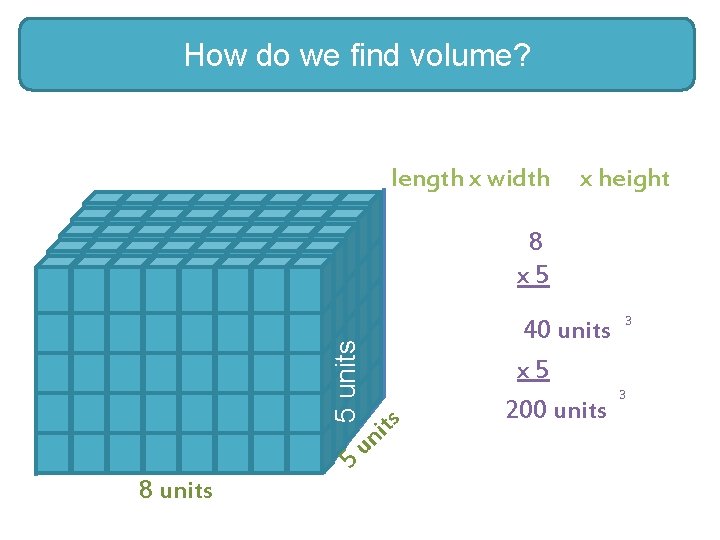
Core Lesson How Let’s Review do we find volume? length x width x height 5 units 8 x 5 8 units 5 ts i un 40 units 3 x 5 3 200 units
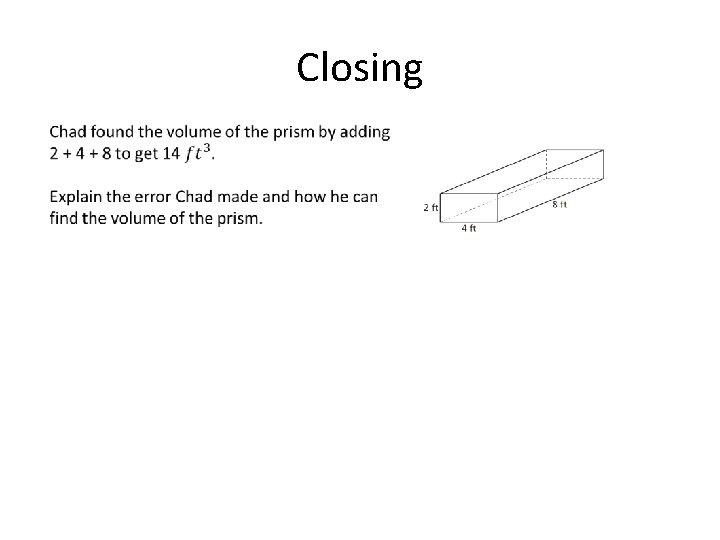
Closing
Day Two
Do Now Celia wants to know if the 25 square inches of wrapping paper she has will be enough to cover her mom’s birthday gift. Does she need to find area, surface area, or volume? Darius wants to know which bottle will hold more lemonade. Does he need to find area, surface area, or volume?
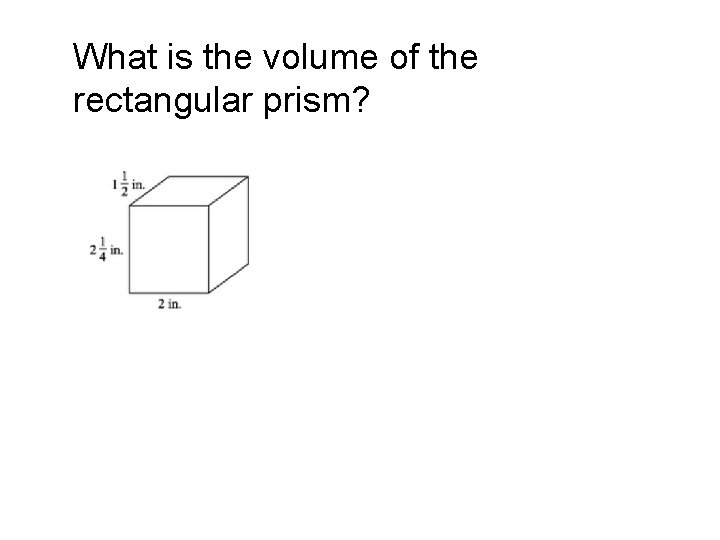
What is the volume of the rectangular prism?
I can model and apply volume formulas for right rectangular prisms to solve real-world and mathematical problems involving rectangular prisms with fractional edge lengths and fractional length cubes.
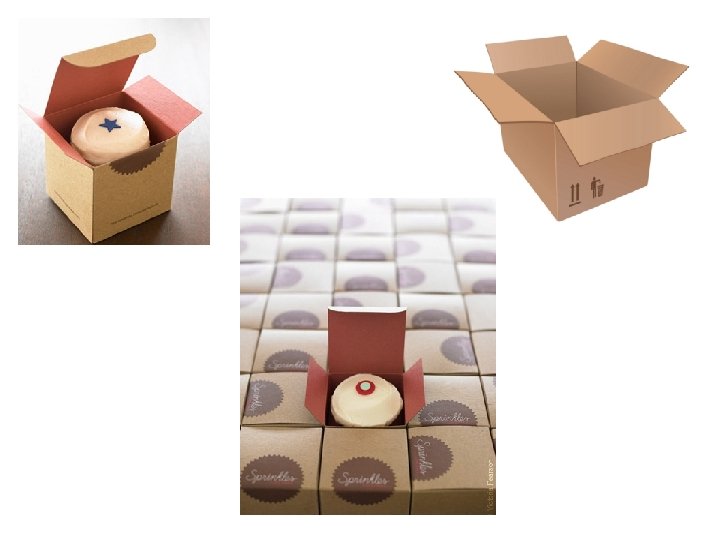
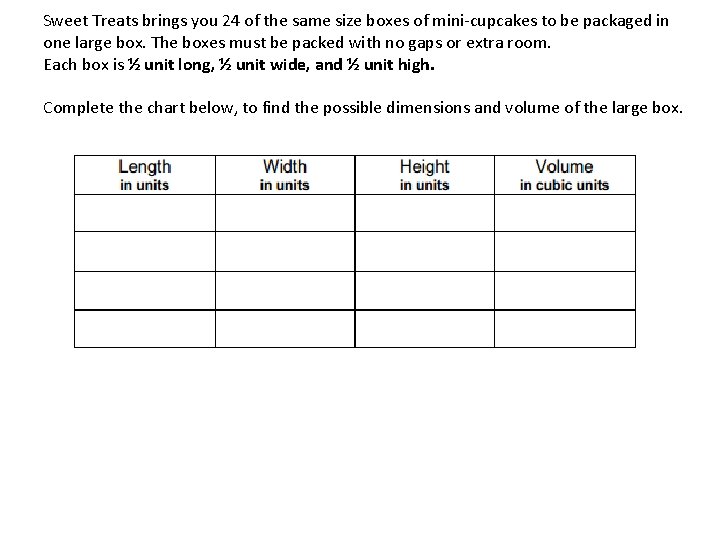
Sweet Treats brings you 24 of the same size boxes of mini-cupcakes to be packaged in one large box. The boxes must be packed with no gaps or extra room. Each box is ½ unit long, ½ unit wide, and ½ unit high. Complete the chart below, to find the possible dimensions and volume of the large box.

Part B 1. How did you find the length of one side? 2. What is the volume of one small box in cubic units? 3. How can you find the volume of the large box using the volume of the small boxes? 4. How does the finding the volume of the large box by multiplying the edge lengths of the large box compare to finding the volume in #3?
What happens to the volume of a prism when the cubes that fill it have fractional edge lengths? How do I find volume of a prism using the volume of the cubes that fill a prism?
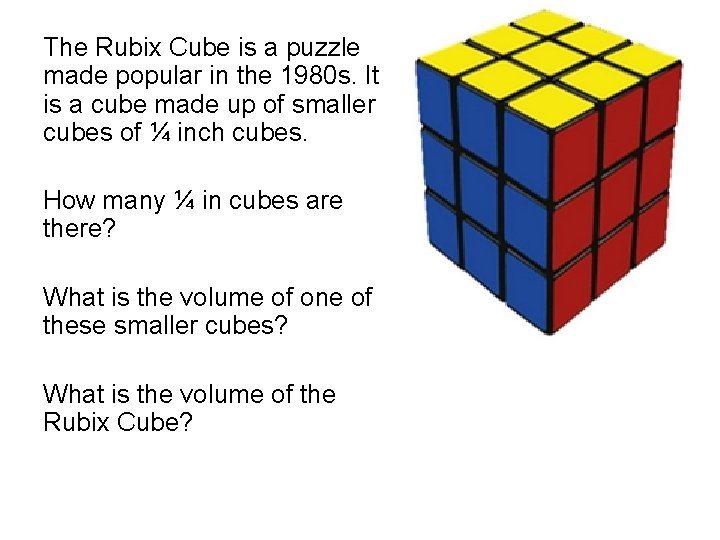
The Rubix Cube is a puzzle made popular in the 1980 s. It is a cube made up of smaller cubes of ¼ inch cubes. How many ¼ in cubes are there? What is the volume of one of these smaller cubes? What is the volume of the Rubix Cube?

Day 3
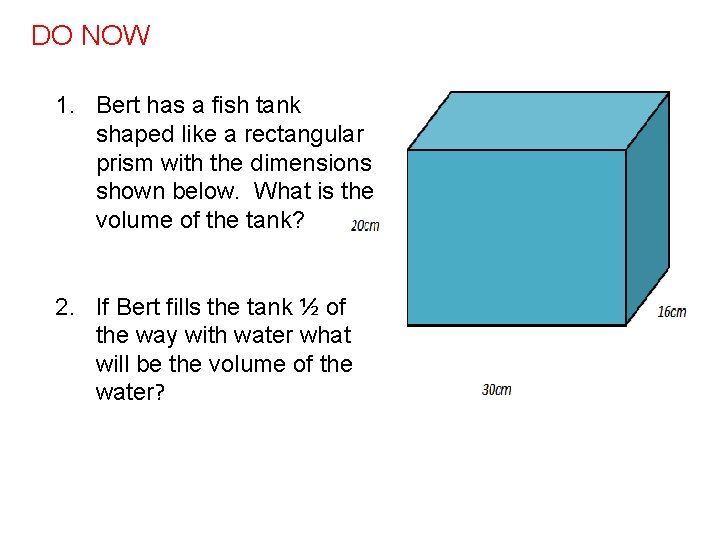
DO NOW 1. Bert has a fish tank shaped like a rectangular prism with the dimensions shown below. What is the volume of the tank? 2. If Bert fills the tank ½ of the way with water what will be the volume of the water?
I can model and apply volume formulas for right rectangular prisms to solve real-world and mathematical problems involving rectangular prisms with fractional edge lengths and fractional length cubes.
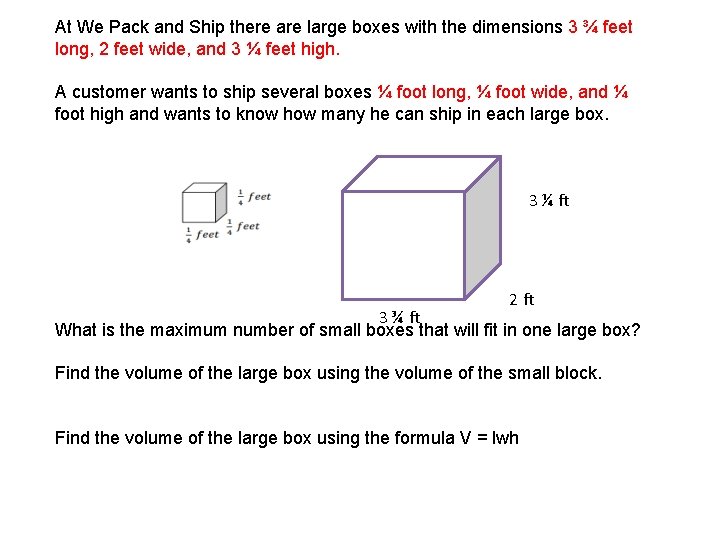
At We Pack and Ship there are large boxes with the dimensions 3 ¾ feet long, 2 feet wide, and 3 ¼ feet high. A customer wants to ship several boxes ¼ foot long, ¼ foot wide, and ¼ foot high and wants to know how many he can ship in each large box. 3 ¼ ft 2 ft 3 ¾ ft What is the maximum number of small boxes that will fit in one large box? Find the volume of the large box using the volume of the small block. Find the volume of the large box using the formula V = lwh
We Ship and Pack • How can you determine how many small boxes will fit across the length of the large box? • How can you determine how many small boxes will fit in the bottom layer (base) of the large box? • If you know how many small boxes will fit in the bottom layer (base) of the box, can you find how many will fit in the whole box? How? • What are different ways to find the volume of a rectangular prism?

Practice A and B Work Session
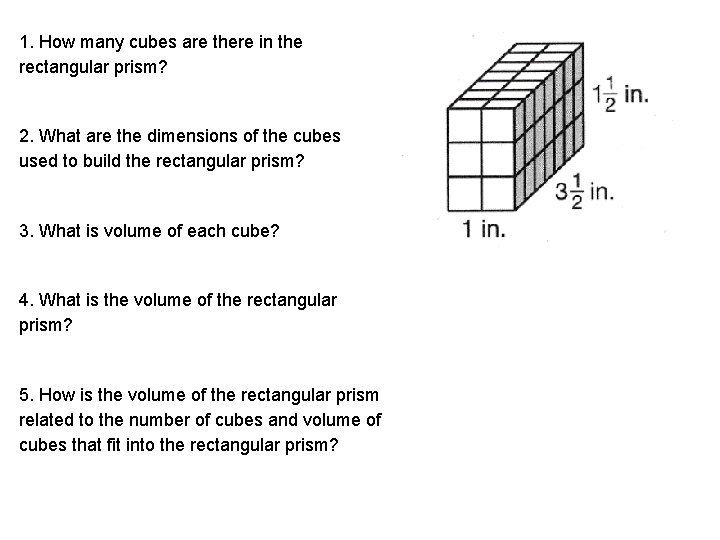
1. How many cubes are there in the rectangular prism? 2. What are the dimensions of the cubes used to build the rectangular prism? 3. What is volume of each cube? 4. What is the volume of the rectangular prism? 5. How is the volume of the rectangular prism related to the number of cubes and volume of cubes that fit into the rectangular prism?

1. What is the volume of the rectangular prism? 2. Using cubes with side lengths of ½ foot, how many cubes would fit inside the rectangular prism? 3. What is the volume of each cube in question 2? 4. Multiply the number of cubes by the volume of each cube. EXPLAIN how this answer compares to the volume you calculated in number 1?
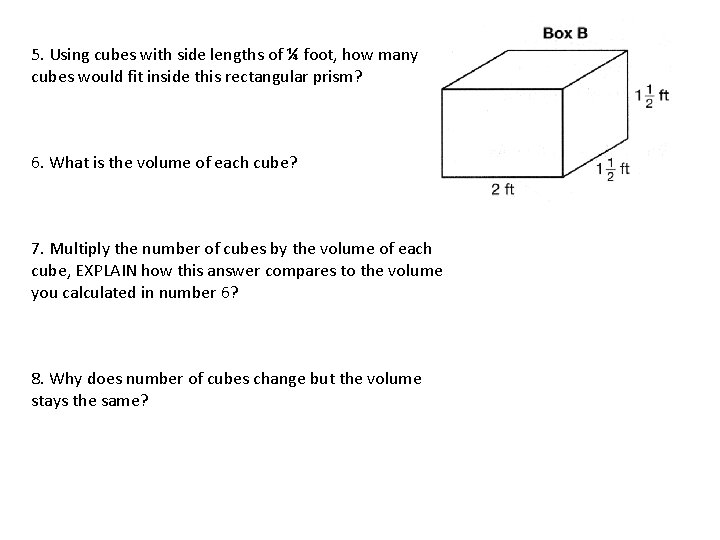
5. Using cubes with side lengths of ¼ foot, how many cubes would fit inside this rectangular prism? 6. What is the volume of each cube? 7. Multiply the number of cubes by the volume of each cube, EXPLAIN how this answer compares to the volume you calculated in number 6? 8. Why does number of cubes change but the volume stays the same?
How can you find volume of a prism using the dimensions of the prism? How can you find the volume of a prism if you know how many cubes are in a prism and the dimensions of the cubes?
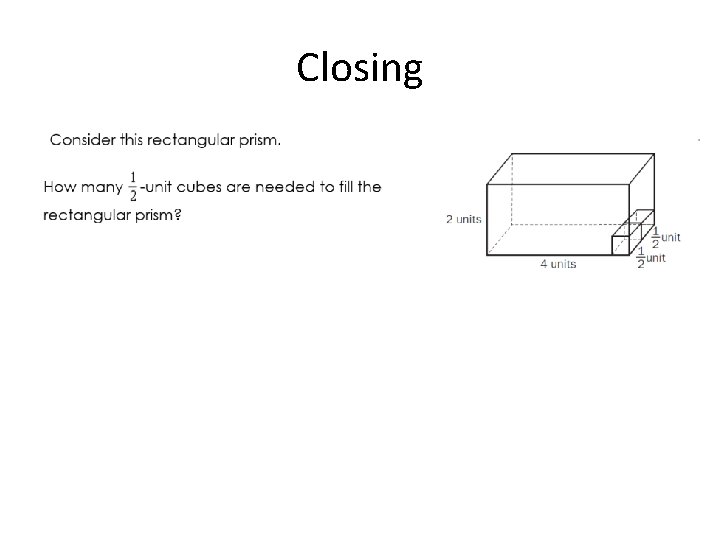
Closing
- Slides: 28