
Day in the Life Consumer Safety Officer Laureen
- Slides: 39
Day in the Life: Consumer Safety Officer Laureen Geniusz Consumer Safety Officer/Medical Device Specialist Office of Medical Device and Radiological Health Operations (OMDRHO), Division 1 Office of Regulatory Affairs U. S. Food and Drug Administration
Presentation Series: Day In the Life • 5 Modules 1. 2. 3. 4. 5. Introduction Consumer Safety Officer Supervisory Consumer Safety Officer Compliance Officer Recall Coordinator 2
Have You Ever Wondered? • What exactly does an FDA Consumer Safety Officer do? • What are industry best practices to support inspections? • What would make inspections more successful? 3
Learning Objectives 1. Describe the basic characteristics and responsibilities of the FDA Consumer Safety Officer. 2. Identify and explain the different types of Medical Device inspections. 3. Describe what happens before, during, and after an inspection. 4
FDA Consumer Safety Officer 5
Consumer Safety Officer • Also referenced as an “Investigator” or “CSO” • About 140 CSOs work within Medical Device Program, under the Office of Regulatory Affairs (ORA) • Science or Engineering background – Receives ORA specialized training in medical device regulations & processes • Experience before FDA, may have: – State or local government – Industry – Or may come directly from college • Basic Investigator and Medical Device Certification 6
Core Functions and Duties • • • Inspections* Investigations* Reports* Recall Audit Checks Consumer Complaints * 90% of time spent on these functions • • Trainings Presentations Workgroups Other duties 7
Investigation vs. Inspection • Different purposes: – Investigation: Less common, information-gathering – Inspection: Determining compliance with laws/regulations • Sometimes an investigation is required to determine if an inspection is applicable/needed – e. g. gathering information about a Consumer Complaint 8
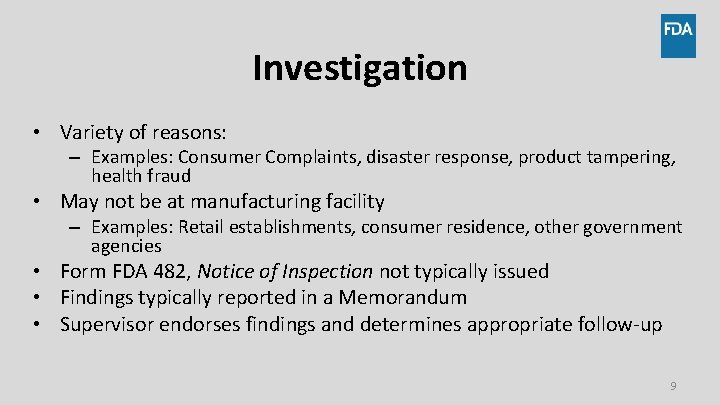
Investigation • Variety of reasons: – Examples: Consumer Complaints, disaster response, product tampering, health fraud • May not be at manufacturing facility – Examples: Retail establishments, consumer residence, other government agencies • Form FDA 482, Notice of Inspection not typically issued • Findings typically reported in a Memorandum • Supervisor endorses findings and determines appropriate follow-up 9
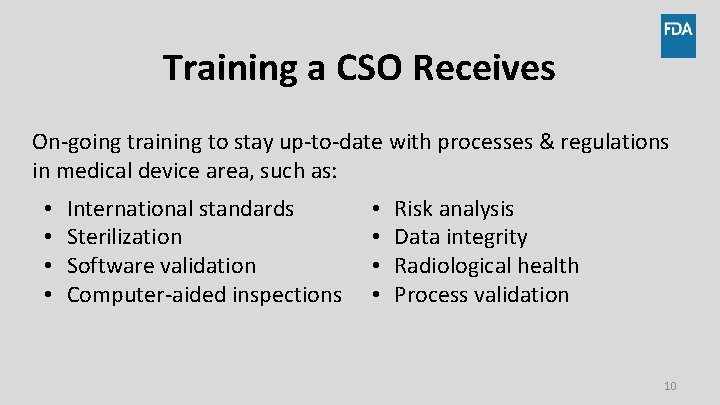
Training a CSO Receives On-going training to stay up-to-date with processes & regulations in medical device area, such as: • • International standards Sterilization Software validation Computer-aided inspections • • Risk analysis Data integrity Radiological health Process validation 10
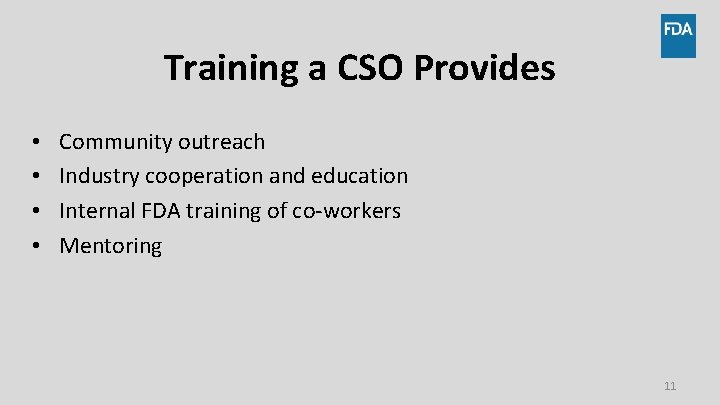
Training a CSO Provides • • Community outreach Industry cooperation and education Internal FDA training of co-workers Mentoring 11
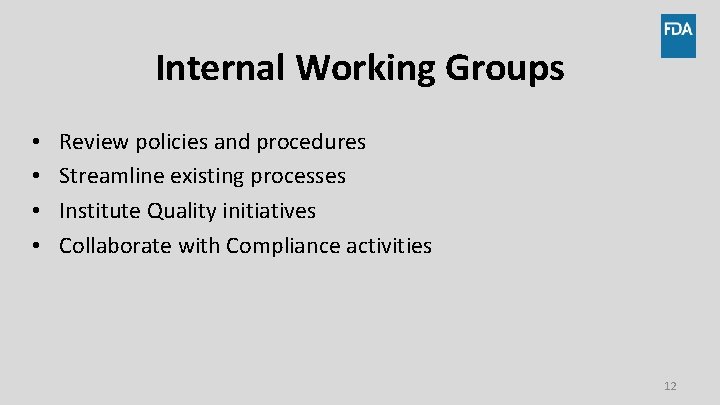
Internal Working Groups • • Review policies and procedures Streamline existing processes Institute Quality initiatives Collaborate with Compliance activities 12
Collaboration with Other Agencies • • • FDA Office of Criminal Investigations (OCI) Federal Bureau of Investigations (FBI) – Criminal cases Assistant United States attorneys (AUSA) United States Marshals Service – Product or property seizure Other Groups in Department of Health and Human Services – Center for Disease Control (CDC) – National Institutes of Health (NIH) – FDA Centers: Devices & Radiological Health (CDRH); Drug (CDER); Biologics (CBER) 13
Medical Device Inspections 14
Risk-Based Inspectional Approach • Firms are identified based on the risk of the device • CDRH and ORA staff may also consider other factors like: – Device classification – Postmarket data – Rapidly-evolving technology • The risk level drives prioritization on annual work plans • The prioritized list is then used to assign inspections to the CSO * CDRH = Center for Devices and Radiological Health 15
Types of Inspections • Routine or surveillance – Example: Electronic Product Radiation Control (EPRC) • • Directed or For-Cause Premarket Approval (PMA) Application Postmarket Surveillance Foreign 16
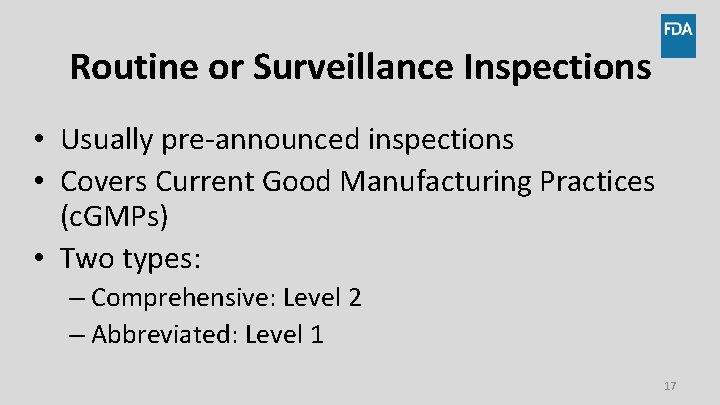
Routine or Surveillance Inspections • Usually pre-announced inspections • Covers Current Good Manufacturing Practices (c. GMPs) • Two types: – Comprehensive: Level 2 – Abbreviated: Level 1 17
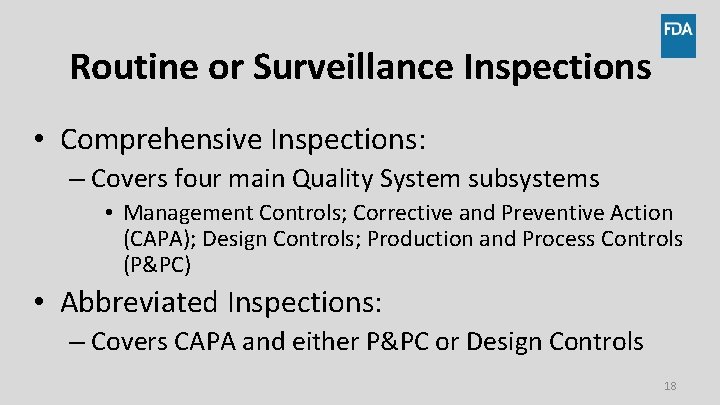
Routine or Surveillance Inspections • Comprehensive Inspections: – Covers four main Quality System subsystems • Management Controls; Corrective and Preventive Action (CAPA); Design Controls; Production and Process Controls (P&PC) • Abbreviated Inspections: – Covers CAPA and either P&PC or Design Controls 18
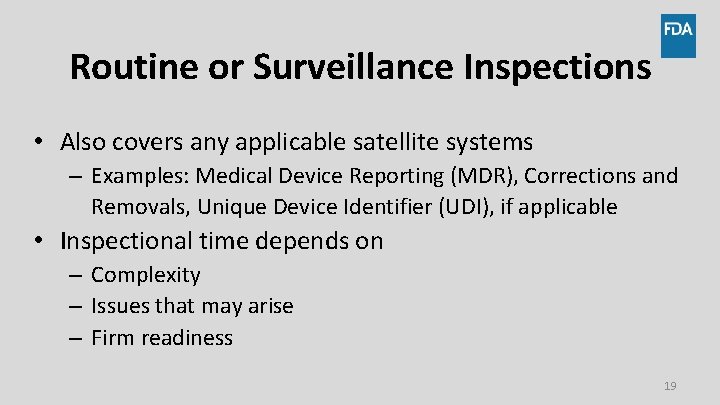
Routine or Surveillance Inspections • Also covers any applicable satellite systems – Examples: Medical Device Reporting (MDR), Corrections and Removals, Unique Device Identifier (UDI), if applicable • Inspectional time depends on – Complexity – Issues that may arise – Firm readiness 19
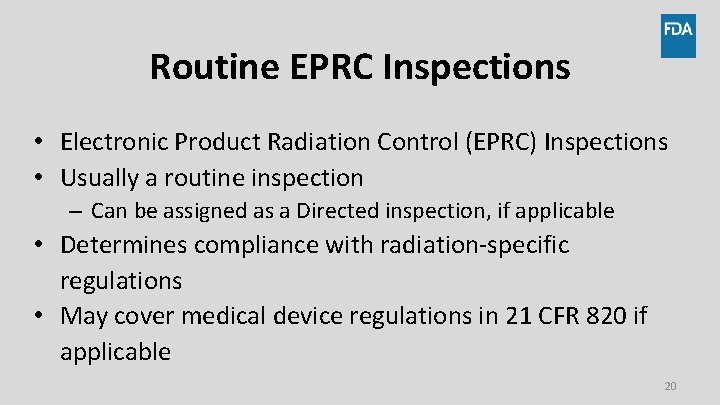
Routine EPRC Inspections • Electronic Product Radiation Control (EPRC) Inspections • Usually a routine inspection – Can be assigned as a Directed inspection, if applicable • Determines compliance with radiation-specific regulations • May cover medical device regulations in 21 CFR 820 if applicable 20
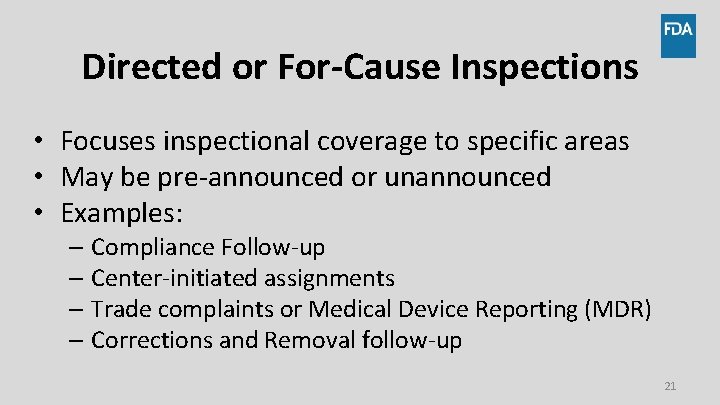
Directed or For-Cause Inspections • Focuses inspectional coverage to specific areas • May be pre-announced or unannounced • Examples: – Compliance Follow-up – Center-initiated assignments – Trade complaints or Medical Device Reporting (MDR) – Corrections and Removal follow-up 21
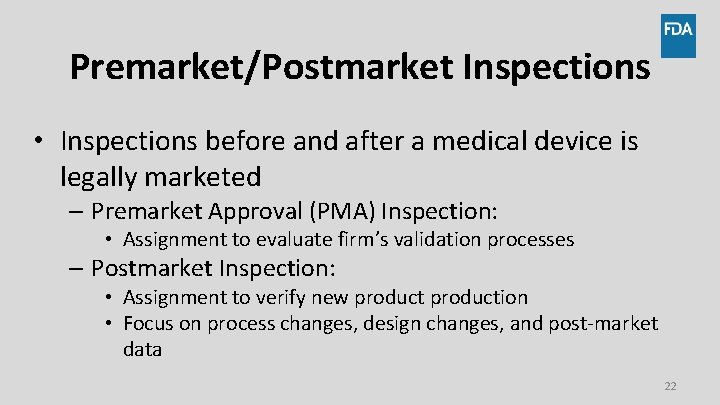
Premarket/Postmarket Inspections • Inspections before and after a medical device is legally marketed – Premarket Approval (PMA) Inspection: • Assignment to evaluate firm’s validation processes – Postmarket Inspection: • Assignment to verify new production • Focus on process changes, design changes, and post-market data 22
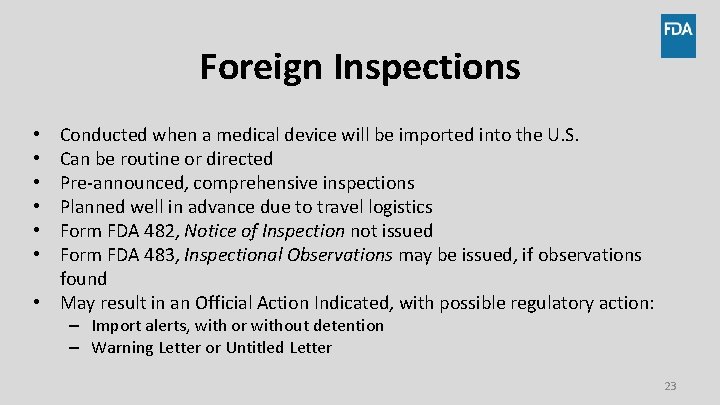
Foreign Inspections Conducted when a medical device will be imported into the U. S. Can be routine or directed Pre-announced, comprehensive inspections Planned well in advance due to travel logistics Form FDA 482, Notice of Inspection not issued Form FDA 483, Inspectional Observations may be issued, if observations found • May result in an Official Action Indicated, with possible regulatory action: • • • – Import alerts, with or without detention – Warning Letter or Untitled Letter 23
General Process of an Inspection 24
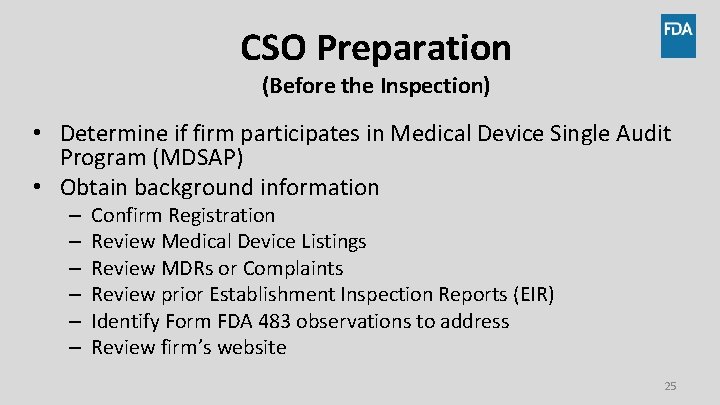
CSO Preparation (Before the Inspection) • Determine if firm participates in Medical Device Single Audit Program (MDSAP) • Obtain background information – – – Confirm Registration Review Medical Device Listings Review MDRs or Complaints Review prior Establishment Inspection Reports (EIR) Identify Form FDA 483 observations to address Review firm’s website 25
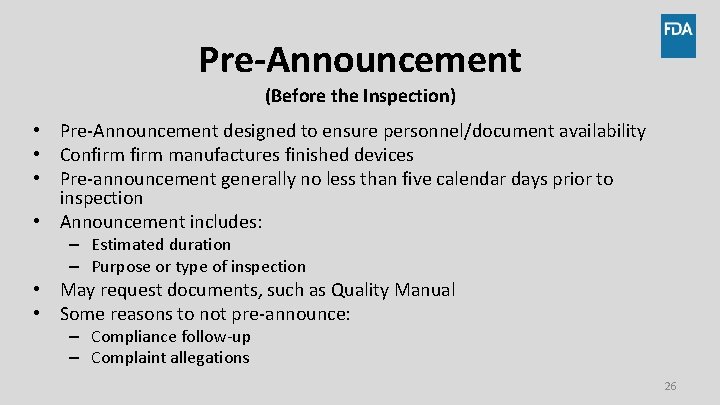
Pre-Announcement (Before the Inspection) • Pre-Announcement designed to ensure personnel/document availability • Confirm manufactures finished devices • Pre-announcement generally no less than five calendar days prior to inspection • Announcement includes: – Estimated duration – Purpose or type of inspection • May request documents, such as Quality Manual • Some reasons to not pre-announce: – Compliance follow-up – Complaint allegations 26
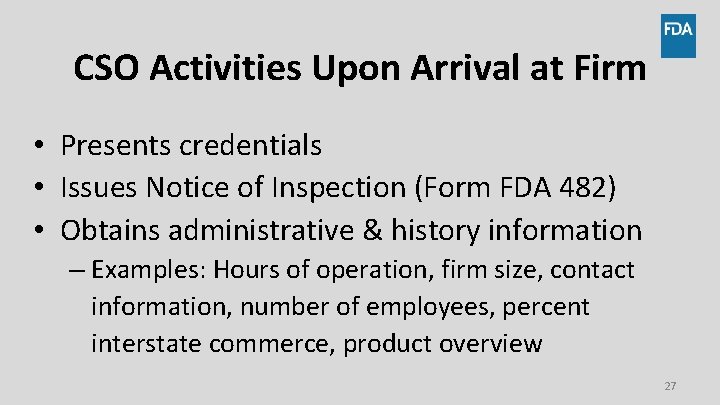
CSO Activities Upon Arrival at Firm • Presents credentials • Issues Notice of Inspection (Form FDA 482) • Obtains administrative & history information – Examples: Hours of operation, firm size, contact information, number of employees, percent interstate commerce, product overview 27
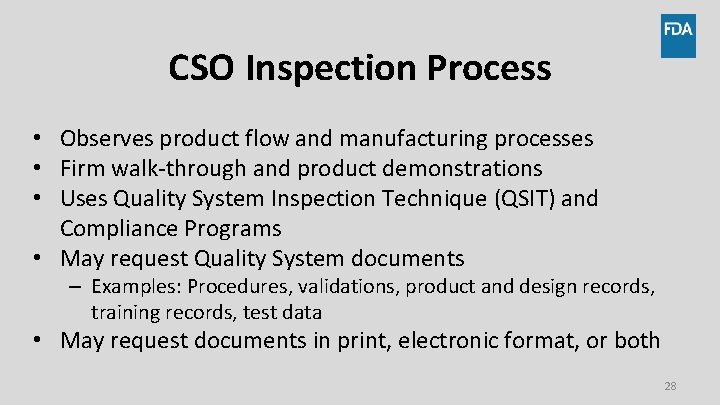
CSO Inspection Process • Observes product flow and manufacturing processes • Firm walk-through and product demonstrations • Uses Quality System Inspection Technique (QSIT) and Compliance Programs • May request Quality System documents – Examples: Procedures, validations, product and design records, training records, test data • May request documents in print, electronic format, or both 28
How You Can Help with an Inspection • Have medical device available for review or show it works • Make a team available that understands the Quality System and related documents • Retrieve & provide requested documents in a timely manner • Give straight-forward and honest responses • It’s OK to say: “I don’t know” or “I have to ask” • Don’t answer if you are unsure or don’t know • Better to take the time to find the answer than to guess • Could sidetrack and add time to the inspection process 29
CSO Activities At End of an Inspection • • • May issue Inspectional Observations (Form FDA 483) – Issued to top management – Commonly cited medical device regulations: 21 CFR 820, 806, 803, 821 Communicates Inspectional findings through written (Form FDA 483) observations Discusses all findings with firm, including: – Verbal discussion items – Form FDA 483 observations May cover potential FDA regulatory action options with firm’s top management May need to collect additional documents if observations are significant 30
CSO Inspectional Observations • All potential observations should have been discussed during inspection – No surprises to firm • Form FDA 483, Inspectional Observations – Usually listed in order of significance – Should be factual, clear, and concise • Verbal discussion items – May be significant, but may not be listed on Form FDA 483 § Examples: Labeling, 510(k) or PMA issues, correction/removal issues – May include minor, non-systemic issues 31
CSO Inspectional Observations • Firm has option to “annotate” observations listed on Form FDA 483 • CSO informs firm how to voluntarily respond to the inspectional findings • Send to Division Compliance Branch • Requested within 15 business days 32
After an Inspection • CSO writes Establishment Inspection Report (EIR) and submits to Supervisory CSO (SCSO) for review and endorsement • CSO recommends initial classification: • No Action Indicated (NAI) • Voluntary Action Indicated (VAI) • Official Action Indicated (OAI) ü The SCSO forwards EIRs with “OAI” proposed classification to Compliance Branch, to determine if further regulatory actions may be warranted • CSO usually not involved with communications to firm after inspection is closed 33
Establishment Inspection Report (EIR) • EIR outlines the firm’s current activities, inspectional coverage, observations, discussions, and supporting documentation • Includes Exhibits and Attachments • EIRs are entered into an FDA electronic database • EIR completion timeframes vary depending on length of inspection, observations and potential classification • SCSO releases a copy of EIR to firm, depending on classification • Firms do not receive (through Field Management Directive 145 process) • EIRs with “OAI” status • EIR’s Exhibits and Attachments 34
Resources Used By CSOs • Investigations Operations Manual (IOM) www. fda. gov/inspections-compliance-enforcement-and-criminalinvestigations/inspection-references/investigations-operations-manual • Quality System Inspections Technique (QSIT) Guide https: //www. fda. gov/inspections-compliance-enforcement-and-criminalinvestigations/inspection-guides/quality-systems 35
Summary • A Consumer Safety Officer, or CSO, has a number of front-line responsibilities where they could interact with a firm. • A CSO has a variety of tasks, but spends a majority of their time doing inspections, investigations and reports. • A CSO routinely conducts a variety of Medical Device inspections, each with a specific purpose. • There is a general sequence of activities that occur before, during and after an Inspection. 36
Your Call to Action 1. Be familiar with the different types of inspections that you may encounter. 2. Be responsive to requests during an inspection to facilitate the inspection process. 3. Encourage open dialogue during inspections to assure all parties involved clearly understand what is being asked. Don’t be afraid to ask for clarity. 4. View other modules in this series to learn more about the individual OMDRHO staff roles. 37
Presentation Series: Day In the Life • 5 Modules 1. 2. 3. 4. 5. Introduction Consumer Safety Officer Supervisory Consumer Safety Officer Compliance Officer Recall Coordinator 38
39