
Day in the Life Compliance Officer Charles J
- Slides: 38
Day in the Life: Compliance Officer Charles J. Chacko Compliance Officer Office of Medical Device and Radiological Health Operations (OMDRHO), Division 3 Office of Regulatory Affairs U. S. Food and Drug Administration
Presentation Series: Day In the Life • 5 Modules 1. 2. 3. 4. 5. Introduction Consumer Safety Officer Supervisory Consumer Safety Officer Compliance Officer Recall Coordinator 3
Learning Objectives 1. Describe the responsibilities of a compliance officer 2. Explain what happens after FDA completes an inspection 3. Discuss the various regulatory actions FDA may take and the factors used to guide which ones to use 4. Identify various tips for effective communication between a firm and FDA involving a regulatory action 4
Compliance Officer Responsibilities 5
Compliance Officer Responsibilities • Review and evaluate evidence and findings from an inspection • Determine the most suitable course of action • Recommend regulatory action(s) to the responsible FDA Program Center • Monitor and manage case enforcement actions • Interact with various levels of FDA officials 6
Compliance Officer Responsibilities • Meet with industry representatives • Ensure that non-compliant establishments make necessary changes toward compliance • Answer inquiries from federal, state, and local agencies • Handle compliance related inquiries 7
What Happens After an Inspection is Completed 8
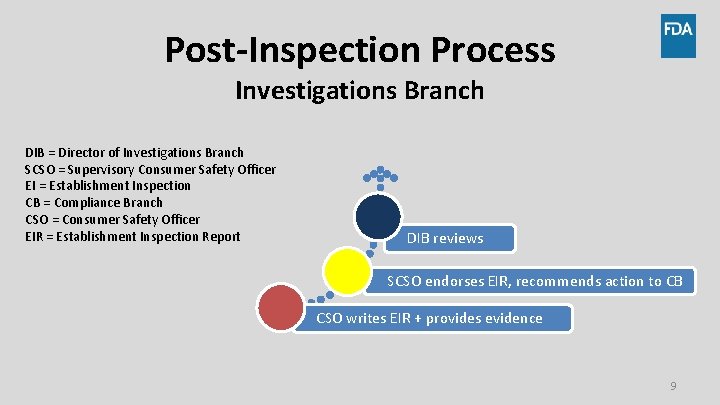
Post-Inspection Process Investigations Branch DIB = Director of Investigations Branch SCSO = Supervisory Consumer Safety Officer EI = Establishment Inspection CB = Compliance Branch CSO = Consumer Safety Officer EIR = Establishment Inspection Report DIB reviews SCSO endorses EIR, recommends action to CB CSO writes EIR + provides evidence 9
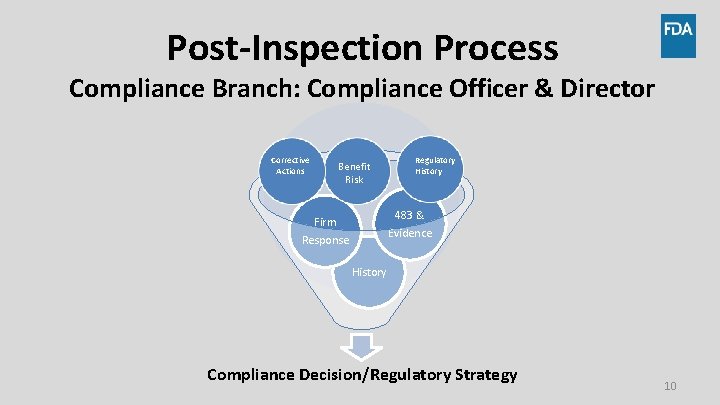
Post-Inspection Process Compliance Branch: Compliance Officer & Director Corrective Actions Benefit Risk Regulatory History 483 & Evidence Firm Response History Compliance Decision/Regulatory Strategy 10
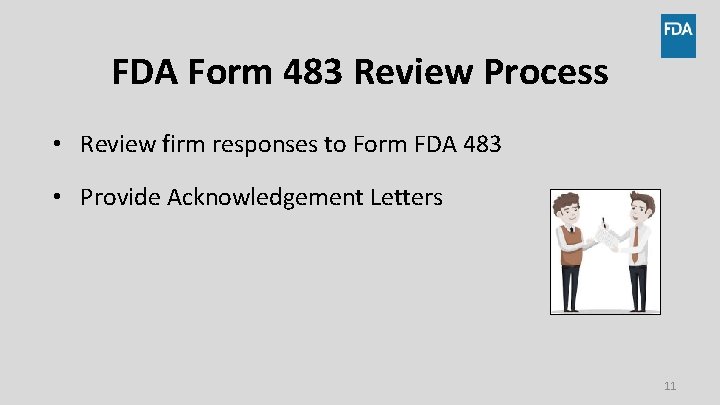
FDA Form 483 Review Process • Review firm responses to Form FDA 483 • Provide Acknowledgement Letters 11
Supporting a Regulatory Action 12
Supporting a Regulatory Action • Significance of violations • Evidence • Demonstration of ongoing violations • Prior warning and promised corrections 13
Regulatory Procedure Manual (RPM) Factors to Consider General Considerations: • Evidence shows that a firm, product, and/or individual: – is in violation of the law or regulations and – failure to achieve adequate and prompt correction (may result in consideration of an enforcement action) • Violation is determined to be of regulatory significance • Issuance of a Warning Letter is appropriate • Reasonable expectation that responsible party will take prompt corrective action 14
RPM: Factors to Consider • • Firm’s compliance history Nature and impact of violations Benefit and risk associated with product Documentation of firm’s adequate, systematic and effective corrective action o Ongoing or promised corrective action does not preclude issuance of a Warning Letter or other regulatory action o Corrective action describes timeframe o Corrective action produces sustained compliance with the law or regulations 15
RPM: Factors to Consider Completed Corrective Actions • Do not preclude consideration of regulatory action should ORA later observe that same or similar violations have not been corrected Acknowledgement Letter • • • Alternative form of FDA communication States that FDA has relied on firm’s actions and/or promises Will include this statement: “This letter and the inspectional observations listed on Form FDA-483 are not intended to indicate that the FDA will or will not take any particular regulatory or administrative action with regard to this matter. You are reminded that it is the responsibility of your firm’s management to maintain compliance with all applicable provisions of the Federal Food, Drug, and Cosmetic Act and its implementing regulations. ” 16
RPM: Factors to Consider Verification of Corrective Actions • Overall completeness and effectiveness of corrective action • Expedited or routine follow-up inspection is typical 17
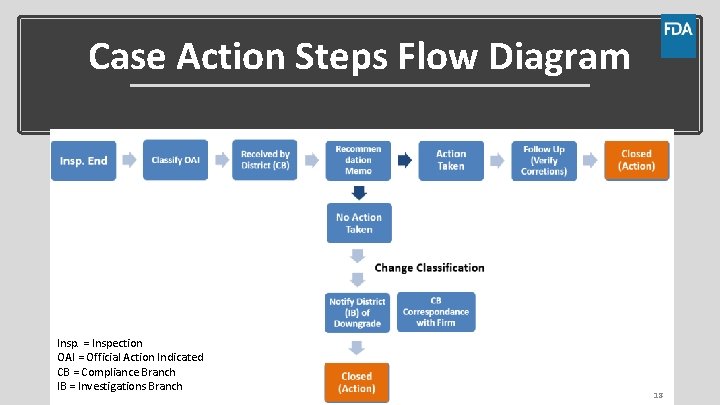
Case Action Steps Flow Diagram Insp. = Inspection OAI = Official Action Indicated CB = Compliance Branch IB = Investigations Branch 18
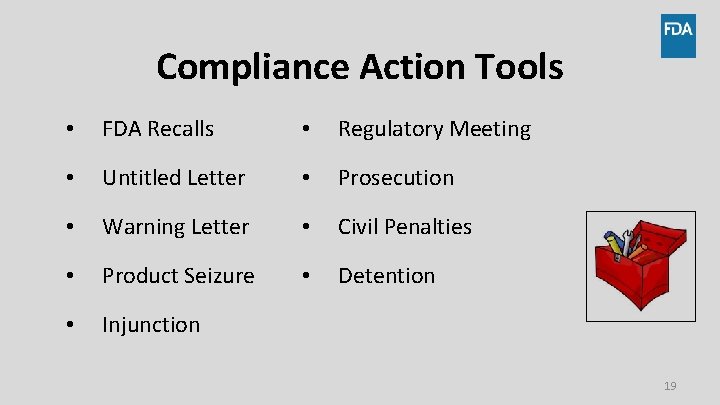
Compliance Action Tools • FDA Recalls • Regulatory Meeting • Untitled Letter • Prosecution • Warning Letter • Civil Penalties • Product Seizure • Detention • Injunction 19
Warning Letter Is an Advisory Action taken to achieve prompt voluntary compliance Ensures scope and seriousness understood by firm Describes/lists violations of FD&C Act, 21 CFR Often has precedent cases (e. g. Dotterweich & Park) Provides “Prior Notice” for other actions (e. g. , court enforcement) Requires FDA Center Concurrence for certain violations – e. g. 510(k)/PMA, labeling/claims, novel technologies • Does not require FDA Center Concurrence for GMPs • Is made public – posted on FDA’s website • • • GMPs = Good Manufacturing Practices PMA = Post-Market Approval 510(k) = Pre-Market Clearance 20
Warning Letter • Warning Letters issued per year on average – About 30 domestic – About 40 foreign • Approximately 7 out of 10 Warning Letters for Quality Systems fall into 2 subsystems: – Production and Process Controls – Corrective and Preventive Action 21
Regulatory Meeting • Informs firm and its responsible individuals of its violative products, practices, and processes • Allows real-time dialogue to address issues and obtain voluntary compliance • Provides prior notice and discusses sanctions available for issuing other actions • Informs attendees that FDA staff cannot serve as consultants • Reiterates agency’s expectations and firm’s obligation to come into compliance 22
Other Actions • SEIZURE – vs. “the product” An action brought against an FDA-regulated product because it is adulterated and/or misbranded within the meaning of the FD&C Act • INJUNCTION – vs. “the behavior & individuals” An order by a court requiring an individual or a corporation to do or refrain from doing a specific act 23
Other Actions • PROSECUTION – vs. “the individual” May be recommended in appropriate cases for violation of Section 301 of the FD&C Act. • CIVIL MONEY PENALTIES • ADMINISTRATIVE DETENTION ORDER Administrative detention provides a means through which FDA can hold adulterated or misbranded products (e. g. , foods, medical devices) and prevent them from entering the marketplace. 24
Compliance Case Flow Case Study: Gas Analyzer 25
Compliance Case Flow • Product: Gas Analyzer • Pre-Inspectional Preparation ü Determining the type of establishment inspection ü Review establishment firm files ü Review firm’s inspection/compliance history ü Review FDA’s procedures and guidance manuals • Intra-Inspection Review ü FDA Form 482 26
Compliance Case Flow • Inspectional Close-out/FDA 483 (IB): - GMPs and labeling evidence - Annotate FDA 483 IB = Investigations Branch CB = Compliance Branch GMPs = Good Manufacturing Practices 510(k) = Pre-Market Clearance • Form FDA 483 response (Firm) - 15 business days requirement • Violations of the Act (CB) - GMPs + Lack of 510(k) - Labeling claims: brochure, instructions for use, website, social media 27
Compliance Case Flow • Post-Inspection Activities (CB) - Forms of communication • Regulatory Action – i. e. Warning Letter - Firm, product, and/or the individual is in violation of the law - Failure to achieve adequate and prompt corrections - Violations are determined to be of regulatory significance - FDA has reasonable expectation the firm will take prompt corrective action - Request firm submit a response within 15 business days • Post-Regulatory Activities: Firm and Consultant CB = Compliance Branch 28
Compliance Case Flow • Post-Regulatory Reinspection • Post-Regulatory Other Action Ø Regulatory Meeting Ø 510(k) status? • Ideal Outcome: Voluntary Compliance 29
Tips for Firms to Effectively Respond to Regulatory Actions 30
Understand Your Product’s Requirements • How is your product classified? • Does your product require a premarket submission before getting to market? • What are your reporting requirements? • What are your Quality System Requirements? • What are your label and labeling requirements? • Do you have a website or social media? 31
Tips for Effective Responses • Annotate; make corrections during Establishment Inspection • Address each observation/deficiency • Be comprehensive and accurate • Perform an effectiveness check on CAPAs • Show evidence of correction and corrective actions • Update/revise Standard Operating Procedures; show both before and after versions CAPA = Corrective and Preventive Action 32
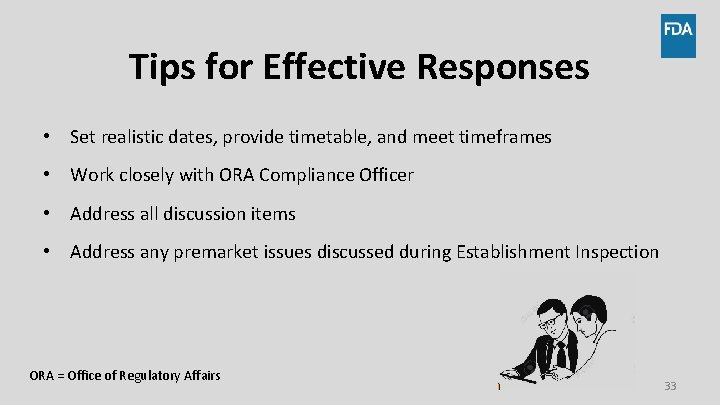
Tips for Effective Responses • Set realistic dates, provide timetable, and meet timeframes • Work closely with ORA Compliance Officer • Address all discussion items • Address any premarket issues discussed during Establishment Inspection ORA = Office of Regulatory Affairs 33
Device Resources 1. FDA Guidance www. fda. gov/medical-devices/device-advice-comprehensive-regulatory-assistance/guidancedocuments-medical-devices-and-radiation-emitting-products 2. CDRH Learn: Multi-Media Industry Education www. fda. gov/training-and-continuing-education/cdrh-learn 3. Device Advice: Text-Based Education www. fda. gov/medical-devices/device-advice-comprehensive-regulatory-assistance 4. Division of Industry and Consumer Education (DICE) DICE@fda. hhs. gov 5. Ombudsman (e. g. , dispute resolution) ORAOmbudsman@fda. hhs. gov and CDRHOmbudsman@fda. hhs. gov 34
Summary • Compliance Officers roles are critical to protecting the consumer • ORA issues advisory and enforcement actions as a result of the product’s health risk and violation of law • ORA’s Compliance Branch communication strategies and riskbased enforcement actions help to reduce and prevent patient harm • Compliance cases aim to ensure a positive public health outcome 35
Your Call to Action 1. Understand your regulatory responsibilities 2. Stay informed and use various FDA resources 3. View other modules in this series to learn more about the individual OMDRHO staff roles OMDRHO = Office of Medical Device and Radiological Health Operations 36
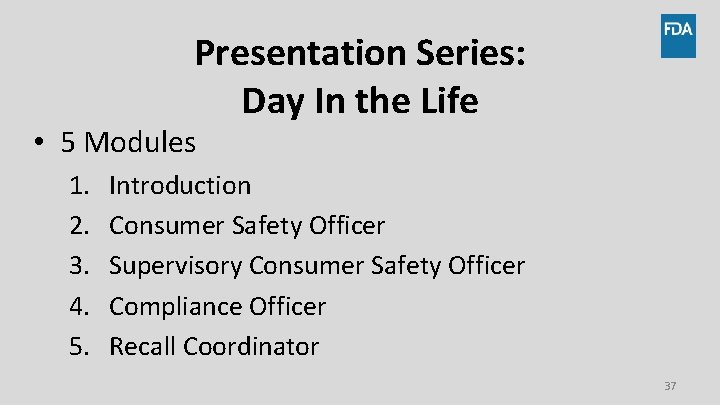
Presentation Series: Day In the Life • 5 Modules 1. 2. 3. 4. 5. Introduction Consumer Safety Officer Supervisory Consumer Safety Officer Compliance Officer Recall Coordinator 37
38