
Day 6 UNIT 1 Motion Graphs x t



- Slides: 18
Day 6 UNIT 1 Motion Graphs x t Lyzinski Physics
Day #6 * v-t graphs * slopes & areas of v-t graphs * instantaneous accelerations
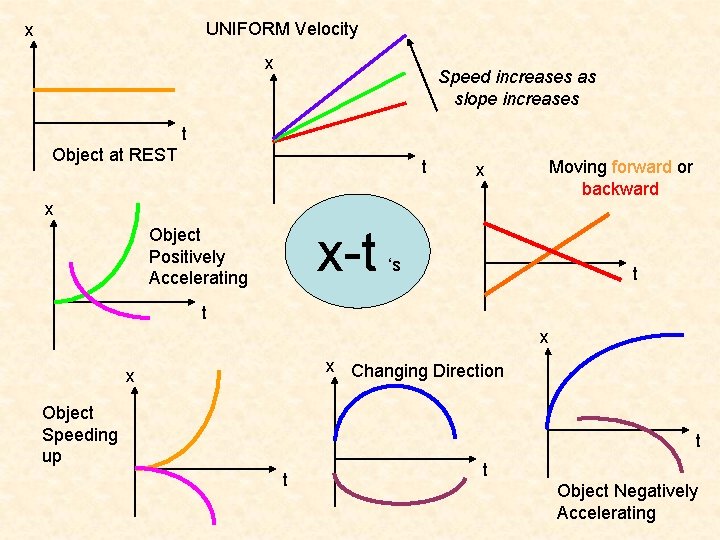
UNIFORM Velocity x x Speed increases as slope increases t Object at REST t Moving forward or backward x x x-t Object Positively Accelerating ‘s t t x x Changing Direction x Object Speeding up t t t Object Negatively Accelerating
UNIFORM Positive (+) Acceleration v Acceleration increases as slope increases v t t v-t UNIFORM Velocity (no acceleration) v v Changing Direction ‘s t v Object at REST UNIFORM Negative (-) Acceleration t t
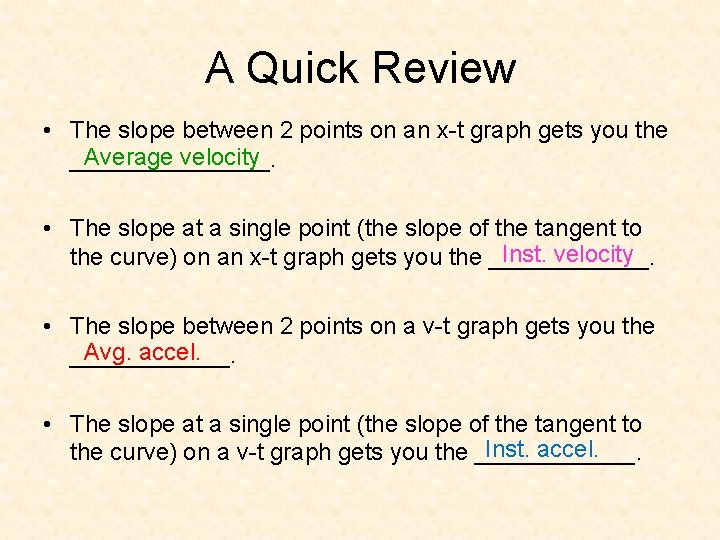
A Quick Review • The slope between 2 points on an x-t graph gets you the Average velocity ________. • The slope at a single point (the slope of the tangent to Inst. velocity the curve) on an x-t graph gets you the ______. • The slope between 2 points on a v-t graph gets you the Avg. accel. ______. • The slope at a single point (the slope of the tangent to Inst. accel. the curve) on a v-t graph gets you the ______.
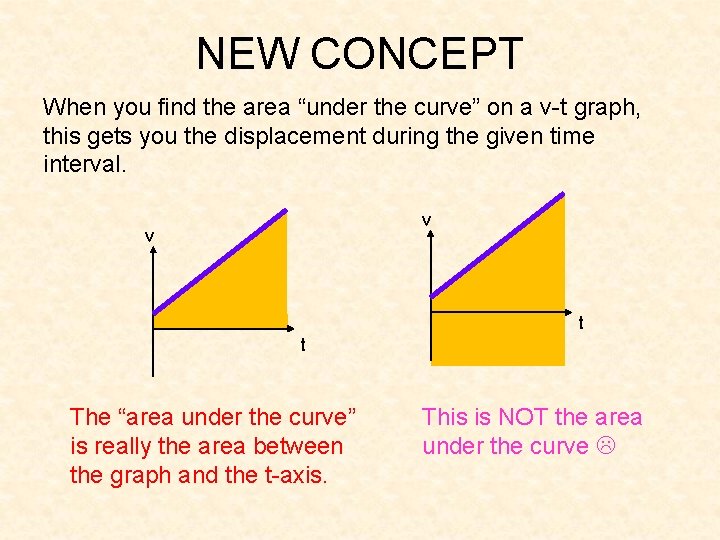
NEW CONCEPT When you find the area “under the curve” on a v-t graph, this gets you the displacement during the given time interval. v v t t The “area under the curve” is really the area between the graph and the t-axis. This is NOT the area under the curve
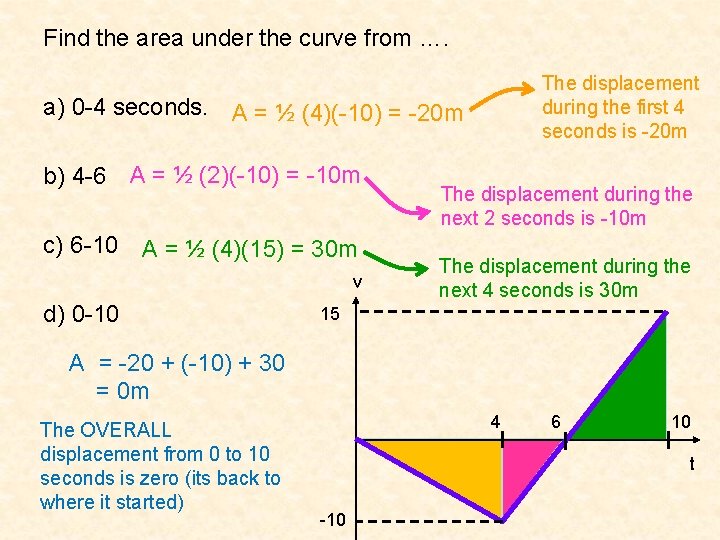
Find the area under the curve from …. The displacement during the first 4 seconds is -20 m a) 0 -4 seconds. A = ½ (4)(-10) = -20 m b) 4 -6 A = ½ (2)(-10) = -10 m c) 6 -10 A = ½ (4)(15) = 30 m v d) 0 -10 The displacement during the next 2 seconds is -10 m The displacement during the next 4 seconds is 30 m 15 A = -20 + (-10) + 30 = 0 m The OVERALL displacement from 0 to 10 seconds is zero (its back to where it started) 4 6 10 t -10
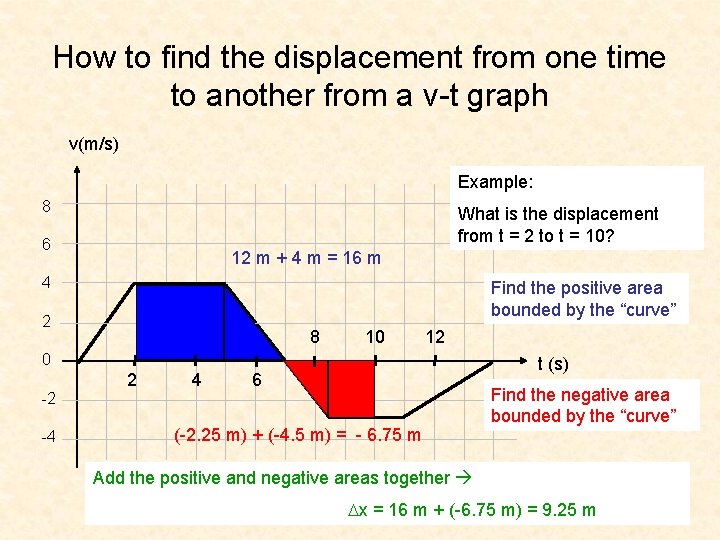
How to find the displacement from one time to another from a v-t graph v(m/s) Example: 8 What is the displacement from t = 2 to t = 10? 6 12 m + 4 m = 16 m 4 Find the positive area bounded by the “curve” 2 8 10 12 0 -2 -4 2 4 t (s) 6 (-2. 25 m) + (-4. 5 m) = - 6. 75 m Find the negative area bounded by the “curve” Add the positive and negative areas together Dx = 16 m + (-6. 75 m) = 9. 25 m
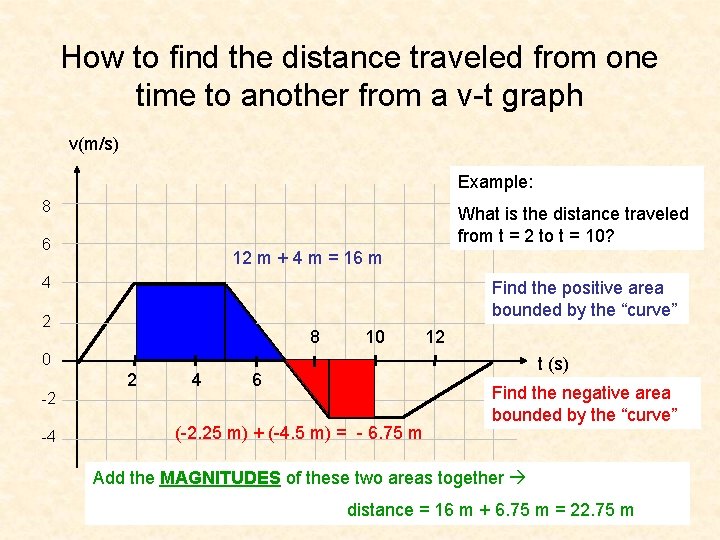
How to find the distance traveled from one time to another from a v-t graph v(m/s) Example: 8 What is the distance traveled from t = 2 to t = 10? 6 12 m + 4 m = 16 m 4 Find the positive area bounded by the “curve” 2 8 10 12 0 -2 -4 2 4 t (s) 6 (-2. 25 m) + (-4. 5 m) = - 6. 75 m Find the negative area bounded by the “curve” Add the MAGNITUDES of these two areas together distance = 16 m + 6. 75 m = 22. 75 m
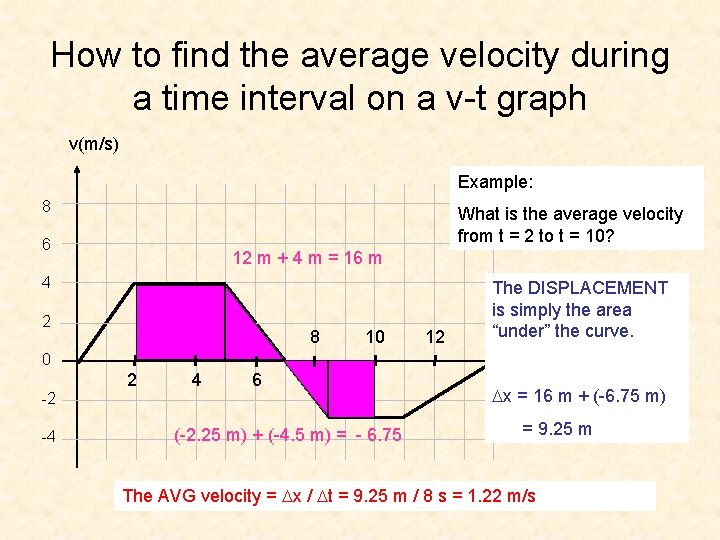
How to find the average velocity during a time interval on a v-t graph v(m/s) Example: 8 What is the average velocity from t = 2 to t = 10? 6 12 m + 4 m = 16 m 4 2 8 10 12 The DISPLACEMENT is simply the area “under” the curve. 0 -2 -4 2 4 6 (-2. 25 m) + (-4. 5 m) = - 6. 75 t (s) Dx = 16 m + (-6. 75 m) = 9. 25 m The AVG velocity = Dx / Dt = 9. 25 m / 8 s = 1. 22 m/s
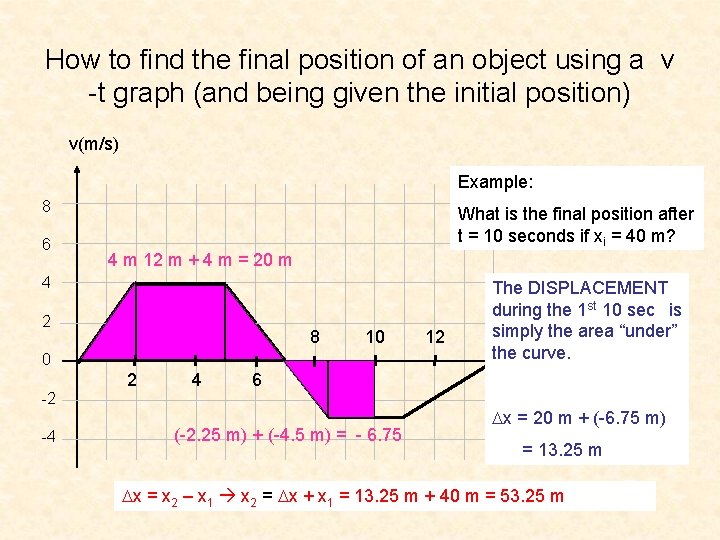
How to find the final position of an object using a v -t graph (and being given the initial position) v(m/s) Example: 8 6 What is the final position after t = 10 seconds if xi = 40 m? 4 m 12 m + 4 m = 20 m 4 2 8 10 0 -2 -4 2 4 6 (-2. 25 m) + (-4. 5 m) = - 6. 75 12 The DISPLACEMENT during the 1 st 10 sec is simply the area “under” the curve. t (s) Dx = 20 m + (-6. 75 m) = 13. 25 m Dx = x 2 – x 1 x 2 = Dx + x 1 = 13. 25 m + 40 m = 53. 25 m
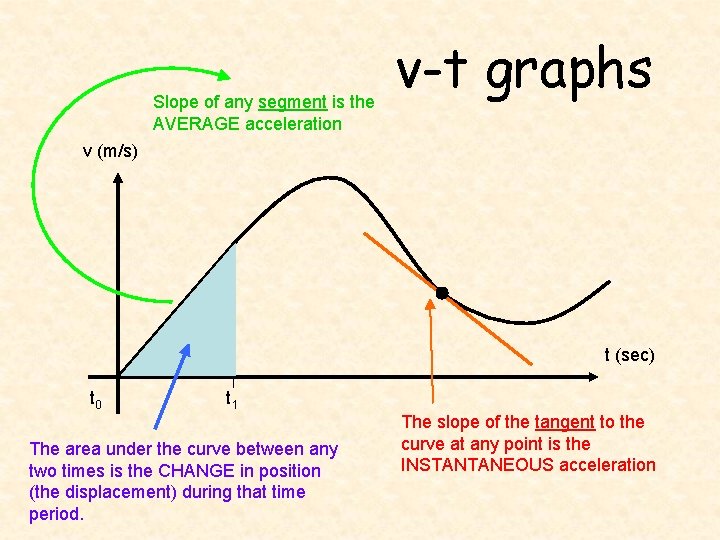
Slope of any segment is the AVERAGE acceleration v-t graphs v (m/s) t (sec) t 0 t 1 The area under the curve between any two times is the CHANGE in position (the displacement) during that time period. The slope of the tangent to the curve at any point is the INSTANTANEOUS acceleration
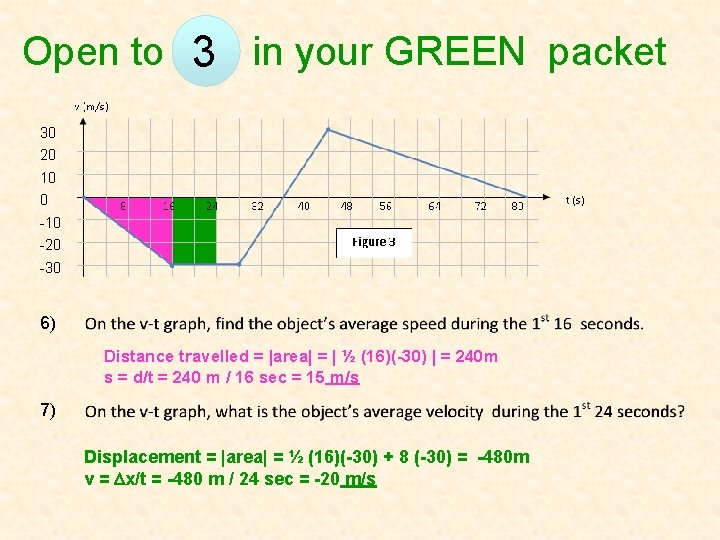
Open to 3 in your GREEN packet 30 20 10 0 -10 -20 -30 6) Distance travelled = |area| = | ½ (16)(-30) | = 240 m s = d/t = 240 m / 16 sec = 15 m/s 7) Displacement = |area| = ½ (16)(-30) + 8 (-30) = -480 m v = Dx/t = -480 m / 24 sec = -20 m/s
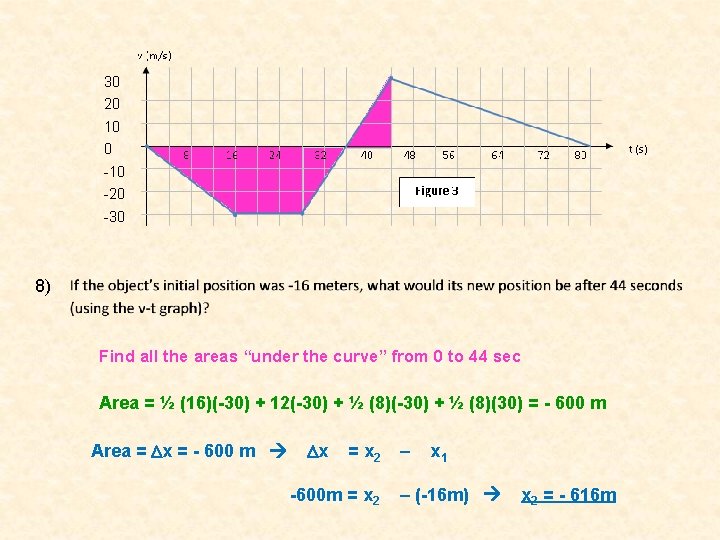
30 20 10 0 -10 -20 -30 8) Find all the areas “under the curve” from 0 to 44 sec Area = ½ (16)(-30) + 12(-30) + ½ (8)(30) = - 600 m Area = Dx = - 600 m Dx = x 2 -600 m = x 2 – x 1 – (-16 m) x 2 = - 616 m
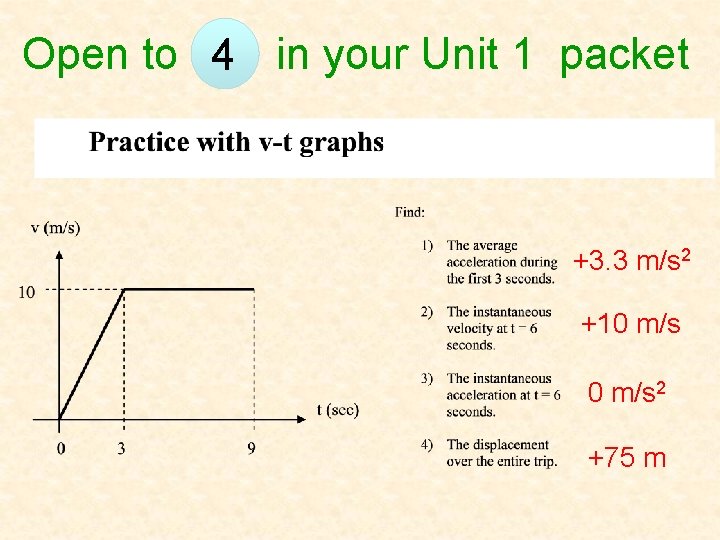
Open to 4 in your Unit 1 packet +3. 3 m/s 2 +10 m/s 2 +75 m
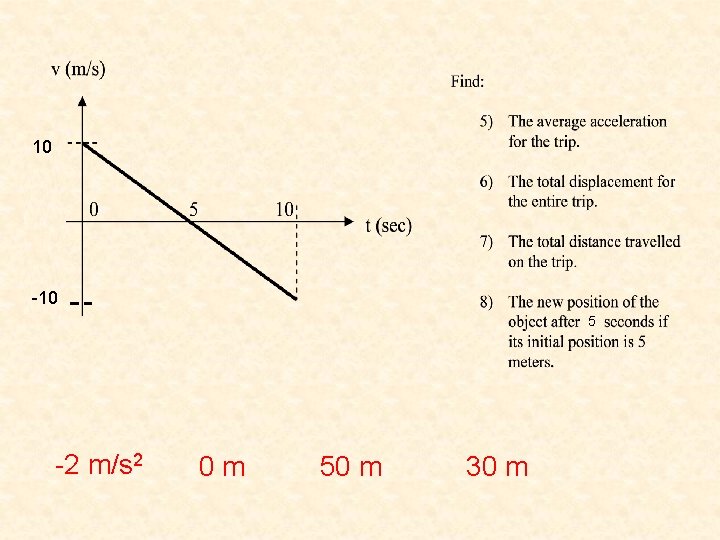
10 -10 5 -2 m/s 2 0 m 50 m 30 m
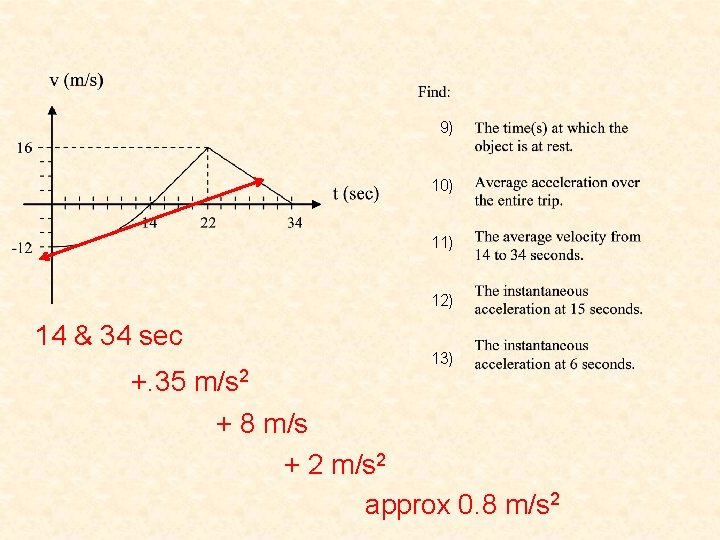
9) 10) 11) 12) 14 & 34 sec +. 35 m/s 2 13) + 8 m/s + 2 m/s 2 approx 0. 8 m/s 2
HOMEWORK Check out your Unit 1 Schedule … Day #6 Another Quiz tomorrow -minutes again) (20