
DAY 5 How do cells in the brain
DAY 5: How do cells in the brain communicate? What are the major chemicals in the brain that affect behavior?
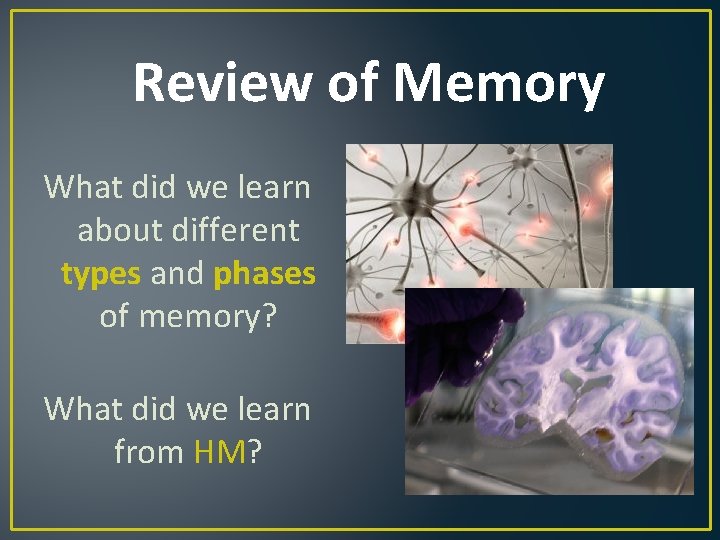
Review of Memory What did we learn about different types and phases of memory? What did we learn from HM?

Neurons Cells in the brain that carry messages through signals to other parts of the brain.
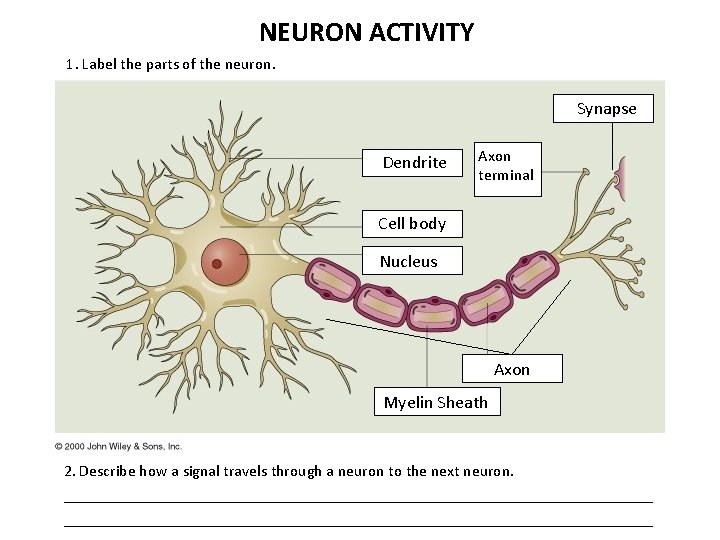
NEURON ACTIVITY 1. Label the parts of the neuron. Synapse Dendrite Axon terminal Cell body Nucleus Axon Myelin Sheath 2. Describe how a signal travels through a neuron to the next neuron. __________________________________________________________________________
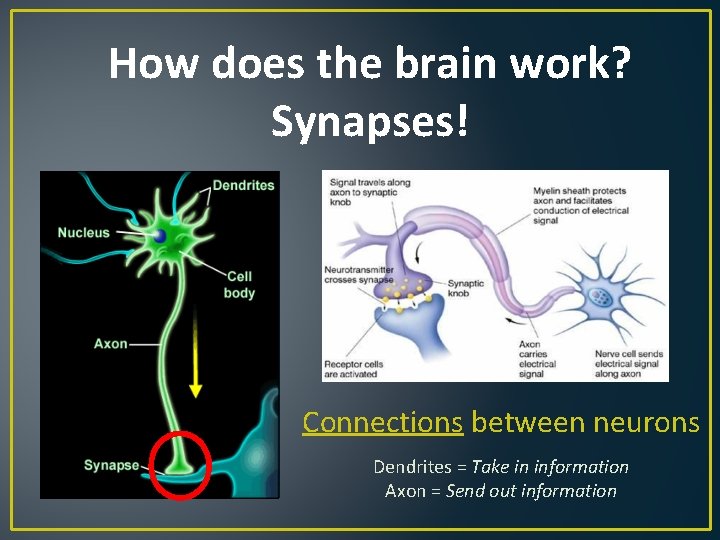
How does the brain work? Synapses! Connections between neurons Dendrites = Take in information Axon = Send out information
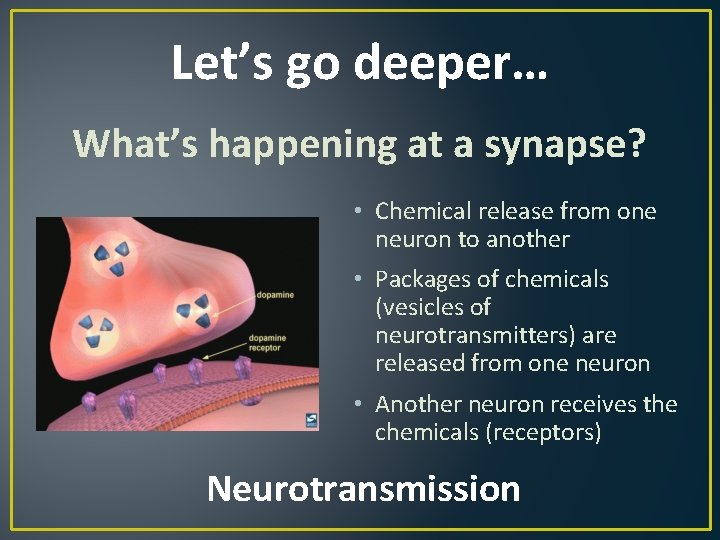
Let’s go deeper… What’s happening at a synapse? • Chemical release from one neuron to another • Packages of chemicals (vesicles of neurotransmitters) are released from one neuron • Another neuron receives the chemicals (receptors) Neurotransmission
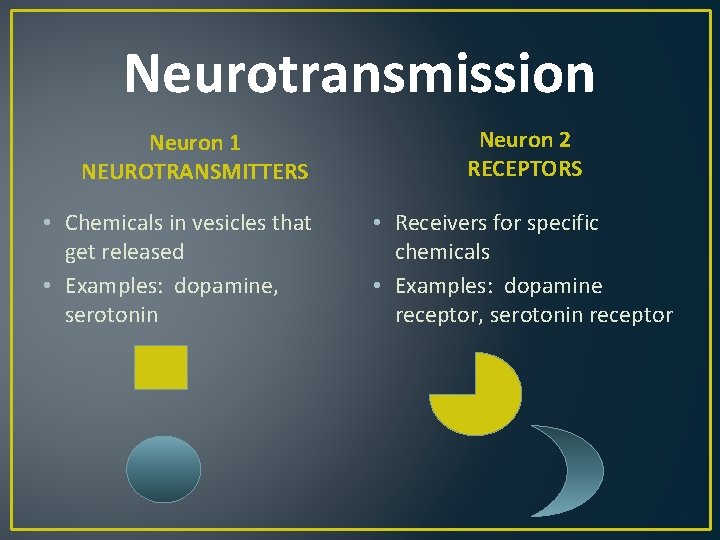
Neurotransmission Neuron 1 NEUROTRANSMITTERS • Chemicals in vesicles that get released • Examples: dopamine, serotonin Neuron 2 RECEPTORS • Receivers for specific chemicals • Examples: dopamine receptor, serotonin receptor
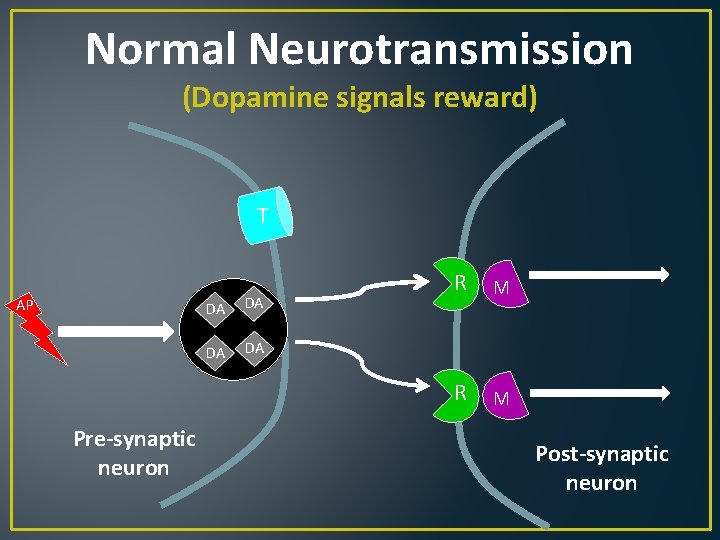
Normal Neurotransmission (Dopamine signals reward) T AP Pre-synaptic neuron DA DA R M Post-synaptic neuron
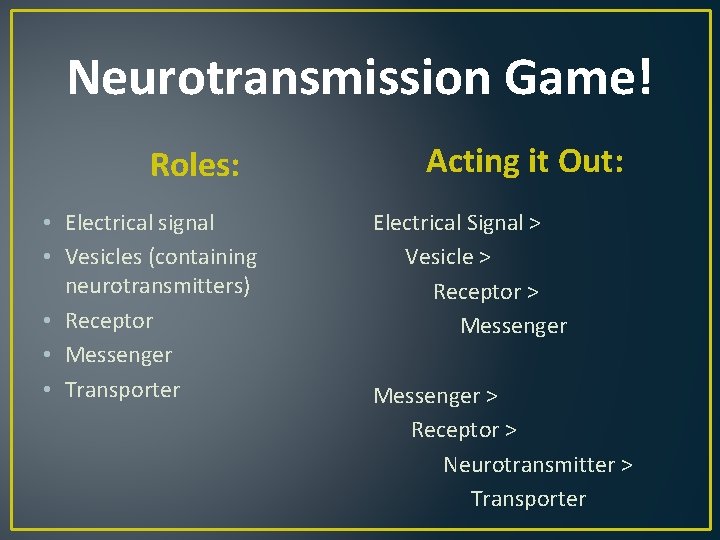
Neurotransmission Game! Roles: • Electrical signal • Vesicles (containing neurotransmitters) • Receptor • Messenger • Transporter Acting it Out: Electrical Signal > Vesicle > Receptor > Messenger > Receptor > Neurotransmitter > Transporter
Short break
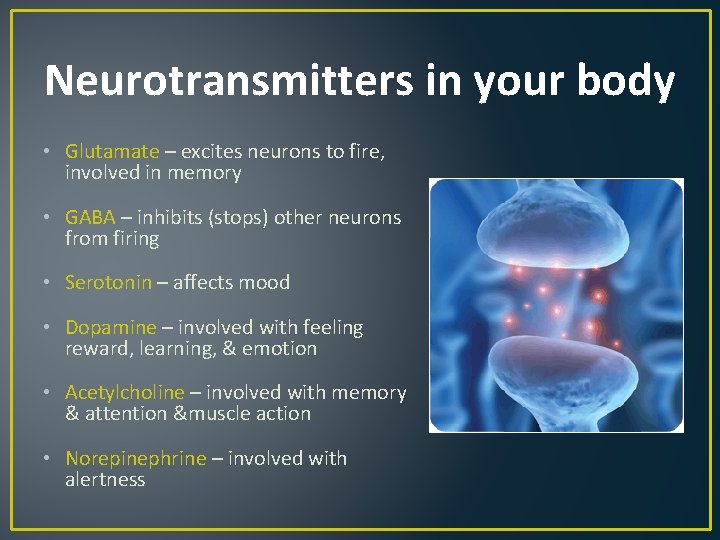
Neurotransmitters in your body • Glutamate – excites neurons to fire, involved in memory • GABA – inhibits (stops) other neurons from firing • Serotonin – affects mood • Dopamine – involved with feeling reward, learning, & emotion • Acetylcholine – involved with memory & attention &muscle action • Norepinephrine – involved with alertness
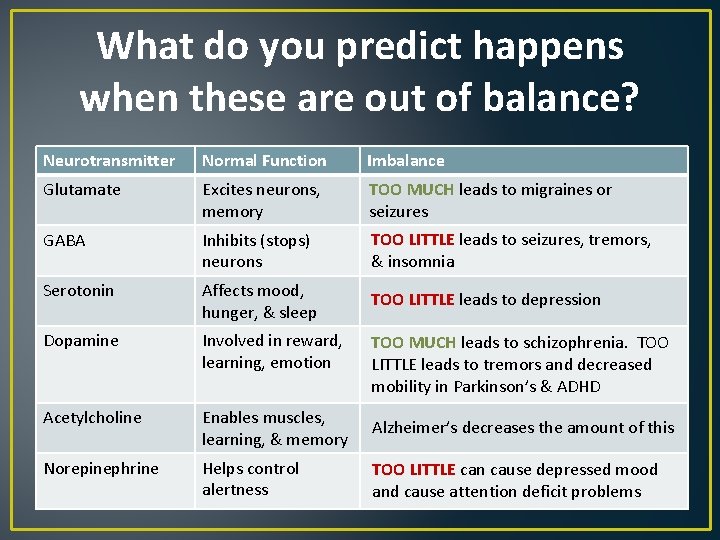
What do you predict happens when these are out of balance? Neurotransmitter Normal Function Imbalance Glutamate Excites neurons, memory TOO MUCH leads to migraines or seizures GABA Inhibits (stops) neurons TOO LITTLE leads to seizures, tremors, & insomnia Serotonin Affects mood, hunger, & sleep TOO LITTLE leads to depression Dopamine Involved in reward, learning, emotion Acetylcholine Enables muscles, learning, & memory Alzheimer’s decreases the amount of this Norepinephrine Helps control alertness TOO LITTLE can cause depressed mood and cause attention deficit problems TOO MUCH leads to schizophrenia. TOO LITTLE leads to tremors and decreased mobility in Parkinson’s & ADHD
Neurotransmitter Challenge • In a group of 3, pick one neurotransmitter. • Learn how it operates in the brain normally. • Learn what happens if it’s out of balance. • Does this result in a different mood status? • Does this result in a disease or disorder? • With your group, act out a modified version of the Neurotransmission Game to simulate your neurotransmitter working normally and abnormally.
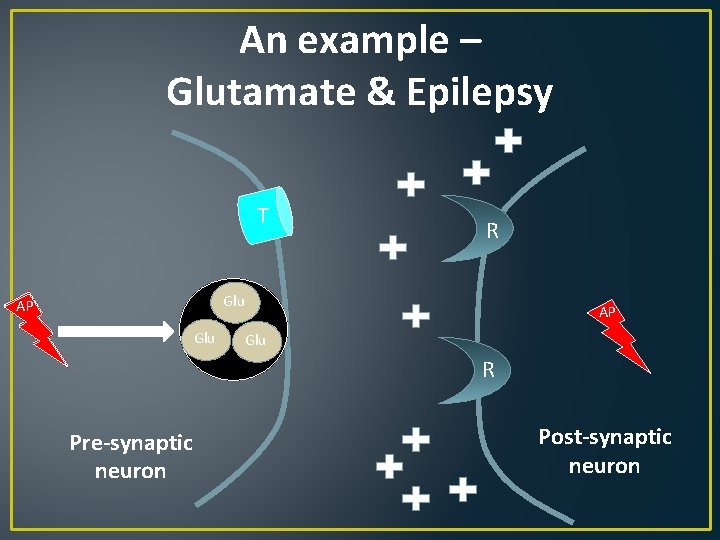
An example – Glutamate & Epilepsy T R Glu AP Glu R Pre-synaptic neuron Post-synaptic neuron
Neurotransmitter Challenge • Choose from the following neurotransmitters: • Serotonin • Dopamine • Acetylcholine • Norepinephrine
Reflection Time Think about what you did and learned today. • What does that make you think? • Where do you feel confused? • What are you still curious to learn more about?
- Slides: 16