
DAY 46 BASIC RESULTS OF RIGID MOTIONS INTRODUCTION
DAY 46 – BASIC RESULTS OF RIGID MOTIONS
INTRODUCTION A rigid motion is a transformation on a plane that preserves the distance between the points and the relative position of the points. There are four rigid motions namely reflection, glide reflection, translation, and rotation. In this lesson, we are going to illustrate and explain the basic theorems on results of these rigid motions on different figures.
VOCABULARY Rigid motion This is a transformation on a plane that preserves the distance between the points and the relative position of the points such that the pre-image and the image have the same shape and size. Non-collinear points Three or more points in a plane which do not lie in a single line.
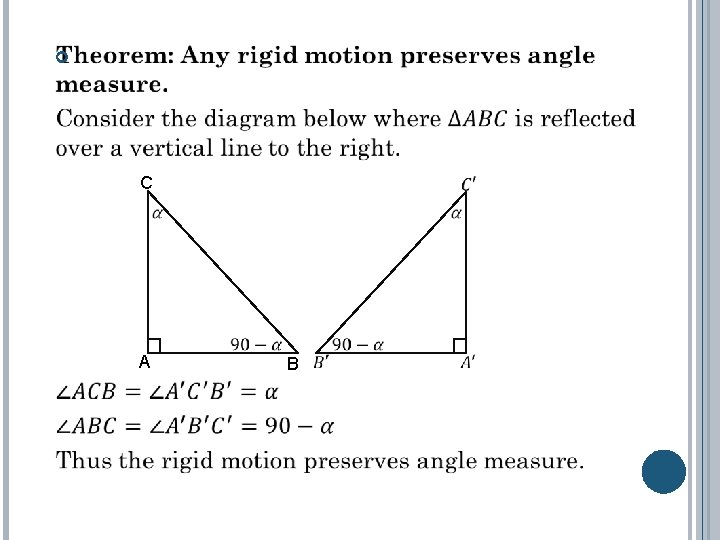
C A B
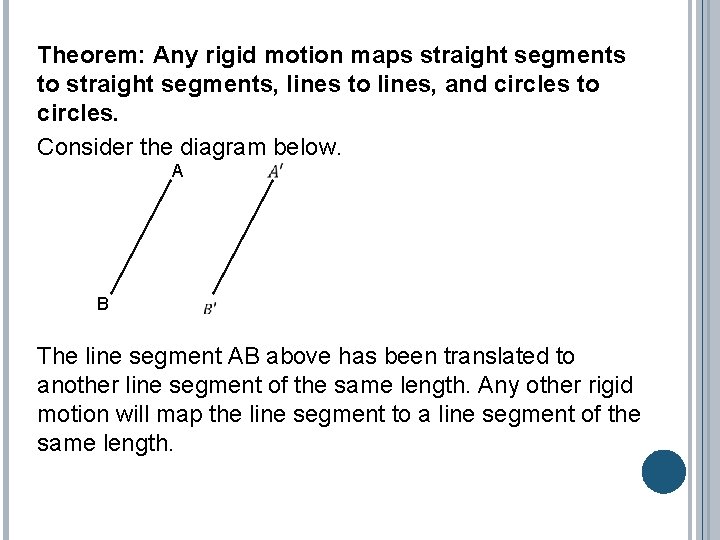
Theorem: Any rigid motion maps straight segments to straight segments, lines to lines, and circles to circles. Consider the diagram below. A B The line segment AB above has been translated to another line segment of the same length. Any other rigid motion will map the line segment to a line segment of the same length.
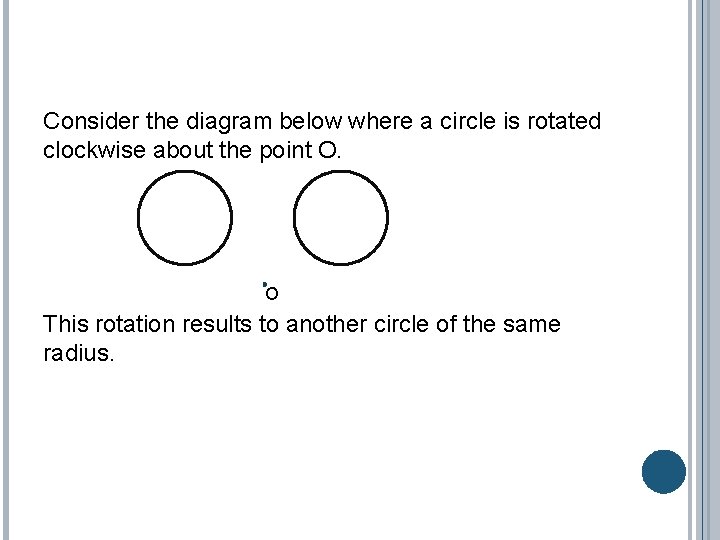
Consider the diagram below where a circle is rotated clockwise about the point O. O This rotation results to another circle of the same radius.
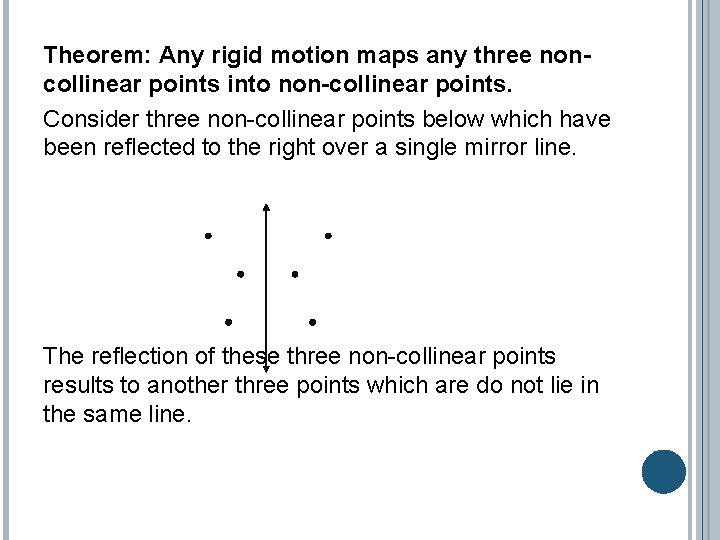
Theorem: Any rigid motion maps any three noncollinear points into non-collinear points. Consider three non-collinear points below which have been reflected to the right over a single mirror line. The reflection of these three non-collinear points results to another three points which are do not lie in the same line.
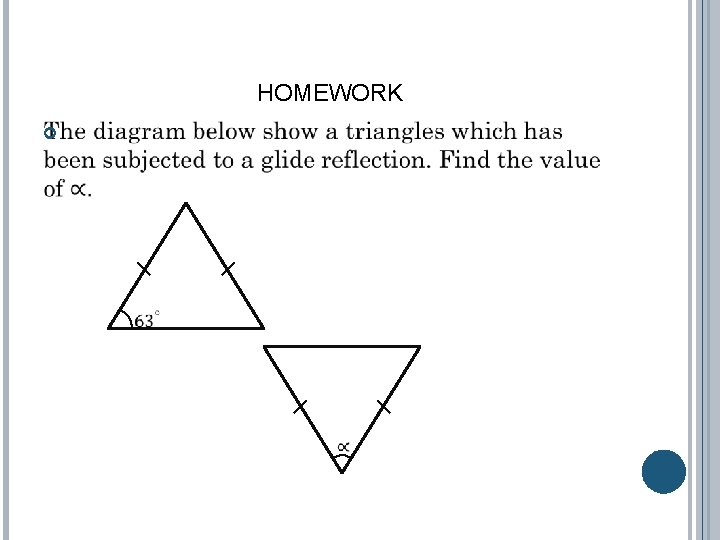
HOMEWORK

ANSWERS TO HOMEWORK

THE END
- Slides: 11