
DAY 42 THE BARBARIAN INVASIONS THE MIGRATION PERIOD
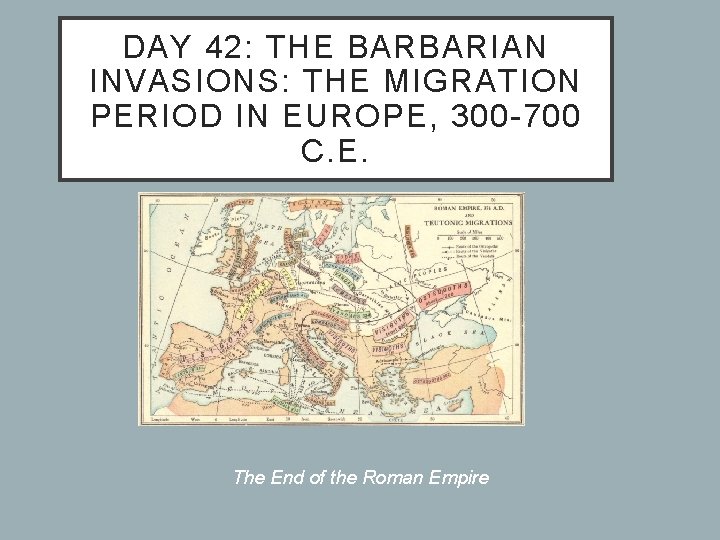
DAY 42: THE BARBARIAN INVASIONS: THE MIGRATION PERIOD IN EUROPE, 300 -700 C. E. The End of the Roman Empire
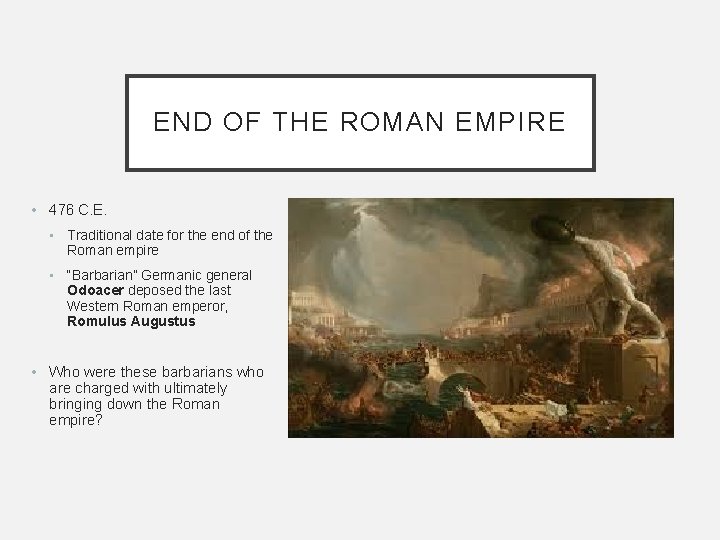
END OF THE ROMAN EMPIRE • 476 C. E. • Traditional date for the end of the Roman empire • “Barbarian” Germanic general Odoacer deposed the last Western Roman emperor, Romulus Augustus • Who were these barbarians who are charged with ultimately bringing down the Roman empire?
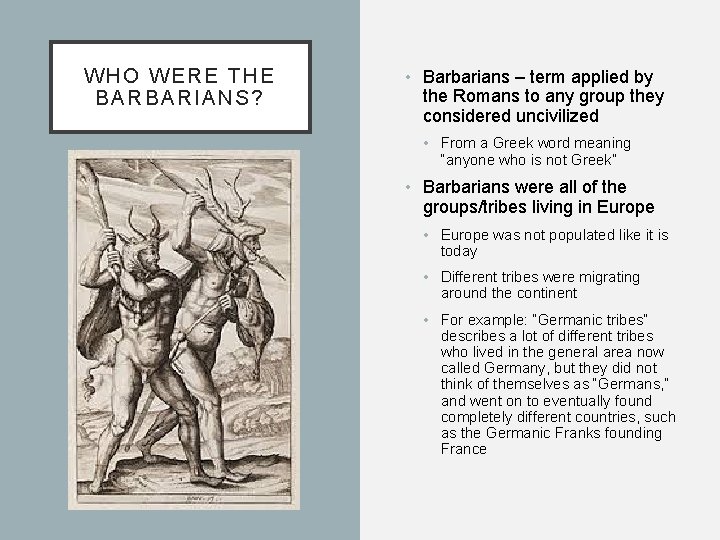
WHO WERE THE BARBARIANS? • Barbarians – term applied by the Romans to any group they considered uncivilized • From a Greek word meaning “anyone who is not Greek” • Barbarians were all of the groups/tribes living in Europe • Europe was not populated like it is today • Different tribes were migrating around the continent • For example: “Germanic tribes” describes a lot of different tribes who lived in the general area now called Germany, but they did not think of themselves as “Germans, ” and went on to eventually found completely different countries, such as the Germanic Franks founding France
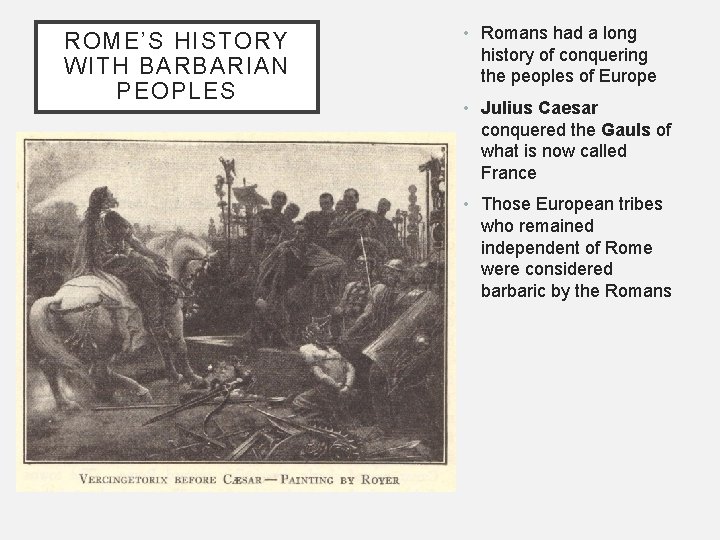
ROME’S HISTORY WITH BARBARIAN PEOPLES • Romans had a long history of conquering the peoples of Europe • Julius Caesar conquered the Gauls of what is now called France • Those European tribes who remained independent of Rome were considered barbaric by the Romans
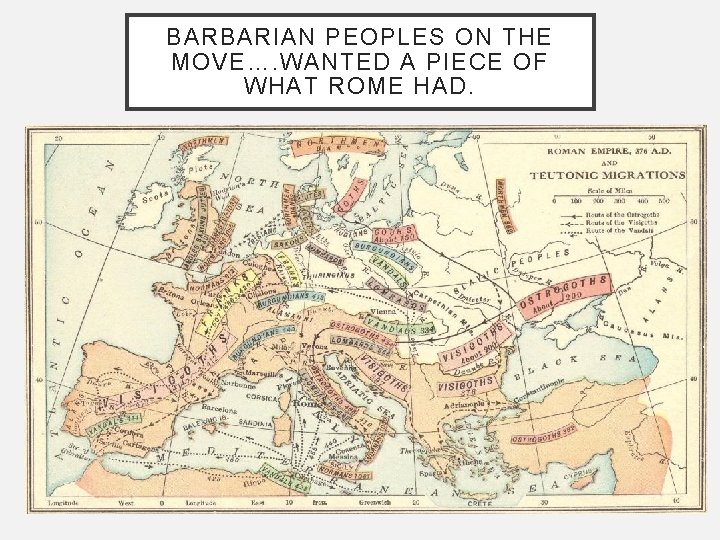
BARBARIAN PEOPLES ON THE MOVE…. WANTED A PIECE OF WHAT ROME HAD.
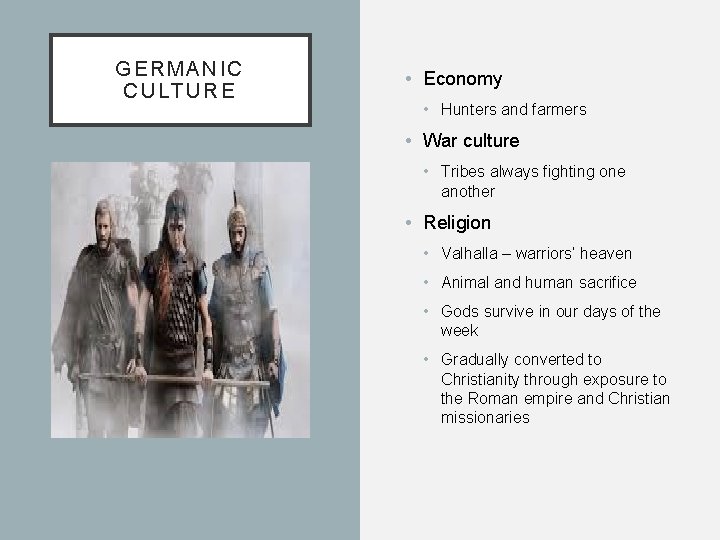
GERMANIC CULTURE • Economy • Hunters and farmers • War culture • Tribes always fighting one another • Religion • Valhalla – warriors’ heaven • Animal and human sacrifice • Gods survive in our days of the week • Gradually converted to Christianity through exposure to the Roman empire and Christian missionaries
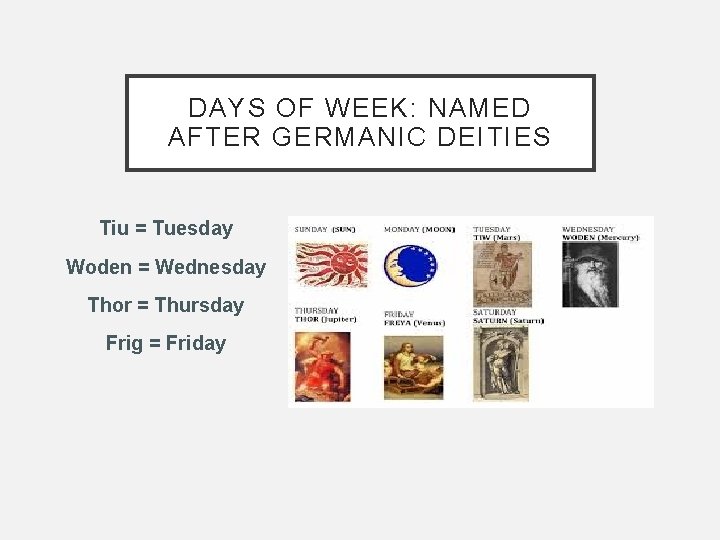
DAYS OF WEEK: NAMED AFTER GERMANIC DEITIES Tiu = Tuesday Woden = Wednesday Thor = Thursday Frig = Friday
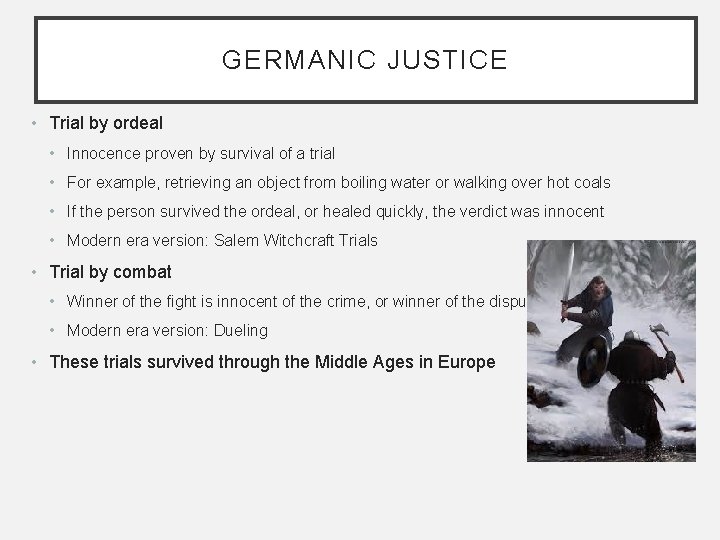
GERMANIC JUSTICE • Trial by ordeal • Innocence proven by survival of a trial • For example, retrieving an object from boiling water or walking over hot coals • If the person survived the ordeal, or healed quickly, the verdict was innocent • Modern era version: Salem Witchcraft Trials • Trial by combat • Winner of the fight is innocent of the crime, or winner of the dispute • Modern era version: Dueling • These trials survived through the Middle Ages in Europe
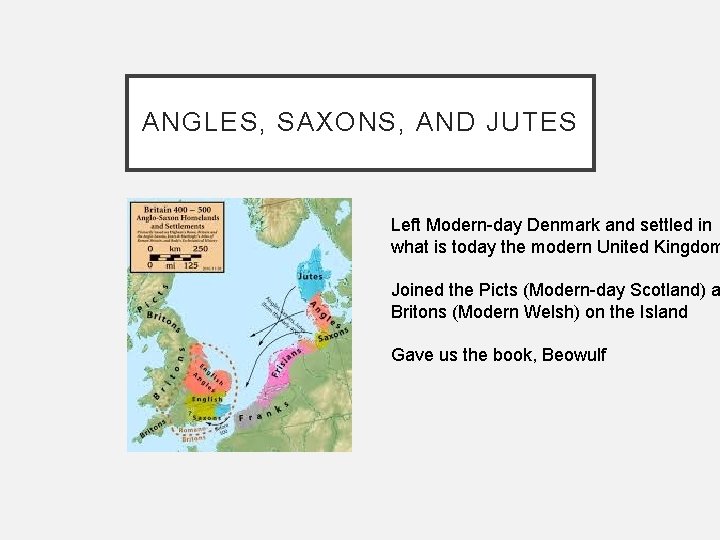
ANGLES, SAXONS, AND JUTES Left Modern-day Denmark and settled in what is today the modern United Kingdom Joined the Picts (Modern-day Scotland) a Britons (Modern Welsh) on the Island Gave us the book, Beowulf
A PAUSE FOR THE CAUSE- WHAT IS YOUR FAVORITE STORY AND WHY?
THE ARCHETYPES OF BEOWULF The Oldest Known Text in the English Language 1. What is good and evil 2. Forging a self-identity 3. Demonstration of strength and skill 4. Obtaining wealth 5. Religious beliefs 6. Violence in Our World 7. Demonstrating Courage 8. Death and Mortality 9. Supernatural forces 10. Maintaining tradition
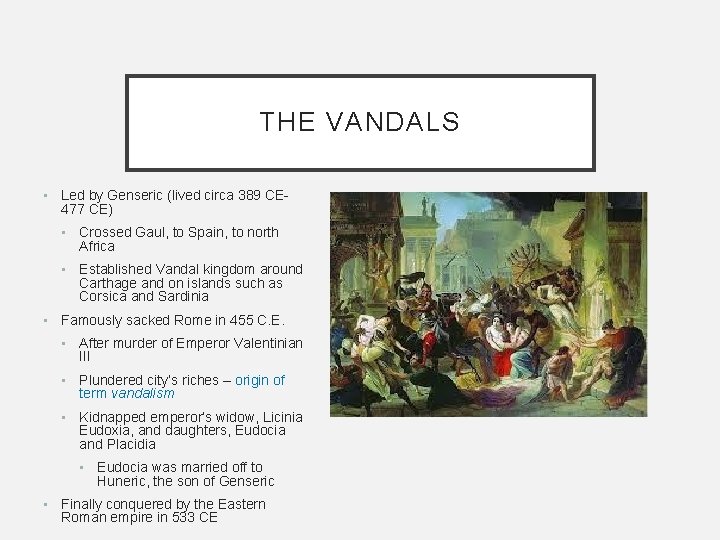
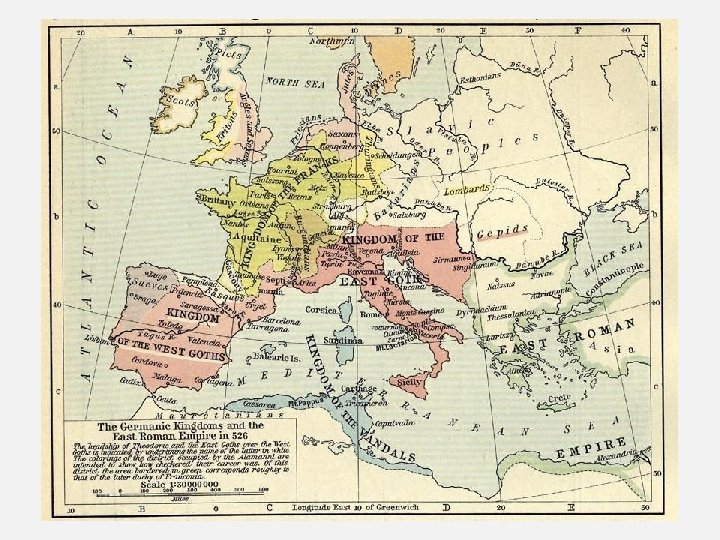
THE VANDALS • Led by Genseric (lived circa 389 CE 477 CE) • Crossed Gaul, to Spain, to north Africa • Established Vandal kingdom around Carthage and on islands such as Corsica and Sardinia • Famously sacked Rome in 455 C. E. • After murder of Emperor Valentinian III • Plundered city’s riches – origin of term vandalism • Kidnapped emperor’s widow, Licinia Eudoxia, and daughters, Eudocia and Placidia • Eudocia was married off to Huneric, the son of Genseric • Finally conquered by the Eastern Roman empire in 533 CE
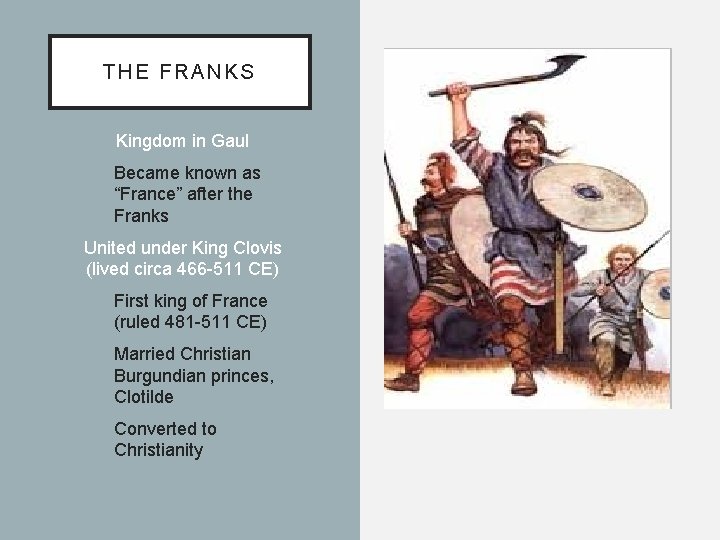
THE FRANKS Kingdom in Gaul Became known as “France” after the Franks United under King Clovis (lived circa 466 -511 CE) First king of France (ruled 481 -511 CE) Married Christian Burgundian princes, Clotilde Converted to Christianity
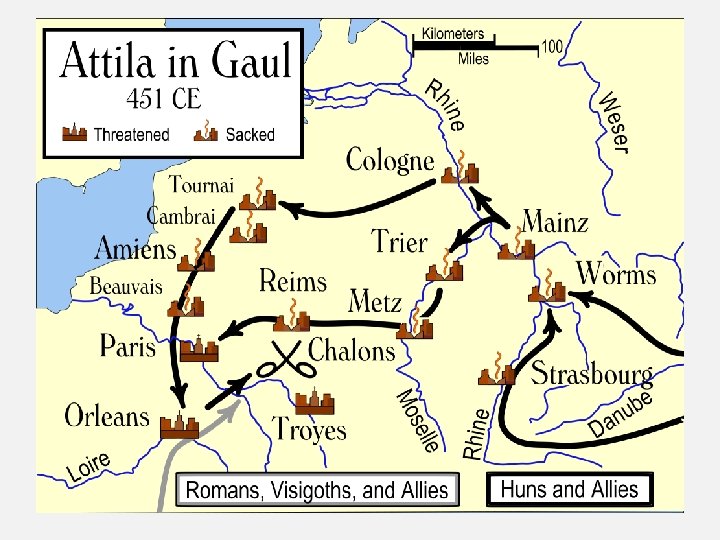
THE HUNS • From Asia, east of the Volga River • Their migration pushed the Goths into the Roman empire, ca. 370 CE • Led by Attila the Hun (lived 406 -453 CE) • Campaign in Gaul • Sacked various cities • Finally defeated by alliance of Romans and Visigoths under General Aetius at the Battle of Chalons (451 CE) • 450 CE – Emperor Valentinian III’s sister, Honoria, sent him an engagement ring (to avoid a forced marriage) • Attila used this pretext to attempt an invasion of Rome (452 CE) • According to legend, Pope Leo I, helped by St. Peter and St. Paul, convinced Attila at the Po River to halt his advance • Attila retreated and died a year later, allegedly by choking to death on his own blood (from a nosebleed) while in a drunken stupor following his wedding to Ildico
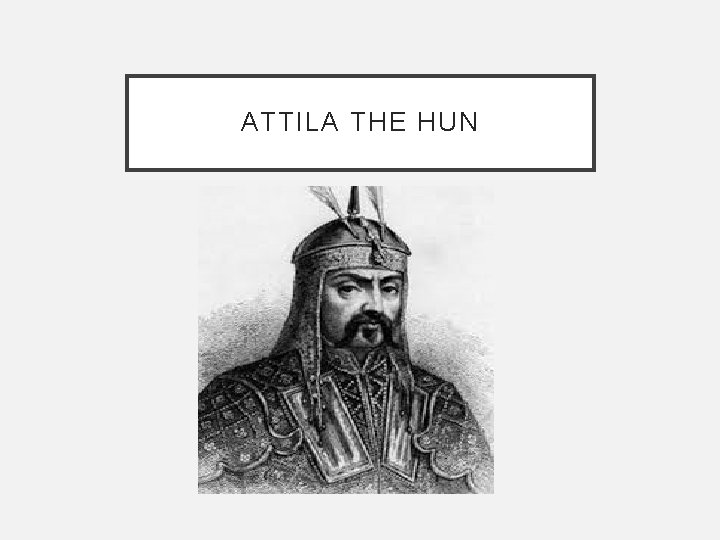
ATTILA THE HUN
A QUOTE THAT SUMS HIM UP “There, where I have passed, the grass will never grow again”Attila the Hun
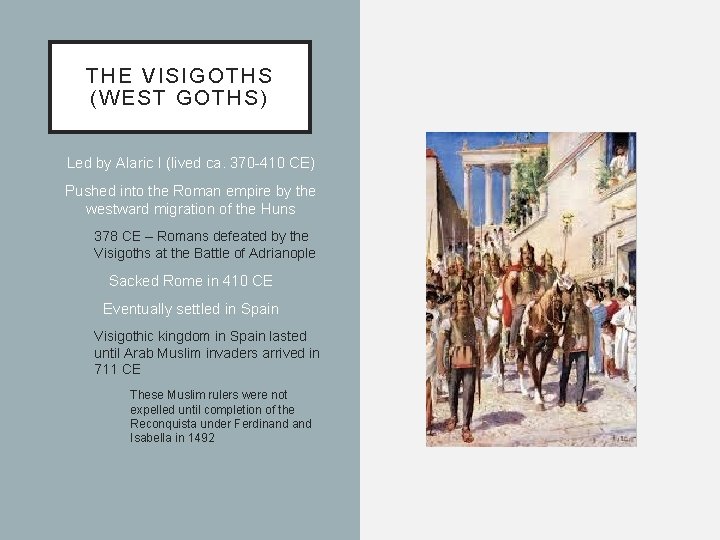
THE VISIGOTHS (WEST GOTHS) Led by Alaric I (lived ca. 370 -410 CE) Pushed into the Roman empire by the westward migration of the Huns 378 CE – Romans defeated by the Visigoths at the Battle of Adrianople Sacked Rome in 410 CE Eventually settled in Spain Visigothic kingdom in Spain lasted until Arab Muslim invaders arrived in 711 CE These Muslim rulers were not expelled until completion of the Reconquista under Ferdinand Isabella in 1492
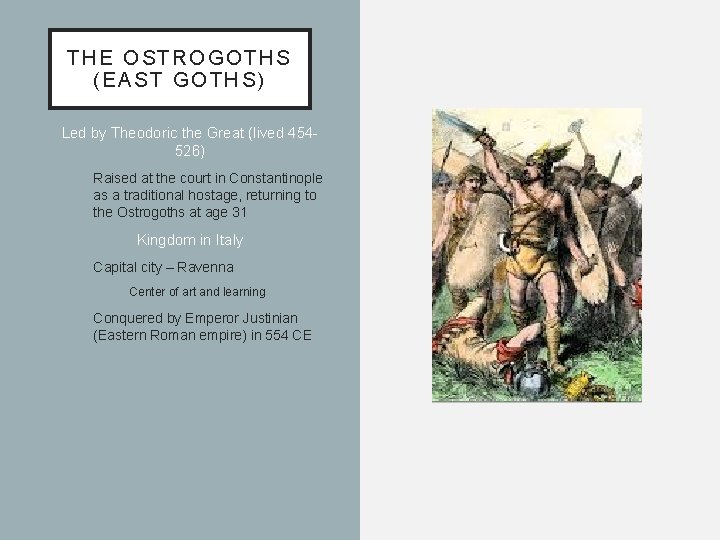
THE OSTROGOTHS (EAST GOTHS) Led by Theodoric the Great (lived 454526) Raised at the court in Constantinople as a traditional hostage, returning to the Ostrogoths at age 31 Kingdom in Italy Capital city – Ravenna Center of art and learning Conquered by Emperor Justinian (Eastern Roman empire) in 554 CE
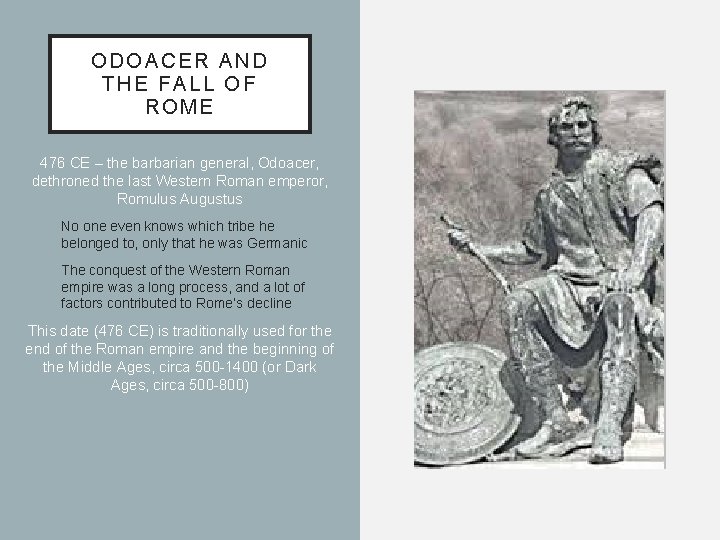
ODOACER AND THE FALL OF ROME 476 CE – the barbarian general, Odoacer, dethroned the last Western Roman emperor, Romulus Augustus No one even knows which tribe he belonged to, only that he was Germanic The conquest of the Western Roman empire was a long process, and a lot of factors contributed to Rome’s decline This date (476 CE) is traditionally used for the end of the Roman empire and the beginning of the Middle Ages, circa 500 -1400 (or Dark Ages, circa 500 -800)
DAY 42: REVIEW QUESTIONS 1. What is the traditional date for the end of the Roman empire? 2. Who were the barbarians? 3. Describe elements of ancient Germanic culture that are still with us. 4. How did England get its name? 5. Explain the origin of the term vandalism. 6. How did France get its name? 7. Who was Atilla the Hun and why was he so feared? 8. Why is Beowulf considered such an important literary work? What archetypes did it have that remain in modern times?
- Slides: 22