
Day 4 Session 2 Biological reference points 1

Day 4 Session 2 Biological reference points 1

Overview • What are biological reference points? • What are they used for? • Which reference points are used by the WCPFC and its members? • Which reference points are calculated in the Commission stock assessments? • How are MSY based reference points calculated? • How do we interpret biological reference points to incorporate in fisheries management decision making processes? • What are target and limit reference points? • The precautionary approach and reference points
What are biological reference points? A biological reference point (BRP) is a metric or measure of stock status (health) from a biological perspective, that fisheries managers wish to either achieve or avoid. Biological reference points often reflect the combination of several components of stock dynamics (growth, recruitment and mortality, usually including fishing mortality) into a single index. The reference point is often expressed as an associated fishing mortality rate or a biomass level. e. g. Bcurrent/BMSY = 1 [Gabriel and Mace, 1999]
What are biological reference points? Biological reference points are used to provide fisheries managers information regarding: 1. The status (health) of a stock 2. The impacts of fishing on a stock …. and in doing so, assist in the provision of advice to management from the outputs of stock assessments They can also be used to evaluate the performance of fishery managers, if those reference points are tied into the objectives which the managers are trying to achieve.
What are biological reference points? In general, consideration of biological reference points requires consideration of both the reference point itself and its associated indicator. What do we mean? 1. Reference Point – the pre-determined level of a given indicator that corresponds to a particular state of the stock that management either seeks to achieve or avoid. e. g. Bcurrent/BMSY = 1 2. Indicator – is a quantity used to measure the status of a stock against a given Reference Point. e. g. Bcurrent/BMSY
What are the different types of reference point? The three main types of reference point are: · Target Reference Points (TRPs) - describe the intended outcome for the stock and are generally associated with management objectives. (e. g. currently Fc/Fmsy=1; Bc/Bmsy=1, in the WCPFC) · Limit Reference Points (LRPs) - describe an undesirable state of the indicator that should be avoided with high probability. These are intended to constrain harvesting within safe biological limits. Fishery management strategies should ensure that the risk of exceeding limit reference points is very low. · Trigger Reference Points (Tr. RPs) - identify a predefined management response. The set of trigger reference points may include the target and limit reference points, but could also be reference points between the two.

What are the different types of reference point? 1. 2 Target Reference Point (TRP) 1. 0 Bcurrent/BMSY For example: Limit Reference Point (TRP) Time

What are biological reference points? To get an understanding of how this all works in more detail, lets consider as examples the key biological reference points used by the WCPFC. These are known as MSY based reference points
Which BRPs are used by the Commission and why? The Commission uses a number of MSY based reference points to assist its decision making processes. To understand this lets get our definitions clear: 1. What is MSY? The maximum sustainable yield (MSY) is the maximum yield (catch) that can be taken on average from the fishery in the long term without impacting the reproductive potential of the stock. 2. What is BMSY? The stock biomass level at which the fishery is able to achieve the maximum sustainable yield 3. What is FMSY? The fishing mortality rate which provides the maximum sustainable yield.
Which BRPs are used by the Commission and why? The key MSY based reference points used by the WCPFC are in fact ratios of quantities. For example: Fcurrent/FMSY = 1 …is a key reference point used by the WCPFC. It is a specific value of the indicator Fcurrent/FMSY which is the current (or recent average) fishing mortality rate divided by the fishing mortality rate which will provide the maximum sustainable yield. Values greater than 1 indicate that overfishing is occuring, and if effort level are not reduced, an overfished fishery will develop.
Which BRPs are used by the Commission and why? Another example: Bcurrent/BMSY = 1 …is the other key reference point used by the WCPFC. It is a specific value of the indicator Bcurrent/BMSY which is the current (or recent average) biomass divided by the biomass which will provide the maximum sustainable yield. Values less than 1 indicate that the fishery is overfished, and very significant reductions in fishing effort are required for recovery to occur There are some significant risks associated with managing fisheries based on these reference points which will be discussed later.
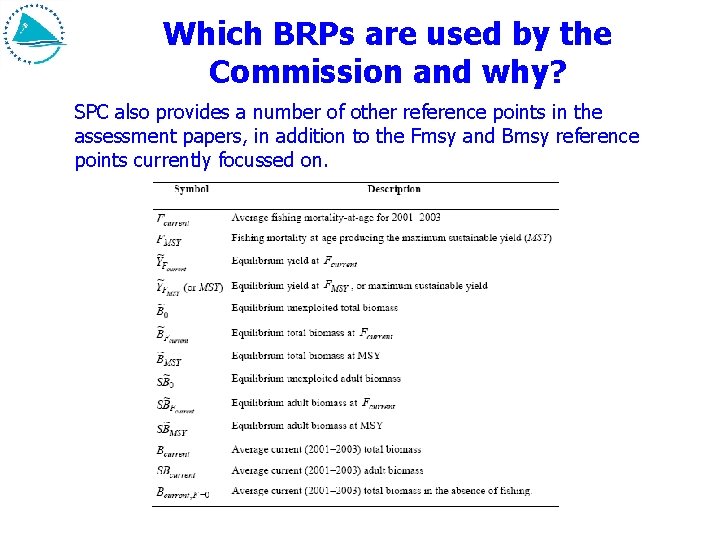
Which BRPs are used by the Commission and why? SPC also provides a number of other reference points in the assessment papers, in addition to the Fmsy and Bmsy reference points currently focussed on.

Why is the WCPFC using these MSY based reference points? The WCPFC convention makes reference to a number of reference points, most importantly: • Maintain or restore stocks at [biomass] levels capable of producing MSY [Article 5(b)]: i. e. Maintain Bcurrent BMSY • Eliminate overfishing and excess fishing capacity [Article 5(g)]: i. e. Maintain Fcurrent FMSY These references flow originally from the UN Fish Stocks Agreement.
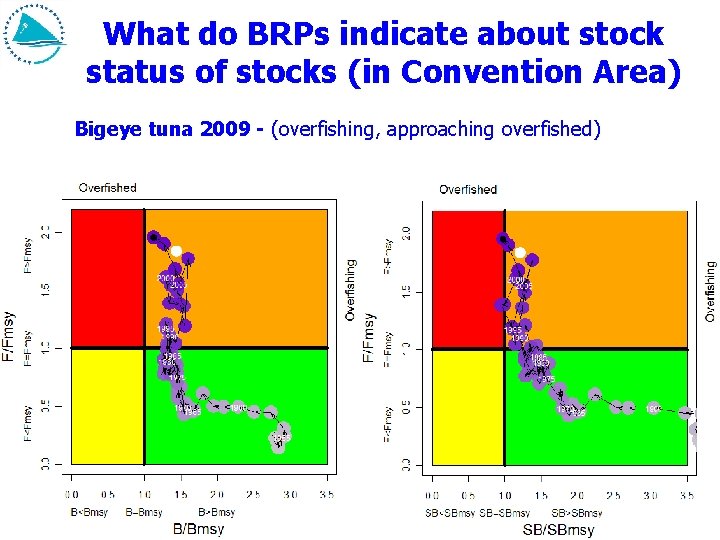
What do BRPs indicate about stock status of stocks (in Convention Area) Bigeye tuna 2009 - (overfishing, approaching overfished)
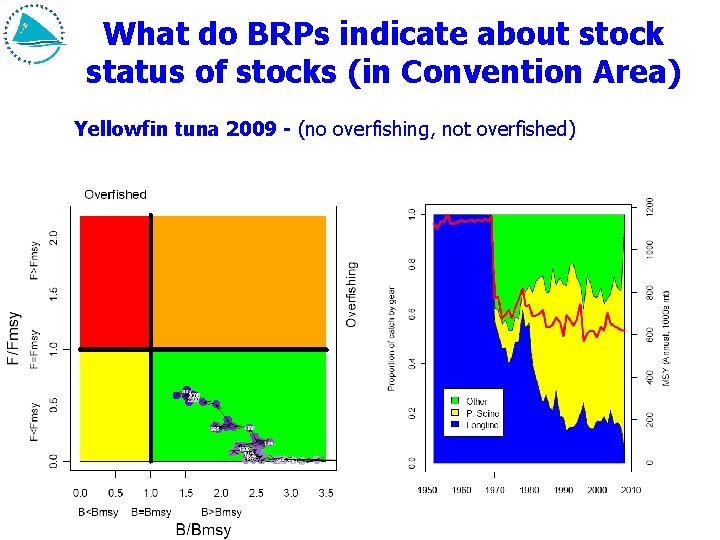
What do BRPs indicate about stock status of stocks (in Convention Area) Yellowfin tuna 2009 - (no overfishing, not overfished) . .
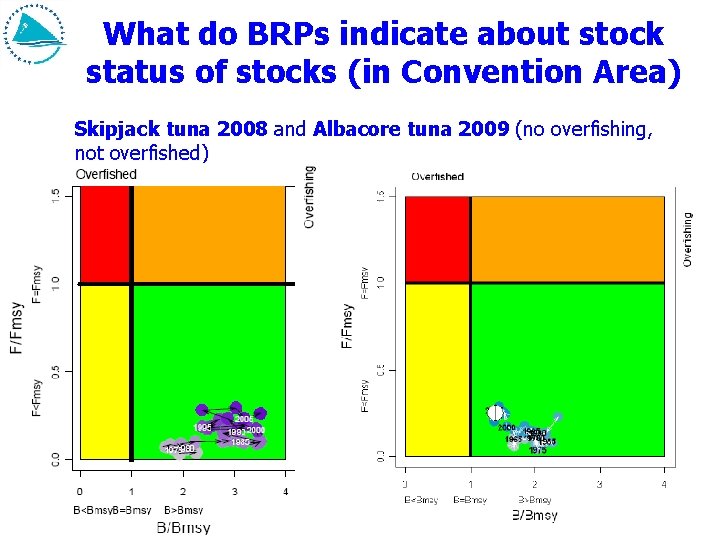
What do BRPs indicate about stock status of stocks (in Convention Area) Skipjack tuna 2008 and Albacore tuna 2009 (no overfishing, not overfished)
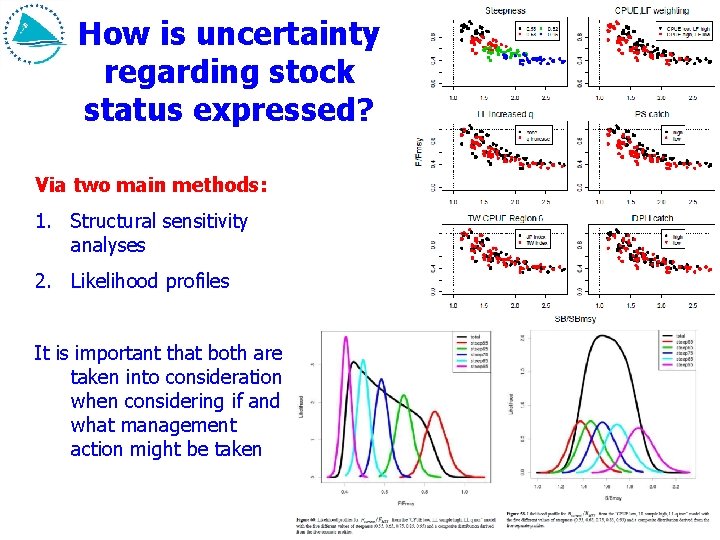
How is uncertainty regarding stock status expressed? Via two main methods: 1. Structural sensitivity analyses 2. Likelihood profiles It is important that both are taken into consideration when considering if and what management action might be taken
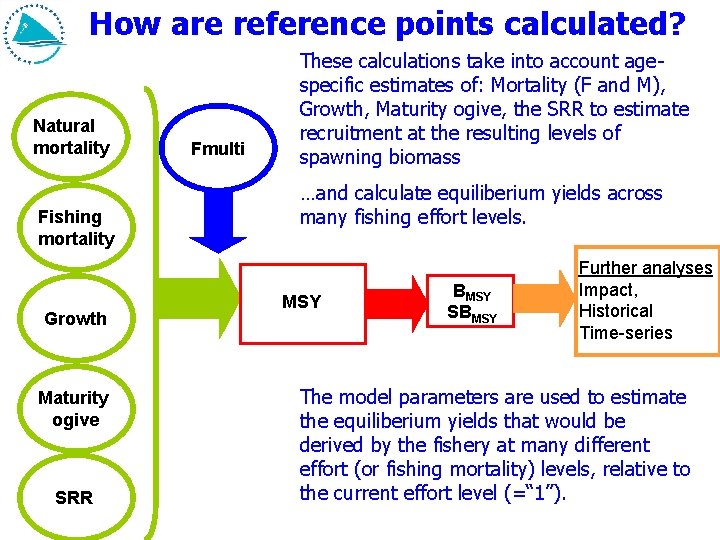
How are reference points calculated? Natural mortality Fishing mortality Growth Maturity ogive SRR Fmulti These calculations take into account agespecific estimates of: Mortality (F and M), Growth, Maturity ogive, the SRR to estimate recruitment at the resulting levels of spawning biomass …and calculate equiliberium yields across many fishing effort levels. MSY BMSY SBMSY Further analyses Impact, Historical Time-series The model parameters are used to estimate the equiliberium yields that would be derived by the fishery at many different effort (or fishing mortality) levels, relative to the current effort level (=“ 1”).
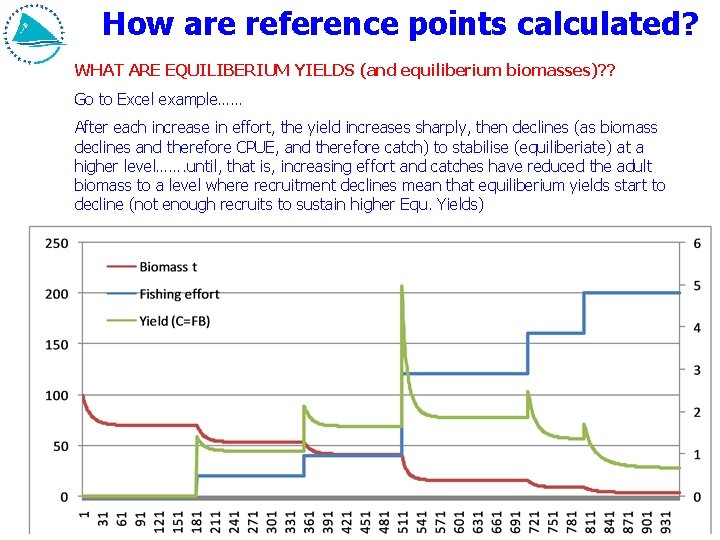
How are reference points calculated? WHAT ARE EQUILIBERIUM YIELDS (and equiliberium biomasses)? ? Go to Excel example…… After each increase in effort, the yield increases sharply, then declines (as biomass declines and therefore CPUE, and therefore catch) to stabilise (equiliberiate) at a higher level……. until, that is, increasing effort and catches have reduced the adult biomass to a level where recruitment declines mean that equiliberium yields start to decline (not enough recruits to sustain higher Equ. Yields)
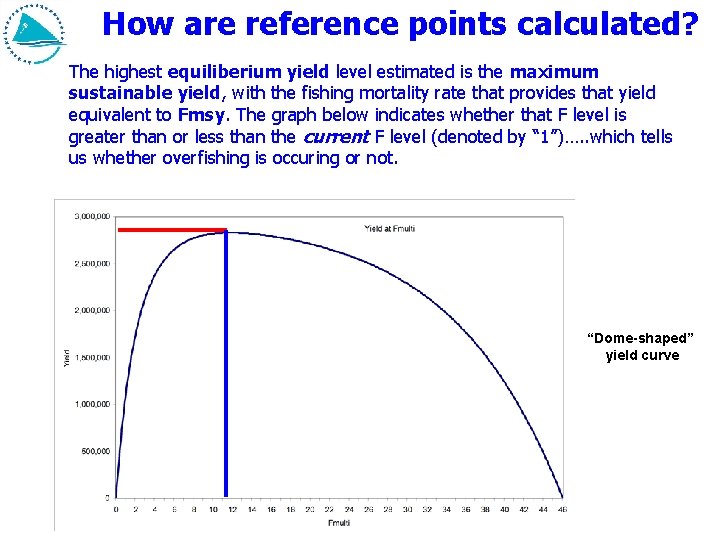
How are reference points calculated? The highest equiliberium yield level estimated is the maximum sustainable yield, with the fishing mortality rate that provides that yield equivalent to Fmsy. The graph below indicates whether that F level is greater than or less than the current F level (denoted by “ 1”)…. . which tells us whether overfishing is occuring or not. “Dome-shaped” yield curve
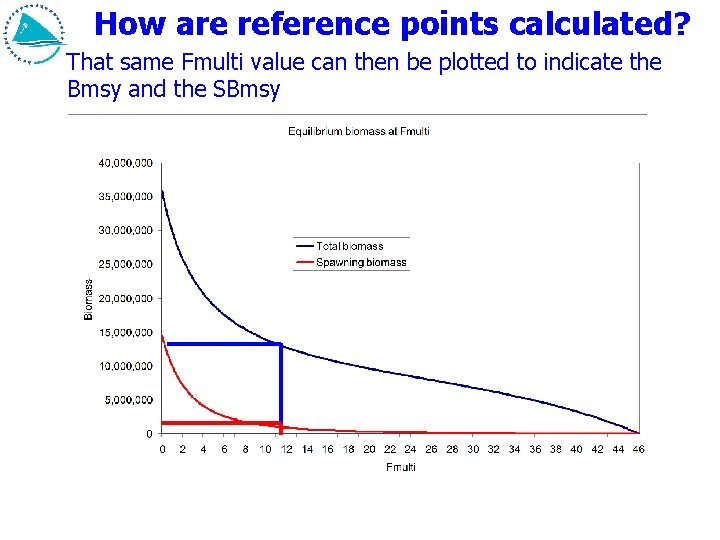
How are reference points calculated? That same Fmulti value can then be plotted to indicate the Bmsy and the SBmsy
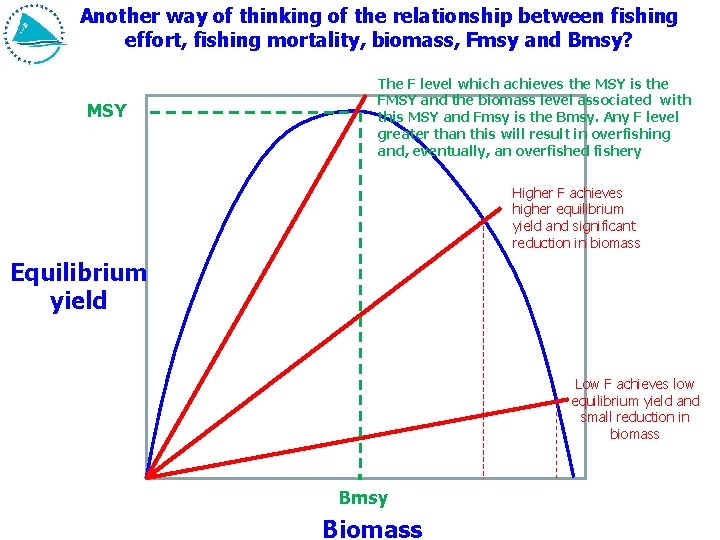
Another way of thinking of the relationship between fishing effort, fishing mortality, biomass, Fmsy and Bmsy? MSY The F level which achieves the MSY is the FMSY and the biomass level associated with this MSY and Fmsy is the Bmsy. Any F level greater than this will result in overfishing and, eventually, an overfished fishery Higher F achieves higher equilibrium yield and significant reduction in biomass Equilibrium yield Low F achieves low equilibrium yield and small reduction in biomass Bmsy Biomass
What do we need to be cautious about MSY based reference points? MSY based reference points are often used as target reference points (e. g by the WCPFC). This is widely recognised as a high risk strategy in fisheries, because stock assessments can not predict with high certainty where MSY lies (it is difficult to determine where it is exactly without fishing the stock below BMSY). Thus aiming for MSY carries a high risk of fishing the stock down past Bmsy, effecting recruitment levels and lowering sustainable yield levels. Hence it is often recommended by scientists that, if you wish to reduce the risk of fishing past MSY, managers set a more precautionary reference point as the target and use MSY as the limit reference point (the reference point to be avoided).
Summary • RPs are a way of summarising the outputs of a stock assessment • They allow; • the status of a stock to be assessed • The impacts of fishing on a stock to be estimated • The performance of the stock against management objectives to be assessed • RPs vary through time due to changes in fisheries, catches and the incorporation of new information • MSY based reference points are currently used by the WCPFC. • MSY based reference points carry significant risk, due to difficulties in estimating MSY.
- Slides: 24