
Day 4 Part 1 Lumping and Delumping Pseudoization

- Slides: 19
Day 4 – Part 1: Lumping and De-lumping § Pseudoization (Lumping) § Black Oil Models § De-lumping (Black-Oil to Compositional) Course in Advanced Fluid Phase Behavior. © Pera A/S 1
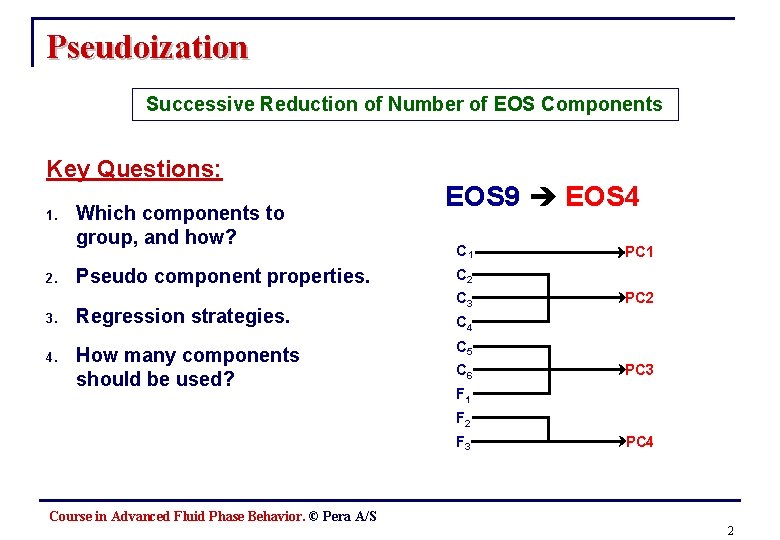
Pseudoization Successive Reduction of Number of EOS Components Key Questions: 1. 2. Which components to group, and how? Pseudo component properties. 3. Regression strategies. 4. How many components should be used? EOS 9 EOS 4 C 1 PC 1 C 2 C 3 PC 2 C 4 C 5 C 6 PC 3 F 1 F 2 F 3 PC 4 Course in Advanced Fluid Phase Behavior. © Pera A/S 2
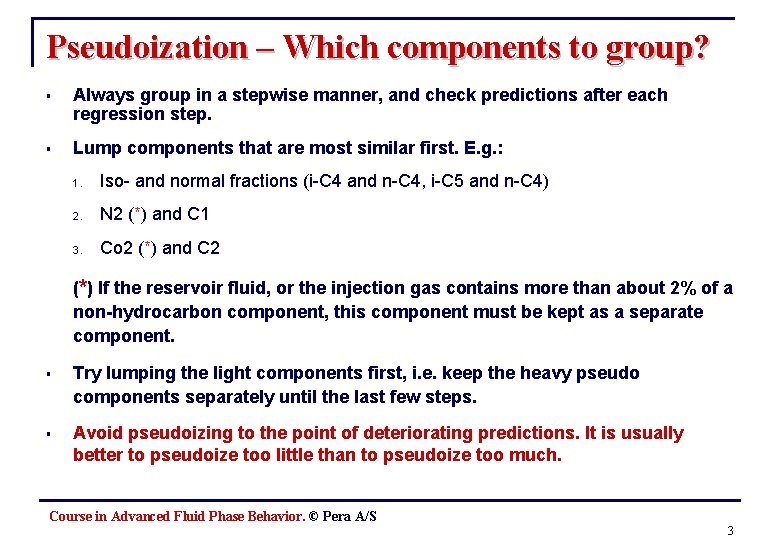
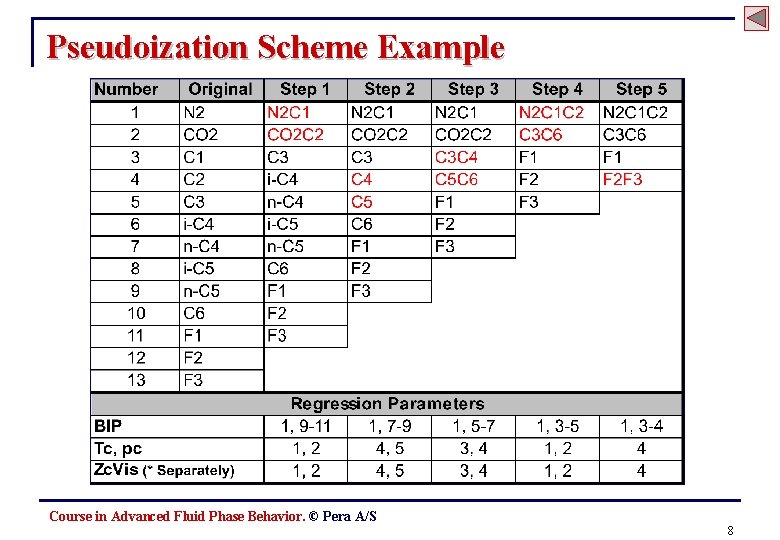
Pseudoization – Which components to group? § Always group in a stepwise manner, and check predictions after each regression step. § Lump components that are most similar first. E. g. : 1. Iso- and normal fractions (i-C 4 and n-C 4, i-C 5 and n-C 4) 2. N 2 (*) and C 1 3. Co 2 (*) and C 2 (*) If the reservoir fluid, or the injection gas contains more than about 2% of a non-hydrocarbon component, this component must be kept as a separate component. § Try lumping the light components first, i. e. keep the heavy pseudo components separately until the last few steps. § Avoid pseudoizing to the point of deteriorating predictions. It is usually better to pseudoize too little than to pseudoize too much. Course in Advanced Fluid Phase Behavior. © Pera A/S 3
Pseudo Component Properties § § § Pc, Tc and can be determined by Kay’s mixing rule: Coats has suggested an approach that preserves the volumetric behavior at undersaturated conditions, by ensuring that the mixture EOS constants A and B are unchanged by the pseudoization. Any PVT package should automatically calculate the pseudo properties (based on some set of mixing rules) Course in Advanced Fluid Phase Behavior. © Pera A/S 4
Pseudoization – Regression Strategies. § Always group in a stepwise manner. § Regress to maintain the best possible fit of the original (full) EOS model, instead of the actual experimental data! § Expand the data range in pressure, temperature and composition space. § At each pseudoization step, regress only on properties of the new pseudo components introduced at that stage. (However an update of the C 1 – heavy component BIPs can be made at every stage). § We reccomend regressing on pc, Tc for the new grouped components at each stage. In addition, the BIPs between the C 1 pseudo fraction and the heavy pseudo components should be updated at each stage. § An alternative approach to changing Tc, pc is to regress directly on the a and b parameters (Coats). Course in Advanced Fluid Phase Behavior. © Pera A/S 5
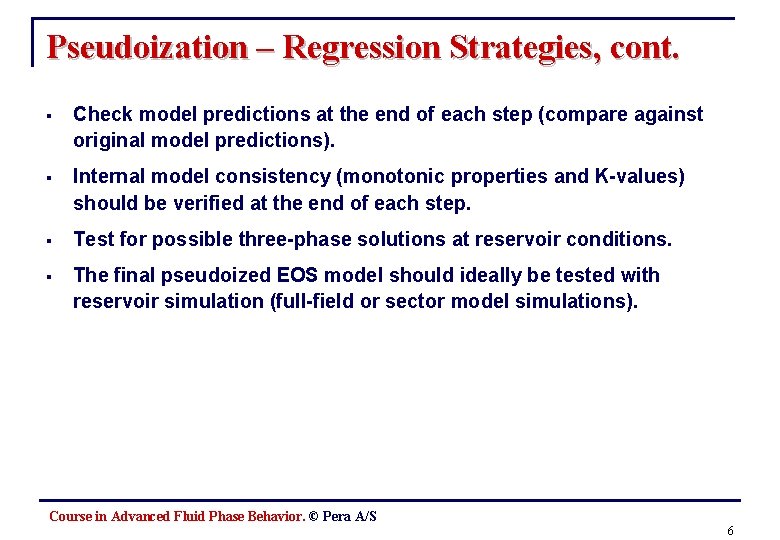
Pseudoization – Regression Strategies, cont. § Check model predictions at the end of each step (compare against original model predictions). § Internal model consistency (monotonic properties and K-values) should be verified at the end of each step. § Test for possible three-phase solutions at reservoir conditions. § The final pseudoized EOS model should ideally be tested with reservoir simulation (full-field or sector model simulations). Course in Advanced Fluid Phase Behavior. © Pera A/S 6
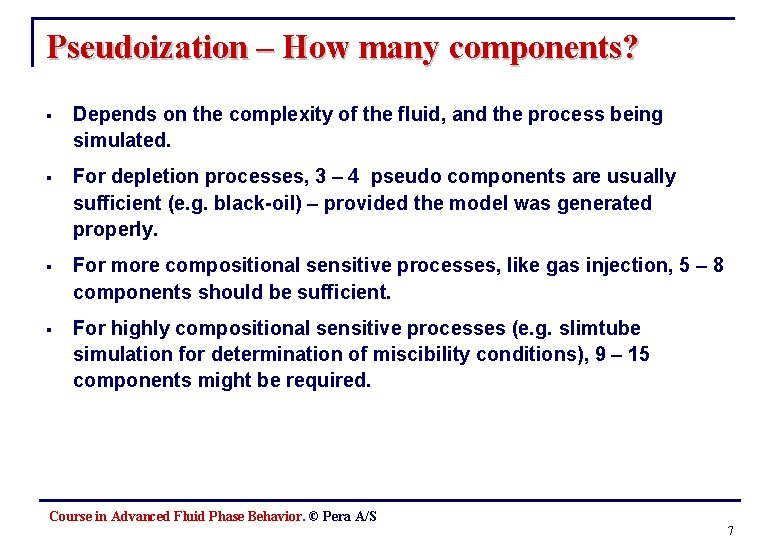
Pseudoization – How many components? § Depends on the complexity of the fluid, and the process being simulated. § For depletion processes, 3 – 4 pseudo components are usually sufficient (e. g. black-oil) – provided the model was generated properly. § For more compositional sensitive processes, like gas injection, 5 – 8 components should be sufficient. § For highly compositional sensitive processes (e. g. slimtube simulation for determination of miscibility conditions), 9 – 15 components might be required. Course in Advanced Fluid Phase Behavior. © Pera A/S 7
Pseudoization Scheme Example Course in Advanced Fluid Phase Behavior. © Pera A/S 8
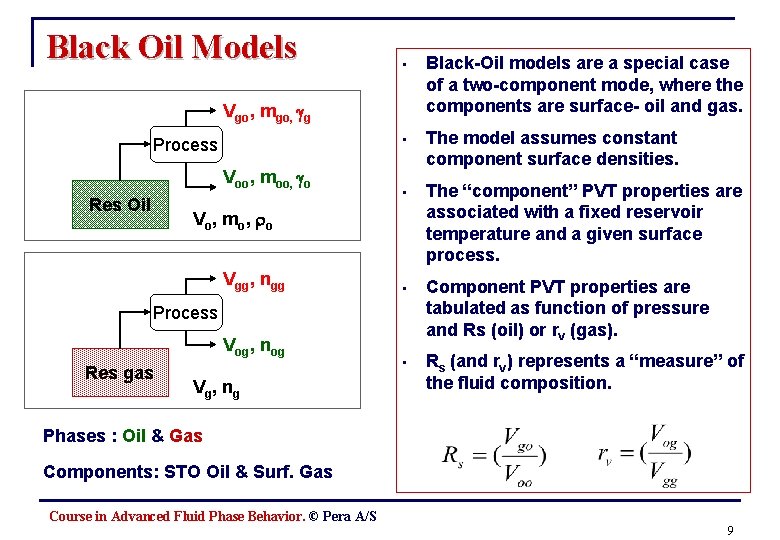
Black Oil Models • Black-Oil models are a special case of a two-component mode, where the components are surface- oil and gas. • The model assumes constant component surface densities. • The “component” PVT properties are associated with a fixed reservoir temperature and a given surface process. • Component PVT properties are tabulated as function of pressure and Rs (oil) or rv (gas). • Rs (and rv) represents a “measure” of the fluid composition. Vgo, mgo, g Process Voo, moo, o Res Oil V o, m o, o Vgg, ngg Process Vog, nog Res gas V g, n g Phases : Oil & Gas Components: STO Oil & Surf. Gas Course in Advanced Fluid Phase Behavior. © Pera A/S 9
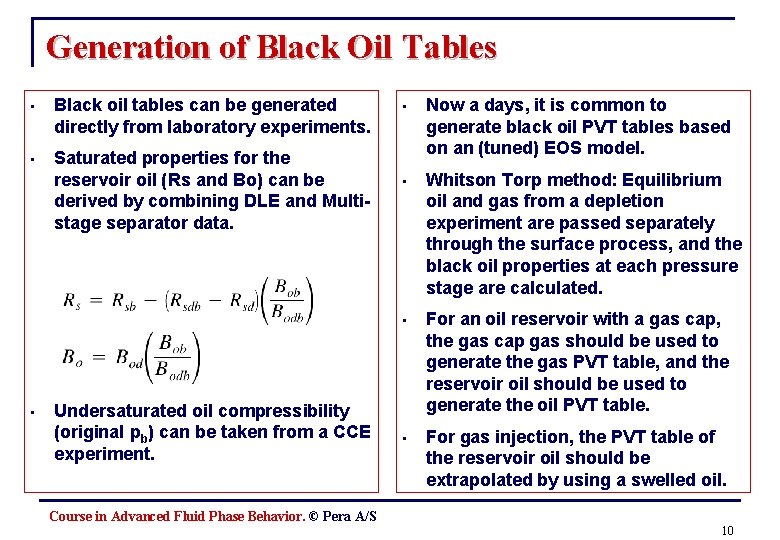
Generation of Black Oil Tables • Black oil tables can be generated directly from laboratory experiments. • Saturated properties for the reservoir oil (Rs and Bo) can be derived by combining DLE and Multistage separator data. • Undersaturated oil compressibility (original pb) can be taken from a CCE experiment. • Now a days, it is common to generate black oil PVT tables based on an (tuned) EOS model. • Whitson Torp method: Equilibrium oil and gas from a depletion experiment are passed separately through the surface process, and the black oil properties at each pressure stage are calculated. • For an oil reservoir with a gas cap, the gas cap gas should be used to generate the gas PVT table, and the reservoir oil should be used to generate the oil PVT table. • For gas injection, the PVT table of the reservoir oil should be extrapolated by using a swelled oil. Course in Advanced Fluid Phase Behavior. © Pera A/S 10
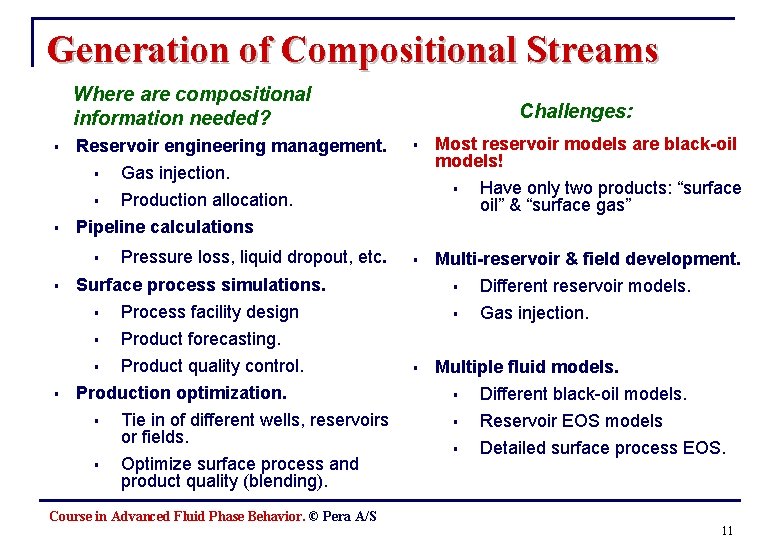
Generation of Compositional Streams Where are compositional information needed? § Reservoir engineering management. § Challenges: § Gas injection. § Production allocation. Pipeline calculations § § § Pressure loss, liquid dropout, etc. Surface process simulations. § Process facility design § Product forecasting. § Product quality control. Production optimization. § Tie in of different wells, reservoirs or fields. § Optimize surface process and product quality (blending). Most reservoir models are black-oil models! Have only two products: “surface oil” & “surface gas” § Multi-reservoir & field development. § Different reservoir models. § Gas injection. § Multiple fluid models. § Different black-oil models. § Reservoir EOS models § Detailed surface process EOS. Course in Advanced Fluid Phase Behavior. © Pera A/S 11
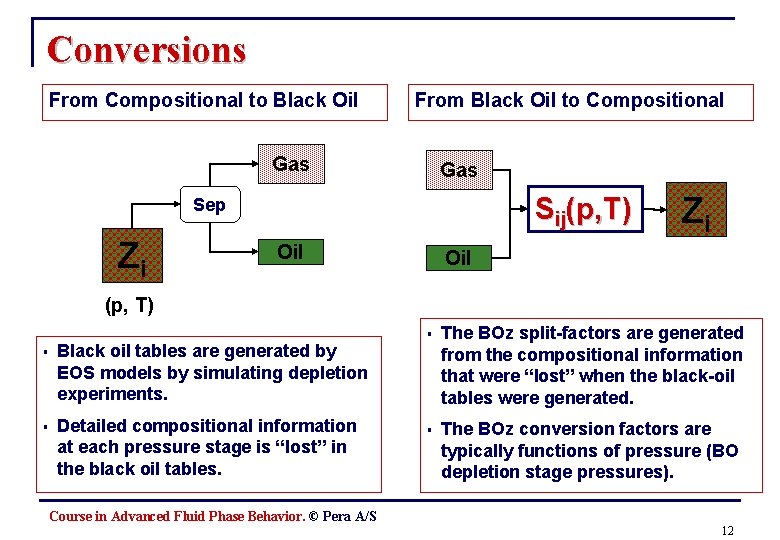
Conversions From Compositional to Black Oil From Black Oil to Compositional Gas Sij(p, T) Sep Zi Oil (p, T) § Black oil tables are generated by EOS models by simulating depletion experiments. § Detailed compositional information at each pressure stage is “lost” in the black oil tables. § The BOz split-factors are generated from the compositional information that were “lost” when the black-oil tables were generated. § The BOz conversion factors are typically functions of pressure (BO depletion stage pressures). Course in Advanced Fluid Phase Behavior. © Pera A/S 12
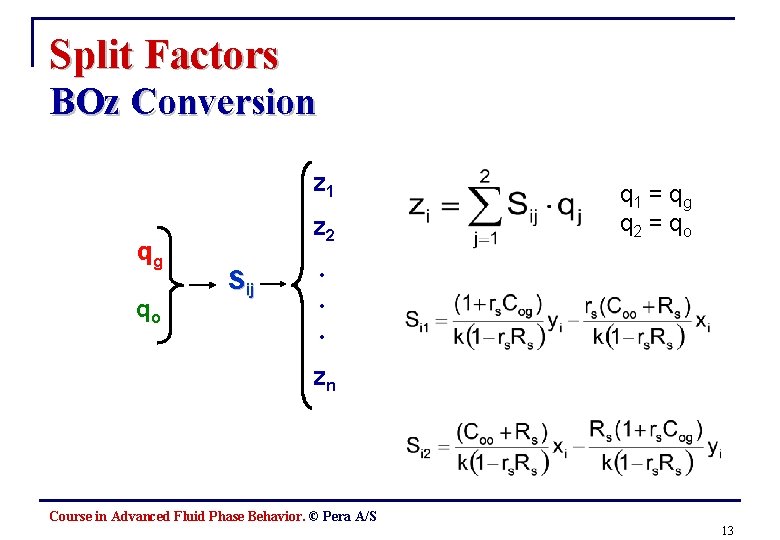
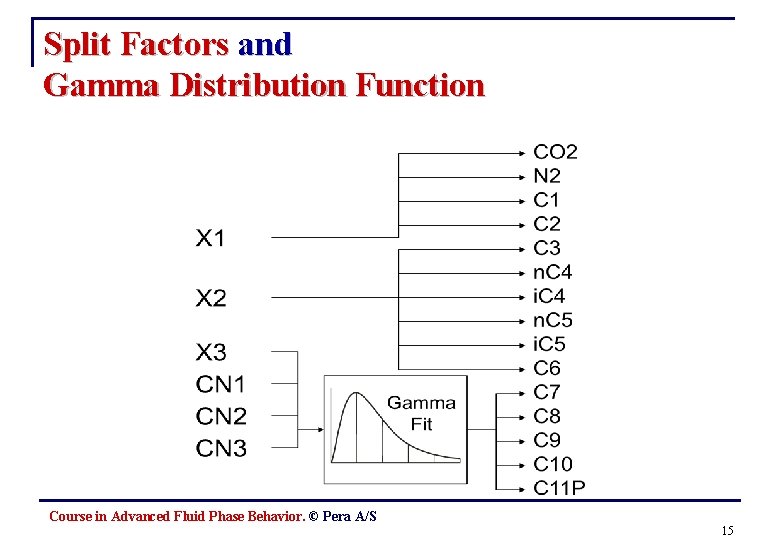
Split Factors BOz Conversion z 1 qg qo z 2 Sij q 1 = q g q 2 = q o . . . zn Course in Advanced Fluid Phase Behavior. © Pera A/S 13
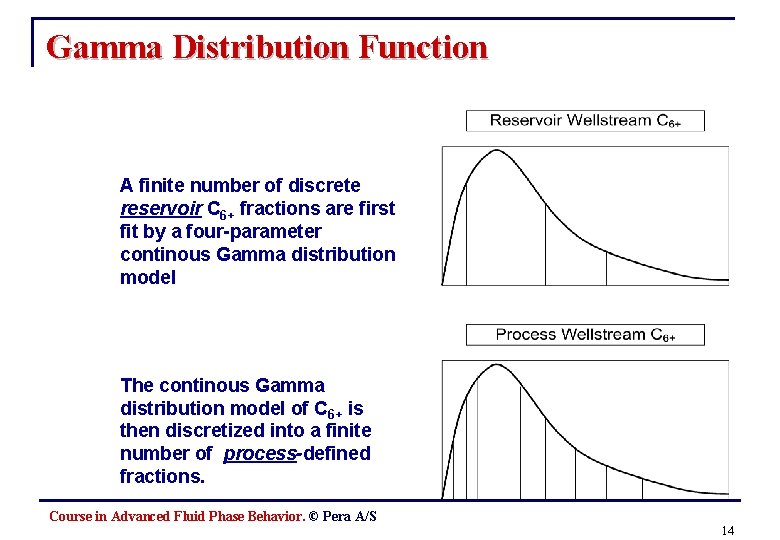
Gamma Distribution Function A finite number of discrete reservoir C 6+ fractions are first fit by a four-parameter continous Gamma distribution model The continous Gamma distribution model of C 6+ is then discretized into a finite number of process-defined fractions. Course in Advanced Fluid Phase Behavior. © Pera A/S 14
Split Factors and Gamma Distribution Function Course in Advanced Fluid Phase Behavior. © Pera A/S 15
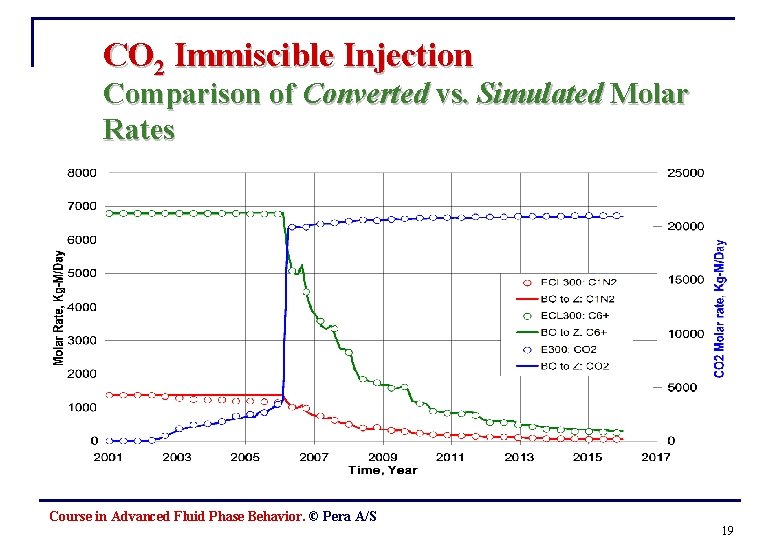
Example - CO 2 Immiscible Injection BOz Conversion § North Sea 2 D Sector Model. § Highly undersaturated, low API oil. § 1 horizontal producing well in lower-structure. § 1 gas injection well in upper-structure. § BOz conversion of black-oil surface gas and oil rates. § Compare with E 300 model results. Course in Advanced Fluid Phase Behavior. © Pera A/S 16
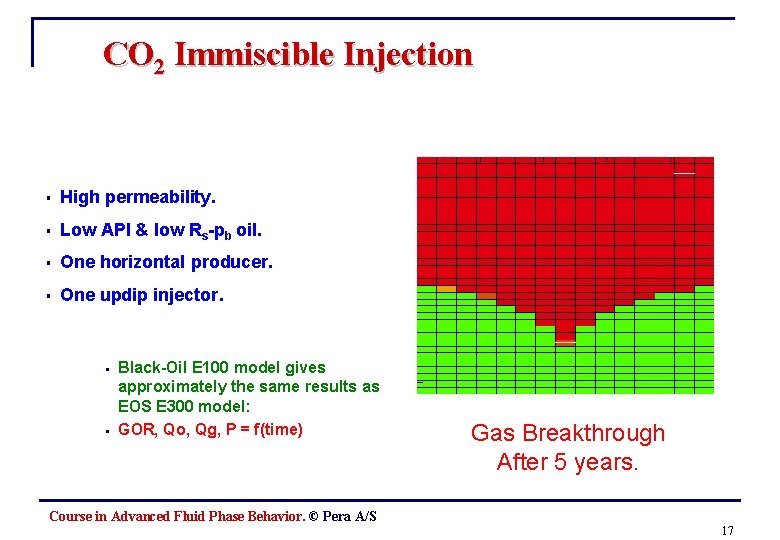
CO 2 Immiscible Injection § High permeability. § Low API & low Rs-pb oil. § One horizontal producer. § One updip injector. § § Black-Oil E 100 model gives approximately the same results as EOS E 300 model: GOR, Qo, Qg, P = f(time) Gas Breakthrough After 5 years. Course in Advanced Fluid Phase Behavior. © Pera A/S 17
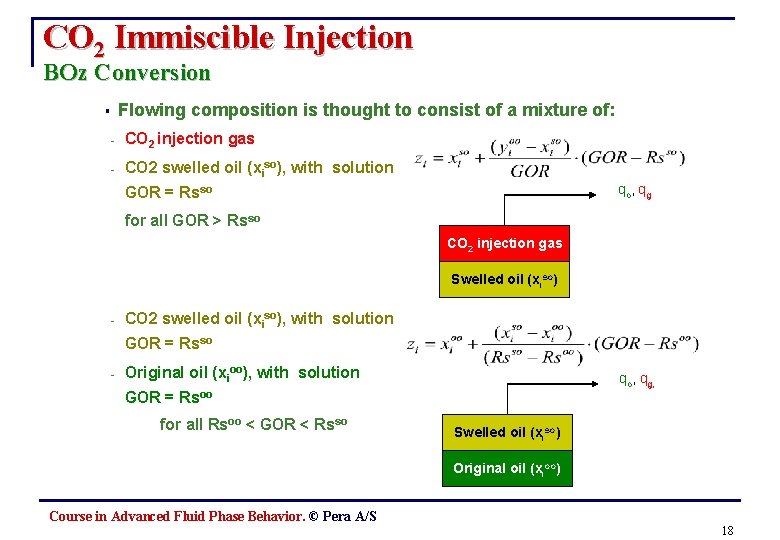
CO 2 Immiscible Injection BOz Conversion Flowing composition is thought to consist of a mixture of: § - CO 2 injection gas - CO 2 swelled oil (xiso), with solution qo, qg GOR = Rsso for all GOR > Rsso CO 2 injection gas Swelled oil (xiso) - CO 2 swelled oil (xiso), with solution GOR = Rsso - Original oil (xioo), with solution qo, qg, GOR = Rsoo for all Rsoo < GOR < Rsso Swelled oil (xiso) Original oil (xioo) Course in Advanced Fluid Phase Behavior. © Pera A/S 18
CO 2 Immiscible Injection Comparison of Converted vs. Simulated Molar Rates Course in Advanced Fluid Phase Behavior. © Pera A/S 19