
Day 3 Session 1 Natural and Fishing Mortality

- Slides: 43
Day 3, Session 1 Natural and Fishing Mortality
Where are we going? Overview of this session: 1. What is mortality? 2. • • What is natural mortality? How and why does it vary with age and size? Why do we estimate it? How is it estimated outside a stock assessment? How is it estimated within a stock assessment (MFCL)? 3. • • What is fishing mortality? How and why does it vary with age and size? Why do we estimate it? How is it estimated outside a stock assessment? How is it estimated within a stock assessment (MFCL)? 4. Summary
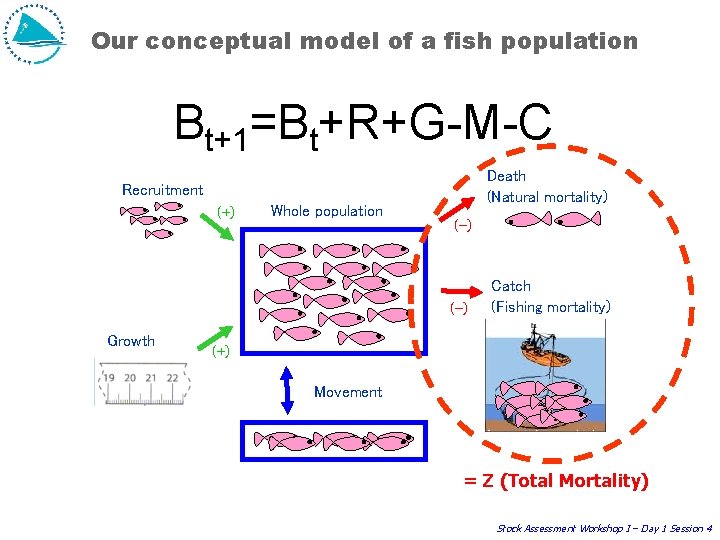
Our conceptual model of a fish population Bt+1=Bt+R+G-M-C Death (Natural mortality) Recruitment (+) Whole population (-) Growth Catch (Fishing mortality) (+) Movement = Z (Total Mortality) Stock Assessment Workshop I – Day 1 Session 4
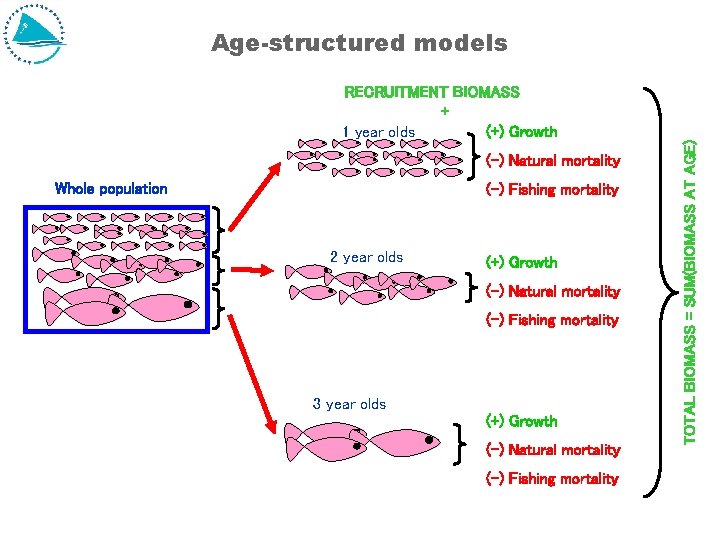
Age-structured models (-) Natural mortality Whole population (-) Fishing mortality 2 year olds (+) Growth (-) Natural mortality (-) Fishing mortality 3 year olds (+) Growth (-) Natural mortality (-) Fishing mortality TOTAL BIOMASS = SUM(BIOMASS AT AGE) RECRUITMENT BIOMASS + 1 year olds (+) Growth
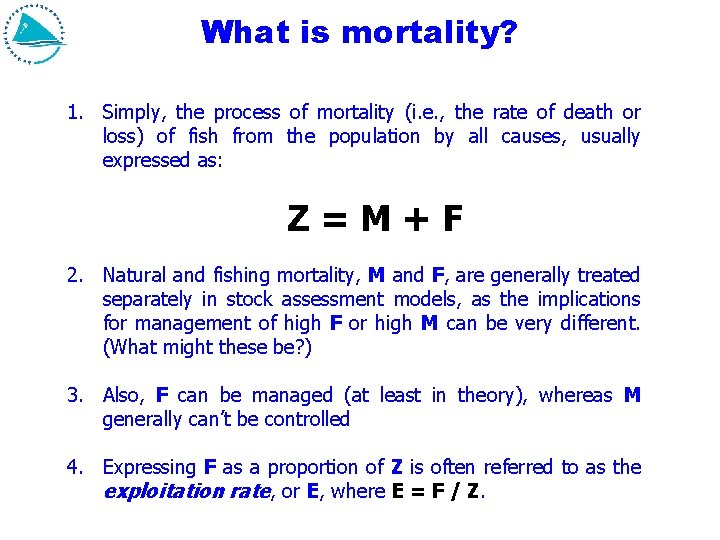
What is mortality? 1. Simply, the process of mortality (i. e. , the rate of death or loss) of fish from the population by all causes, usually expressed as: Z=M+F 2. Natural and fishing mortality, M and F, are generally treated separately in stock assessment models, as the implications for management of high F or high M can be very different. (What might these be? ) 3. Also, F can be managed (at least in theory), whereas M generally can’t be controlled 4. Expressing F as a proportion of Z is often referred to as the exploitation rate, or E, where E = F / Z.
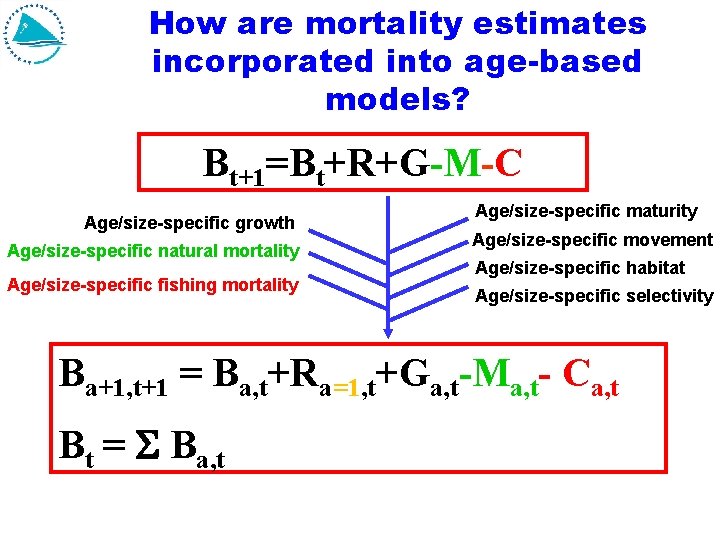
How are mortality estimates incorporated into age-based models? Bt+1=Bt+R+G-M-C Age/size-specific growth Age/size-specific natural mortality Age/size-specific fishing mortality Age/size-specific maturity Age/size-specific movement Age/size-specific habitat Age/size-specific selectivity Ba+1, t+1 = Ba, t+Ra=1, t+Ga, t-Ma, t- Ca, t Bt = Ba, t
Natural Mortality
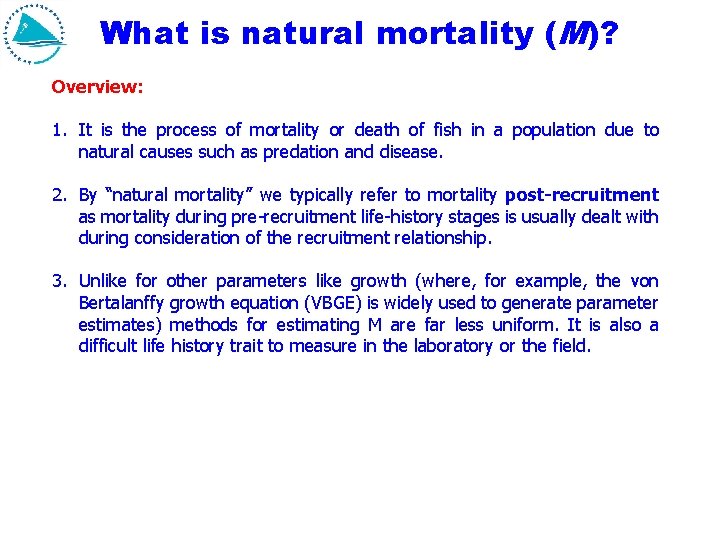
What is natural mortality (M)? Overview: 1. It is the process of mortality or death of fish in a population due to natural causes such as predation and disease. 2. By “natural mortality” we typically refer to mortality post-recruitment as mortality during pre-recruitment life-history stages is usually dealt with during consideration of the recruitment relationship. 3. Unlike for other parameters like growth (where, for example, the von Bertalanffy growth equation (VBGE) is widely used to generate parameter estimates) methods for estimating M are far less uniform. It is also a difficult life history trait to measure in the laboratory or the field.
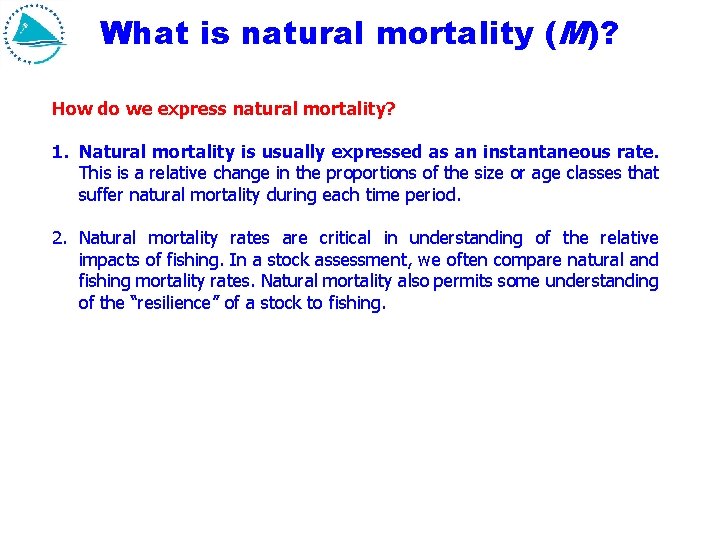
What is natural mortality (M)? How do we express natural mortality? 1. Natural mortality is usually expressed as an instantaneous rate. This is a relative change in the proportions of the size or age classes that suffer natural mortality during each time period. 2. Natural mortality rates are critical in understanding of the relative impacts of fishing. In a stock assessment, we often compare natural and fishing mortality rates. Natural mortality also permits some understanding of the “resilience” of a stock to fishing.
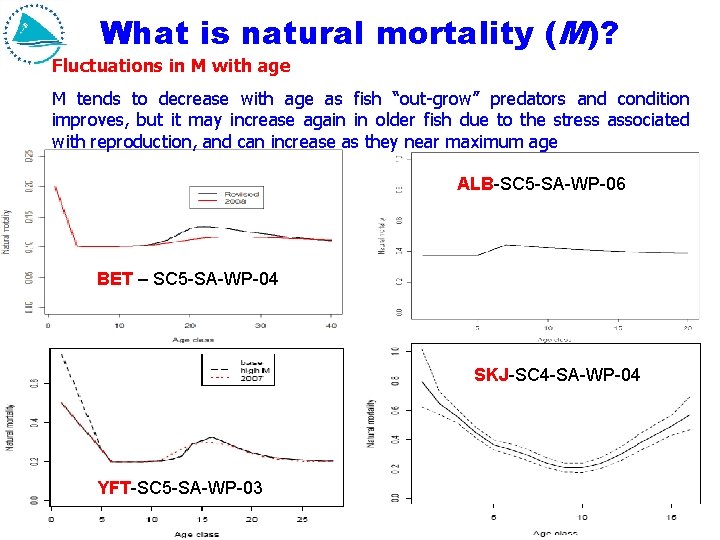
What is natural mortality (M)? Fluctuations in M with age M tends to decrease with age as fish “out-grow” predators and condition improves, but it may increase again in older fish due to the stress associated with reproduction, and can increase as they near maximum age ALB-SC 5 -SA-WP-06 BET – SC 5 -SA-WP-04 SKJ-SC 4 -SA-WP-04 YFT-SC 5 -SA-WP-03
What is natural mortality (M)? Why does natural mortality fluctuate over a fish’s life? Some reasons include: • Reduced vulnerability to predation with increased age or size Fish may “out-grow” predators as they age and increase in size • Senescence Fish may “wear out” as they age and approach the end of their life cycle; their fitness may decline with age and accumulated reproductive and other stresses • Movement Fish may move away from areas of high mortality as they grow • Behavioural changes Formation of schools or other social structures • Changes in ecosystem status Changes in prey or habitat availability due to other factors may trigger a change in natural mortality • Changes in population abundance Density-dependant effects such as intra-specific competition or cannibalism
What is natural mortality (M)? What benefits does a good understanding of M offer within a stock assessment? 1. It permits an understanding of the likely “robustness” of the stock 2. It is a critical parameter within our understanding of fish population dynamics: Bt+1 = Bt + R + G - M - C 3. It allows an understanding to be gained of the relative effect of fishing on the population (e. g. , by comparing natural and fishing mortality rates; natural and fishing mortality are defined to sum together to produce total mortality): Z = M + F; E = F / Z
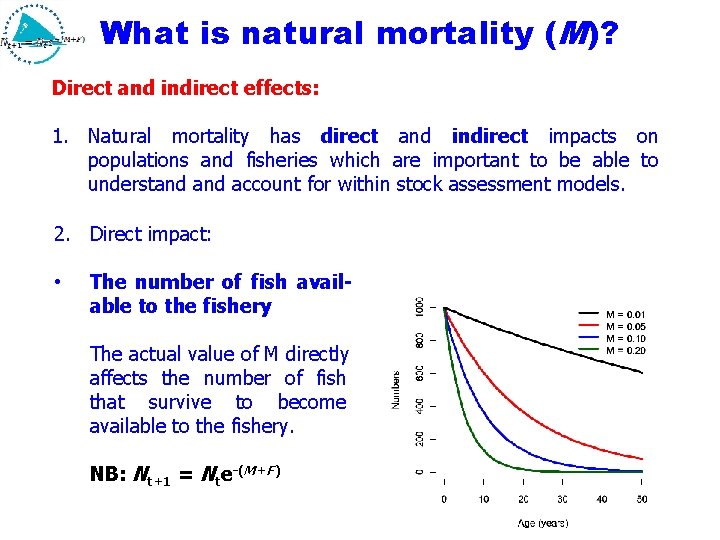
What is natural mortality (M)? Direct and indirect effects: 1. Natural mortality has direct and indirect impacts on populations and fisheries which are important to be able to understand account for within stock assessment models. 2. Direct impact: • The number of fish available to the fishery The actual value of M directly affects the number of fish that survive to become available to the fishery. NB: Nt+1 = Nte-(M+F)
What is natural mortality (M)? Direct and indirect effects: 3. Indirect impacts: • Reproductive biomass There is a need to ensure that sufficient numbers of fish survive to reproductive age to ensure future recruitment success. • Possible need to restrict fishing mortality on specific life-history stages Species with low M are typically longer lived and less productive (produce fewer young, grow more slowly, mature later). They typically have a stronger stock- recruitment relationship. For species with low-M and a strong stock recruitment relationship, the impacts of fishing on recruitment will occur at much lower levels of F than for species with high-M
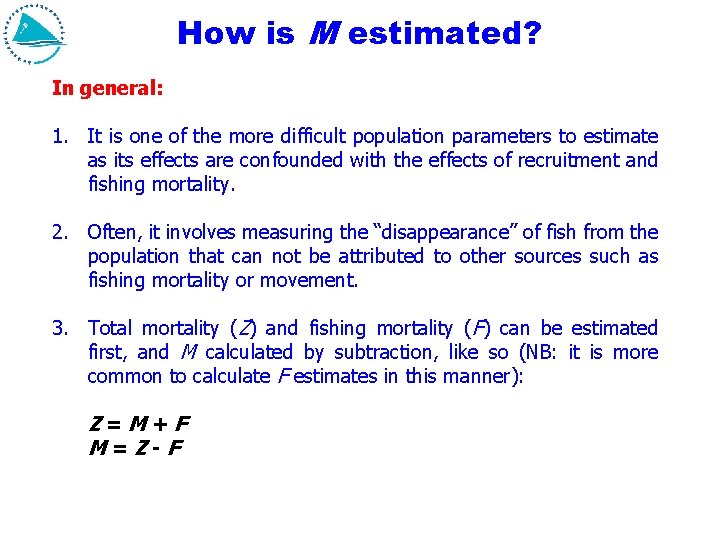
How is M estimated? In general: 1. It is one of the more difficult population parameters to estimate as its effects are confounded with the effects of recruitment and fishing mortality. 2. Often, it involves measuring the “disappearance” of fish from the population that can not be attributed to other sources such as fishing mortality or movement. 3. Total mortality (Z) and fishing mortality (F) can be estimated first, and M calculated by subtraction, like so (NB: it is more common to calculate F estimates in this manner): Z=M+F M=Z-F
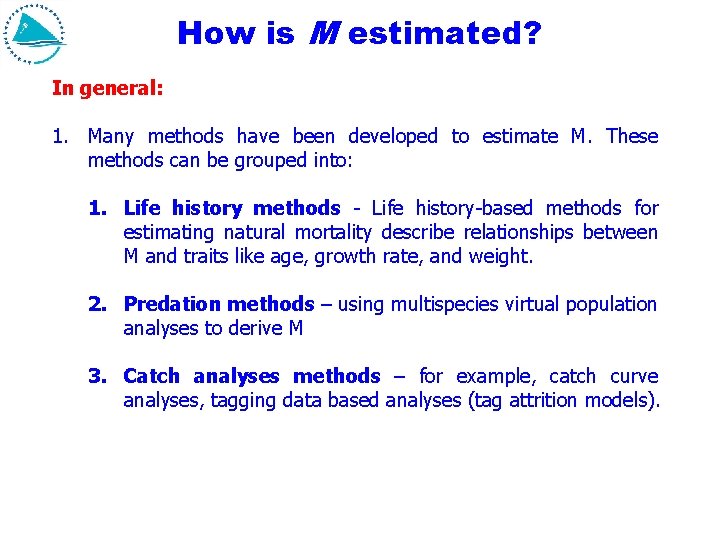
How is M estimated? In general: 1. Many methods have been developed to estimate M. These methods can be grouped into: 1. Life history methods - Life history-based methods for estimating natural mortality describe relationships between M and traits like age, growth rate, and weight. 2. Predation methods – using multispecies virtual population analyses to derive M 3. Catch analyses methods – for example, catch curve analyses, tagging data based analyses (tag attrition models).
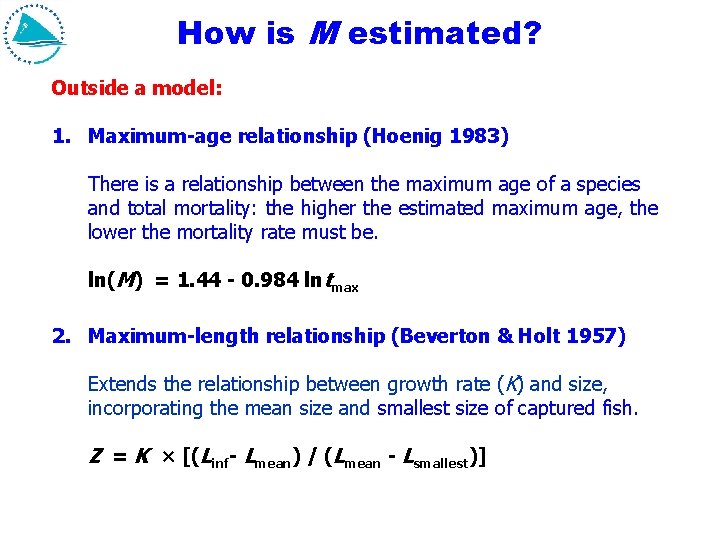
How is M estimated? Outside a model: 1. Maximum-age relationship (Hoenig 1983) There is a relationship between the maximum age of a species and total mortality: the higher the estimated maximum age, the lower the mortality rate must be. ln(M) = 1. 44 - 0. 984 lntmax 2. Maximum-length relationship (Beverton & Holt 1957) Extends the relationship between growth rate (K) and size, incorporating the mean size and smallest size of captured fish. Z = K × [(Linf- Lmean) / (Lmean - Lsmallest)]
How is M estimated? Outside a model: 3. Application of the relationship between M and K • The ratio between natural mortality and the von Bertalanffy growth rate parameter has been estimated to be between 1. 5 and 1. 6 with a standard error of 0. 58. • This is thought to be a result of biological “tradeoffs” between growth and mortality and the influences of reproduction and survival. • So, if you have an estimate of K (e. g. , from fitting the VBGF), then you also have a starting point for M: e. g. , K = 0. 4, M ≈ 0. 6 • Like all of these biological relationships, this is crude, but in the absence of any other information it can be useful.
How is M estimated? Outside a model: 4. Catch-curve analysis • Requires adequate sampling of the stock to develop representative age-frequency distribution. Potentially expensive. • The slope of the declining age-frequency curve after the assumed age at full recruitment provides an estimate of mortality. • Note that in the absence of fishing or when the stock is lightly exploited, this can be assumed to be natural mortality, M. In the presence of fishing, this will be total mortality, Z. M = -1 × slope or Z = -1 × slope
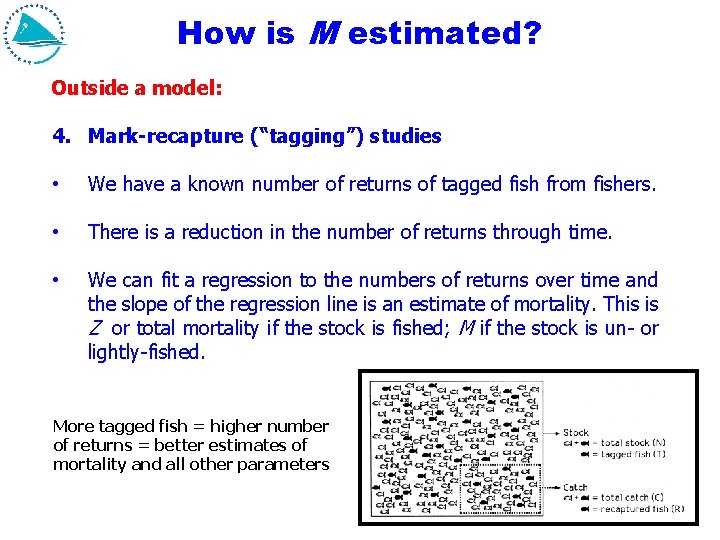
How is M estimated? Outside a model: 4. Mark-recapture (“tagging”) studies • We have a known number of returns of tagged fish from fishers. • There is a reduction in the number of returns through time. • We can fit a regression to the numbers of returns over time and the slope of the regression line is an estimate of mortality. This is Z or total mortality if the stock is fished; M if the stock is un- or lightly-fished. More tagged fish = higher number of returns = better estimates of mortality and all other parameters
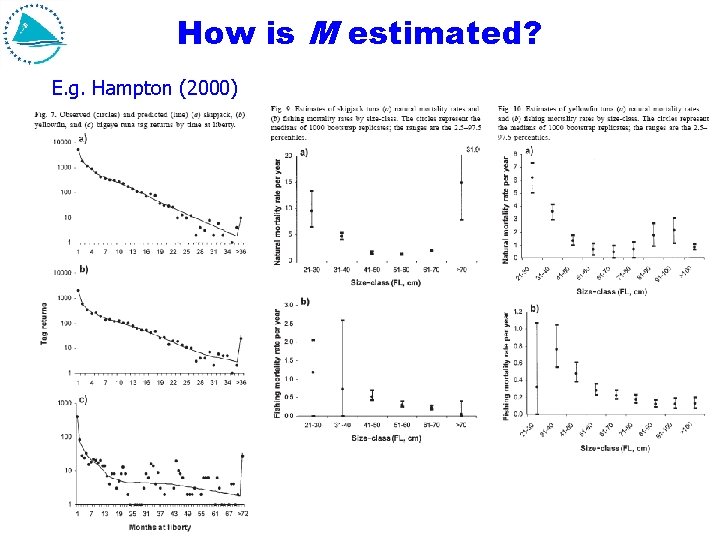
How is M estimated? Outside a model: 4. Mark-recapture (“tagging”) studies…. continued • E. g. Hampton (2000) • The Tag-attrition model (Kleiber et al. 1987; Hampton 1997) is a size aggregated capture-recapture model. Hampton (2000) builds upon the Tag-attrition model to estimate mortality in tropical tunas. • In Hampton’s model, the tagging data were classified based on the size at release. A VBGE was used to calculate growth while the tagged fish was at liberty. Then, using maximum likelihood, natural and fishing mortality are estimated. • Hampton (2000) found that natural mortality increased at the latest age classes.
How is M estimated? E. g. Hampton (2000)
How is M incorporated into stock assessments? Within a model: 1. A constant M • An estimate of M from another study is assumed and fixed in the model for all age-classes. • At each time step, M-proportion of fish from each age-class are removed from each age class. • This allows the model to incorporate mortality for each ageclass at each time-step, but the mortality rate does not vary by age-class. • Typically, we test the sensitivity of the model outputs to the assumed value of M systematically varying the value of M assumed and repeating the fit (“sensitivity analysis”).
How is M incorporated into stock assessments? Within a model: 2. Fixed age or size-class specific M values • Mortality estimates for some age or length classes may be available from other studies. • These can also applied at each time step to the corresponding age-classes in the model partition to remove fish from the model. • Everything else being equal, the use of age-specific M values provides a greater degree of realism—biomass estimates and other outputs will incorporate age-specific M.
How is M incorporated into stock assessments? Within a model: 3. M can be estimated during the assessment model fit • Starting value However, this still requires a plausible starting value (seedvalue) and range[usually from previous studies] • Sources Starting values can be compiled from the published scientific literature or from the results of previous assessments • MULTIFAN-CL has considerable flexibility in how it handles M. M can be treated either as a single, average value or as agespecific values.
Fishing Mortality
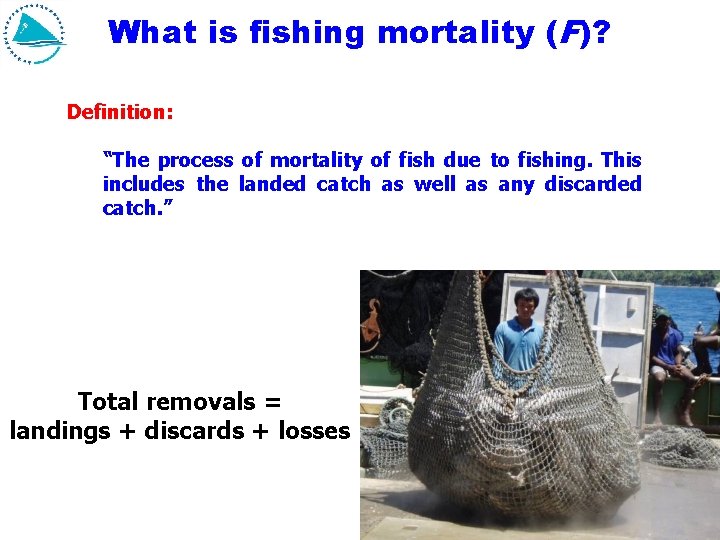
What is fishing mortality (F)? Definition: “The process of mortality of fish due to fishing. This includes the landed catch as well as any discarded catch. ” Total removals = landings + discards + losses
What is fishing mortality (F)? Why do we give fishing mortality so much attention? 1. We wish to understand the past, present and future probable impacts of fishing upon the fish stocks that we are responsible for so that we can meet our long-term goals for these resource(s). 2. With age structured models we can go one step further, an identify which components (age classes) within the stock are the most affected by fishing. 3. In situations where the resource is being overexploited, we can simulate different alternative management options by simulating different fishing mortality rates by different gears on different age classes within the stock.
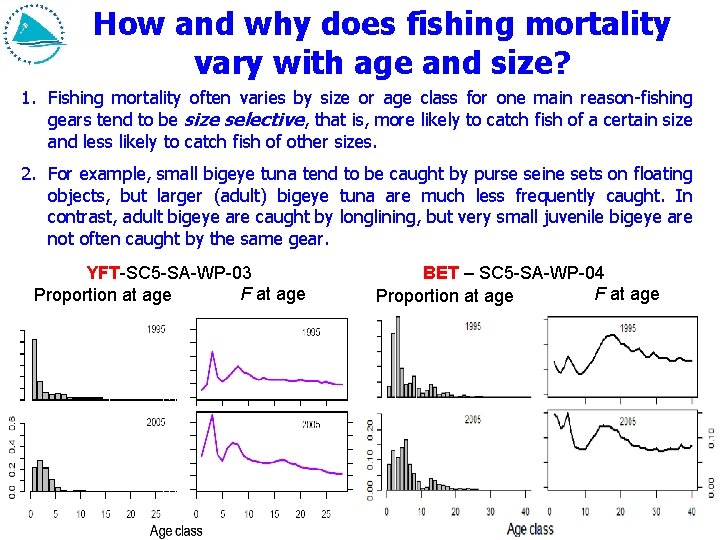
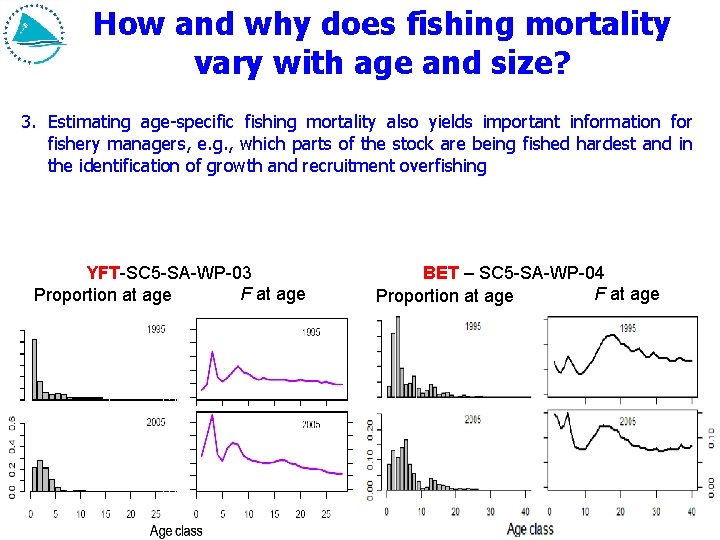
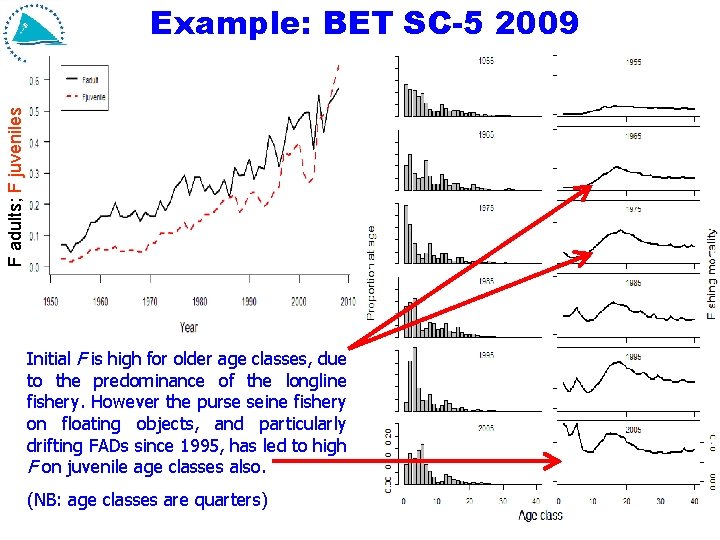
How and why does fishing mortality vary with age and size? 1. Fishing mortality often varies by size or age class for one main reason-fishing gears tend to be size selective, that is, more likely to catch fish of a certain size and less likely to catch fish of other sizes. 2. For example, small bigeye tuna tend to be caught by purse seine sets on floating objects, but larger (adult) bigeye tuna are much less frequently caught. In contrast, adult bigeye are caught by longlining, but very small juvenile bigeye are not often caught by the same gear. YFT-SC 5 -SA-WP-03 F at age Proportion at age BET – SC 5 -SA-WP-04 F at age Proportion at age
How and why does fishing mortality vary with age and size? 3. Estimating age-specific fishing mortality also yields important information for fishery managers, e. g. , which parts of the stock are being fished hardest and in the identification of growth and recruitment overfishing YFT-SC 5 -SA-WP-03 F at age Proportion at age BET – SC 5 -SA-WP-04 F at age Proportion at age
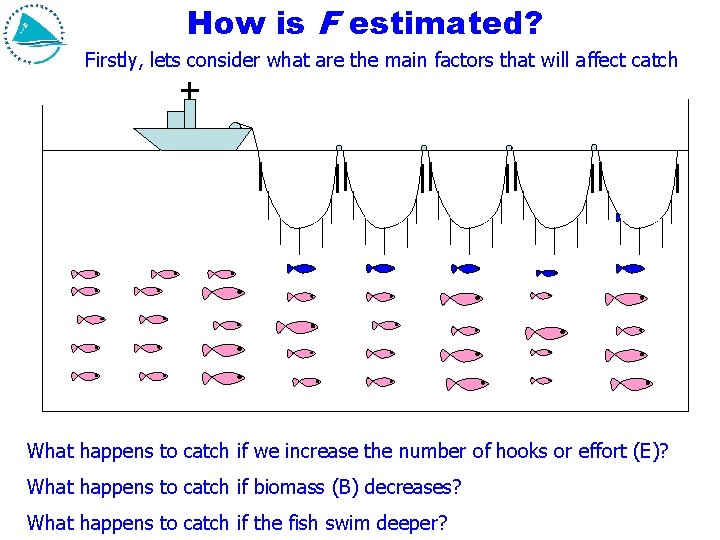
How is F estimated? Firstly, lets consider what are the main factors that will affect catch What happens to catch if we increase the number of hooks or effort (E)? What happens to catch if biomass (B) decreases? What happens to catch if the fish swim deeper?
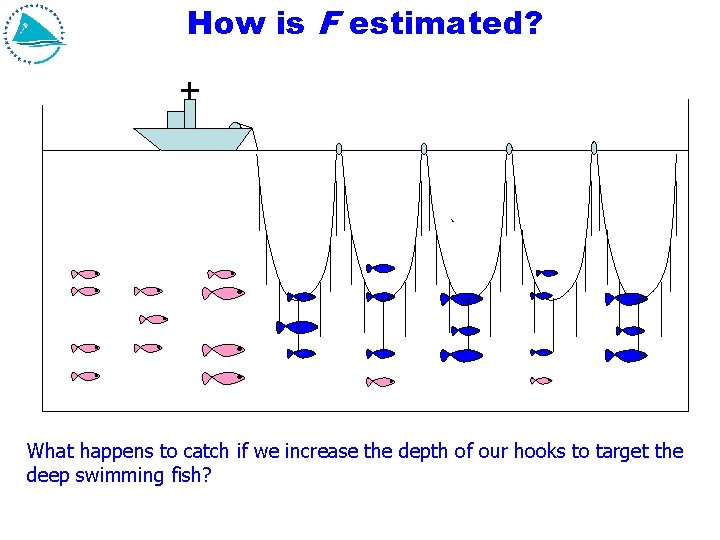
How is F estimated? What happens to catch if we increase the depth of our hooks to target the deep swimming fish?
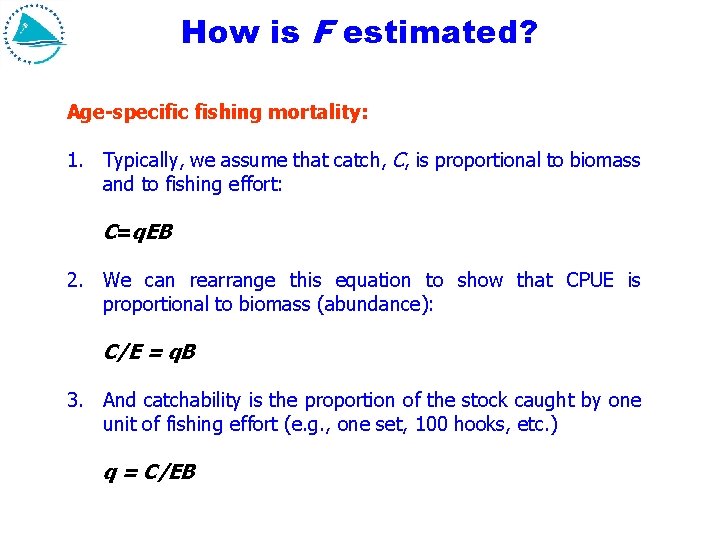
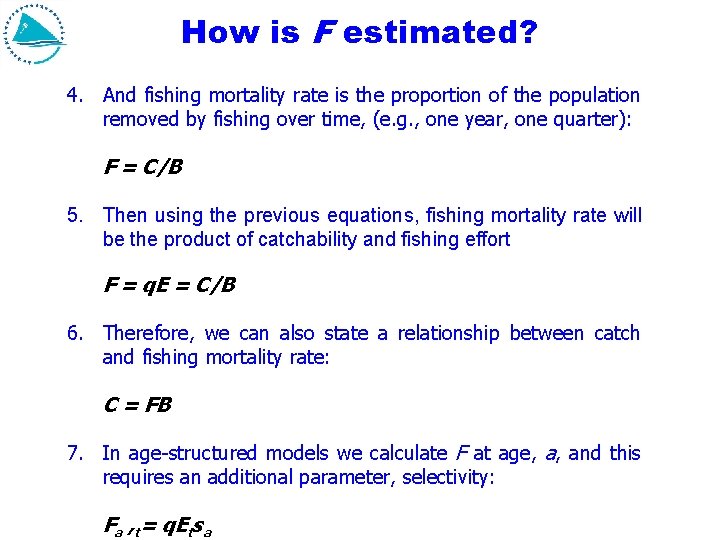
How is F estimated? Age-specific fishing mortality: 1. Typically, we assume that catch, C, is proportional to biomass and to fishing effort: C=q. EB 2. We can rearrange this equation to show that CPUE is proportional to biomass (abundance): C/E = q. B 3. And catchability is the proportion of the stock caught by one unit of fishing effort (e. g. , one set, 100 hooks, etc. ) q = C/EB
How is F estimated? 4. And fishing mortality rate is the proportion of the population removed by fishing over time, (e. g. , one year, one quarter): F = C/B 5. Then using the previous equations, fishing mortality rate will be the product of catchability and fishing effort F = q. E = C/B 6. Therefore, we can also state a relationship between catch and fishing mortality rate: C = FB 7. In age-structured models we calculate F at age, a, and this requires an additional parameter, selectivity: Fa , t= q. Etsa
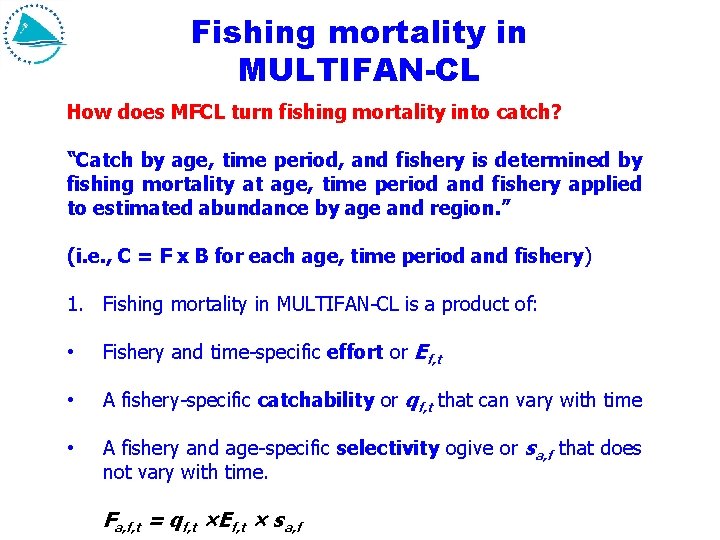
Fishing mortality in MULTIFAN-CL How does MFCL turn fishing mortality into catch? “Catch by age, time period, and fishery is determined by fishing mortality at age, time period and fishery applied to estimated abundance by age and region. ” (i. e. , C = F x B for each age, time period and fishery) 1. Fishing mortality in MULTIFAN-CL is a product of: • Fishery and time-specific effort or Ef, t • A fishery-specific catchability or qf, t that can vary with time • A fishery and age-specific selectivity ogive or sa, f that does not vary with time. Fa, f, t = qf, t ×Ef, t × sa, f
F adults; F juveniles Example: BET SC-5 2009 Initial F is high for older age classes, due to the predominance of the longline fishery. However the purse seine fishery on floating objects, and particularly drifting FADs since 1995, has led to high F on juvenile age classes also. (NB: age classes are quarters)
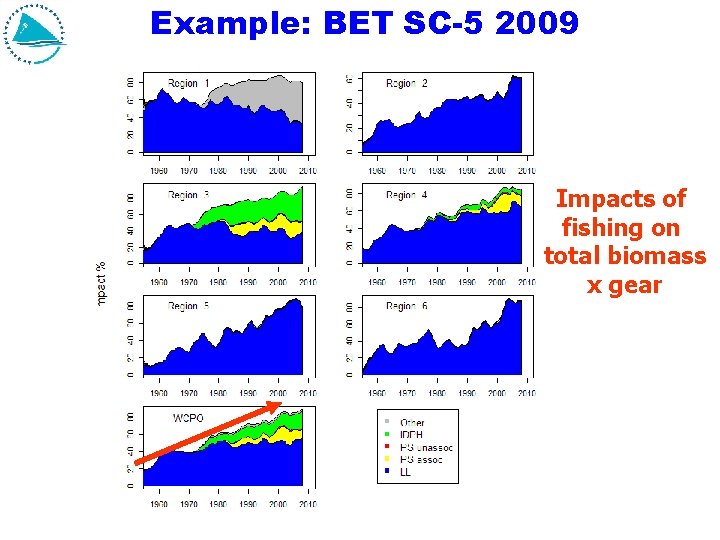
Example: BET SC-5 2009 Impacts of fishing on total biomass x gear
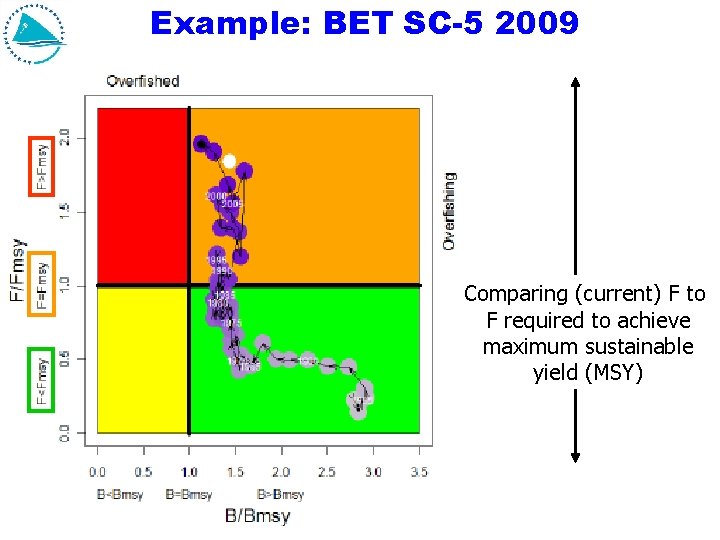
Example: BET SC-5 2009 Comparing (current) F to F required to achieve maximum sustainable yield (MSY)
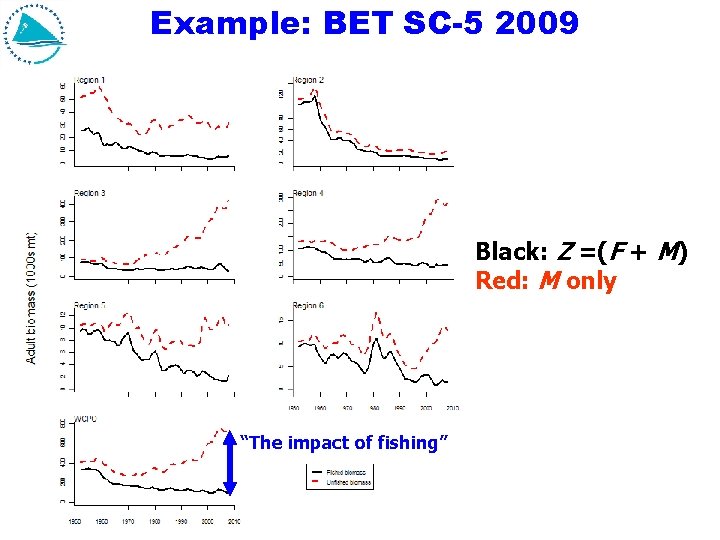
Fishing mortality in MULTIFAN-CL Calculating unfished biomass: 1. MFCL models can be used to estimate biomass that would have occurred in the absence of fishing. This is achieved by “turning off” fishing mortality, i. e. , : Z=M+F=M+0=M 2. This allows the calculation of biomass trajectories in the absence of fishing, but utilising all other assumptions made in the model (e. g. , year-class strength estimates, etc. ). 3. This can be used to estimate the reduction in biomass as a result of fishing, given the assumptions made in the model.
Example: BET SC-5 2009 Black: Z =(F + M) Red: M only “The impact of fishing”
Summary Natural mortality (M): 1. It is a critical variable in describing population dynamics. 2. It is likely to vary with size or age of fish. 3. It can be estimated using a variety of techniques, but can be difficult to estimate, as its effects are confounded by the effects of F and R. Mark-recapture data are particularly useful. 4. A sound understanding of M is critical to produce “realistic” stock assessment models, although it can be difficult to select one particular value or set of values in preference to any others.
Summary Natural mortality (M): 5. As a result of this, the impacts of alternative assumed values of M on stock assessment model outputs are often examined in sensitivity analyses. 6. Age-structured stock assessment models like MULTIFAN-CL can deal with M in a variety of ways: e. g. , (i) single fixed value of M; (ii) age-specific fixed values of M; and (iii) estimable values of M. 7. Changing the value of M potentially affects a very wide variety of model outputs including biological reference points such as BMSY, the relative impacts of fishing on different age classes, and so on.
Summary Fishing mortality (F): 1. Can be estimated within stock assessment model fits and by other methods outside (e. g. mark-recapture analysis, effort series analyses etc) 2. In an age-structured stock assessment model fit, F is usually calculated for each time, age and fishery as a function of selectivity, catchability, and fishing effort. 3. Estimating F is critical in the calculation and interpretation of biological reference points, such as Fcurrent /FMSY. 4. Estimating F-at-age is also important in the identification of overfishing (e. g. growth or recruitment overfishing). 5. It can be “switched off” within a model to estimate the impacts of fishing. This is often done with MULTIFAN-CL.