
Day 3 Psychosocial care spirituality bereavement Principles Practice
Day 3 Psychosocial care, spirituality & bereavement Principles & Practice of End of Life Care Registered Practitioners 2018 www. pilgrimshospices. org
Aim of day • Explore the holistic approach to assessment & care planning to identify psychological, social, spiritual & bereavement needs of patients/families & carers & consider the impact this can have. www. pilgrimshospices. org
Learning outcomes care planning holistic approach to care • Analyse why the holistic approach to assessment & care is essential to best practice in end of life care. • Explore tools available to support. • Examine own role in supporting patients & families psychological, social, spiritual & bereavement needs & consider when to refer. www. pilgrimshospices. org
What do we mean by holistic & person-centred approach to care? 1. With the patient in the centre, consider the impact of facing death for the patient & the family. 2. Think of an example of holistic care planning from own practice & complete the following form. www. pilgrimshospices. org
Holistic Common Assessment (HCA) of supportive & palliative care needs for adults requiring end of life care (NEo. LCP – 2010) • As well as focusing on physical physica concerns, equal emphasis must made to ensure that psychological, psychological social & spiritual needs are effectively met. Active link to HCA document: • http: //www. slideshare. net/NHSIQlegacy/holisticcommon-assessment (no recent update) www. pilgrimshospices. org
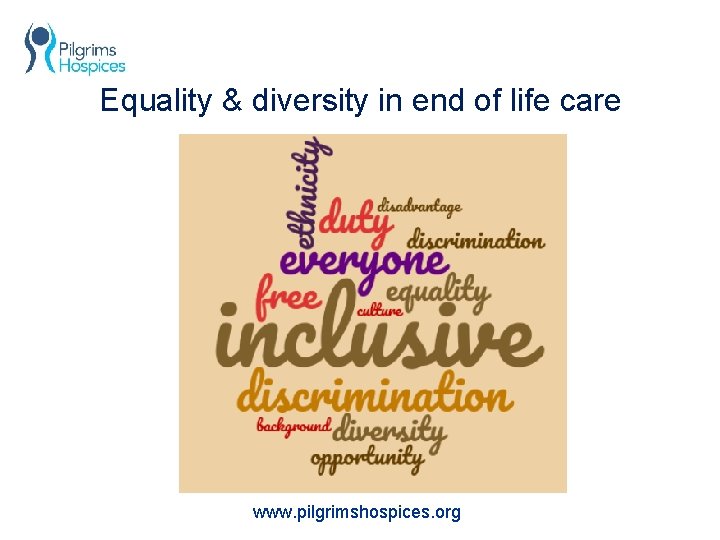
Equality & diversity in end of life care www. pilgrimshospices. org
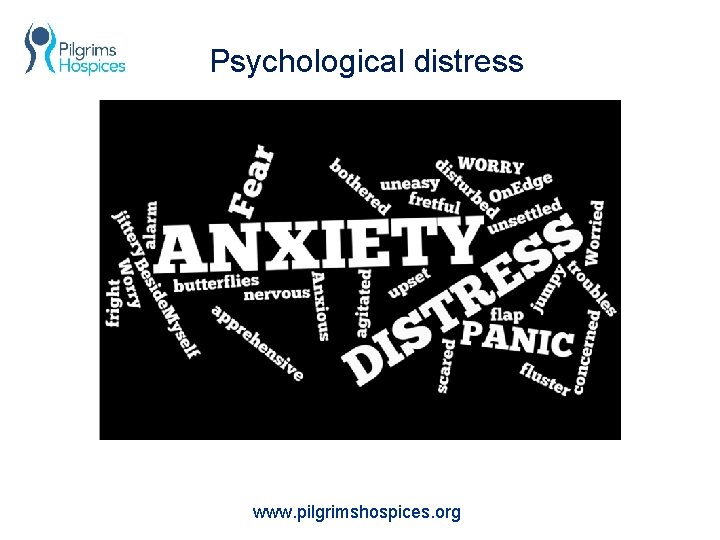
Psychological distress www. pilgrimshospices. org
What do we know about anxiety? Evidence base • Anxiety is an unsurprising response to cancer diagnosis. • Can range in intensity & may increase with disease progression. (Review by Smith et al 2014) • Can have a significant impact on patients at end of life. (Spencer et al 2010) • Prevalence of emotional distress is high in patients with advanced heart failure. Some studies suggest may be higher than for cancer. (Ramsenthaler 2011) • Significant symptom for people with COPD & prevalence may be higher than for cancer or heart failure. (Hill et al 2008) www. pilgrimshospices. org
What else do we know? • Patients & carers with any level of distress (from mild to severe) may benefit from psychological support. • Despite awareness of prevalence of distress, psychological symptoms frequently not recognised & therefore not offered the support they may need. • Health & social care staff may not have the appropriate assessment skills & may not realise the benefits of psychological support. (NICE 2004) Lots of distress + lack of help + lack of training = even more distress www. pilgrimshospices. org
![NICE - End of life care for adults Quality Standard [QS 13] Published date:](http://slidetodoc.com/presentation_image_h2/651f402efbf6dddb2d9c5b2470ded29f/image-10.jpg "NICE - End of life care for adults Quality Standard [QS 13] Published date:")
NICE - End of life care for adults Quality Standard [QS 13] Published date: November 2011 Last updated: march 2017 • https: //www. nice. org. uk/guidance/qs 13/chapter/Quality-statement-4 Holistic-support-physical-and-psychological www. pilgrimshospices. org
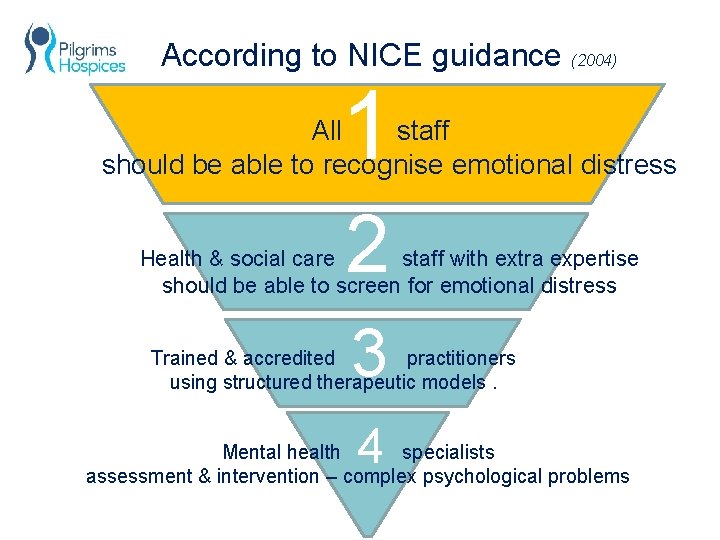
According to NICE guidance (2004) 1 All staff should be able to recognise emotional distress 2 Health & social care staff with extra expertise should be able to screen for emotional distress 3 Trained & accredited practitioners using structured therapeutic models. 4 Mental health specialists assessment & intervention – complex psychological problems www. pilgrimshospices. org
What should we be doing? When there is evidence of general emotional distress (Level 1) • • All staff responsible for patient care have a responsibility to assess & meet general emotional care needs. Staff must be able to recognise psychological distress & the awareness & competence to avoid causing psychological harm. Staff must engage with respect, dignity, kindness, communicate honestly & establish & maintain a support relationship. Communicate information effectively. Recognise boundary of own competence & refer as appropriate. (NICE 2004 due to be updated) www. pilgrimshospices. org
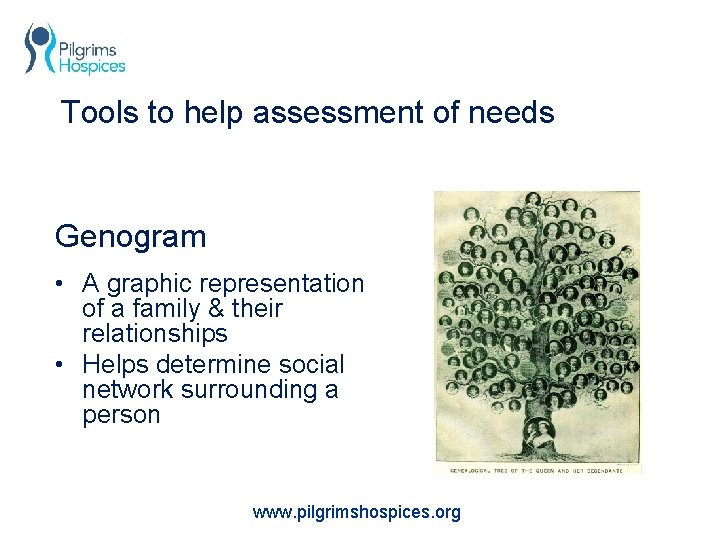
Tools to help assessment of needs Genogram • A graphic representation of a family & their relationships • Helps determine social network surrounding a person www. pilgrimshospices. org
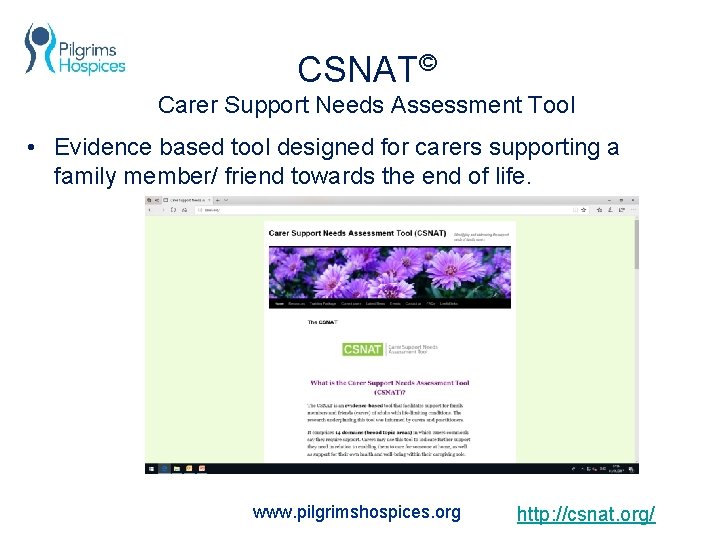
CSNAT© Carer Support Needs Assessment Tool • Evidence based tool designed for carers supporting a family member/ friend towards the end of life. www. pilgrimshospices. org http: //csnat. org/
How do we measure effectiveness of our intervention? www. pilgrimshospices. org
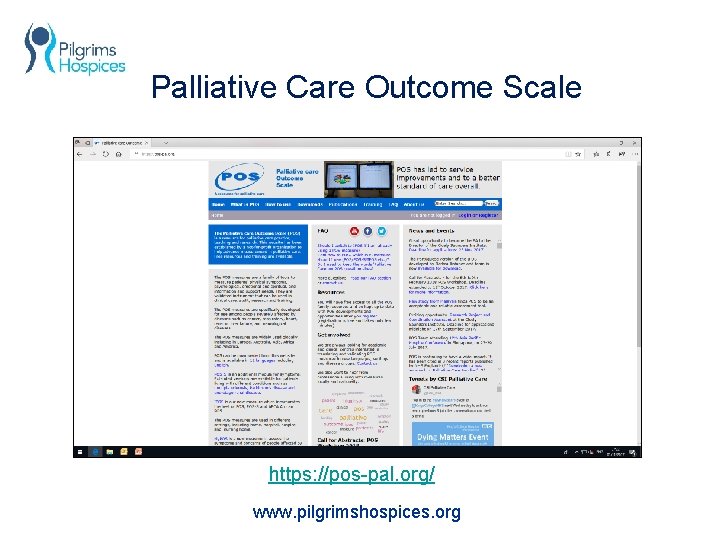
Palliative Care Outcome Scale https: //pos-pal. org/ www. pilgrimshospices. org
Is there something else? Have you heard about SAGE & THYME® Notice distress, hear concerns, respond helpfully • http: //www. sageandthymetraining. org. uk/ Pilgrims deliver SAGE &THYME 3 hour workshop www. pilgrimshospices. org
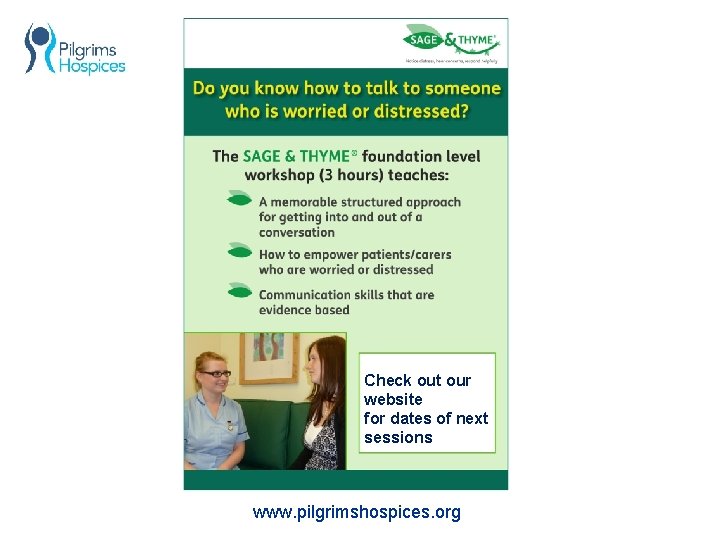
Check out our website for dates of next sessions www. pilgrimshospices. org
References & useful resources • CSNAT - http: //csnat. org/ (need to register to access) • Dying Matters - check out their leaflets http: //www. dyingmatters. org/ • Holistic Common Assessment (NEo. LCP 2010) Can still access via - http: //www. slideshare. net/NHSIQlegacy/holisticcommon-assessment (no update) • Palliative Care Outcome Scale -http: //pos-pal. org/maix/ (need to register to access forms) www. pilgrimshospices. org
- Slides: 19