
Day 3 EAD 800 Valbonne 04 Structural Theories
Day 3 EAD 800 Valbonne 04 Structural Theories
Today’s topics: Weberian bureaucracy Types of formalization Professionalism vs bureaucracy Loose coupling Case study Hypotheses
Weberian bureaucracy: Division of labor Specialization Impersonal orientation Hierarchy of authority Rules and regulations Career orientation
Weberian bureaucracy: Experience tends to universally show that the purely bureaucratic type of administrative organization…is, from a purely technical point of view, capable of attaining the highest degree of efficiency” (Weber, 1947).

Functions and dysfunctions of Weberian Model: Characteristic Function Dysfunction Division of Labor Expertise Boredom Impersonal Orientation Rationality Lack of morale Hierarchy of Authority Disciplined compliance and coordination Communication blocks Rules and regulations Continuity and uniformity Rigidity and goal displacement Career orientation Incentive Conflict between achievement and seniority

Integration of Formal and Informal Systems Activities Interaction FORMAL INFORMAL Sentiments Hierarchy Informal structure Division of Labor Division into cliques Formalization Informal norms Impersonality Personal relations Formal Communication and Leadership Informal communication and Leadership ENVIRONMENT – Physical, technical, social
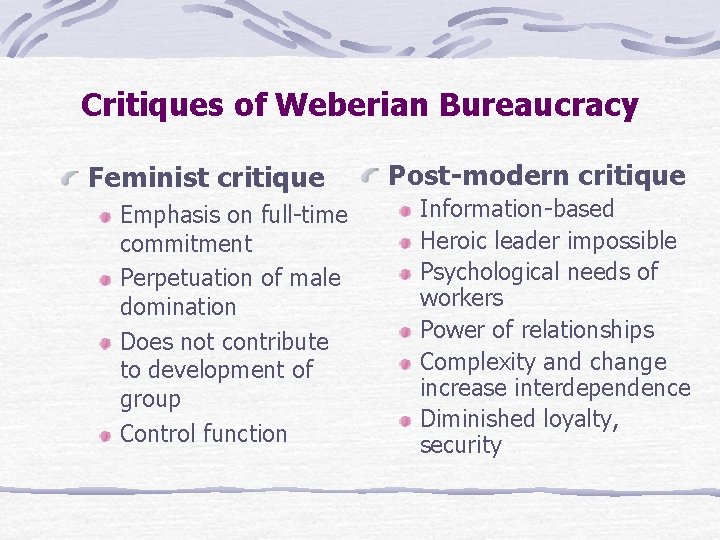
Critiques of Weberian Bureaucracy Feminist critique Emphasis on full-time commitment Perpetuation of male domination Does not contribute to development of group Control function Post-modern critique Information-based Heroic leader impossible Psychological needs of workers Power of relationships Complexity and change increase interdependence Diminished loyalty, security
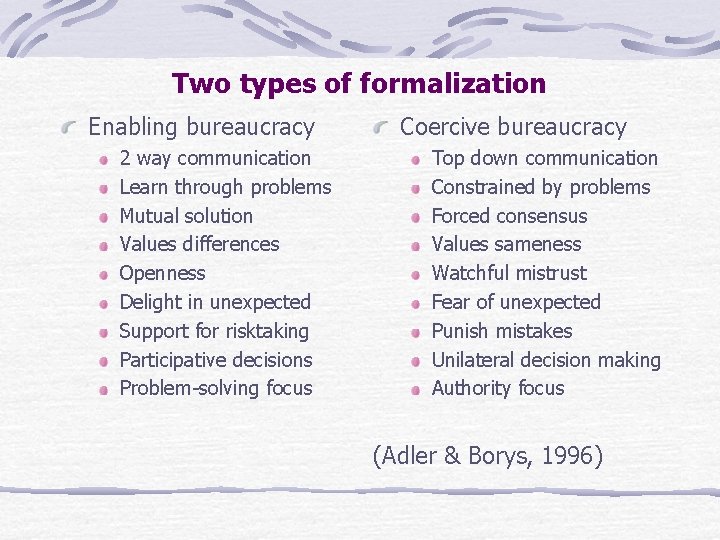
Two types of formalization Enabling bureaucracy 2 way communication Learn through problems Mutual solution Values differences Openness Delight in unexpected Support for risktaking Participative decisions Problem-solving focus Coercive bureaucracy Top down communication Constrained by problems Forced consensus Values sameness Watchful mistrust Fear of unexpected Punish mistakes Unilateral decision making Authority focus (Adler & Borys, 1996)
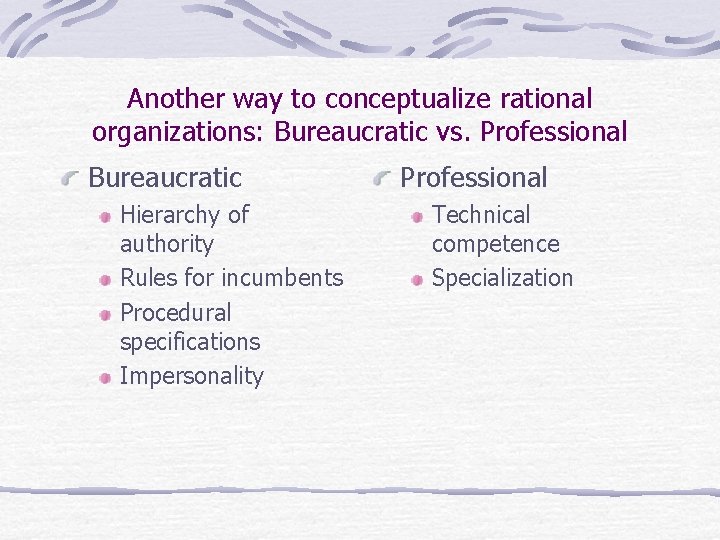
Another way to conceptualize rational organizations: Bureaucratic vs. Professional Bureaucratic Hierarchy of authority Rules for incumbents Procedural specifications Impersonality Professional Technical competence Specialization
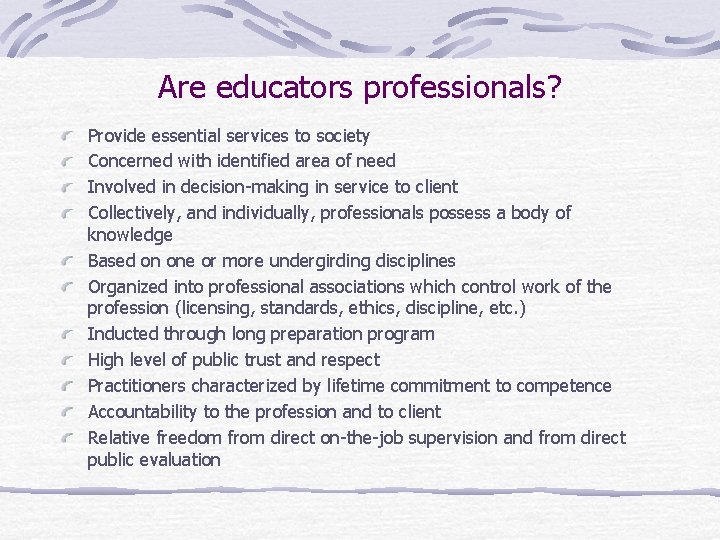
Are educators professionals? Provide essential services to society Concerned with identified area of need Involved in decision-making in service to client Collectively, and individually, professionals possess a body of knowledge Based on one or more undergirding disciplines Organized into professional associations which control work of the profession (licensing, standards, ethics, discipline, etc. ) Inducted through long preparation program High level of public trust and respect Practitioners characterized by lifetime commitment to competence Accountability to the profession and to client Relative freedom from direct on-the-job supervision and from direct public evaluation
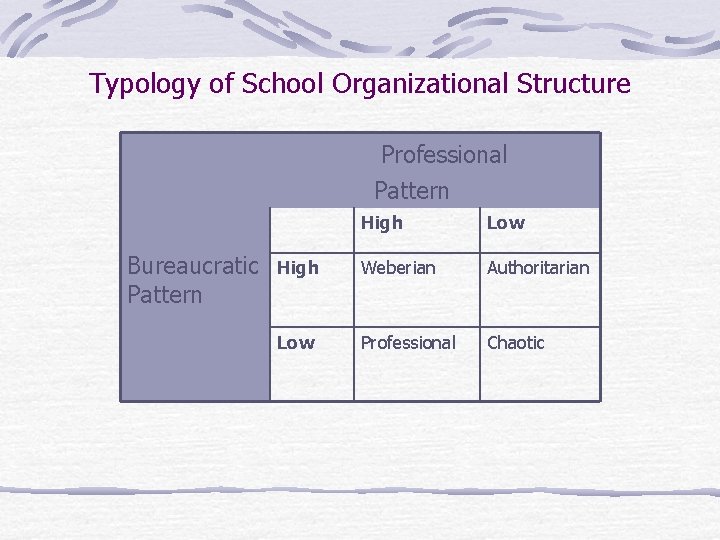
Typology of School Organizational Structure Professional Pattern Bureaucratic Pattern High Low High Weberian Authoritarian Low Professional Chaotic
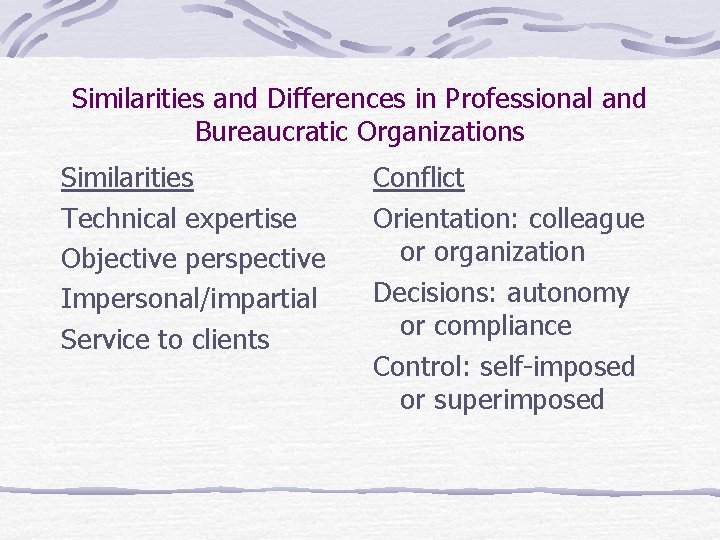
Similarities and Differences in Professional and Bureaucratic Organizations Similarities Technical expertise Objective perspective Impersonal/impartial Service to clients Conflict Orientation: colleague or organization Decisions: autonomy or compliance Control: self-imposed or superimposed
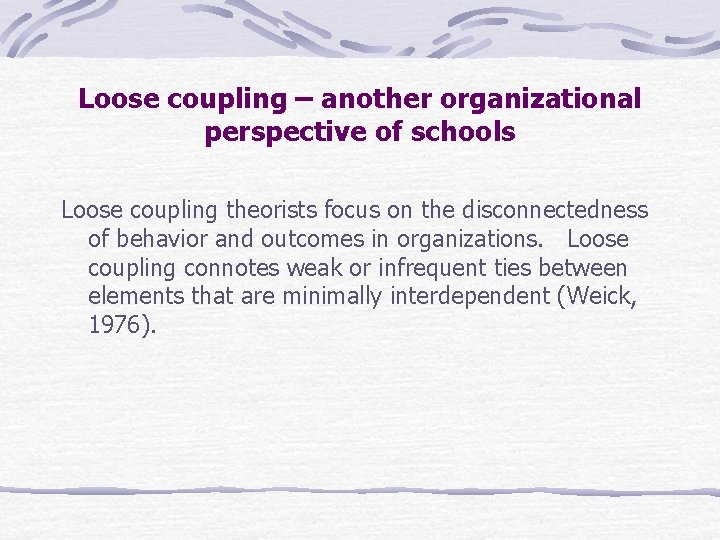
Loose coupling – another organizational perspective of schools Loose coupling theorists focus on the disconnectedness of behavior and outcomes in organizations. Loose coupling connotes weak or infrequent ties between elements that are minimally interdependent (Weick, 1976).
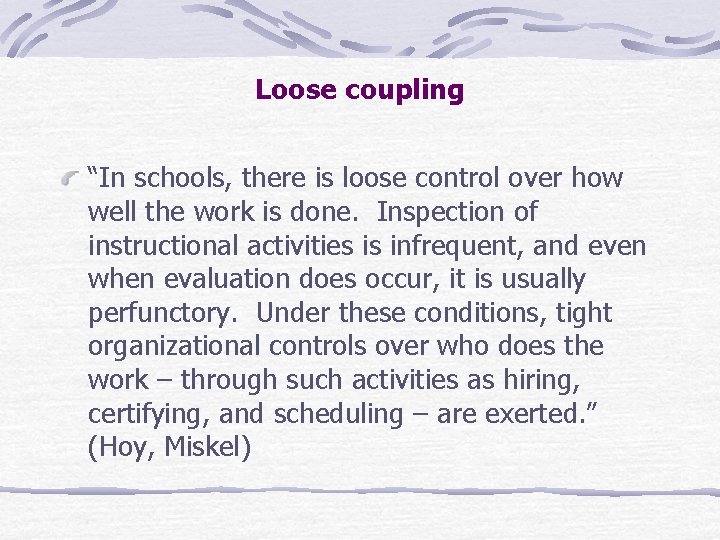
Loose coupling “In schools, there is loose control over how well the work is done. Inspection of instructional activities is infrequent, and even when evaluation does occur, it is usually perfunctory. Under these conditions, tight organizational controls over who does the work – through such activities as hiring, certifying, and scheduling – are exerted. ” (Hoy, Miskel)
Managing change in rational system “Find goals and or means that can be evaluated easily and to which the participants can commit themselves. It is assumed that if relevant information is gathered to define the problem properly and if the resistance of recalcitrant parties is overcome, then a decision can be made that will correct any problems. In this view, a fairly stable group of decision makers who agree on goals and technology is managing change. ”
Managing change in an open system Concentrate efforts on one or two critical problems Learn the history of an issue, including when it came up, who took what positions, who won, who lost Build coalitions to mobilize support Use the formal system of committee memberships and the informal system of discussions and mediation (Berger, 1981)
Bees and Flies Experimentation, persistence, trial and error, risks, improvisation, one best way, detours, confusion, rigidity, randomness. Tightness and looseness
Weick’s interest High differentiation – low integration Such systems may appear ineffective when assessed by criteria tied to efficiency, but may be more effective when assessed against criteria that index flexibility, ability to improvise, and capacity for self-design.
Holographic organization – loosely coupled Principle 1 – Build the “whole” into the parts Visions, values and culture as corporate DNA Networked intelligence Structures that reproduce themselves Holistic teams; diversified roles
Holographic organization – loosely coupled Principle 2 – The importance of redundancy In information processing In skills and design of work
Holographic organization – loosely coupled Principle 3 – Requisite variety Internal complexity must match that of the environment
Holographic organization – loosely coupled Principle 4 – Minimum Specs Define no more than is absolutely necessary
Holographic organization – loosely coupled Principle 5 – Learn to learn Scan and anticipate environmental change Double-loop learning Emergent design
Organizational change Loose coupling is the source of adaptability in most organizations, whereas tight coupling is the source of most adaptation. In a loosely-coupled organization, there is less necessity for major change because change is continuous. If major change becomes necessary, however, it is much harder to diffuse it among systems that are loosely-coupled.
Organizational Change A tightly coupled system may be slow to innovate yet retain the privilege of “historic backwardness” that allows it to benefit from the lessons of the more loosely coupled systems that made the first innovation. The efficiencies that accompany tight coupling may then allow those organizations that are second on the scene to grind up those who were first.
- Slides: 25