
Day 29 Bug Algorithms 1 1192022 Fundamental Problems

Day 29 Bug Algorithms 1 1/19/2022
Fundamental Problems � Chapter � "Before � lists 1. 2. 3. 4. 5. 2 2 of Dudek and Jenkin begins: delving into the harsh realities of real robots. . . “ 5 fundamental problems path planning localization sensing or perception mapping simultaneous localization and planning 1/19/2022
A Point Robot � represents � the point P fully describes the state of the robot � called � robot 3 a mobile robot as a point in the plane* pose or configuration motion causes the state to change 1/19/2022
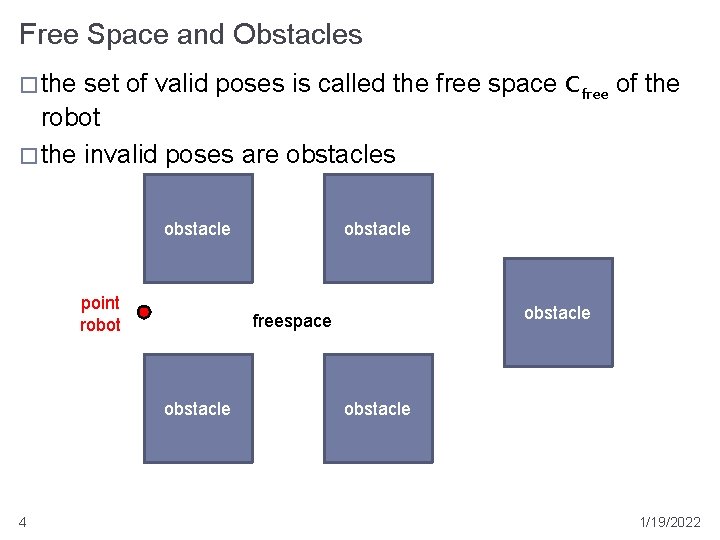
Free Space and Obstacles � the set of valid poses is called the free space Cfree of the robot � the invalid poses are obstacles obstacle point robot obstacle freespace obstacle 4 obstacle 1/19/2022
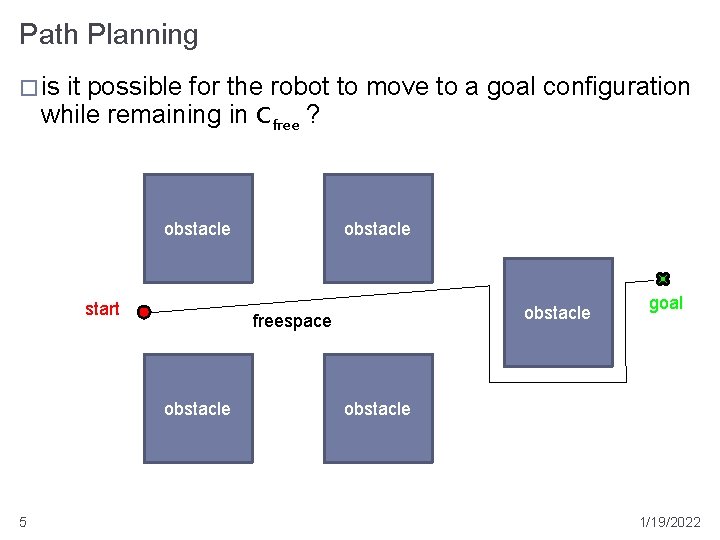
Path Planning � is it possible for the robot to move to a goal configuration while remaining in Cfree ? obstacle start obstacle freespace obstacle 5 obstacle goal obstacle 1/19/2022
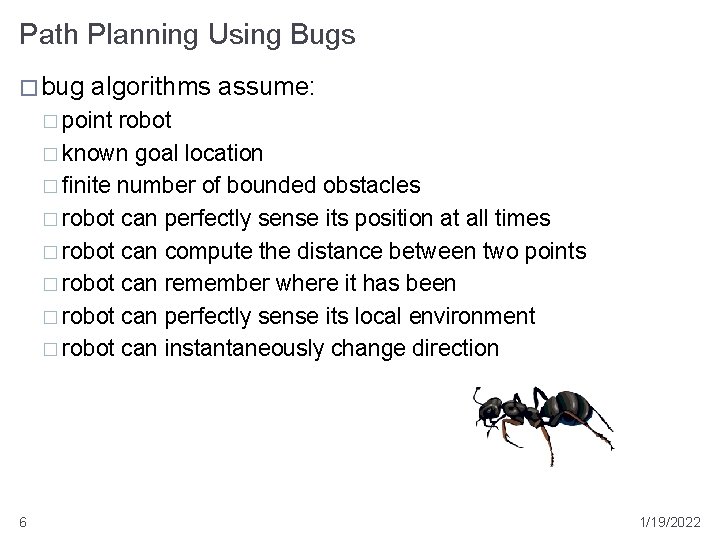
Path Planning Using Bugs � bug algorithms assume: � point robot � known goal location � finite number of bounded obstacles � robot can perfectly sense its position at all times � robot can compute the distance between two points � robot can remember where it has been � robot can perfectly sense its local environment � robot can instantaneously change direction 6 1/19/2022
Bug Zero � assumes a perfect contact sensor � repeat � head towards goal � if goal is reached then stop � if an obstacle is reached then follow the boundary until heading towards the goal is again possible 7 1/19/2022

Bug Zero obstacle start obstacle freespace obstacle 8 obstacle a right turning bug goal obstacle 1/19/2022
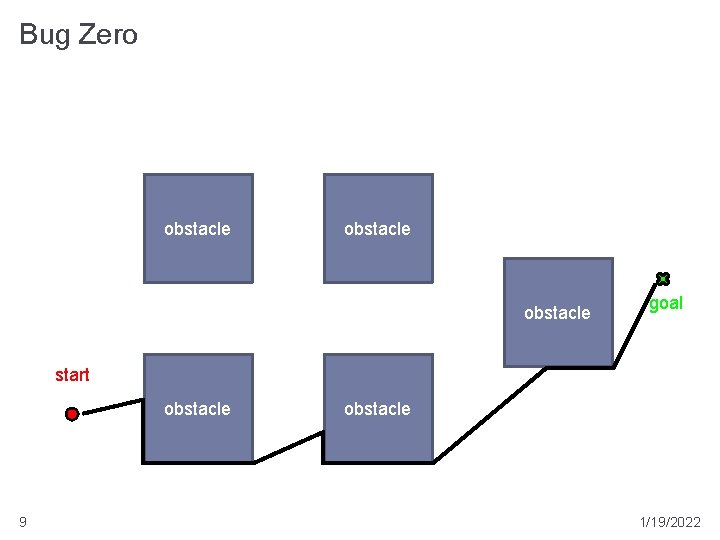
Bug Zero obstacle goal start obstacle 9 obstacle 1/19/2022
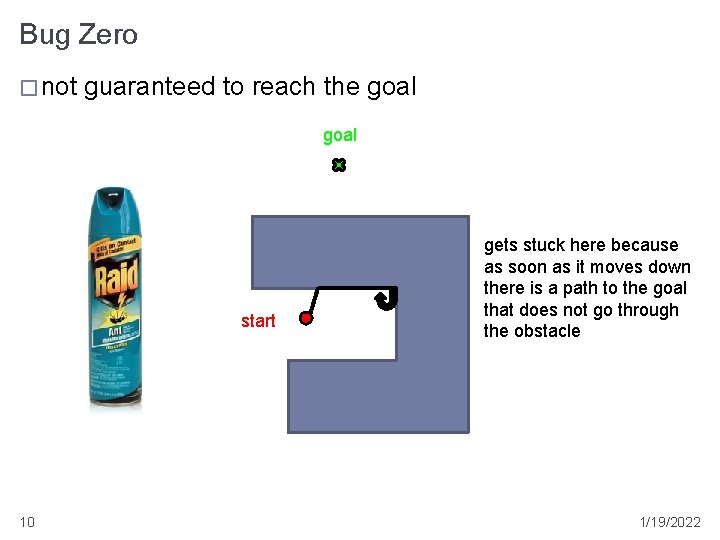
Bug Zero � not guaranteed to reach the goal start 10 obstacle gets stuck here because as soon as it moves down there is a path to the goal that does not go through the obstacle 1/19/2022
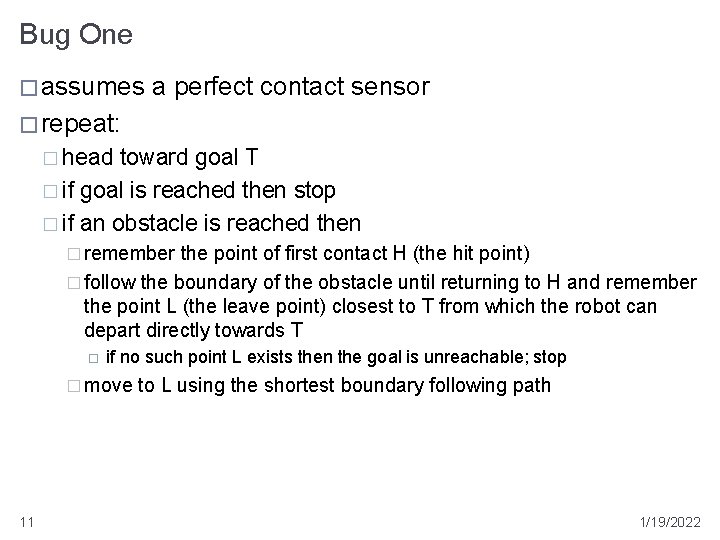
Bug One � assumes a perfect contact sensor � repeat: � head toward goal T � if goal is reached then stop � if an obstacle is reached then � remember the point of first contact H (the hit point) � follow the boundary of the obstacle until returning to H and remember the point L (the leave point) closest to T from which the robot can depart directly towards T if no such point L exists then the goal is unreachable; stop � move 11 to L using the shortest boundary following path 1/19/2022
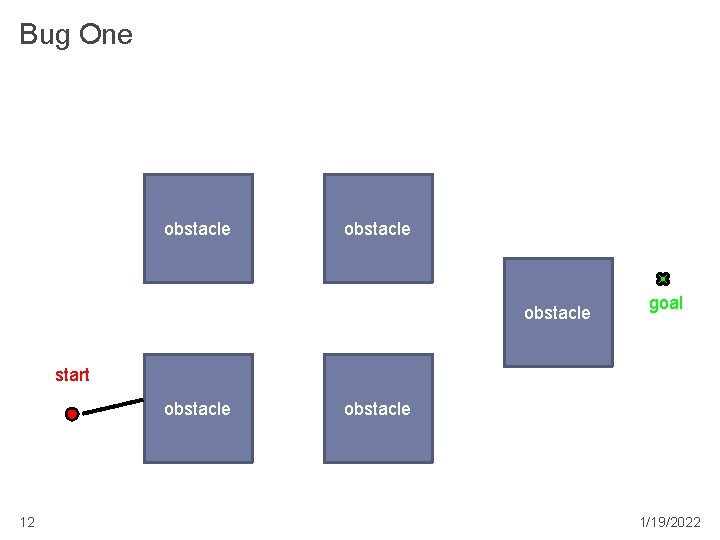
Bug One obstacle goal start obstacle 12 obstacle 1/19/2022
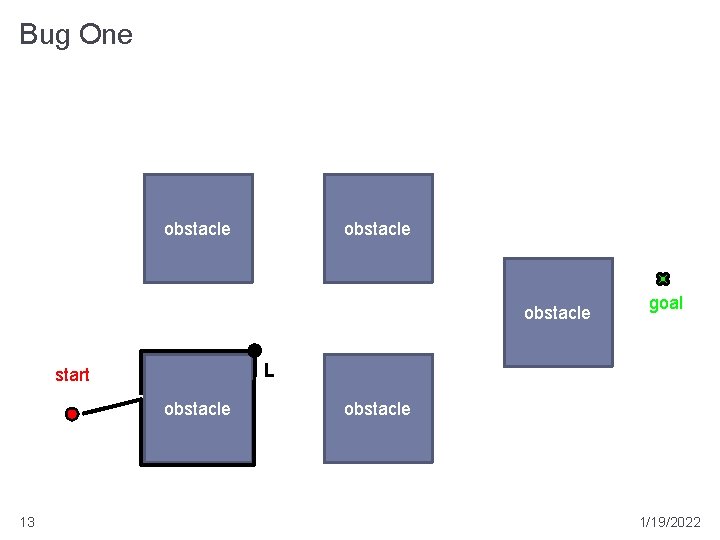
Bug One obstacle L start obstacle 13 goal obstacle 1/19/2022
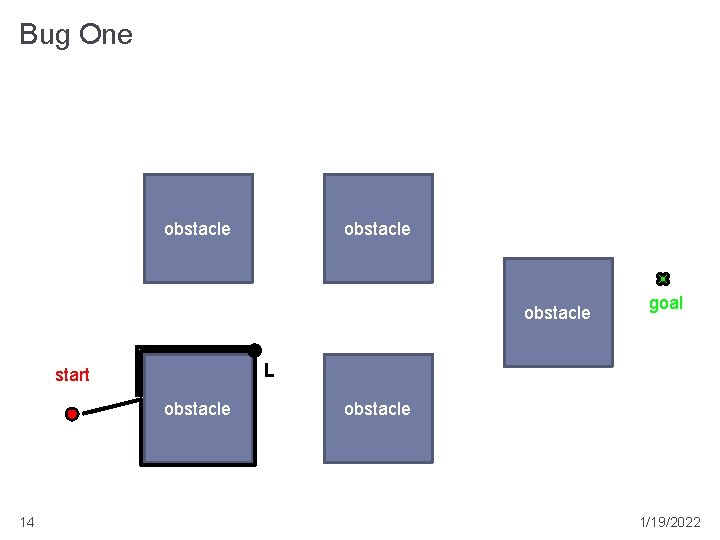
Bug One obstacle L start obstacle 14 goal obstacle 1/19/2022
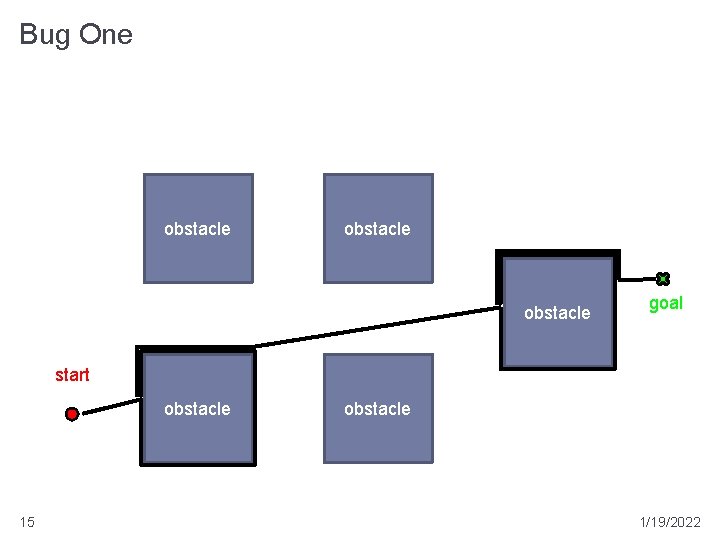
Bug One obstacle goal start obstacle 15 obstacle 1/19/2022
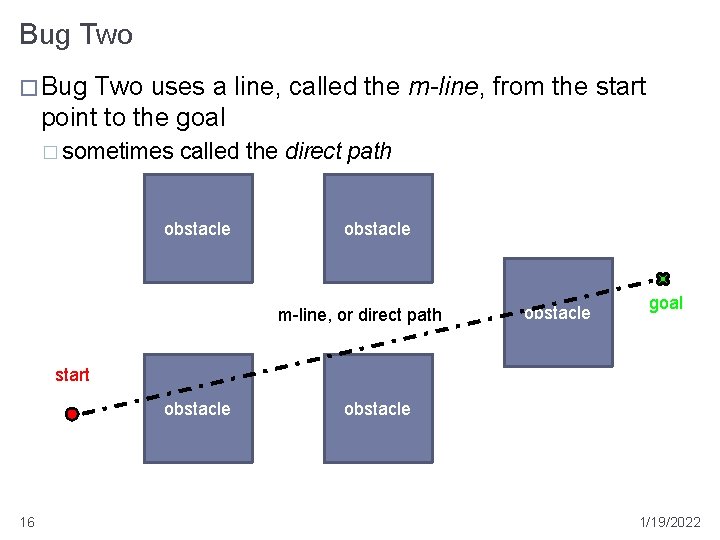
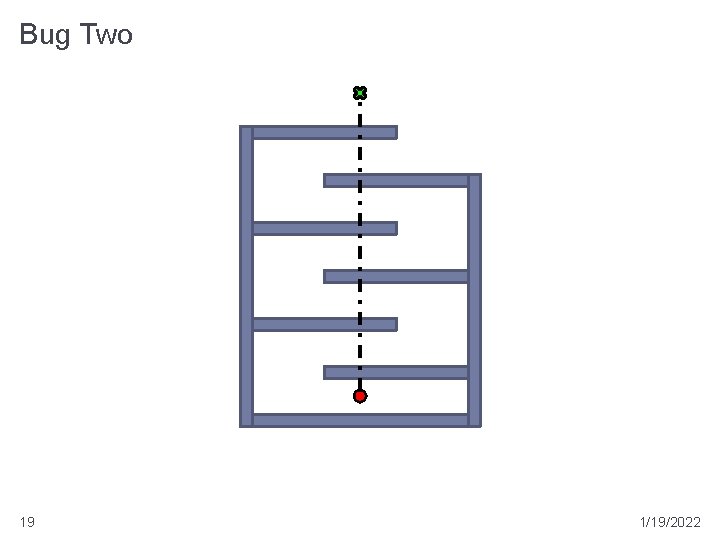
Bug Two � Bug Two uses a line, called the m-line, from the start point to the goal � sometimes called the direct path obstacle m-line, or direct path obstacle goal start obstacle 16 obstacle 1/19/2022
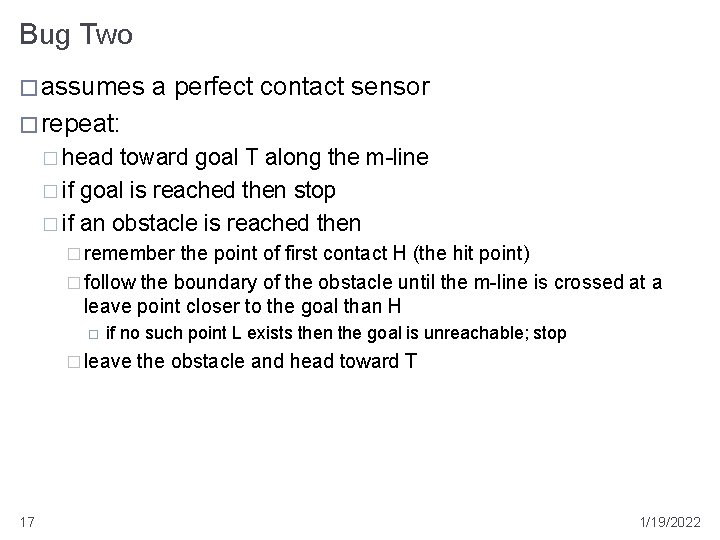
Bug Two � assumes a perfect contact sensor � repeat: � head toward goal T along the m-line � if goal is reached then stop � if an obstacle is reached then � remember the point of first contact H (the hit point) � follow the boundary of the obstacle until the m-line is crossed at a leave point closer to the goal than H if no such point L exists then the goal is unreachable; stop � leave 17 the obstacle and head toward T 1/19/2022
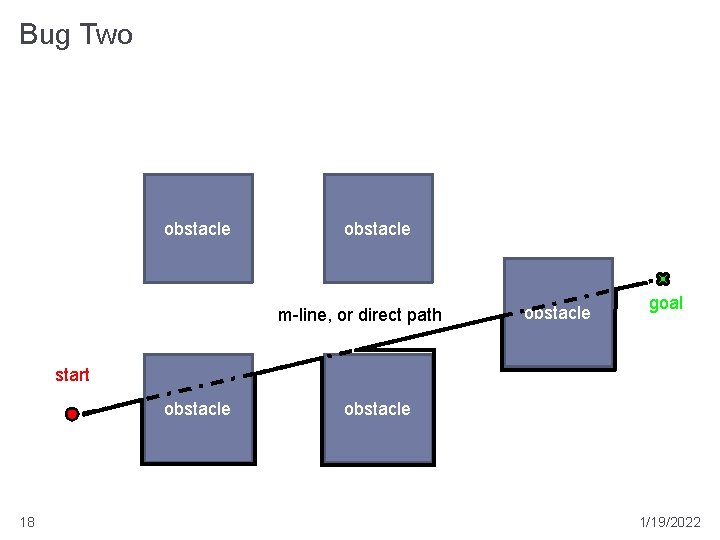
Bug Two obstacle m-line, or direct path obstacle goal start obstacle 18 obstacle 1/19/2022
Bug Two 19 1/19/2022
Bug One versus Bug Two � Bug � it considers all leave points before leaving the obstacle � Bug � it 20 One uses exhaustive search Two uses greedy search takes the first leave point that is closer to the goal 1/19/2022
Sensing the Environment � Bug 1 and Bug 2 use a perfect contact sensor � we might be able to achieve better performance if we equip the robot with a more powerful sensor � a range sensor measures the distance to an obstacle; e. g. , laser range finder � emits a laser beam into the environment and senses reflections from obstacles � essentially unidirectional, but the beam can be rotated to obtain 360 degree coverage � http: //velodynelidar. com/lidar. aspx 21 1/19/2022
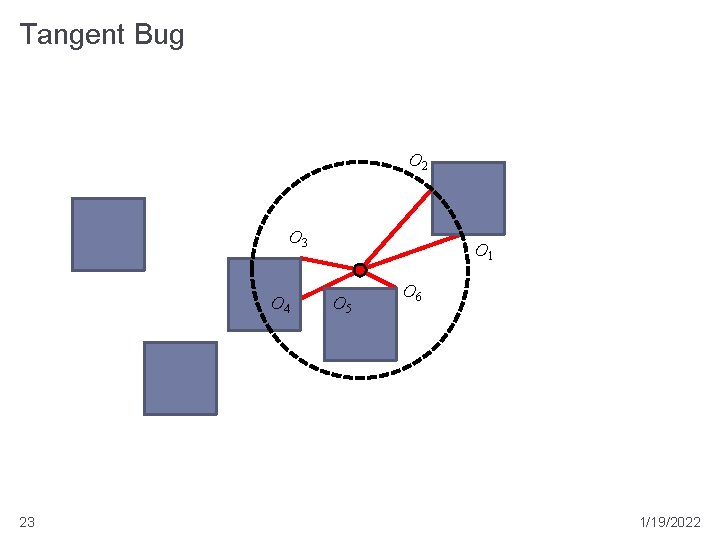
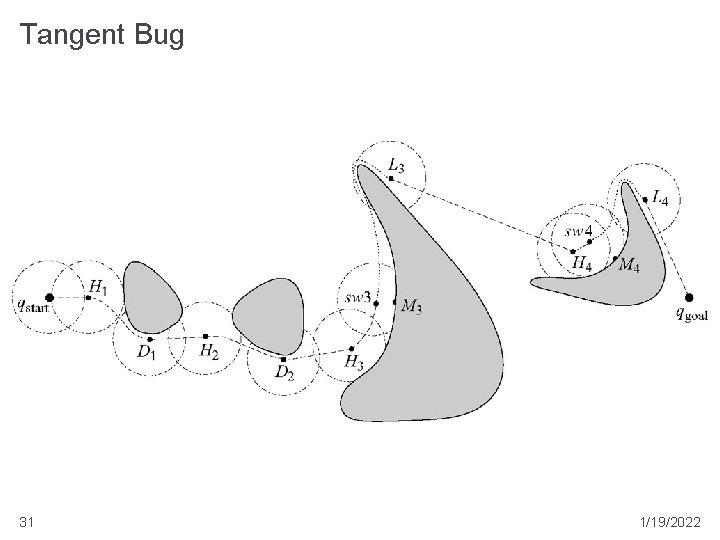
Tangent Bug � assumes a perfect 360 degree range finder with a finite range the distance r(x, q) to the first obstacle intersected by the ray from x with angle q � has a maximum range beyond which all distance measurements are considered to be r = � measures � the 22 robot looks for discontinuities in r(x, q) 1/19/2022
Tangent Bug O 2 O 3 O 4 23 O 1 O 5 O 6 1/19/2022
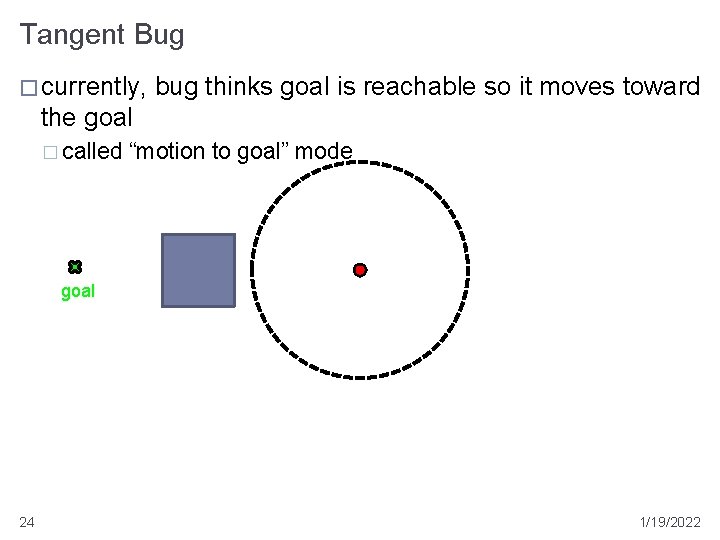
Tangent Bug � currently, bug thinks goal is reachable so it moves toward the goal � called “motion to goal” mode goal 24 1/19/2022
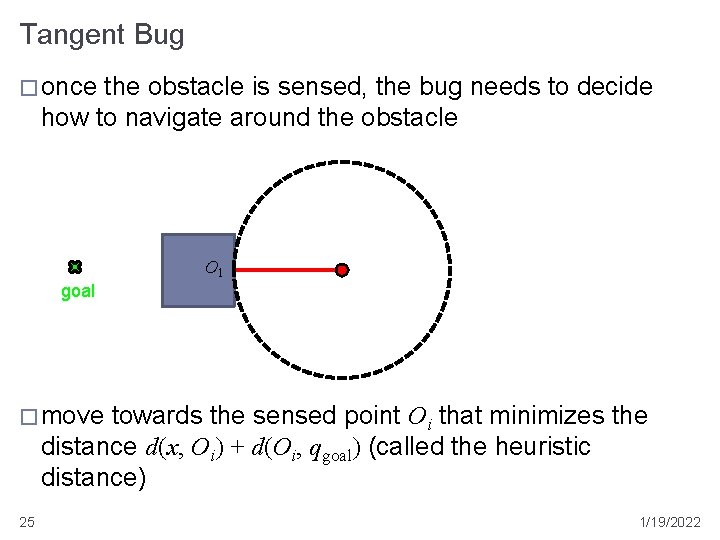
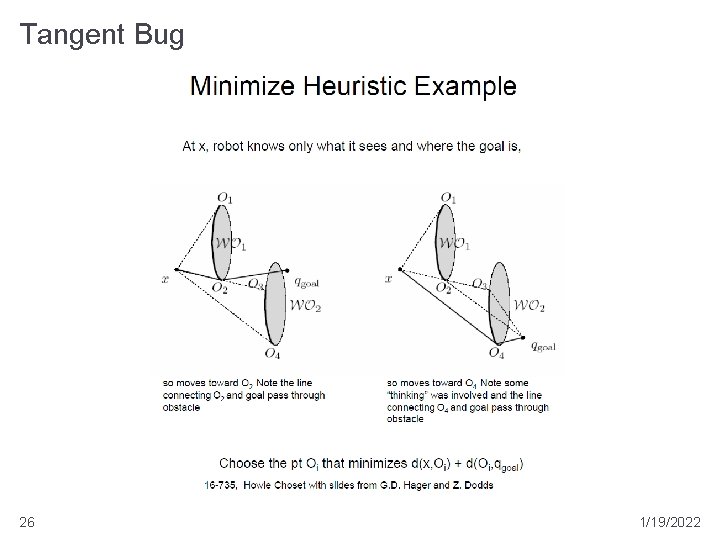
Tangent Bug � once the obstacle is sensed, the bug needs to decide how to navigate around the obstacle O 1 goal � move towards the sensed point Oi that minimizes the distance d(x, Oi) + d(Oi, qgoal) (called the heuristic distance) 25 1/19/2022
Tangent Bug 26 1/19/2022
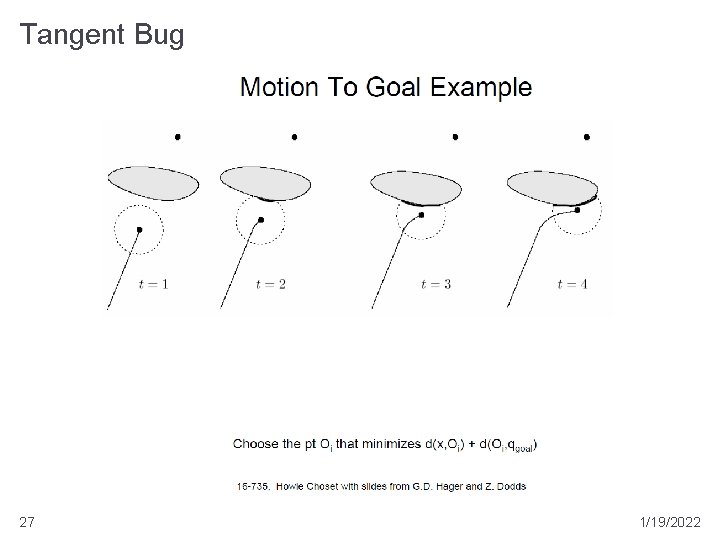
Tangent Bug 27 1/19/2022
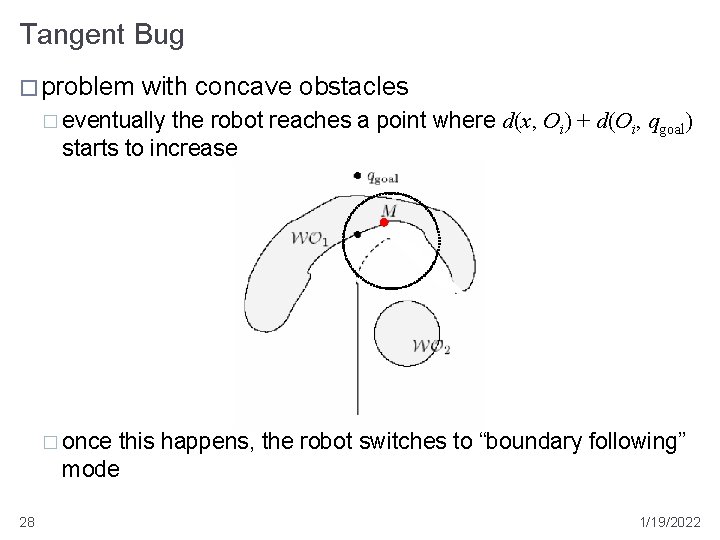
Tangent Bug � problem with concave obstacles � eventually the robot reaches a point where d(x, Oi) + d(Oi, qgoal) starts to increase � once this happens, the robot switches to “boundary following” mode 28 1/19/2022
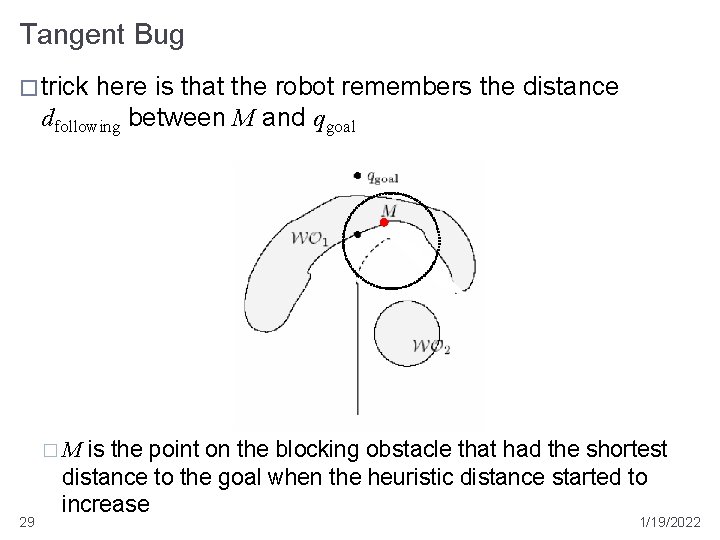
Tangent Bug � trick here is that the robot remembers the distance dfollowing between M and qgoal is the point on the blocking obstacle that had the shortest distance to the goal when the heuristic distance started to increase �M 29 1/19/2022
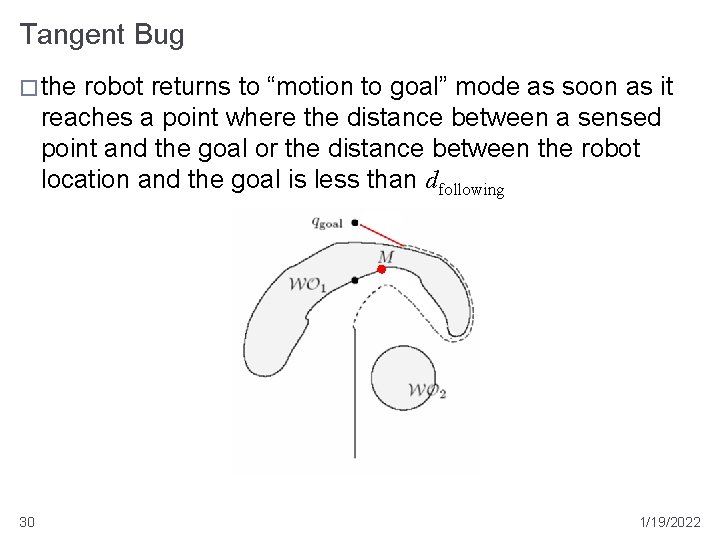
Tangent Bug � the robot returns to “motion to goal” mode as soon as it reaches a point where the distance between a sensed point and the goal or the distance between the robot location and the goal is less than dfollowing 30 1/19/2022
Tangent Bug 31 1/19/2022
Tangent Bug � full � � details Principles of Robot Motion: Theory, Algorithms, and Implementations http: //www. library. yorku. ca/find/Record/2154237 � nice � 32 animation http: //www. cs. cmu. edu/~motionplanning/student_gallery/2006/st/hw 2 pub. htm 1/19/2022
- Slides: 32