
Day 28 What are destructive Earth processes Destructive
- Slides: 10
Day 28 What are destructive Earth processes? Destructive processes break down old landforms. examples: weathering; erosion; tectonic plates sinking and melting What are constructive Earth processes? Constructive processes build new land forms. examples: mountain building; deposition; new crust formation Daily Warm-Up Exercises 1
Mini Geologic Time Lines (Part 3) Investigation 6 It's About Time 2
Mini Time Lines Each pair will make a time line on addingmachine tape. Your time line should be 4. 5 meters long to show all of Earth history. We will only use 70 cm. What scale will we need to use to represent 4. 5 billion years? 1 mm = 1 million years 3
Geological Eras Geologists have divided Earth's history into four eras based on the kinds of organisms that existed at the time. • Cenozoic • Mesozoic • Paleozoic • Precambrian 4
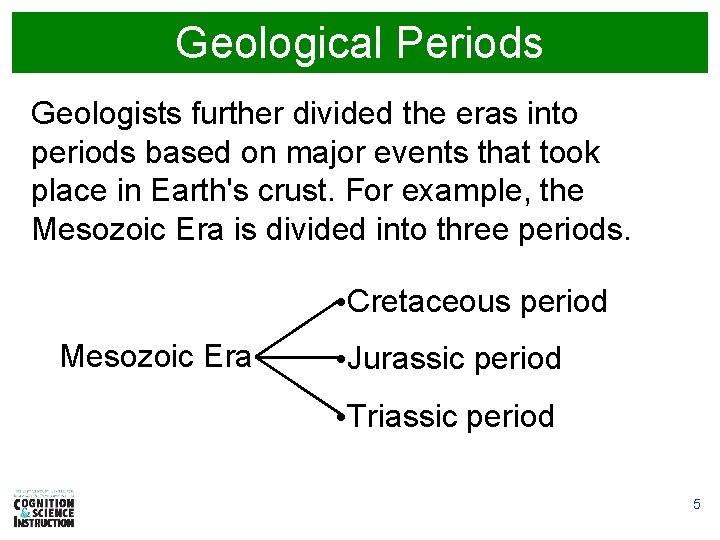
Geological Periods Geologists further divided the eras into periods based on major events that took place in Earth's crust. For example, the Mesozoic Era is divided into three periods. • Cretaceous period Mesozoic Era • Jurassic period • Triassic period 5
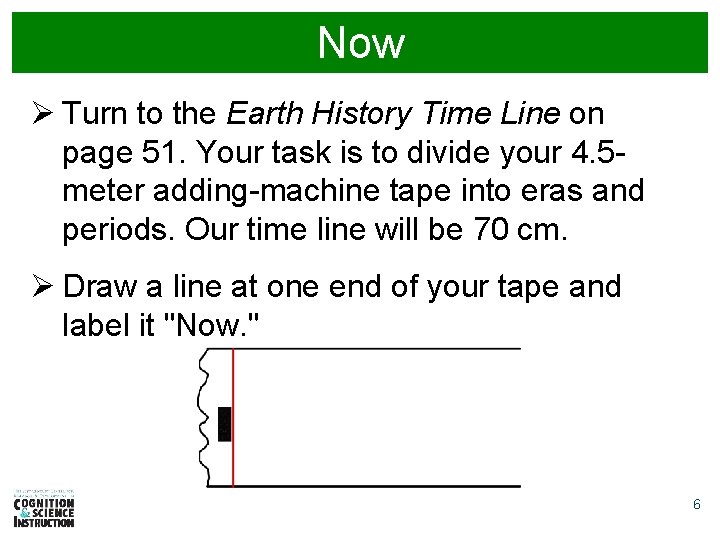
Now Ø Turn to the Earth History Time Line on page 51. Your task is to divide your 4. 5 meter adding-machine tape into eras and periods. Our time line will be 70 cm. Ø Draw a line at one end of your tape and label it "Now. " 6
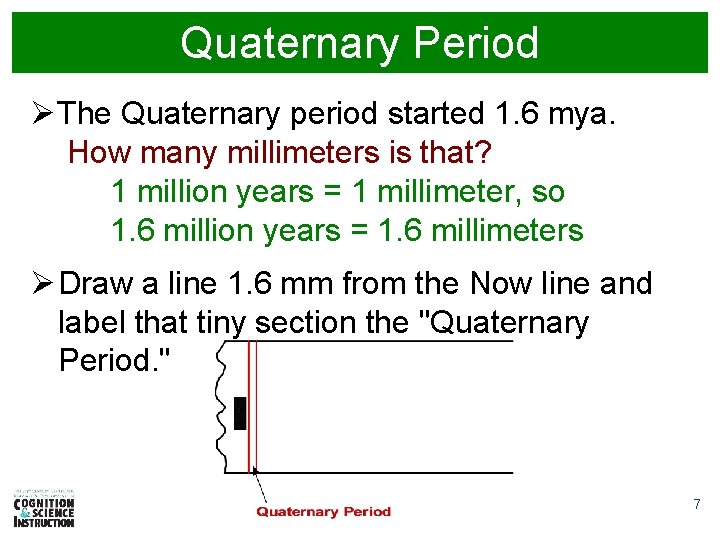
Quaternary Period ØThe Quaternary period started 1. 6 mya. How many millimeters is that? 1 million years = 1 millimeter, so 1. 6 million years = 1. 6 millimeters Ø Draw a line 1. 6 mm from the Now line and label that tiny section the "Quaternary Period. " 7
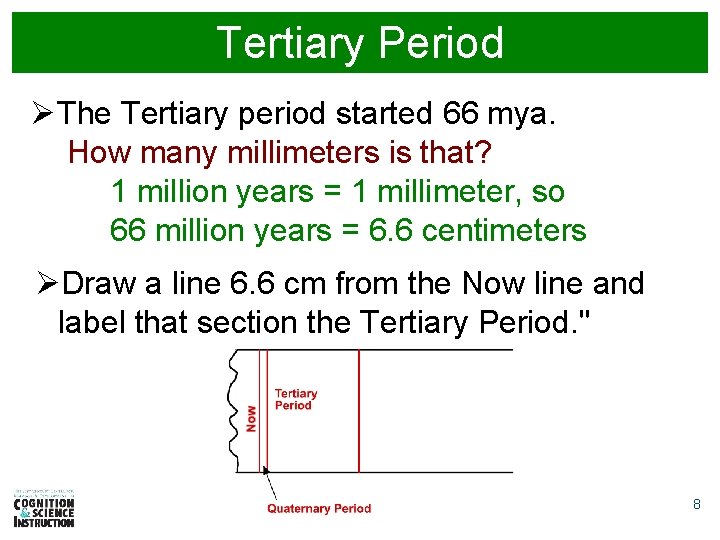
Tertiary Period ØThe Tertiary period started 66 mya. How many millimeters is that? 1 million years = 1 millimeter, so 66 million years = 6. 6 centimeters ØDraw a line 6. 6 cm from the Now line and label that section the Tertiary Period. " 8
VERY IMPORTANT!!! Ø All measurements must be made from the Now line. Ø The zero end of the ruler must always stay on the Now line. 9
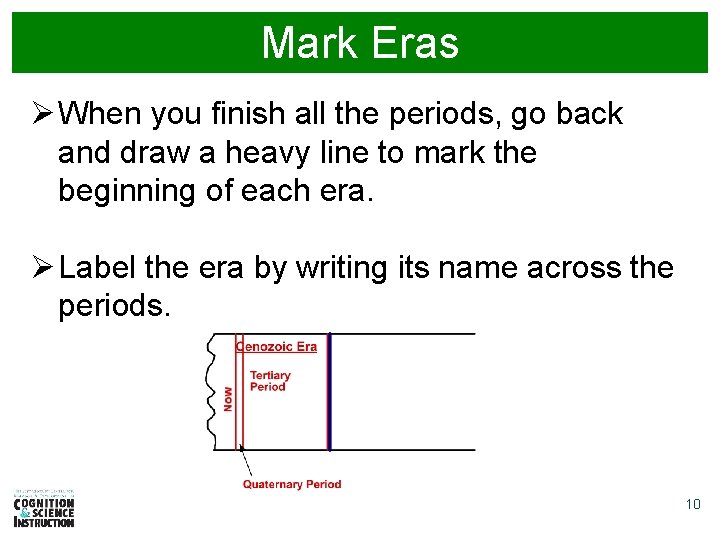
Mark Eras Ø When you finish all the periods, go back and draw a heavy line to mark the beginning of each era. Ø Label the era by writing its name across the periods. 10