
Day 2 Session 3 Learning Outcome mapping Agenda

- Slides: 17
Day 2 – Session 3 Learning Outcome mapping
Agenda • Programme outcomes – top down or bottom up? • Programme to module level • Assessment of Learning outcomes
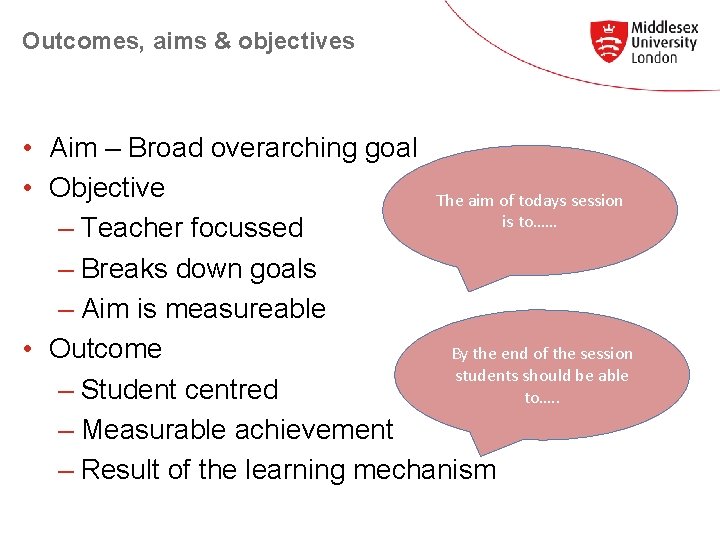
Outcomes, aims & objectives • Aim – Broad overarching goal • Objective The aim of todays session is to…… – Teacher focussed – Breaks down goals – Aim is measureable • Outcome By the end of the session students should be able – Student centred to…. . – Measurable achievement – Result of the learning mechanism
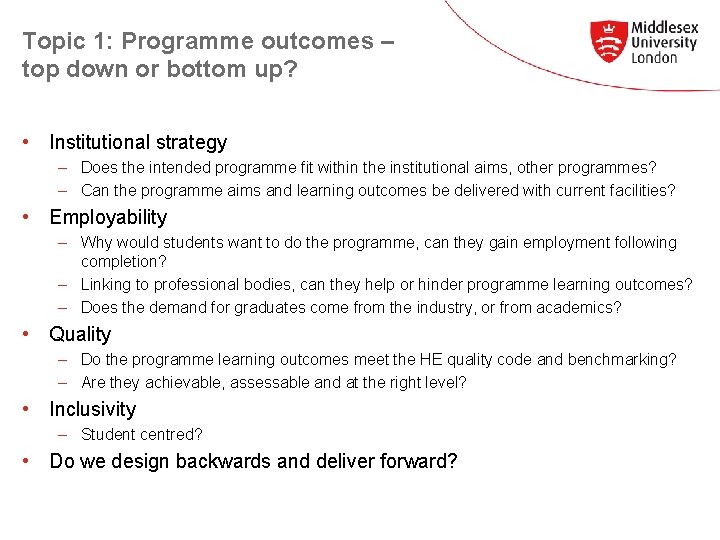
Topic 1: Programme outcomes – top down or bottom up? • Institutional strategy – Does the intended programme fit within the institutional aims, other programmes? – Can the programme aims and learning outcomes be delivered with current facilities? • Employability – Why would students want to do the programme, can they gain employment following completion? – Linking to professional bodies, can they help or hinder programme learning outcomes? – Does the demand for graduates come from the industry, or from academics? • Quality – Do the programme learning outcomes meet the HE quality code and benchmarking? – Are they achievable, assessable and at the right level? • Inclusivity – Student centred? • Do we design backwards and deliver forward?
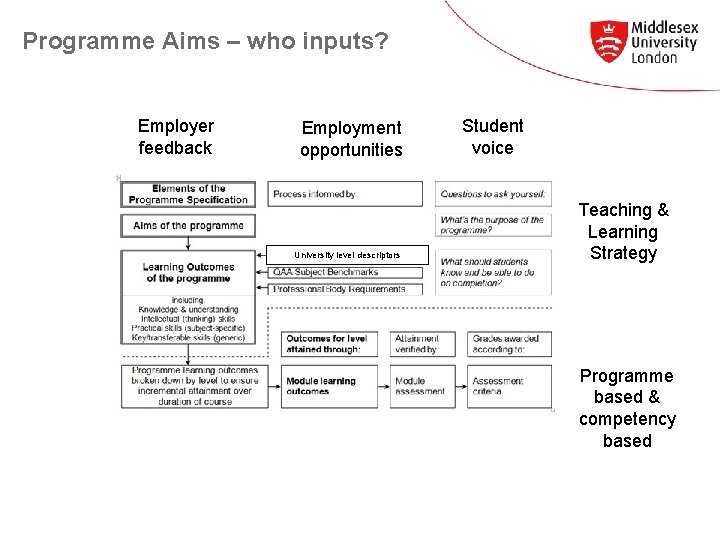
Programme Aims – who inputs? Employer feedback Employment opportunities University level descriptors Student voice Teaching & Learning Strategy Programme based & competency based
Topic 1: Programme outcomes – top down or bottom up? • How do we write programme learning outcomes? – Clear, accessible LOs of the programme – These are the LOs of the programme upon COMPLETION • Clearly identify the highest level required • Allow the programme to be dynamic whilst maintaining its integrity. – Eg. Don’t refer to particular dates, documentation or legislation that may change during the programme’s lifespan. • Ensure the programme meets professional standards and allows academic and employer demands to both be recognised. • Fits within the institutional portfolio, the department strategy, the industry requirement & the HE governance. – Programme delivery team ownership?
Topic 2: Module Learning Outcomes • Module Learning outcomes need to be written with programme LO’s in mind or vice versa!– mapping process, integrity. – Assessment load and design, to be effective, requires consideration at programme level (beyond the module) (Programme Level Assessment) • Module LO’s are more specific to level, subject and skills. – The knowledge and understanding that a student will be expected to have upon completion; • Apply knowledge of contemporary issues within sports coaching, including sport policy, governance and commercial aspects of the coaching industry to practice. – key skills such as communication, numeracy, the use of IT and learning how to learn (transferable) • Eg: Critically appraise current practice and literature, synthesising information from a range of sources; undertake systematic rigorous research to underpin discipline specific best practice. – Cognitive (intellectual) skills, such as an understanding of methodologies or ability in critical analysis; • Undertake critical reflection of own practice, forming coaching beliefs and values, whilst analysing and mentoring peers as part of a programme facing community of practice – Graduate skills/practical/professional skills • • Eg: Generate inventive pedagogical solutions to problem-based or work-based scenarios, communicating effectively with a range of ages and ability levels across groups and individual performers. Could be laboratory based, competency based, link to professional level of qualification etc. .
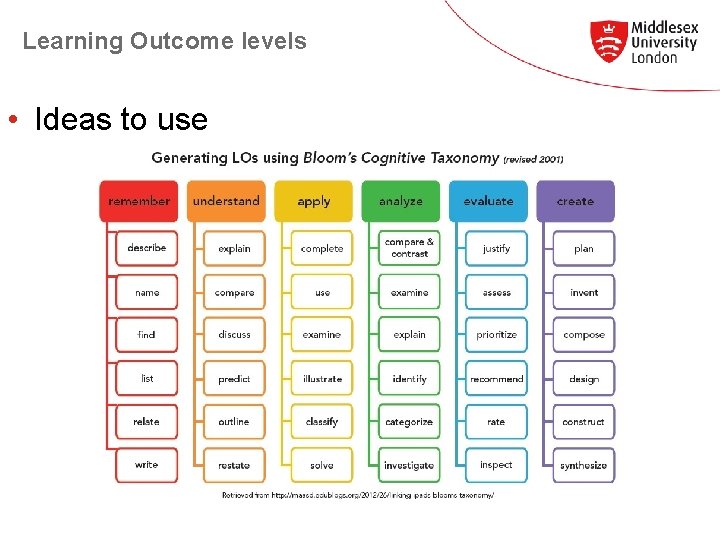
Learning Outcome levels • Ideas to use
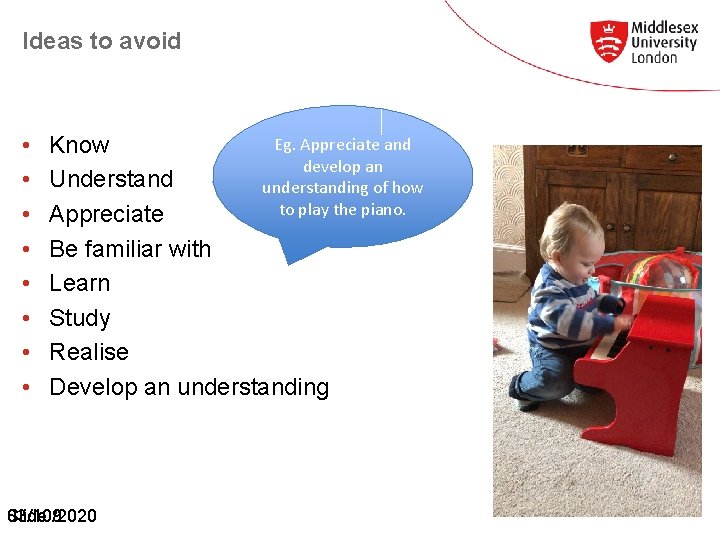
Ideas to avoid • • Eg. Appreciate and Know develop an Understand understanding of how to play the piano. Appreciate Be familiar with Learn Study Realise Develop an understanding 03/10/2020 Slide 9
Benefits of Learning outcomes • • “currency of HE” Clear, consistent, comparable Quality assurance Student mobility Programme accreditation Credit workload/system Qualification framework transparency (ECF) Clarity for students & employers 03/10/2020 Slide
Potential problems of Learning Outcomes • Assessment driven, summative focus • Over-assessment – Key time periods • Limit the curriculum if not written properly • Limit learning potential if not expansive • Maintain a segmented programme of modules rather than a constant programme level benchmark.
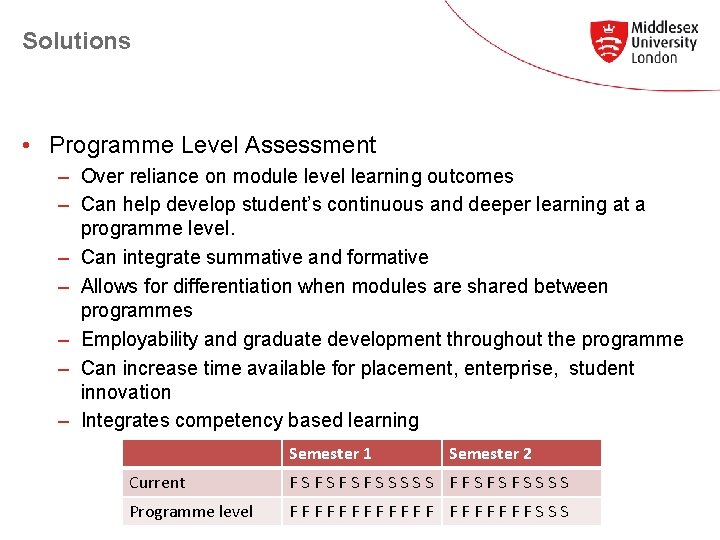
Solutions • Programme Level Assessment – Over reliance on module level learning outcomes – Can help develop student’s continuous and deeper learning at a programme level. – Can integrate summative and formative – Allows for differentiation when modules are shared between programmes – Employability and graduate development throughout the programme – Can increase time available for placement, enterprise, student innovation – Integrates competency based learning Semester 1 Semester 2 Current FSFSSSSS FFSFSFSSSS Programme level FFFFFFFSSS
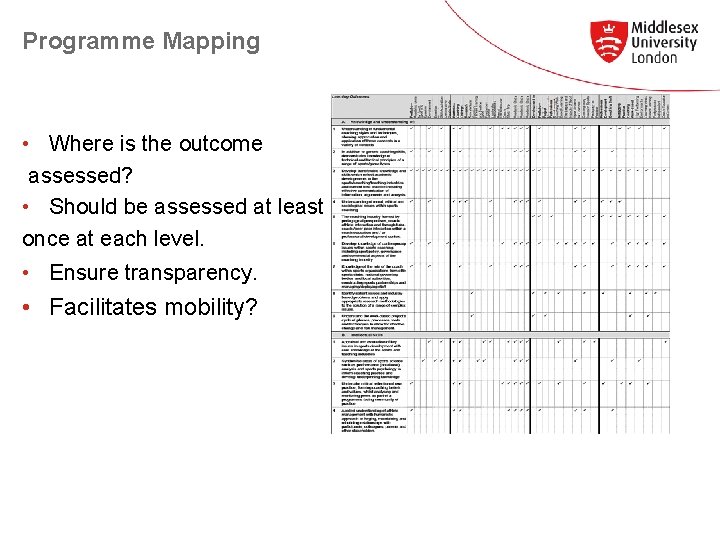
Programme Mapping • Where is the outcome assessed? • Should be assessed at least once at each level. • Ensure transparency. • Facilitates mobility?
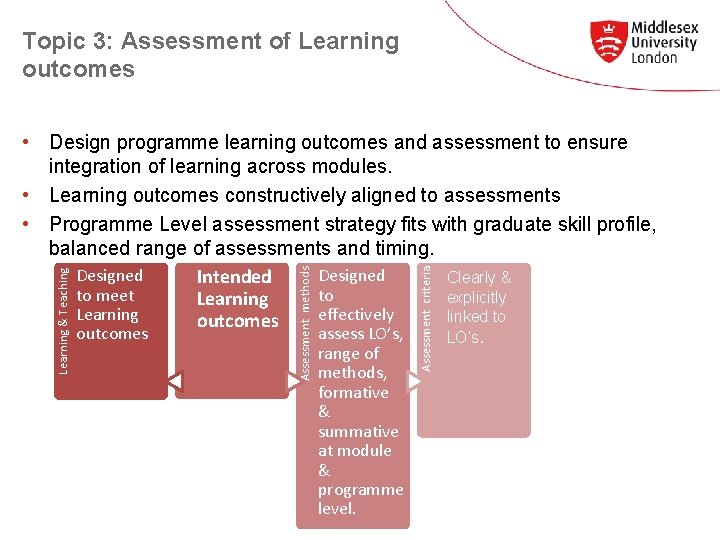
Topic 3: Assessment of Learning outcomes assess LO’s, range of methods, formative & summative at module & programme level. Assessment criteria outcomes Assessment methods Learning & Teaching • Design programme learning outcomes and assessment to ensure integration of learning across modules. • Learning outcomes constructively aligned to assessments • Programme Level assessment strategy fits with graduate skill profile, balanced range of assessments and timing. Designed Intended Clearly & to to meet explicitly Learning effectively Learning linked to outcomes LO’s.
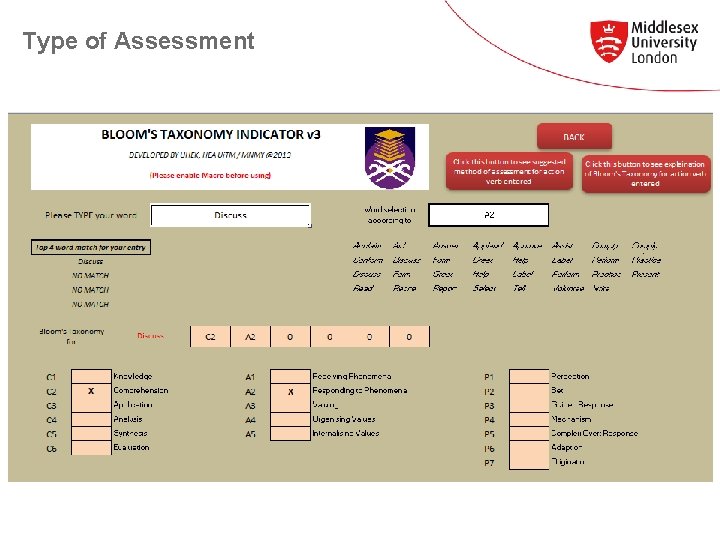
Type of Assessment
Train-storming • Explain how learning outcomes are used in your own institution for the creation of new curricula at your institution. • Describe how learning outcome maps can be used to determine the appropriate level and focus of study for your institution’s courses. • Describe how learning outcomes would be used by your institution for assessing whether a student mobility to another University’s course should be authorised.
Questions ?