
Day 2 A Understanding the big picture Factors
Day 2 A Understanding the big picture: Factors influencing the prevalence of GBV Connect with Respect: Addressing school-related gender-based violence (SRGBV)
Reflections and highlights How did the activities we did yesterday help us meet our objectives? ✏�What was useful? �� What got you thinking?
Activity 3: Human rights and gender equality in everyday moments Learning Intentions: • Identify what respect for gender equality and human rights could look like in everyday human interactions • Share local terms and phrases used to talk about rights and responsibilities
Questions following the mirror game • Mirror game • What would be happening in each of the following settings if men and women were provided with equal opportunities. • Family - if there was gender equality in families: • Parents would make sure that girls could… • Parents would make sure that boys could… • School - if there was gender equality in school: • Teachers would make sure that girls could… • Teachers would make sure that boys could… • Fellow students would make sure that girls could…. • Fellow students would make sure that boys could… • Workplace - if there was gender equality in the workplace: • • Bosses would make sure that women/girls could… Bosses would make sure that men/boys could… Fellow workers would make sure that women/girls could… Fellow workers would make sure that men/boys could…
Topic 2, Activity 3: Positive and negative uses of power Learning objectives: In this activity students will: • Consider the kinds of power that exist in various relationships • Develop an understanding of the positive and negative uses of power • Identify positive and negative uses of power within peer and gender relationships
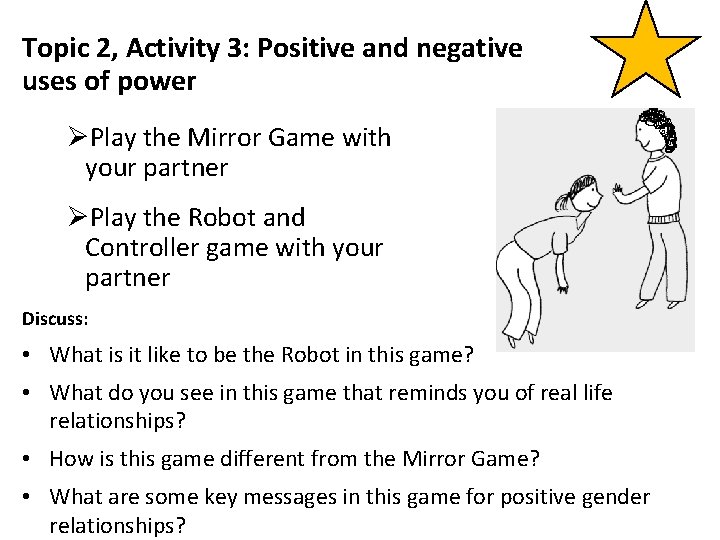
Topic 2, Activity 3: Positive and negative uses of power ØPlay the Mirror Game with your partner ØPlay the Robot and Controller game with your partner Discuss: • What is it like to be the Robot in this game? • What do you see in this game that reminds you of real life relationships? • How is this game different from the Mirror Game? • What are some key messages in this game for positive gender relationships?
This activity helps students to learn that: • People can use their power in positive and negative ways. • There are different kinds of power, including ‘power over’, ‘power with’, and ‘power within’. • Relationships are influenced by the way people use their power within that relationship. • Power is determined by different characteristics such as age, gender, ethnicity, education, wealth, and is different in different situations. • People with power over others have a responsibility to use this power in a way that is respectful of the human rights of others.
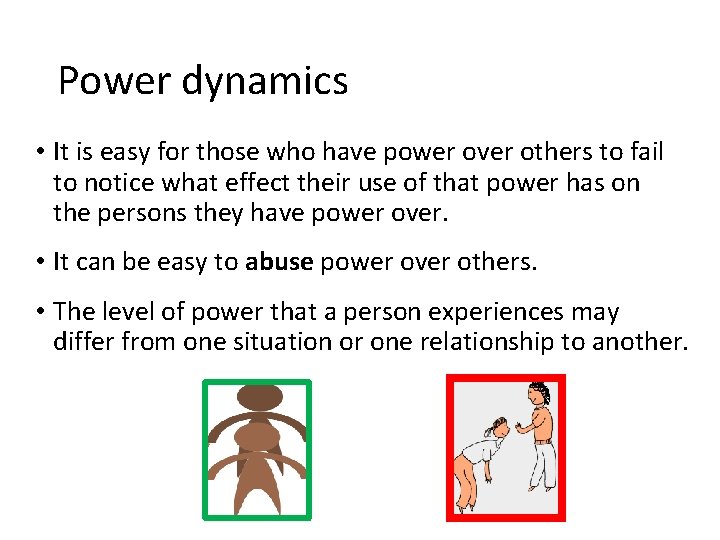
Power dynamics • It is easy for those who have power over others to fail to notice what effect their use of that power has on the persons they have power over. • It can be easy to abuse power over others. • The level of power that a person experiences may differ from one situation or one relationship to another.
Types of power • Power over: Having control over someone, or over a situation. This power over others can be used in positive or negative ways. • Power with: Having power with other people and groups, involves working with others to make things happen. This power can also be used in either positive or negative ways. • Power within: Having resources, ideas, knowledge, tools and skills for convincing oneself and other people to do something.
Topic 2, Activity 5: Difference and discrimination In this activity students will: • Develop an understanding of the term ‘discrimination’. • Develop awareness that discrimination is an abuse of power. • Identify groups and sub-groups who are more likely to experience stigma and discrimination.
Topic 2, Activity 5: Difference and discrimination Task: Part 1 • In your group, brainstorm the different groups of people in the world who experience discrimination • Write each idea on a separate slip of paper Task: Part 2 • Divide the slips evenly between group members • Take turns to rank them on a scale from groups that are most to least likely to experience severe discrimination
This activity helps students to learn that: • Some people are treated badly because of their gender, religion, nationality, ethnicity (culture), race, sexual preference, wealth, social position, disabilities, or other personal traits. • This negative treatment is called discrimination. • Discrimination causes harm because it stops people from having equal opportunities and from living in safety. • Many forms of discrimination, including gender-based discrimination occur when people or groups with more power make negative use of that power.
Gender-based discrimination • Some groups experience multiple and/or severe forms of discrimination because of their gender • Females often experience discrimination and reduced opportunities What are some examples of the types of discrimination experienced by girls and women in your setting?
Topic 2, Activity 6: Local Leaders Learning objectives • Identify simple acts of friendship that can be used to provide positive peer support • Develop positive norms for intervening to provide peer support for those experiencing stigma or discrimination
Topic 2, Activity 6: Local Leaders • Three ‘local leaders’ – Tracy, Godfrey and Bheki • They are ‘local leaders’ when their peers choose to follow their direction by using positive acts of friendship and to reject acts of bullying or violence. • Once they have selected their character and the situation that this character is dealing with their task is to: • Select a scenario and a set of 5 (or more) acts of kindness that this character could use to show peer support
Game: Anyone who… • Seat students on chairs arranged in a circle (remove any spare chairs). • As the teacher, start by standing in the centre of the circle. Explain that you are going to call out ‘Anyone who…’ and then add some information (e. g. ‘Anyone who likes eating fruit). All the people of this category must jump up and find a new seat. Start the game by making the first call (e. g. ‘Anyone who is wearing white shoes’). As students run to find a different chair, make you sure take one of the empty chairs so that one student is left without a chair in the middle. • This student will make the next call in the game (for example, she might say ‘Anyone who walked to school today’). Then all those who walked to school must swap to new seats. • Play a few rounds of the game. By this time students will be seated in a mixed arrangement and some differences and similarities will have been noted. • Ask students what key messages they see in this game that might be relevant to theme that everyone is different. • Highlight that there are many differences between people in the group. Different people bring different ideas and strengths. We need to respect those who are different as well as those who are similar to us
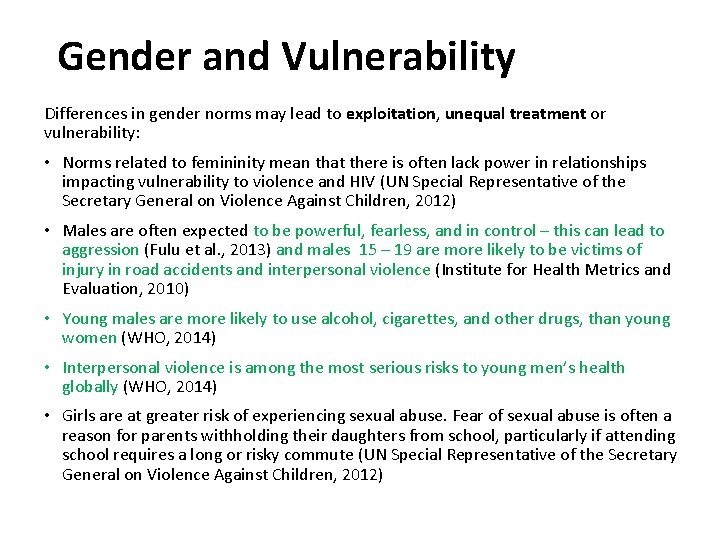
Gender and Vulnerability Differences in gender norms may lead to exploitation, unequal treatment or vulnerability: • Norms related to femininity mean that there is often lack power in relationships impacting vulnerability to violence and HIV (UN Special Representative of the Secretary General on Violence Against Children, 2012) • Males are often expected to be powerful, fearless, and in control – this can lead to aggression (Fulu et al. , 2013) and males 15 – 19 are more likely to be victims of injury in road accidents and interpersonal violence (Institute for Health Metrics and Evaluation, 2010) • Young males are more likely to use alcohol, cigarettes, and other drugs, than young women (WHO, 2014) • Interpersonal violence is among the most serious risks to young men’s health globally (WHO, 2014) • Girls are at greater risk of experiencing sexual abuse. Fear of sexual abuse is often a reason for parents withholding their daughters from school, particularly if attending school requires a long or risky commute (UN Special Representative of the Secretary General on Violence Against Children, 2012)
References • Fulu, E. , et al. (2013). Why do some men use violence against women and how can we prevent it? Quantitative Findings from the United Nations Multi-country Study on Men and Violence in Asia and the Pacific. Bangkok, UNDP, UNFPA, UN Women and UNV. • Patton, G. C. , et al. (2012). "Health of the world's adolescents: a synthesis of internationally comparable data. " The Lancet 379(9826): 1665 -1675. • Institute for Health Metrics and Evaluation (2010). Global Burden of Disease and Injury Study. Washington D. C. , Institute for Health Metrics and Evaluation. • World Health Organisation (2014). Global status report on alcohol and health-2014, World Health Organisation. • United Nations Special Representative of the Secretary General on Violence Against Children. (2012). Tackling Violence in Schools: A Global Perspective: Bridging the Gap between Standards and Practice. Retrieved from New York:
- Slides: 18