
Day 1 PROJECTILE MOTION Center of Mass F
















- Slides: 61
Day 1
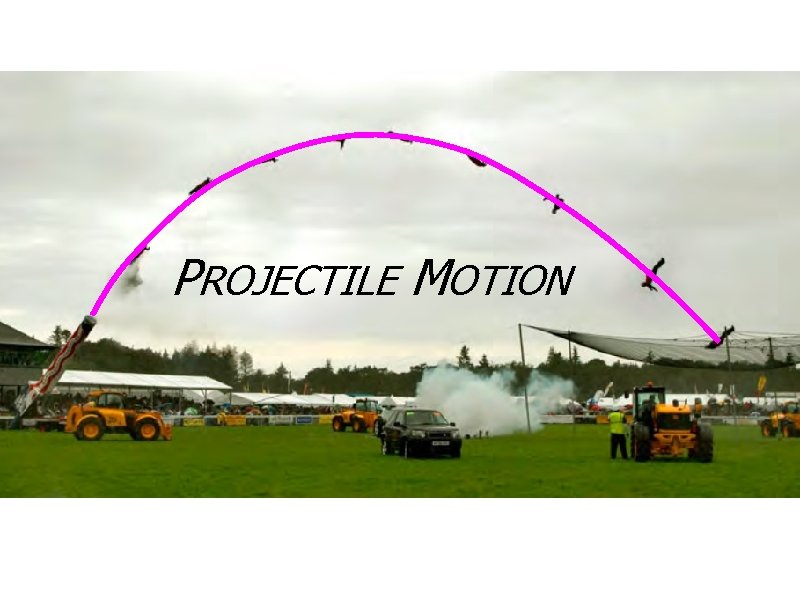
PROJECTILE MOTION
Center of Mass F Projectiles may rotate around their center of mass while in the air, but the center of mass will always make a parabolic trajectory if moving in two or more dimensions. F Anything can be a projectile. (Including you)
Who is in the air longer?
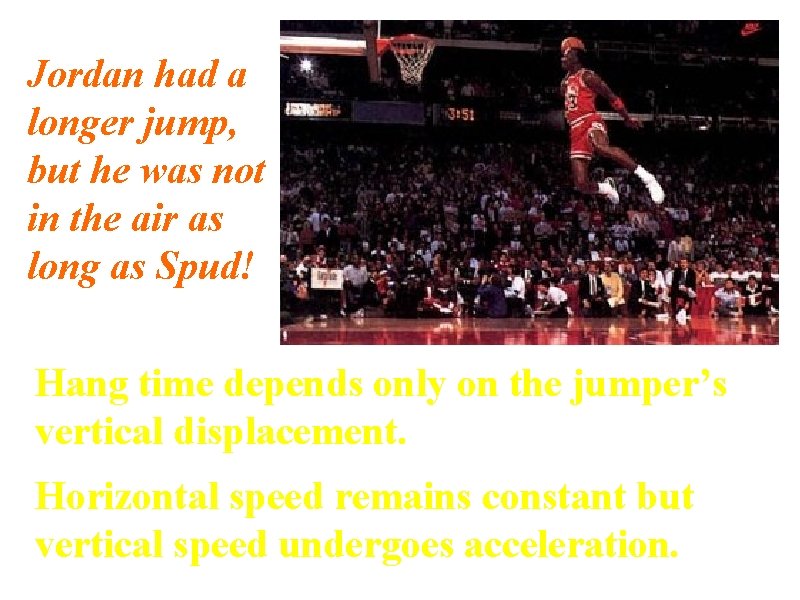
At only 5’ 7”, he won the 1986 NBA Slam Dunk Championship.
Michael ‘Air’ Jordan Won Slam Dunk Constest in 1987 and 1988.
Dunk Videos Spud: http: //www. youtube. com/watch? v=8 m. Y 6 -ycnw. Z 8 Jordan: http: //www. youtube. com/watch? v=s. Uz 3 ZYfo. Nxo `
Espn Sport Science https: //www. youtube. com/watch? v=v. Zq. Vq 5 Lrd. QQ
Hang Time – Optical Illusion F Which reaches a greater overall height? F Which stretches their body more? F Which travels farther horizontally?
Jordan had a longer jump, but he was not in the air as long as Spud! Hang time depends only on the jumper’s vertical displacement. Horizontal speed remains constant but vertical speed undergoes acceleration.
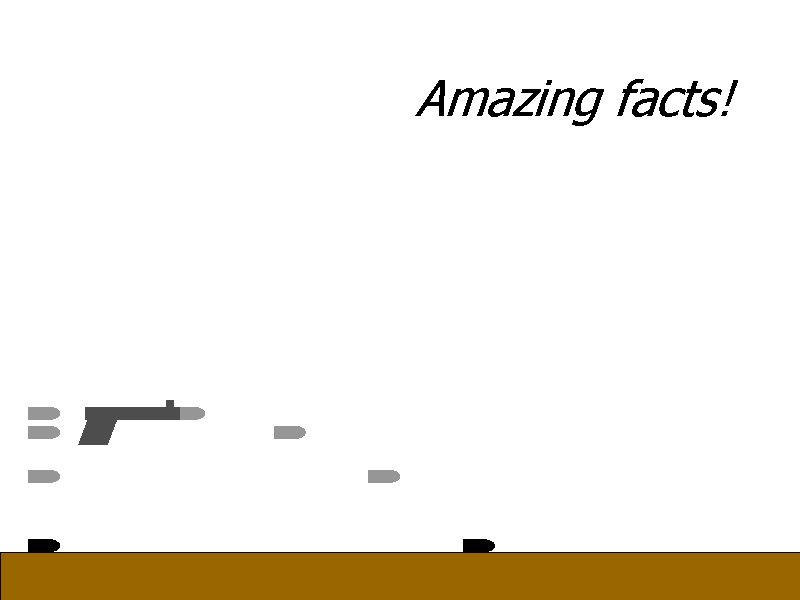
Amazing facts!
Amazing facts!
Amazing facts!
Amazing facts! Why?
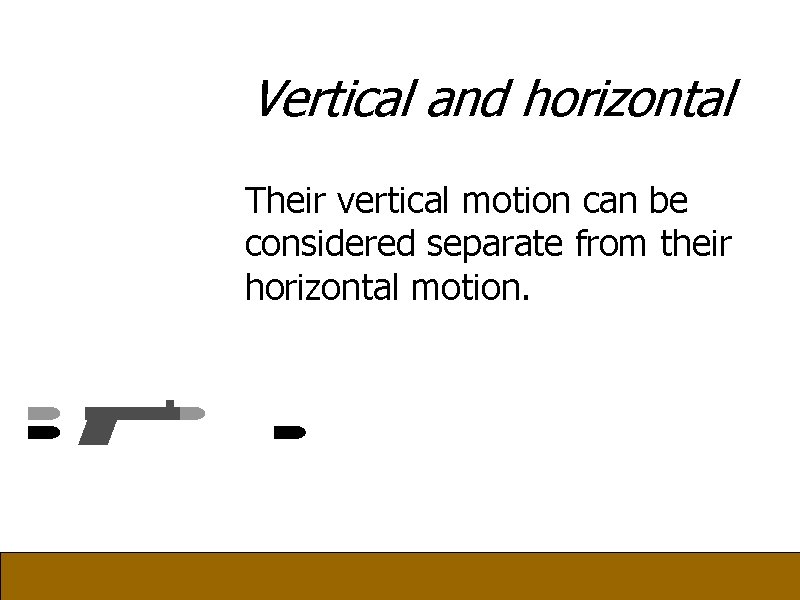
Vertical and horizontal Their vertical motion can be considered separate from their horizontal motion.
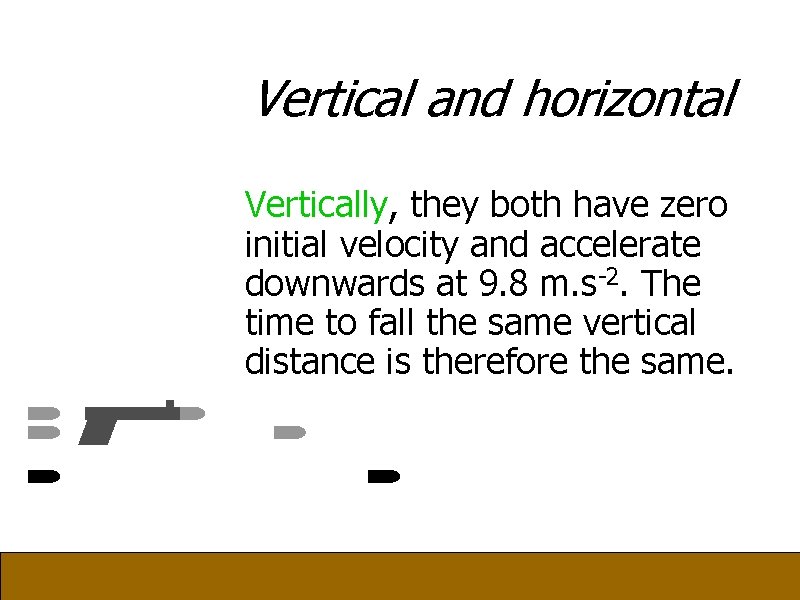
Vertical and horizontal Vertically, they both have zero initial velocity and accelerate downwards at 9. 8 m. s-2. The time to fall the same vertical distance is therefore the same.
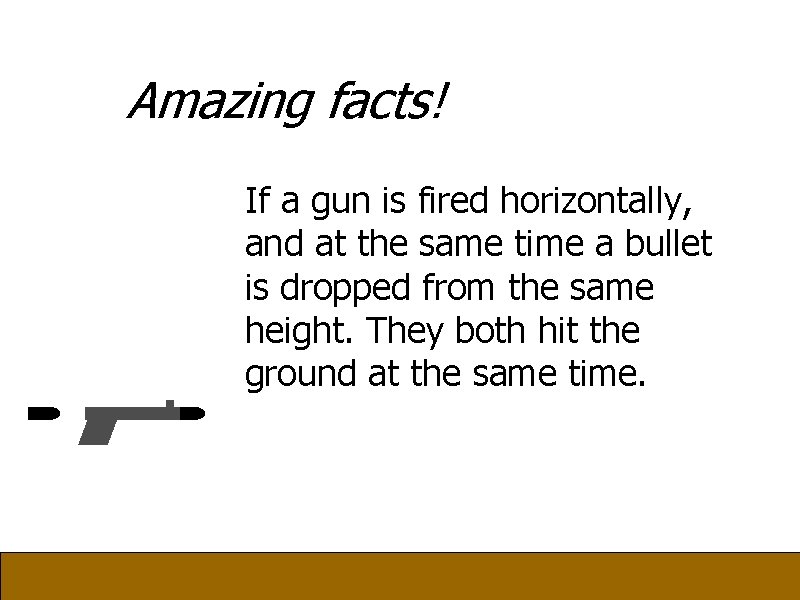
Amazing facts! If a gun is fired horizontally, and at the same time a bullet is dropped from the same height. They both hit the ground at the same time.
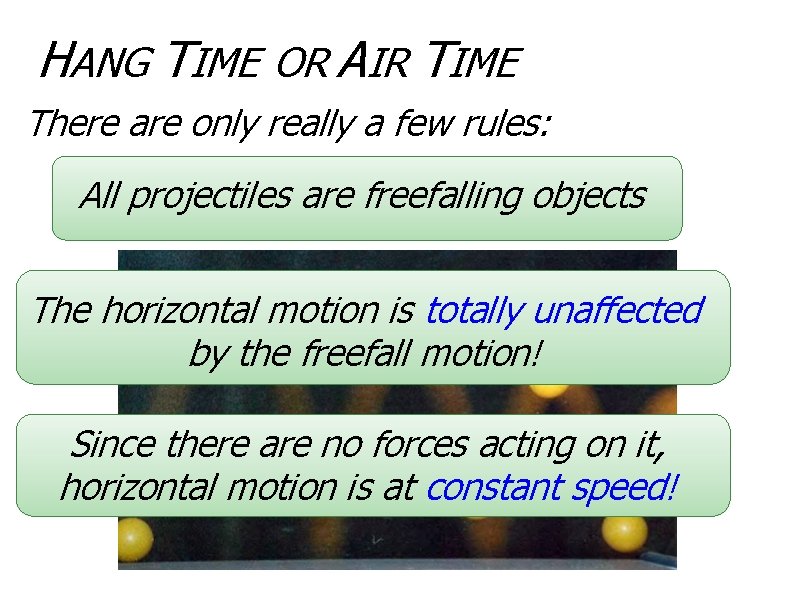
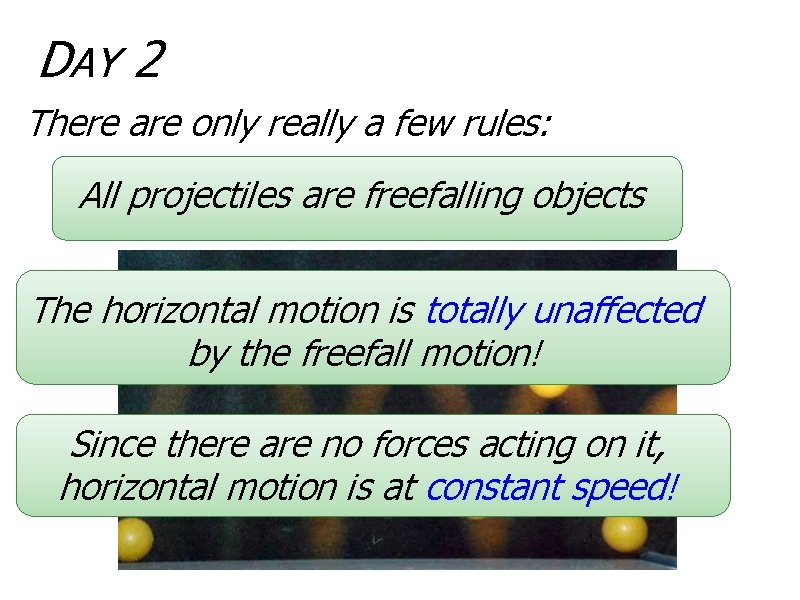
HANG TIME OR AIR TIME There are only really a few rules: All projectiles are freefalling objects The horizontal motion is totally unaffected by the freefall motion! Since there are no forces acting on it, horizontal motion is at constant speed!
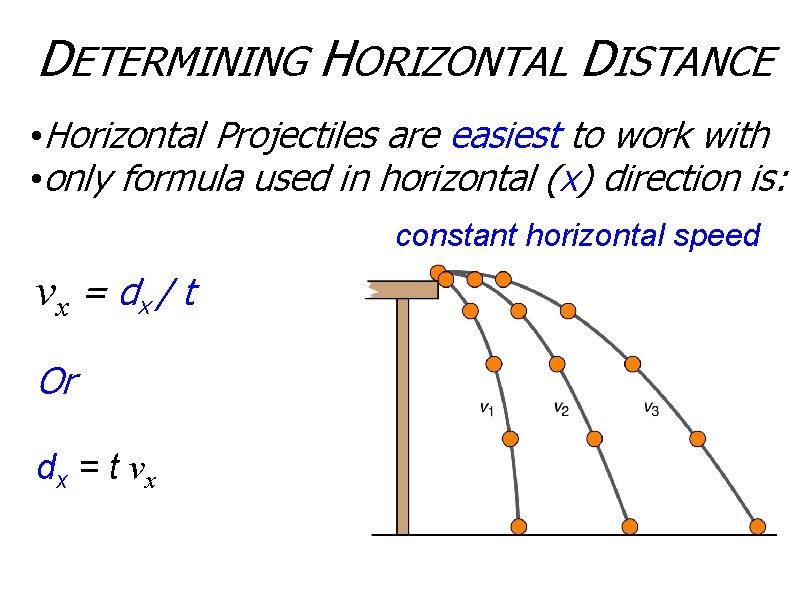
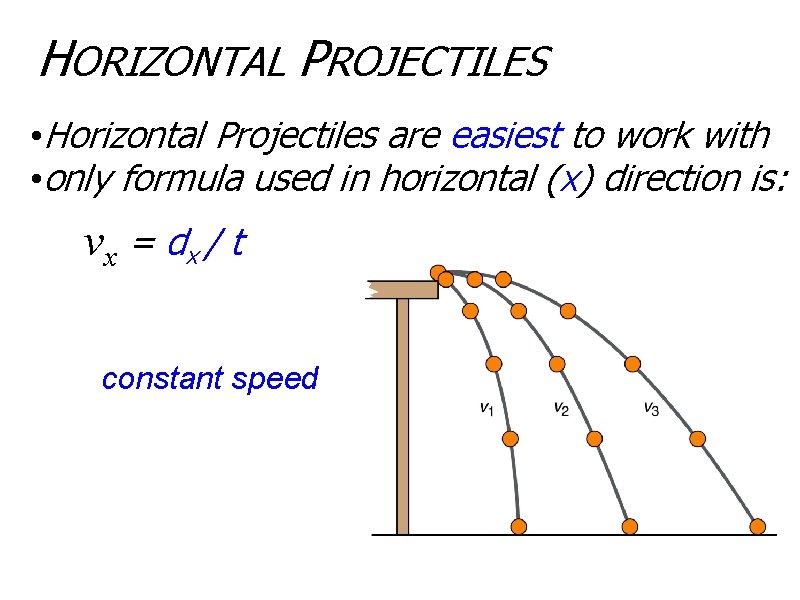
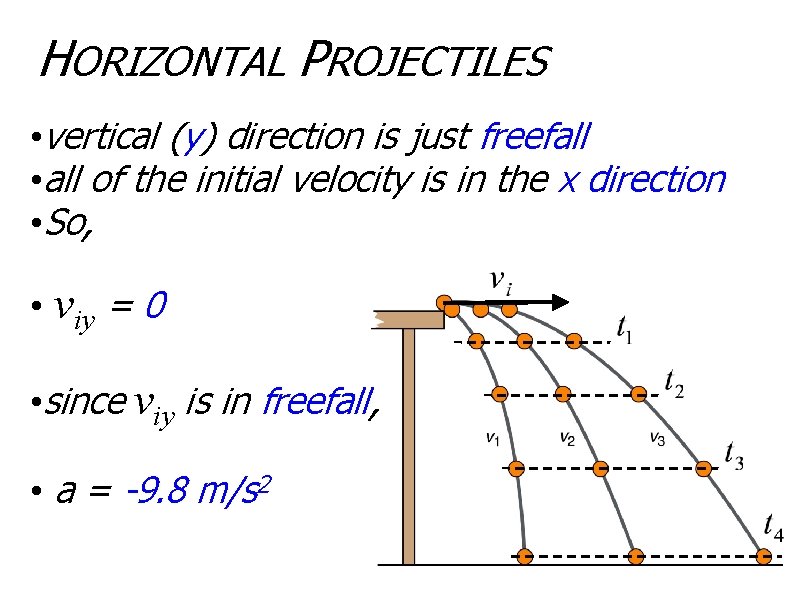
DETERMINING HORIZONTAL DISTANCE • Horizontal Projectiles are easiest to work with • only formula used in horizontal (x) direction is: constant horizontal speed v x = dx / t Or dx = t v x
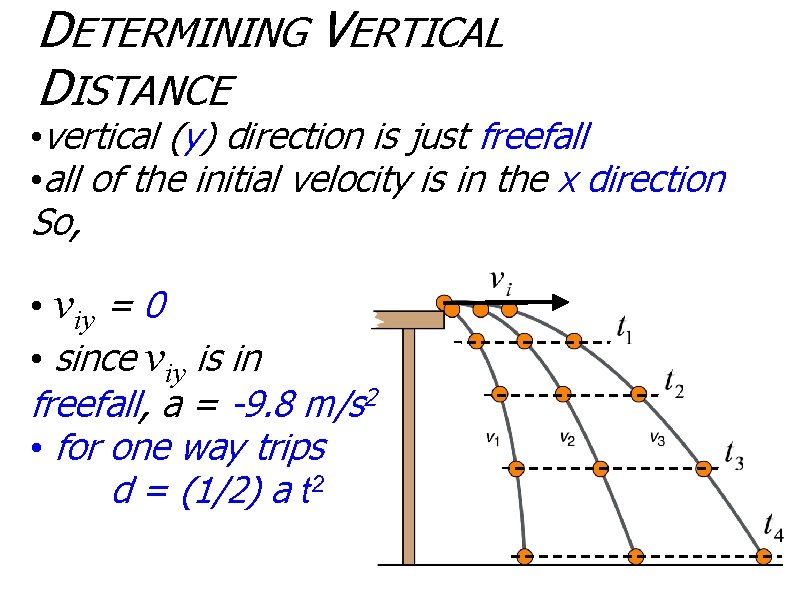
DETERMINING VERTICAL DISTANCE • vertical (y) direction is just freefall • all of the initial velocity is in the x direction So, • viy = 0 • since viy is in freefall, a = -9. 8 m/s 2 • for one way trips d = (1/2) a t 2
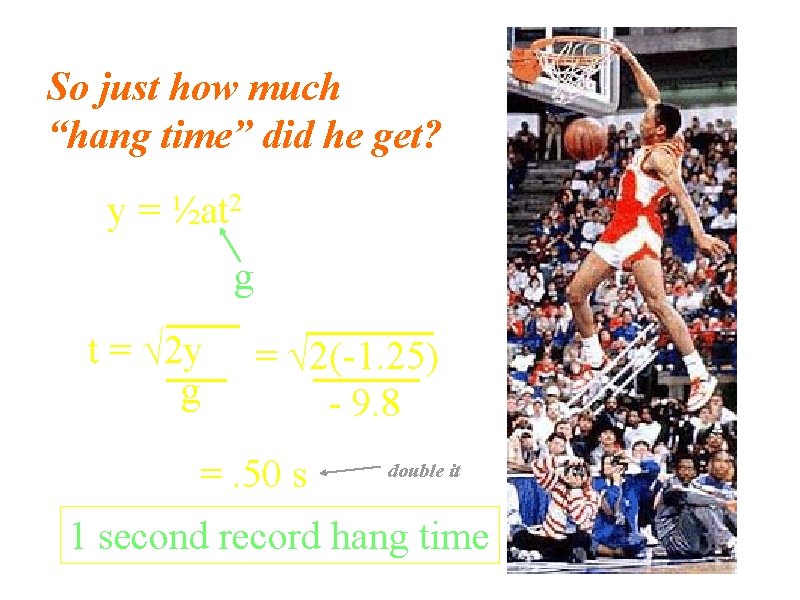
Spud Webb has a better hang time. In Fact: Spud Webb holds the vertical jump world record at an amazing 1. 25 m.
So just how much “hang time” did he get? y = ½at 2 g t = √ 2 y g = √ 2(-1. 25) - 9. 8 =. 50 s double it 1 second record hang time
Hang Time Activity Work in your table groups. Materials: meter stick, tape Will you need a stop watch?
Martial Arts Master Legend of a martial arts master dodging a bullet. If it did happen, how did he do it?
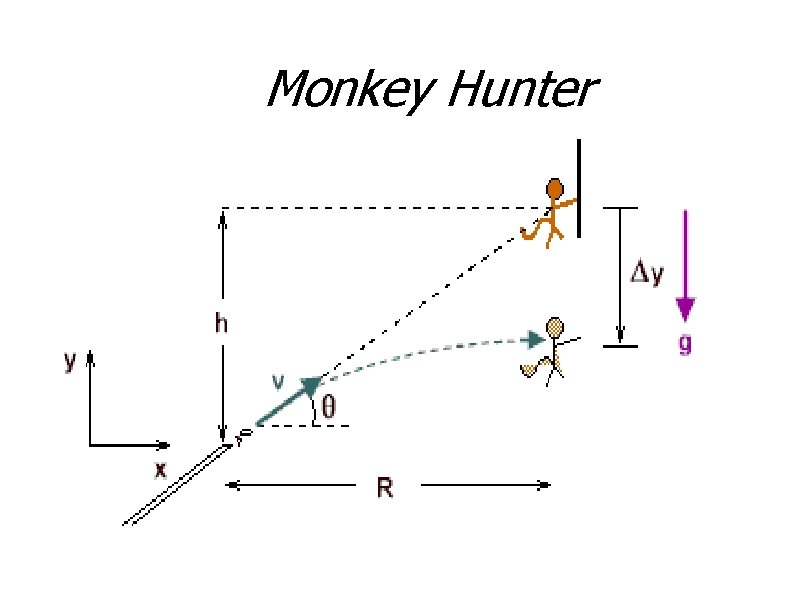
Monkey Hunter F Is it possible to curve a bullet?
Monkey Hunter
Displacement v. Absolute Height
Day 2
DAY 2 There are only really a few rules: All projectiles are freefalling objects The horizontal motion is totally unaffected by the freefall motion! Since there are no forces acting on it, horizontal motion is at constant speed!
HORIZONTAL PROJECTILES • Horizontal Projectiles are easiest to work with • only formula used in horizontal (x) direction is: v x = dx / t constant speed
HORIZONTAL PROJECTILES • vertical (y) direction is just freefall • all of the initial velocity is in the x direction • So, • viy = 0 • since viy is in freefall, • a = -9. 8 m/s 2
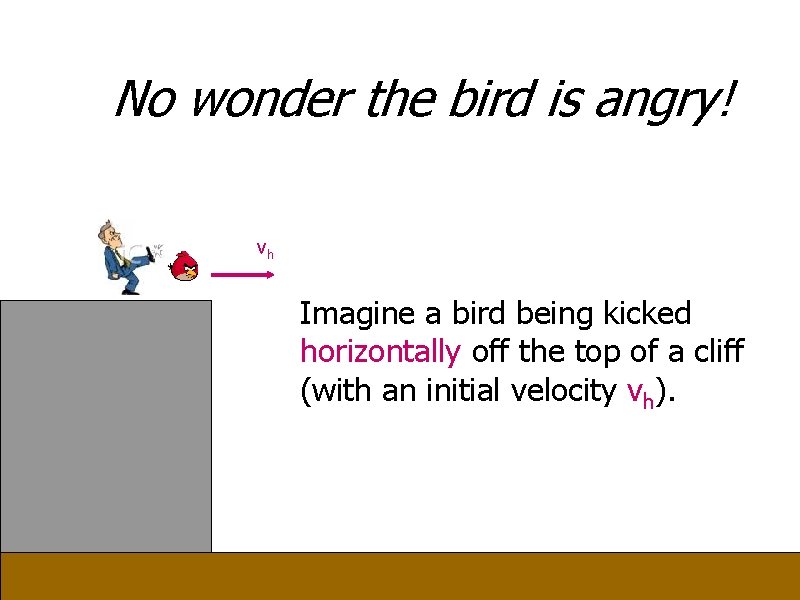
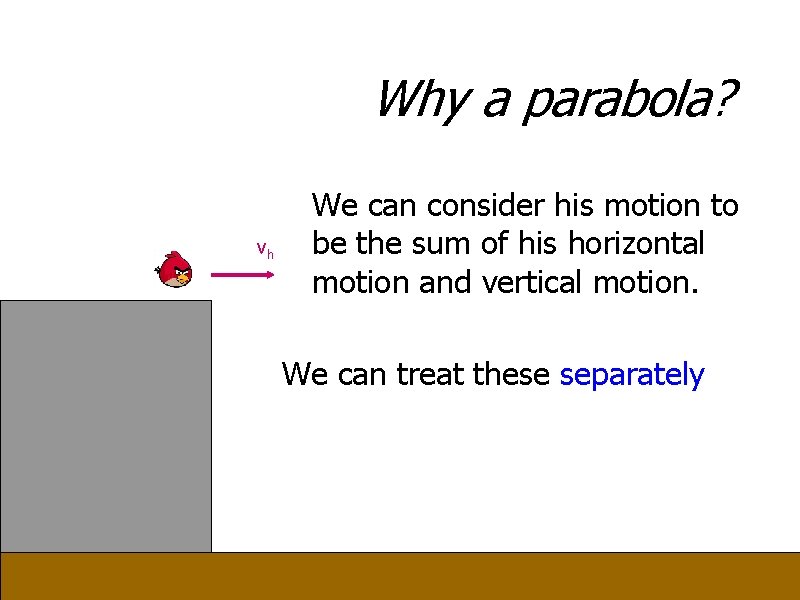
No wonder the bird is angry! vh Imagine a bird being kicked horizontally off the top of a cliff (with an initial velocity vh).
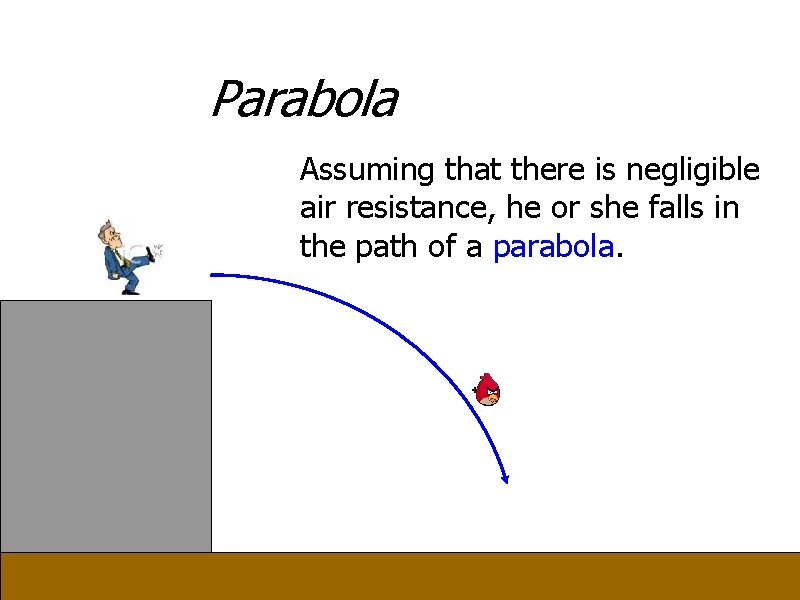
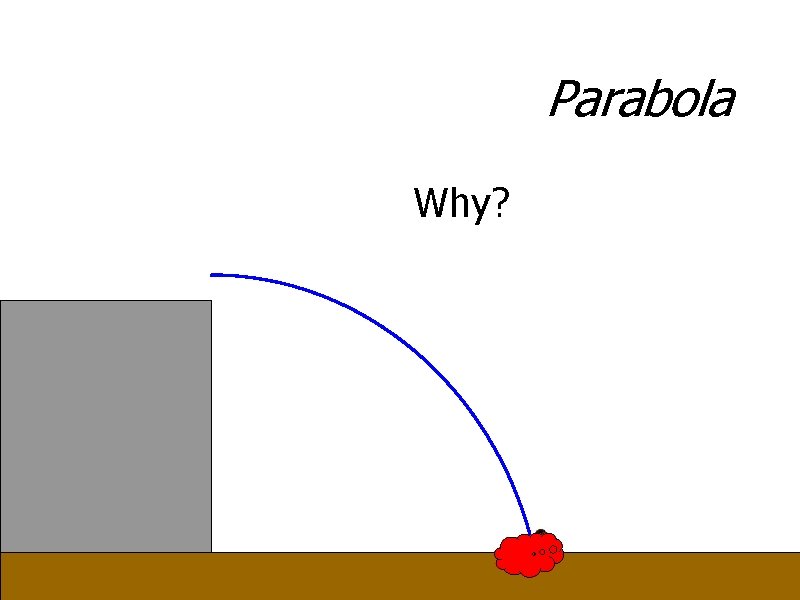
Parabola Assuming that there is negligible air resistance, he or she falls in the path of a parabola.
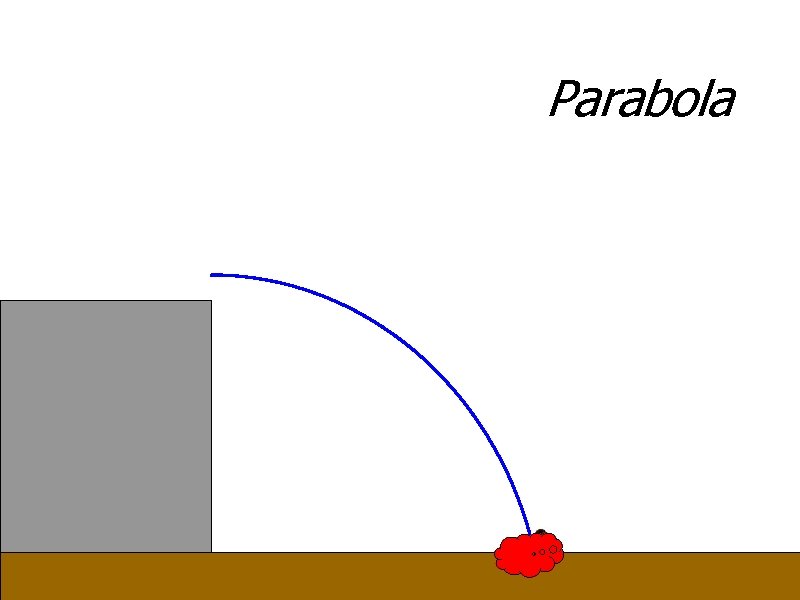
Parabola
Parabola Why?
Why a parabola? vh We can consider his motion to be the sum of his horizontal motion and vertical motion. We can treat these separately
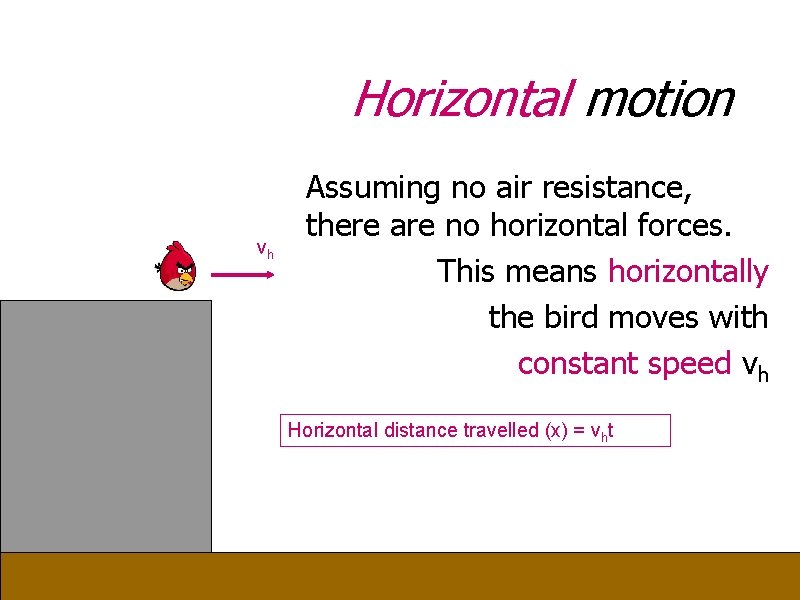
Horizontal motion vh Assuming no air resistance, there are no horizontal forces. This means horizontally the bird moves with constant speed vh Horizontal distance travelled (x) = vht
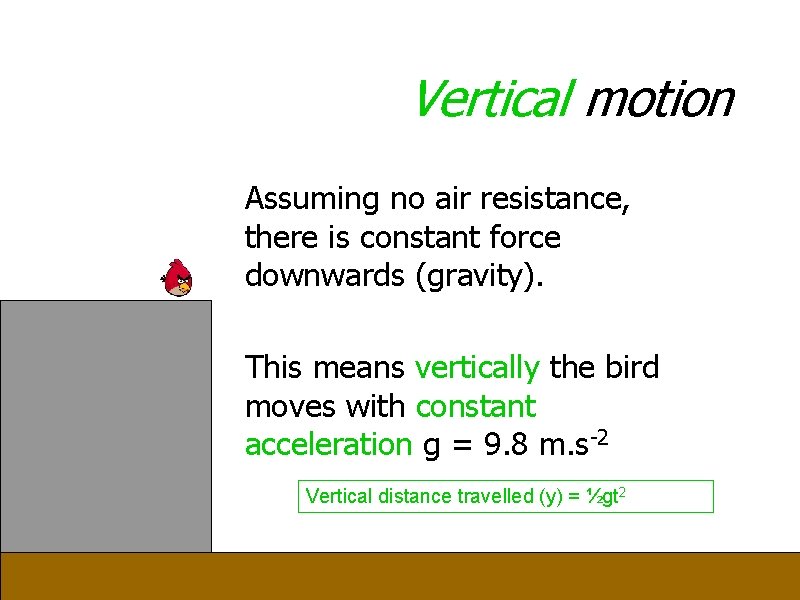
Vertical motion Assuming no air resistance, there is constant force downwards (gravity). This means vertically the bird moves with constant acceleration g = 9. 8 m. s-2 Vertical distance travelled (y) = ½gt 2
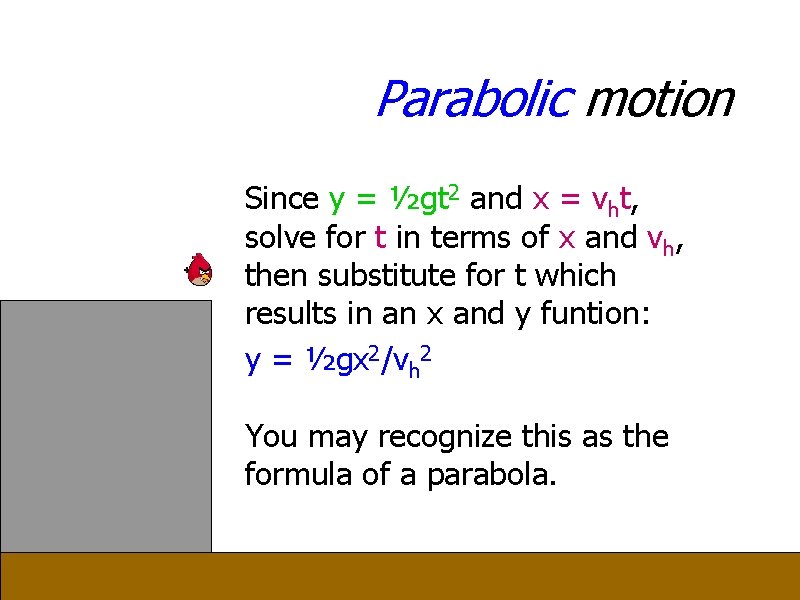
Parabolic motion Since y = ½gt 2 and x = vht, solve for t in terms of x and vh, then substitute for t which results in an x and y funtion: y = ½gx 2/vh 2 You may recognize this as the formula of a parabola.
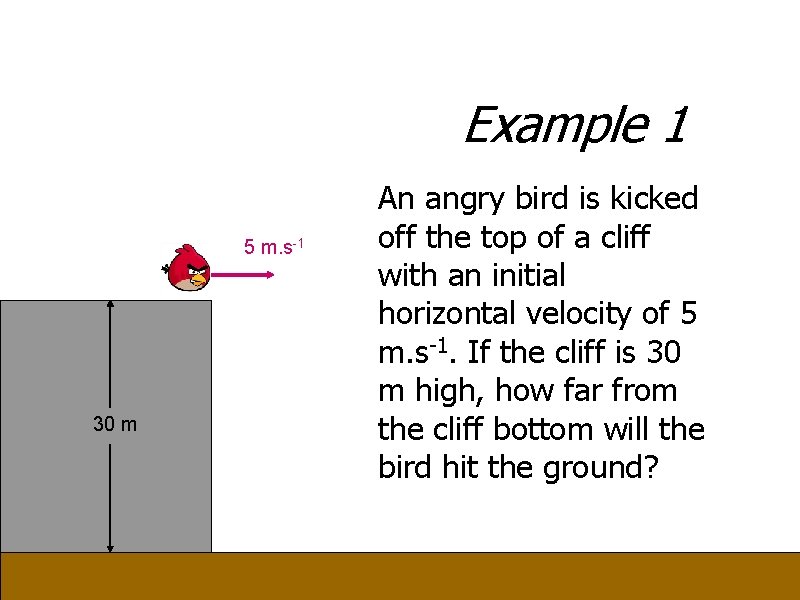
Example 1 5 m. s-1 30 m An angry bird is kicked off the top of a cliff with an initial horizontal velocity of 5 m. s-1. If the cliff is 30 m high, how far from the cliff bottom will the bird hit the ground?
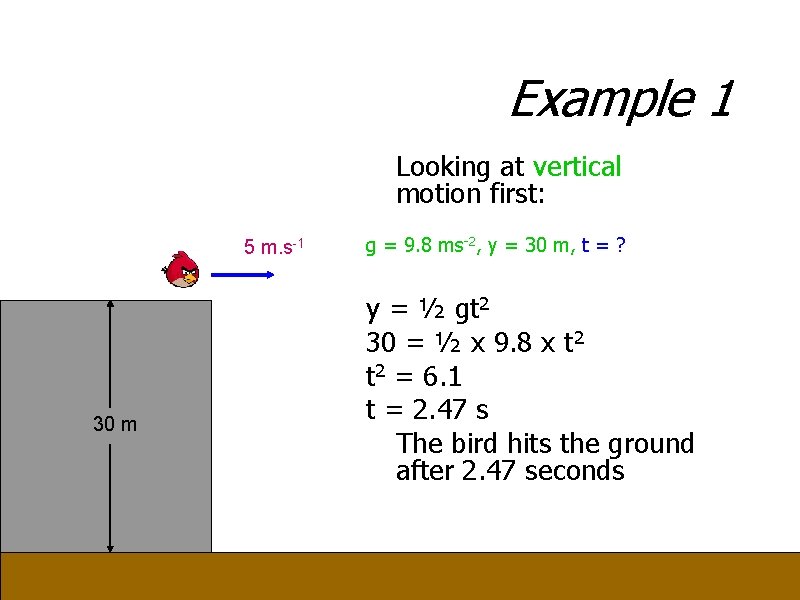
Example 1 Looking at vertical motion first: 5 m. s-1 30 m g = 9. 8 ms-2, y = 30 m, t = ? y = ½ gt 2 30 = ½ x 9. 8 x t 2 = 6. 1 t = 2. 47 s The bird hits the ground after 2. 47 seconds
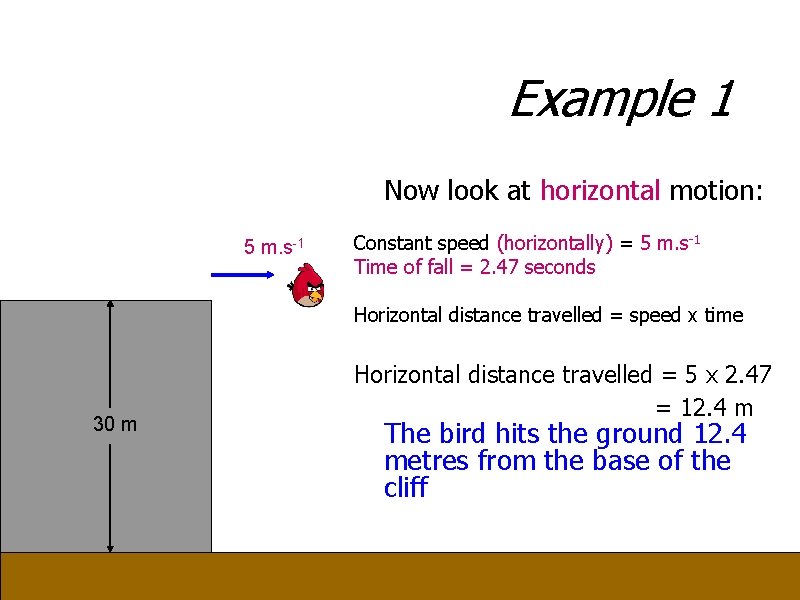
Example 1 Now look at horizontal motion: 5 m. s-1 Constant speed (horizontally) = 5 m. s-1 Time of fall = 2. 47 seconds Horizontal distance travelled = speed x time 30 m Horizontal distance travelled = 5 x 2. 47 = 12. 4 m The bird hits the ground 12. 4 metres from the base of the cliff
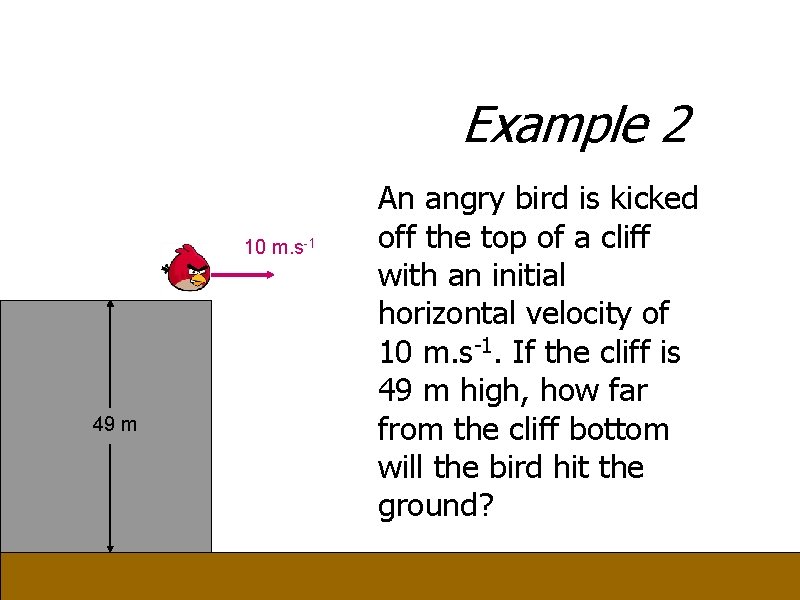
Example 2 10 m. s-1 49 m An angry bird is kicked off the top of a cliff with an initial horizontal velocity of 10 m. s-1. If the cliff is 49 m high, how far from the cliff bottom will the bird hit the ground?
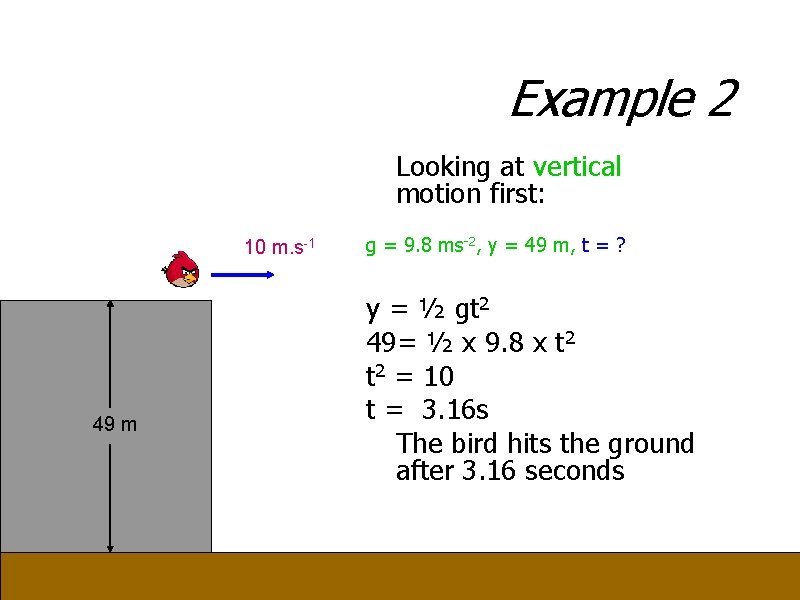
Example 2 Looking at vertical motion first: 10 m. s-1 49 m g = 9. 8 ms-2, y = 49 m, t = ? y = ½ gt 2 49= ½ x 9. 8 x t 2 = 10 t = 3. 16 s The bird hits the ground after 3. 16 seconds
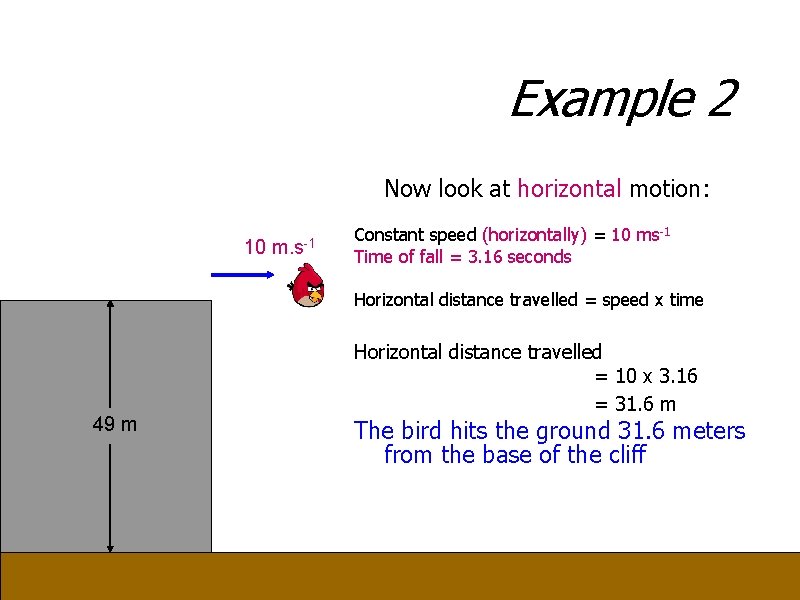
Example 2 Now look at horizontal motion: 10 m. s-1 Constant speed (horizontally) = 10 ms-1 Time of fall = 3. 16 seconds Horizontal distance travelled = speed x time 49 m Horizontal distance travelled = 10 x 3. 16 = 31. 6 m The bird hits the ground 31. 6 meters from the base of the cliff
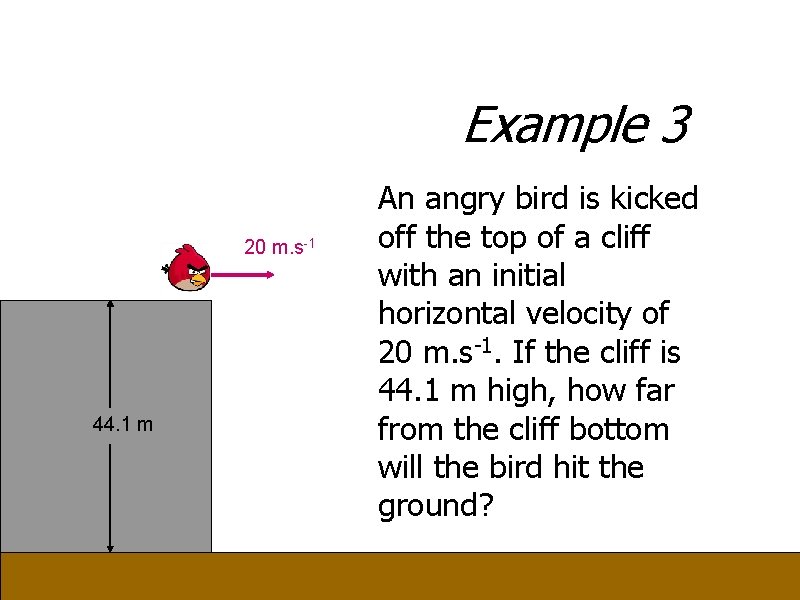
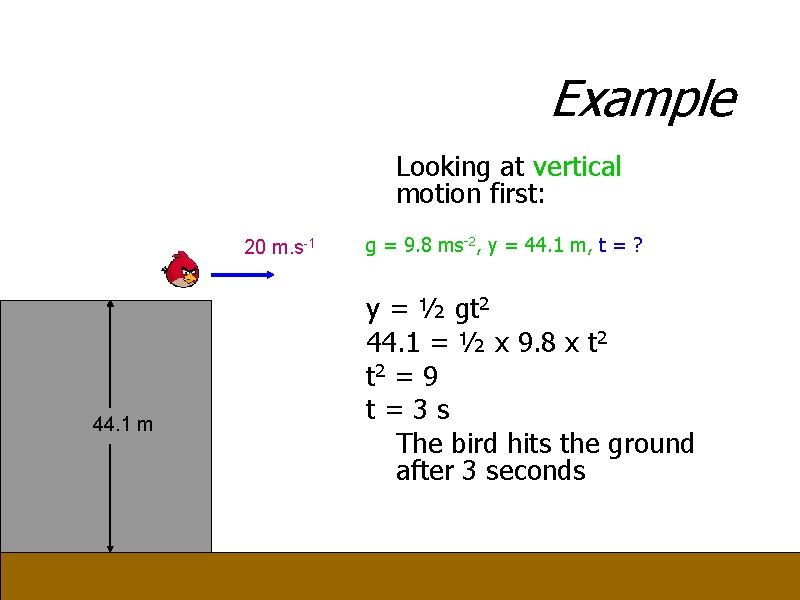
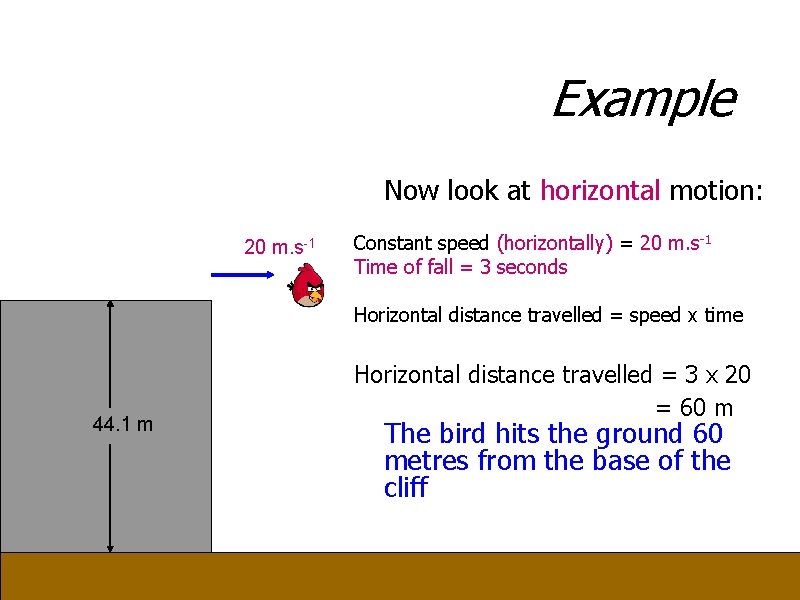
Example 3 20 m. s-1 44. 1 m An angry bird is kicked off the top of a cliff with an initial horizontal velocity of 20 m. s-1. If the cliff is 44. 1 m high, how far from the cliff bottom will the bird hit the ground?
Example Looking at vertical motion first: 20 m. s-1 44. 1 m g = 9. 8 ms-2, y = 44. 1 m, t = ? y = ½ gt 2 44. 1 = ½ x 9. 8 x t 2 = 9 t=3 s The bird hits the ground after 3 seconds
Example Now look at horizontal motion: 20 m. s-1 Constant speed (horizontally) = 20 m. s-1 Time of fall = 3 seconds Horizontal distance travelled = speed x time 44. 1 m Horizontal distance travelled = 3 x 20 = 60 m The bird hits the ground 60 metres from the base of the cliff
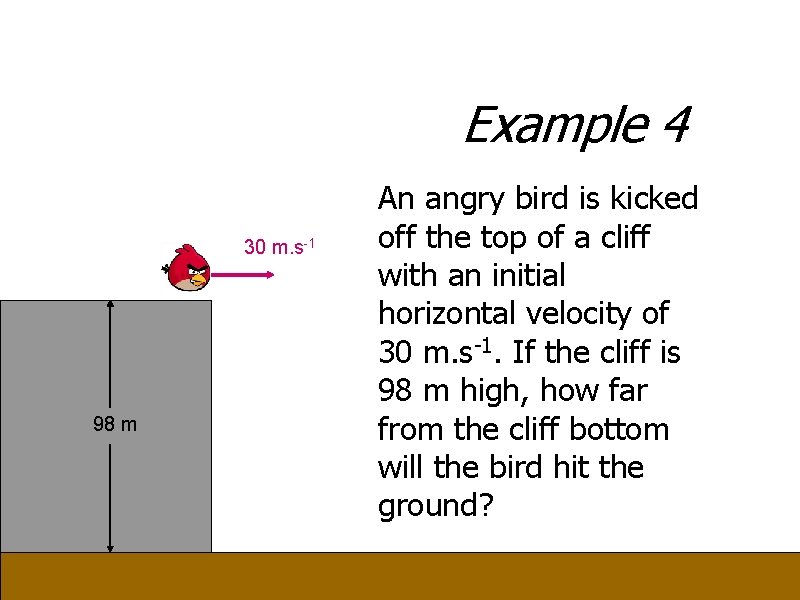
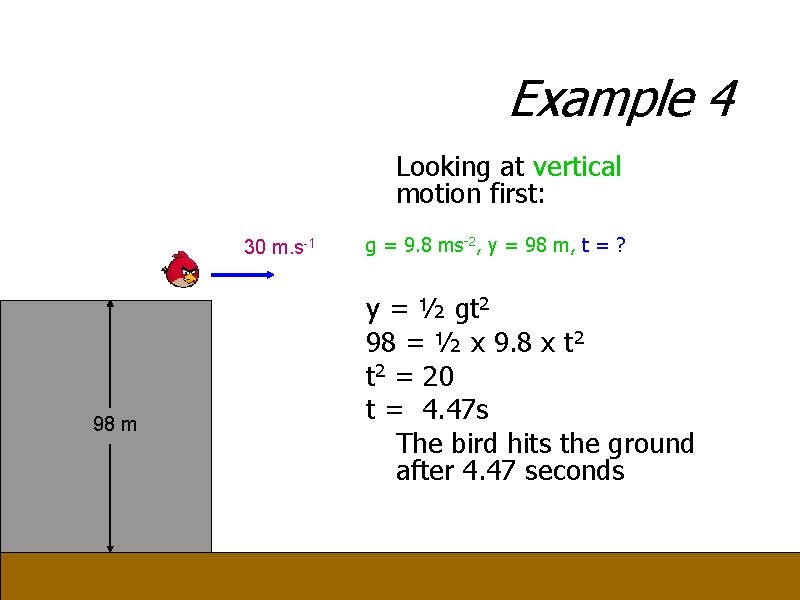
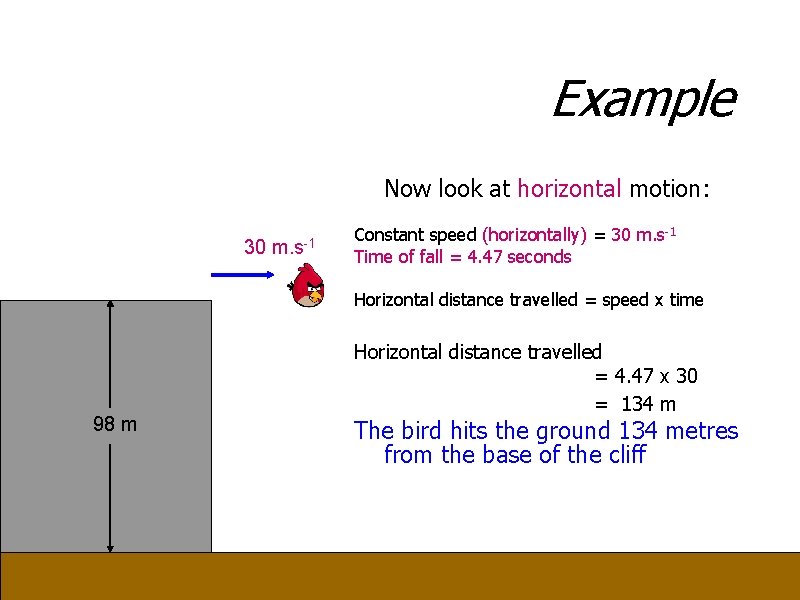
Example 4 30 m. s-1 98 m An angry bird is kicked off the top of a cliff with an initial horizontal velocity of 30 m. s-1. If the cliff is 98 m high, how far from the cliff bottom will the bird hit the ground?
Example 4 Looking at vertical motion first: 30 m. s-1 98 m g = 9. 8 ms-2, y = 98 m, t = ? y = ½ gt 2 98 = ½ x 9. 8 x t 2 = 20 t = 4. 47 s The bird hits the ground after 4. 47 seconds
Example Now look at horizontal motion: 30 m. s-1 Constant speed (horizontally) = 30 m. s-1 Time of fall = 4. 47 seconds Horizontal distance travelled = speed x time 98 m Horizontal distance travelled = 4. 47 x 30 = 134 m The bird hits the ground 134 metres from the base of the cliff
Closure What are the steps for calculating the vertical distance traveled of a free falling object? What is the formula used to calculate time in the air? What is the formula for calculating vertical distance traveled?
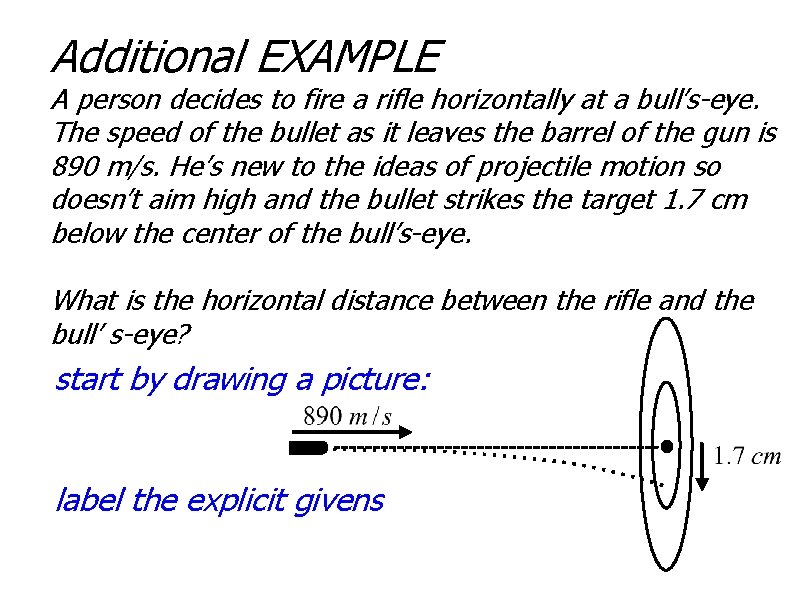
Additional EXAMPLE A person decides to fire a rifle horizontally at a bull’s-eye. The speed of the bullet as it leaves the barrel of the gun is 890 m/s. He’s new to the ideas of projectile motion so doesn’t aim high and the bullet strikes the target 1. 7 cm below the center of the bull’s-eye. What is the horizontal distance between the rifle and the bull’ s-eye? start by drawing a picture: label the explicit givens
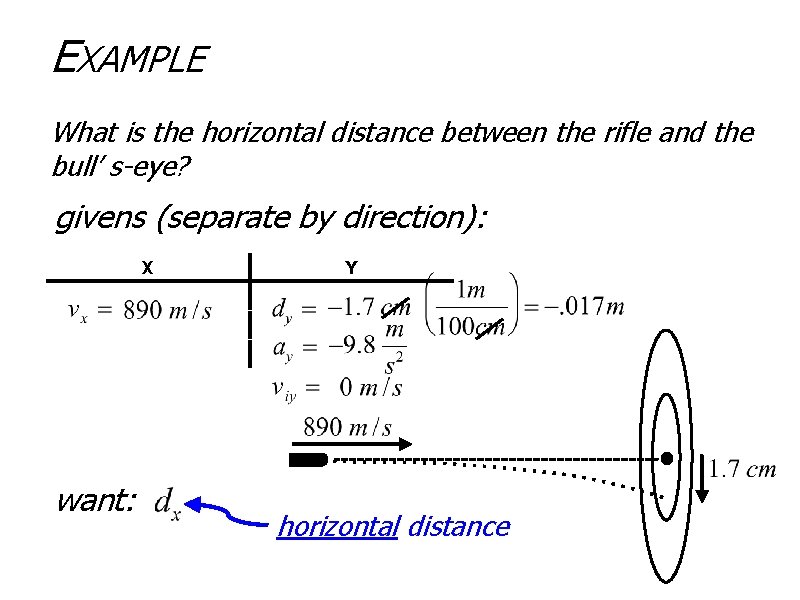
EXAMPLE What is the horizontal distance between the rifle and the bull’ s-eye? givens (separate by direction): X want: Y horizontal distance
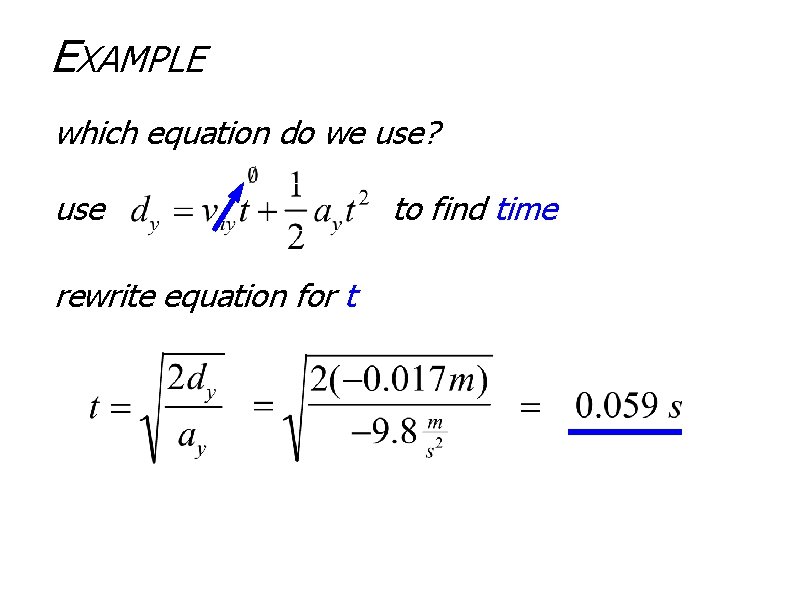
EXAMPLE which equation do we use? use rewrite equation for t to find time
EXAMPLE Use t and vx to solve for dx
Projectile Motion Day 1 and 2 Lessons Mr. Barker
Optional Lesson
Angry Birds need your help.
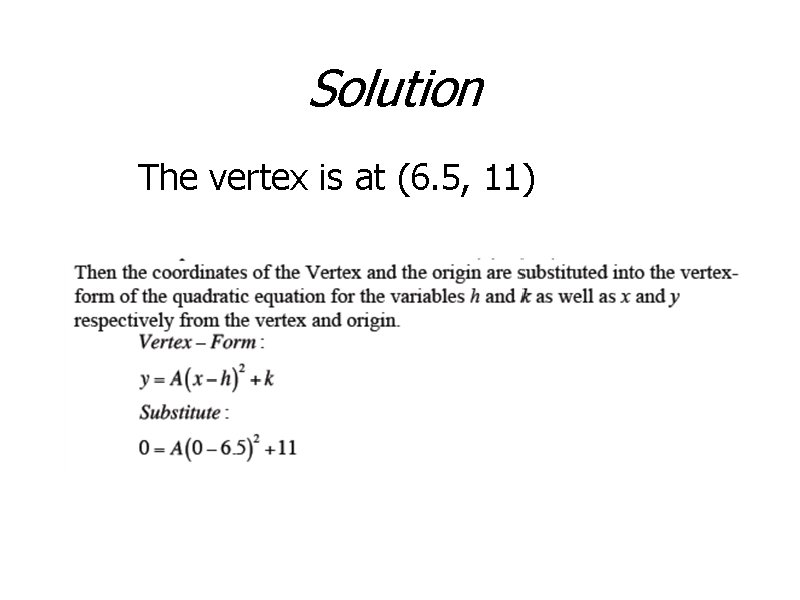
Solution The vertex is at (6. 5, 11)
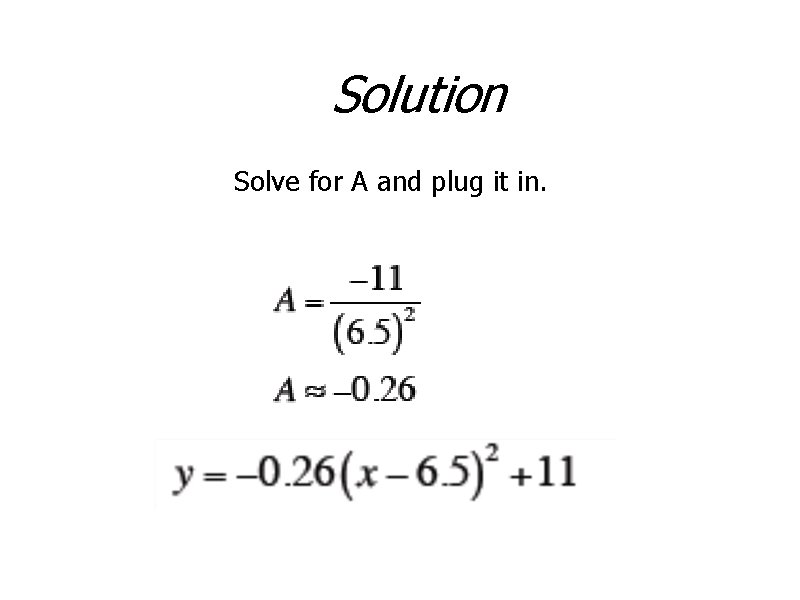
Solution Solve for A and plug it in.