
Day 1 Cardiovascular System The vessels Capillary Bed
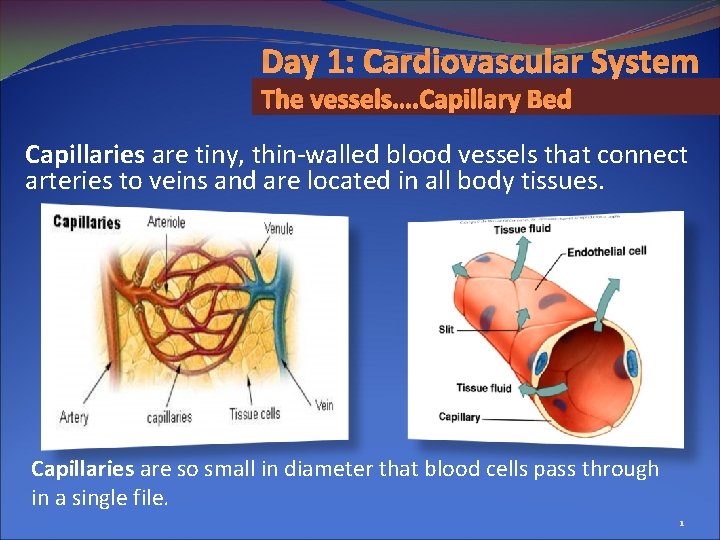
Day 1: Cardiovascular System The vessels…. Capillary Bed Capillaries are tiny, thin-walled blood vessels that connect arteries to veins and are located in all body tissues. Capillaries are so small in diameter that blood cells pass through in a single file. 1
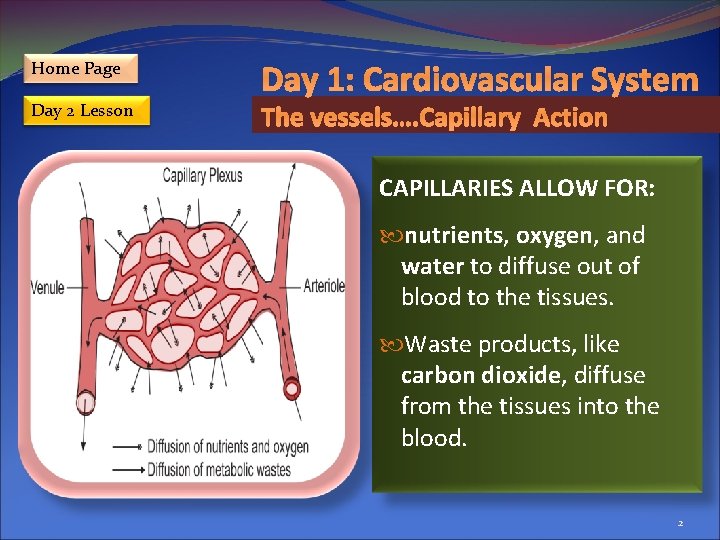
Home Page Day 2 Lesson Day 1: Cardiovascular System The vessels…. Capillary Action CAPILLARIES ALLOW FOR: nutrients, oxygen, and water to diffuse out of blood to the tissues. Waste products, like carbon dioxide, diffuse from the tissues into the blood. 2
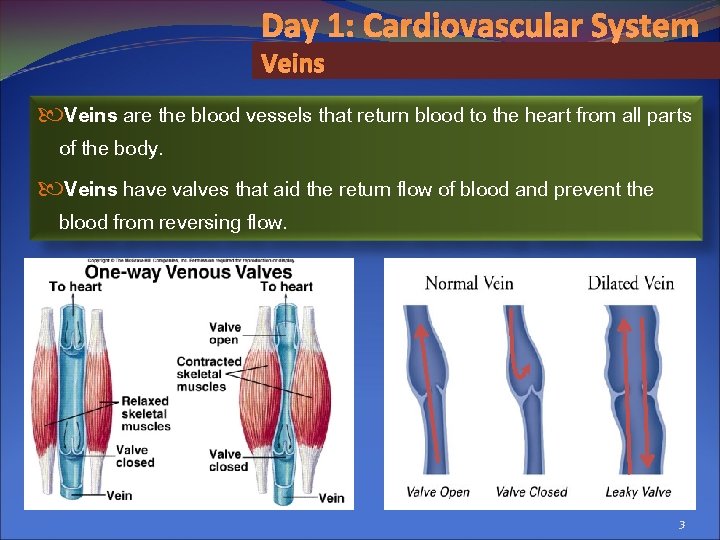
Day 1: Cardiovascular System Veins are the blood vessels that return blood to the heart from all parts of the body. Veins have valves that aid the return flow of blood and prevent the blood from reversing flow. 3
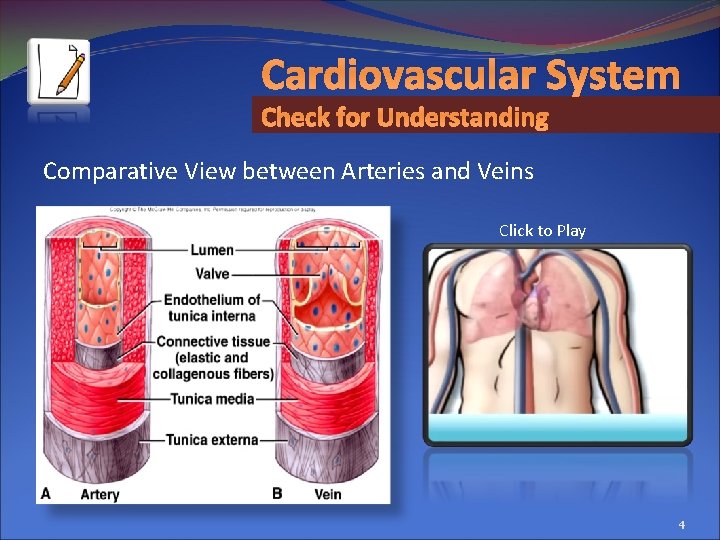
Cardiovascular System Check for Understanding Comparative View between Arteries and Veins Click to Play 4
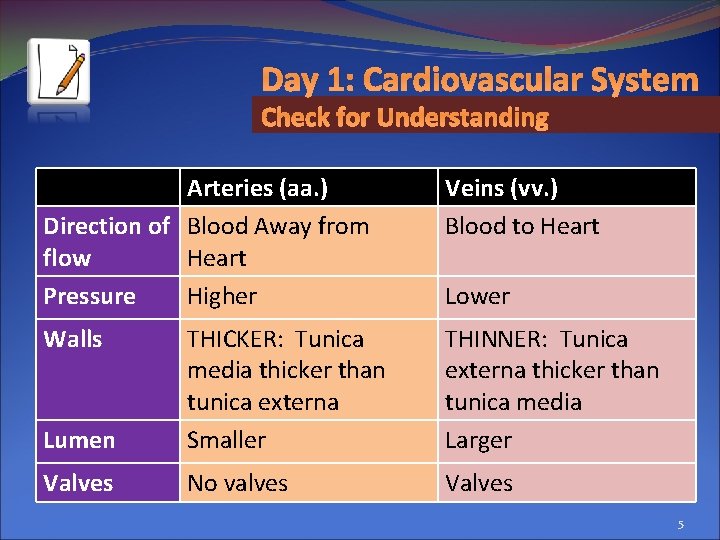
Day 1: Cardiovascular System Check for Understanding Arteries (aa. ) Direction of Blood Away from flow Heart Pressure Higher Veins (vv. ) Blood to Heart Walls Lumen THICKER: Tunica media thicker than tunica externa Smaller THINNER: Tunica externa thicker than tunica media Larger Valves No valves Valves Lower 5
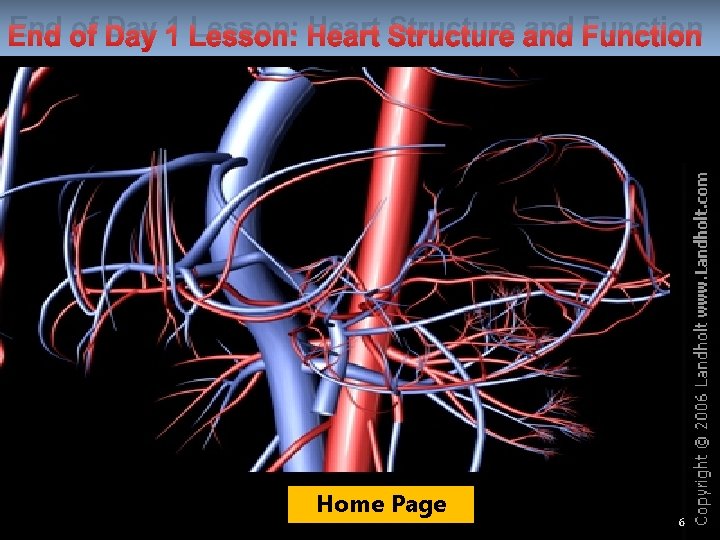
End of Day 1 Lesson: Heart Structure and Function Home Page 6
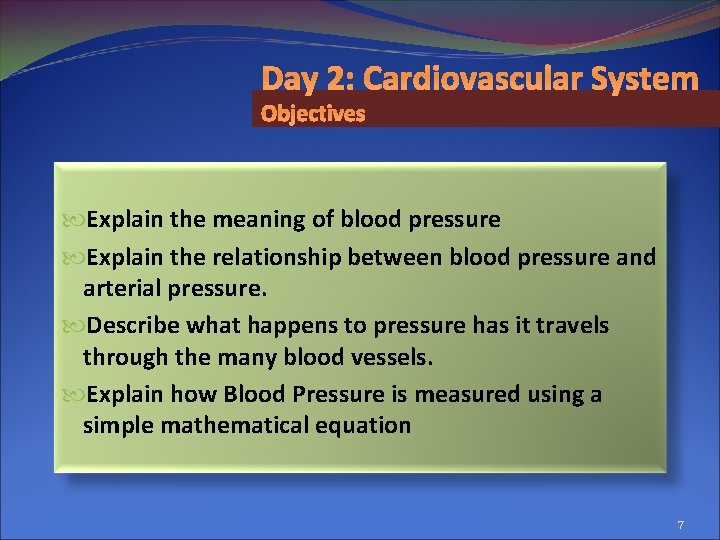
Day 2: Cardiovascular System Objectives Explain the meaning of blood pressure Explain the relationship between blood pressure and arterial pressure. Describe what happens to pressure has it travels through the many blood vessels. Explain how Blood Pressure is measured using a simple mathematical equation 7
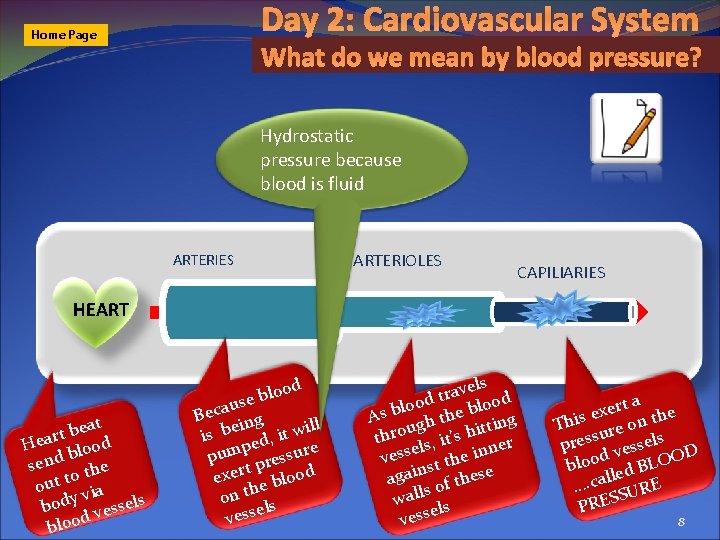
Day 2: Cardiovascular System Home Page What do we mean by blood pressure? Hydrostatic pressure because blood is fluid ARTERIES ARTERIOLES CAPILIARIES HEART eat b t r Hea blood send the to out via body vessels d bloo ood l b e us Beca ing ill e is b ed, it w p pum pressure t exer e blood h on t ls e vess vels a r t lood he blood b s A t h g ting t u i o h r th it’s ner , s l e vess st the in n agai of these s wall ls e vess rt a e e x e This ure on th s pres vessels D d O bloo ed BLO ll …. ca SURE S PRE 8
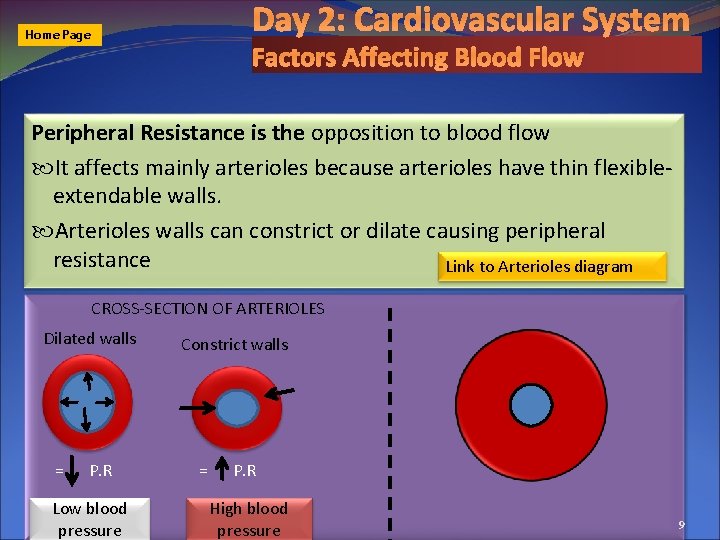
Day 2: Cardiovascular System Home Page Factors Affecting Blood Flow Peripheral Resistance is the opposition to blood flow It affects mainly arterioles because arterioles have thin flexibleextendable walls. Arterioles walls can constrict or dilate causing peripheral resistance Link to Arterioles diagram CROSS-SECTION OF ARTERIOLES Dilated walls = P. R Low blood pressure Constrict walls = P. R High blood pressure 9
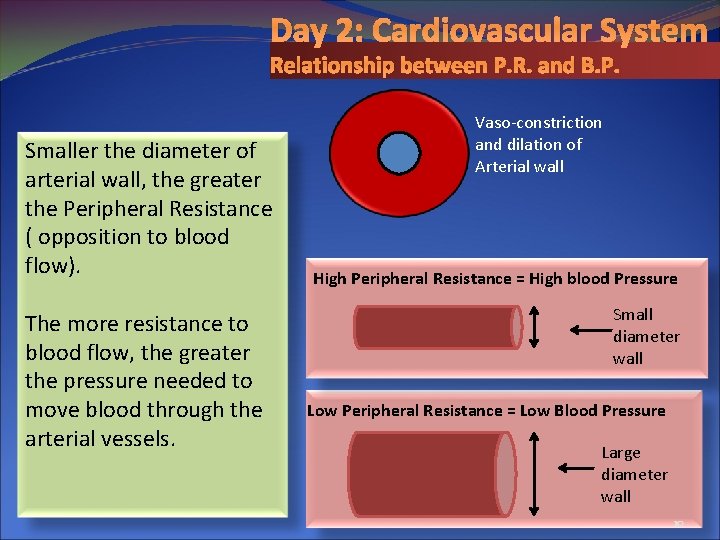
Day 2: Cardiovascular System Relationship between P. R. and B. P. Smaller the diameter of arterial wall, the greater the Peripheral Resistance ( opposition to blood flow). The more resistance to blood flow, the greater the pressure needed to move blood through the arterial vessels. Vaso-constriction and dilation of Arterial wall High Peripheral Resistance = High blood Pressure Small diameter wall Low Peripheral Resistance = Low Blood Pressure Large diameter wall 10
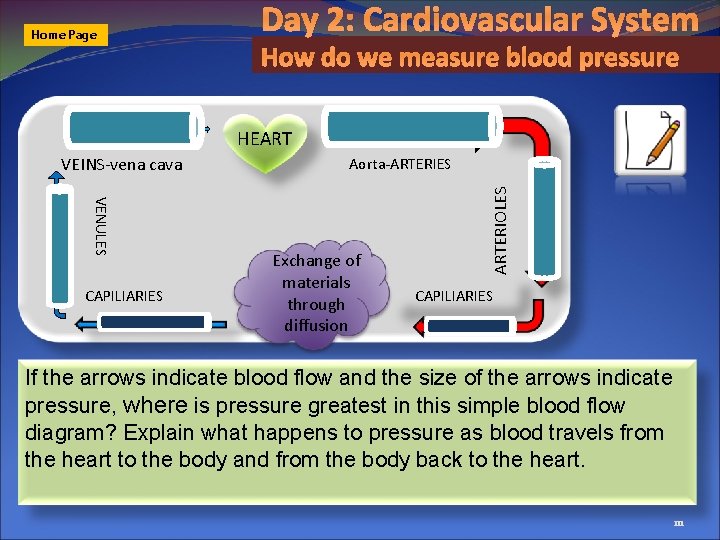
Home Page Day 2: Cardiovascular System How do we measure blood pressure HEART VENULES CAPILIARIES Aorta-ARTERIES Exchange of materials through diffusion ARTERIOLES VEINS-vena cava CAPILIARIES If the arrows indicate blood flow and the size of the arrows indicate pressure, where is pressure greatest in this simple blood flow diagram? Explain what happens to pressure as blood travels from the heart to the body and from the body back to the heart. 1111
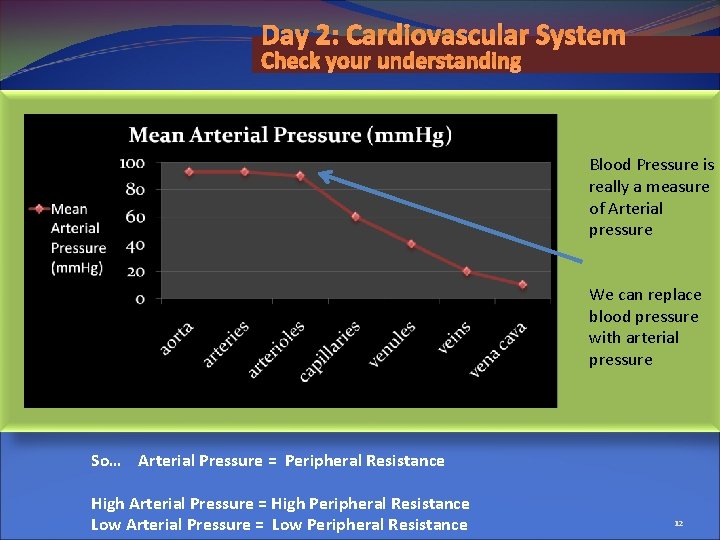
Day 2: Cardiovascular System Check your understanding Blood Pressure is really a measure of Arterial pressure We can replace blood pressure with arterial pressure So… Arterial Pressure = Peripheral Resistance High Arterial Pressure = High Peripheral Resistance Low Arterial Pressure = Low Peripheral Resistance 12
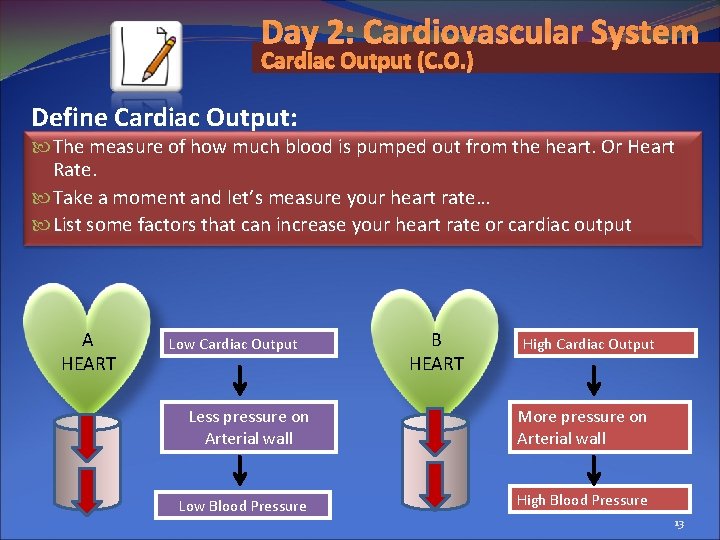
Day 2: Cardiovascular System Cardiac Output (C. O. ) Define Cardiac Output: The measure of how much blood is pumped out from the heart. Or Heart Rate. Take a moment and let’s measure your heart rate… List some factors that can increase your heart rate or cardiac output A HEART Low Cardiac Output B HEART High Cardiac Output Less pressure on Arterial wall More pressure on Arterial wall Low Blood Pressure High Blood Pressure 13
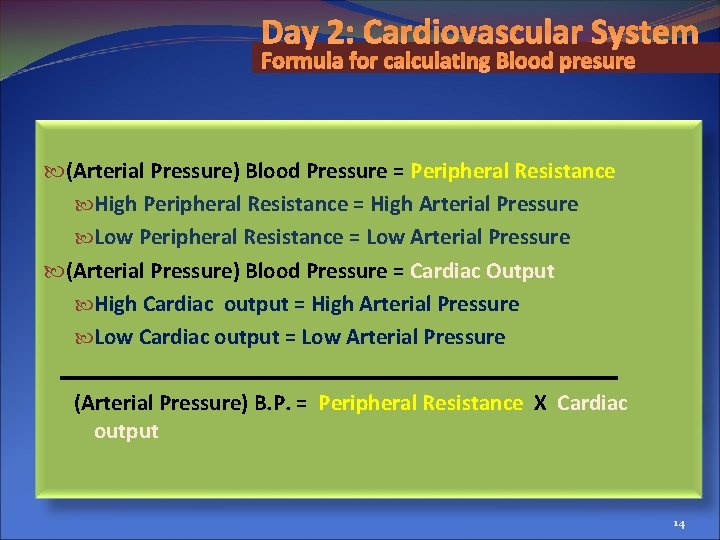
Day 2: Cardiovascular System Formula for calculating Blood presure (Arterial Pressure) Blood Pressure = Peripheral Resistance High Peripheral Resistance = High Arterial Pressure Low Peripheral Resistance = Low Arterial Pressure (Arterial Pressure) Blood Pressure = Cardiac Output High Cardiac output = High Arterial Pressure Low Cardiac output = Low Arterial Pressure (Arterial Pressure) B. P. = Peripheral Resistance X Cardiac output 14
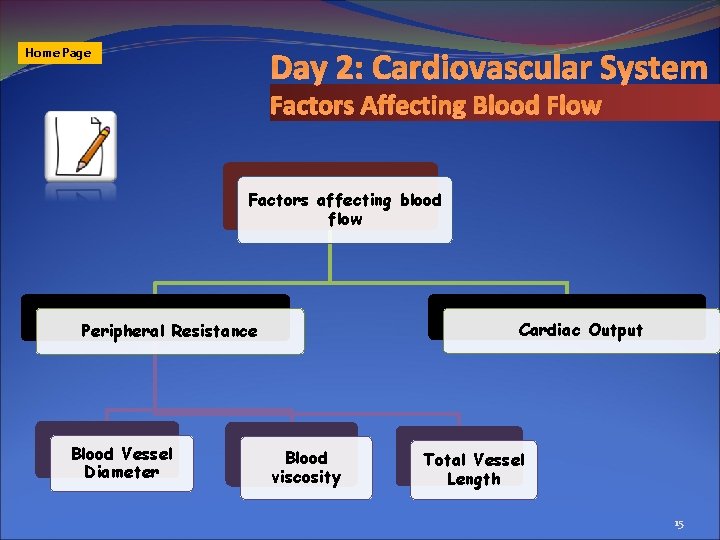
Day 2: Cardiovascular System Home Page Factors Affecting Blood Flow Factors affecting blood flow Cardiac Output Peripheral Resistance Blood Vessel Diameter Blood viscosity Total Vessel Length 15
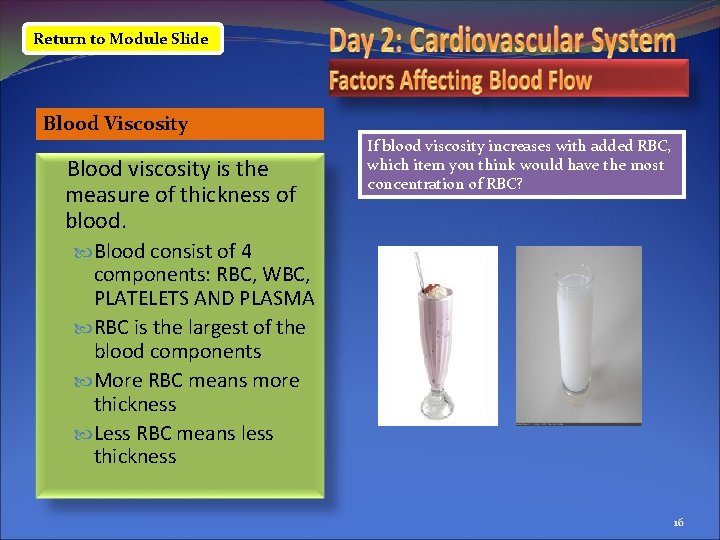
Return to Module Slide Blood Viscosity Blood viscosity is the measure of thickness of blood. If blood viscosity increases with added RBC, which item you think would have the most concentration of RBC? Blood consist of 4 components: RBC, WBC, PLATELETS AND PLASMA RBC is the largest of the blood components More RBC means more thickness Less RBC means less thickness 16
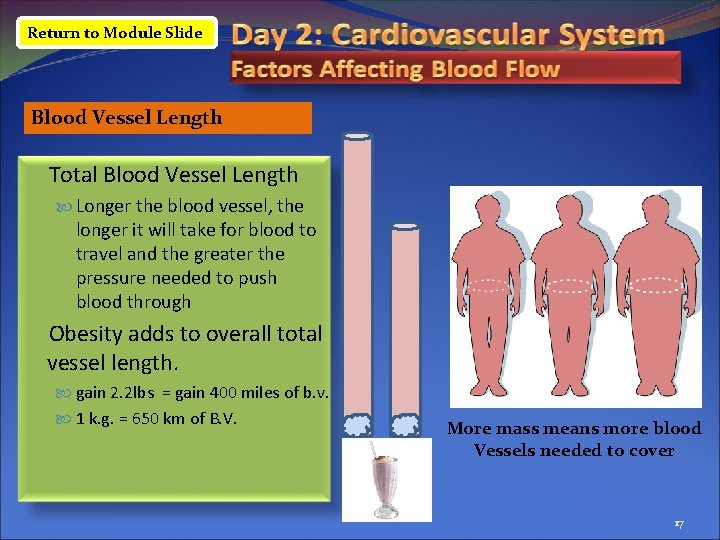
Return to Module Slide Blood Vessel Length Total Blood Vessel Length Longer the blood vessel, the longer it will take for blood to travel and the greater the pressure needed to push blood through Obesity adds to overall total vessel length. gain 2. 2 lbs = gain 400 miles of b. v. 1 k. g. = 650 km of B. V. More mass means more blood Vessels needed to cover 17
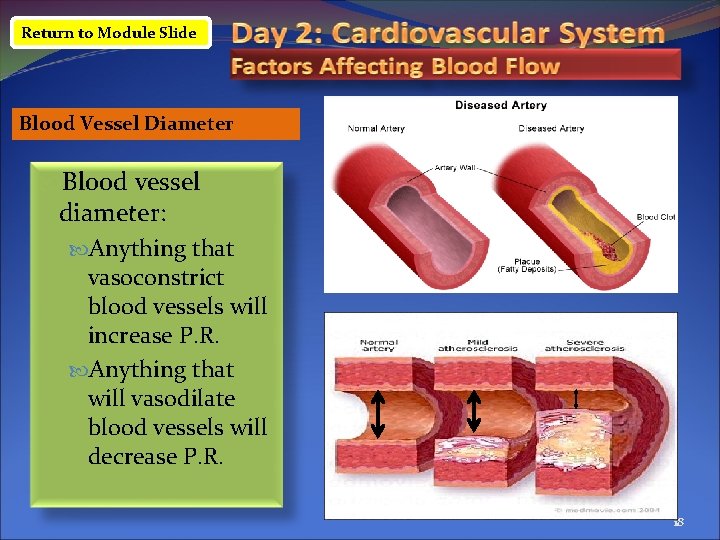
Return to Module Slide Blood Vessel Diameter Blood vessel diameter: Anything that vasoconstrict blood vessels will increase P. R. Anything that will vasodilate blood vessels will decrease P. R. 18
- Slides: 18