
DAY 1 Biomolecules Enzymes Cell Structure Prokaryotes vs
DAY 1 Biomolecules, Enzymes, Cell Structure, Prokaryotes vs. Eukaryotes
Day # 1 (MONDAY) : CONCEPTS: biomolecules, Enzymes, Cell Structure, Prokaryote/Eukaryote 1. Pass out review packets and Folders 2. Biomolecule cards : oral review, and then manipulatives 3. Packet # 1 - 11 4. Enzymes: review the parts, activation energy, etc 5. Packet # 12 -13 6. Prokaryote/ Prokaryote T-Chart 7. Packet # 14 -27 8. MOC STAAR Questions: 11, 26, 46, 37
Biomolecules • What are the 4 Biomolecules? • Which Biomolecule(s) have Carbon, Hydrogen & Oxygen (CHO)? • Which Biomolecule(s) have Carbon, Hydrogen, Oxygen & Nitrogen (CHON)? • Which Biomolecule(s) have Carbon, Hydrogen, Oxygen, Nitrogen & Phosphorus (CHONP)?

Monomers & Polymers • Macromolecules are actually made up of even smaller subunits. Each subunit of a macromolecule is called a monomer. • The macromolecules themselves are called polymers, because they are made up of many of these subunits. Monomer: one basic unit or subunit Polymer: a chain of many basic units
Carbohydrates
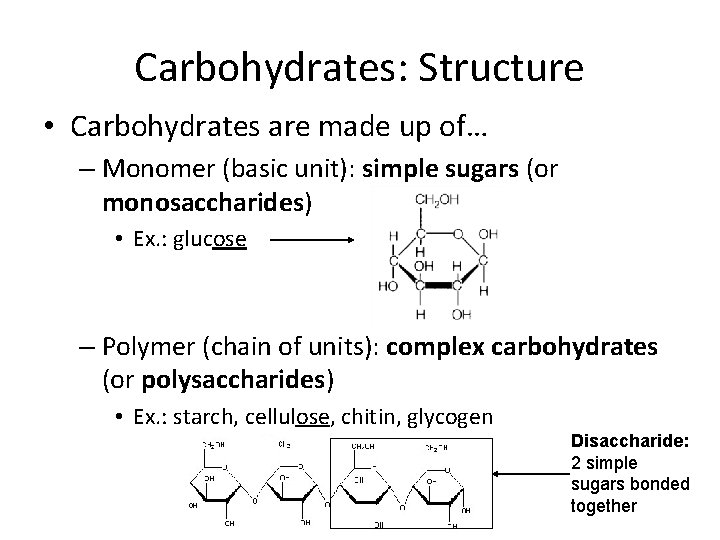
Carbohydrates: Structure • Carbohydrates are made up of… – Monomer (basic unit): simple sugars (or monosaccharides) • Ex. : glucose – Polymer (chain of units): complex carbohydrates (or polysaccharides) • Ex. : starch, cellulose, chitin, glycogen Disaccharide: 2 simple sugars bonded together

Carbohydrates: Function • Provide body with energy! Complex carb (ex. Starch) – What should you eat before playing the big game? Candy bar or pasta? • Candy bar: contains simple sugars, provides a short burst of energy • Pasta: contains starch which takes longer to break down, provides longer-lasting energy – *We can’t digest cellulose- it is used as fiber, or roughage instead. Broken down to disaccharides Broken down further • Ex. : corn Simple sugars (ex. Glucose)
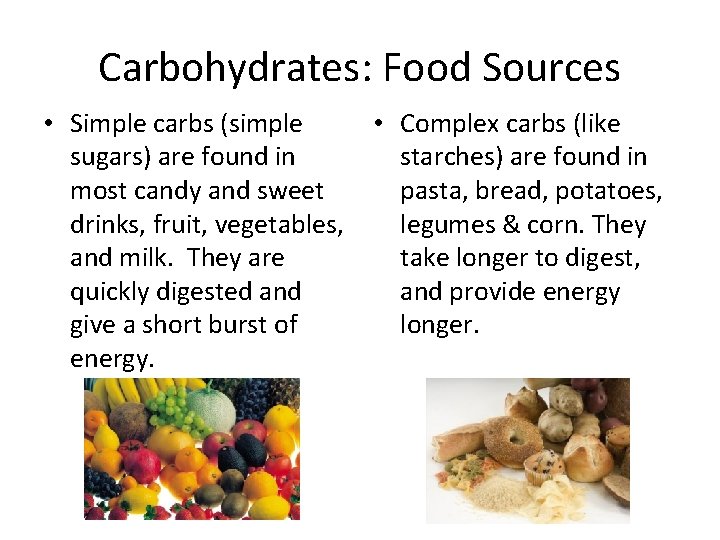
Carbohydrates: Food Sources • Simple carbs (simple sugars) are found in most candy and sweet drinks, fruit, vegetables, and milk. They are quickly digested and give a short burst of energy. • Complex carbs (like starches) are found in pasta, bread, potatoes, legumes & corn. They take longer to digest, and provide energy longer.
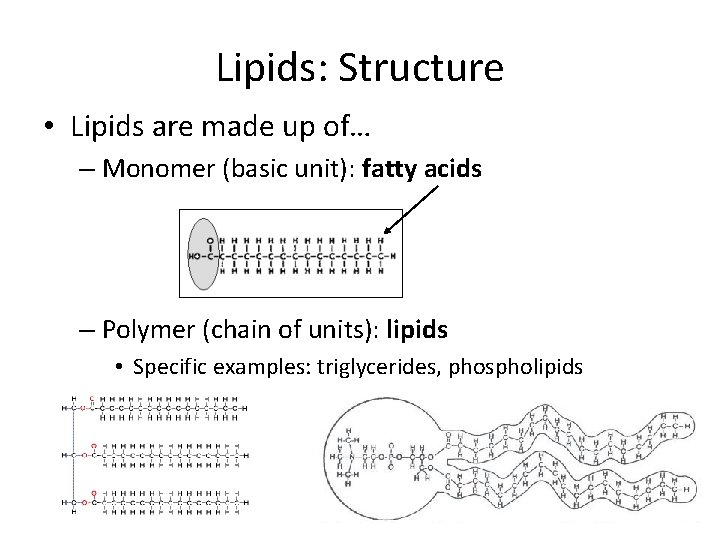
Lipids: Structure • Lipids are made up of… – Monomer (basic unit): fatty acids – Polymer (chain of units): lipids • Specific examples: triglycerides, phospholipids
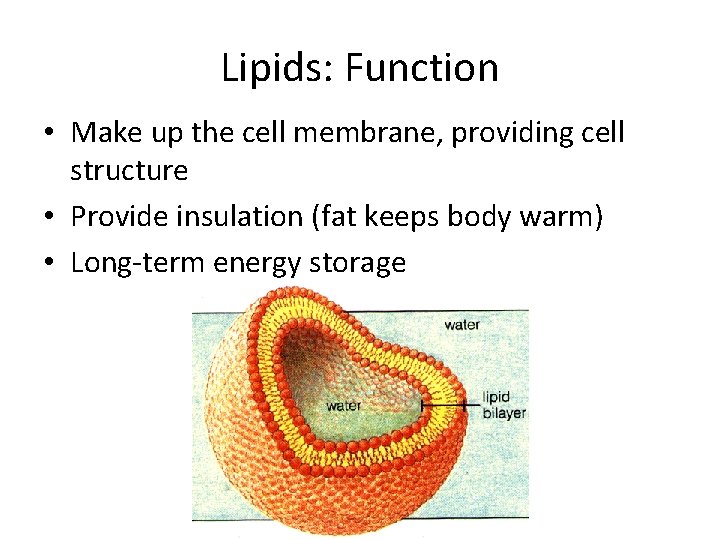
Lipids: Function • Make up the cell membrane, providing cell structure • Provide insulation (fat keeps body warm) • Long-term energy storage
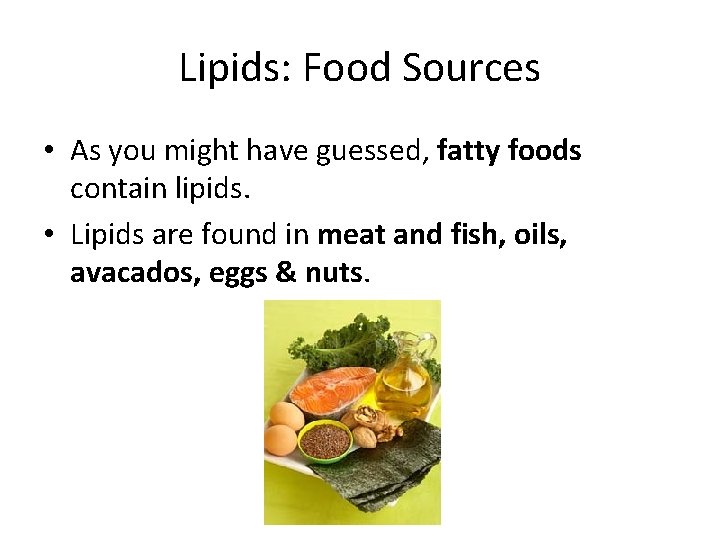
Lipids: Food Sources • As you might have guessed, fatty foods contain lipids. • Lipids are found in meat and fish, oils, avacados, eggs & nuts.
Proteins
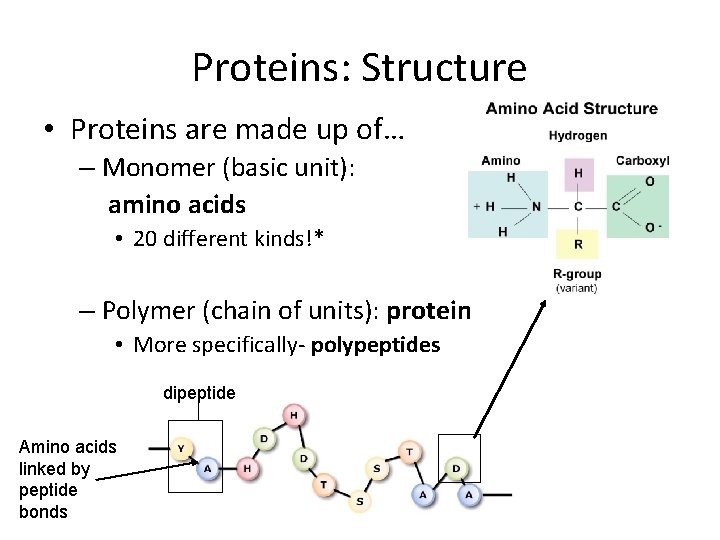
Proteins: Structure • Proteins are made up of… – Monomer (basic unit): amino acids • 20 different kinds!* – Polymer (chain of units): protein • More specifically- polypeptides dipeptide Amino acids linked by peptide bonds
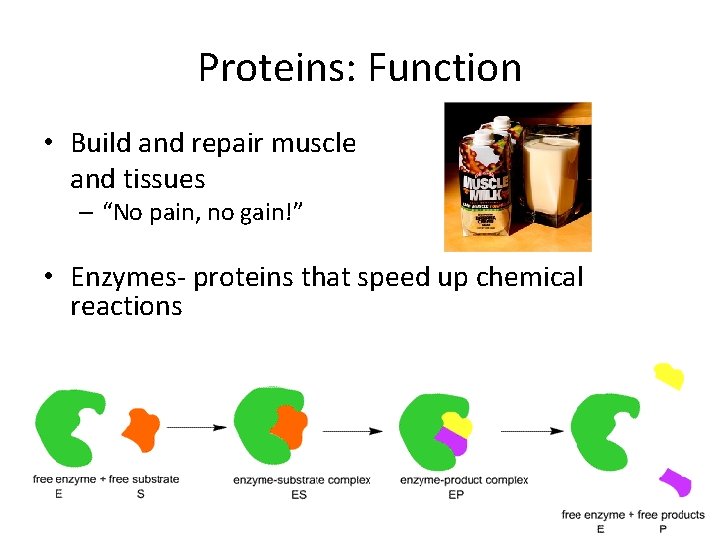
Proteins: Function • Build and repair muscle and tissues – “No pain, no gain!” • Enzymes- proteins that speed up chemical reactions
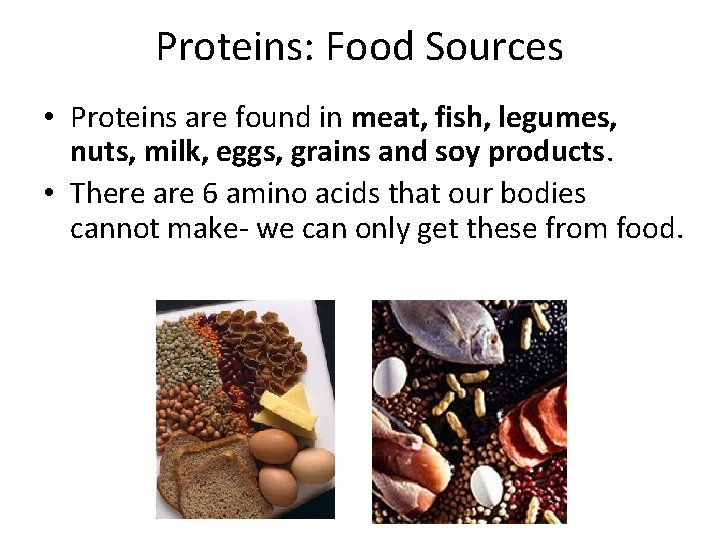
Proteins: Food Sources • Proteins are found in meat, fish, legumes, nuts, milk, eggs, grains and soy products. • There are 6 amino acids that our bodies cannot make- we can only get these from food.
Nucleic Acids
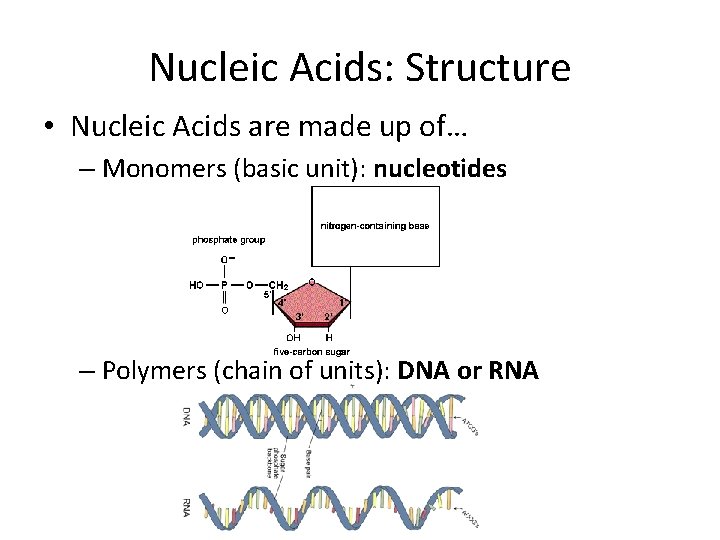
Nucleic Acids: Structure • Nucleic Acids are made up of… – Monomers (basic unit): nucleotides – Polymers (chain of units): DNA or RNA
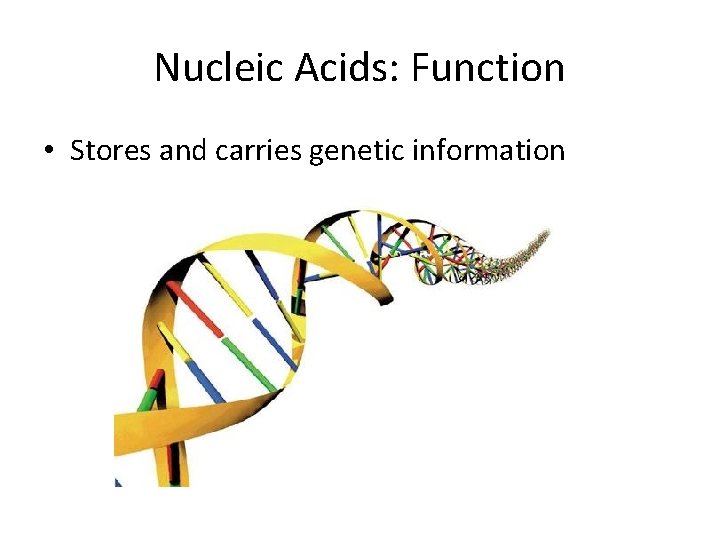
Nucleic Acids: Function • Stores and carries genetic information
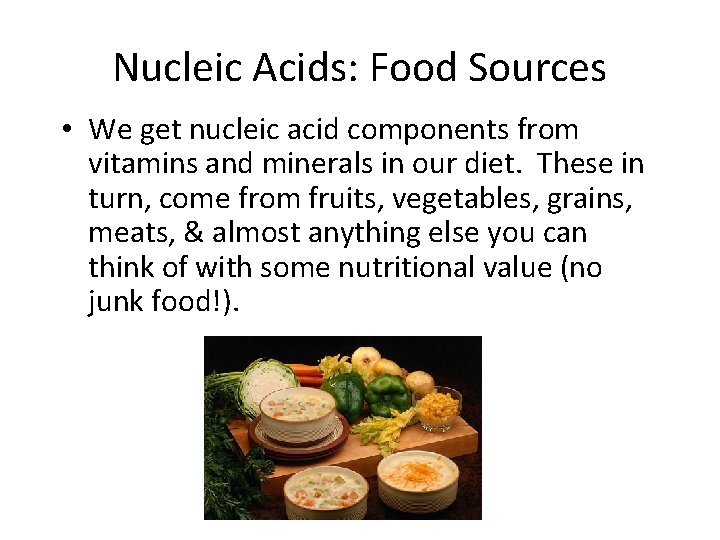
Nucleic Acids: Food Sources • We get nucleic acid components from vitamins and minerals in our diet. These in turn, come from fruits, vegetables, grains, meats, & almost anything else you can think of with some nutritional value (no junk food!).
Digestion & Reconstruction • When macromolecules are eaten, they are digested and broken down into their subunits (monomers). – Analogy: taking apart an old brick building • Inside the cells, these subunits are reconstructed into the macromolecules we need. – Analogy: using bricks to build a new building
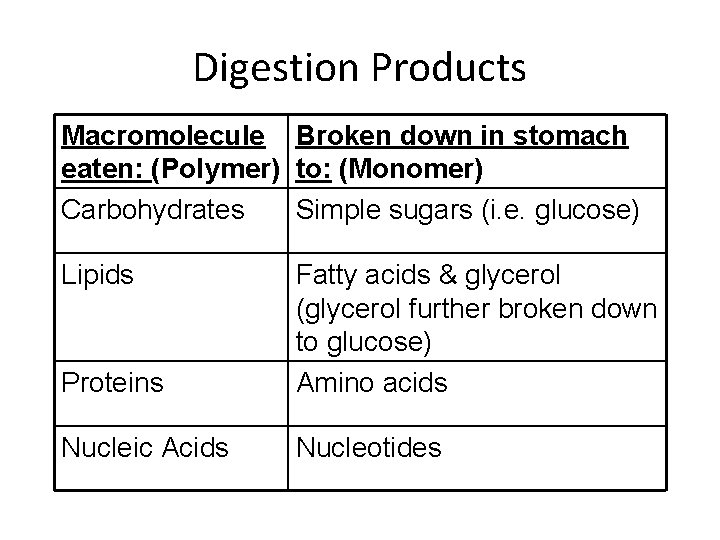
Digestion Products Macromolecule Broken down in stomach eaten: (Polymer) to: (Monomer) Carbohydrates Simple sugars (i. e. glucose) Lipids Proteins Fatty acids & glycerol (glycerol further broken down to glucose) Amino acids Nucleic Acids Nucleotides
Biomolecule Manipulatives. Take out the cards out of the bag. Match them up based on the 4 different Biomolecules. Line the Title cards at the top of your desk Carbs, Lipids, Protein, Nucleic Acid
Biomolecules Review Questions
Question Can you compare Polymers and Monomers?
Answer Polymers are large molecules made of smaller molecules. Monomers are the smaller molecules.
Question What is the monomer for a Protein?
Answer Amino Acids
Question What is the role of Carbohydrates
Answer Main Source of Energy
Question Which elements are found in Biomolecules?
Answer Carbon (C) Oxygen (O) Hydrogen (H) Nitrogen (N) Phosphorus (P)
Question What are some examples of Lipids?
Answer Fats, Oils and Waxes
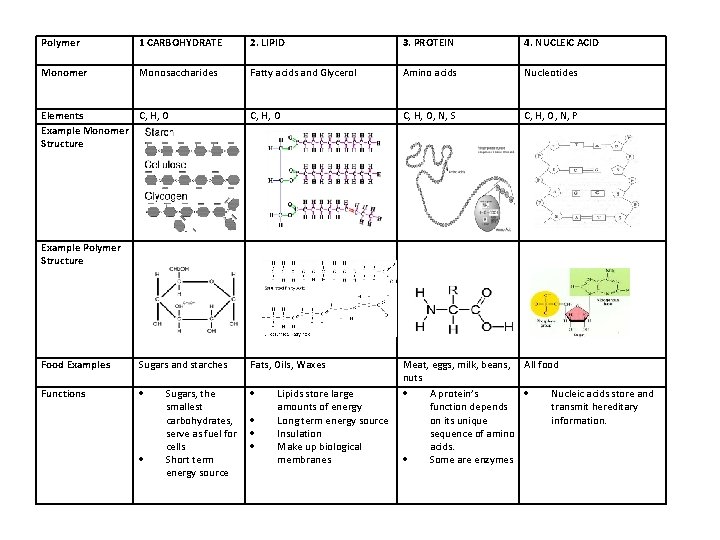
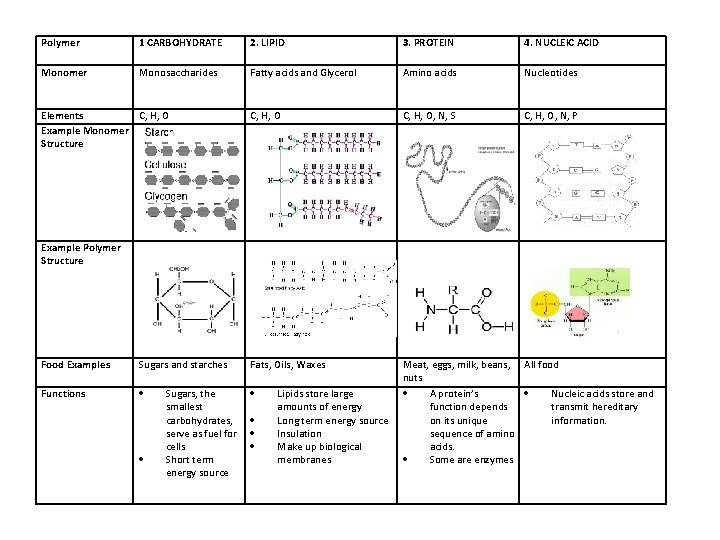
Polymer 1 CARBOHYDRATE 2. LIPID 3. PROTEIN 4. NUCLEIC ACID Monomer Monosaccharides Fatty acids and Glycerol Amino acids Nucleotides C, H, O, N, S C, H, O, N, P Meat, eggs, milk, beans, All food nuts A protein’s Nucleic acids store and function depends transmit hereditary on its unique information. sequence of amino acids. Some are enzymes Elements C, H, O Example Monomer Structure Example Polymer Structure Food Examples Sugars and starches Fats, Oils, Waxes Functions Sugars, the smallest carbohydrates, serve as fuel for cells Short term energy source Lipids store large amounts of energy Long term energy source Insulation Make up biological membranes

GET OUT YOUR GREEN PACKET… • Complete # 1 -11
Polymer 1 CARBOHYDRATE 2. LIPID 3. PROTEIN 4. NUCLEIC ACID Monomer Monosaccharides Fatty acids and Glycerol Amino acids Nucleotides C, H, O, N, S C, H, O, N, P Meat, eggs, milk, beans, All food nuts A protein’s Nucleic acids store and function depends transmit hereditary on its unique information. sequence of amino acids. Some are enzymes Elements C, H, O Example Monomer Structure Example Polymer Structure Food Examples Sugars and starches Fats, Oils, Waxes Functions Sugars, the smallest carbohydrates, serve as fuel for cells Short term energy source Lipids store large amounts of energy Long term energy source Insulation Make up biological membranes
5. A 6. D 7. C 8. B 9. Carbon, Hydrogen, Oxygen 10. Both are forms of energy (Carbs are short term energy and Lipids are stored energy) and they both have the elements C, H, O 11. Monomer is a building block of polymers. Polymers are made up of many monomers. Biomolecules are Polymers and they are made up of many monomers.
Enzymes… Are proteins that act as biological catalysts. • A Catalyst is anything that speeds up the rate of a chemical reaction. • Catalysts speed up reactions by lowering the activation energy. • Cells use enzymes to speed up reactions necessary for life. For example – breaking down biomolecules in food, and synthesizing new molecules,
Quick Note: Enzymes almost always end in “ase” e. g. Catalase, Amalase, Lactase
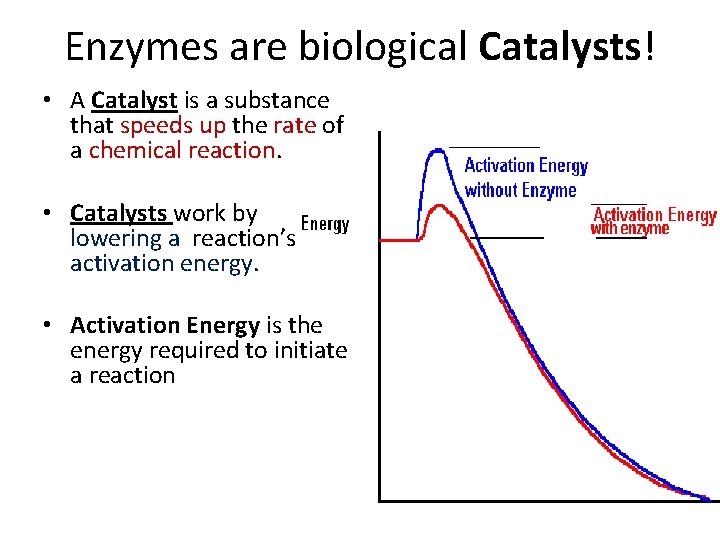
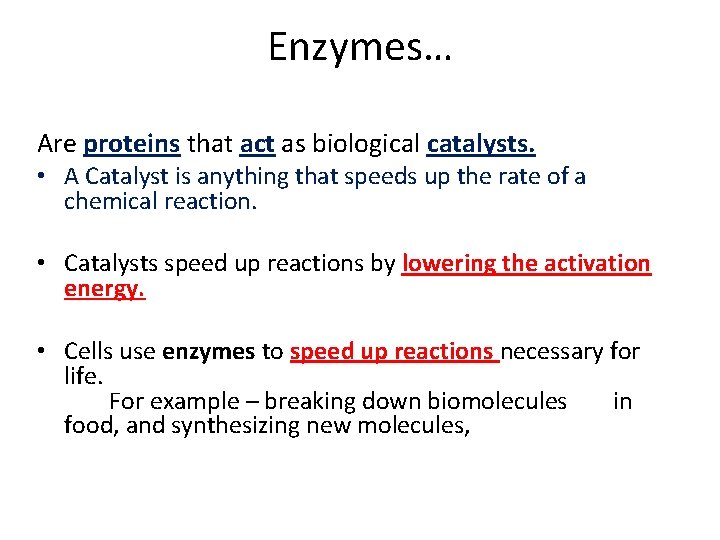
Enzymes are biological Catalysts! • A Catalyst is a substance that speeds up the rate of a chemical reaction. • Catalysts work by lowering a reaction’s activation energy. • Activation Energy is the energy required to initiate a reaction
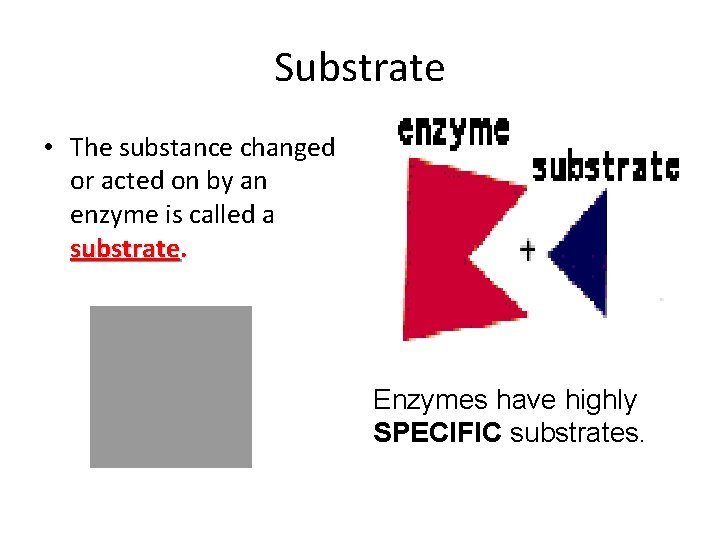
Substrate • The substance changed or acted on by an enzyme is called a substrate. Enzymes have highly SPECIFIC substrates.
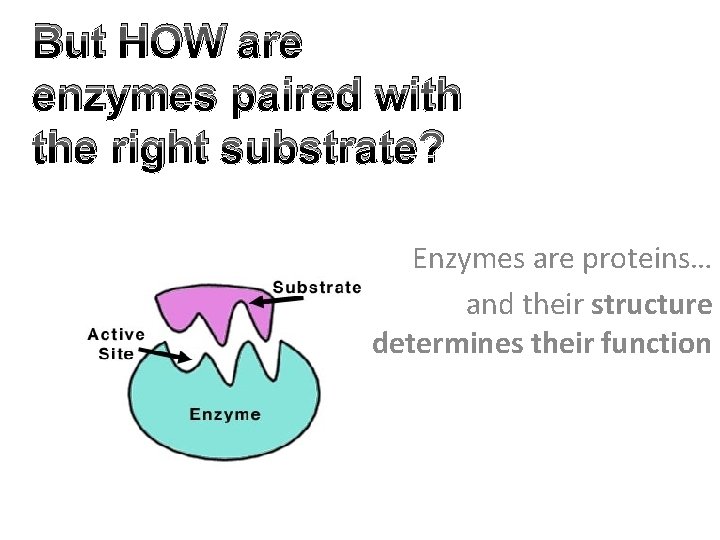
But HOW are enzymes paired with the right substrate? Enzymes are proteins… and their structure determines their function
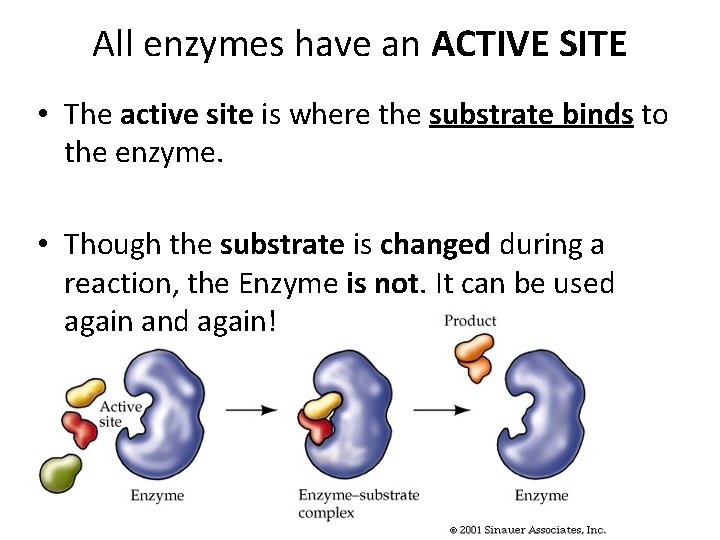
All enzymes have an ACTIVE SITE • The active site is where the substrate binds to the enzyme. • Though the substrate is changed during a reaction, the Enzyme is not. It can be used again and again!
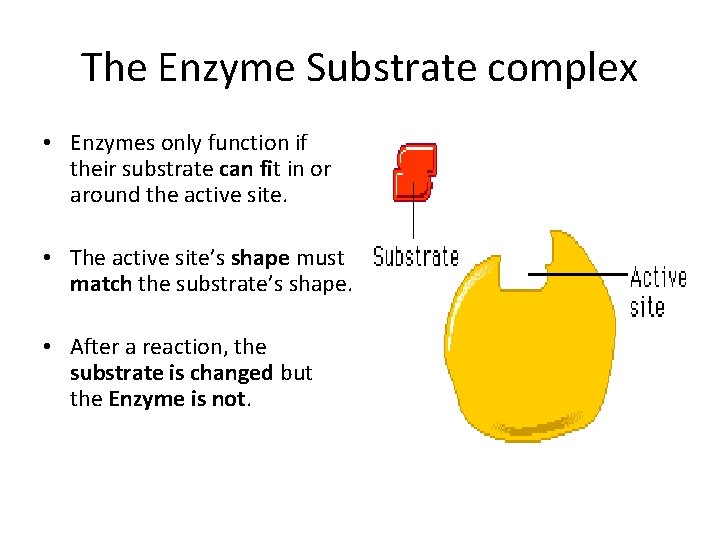
The Enzyme Substrate complex • Enzymes only function if their substrate can fit in or around the active site. • The active site’s shape must match the substrate’s shape. • After a reaction, the substrate is changed but the Enzyme is not.
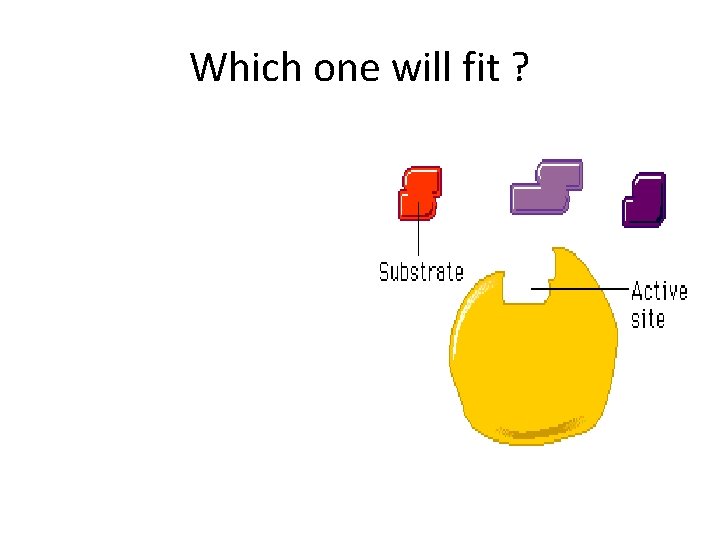
Which one will fit ?
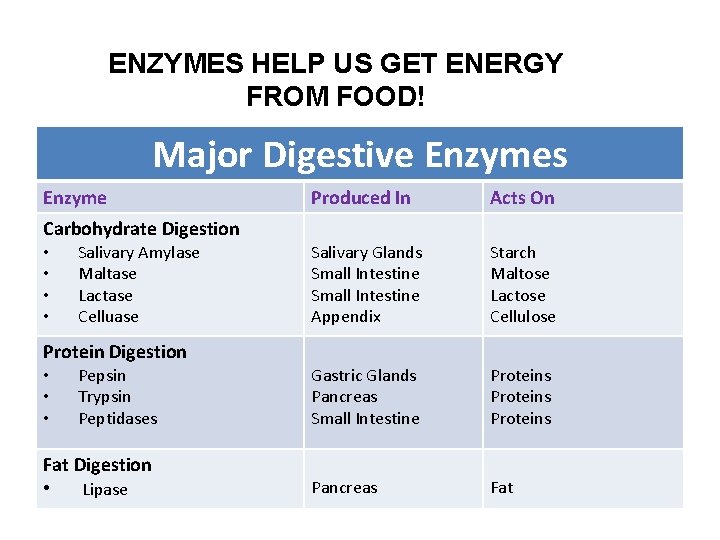
ENZYMES HELP US GET ENERGY FROM FOOD! Major Digestive Enzymes Enzyme Carbohydrate Digestion • • Salivary Amylase Maltase Lactase Celluase Protein Digestion • • • Pepsin Trypsin Peptidases Fat Digestion • Lipase Produced In Acts On Salivary Glands Small Intestine Appendix Starch Maltose Lactose Cellulose Gastric Glands Pancreas Small Intestine Proteins Pancreas Fat

GET OUT YOUR GREEN PACKET… • Complete # 12 -13
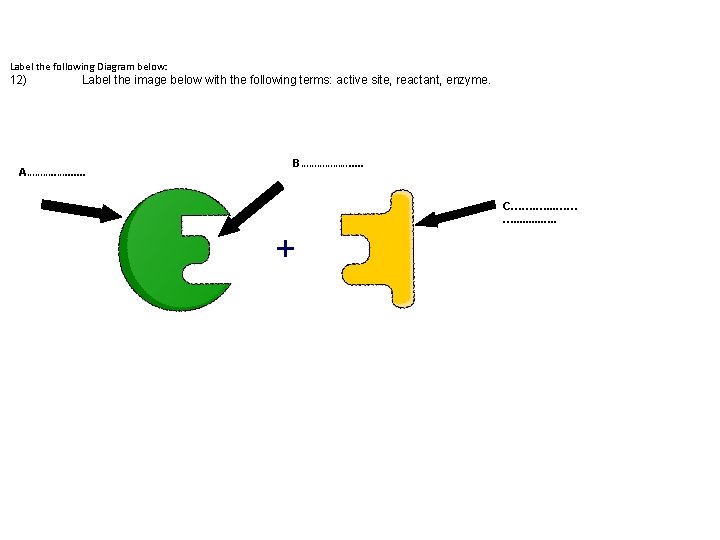
Label the following Diagram below: 12) Label the image below with the following terms: active site, reactant, enzyme. A………. . B………………. . . C……. …. . . …… …. . . +
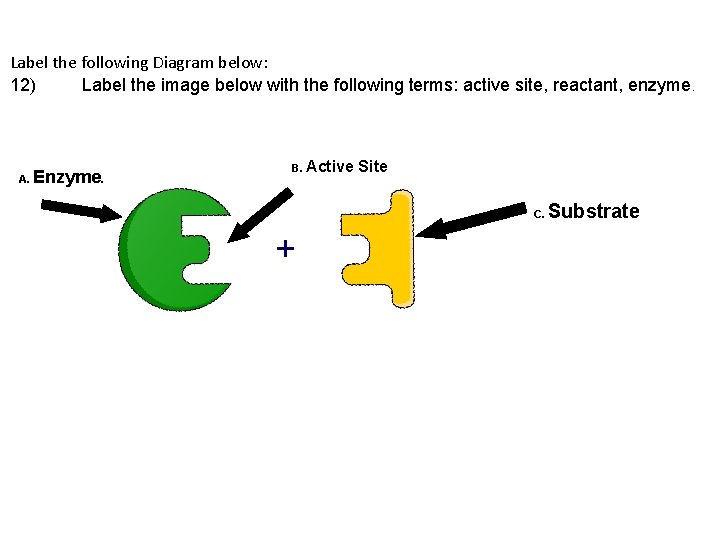
Label the following Diagram below: 12) Label the image below with the following terms: active site, reactant, enzyme. A. Enzyme. B. Active Site C. + Substrate
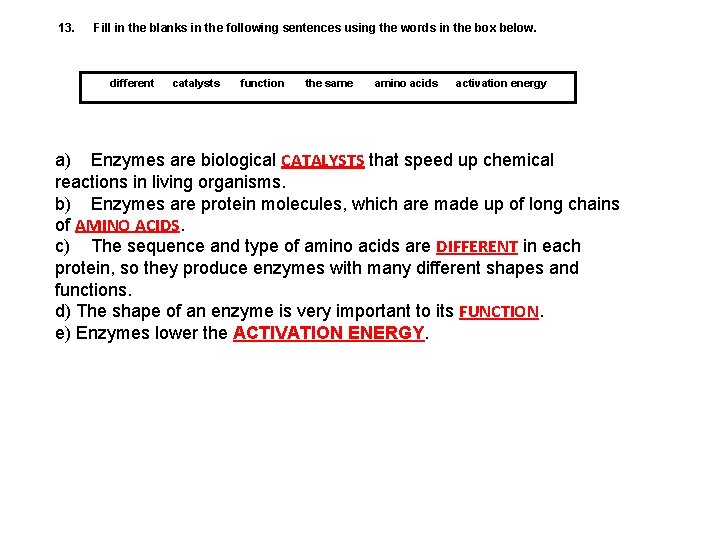
13. Fill in the blanks in the following sentences using the words in the box below. different catalysts function the same amino acids activation energy a) Enzymes are biological CATALYSTS that speed up chemical reactions in living organisms. b) Enzymes are protein molecules, which are made up of long chains of AMINO ACIDS. c) The sequence and type of amino acids are DIFFERENT in each protein, so they produce enzymes with many different shapes and functions. d) The shape of an enzyme is very important to its FUNCTION. e) Enzymes lower the ACTIVATION ENERGY.
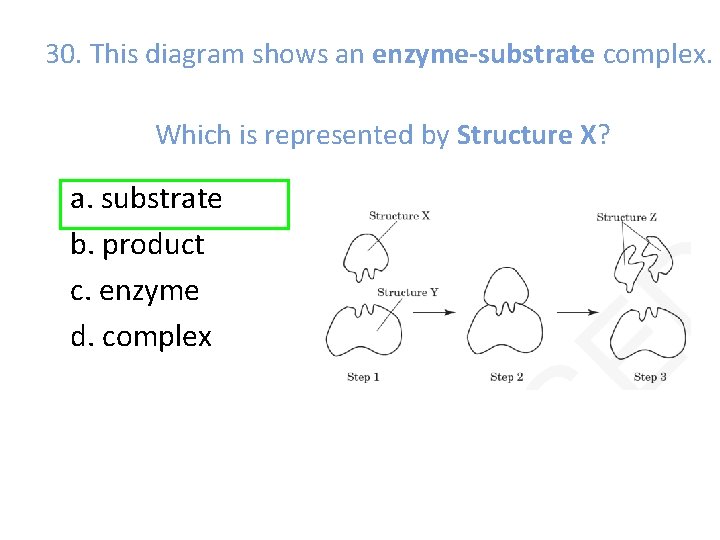
30. This diagram shows an enzyme-substrate complex. Which is represented by Structure X? a. substrate b. product c. enzyme d. complex
CELLS
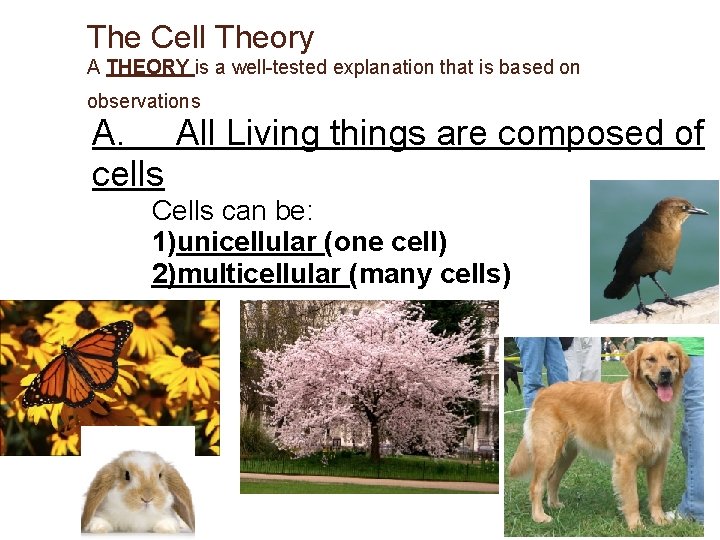
The Cell Theory A THEORY is a well-tested explanation that is based on observations A. All Living things are composed of cells Cells can be: 1)unicellular (one cell) 2)multicellular (many cells)
Cell Theory cont… B. Cells are the basic units of living things
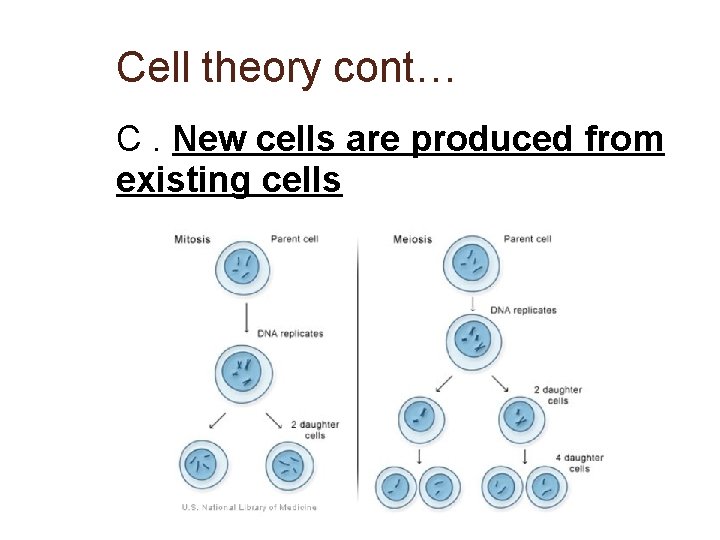
Cell theory cont… C. New cells are produced from existing cells
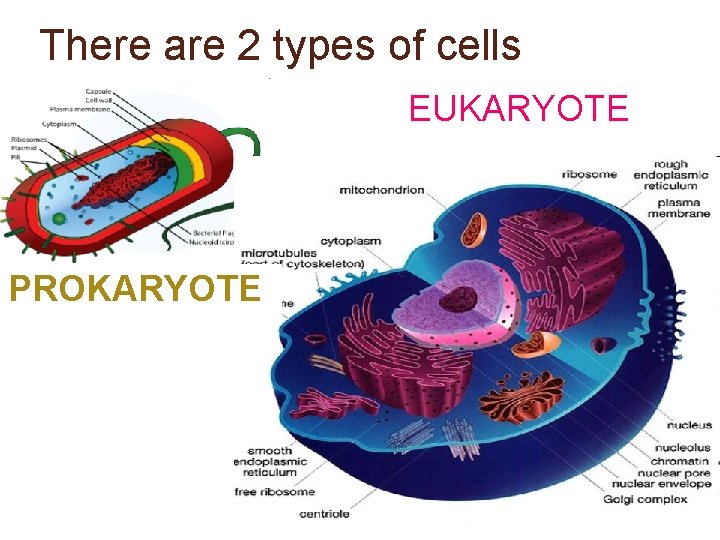
There are 2 types of cells EUKARYOTE PROKARYOTE
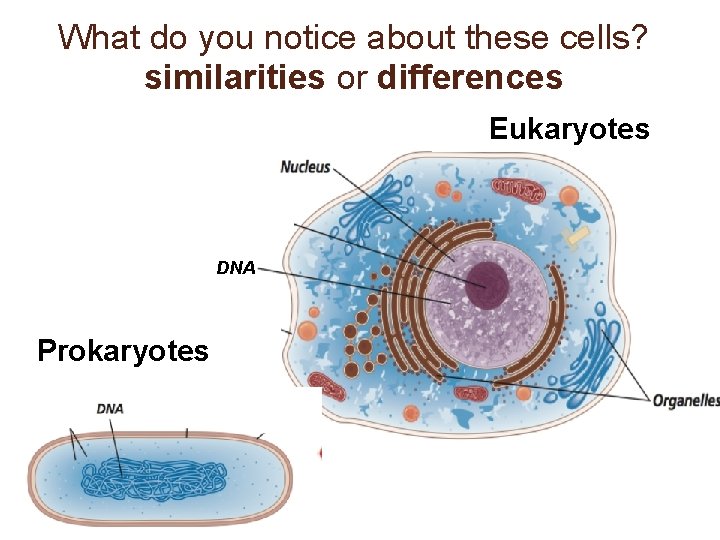
What do you notice about these cells? similarities or differences Eukaryotes DNA Prokaryotes
On your desk Write a Venn Diagram. Prokaryote vs. Eukaryote
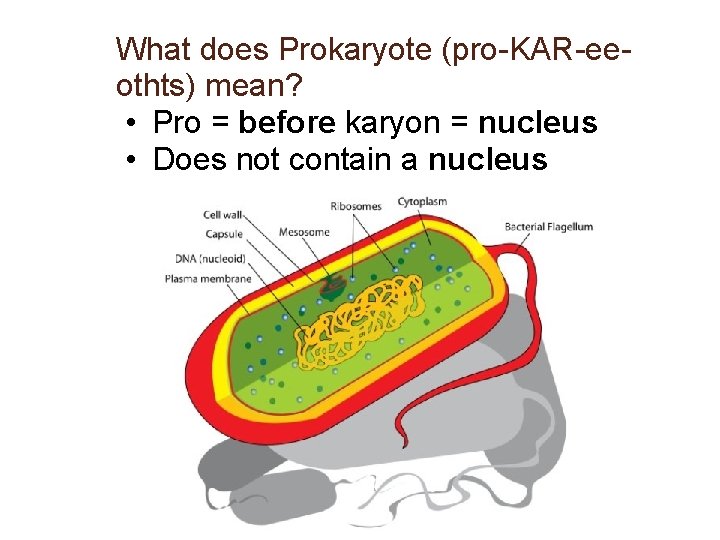
What does Prokaryote (pro-KAR-eeothts) mean? • Pro = before karyon = nucleus • Does not contain a nucleus
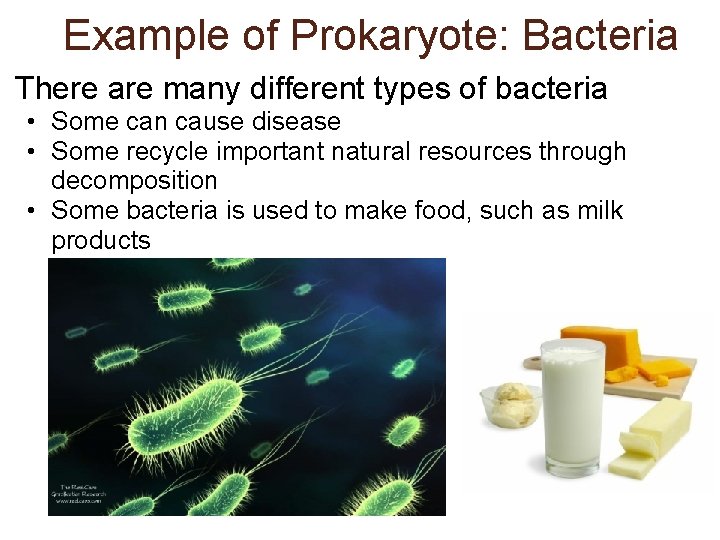
Example of Prokaryote: Bacteria There are many different types of bacteria • Some can cause disease • Some recycle important natural resources through decomposition • Some bacteria is used to make food, such as milk products
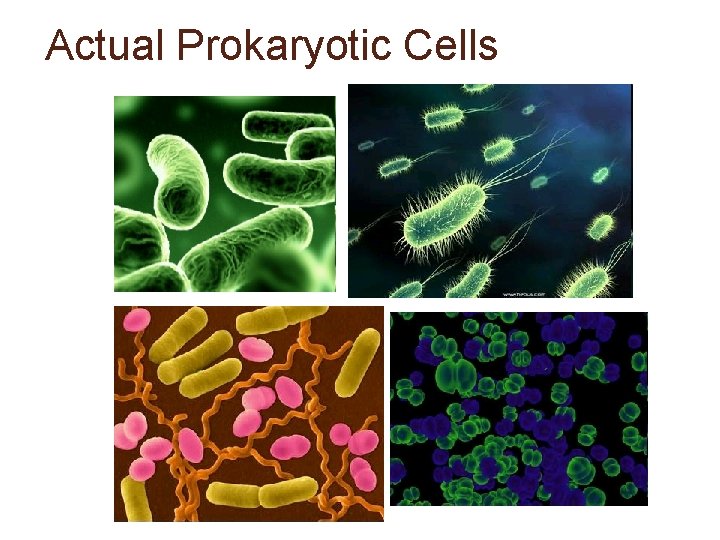
Actual Prokaryotic Cells
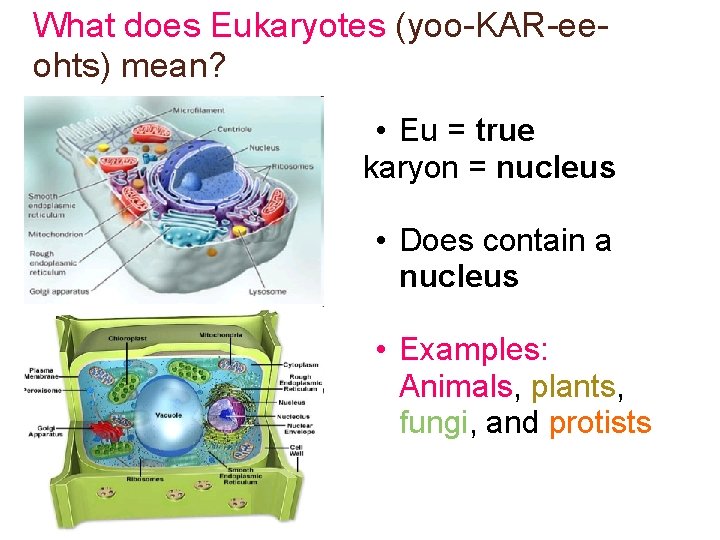
What does Eukaryotes (yoo-KAR-eeohts) mean? • Eu = true karyon = nucleus • Does contain a nucleus • Examples: Animals, plants, fungi, and protists
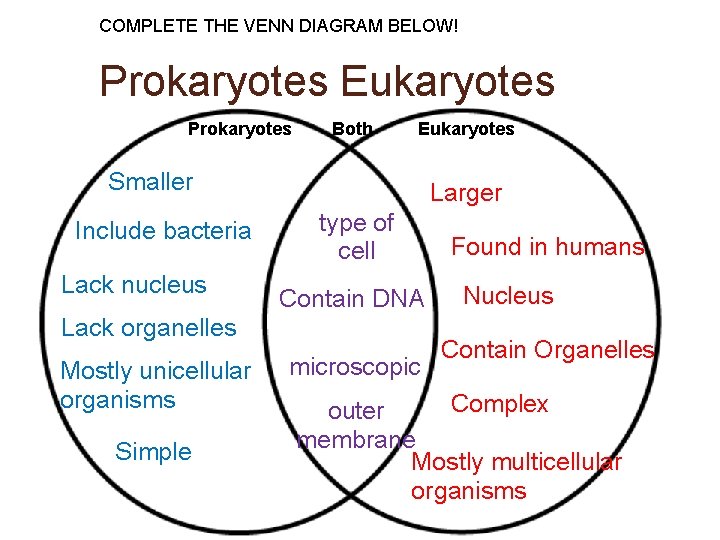
COMPLETE THE VENN DIAGRAM BELOW! Prokaryotes Eukaryotes Prokaryotes Both Eukaryotes Smaller Include bacteria Lack nucleus Larger type of cell Contain DNA Lack organelles Mostly unicellular organisms Simple microscopic Found in humans Nucleus Contain Organelles Complex outer membrane Mostly multicellular organisms
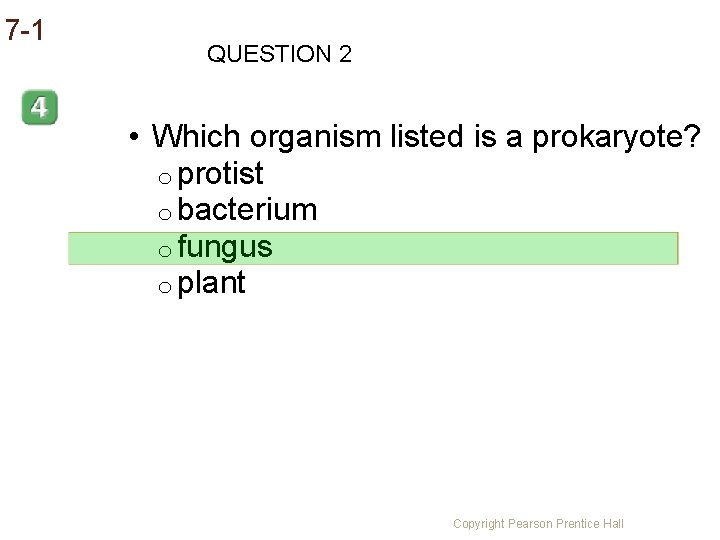
7 -1 QUESTION 2 • Which organism listed is a prokaryote? o protist o bacterium o fungus o plant Copyright Pearson Prentice Hall
GET OUT YOUR GREEN PACKET… • Complete # 14 -27
14. Bacteria 15. Plant 16. Animal 17. Prokaryote 18. Eukaryote 19. Eukaryote 20. Prokaryotic 21. Eukaryotic 22. Eukaryotic 23. Bacteria 24. DNA 25. Small & Simple 26. Large & Complex 27. Cell wall, chloroplast, large vacuole
MOC STAAR QUESTIONS • 11, 26, 46, 37
- Slides: 67