
DAVISBAHCALL EXPERIMENT AT HOMESTAKE Peggy Norris Black Hills
DAVIS-BAHCALL EXPERIMENT AT HOMESTAKE Peggy Norris, Black Hills State Univ/Sanford Underground Laboratory at Homestake
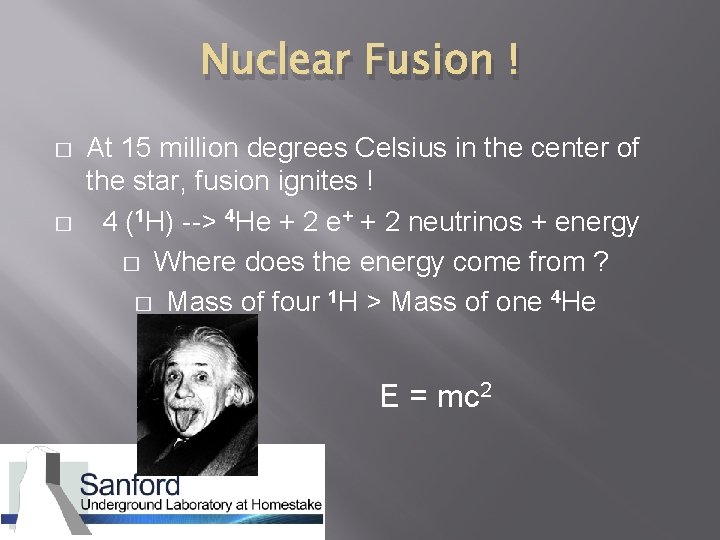
Nuclear Fusion ! � � At 15 million degrees Celsius in the center of the star, fusion ignites ! 4 (1 H) --> 4 He + 2 e+ + 2 neutrinos + energy � Where does the energy come from ? � Mass of four 1 H > Mass of one 4 He E = mc 2
How much Energy � � 4 (1 H) --> 4 He + 2 e+ + 2 neutrinos + energy Energy released = 25 Me. V = 4 x 10 -12 Joules = 1 x 10 -15 Calories � But the sun does this 1038 times a second ! � Sun has 1056 H atoms to burn !
� Mp = 1. 0078 � MHe = 4. 0026 � = 0. 025 amu �
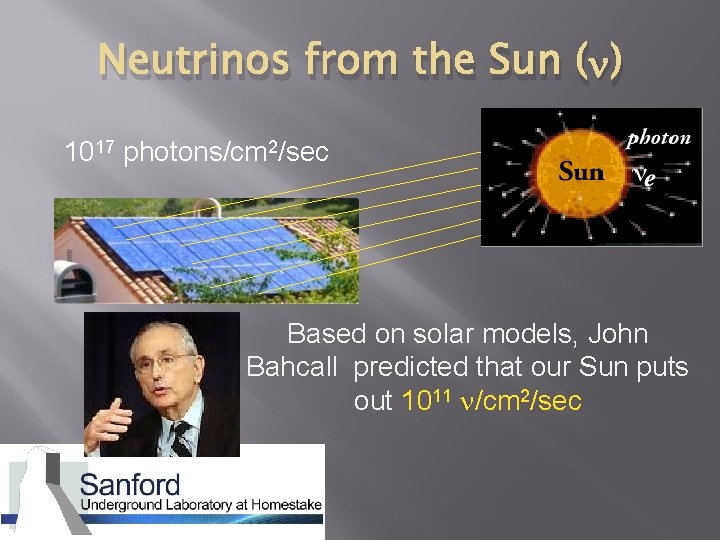
Neutrinos from the Sun ( ) 1017 photons/cm 2/sec Based on solar models, John Bahcall predicted that our Sun puts out 1011 /cm 2/sec
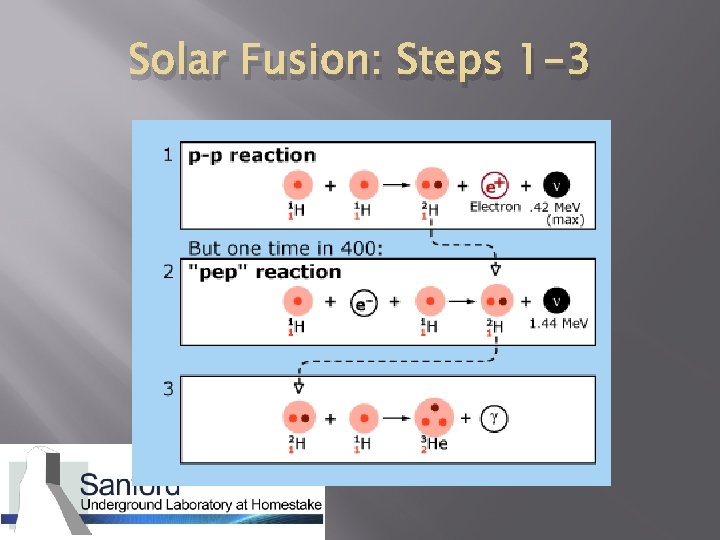
Solar Fusion: Steps 1 -3
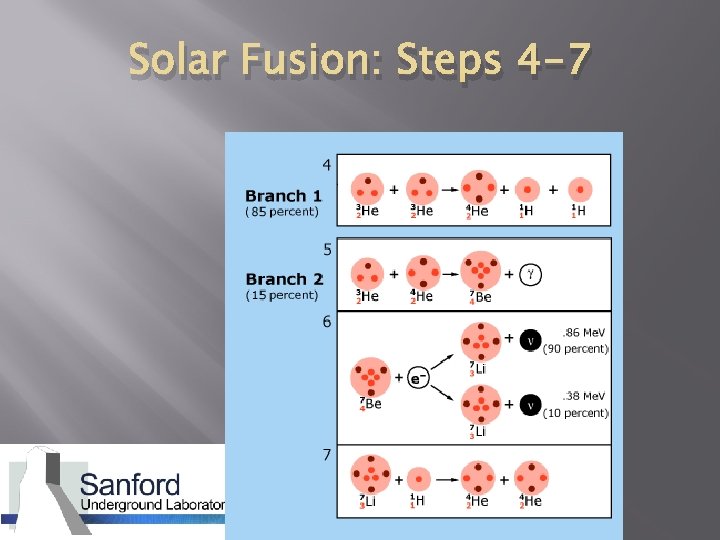
Solar Fusion: Steps 4 -7
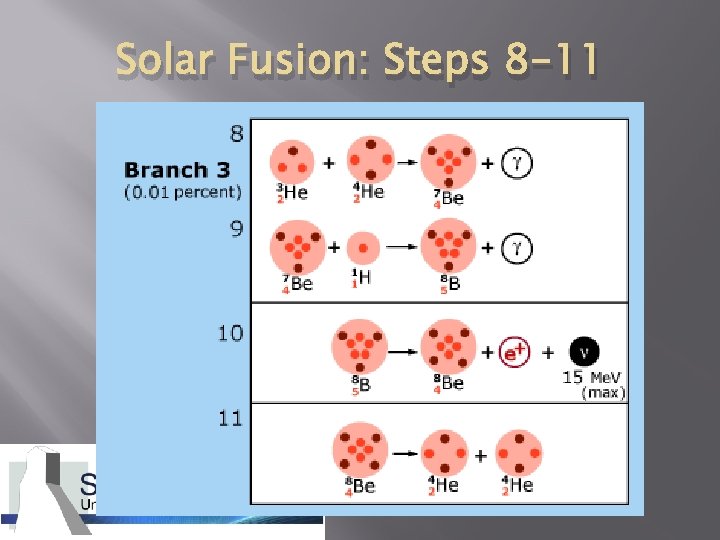
Solar Fusion: Steps 8 -11
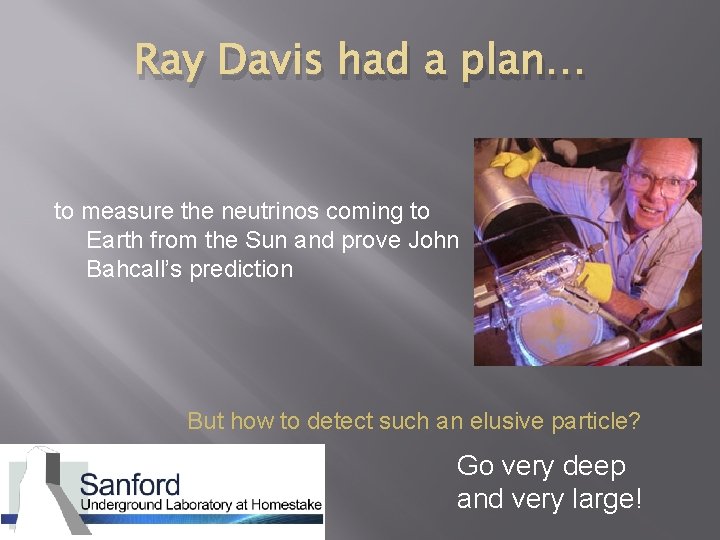
Ray Davis had a plan… to measure the neutrinos coming to Earth from the Sun and prove John Bahcall’s prediction But how to detect such an elusive particle? Go very deep and very large!
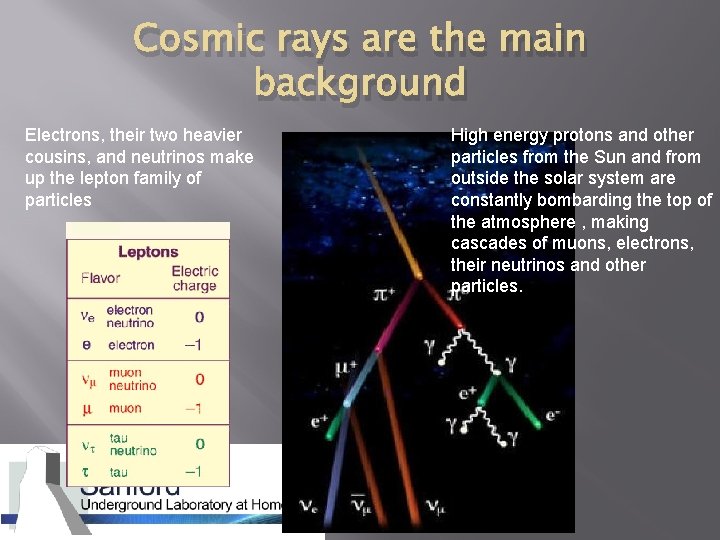
Cosmic rays are the main background Electrons, their two heavier cousins, and neutrinos make up the lepton family of particles High energy protons and other particles from the Sun and from outside the solar system are constantly bombarding the top of the atmosphere , making cascades of muons, electrons, their neutrinos and other particles.
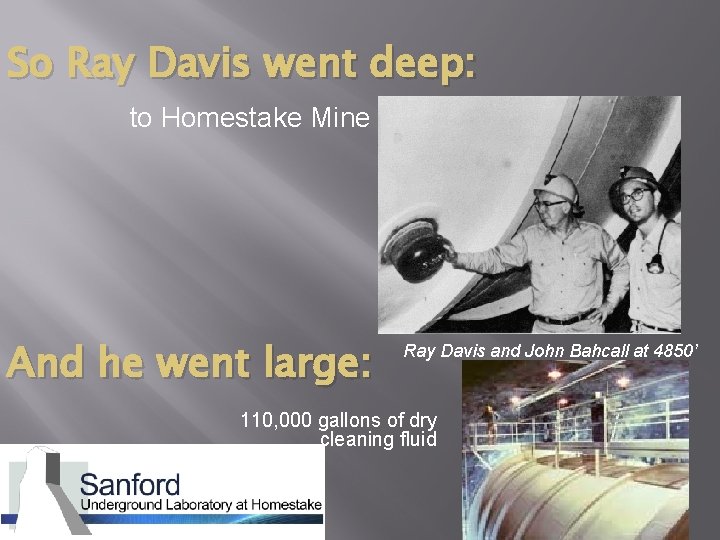
So Ray Davis went deep: to Homestake Mine And he went large: Ray Davis and John Bahcall at 4850’ 110, 000 gallons of dry cleaning fluid
t
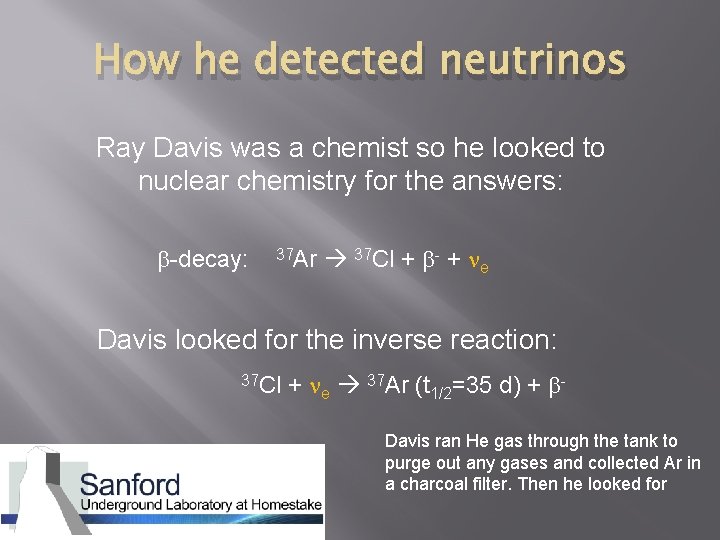
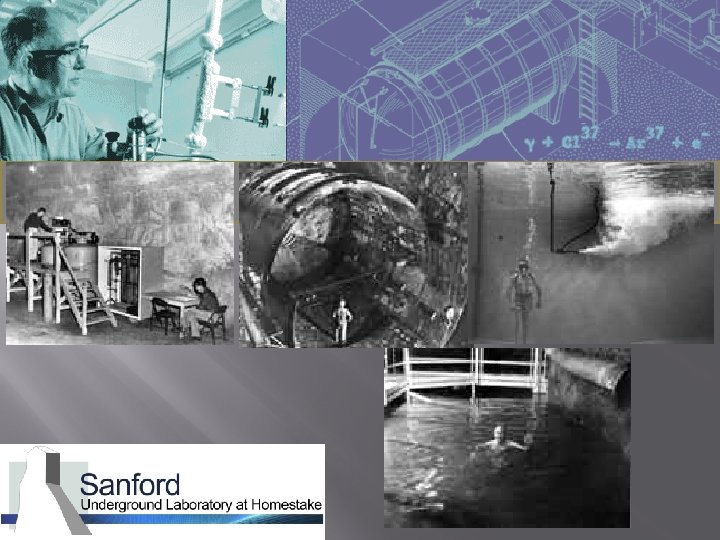
How he detected neutrinos Ray Davis was a chemist so he looked to nuclear chemistry for the answers: -decay: 37 Ar 37 Cl + - + e Davis looked for the inverse reaction: 37 Cl + e 37 Ar (t 1/2=35 d) + Davis ran He gas through the tank to purge out any gases and collected Ar in a charcoal filter. Then he looked for
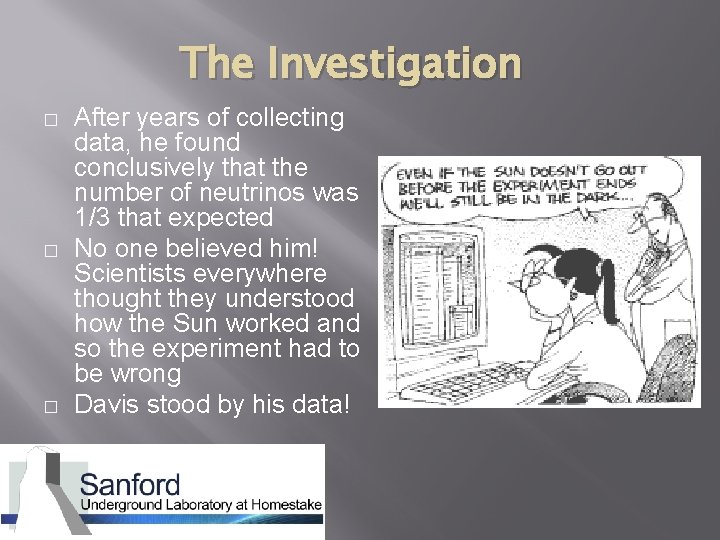
The Investigation � � � After years of collecting data, he found conclusively that the number of neutrinos was 1/3 that expected No one believed him! Scientists everywhere thought they understood how the Sun worked and so the experiment had to be wrong Davis stood by his data!
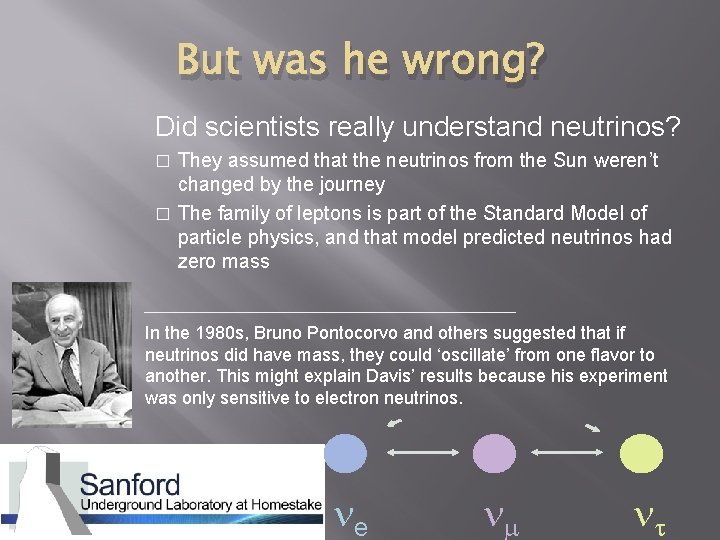
But was he wrong? Did scientists really understand neutrinos? They assumed that the neutrinos from the Sun weren’t changed by the journey � The family of leptons is part of the Standard Model of particle physics, and that model predicted neutrinos had zero mass � In the 1980 s, Bruno Pontocorvo and others suggested that if neutrinos did have mass, they could ‘oscillate’ from one flavor to another. This might explain Davis’ results because his experiment was only sensitive to electron neutrinos. e
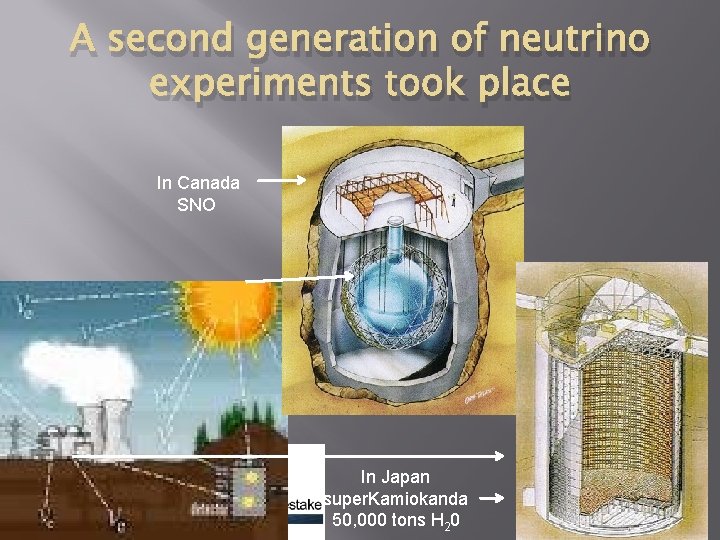
A second generation of neutrino experiments took place In Canada SNO In Japan super. Kamiokanda 50, 000 tons H 20
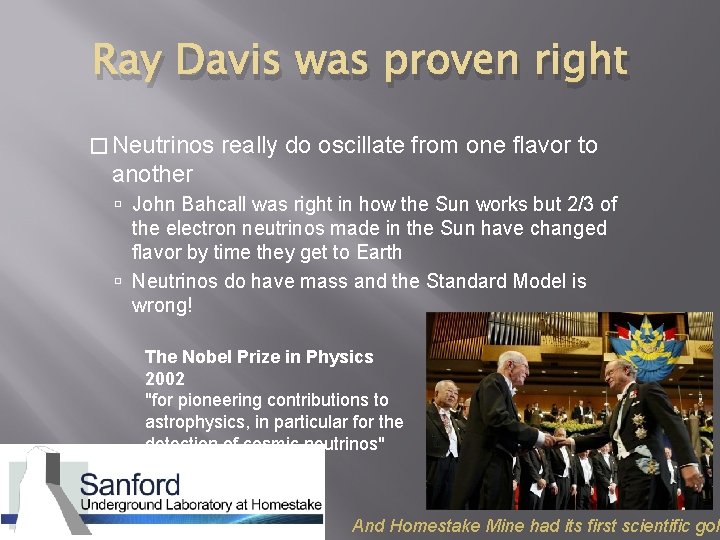
Ray Davis was proven right � Neutrinos really do oscillate from one flavor to another John Bahcall was right in how the Sun works but 2/3 of the electron neutrinos made in the Sun have changed flavor by time they get to Earth Neutrinos do have mass and the Standard Model is wrong! The Nobel Prize in Physics 2002 "for pioneering contributions to astrophysics, in particular for the detection of cosmic neutrinos" And Homestake Mine had its first scientific gold
Fixing the Standard Model In order to fix the standard model, scientists need to understand more about neutrinos What is the mass ‘hierarchy’ of neutrinos, that is which is the heaviest and which the lightest (actually measuring their absolute mass is probably impossible) 2. Are neutrinos their own antiparticles? 1. Experiments are planned for the DUSEL Laboratory at Homestake to answer both questions
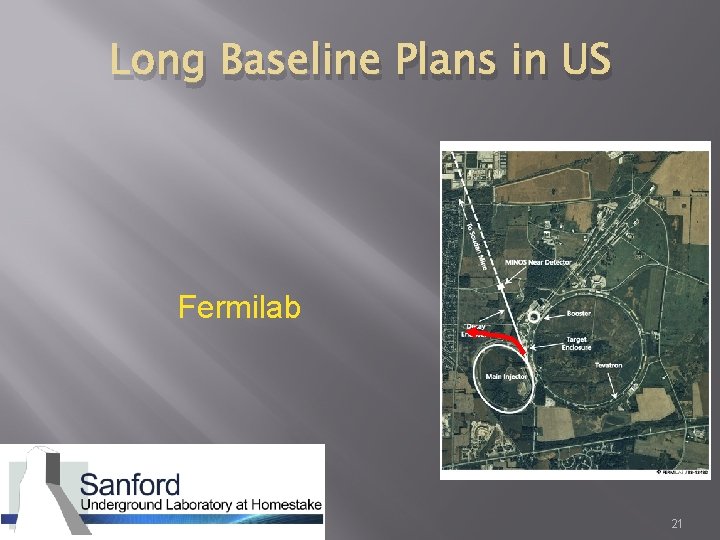
1. To understand the mass hierarchy of neutrinos “Long Baseline” studies �Make a beam at an accelerator lab �Steer it to a distant site �Install biggest detector you can 19
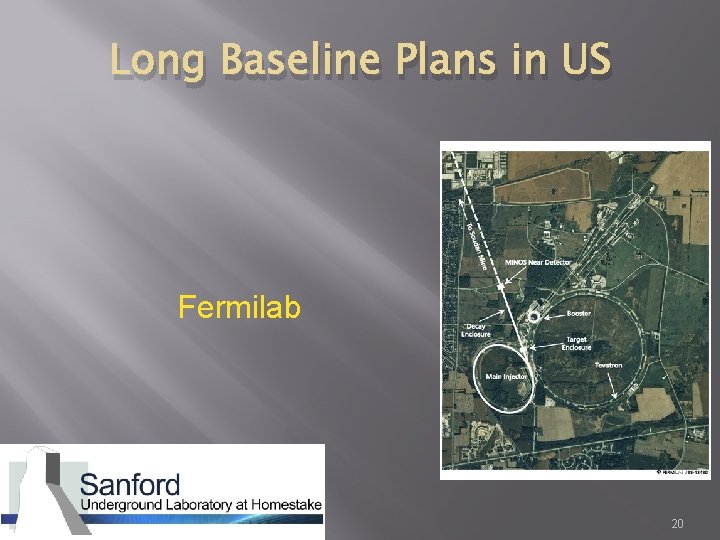
Long Baseline Plans in US Fermilab 20
Long Baseline Plans in US Fermilab 21
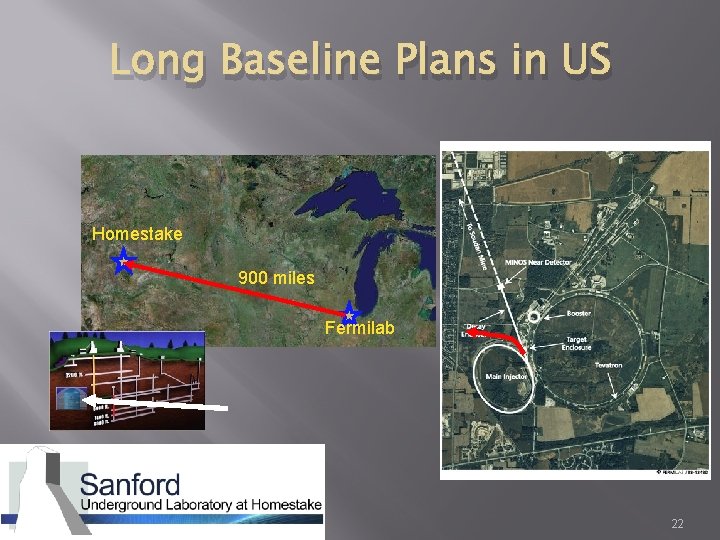
Long Baseline Plans in US Homestake 900 miles Fermilab 22
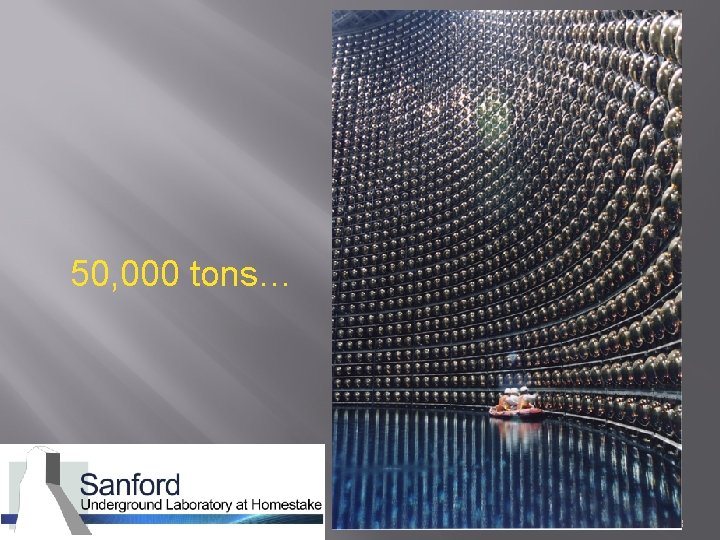
50, 000 tons… 23
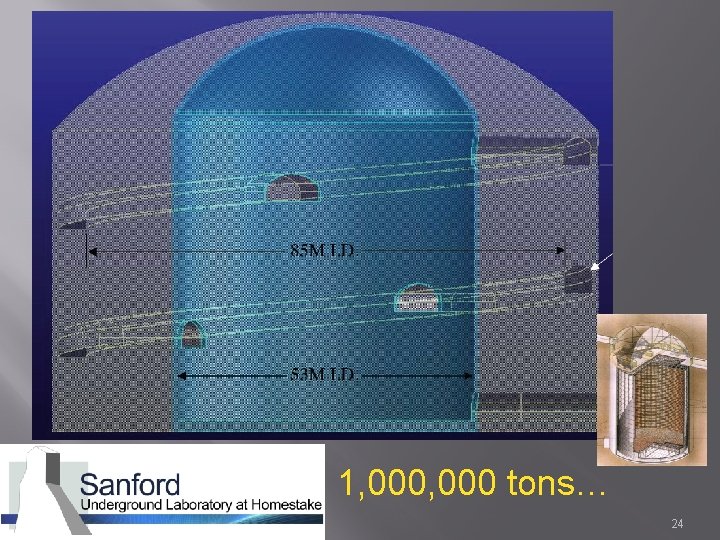
1, 000 tons… 24
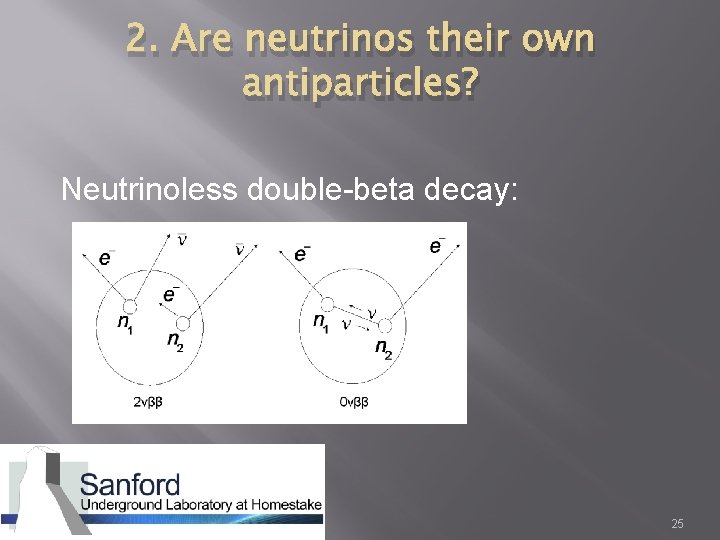
2. Are neutrinos their own antiparticles? Neutrinoless double-beta decay: 25
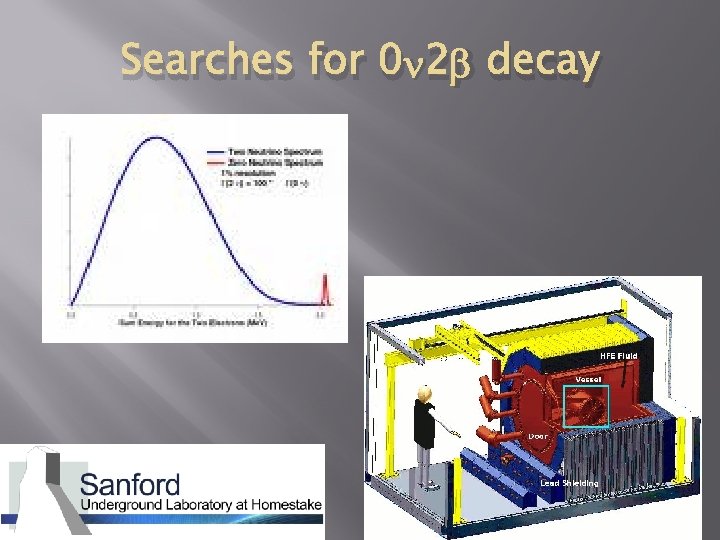
Searches for 0 2 decay
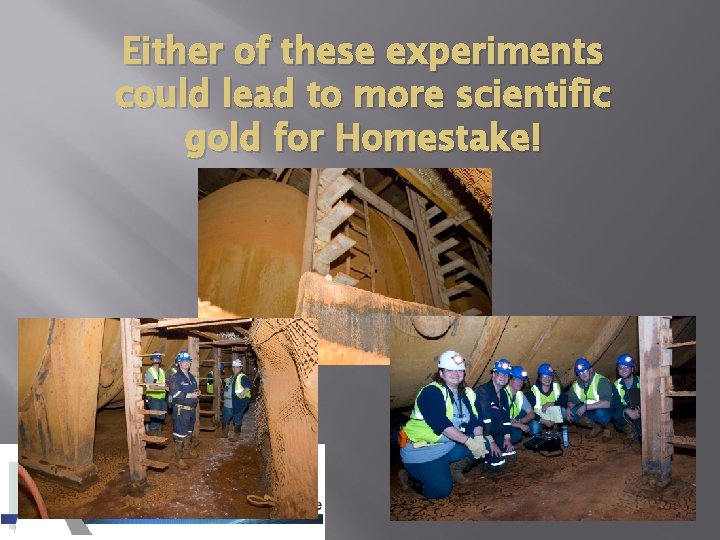
Either of these experiments could lead to more scientific gold for Homestake!
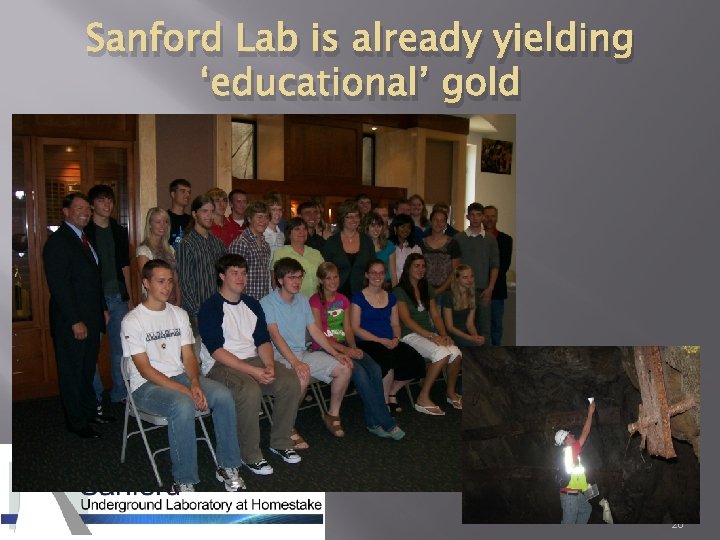
Sanford Lab is already yielding ‘educational’ gold 28
- Slides: 28